On April 7, 2026, a 42-year-old miner named Francisco Zapata was discovered alive after being trapped for 14 days at the far end of a three-kilometer-long tunnel full of sludge and water, 300 meters below the surface.
Julio Saldaña, leader of the eight-man team rescue team who saved Zapata from the mine, has spoken about the rescue for the first time, telling Mexico News Daily how the dramatic escape unfolded.
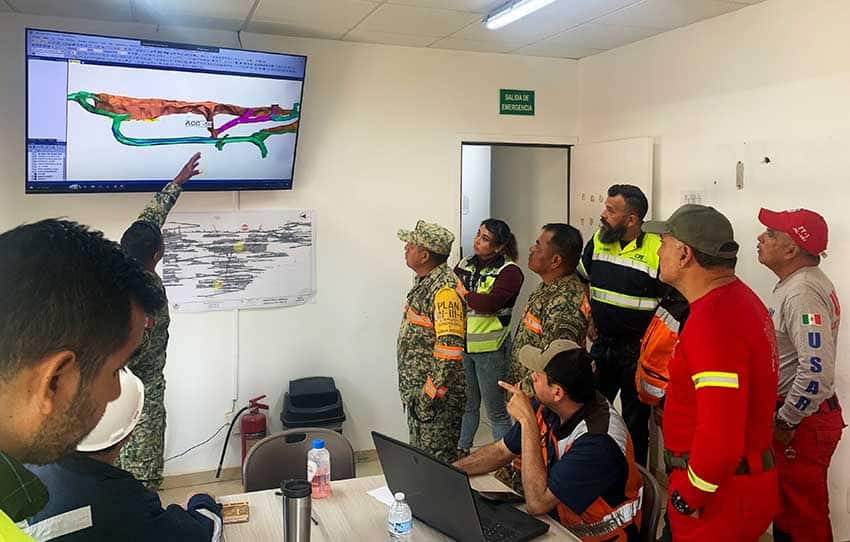
La Mina Santa Fe is located in a remote spot 70 kilometers southeast of Mazatlán. After extracting gold and silver from the mine, the operators were storing the liquified tailings in a dam, unwisely located directly above one of the tunnels leading into the mine. The “mud” in this pool consisted of finely ground silica, clay and silt, possibly mixed with reagents like cyanide, plus traces of arsenic, lead, zinc and manganese, along with sulfide minerals.
175,000 meters of muck
On March 25, the floor of the tailings pool collapsed, and 17,500 cubic meters of toxic sludge poured into the mine. Most of the men inside managed to escape with their lives, but six days after the event, three men were still not accounted for.
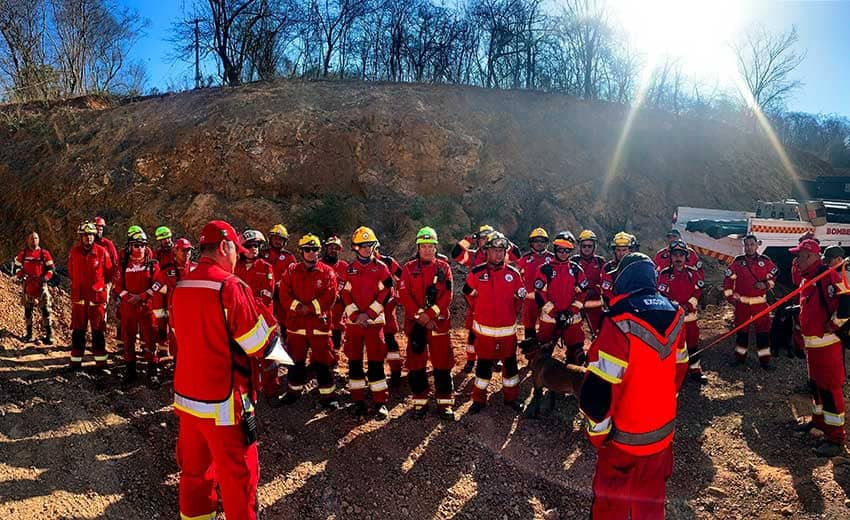
A call for help went out to Mexico’s most experienced rescue teams, including Guadalara’s elite Urban Search and Rescue (USAR) unit.
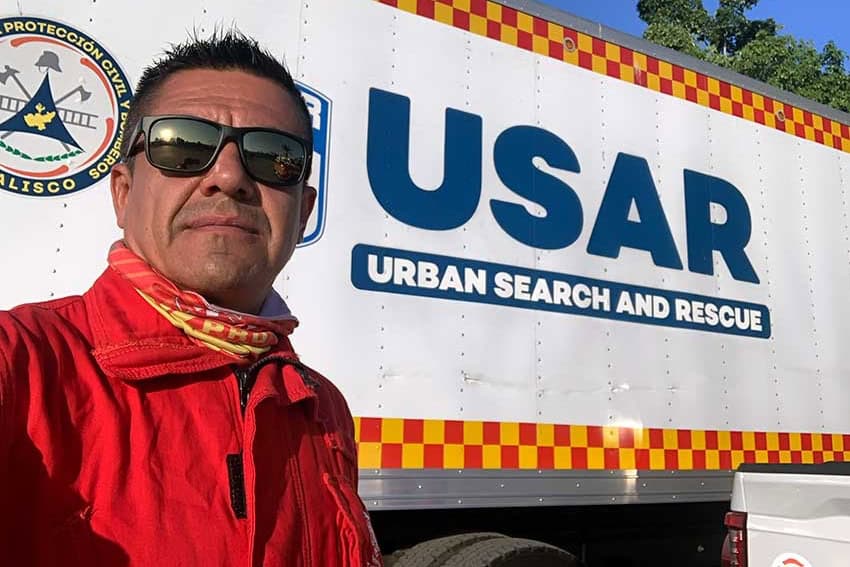
“At 8:00 pm on March 30, 40 of us set out from Guadalajara,” USAR commander Julio Saldaña told me. “We drove nonstop for 24 hours with 16 tons of equipment and two dogs. When we arrived, we found that the Army, the Navy, Protección Civil and the Red Cross were all present … and they were all frustrated.”
The new arrivals discovered that both of the mine’s entrance tunnels were filled with tailings mud.

“There was simply no way to proceed,” said Saldaña. “That stuff was not your ordinary mud. If you put your foot into it, you couldn’t pull it back out — the cohesion of that muck was unbelievable!”
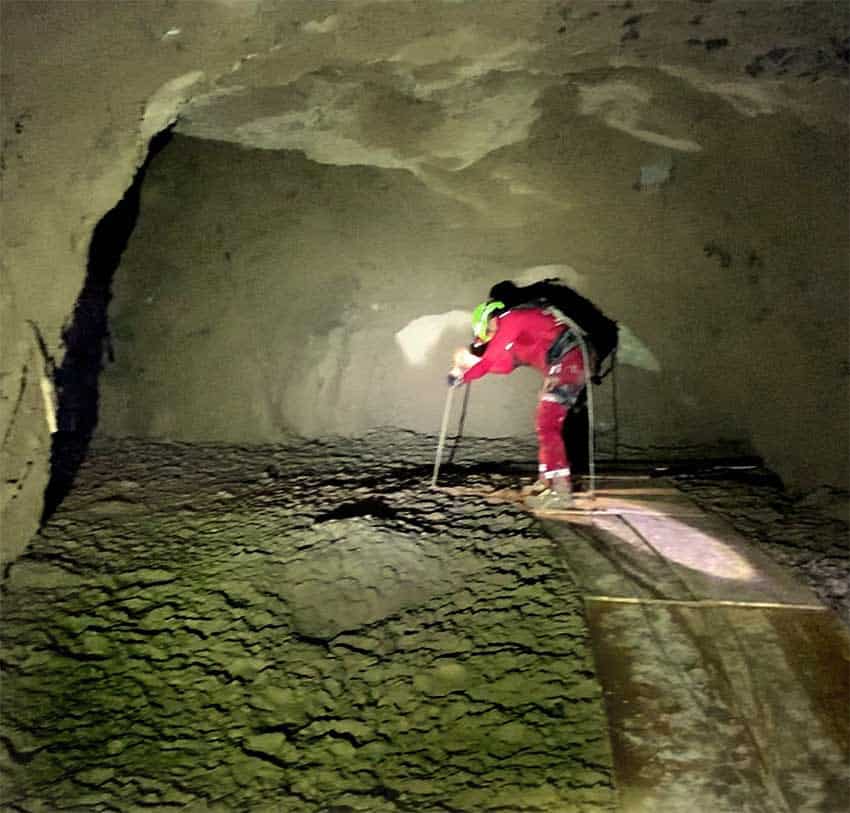
The missing miners were at the end of three kilometers of this toxic sludge, and all the rescuers were trying to figure out how to reach them.
Hot, humid, and pitch dark
“So we sent for wooden planks, 60 centimeters wide by 2.2 meters long and we started placing them on top of the mud, in a straight line, one after the other. Now, sometimes there was only a space of 50 centimeters above the boards and, of course, the ventilation, lighting and electrical systems had been knocked out by the mud flow. So, the whole time, we had total darkness, 100% humidity, and a temperature of 38 degrees Celsius — that’s 100 degrees Fahrenheit!”
The longer the boardwalk grew, the farther the next board had to be carried from the mine entrance.
“We had to carefully watch each other and run to help anybody who fell into that tailings soup.”
At this speed, it took six days to reach the area where the miners were supposedly trapped.
Visibility zero
“The mud petered out, and we were now faced with a 50-meter-long pool of toxic water, at the end of which there was a vado, a water-filled, V-shaped sump. To get past that, we needed divers.”
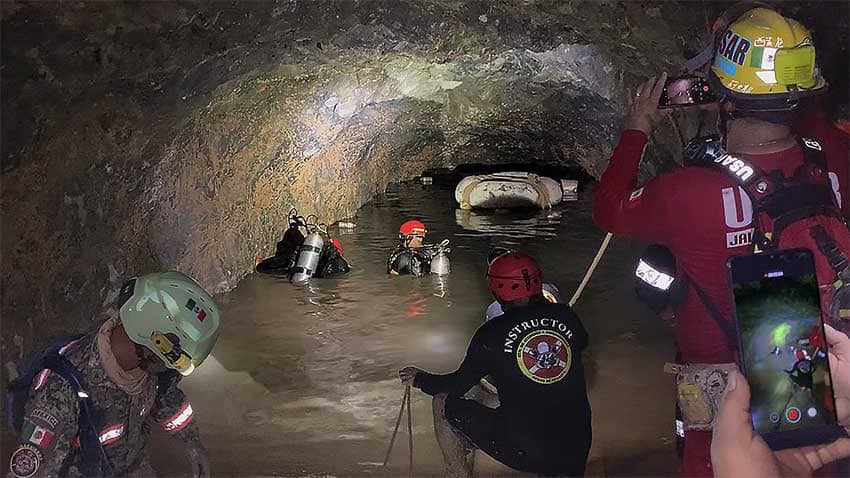
Three military divers were brought in. These reported a visibility of absolute zero. On top of that was the danger of exposure to unknown chemicals in the water.
“Such being the case,” said Saldaña, “we decided to try pumping out the water. But that meant bringing a 400-kilo pump over the boardwalk.
“Imagine that! We made a kind of cart, with one guy pushing and one pulling, and, of course, we had to have an electrical cord three kilometers long. The CFE supplied that, along with great maps of the mine, so we knew just what was coming up next.”
Trench foot and despair
“At this point, most of us had trench foot. Ten of us had been hurt. After a week of frustration, my compañeros were asking, ‘When are we going home?’ I went back to camp and woke up at 6 a.m. to a beautiful moon. ‘This is the day!’ I said to myself.”
When Saldaña reached the end of the tunnel, he found the water level much lower. The divers decided to try passing the sump.
Following standard procedure for this, two divers went into the sump holding onto a rope while the third stayed at the sump entrance, feeding the line to them. Communication was via short tugs on the rope.
The divers who disappeared
“Fifteen minutes passed,” said Saldaña, “and suddenly the third diver turned to me. There was a look of panic on his face. He lifted his hand, and there was the end of the rope, dangling. The two divers had broken the golden rule of cave diving and had let go of the rope!
“I was in charge, and now I felt responsible for two deaths. We were preparing to send somebody back up to the surface with the bad news when suddenly the two missing divers popped up. One of them took off his regulator and shouted, ‘¡Está vivo! He’s alive!’
“Well, I went from grief to gratitude to surprise all at once. But how could anyone be alive after 14 days without food or water? That was impossible!”
I knew you would come for me
The senior diver explained. They had gone through the sump until they had no more rope. They were about to return when “Suddenly we saw a flash of light from up above,” he said. “It blinked off and then on again. I let go of the rope and popped up in a big air bubble … and there was Francisco Zapata. I don’t know which of us was more shocked. Zapata started to cry, saying ‘I knew you would come for me.’”
Sitting in an air-filled space less than a meter high, Zapata had carefully rationed his food, water and light, and at the end was drinking his urine and even some of the tailings water.
Divers brought Zapata food and drink, and the next day — after a crash course in cave diving — he dove the sump and ended up walking out of the mine on his own two feet. Then he was scooped up by a helicopter and taken directly to the main hospital of Mazatlán, and today he leads a normal life.
“I’ve been doing this sort of thing for 25 years,” says Saldaña, but this was the most intense experience of my life. I’ve always said I don’t believe in miracles, but in this case … I wonder.”
John Pint has lived near Guadalajara, Jalisco, for more than 30 years and is the author of “A Guide to West Mexico’s Guachimontones and Surrounding Area” and co-author of “Outdoors in Western Mexico.” More of his writing can be found on his website.