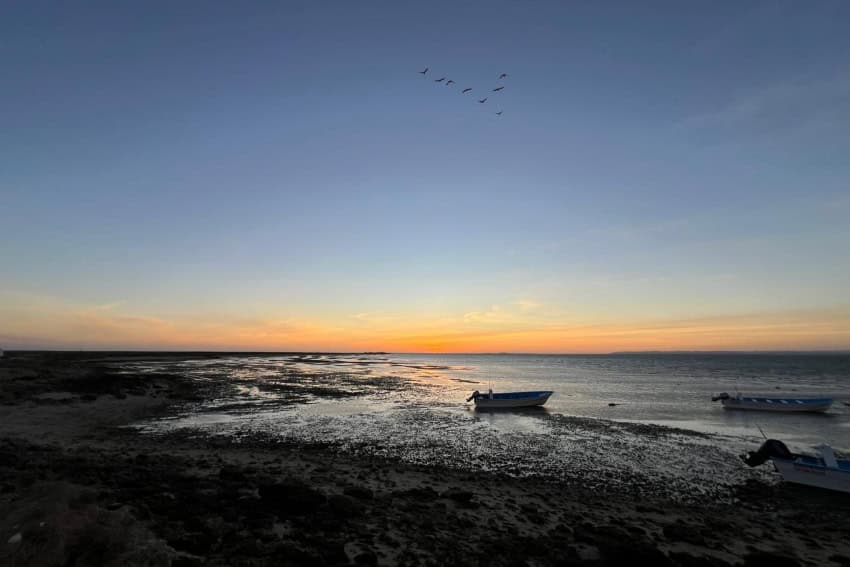
On a windswept stretch of Baja California’s Pacific coast, Beatriz Padilla braces her canvas against the desert extremes and waits for the whales.
For months, she has followed their migration, painting what she calls their “voices” as their numbers decline.
Now, as scientists warn the whales are under growing pressure, a Mexican court has ordered a halt to tanker traffic tied to a massive liquefied natural gas (LNG) project that she and many others have been fighting — effectively blocking its ability to export gas while the case moves through the courts. The order stems from a lawsuit filed by the environmental organization Nuestro Futuro and allied groups, arguing that regulators failed to fully assess the project’s risks to the Gulf’s marine life. In an unusual legal approach, the case frames whales as rights-bearing entities. The ruling temporarily blocks LNG tanker traffic — a move aimed at preventing irreversible harm while the case proceeds.
‘The world’s aquarium’
Called “the world’s aquarium” by Jacques Cousteau, the Gulf of California — or Sea of Cortez — is one of the most biodiverse marine ecosystems on Earth. This narrow body of water harbors over 39% of the world’s marine mammals, including blue whales, sperm whales, fin whales and the critically endangered vaquita porpoise.
The Saguaro Energy LNG project would pipe fracked gas from Texas’ Permian Basin through 800 kilometers of Northern Mexico to Puerto Libertad, Sonora. From there, the gas would be exported via giant tankers to markets in Asia.
Growing concerns about the project have taken on new urgency in recent days, as a major oil spill across the country in the Gulf of Mexico has already killed marine life, threatened whale populations and despoiled over 650 kilometers of coastline.

“States bordering the Gulf of California, such as Sonora and Baja California Sur, have already raised the alarm because they do not want to be affected by the fossil fuel industry as is happening in the Gulf of Mexico,” said Cecilia García Muñoz of Northwest Environmental Defense (DAN). Both state legislatures have formally asked federal authorities for more information on the proposed fossil fuel terminals and called for a strategic environmental assessment to avoid harm to fishing, tourism and local communities, she added.
Pressures on the whales that breed in the Gulf of California
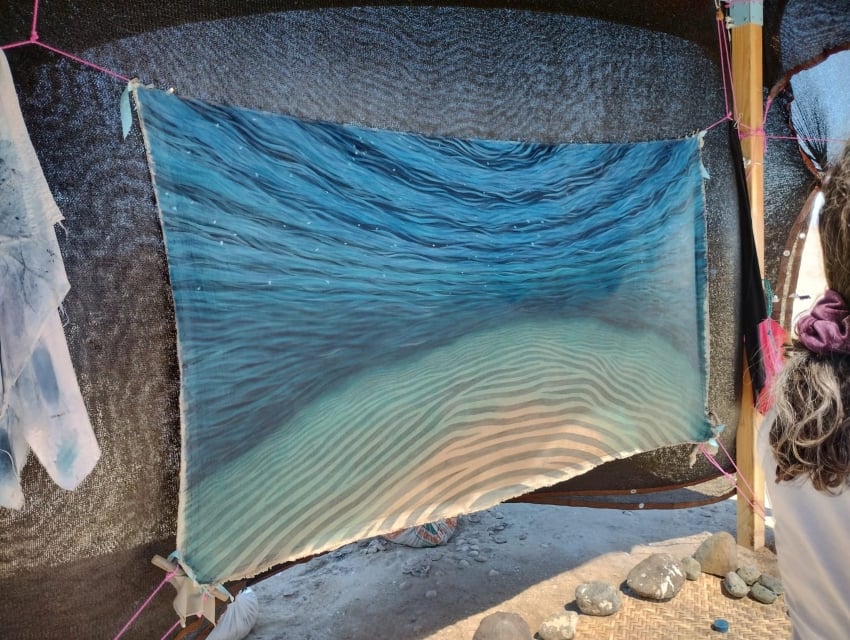
Last year, Padilla fasted for 21 days on the Gulf of California, painting to draw attention to the Saguaro project. This year, she followed the whales to the Pacific side of the peninsula, spending two months encamped along the gray whales’ winter migration route, translating the whales’ vocalizations into paint on canvas.
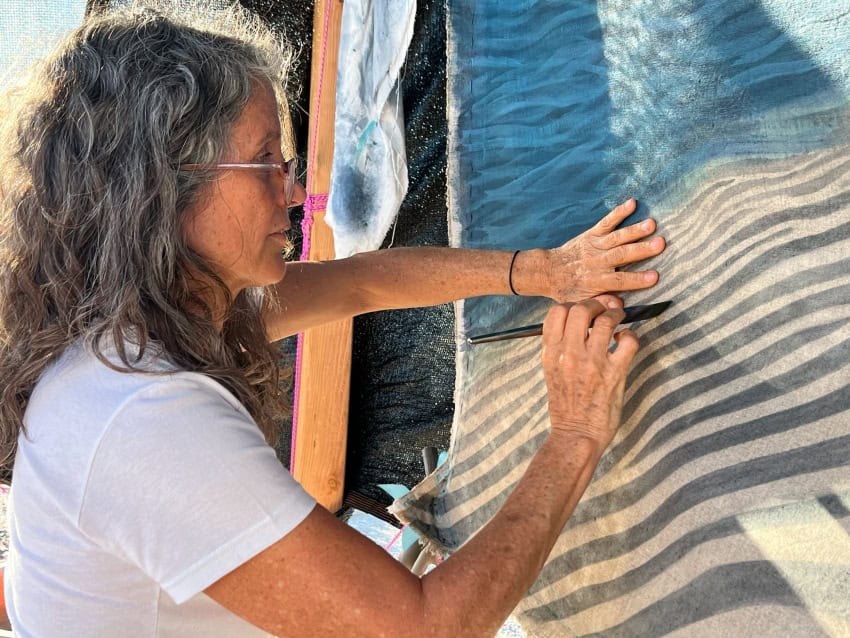
Her shift to the bigger picture reflects a growing unease among scientists and activists alike regarding whale populations. Starvation and other factors have caused gray whale numbers along Mexico’s Pacific coast to plummet from 27,000 to less than 13,000 from 2019 to 2024 following what scientists call an “unusual mortality event.”
The die-off is linked largely to the loss of sea ice in the Arctic, which disrupts the growth of algae critical to the whales’ survival, as well as the oil-rich crustaceans on the seafloor that gray whales depend on. Researchers report whales arriving thinner, under stress. In one year alone, nearly 900 gray whales were found dead along the Pacific coast from Alaska to Mexico.
“They’re already struggling,” Padilla said, pointing to a cascade of pressures on whale populations: entanglement in millions of tons of abandoned “ghost nets”; increasing ship traffic, with its risk of collisions and relentless underwater noise; pollution from plastics, heavy metals and agricultural runoff; and overfishing, including the growing demand for products made with krill, an essential food for many whales.
Art and activism
“We must not add more pressures. Projects to export LNG from their mating, birthing and calving sanctuaries, and along whale migration routes, should not even be considered.”
Padilla’s artistic intervention is just one in a wide and creative range of citizen actions aimed at the cancellation of Saguaro and other LNG terminals to protect the biodiversity hotspot, including the Nuestro Futuro lawsuit. Conexiones Climaticas has been waging a creative campaign involving schools, businesses, coordinated vigils and even a whale sighting contest, motivating thousands to speak up for the whales.
The group is among more than 30 organizations that have taken complaints to United Nations bodies, arguing the projects threaten a UNESCO-recognized World Heritage marine ecosystem. That pressure is already showing results: In late February, opponents secured a major victory when the U.S. energy company Sempra withdrew its application for the Vista Pacífico LNG export project in Topolobampo, Sinaloa.
Scientists warn of “incalculable” impacts
Marine scientists warn that the Gulf of California is uniquely vulnerable to increased ship traffic. In a scientific opinion led by researcher Lorena Viloria and backed by the Mexican Society of Marine Mammalogy (SOMEMMA), experts expressed “total opposition” to the Saguaro LNG project.
The letter, supported by more than 200 specialists in marine mammals, warns that the combined impacts of construction, vessel traffic and underwater noise could have “incalculable” effects on whale populations in one of the most biodiverse marine regions in the world.
The region is home to at least eight species of whales, including blue, humpback, fin and sperm whales, some migrating through its waters, and others as resident populations that remain year-round. Among the most vulnerable is the fin whale, a species with a small, genetically distinct population in the Gulf of California estimated at just a few hundred individuals.
Whale collision risks
“This is the whale with the highest rate of ship collisions in the world,” said Viloria, head of SOMEMMA’s scientific committee.
Whales often cannot detect or avoid large vessels in time, she said — especially in a region where maritime traffic has historically been relatively low. As ship traffic increases, so does the likelihood of collisions.
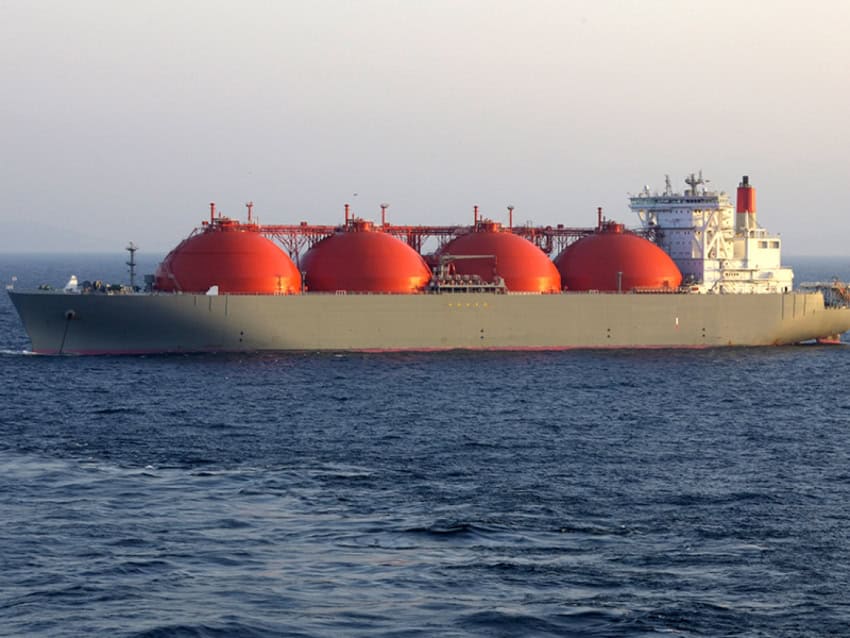
The LNG tankers envisioned for the region would be massive — up to 300 meters long, roughly the length of three football fields — and scientists warn they pose a direct collision risk to whales that surface to breathe in busy shipping lanes. Indeed, their detractors have dubbed them “mataballenas” (whale killers). Even more concerning, most collisions go unrecorded. A whale struck in open water may sink without a trace, while ships often do not detect the impact.
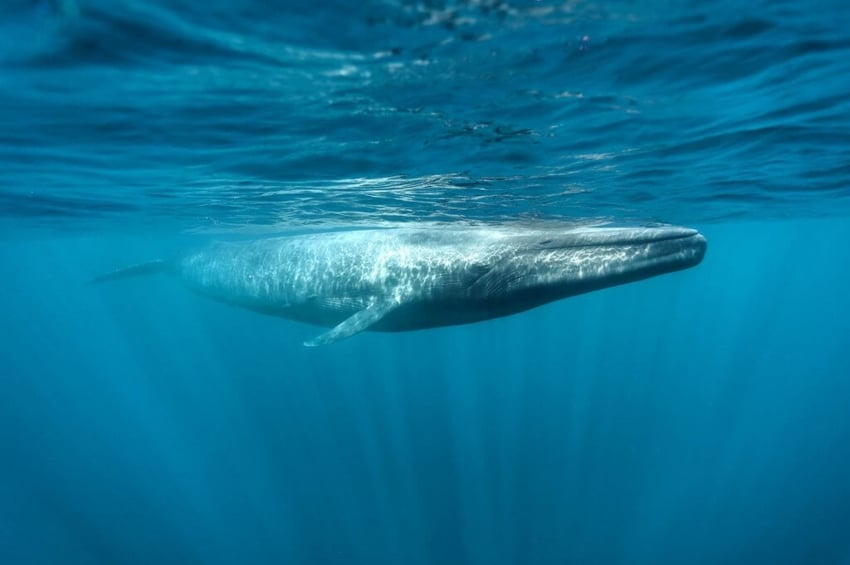
“These ships are so large that they can strike a whale and not even realize it,” Viloria said.
Such collisions are not hypothetical. In one documented case in Japan, a tanker arrived in port with a dead whale draped across its bow — a stark illustration of the dangerous mismatch between industrial vessels and marine life.
Noise pollution and whales
Noise is another major concern. Large vessels generate low-frequency sound that can travel long distances underwater, interfering with whales’ ability to communicate, navigate and find food.
“There’s no remediation possible where you can convince a whale to coexist with a roar that prevents it from communicating for all of its vital functions,” said Pablo Montaño, director of Conexiones Climáticas, interviewed last year by journalist Carmen Aristegui.
Padilla, who attended the SOMEMMA conference, hand-delivered the scientists’ letters to five government agencies. Despite the scientists’ warnings, responses have been limited. In a formal reply, Mexico’s environmental safety agency (ASEA) said that any project would be required to comply with existing environmental regulations and that authorities are reviewing past approvals. However, the agency indicated that it would not be appropriate to suspend activities for projects that demonstrate compliance with current legal requirements.
Opponents argue that the Saguaro project rests on a questionable regulatory foundation. According to Claudia Campero of Conexiones Climaticas, the project traces back to a 2006 proposal for a very different type of facility — an LNG import terminal that was never built. The current plan, by contrast, is a large-scale export project.
“They are trying to use the same permit for a completely different project,” she said. “The characteristics and impacts are not the same.”
Environmental advocates say the distinction is critical, raising concerns that current impacts — including increased ship traffic, emissions and risks to marine life — were not fully evaluated under the original approval.
Whales or gas — no middle ground
Opposition to the projects has surged in recent months, coalescing into a nationwide campaign known as Ballenas o Gas — a coalition of more than 40 Mexican organizations working to stop LNG expansion in the Gulf of California.
The campaign has gathered more than 300,000 signatures calling on the federal government to halt the projects, while mobilizing students, businesses and coastal communities across the country. In classrooms, children have submitted thousands of drawings of whales; in restaurants and cafés, campaign materials invite customers to take a stand.
But for organizers, the message is ultimately stark.
“There’s no possibility of coexistence between these massive gas projects and the whales of the Gulf of California,” said Campero, a leader of the campaign.

“This is a struggle for their survival,” she said.
‘A sacrifice zone’
The campaign has combined grassroots organizing with legal challenges, scientific advocacy and international pressure — helping delay key permits and, advocates say, contributing to Sempra’s decision to withdraw its application for the Vista Pacífico LNG project in Topolobampo, Sinaloa.
Like the much larger Saguaro, the project had been designed to liquefy the U.S.-sourced natural gas for export to Asian markets, with exports once projected to begin later this decade. Other projects, including the much larger Saguaro LNG terminal, continue to advance. A third project, Amigo LNG, has also been proposed near Guaymas. Together, the projects would transform the Gulf into a corridor for large-scale LNG shipping, linking U.S. fracked gas production with global markets.
For Campero, the stakes extend far beyond a single project.
“We are turning Mexico into a transit corridor — a sacrifice zone — for gas that isn’t even for us,” she said.

Even as global demand remains uncertain, she added, companies continue to push forward projects that could reshape one of the most biodiverse marine regions on the planet.
“The question is very simple,” she said. “Do we want whales — or gas?”
What’s at stake for coastal communities
Beyond the risks to whales, advocates warn that expanding LNG infrastructure could have far-reaching impacts on coastal communities that depend on the Gulf of California for their livelihoods.
The region supports fisheries, shrimping and a growing ecotourism industry, while also serving as a source of cultural identity for many coastal communities — incompatible with the “very, very disruptive infrastructure” of an LNG terminal, said Mima Holt, Global Energy Transition Advocate with the Natural Resources Defense Council.
She pointed to similar development along the U.S. Gulf Coast in Texas and Louisiana, where communities have “basically been ransacked by the gas industry.”
“An example of this would be Freeport, Texas,” she said. “Before Freeport LNG came, it was a thriving community, a big vacation spot for many of the cities close to it in Texas. But now, Freeport LNG is basically evicted, including many of the families that have had beach houses there for generations, and there is no longer the sense of community in the beaches there.”
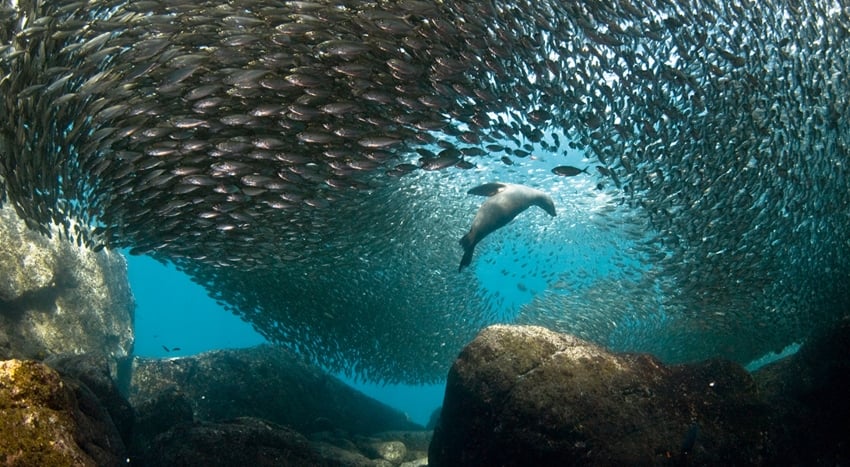
Holt warned that increased tanker traffic and industrial activity could disrupt marine ecosystems in ways that ripple outward — affecting fish populations, tourism and food security.
“If this kind of shipping route affects whales, then just think about how much that would affect the fish catch in that area,” Holt said. “And what kind of consequences would that mean for the availability of this kind of food for the Mexican population?”
Watching the water
Back on the Pacific coast, Padilla spent two months observing the whales. From a boat where she accompanied a fisherman and played a haunting melody with her flute, a pair of fascinated grey whales circled the boat as she played. Before she began painting, she took the canvas out onto the water and dipped it in as a curious whale approached the boat.
In a recent journal entry from her encampment at Kuyimá Camp near Laguna San Ignacio, she described a season already beginning to change. Many gray whales had departed earlier than usual, she wrote, and sightings had become increasingly scarce.
On one outing, she encountered the body of a young whale.
“The absence of the whales is felt,” she wrote.
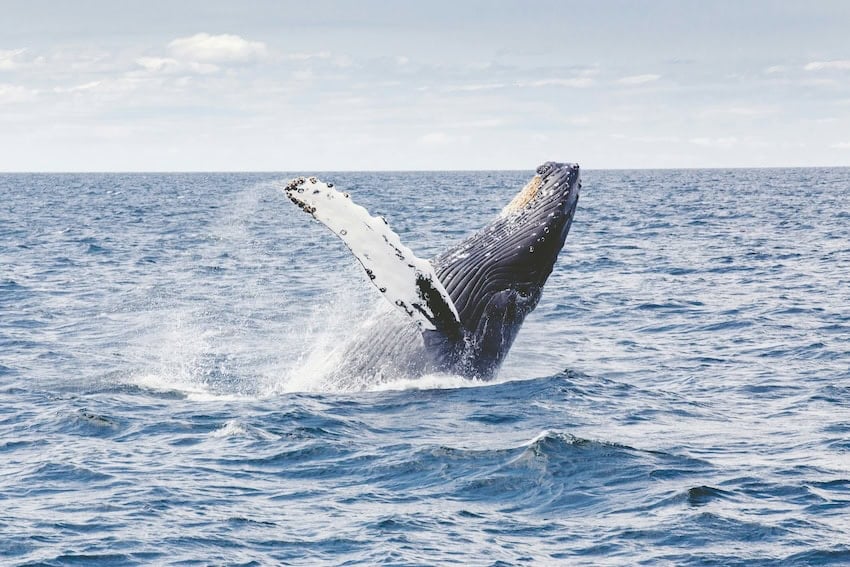
Scientists caution that it is too early to draw firm conclusions about the causes of shifting whale patterns. But the changes are being closely watched in a region already under pressure from climate change, industrial development and increasing human activity.
For Padilla, the experience has reinforced a sense of urgency.
“The whales really need us,” she said.
As plans for LNG development continue to move forward, researchers and advocates say the question is no longer whether the Gulf of California will change — but how much, and at what cost.
Tracy L. Barnett is a Guadalajara-based freelance writer and the founder of The Esperanza Project.