I’m writing this text on a plane back from Ciudad Juárez (Chihuahua)-El Paso (Texas), to Mexico City. The U.S.-Mexico border phenomenon is something hard to cover in a few paragraphs, but I’ll give it a try.
The border is almost a country in and of itself. It has history, shared territory, culture, traditions and communities that long predate the line drawn on the map. Less than two centuries ago, all the lands that are now the U.S.-Mexico border states belonged to the same nation.
Looking for Parts 1 and 2? Catch up here.
Together, those ten states (four American, six Mexican) form an economy worth roughly US $7 trillion: the third-largest on the planet, just behind China and nearly as big as the UK and France combined. In terms of population, the border region is home to more than 100 million people, more than Vietnam, France, Germany, the UK or Turkey; more than twice the population of Canada, Spain or South Korea.
Every day, more than two billion dollars in goods cross that line.
Cars assembled in North America crisscross it multiple times before rolling off the line. Agricultural supply chains stretch from Canadian prairies to Mexican fields to American supermarkets. What started as trade has quietly become continental co-production and social blending. I see more in common between a regio from Nuevo León and a Texan than between a regio and a yucateco — or between a Texan and a Californian, for that matter.

And yet the infrastructure and institutions governing the border still behave as if none of this integration exists.
I flew from Mexico City to Ciudad Juárez. A driver picked me up and took me to El Paso. Fortunately, she had the Secure Electronic Network for Travelers Rapid Inspection (SENTRI), a trusted traveler certificate that allowed us to go through the express line. It took us about half an hour from the start of the “express” line to the bridge, where I had to step out and walk across the bridge. In the end, it took me about 50 minutes to get to the U.S. once the line started. Unfortunately for my colleagues, they had no SENTRI, and they waited 2.5 hours in line to cross one of the three bridges connecting Juarez to El Paso.
The border runs on outdated procedures, fragmented data systems and physical inspections straight out of the last century. The result is a frustrating paradox: the production networks and societies that rely on it grow ever more intertwined, while the border itself stays slow, opaque and ripe for criminal exploitation.
We desperately need a smarter border.
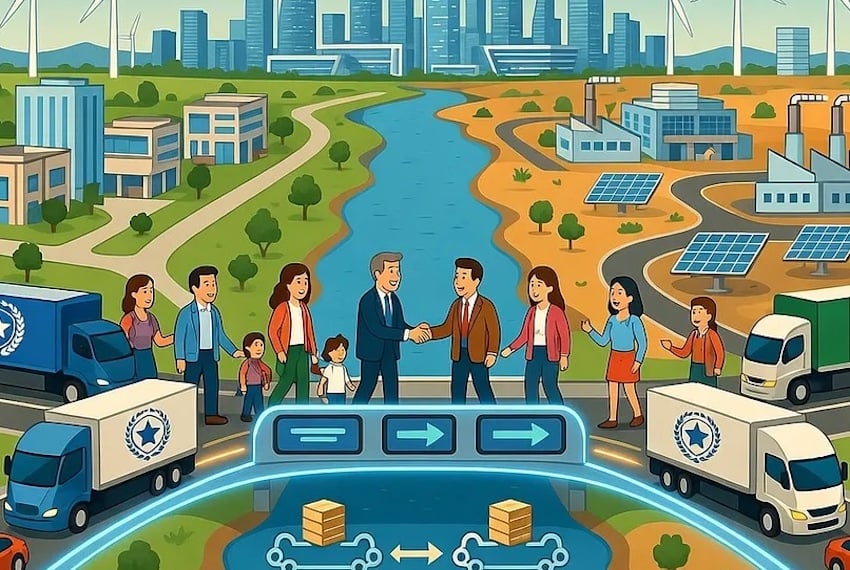
Imagine one that works less like a wall and more like an intelligent filter — speeding up everything legitimate while surgically catching the bad stuff. The technology already exists: data analytics, real-time tracking, supply-chain transparency, smart infrastructure. Customs could run joint inspections and ditch the duplicative nonsense that inflates costs and kills just-in-time manufacturing. Trusted-trader programs (U.S. CTPAT, Mexico’s OEA; basically the SENTRI or Global Entry of trade) could become fully interoperable, letting certified shipments glide through dedicated lanes. A trilateral “single window” digital platform could replace mountains of paper with secure, risk-based clearance.
Startup aims to speed up trade with Monterrey-to-Texas automated freight corridor
But real security can’t stop at the bridge. That’s where Mexico’s Safe Logistics Corridors idea shines. Certify not just the company and the cargo at the factory gate, but the entire route: from Pacific ports like Lázaro Cárdenas or Manzanillo, along guarded highways, through secure rest areas, all the way to the border. Digital tracking, coordinated patrols and real-time monitoring. At the crossing, that trusted status unlocks the fast lane. The whole journey becomes a secure, continental conveyor belt.
The payoff is huge. Legitimate trade flows faster and cheaper. Criminal networks lose their favorite blind spots — meaning better chances of stopping fentanyl heading north and firearms heading south. One smart system quietly chips away at three of the most toxic bilateral headaches at once: drugs, guns and irregular migration.
On my return trip from El Paso to Juárez, the bridge was almost empty. There was no passport check-in or visa check-out at the border; the crossing took minutes. The contrast was almost comical.
In the end, a smarter border isn’t about erasing lines or surrendering sovereignty. It’s about managing flows — of goods, people and ideas—with far more intelligence, coordination and earned trust. Prosperity, efficiency and security aren’t trade-offs here; they can reinforce one another if we let them.
North America already has the economic foundations of a true continental powerhouse, rivaling Europe’s integrated market or East Asia’s production networks. Yet our border infrastructure still feels stuck in the 1970s. If we project today’s problems eighty years forward without bold upgrades, they won’t magically disappear — they’ll multiply.
It’s been more than fifty years since the American Chamber of Commerce of Mexico (AMCHAM) last opened a chapter on Mexican soil.
Sitting in Juárez-El Paso, the case for doubling down on this region feels obvious, and I’m glad AMCHAM is spearheading its new Northwest Chapter. During my time at the border, I kept hearing businesspeople calling it “the world’s best-kept secret.”
It is time to break the news.
Pedro Casas Alatriste is the Executive Vice President and CEO of the American Chamber of Commerce of Mexico (AmCham). Previously, he has been the Director of Research and Public Policy at the US-Mexico Foundation in Washington, D.C. and the Coordinator of International Affairs at the Business Coordinating Council (CCE). He has also served as a consultant to the Inter-American Development Bank. Follow his Substack here.