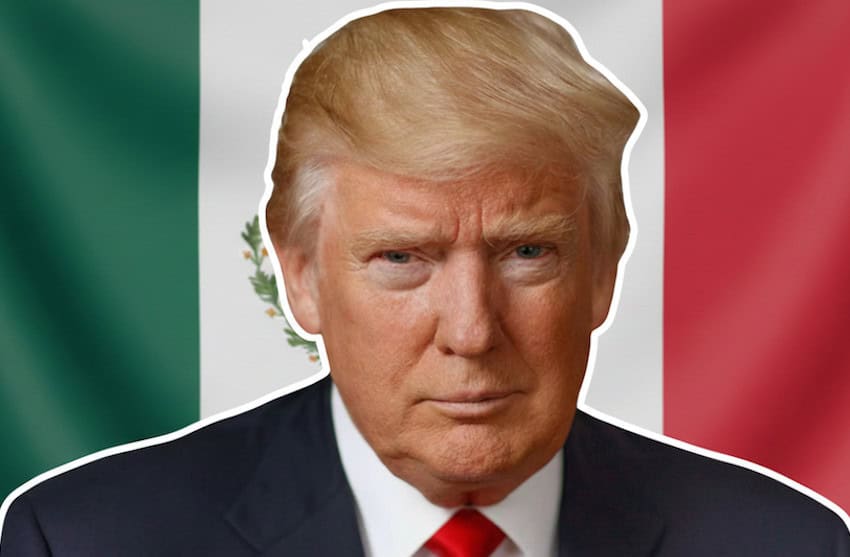
We all heard it. President Trump, in a Fox News interview, declared that Mexico’s President Sheinbaum is afraid of the cartels, and then, with his trademark bluntness, delivered the phrase that now echoes across both sides of the border: “Something has to be done with Mexico.”
The question, of course, is what that “something” means. A mobilization like the one he boasted about in Venezuela? A military strike disguised as humanitarian aid? In geopolitics, answers are never simple, but several factors suggest such a U.S.-led operation would be not only ineffective but dangerously misguided.
Balkanization
Cartels function everywhere in Mexico, but their activities vary. Along the borders, they once specialized in human smuggling — a business reshaped, though not erased, by Trump’s immigration crackdowns. In Puebla, they steal. In Mexico City, they extort. Their operations reach deep into daily life, adapting like a shadow economy that feeds on absence and fear.
The popular image of gleaming narcos with gold chains and pet tigers misses the truth. These are not caricatures; they are corporations. They run logistics networks that operate with the efficiency of global retailers. The difference is that Walmart files taxes; cartels file body counts.
And when you remove cartel leaders, you don’t end the organization. The fall of El Chapo divided the Sinaloa cartel into rival factions, as his sons, Los Chapitos, battled his old partner Ismael “El Mayo” Zambada for control. Violence surged. New cells formed. “Kingpin strategy” is not a decapitation, but instead a fragmentation of the problem into even harder to remove pieces. Each head cut off becomes a new command structure, smaller, quicker, and often more violent.
Something is already being done
Let’s not pretend Mexico and the U.S. operate in isolation. DEA agents and American intelligence personnel have worked in Mexico for decades. Bilateral operations against cartels are routine; intelligence is shared, coordinated, and, often, successful.

If what Trump imagines is Marines parading through Mexican streets, that’s not cooperation. It’s an invasion. President Sheinbaum is right: that would be a direct violation of Mexican sovereignty. Mexico is not a failed state begging for rescue; it’s a struggling democracy managing one of the harshest criminal ecosystems on the planet, one fed by its neighbour, often with limited tools and too little support.

Just look at Security Secretary Omar García Harfuch’s record — his operations dismantled dozens of criminal cells and captured high-ranking traffickers. Progress exists. What doesn’t is patience.
As long as demand exists
Believing that killing cartel leaders will end drug addiction is delusional. The only way to deal with the problem seriously is to treat addiction as the public health crisis it is. Switzerland learned that decades ago. Instead of declaring war on heroin in the 1980s, the Swiss government created supervised heroin and methadone programs so addicts could transition safely toward recovery. Infection rates dropped, overdose deaths plummeted, and drug-related crime fell. The state, not the streets, took control.
Mexico has destroyed countless synthetic drug labs, but the results are temporary at best. When one operation disappears, another one appears elsewhere. As long as the U.S. appetite for narcotics endures, Mexico’s cartels will adapt, relocate, and rebuild.
In essence, legalization removes control from the hands of the criminal underworld and places it squarely with institutions. It doesn’t celebrate drug use, it sets boundaries around it—with rules about who can sell, who can buy, and where consumption can happen. Legalization doesn’t mean permissiveness; it means precision.

“Something has to be done”
On this point, Trump isn’t alone. Mexicans are equally desperate. We are tired of the headlines, the funerals and the fear. Our parents remember another Mexico, one where you could travel at night without locking your doors. My generation remembers the warning signs: don’t drive certain highways, don’t look at strangers too long, don’t ask who lives next door.
Of course, we want the violence to stop. But we also know what happens when foreign troops step in under the pretext of restoration. They rarely leave when the fighting’s over. Once a Marine garrison appears in Chiapas or Sinaloa, sovereignty becomes a negotiation, not a right.
Intervention promises quick relief but often ends in permanent instability. The “war on terror” taught us that lesson painfully well.
A final thought
Drugs are already here. The question is who decides their terms — cartels or governments. Prohibition has failed for half a century; legalization, for all its risks, at least offers the chance to manage the damage instead of multiplying it.
Something does have to be done about Mexico — about the violence, about the fear, about the hypocrisy on both sides of the border. But the solution won’t come from cruise missiles or foreign boots on Mexican soil. It will come when both countries can admit that the drug war, as we’ve waged it, has been an act of self-deception.
As Mexicans, we’ve lived with this crisis for far too long and perhaps we’ve also been shortsighted about how to confront it. We’ve demanded action, yet often repeated the same failed formulas. Maybe the real challenge is daring to do something different — and finally breaking free from the cycle that keeps us trapped between fear and denial.
Maria Meléndez writes for Mexico News Daily in Mexico City.