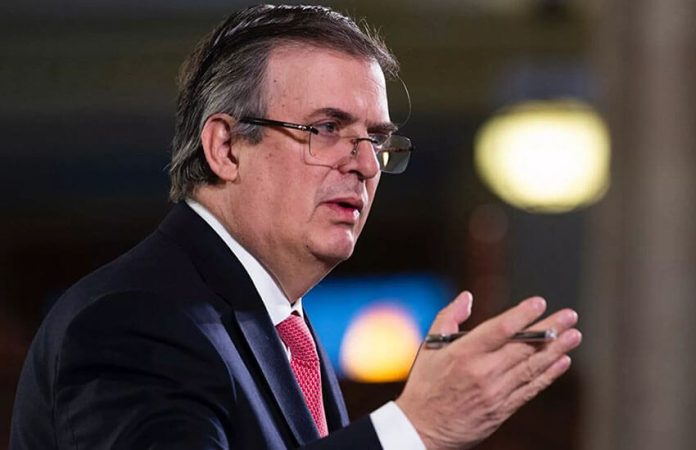
Marcelo Ebrard and Alejandro Mayorkas meet Tuesday in Washington.
The Mexican and United States governments have agreed to divert some northbound cross-border traffic away from Texas to New Mexico in retaliation for the strict vehicle inspection program implemented by the Lone Star State last month.
Some traffic will be diverted to the border crossing between San Jerónimo, Chihuahua, and Santa Teresa, New Mexico.
The crossing, located about 70 kilometers south of Las Cruces – New Mexico’s second largest city – and approximately 25 kilometers west of El Paso, Texas, is set to be expanded to cope with increased commercial vehicle traffic.
The decision to divert some traffic to that crossing was taken Tuesday during a meeting between Foreign Affairs Minister Marcelo Ebrard and United States Secretary of Homeland Security Alejandro Mayorkas in Washington. It will take months to implement, the newspaper Milenio reported.
Ebrard said on Twitter that he spoke to Mayorkas about “new infrastructure for the border with New Mexico in San Jerónimo-Santa Teresa to facilitate binational transport.”
Mexico’s ambassador to the United States, Esteban Moctezuma, and the U.S. ambassador to Mexico, Ken Salazar, were among the other officials who attended the meeting.
Milenio said it was informed by diplomatic authorities that the final decision to expand the New Mexico border crossing was taken after reaching the conclusion that Mexico couldn’t trust Texas as a trade partner.
In early April, Governor Greg Abbott – who claims that the U.S. government isn’t doing enough to secure the border with Mexico – directed Texas authorities to conduct more thorough inspections of all commercial vehicles crossing into the state from Mexico in order to detect drugs and migrants trying to enter the U.S. illegally.
The more stringent vehicle inspection program, which lasted about a week, caused long delays for truckers trying to cross into Texas and generated huge economic losses. It was suspended after Abbott reached agreements with governors of four Mexican border states, who committed to enhancing security measures on the southern side of the border.
Ebrard accused the Texas governor of extortion for his negotiation methods with the governors of Tamaulipas, Nuevo León, Coahuila and Chihuahua, saying that Abbott had attempted to blackmail them, instead of looking for compromise.
“It’s extortion. Closing the border and forcing you to sign whatever I say. That’s not an agreement, an agreement is when you and I agree on something,” he said.
To reduce Mexico’s reliance on border crossings with Texas for the export of products to the U.S., authorities are also considering the possibility of a rail link to the New Mexico border.
“I don’t think we’re going to use Texas any more,” Economy Minister Tatiana Clouthier said last week, referring to a proposed rail link to connect Mexico’s Pacific coast to the northern border via the Bajío region, a manufacturing hub.
“We’re going to seek a [rail] connection to New Mexico because we can’t put all our eggs in one basket and be held hostage by someone who wants to use trade as a political issue,” she said.
President López Obrador accused the Texas government of acting against the principles of free trade in implementing a stricter vehicle inspection program. The measures introduced were “completely contrary to free trade” and amounted to “chicanery” on the part of Texas, he said last month.
“Legally they can do it but it’s really despicable,” López Obrador said. “… Why do they do it? I believe that the governor of Texas aspires to be the Republican Party candidate,” he said, apparently referring to the U.S. 2024 presidential election.
Abbott is already in the race for November’s election to elect a new governor in Texas after winning the Republican Party nomination in April. He is currently serving his second term as governor.
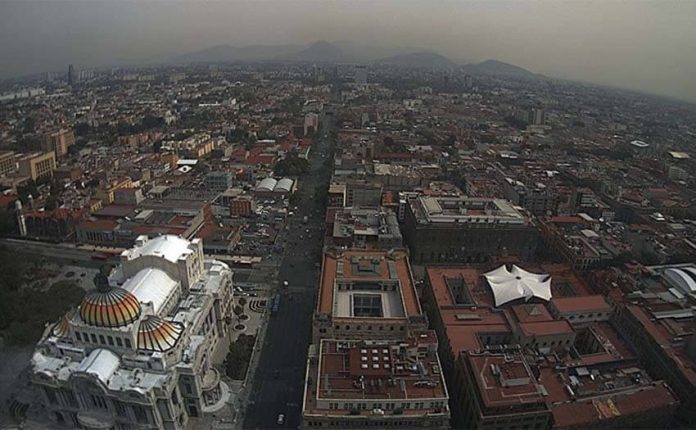
Two factors CAMe blamed for the poor air quality in the Valley of Mexico were a lingering high pressure system and temperatures above 24 degrees Celsius. webcams of Mexico
Air quality has once again deteriorated in Mexico City, leading authorities to declare a phase 1 environmental alert.
The alert was activated Monday due to high levels of ozone pollution in the metropolitan area and renewed at 3:00 p.m. Tuesday.
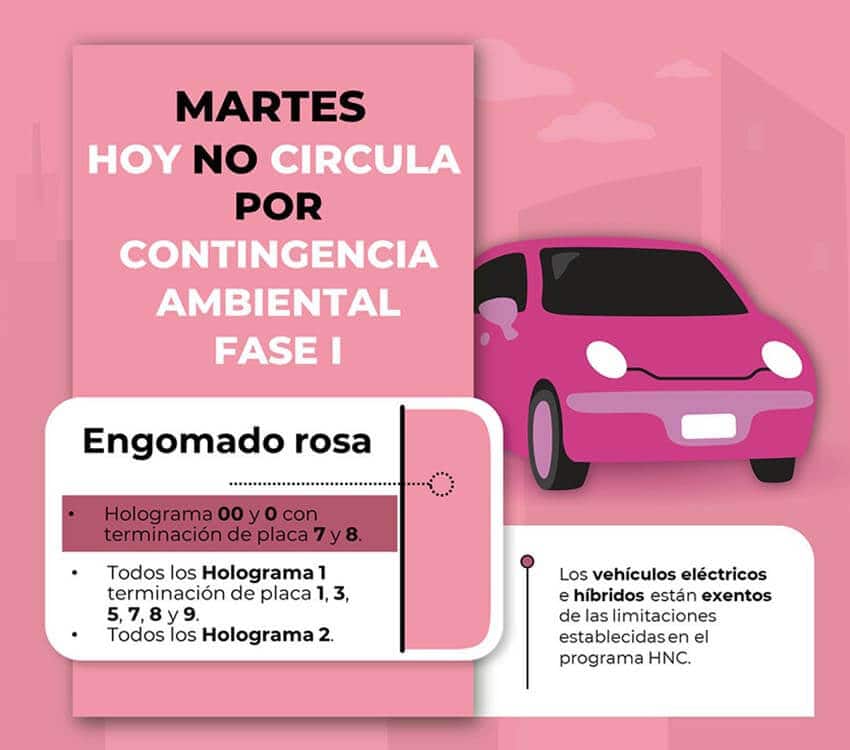
Many vehicles, including a large number of those with license plates that end in 1,3,5,7,8 and 9, are consequently prohibited from using roads in the metropolitan area between 5:00 a.m. and 10:00 p.m. Tuesday. Restrictions aimed at reducing ozone levels also apply to many industrial facilities.
The current phase 1 alert comes just over a month since the last one was declared. Ozone levels as high as 169 parts per billion (ppb) were recorded in Mexico City Monday afternoon. The city government considers concentrations of ground-level ozone over 70 ppb to be unhealthy. Weather conditions are currently favorable to the accumulation of ozone in the capital.
The Environmental Commission of the Megalopolis (CAMe) said Tuesday afternoon that information from the Mexico City Atmospheric Monitoring System “indicates that the high-pressure system in the Valley of Mexico remains and [that] the production of ozone is continuing in the presence of high solar radiation and temperatures above 24 C.”
Poster from CAMe listing which vehicles may not drive on Tuesday until after 10 p.m., based on their windshield sticker and the last number of their license plate. Hybrid and electric cars are exempt from the restrictions. CAME
It also said that wind conditions were impeding the dispersion of the ozone contamination. CAMe will issue its next report at 8:00 p.m. Tuesday.
A map published by Mexico City authorities at 3:00 p.m. on Tuesday showed that air quality was poor at 12 of 14 points in the capital where data is collected. It also showed poor air quality at four locations in México state, which borders the capital to the north, east and west.
Residents of the Valley of México metropolitan area were advised to avoid outdoor activities including exercise between 1:00 p.m. and 7:00 p.m. on Tuesday due to risks associated with exposure to polluted air.
Excessive ozone in the air can have a marked effect on human health, according to the World Health Organization, which says that it can cause “breathing problems, trigger asthma, reduce lung function and cause lung diseases.”
The United Nations declared Mexico City to be the most polluted city on the planet in 1992. While air pollution is still a problem at times, the situation in the capital and surrounding areas has improved significantly over the past three decades.
The ancient Maya who lived in this region believed that cenotes were the access to points to the underworld. (Nori Velazquez/Amigos de Sian Ka'an)
The Yucatán Peninsula, a massive limestone platform of 165,000 square kilometers and one of the world’s largest karst formations, hosts one of the planet’s most spectacular subterranean aquifers — thousands of kilometers of underground rivers and lakes.
This hidden aquatic world is largely the result of a rare encounter between cosmic and earthly matter — an enormous meteor that crashed into our planet 65 million years ago.
When the Chicxulub Meteor struck the peninsula, the impact was so great that it fractured the region’s brittle limestone, opening up fissures and holes that allowed virtually all surface water to drain into a subterranean world of dark, sunless caverns and tunnels, creating a subsurface world like no other on Earth.
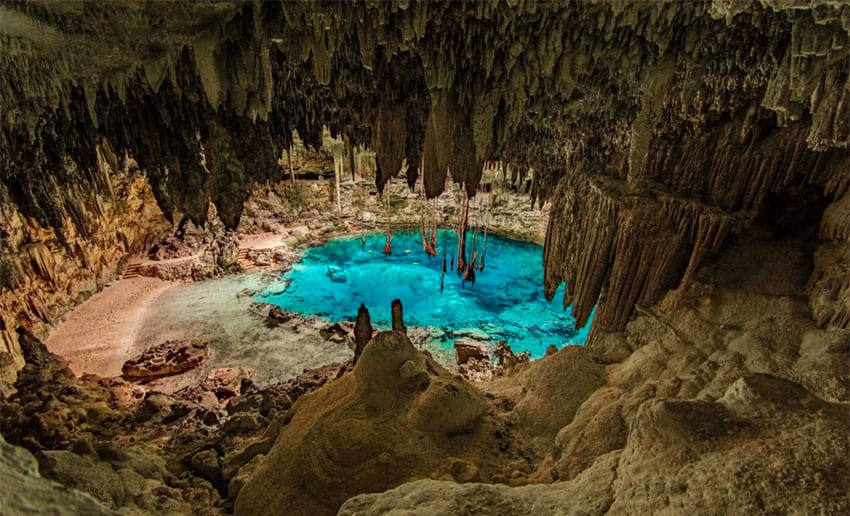
This system of complex underground rivers and caves finds portals to the dry land above by way of sinkholes, or cenotes. Thirty years ago, scientists documented the existence of about 7,000 cenotes on the peninsula; today, some believe the real number may be twice that.
I recently visited one of these mindboggling cenotes, locally known as the Templo Mayor.
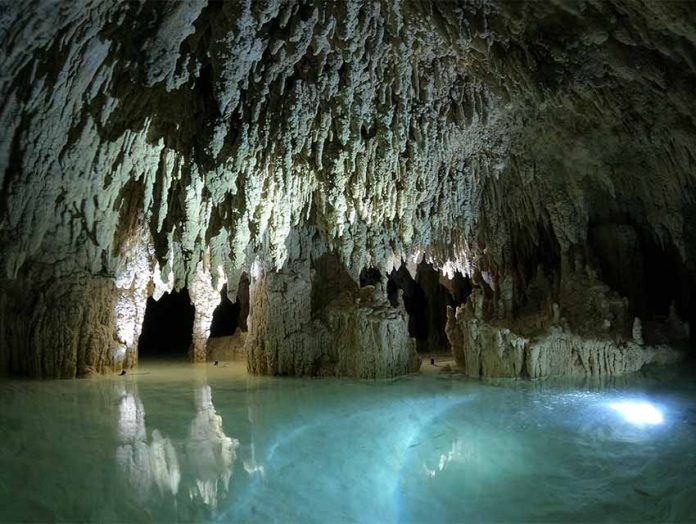
Among the countless creatures in this dark, winding underground system of karst formations are bats and blind fishes. Bejil-Ha
“Welcome to Batman’s world,” Einner Medina proudly tells me as I crouch to avoid hitting my head on limestone formations. I follow him into a cenote in the Chemuyil community in Quintana Roo, on the Yucatán Peninsula.
Medina is the leader of the Bejil-Ha–Water Path — an ecotourist group of young men and women committed to their community, to Mexico and to our planet.
This is my first journey ever into the Mexican (and Maya) underworld, my first close encounter with the cenotes, with what the Maya called that “deep thing — abysm and profundity.” My first contact with these water holes along the long road that all Mexicans must travel through on our journey after death.
There, in the underground, is the doorway to the Mexican underworld. Where the traveling souls of the dead are reflected on the stalactites that hang from the cave’s ceiling and the stalagmites that rise from its floor. In the heart of the Mayan jungle.
Cenotes are our red blood, our mahogany-colored skin, our mouth, eyes and lungs. A place where our ancestral souls rest. And cenotes are all the living things they house: bats; blind white ladies and other blind fishes. They are also the uncolored sponges, bivalves and crustaceans. Cenotes are iguanas, toads, swallows and the Toh, also known as the turquoise-browed motmot.
And cenotes are Xibalbanus tulumensis, a tiny, blind, venomous, hermaphroditic crustacean whose ancestral distribution is linked to the ancient Tethys Sea. With its name, it honors Xibalba, the Maya underworld — a world in which we would be eternally lost if these humid sinkholes did not exist to guide us.
“Let us make the eternal darkness,” Medina says to us. Submerged in water, in the heart of the cenote 12 meters below the forested land, we turn off our small lamps. We make our way through the darkness and the silence.
What my wide-open eyes see is the boundless fusion between eternal darkness and eternal light — a state of grace, of dying without being dead, an indescribable peace, infinite calm. Floating on the water’s surface, I close my eyes, trying to see, but there are no differences when in eternal darkness.
Submerged to the chest, I slowly move my left hand toward the water, feeling it move through the air, independent from the rest of my body, until it enters the water, demonstrating to me that here the boundaries between air and water are just a mirage.
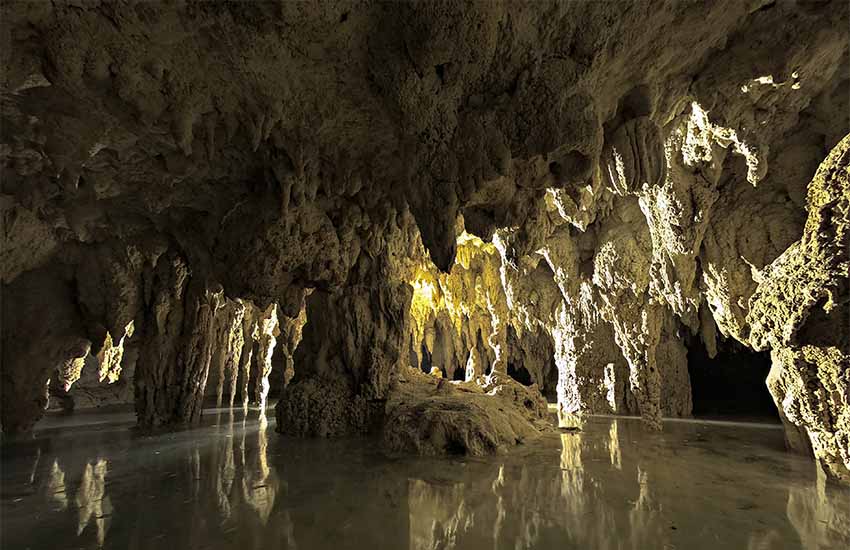
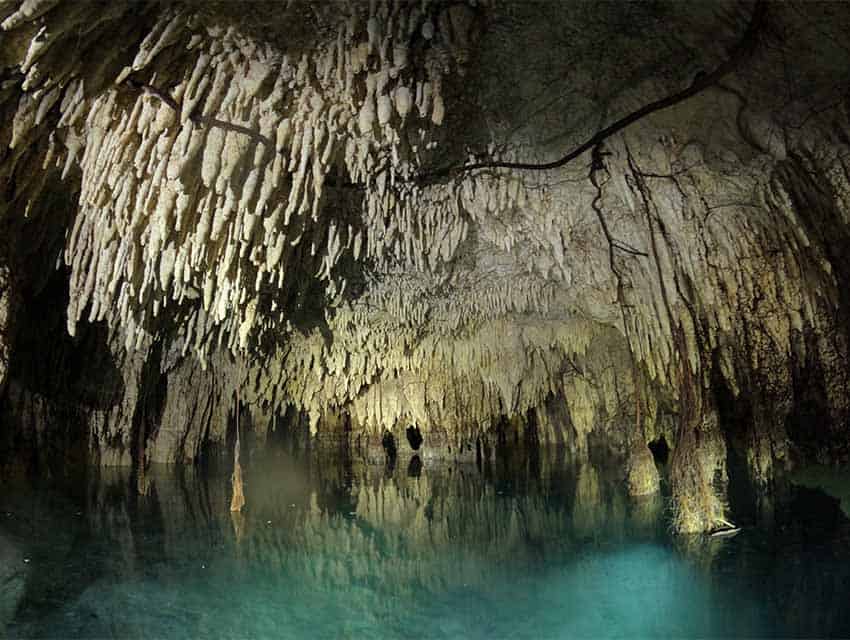
To reach the cenote’s heart, we swim under a dome framed by the speleothems that bear semblance to Tyrannosaurus rex jaws: they are the stalactites that hang from the roof and the stalagmites that grow from the floor — both growing, drop by drop, in opposite directions toward one another over millions of years.
Above, irregular, sharp cones each have a central channel, through which mineralized water runs ever so slowly. Below, there are solid forms, also built drop by drop, rounded like macaroni.
Each stalactite and stalagmite are born from a drop of mineralized water: mirror rocky formations that seek one another, gravitating ever so slowly toward an earthly, geological kiss. They are the yin and yang of the Mexican underworld.
When bats brush up against the cenote’s formations, the sound is musical, says Einner Medina of Bejil-Ha–Water Path. Bejil-Ha
While swimming, I see everywhere thin roots of the poplars descending from the jungle. The cenote is at once a floating and hanging garden.
“Listen to the cenote,” Medina says. I sharpen my hearing but hear nothing.
Suddenly, my face feels the hot air displaced by flapping wings that are not of a bird, and I hear the unmistakable sound of long, membranous bat wings. I smell the sweet and sour breath as it passes.
And then another bat and another, and many more pass, a chiropteran procession. The guardians of the cenote are telling us that we are in their territory. They warn us that they follow our movements and thoughts and that we would be well advised to keep our intentions honorable because we are at their mercy in this eternal darkness.
But, to my surprise, I eventually realize that all of the sounds and smells and movement are an illusion: there are not many bats; it is only the same inquisitive individual circling around us over and over, taking stock of our presence.
Seeing nothing, but with my eyes wide open, I enjoy the sound of its wings and the aromas of the misunderstood and vilified flying creature of the night — and planetary champion at devouring insects, dispersing seeds and pollinating plants. Blessed are the bats, the only winged mammal that has conquered the entire planet except for Antarctica.
Medina interrupts my thoughts. “That is nothing, Omar. Come back soon to listen to the sound of bells when many bats are flying and their wings brush against the stalactites.”
I can’t imagine anything more glorious than a bat symphony performed in the Mexican underworld.
Seconds after we turn our lamps back on, I see air bubbles emerging on the cenote’s surface. What I see takes me back to memories of Stanley Kubrick’s film 2001:A Space Odyssey and my favorite James Bond movie, Thunderball.
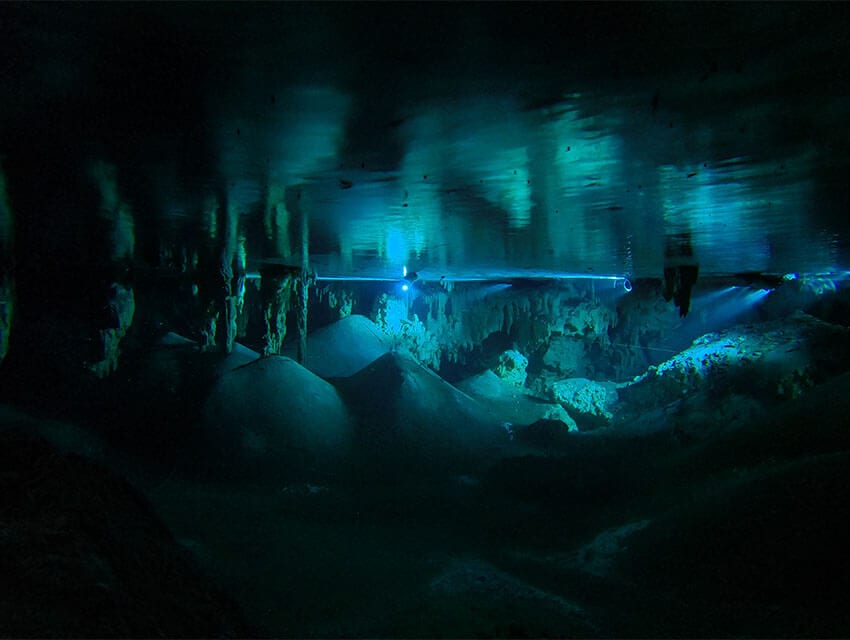
Just 10 meters from us, two slender divers, like lost subterranean angels in silvery wetsuits, are being pulled through the water by small propulsion vehicles equipped with powerful lamps.
At first, I thought I was hallucinating due to insufficient oxygen levels in the cave; then I thought that the divers were aliens from another galaxy. Finally, I thought I had died and begun my own path to Xibalba.
Seeing my astonishment, Medina calmed me down and explained that they were a couple of the many speleologists who spend their life studying and protecting the cenotes and underground rivers.
Each stalactite and stalagmite in a cenote is born from a drop of mineralized water. Bejil-Ha
The time comes to bid farewell to the underworld’s doorway. From the entrance to the inundated cave, I look one last time at the ray of sunlight entering through a crack on the cenote’s other side, a shaft of radiance where the sky meets the underworld.
Through my dive mask, I lift my head from the water’s surface for a final glimpse at the sun’s illumination on a small rock platform — a natural shelf that likely served as a contemplative place for a Maya emperor or a priest, a shining spot visible only to those convinced that the boundaries between air and water are but an illusion.
I thank Einner Medina for his patience in teaching us how to make our way through the eternal darkness and listen to the cenote. All photographs and videos used in this essay belong to his group. Visit their website, where you can learn how to listen to the cenote yourself.
Omar Vidal, a scientist, was a university professor in Mexico, is a former senior officer at the UN Environment Program and the former director-general of the World Wildlife Fund-Mexico.
Grupo Xcaret prefers to ask for forgiveness rather than permission, minister says.
Amid criticism over the absence of environmental permits for its Maya Train project, the government fired back Monday by claiming that a Quintana Roo theme park and hotel operator has never obtained permits for its projects.
Environment Minister María Luisa Albores made the accusation against Grupo Xcaret at President López Obrador’s regular news conference.
“Xcaret is a group that prefers to ask for forgiveness rather than permission,” she told reporters.
“In all its projects and proposals it has never presented an environmental impact statement [EIS]. That’s a reality because we’re inside the Environment Ministry [Semarnat],” Albores said.
Individuals and companies seeking approval for a construction project are required to submit an EIS in order to gain the permits they need.
Xcaret operates several theme parks in the Riviera Maya of Quintana Roo, including its flagship park near Playa del Carmen, which opened in 1990.
López Obrador said construction of the company’s parks has damaged the environment and questioned why “pseudo-environmentalists” opposed to the Maya Train project didn’t speak up against them.
The company “has a lot of influence with the media,” he said, asserting that there are columnists who have cosy relationships with its owners.
López Obrador noted that Xcaret has one project under development near Valladolid, Yucatán, where it is “joining cenotes,” or natural sinkholes. He has previously criticized the project while defending the 1,500-kilometer Maya Train against claims it will cause irreversible damage to the environment.
The president’s spokesman, Jesús Ramírez, said on Twitter on April 27 that “devastation” caused by Grupo Xcaret at the Xibalbá park site is an “ecocide.”
“The company perforated cenotes, diverted subterranean rivers and created artificial channels. It’s a shame that the environmentalists that protest against the Maya Train don’t see this destruction. No to predatory tourism development,” he wrote.
A cenote at Xibalbá, Yucatán.
The 250-hectare Xibalbá park, which includes eight cenotes, was described by Grupo Xcaret president and general director Miguel Quintana Pali in 2020 as the biggest project the company has ever developed. “It’s the most lavish, grandiose, the most beautiful,” he said.
But Semarnat shut the project down in late March because it was being built without environmental approval.
“It doesn’t have a permit,” Albores said Monday. “It’s temporarily shut down because … [Xcaret was] making some revisions to an environmental impact statement proposal, which they didn’t even have [when construction began],” she said.
Despite Semarnat’s closure order, work has continued at Xibalbá, the Mérida-based newspaper Por Esto! reported, providing further evidence of the apparent disdain Xcaret has for environmental authorities.
It said that construction workers were seen working on towers at the entrance to the park as recently as last Saturday. Fidelia Canché Cetzal, commissioner of the community of Yalcobá, where the project is located, confirmed that work continued at the site Monday through Saturday.
All told, about 2,000 people are working on the new 1-billion-peso (US $49.3 million) park, Por Esto! said. The newspaper said the project received authorization for minor construction work, but Xcaret has admitted to significantly altering the local ecosystem, in which it has built a range of amenities to accommodate visitors.
Contrary to Albores’ claim, Por Esto! said that Xcaret has presented two environmental impact statements to support construction of the Xibalbá park. But its claims that the project wouldn’t have – and hasn’t had – a major detrimental impact on the environment have been disputed.
In addition to being criticized by the government, the project has angered environmentalists from organizations such as Greenpeace and Expedición Grosjean, which is dedicated to the conservation of cenotes.
Xcaret is “committing an ecocide,” said Sergio Grosjean, the founder of the latter group.
“It’s bad whichever way you look at it. [Cenotes are] natural unique ecosystems and by connecting them the ecological balance of the bodies of water is broken,” he said.
“… There are people who think that joining cenotes can improve them but it’s not true. It breaks the balance and generates a conflict between species,” Grosjean said.
Despite concerns about the park and Semarnat’s closure order, Xcaret appears optimistic that it will be able to open Xibalbá in the not too distant future. The park already has its own website, where it is described as an “exclusive nature reserve” where visitors can “explore things you have not seen before.”
“After spending a day here, you will get renewed profoundly,” the site says. “It is an unforgettable experience that only Grupo Xcaret can provide.”
A Oaxaca woman has admitted to killing her four children, all of whom were found dead on Monday after apparently being poisoned.
Three girls aged under 10 and a baby boy were found dead on a bed at their home in Chicapa de Castro, a Zapotec community in the Isthmus of Tehuantepe region. Their father made the shocking discovery when he got home from work Monday afternoon, local authorities said.
Local authorities also said that the children’s mother accepted responsibility for the minors’ death, but didn’t say how she killed them.
Local media reports said the children had been poisoned, probably with rat poison. That hypothesis will have to confirmed by autopsies.
The 27-year-old mother, identified as Arely J., received medical treatment Monday for a stab wound to the neck, the newspaper El Universal reported. It was unclear how she sustained the injury, but at least one report suggested it was self-inflicted.
The Oaxaca Attorney General’s Office FGEO said in a statement that it had launched an investigation into the multi-homicide in Chicapa de Castro, located in the municipality of Juchitán.
“The FGEO is committed to carrying out a meticulous investigation taking all evidence into account,” it said.
Chicapa de Castro authorities declared three days of mourning for the deaths of the four children.
“It’s a tragedy that fills us with sadness,” one resident told El Universal. “… The children were innocent beings, little siblings. We won’t forget this tragedy.”
A rendering of the interior of one of the Maya Train's rail cars.
A court in Mérida, Yucatán, has issued another provisional suspension order against the construction of the Maya Train railroad in Quintana Roo.
A second injunction against the Cancún-Tulum section of the 1,500-kilometer line was granted to Defendiendo el Derecho a un Medio Ambiente Sano (Defending the Right to a Healthy Environment), or DMAS, a Cancún-based environmental organization.
In the second lawsuit, DMAS argued that the project violates constitutionally-enshrined rights to due process and a healthy environment.
“They say that without cenotes there is no paradise. We say that without an environmental impact process there mustn’t be a project,” it said in a statement.
There is significant opposition to the southern part of the Quintana Roo section of the railroad, which will run between Playa del Carmen and Tulum.
The federal government modified the route earlier this year, moving the section inland after the business community in Playa del Carmen complained about its construction through the center of the coastal resort city. Jungle has already been cleared for the construction of tracks, triggering protests both at the site of the deforestation and online.
Environment Minister María Luisa Albores acknowledged Monday that definitive environmental approval hasn’t been granted for the Cancún-Tulum leg as well as three other sections of the US $10 billion project. A decree issued by President López Obrador in November allows work to proceed with only provisional approval.
The government has overcome several previous injunctions issued against the railroad and is determined to complete the project next year.
López Obrador – its most prominent proponent – signed a contract on Monday to purchase 42 trains for the railroad, on which tourist, commuter and freight services will run through the states of Tabasco, Campeche, Yucatán, Quintana Roo and Chiapas.
The trains, consisting of a total of 210 rail cars, will be made in Mexico by Alstom, a French company that acquired Canadian-German rail transport manufacturer Bombardier Transportation early last year.
“Twenty years ago we signed a contract with Bombardier, now associated with Alstom, to buy 45 trains and 400 cars for the Mexico City Metro. Today we’re signing with the same companies for the purchase of 42 trains with 210 cars for the Maya Train,” López Obrador wrote on Twitter and Facebook.
“The construction was done and will be done in Ciudad Sahagún, [Hidalgo], always thinking of employment for Mexicans,” the president said.
The federal government announced almost a year ago that a consortium including Alstom was the successful bidder in an international tendering process for the acquisition of rolling stock and rail systems for the Maya Train railroad. The consortium submitted a bid of 36.6 billion pesos (US $1.8 billion) to supply rail systems and 42 trains.
Alstom was part of a consortium that built line 12 of the Mexico City Metro system, part of which collapsed a year ago today, causing an accident that claimed the lives of 26 people. Another member of that consortium was Carlos Slim’s Carso Infrastructure and Construction, which is building section 2 of the Maya Train.
Remittances sent to Mexico increased 18% to US $12.52 billion in the first quarter of 2022, a figure that represents a new record for the first three months of a year.
Reported by the Bank of México (Banxico) on Monday, the figure is $1.91 billion higher than in the first quarter of 2021 and comes after a new calendar year record of over $51 billion in remittances was sent to Mexico last year.
The vast majority come from the United States, where millions of Mexicans live and work.
The central bank reported that remittances totaled $4.68 billion in March, a 12.6% increase compared to the same month of 2021, and that remittances totaled $53.49 billion in the 12-month period to the end of March.
During the first three months of the year, 99% of all funds were sent via electronic transfer, Banxico said. Cash and payments in kind accounted for 0.7% of the $12.52 billion total while the other 0.3% was sent via money order.
The bank also reported a seasonally adjusted figure for remittances in the first quarter. The figure derived from that statistical method was a first quarter record of $13.91 billion, an 18.5% increase compared to the first three months of 2021.
In March, remittances were sent to Mexico in a total of 11.9 million transactions. An average of $393 was transferred in each one, a 6% increase compared to the same month of 2021.
Banxico also reported that remittances totaling $271 million were sent abroad from Mexico in the first three months of the year, an increase of 26.6% compared to the first quarter of 2021. Just over $1.1 billion in remittances left the country in the 12 months to March 31.
New records for incoming remittances were set in both 2020 and 2021 despite the negative impact the coronavirus pandemic had on the global economy.
The United States government’s extensive support for the U.S. economy during the pandemic was cited by many analysts as the main reason for the record remittance levels.
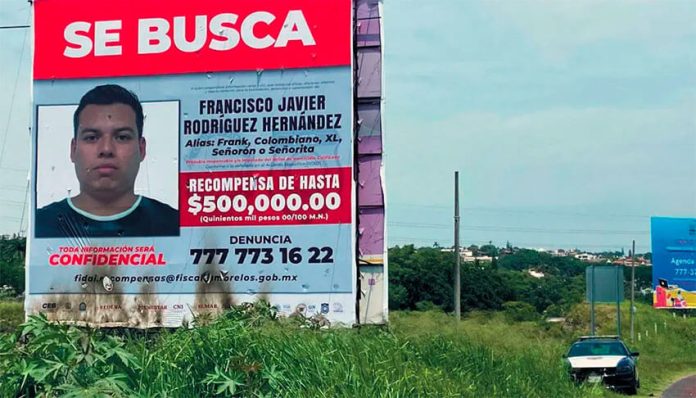
A billboard offers 500,000-peso reward for El Señorón.
Federal security forces caught a senior lieutenant of the powerful Jalisco New Generation Cartel (CJNG) on Friday, the navy and Morelos Attorney General’s Office announced.
Francisco Rodríguez, known by the alias “El Señorón” (the big shot), was arrested in an operation by marines in Mazatlán, Sinaloa, outside a luxury apartment complex in the northwest of the city. He is thought to be a high-ranking member of the CJNG in Morelos.
In June, Rodríguez was identified as the leader of “Los Colombianos” (The Colombians), a criminal group of growing importance in Morelos, allied with the CJNG. Los Colombianos have been linked to homicide, kidnapping, extortion, money lending and drug trafficking. Its leader is believed to be one of the key people behind violence in the state.
Authorities offered a 500,000-peso (US $25,000) reward for information about Rodríguez in July.
Rodríguez is suspected of the murder of three doctors in April 2020, according to the Morelos Attorney General’s Office. An inter-state working group said security forces had an arrest warrant for murder, criminal association and generating violence in Morelos.
The navy said he controlled several synthetic drug laboratories, whose products were distributed in Cuernavaca, Jiutepec, Puente de Ixtla, Amacuzac, Emiliano Zapata, Cuautla, and Cocoyoc.
Morelos Governor Cuauhtémoc Blanco said a violent reaction to the arrest was expected from criminal groups in the state.
The head of CJNG, Nemesio “El Mencho” Oseguera, is one of the most wanted cartel leaders in the world. The U.S. Drug Enforcement Administration has offered US $10 million for his arrest.
Late last year, security forces arrested his wife, Rosalinda González Valencia.
The foreign minister has accused the governor of Texas of extortion for his negotiation methods with Mexican governors, who wanted U.S. officials to lift stringent border checks on vehicles.
The inspection program on vehicles was introduced by Governor Greg Abbott at Texas’ almost 2,000-kilometer border with Mexico in early April, for authorities to conduct more thorough checks to detect drugs and migrants trying to enter the U.S. illegally.
Foreign Minister Marcelo Ebrard said that Abbott had attempted blackmail the governors, instead of looking for compromise. “It’s extortion. Closing the border and forcing you to sign whatever I say. That’s not an agreement, an agreement is when you and I agree on something,” he said.
“The migration problem is not Mexico’s problem,” Ebrard added, before saying that resolving problems around migration depended on the decisions of U.S. officials.
The governor of Nuevo León, Samuel García, and the governors of Tamaulipas, Coahuila and Chihuahua negotiated individually with Abbott to lift restrictions.
García promised to install migration checkpoints for vehicles before they reach the border and to activate patrols across 14 kilometers of the border. After the agreement was signed, traffic flow was revived between Nuevo León and Texas.
Ebrard said that he respected the governors’ decisions to cede to Abbott’s demands, but that he couldn’t take the same approach.
“I don’t judge. I think the governors have to do what they can. They had no alternative, but we are not going to allow a governor to extort Mexico, I will never allow that,” he said.
Ebrard added that Abbott’s behavior should be attributed in part to the his re-election campaign.
Two-way trade between Mexico and Texas was worth US $177.8 billion in 2020, according to the Foreign Ministry, with both sides benefiting almost equally from the cross-border exchange.
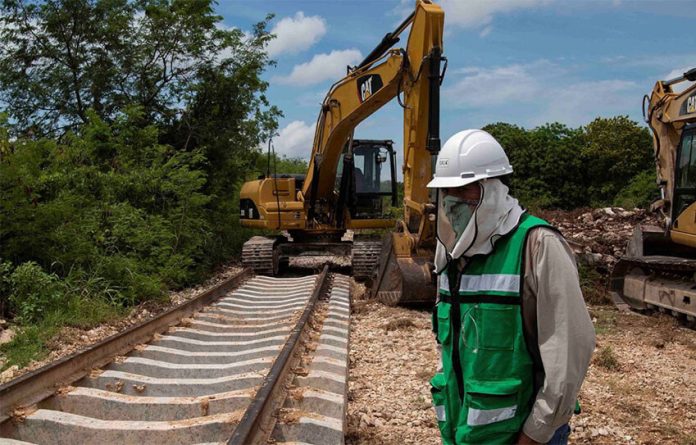
A construction crew works on a section of the Maya Train in Yucatán.
Environment Minister María Luisa Albores acknowledged Monday that definitive environmental approval hasn’t been granted for four sections of the Maya Train railroad project.
She said that sections 4, 5, 6 and 7 only have provisional approval but their construction has been able to proceed thanks to a decree issued by President López Obrador in November.
The decree instructs government agencies to grant provisional authorizations and permits to projects deemed to be of public interest and national security in a maximum period of five working days so as to ensure their timely execution.
Speaking at López Obrador’s regular news conference, Albores said that sections 1, 2 and 3 of the 1,500-kilometer railroad have definitive environmental approval. They are the Palenque-Escárcega, Escárcega-Calkiní and Calkiní-Izamal sections.
The environment minister then admitted that the other four sections only have provisional approval. They are the Izamal-Cancún, Cancún-Tulum, Tulum-Chetumal and Chetumal-Escárcega sections.
Environment Minister María Luisa Albores talked about environmental issues related to the Maya Train at the president’s Monday morning conference.
“What was done is that on November 22, 2021, there was a decree to issue provisional permits,” Albores said. “It doesn’t mean that … technical studies [and] environmental impact statements aren’t being done,” she said.
However, it is unclear when those studies – which are needed for full environmental approval to be granted – will be completed.
Albores – the country’s foremost environmental official – defended companies’ capacity to work on the US $10 billion project while the environmental studies are being carried out. She said that the National Tourism Promotion Fund, which is managing the ambitious project, has experts in the field who monitor work on the railroad to ensure that the environment isn’t adversely affected.
“We’re talking about more than 100 specialists who are in the territory [where the railroad is being built]. … They’re brigades that do everything related to looking after the environment,” she said.
The protesters – which López Obrador has dubbed “pseudo-environmentalists” – have made a lot of noise, but it doesn’t mean work has stopped, she said.
Opponents of the Playa del Carmen-Tulum stretch have denounced the clearing of forested land without environmental permits having been granted and warned of irreversible damage to flora, fauna and subterranean rivers in Quintana Roo.
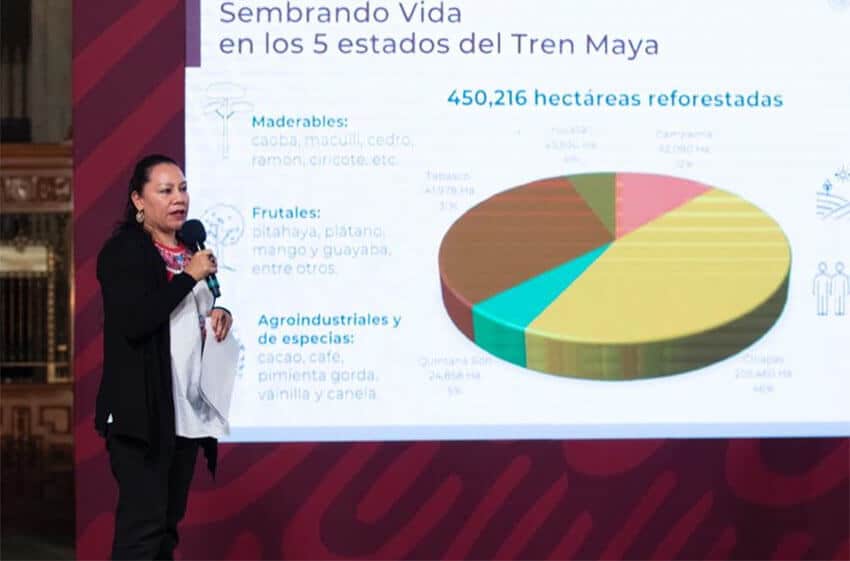
Albores said Monday that “only 300,000 trees” will be cut down to make way for the highly-controversial section before she asserted that over 143 million trees will be planted along the railroad route thanks to the government’s reforestation and employment program, called Sembrando Vida (Sowing Life).
While the environment minister argued that work on the Maya Train sections without definitive environmental approval was legal, given AMLO’s infrastructure decree, a National Autonomous University academic took a different view earlier this year.
Ana Esther Ceceña, an academic with the university’s Economic Research Institute, told the news website Animal Político in late March that environmental impact statements have to be completed before work on the different Maya Train sections can begin.
“That is by law, and they can’t be provisional permits,” she said. “… They haven’t done land or environment studies or even economic feasibility studies. They haven’t done them in advance, they are doing them on the fly,” Ceceña said.
López Obrador, who has consistently denied that the railroad project will damage the environment and has touted the economic benefits it will bring, claimed on March 31 that all environmental permits had already been issued for the Maya Train project – one of his signature infrastructure projects – but Animal Político ran a fact check on the assertion and declared it to be false.