Home Blog Page 1002

Electoral reform, Biden on the line: the week at the morning press conferences

0
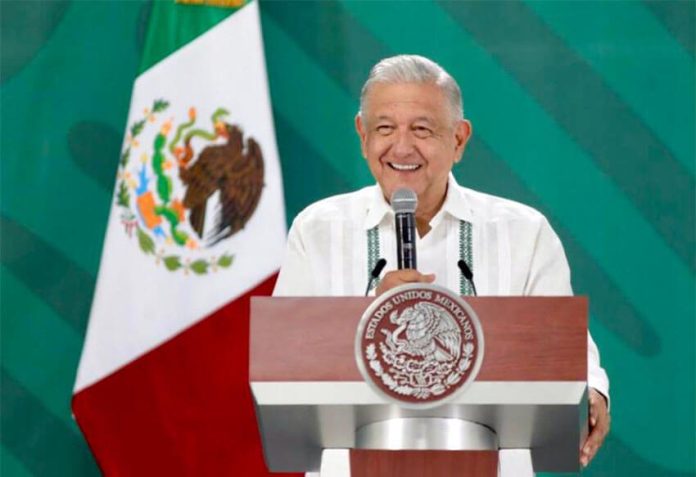
The president was in a good mood on Friday as he gave his morning press conference from Isla Mujeres, Quintana Roo.
The president was in a good mood on Friday as he gave his morning press conference from Isla Mujeres, Quintana Roo. Presidencia de la República

President López Obrador was in Veracruz and San Luis Potosí last weekend checking up on new highways. He was back to Mexico City on Sunday to celebrate his son’s 15th birthday.

Monday

A journalist kicked off the questions with the words of a former U.S. president. Speaking at a rally, Donald Trump had said that AMLO’s government folded on migration negotiations, before adding that despite him being a socialist, he liked the tabasqueño.

“I like President Trump, even though he’s a capitalist,” the president responded.

“The truth is that we understood each other and it was good for both nations … We will not allow any party … in the United States, or any candidate, to use Mexico as a piñata,” he insisted.

On claims that his predecessor had ordered the then CEO of Pemex to pay a bribe to a political opponent, the president said he was the wrong man to ask. Later in the conference he celebrated Emmanuel Macron’s election victory in France and said voters there had chosen liberty, equality and fraternity.

However, the president was more concerned with voters at home, and their pocketbooks. He said a new plan for controlling inflation was forthcoming. Inflation hit 7.72% in the first half of April, far above the Bank of México’s 3% target.

Tuesday

“Fortunately conditions are better, now that the pandemic is almost completely over,” the president declared, adding that the Tuesday health updates would now focus more on the government’s health reforms.

Deputy Health Minister Hugo López-Gatell presented a table of the 30 worst countries for COVID-19 deaths: Mexico was 28th.

There was an update on educational reforms, which provided a platform for a short rant by the suitably named Marx Arriaga, the Education Ministry’s director of educational materials.
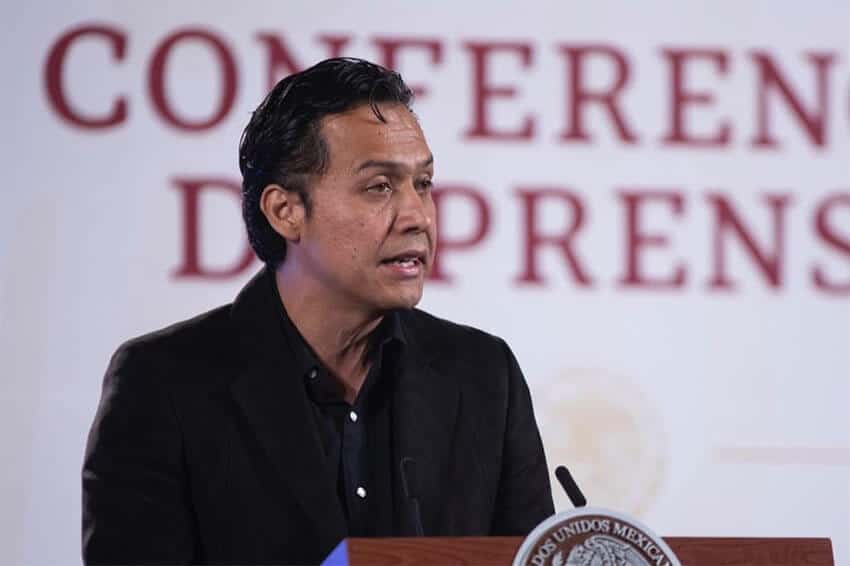
Marx Arriaga, Director of Educational Materials for the Education Ministry, discussed educational reforms at Tuesday's conference.
Marx Arriaga, director of educational materials at the Education Ministry, discussed educational reforms at Tuesday’s conference. Presidencia de la República

“I could point out hundreds of social problems that this meritocratic behaviorist, punitive, patriarchal, racist, competitive, Eurocentric, colonial, inhuman and classist neoliberal [educational] model has generated,” he said.

On billionaire Elon Musk’s likely acquisition of Twitter, the president said he thought it could help liberate the platform. “Hopefully they clean it of the corruption that is there, of manipulation with bots … [hopefully] there will be no censorship so that we can have alternative means of information, and all have the possibility to communicate,” he said.

The president confirmed he would chat with U.S. President Joe Biden on Friday by telephone, but admitted he still didn’t know what they would discuss.

Wednesday

Government media expert Elizabeth García Vilchis presented her regular “who’s who in the lies of the week” section. She said it was a lie that the recently opened Felipe Ángeles airport was empty, and that in fact six flights were departing a day. For the sake of comparison, Mexico City’s main airport — the busiest in Latin America — handled more than 500 departures on Wednesday.

García repeated the claim that the Maya Train project doesn’t damage the environment and added, “There are ecocides that pseudo-environmentalists don’t want to see. They just want to protest against the Maya Train.”

The president said the government’s plan to keep prices in check would cap the cost of 25 basic products “so that the most humble people do not suffer and they are guaranteed the basics at a fair price.” He added that most producers, distributors and stores were on board with the plan.

On environmental matters, the president revealed a chart of international carbon emissions. Mexico was in 42nd place, a mere speck compared to China, which the chart showed emitted three times more carbon than the second worst country, India.

Thursday

Deputy Security Minister Ricardo Mejía Berdeja presented the “Zero Impunity” section on crime. He detailed some of the suspects that had been arrested, including: El Gusano (The Worm), El Chopa (The Black Seabream) and El Grillo (The Cricket), and the Colombian cartel leader El Boliqueso (The Cheeseball), who’d been deported.

Interior Minister Adán Augusto López revealed the details of the electoral reform, which was set for Congress. The constitutional bill would dissolve the National Electoral Institute (INE) replacing it with a directly elected body, cut public funding to political parties, loosen electoral campaigning rules, cut the number of federal and local lawmakers and introduce electronic voting.

“There is no intention to impose a single party. What we want is for there to be an authentic, true democracy in the country and to end electoral fraud,” the president said of the bill.
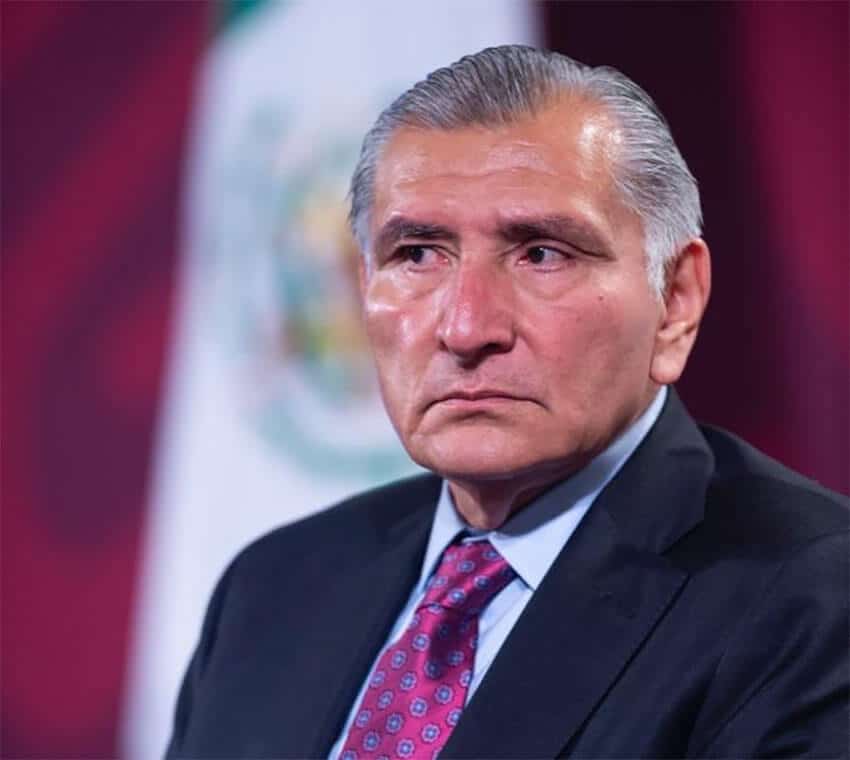
On Thursday, Interior Minister Adán Augusto López spoke about the proposed electoral reform.
On Thursday, Interior Minister Adán Augusto López spoke about the proposed electoral reform. Presidencia de la República

“It’s not possible that in this world, in these times of technological development, we cannot … create a simple, agile, free, secure, secret mechanism,” he added, on a system for electronic voting.

López Obrador extended the conference to bring out deputies from his Morena party, thanking them for the recent nationalization of lithium and encouraging their support for the electoral bill, which could threaten some of their livelihoods. “Long live the transformation of Mexico. Long live the deputies. Long live Mexico!” he exclaimed.

Friday

The conference was broadcast from Isla Mujeres, Quintana Roo, where Governor Carlos Joaquín said tourism in the state had come roaring back since the COVID-19 pandemic abated, but complained about troublesome sargassuma seaweed that emits a foul odor when it decomposes — arriving on the beaches.

The Navy Minister confirmed that marines had collected 97 tonnes of sargassum, saving tourists the eyesore and the unwelcome stench.

Later in the conference, López Obrador insisted that he hadn’t revealed his successor in Thursday’s meeting, after Morena deputies chanted, “President! President!” at the Interior Minister.

He repeated the guarantee that the party’s next candidate for the presidency would be decided by a public survey.

“It’s not only … [Interior Minister] Adán, … [Mexico City Mayor] Claudia Sheinbaum is one of the best, well-rounded and honest. I could say the same about [Foreign Minister] Marcelo Ebrard,” the president said, before mocking the opposition’s lack of obvious candidates.

To round off another week of conferences, Joaquín and AMLO headed off for an emotionally conflicted sandwich: “Cheerful shrimp. I think that’s what it’s called,” the governor said.

The president was dubious.

“Happy shrimp,” Joaquín remembered, correcting himself.

Mexico News Daily

Jalisco’s ‘Crocodile Hunter’ keeps crocs and humans safe from each other

0
American crocodile
The presence of crocodiles in the Lake Chapala area is believed due to them escaping a home in Michoacán and reaching Jalisco via the Lerma River.

In case anyone might have a doubt, Mexico does have crocodiles.

There are three species, in fact, but the most common is Crocodylus acutus, the American crocodile, which frequently lives in estuaries and can grow to a length of over five meters.

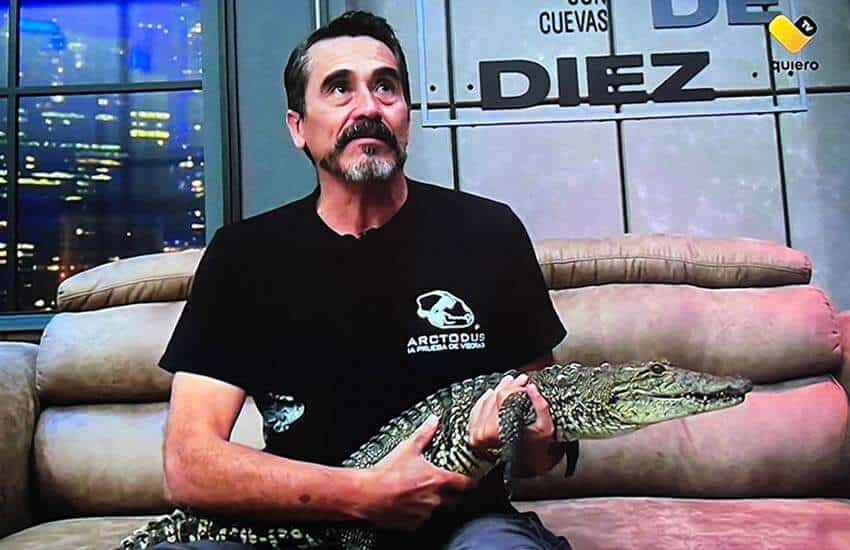
Biologist Paulino Ponce is an independent researcher specializing in crocodiles and human-croc conflicts. A graduate of the University of Guadalajara, he currently heads up a task force dedicated to the tricky business of finding and relocating misplaced crocodiles in Mexico’s biggest inland body of water, Lake Chapala.

“How did you get interested in crocodiles?” I asked Ponce.

Bueno, I’ve always been fascinated by reptiles,” he replied. “When I was five years old, my father took us to a turtle sanctuary, and from then on, I was hooked! I loved reptiles of all kinds, but — you may not believe it — when I grew up, I started out studying music at Guadalajara’s Instituto Cabañas. Yes, I love music, sports and reptiles!”

Paulino Ponce
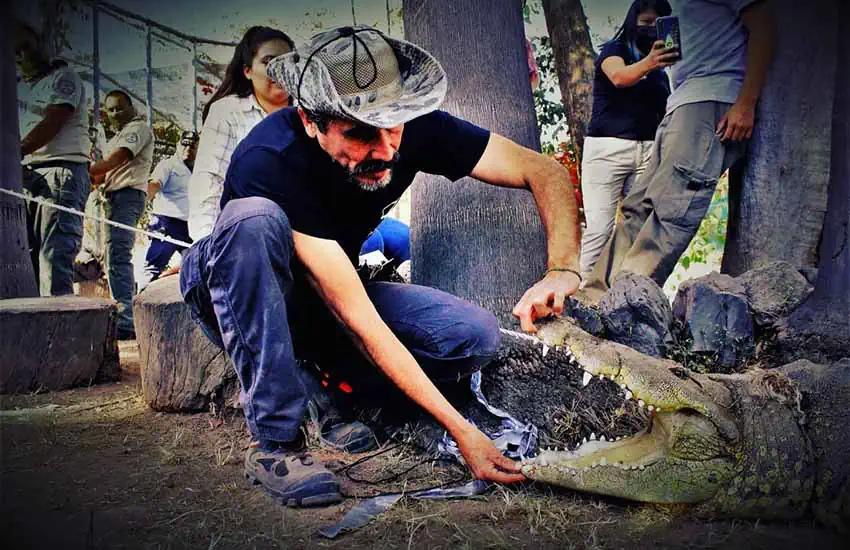
Ponce also teaches about crocodiles. Here he shows how to open a crocodile’s mouth at Villa Fantasia park in Zapopan, Jalisco.Paulino Ponce

Eventually, it seems the reptiles won out, and Ponce ended up at the Herpetarium of the Guadalajara Zoo.

“Here I worked with some of the most poisonous snakes in the world,” he said. “I really enjoyed this, but eventually it came time to do my thesis, and I wanted to write something really useful that would benefit whatever species I was studying — and also benefit the environment. So I picked Crocodylus acutus, which at that time was red-listed as being endangered.”

This led Ponce to the Los Tuxtlas Tropical Biological Station in Los Tuxtlas, Veracruz.

“Here,” he said, “I took a crocodilian training course with herpetologist Dr. [Gustavo] Casas Andreu of the National Autonomous University of Mexico. At night, people would say, ‘Come on, Paulino, let’s go have a beer!’ but I was so fascinated by what I was learning that all I wanted to do was read more about crocodiles!

“Then we went out to do fieldwork at a farm in Laguna Catemaco, also in Veracruz, and one of the course professors was Gonzalo Pérez-Higareda, a real expert in crocodiles. So there he was, demonstrating the problems and techniques for capturing a croc, and when he finished, he held up a rope and he says, ‘Okay, who wants to go out and catch one right now?’

“Well, I jumped right up and grabbed the rope and said, ‘Me! Me!’ And then there was this total silence in the room. Nobody else said a thing. It was a course all about crocodiles, but nobody else volunteered!”

crocodile in Jalisco, Mexico
A croc found in Jalisco’s Primavera Forest, packaged and ready to be received at an animal refuge center. Karina Aguilar

I asked Ponce about the problem of crocodile attacks in Mexico.

“In 1993, the Mexican government organized a meeting about crocodile attacks that were taking place in Puerto Vallarta, where a child had supposedly died,” Ponce explained.

“After that,” he said, “there were meetings and meetings and meetings about crocodile problems, and over and over I would get up and say, ‘What in the world are we doing? While we’re sitting around here, a crocodile could be eating someone! Let’s go take care of the problem!'”

From that time on, Ponce began to take a personal hand in dealing with Jalisco’s crocodile situation.

One example took place in 1996, when a crocodile three meters long attacked a six-year-old girl in Puerto Vallarta. In this case, two crocs were captured and released elsewhere. In another case, a 4.68-meter croc killed a five-year-old boy in the estuary of the Tomatlán River in Jalisco. The culprit was captured and sent to an enclosure. And then there is the story of the crocodile discovered in 2009 in Bosque la Primavera, the huge forest located just west of Guadalajara. Crocs, of course, are not endemic to this forest, but there it was, swimming around in a pond known as El Carrizo.

Crocodile patrol on Lake Chapala, Mexico
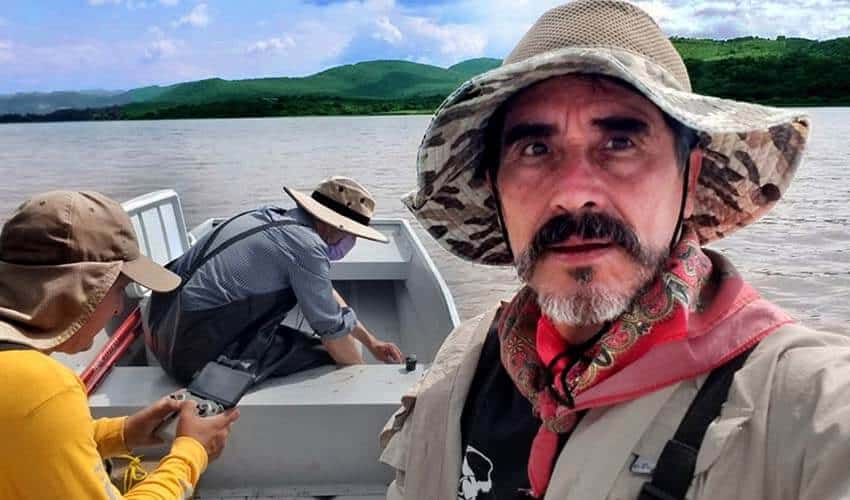
The Lake Chapala Crocodile Patrol prepares to tour the lake. Paulino Ponce

On April 28, 2009, Ponce led a team of volunteer crocodile wranglers there for nighttime crocodile hunting.

At first, they simply watched the crocodile, observing its movements and favorite haunts. The reptile appeared nearly two meters long and had probably been feeding on turtles and tilapia for some time.

United States Peace Corps volunteer Marc Trinks was a member of the team, and he describes the first night they floated into the middle of the pond to confront the crocodile:

“We had a long pole with a noose at the end. Paulino was in the front of the boat, and I was in the back, navigating. We tried to approach the croc fast, kill the motor and coast up to him so Paulino could get him around the neck with the noose. We tried that three times that night until he got scared and wouldn’t let us get close to him anymore.

“And then, the second night, we tried the same thing a few times, and the croc went back in the creek where the pond starts. We corralled him there. We used nets to try to catch him. He got tangled up in one of them, but when we moved in close to grab him, he swam under the nets and escaped. So that was night two lost.”

The crocodile hunters, however, were not discouraged. The following morning, they were back in the pond, laying out snare traps baited with pieces of fresh fish.

Morelet's crocodile in Jalisco, Mexico
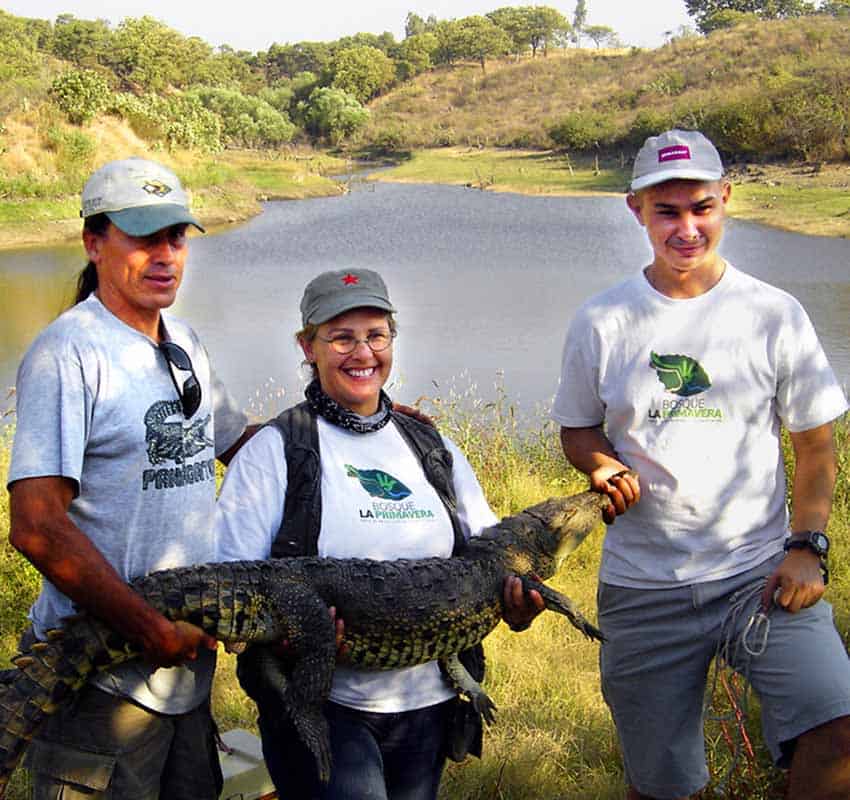
Ponce’s team with a Morelet’s crocodile captured at Lake Chapala and returned to its native habitat on the Pacific Coast. Karina Aguilar

Crocodiles trip these snares when they eat the bait and pull on it, causing the snare to close around the animal’s neck or body.

“On day three, at 2:40 in the afternoon,” Trinks said, “the croc fell into the trap and we got him.”

The crocodile turned out to be 1.74 meters long and “in good shape but a bit thin, possibly due to a scarcity of food in the area,” Trinks said.

Team member Karina Aguilar lamented the fact that the croc had apparently been placed there deliberately by “someone ignorant of how much damage such an action could cause not only to the animal but also to the equilibrium of the local ecosystem.”

Ponce took a sample of the crocodile’s DNA for his biogenetic database, and the Primavera croc was eventually returned to its natural habitat on the Pacific coast.

In Lake Chapala, much like in Bosque la Primavera, it was believed that there were no crocs, but that turned out not to be true.

herpetologist Paulino Ponce of Jalisco Mexico
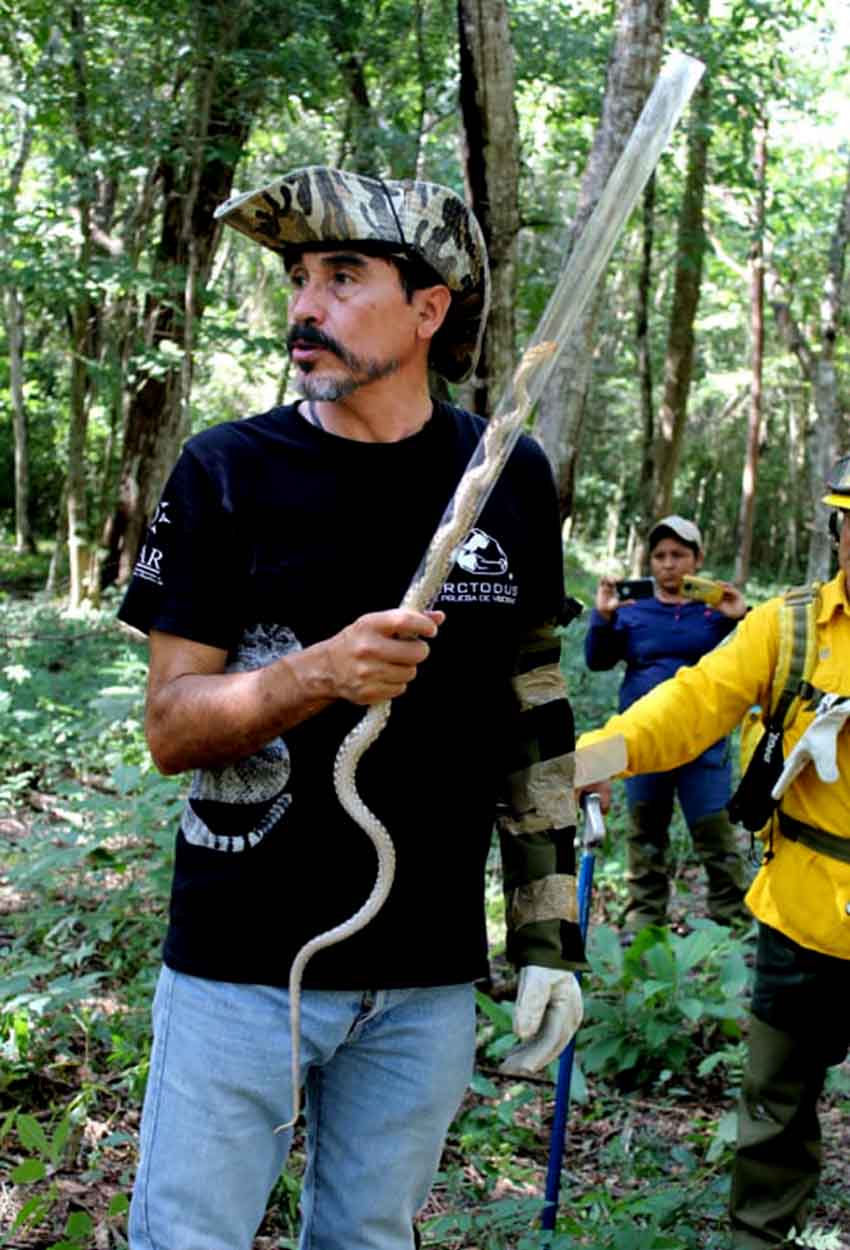
Teaching about poisonous snakes in Campeche: Ponce safely incapacitates a deadly Nauyaca viper using a hollow tube.

“For years, I kept hearing rumors that people had seen crocodiles in the lake,” Ponce told me. Then, in 2011, they invited animal rescuer Andrés González and me to the town of Tizapán on the south shore of Lake Chapala to get a crocodile that local police had captured.

“To my surprise, I saw that it was a Crocodylus moreletii [Morelet’s crocodile] — a native of the Gulf of Mexico, mind you! To make matters worse, the Tizapán police said there was another one in an arroyo [stream] that they had been unable to capture.”

Why, I asked Ponce, are there crocodiles in Lake Chapala?

“Unfortunately,” he replied, “it was human beings who brought them here. After a lot of digging, I learned that years ago, a number of crocs escaped from a house in Michoacán, all of whom headed straight for the Lerma River [which connects Michoacán and Jalisco and eventually empties into Lake Chapala]. And this, it seems, is how the crocodiles made their way to Lake Chapala.”

Since the 1990s right up to the present, said the biologist, there have been many records of croc sightings around Lake Chapala, enough to merit ongoing patrolling.

Ponce has organized a team to do just this, “but,” he said, “we need to keep replacing our equipment, which wears out or gets damaged. For example, we need snares, lights, gasoline, nets, rope, camera traps, a GoPro [a small portable camera]. Our boat is for estuaries, but now we need a bigger one for moving around on the lake.”

Paulino Ponce, crocodile expert from Mexico
Ponce introduces a Morelet’s crocodile to a TV audience.

Funding is the team’s biggest problem, and Ponce is looking for support from lakeside organizations.

“We need to monitor the whole lake,” he said. “Crocs keep turning up everywhere. We have registers from sites all around the lake, from Ajijic, Jocotepec, San Pedro, Jamay … and some of them measure more than three meters!” Lake Chapala is about 80 kilometers long and 20 kilometers wide.

“There are all kinds of places where aquatic plants abound and crocodiles can hide,” Ponce said. “Although there are few chances to be caught by a croc, I recommend caution. People should especially be watchful of their children and their pets. All of them are ‘bite size’ as far as crocodiles are concerned. We know that a crocodile can surprise and catch a fast animal like a cheetah, so one must be alert along the lakeshore. Sometimes a crocodile does grab an adult, a drunk, for example.”

“Once upon a time, more than 70% of the people bitten by crocs in Mexico were fishermen,” he said. “But these days, tourists are gaining on [them], not only at the lake but also in Cancún, Vallarta and Manzanillo.”

To report a croc sighting on Lake Chapala (in English or Spanish), call Paulino Ponce at his WhatsApp phone number: 331-574-9417. You can also send a message to poncecp@hotmail.com. Note the location and time of your sighting and the approximate size of the crocodile, and take photos or videos if possible.

And, if you have the financial means, consider lending the team a hand.

The writer has lived near Guadalajara, Jalisco, since 1985. His most recent book is Outdoors in Western Mexico, Volume Three. More of his writing can be found on his blog.

Target of AMLO’s wrath has reduced investment by US $200 million

0
Like some other private energy companies, Iberdrola has struggled to get necessary permits approved.

Spanish energy company Iberdrola’s investment in Mexico fell to just US $16.1 million in the first quarter of 2022, a 93% decline compared to five years ago and a 60% drop in the space of a year.

The company – which President López Obrador holds up as an example of what he calls unscrupulous foreign firms that have “looted” the country – has cut its investment in the first quarter of every year since the president, a staunch energy nationalist, took office.

Iberdrola, which entered the Mexican market over 20 years ago and has numerous combined cycle power plants here as well as wind and solar farms, invested $222.3 million in Mexico in the first quarter of 2017.

Investment declined 4% to $212.6 million in the first quarter of 2018 before plummeting 62% in the space of a year to just $79.9 million in the first three months of 2019. López Obrador, who has made strengthening state-owned energy companies a central aim of his administration, was sworn in as president on December 1, 2018.

Iberdrola’s investment continued to decline in the first quarters of 2020 and 2021, dropping from $40.7 million in the first three months of last year to just above $16 million last quarter. The figure represents just 0.7% of the company’s global investment in the first quarter of 2022, which totaled $2.35 billion.

Five years ago, in the first quarter of 2017, Iberdrola allocated 20.4% of its global investment to energy projects in Mexico. The president at the time was Enrique Peña Nieto, whose energy reform opened up the sector to foreign and private companies.

In late 2020, Iberdrola threatened to stop investing in Mexico altogether due to a lack of clarity about how the government would treat foreign companies. CEO Ignacio Galán said during a presentation of Iberdrola’s latest financial results that the company didn’t expect to invest heavily in Mexico in the near future.

López Obrador’s proposed electricity reform, which would have guaranteed the state-owned Federal Electricity Commission over half the power market, failed to pass the lower house of Congress earlier this month, allowing foreign and private companies to breathe a sigh of relief, but the federal government has other ways it can make life difficult for non-state actors in the energy sector.

One tactic it has used to hinder private companies is to reject or delay the permits they need to operate without encumbrance in Mexico’s energy sector.

Since March 2021, the Energy Regulatory Commission (CRE) has rejected at least 10 requests made by Iberdrola to modify or renew permits, the newspaper Reforma reported.

Beatriz Marcelino Estrada, president of the Association of Energy Distributors and Dealers, said last month that more than 600 energy sector permit applications submitted to the CRE, the Energy Ministry and the Agency for Safety, Energy and the Environment were stalled. She said the delays were affecting investments worth approximately 18 billion pesos (US $882 million).

Iberdrola’s power plant in the Nuevo León municipality of Pesquería is one of the affected projects. The plant has been unable to operate for almost three months because the CRE refused to modify one of its permits.

Iberdrola, which has a presence in 15 states, is one of the largest private energy companies in the Mexican market. According to the Iberdrola México website, the company generated 16% of the country’s electricity in 2019.

If the government has its way, that figure won’t be going any higher.

With reports from Reforma 

US Embassy issues security alert for Puerto Vallarta, Guadalajara

0
El Chopa was killed in a gun fight last week.
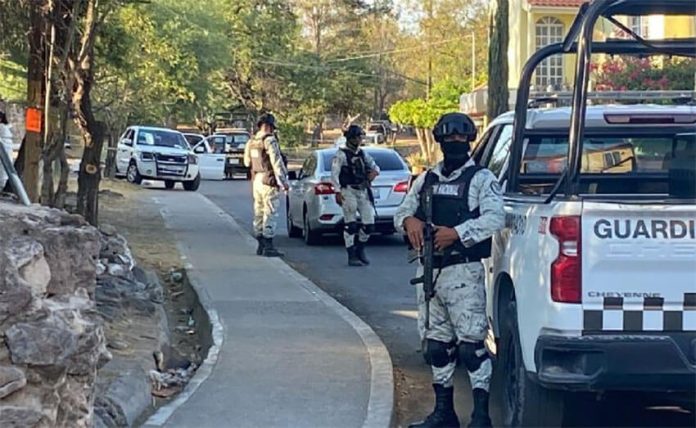
More security forces were sent to Puerto Vallarta after El Chopa was killed in a gun fight last week.

The U.S. Embassy has issued a security alert for its citizens in Puerto Vallarta and Guadalajara after an increase in the presence of federal security forces.

“There is increased presence of Mexican security forces in the Puerto Vallarta area and the potential for confrontations between criminal groups and security forces in the Puerto Vallarta area and in the Guadalajara metropolitan area,” the Thursday alert read.

The warning also applies to Nuevo Nayarit, Nayarit, but did not specify which events triggered the alert in that area.

The warning comes after a confrontation between cartel members and government forces in Puerto Vallarta on April 22 killed an alleged high-level member of the Jalisco New Generation Cartel (CJNG), leading to the deployment of 400 soldiers to the port city. Saúl Alejandro N., known as El Chopa, died from a gunshot wound after being arrested in the death of former Jalisco governor Aristóteles Sandoval in 2020.

Then this week, two off-duty members of the military were kidnapped by members of a CJNG cell before being released Thursday afternoon, according to the Defense Ministry.

The previous alert, issued April 18, instructed citizens to avoid traveling to Zacatecas due to “violent turf battles between cartels.”

With reports from El Universal

National Guardsman in custody for killing student in Guanajuato

0
The students were traveling in a white pickup truck, center left, when the guardsmen began to shoot.
The students were traveling in a white pickup truck, left, when the guardsmen began to shoot.

A member of the National Guard (GN) who shot and killed a student in Irapuato, Guanajuato, on Wednesday has been arrested.

The Guanajuato Attorney General’s Office announced on Twitter Thursday that the guardsman, who also wounded another student, was in custody. It indicated that the next steps in the case against him will be determined within 48 hours.

According to a statement issued by the National Guard, its personnel were carrying out an anti-fuel theft patrol in the municipality of Irapuato when they came across two vehicles parked on a dirt road near Pemex’s Salamanca-León petroleum pipeline.

The GN said the occupants of the vehicles left the area “hastily” when they became aware of the guardsmen’s presence.

Their quick escape “caused confusion and uncertainty among the members of this police institute,” the statement said.

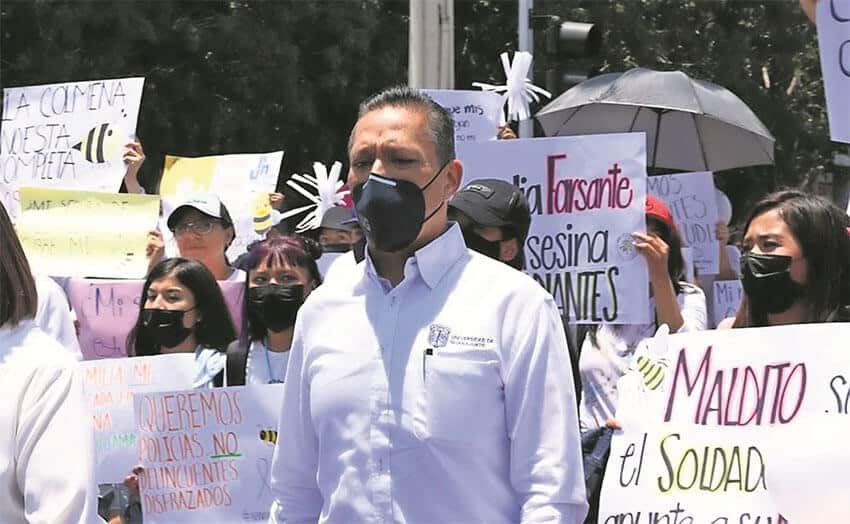
Guanajuato University Rector Luis Felipe Guerrero Agripino attended a student protest on Thursday.

“As a result, a member of the National Guard got out of the vehicle in which he was traveling and unilaterally fired his weapon at the pickup trucks that were leaving,” the GN said, adding that one person was killed and another was injured.

Ángel Yael Ignacio Rangel, a 19-year-old agronomy student at the Irapuato campus of the University of Guanajuato (UG), was shot in the head and died from his injuries. Edith Alejandra Carillo Franco, a 22-year-old UG agronomy student, was shot in the shoulder and later taken to hospital for treatment. She was reported in stable condition. A third student who was driving the vehicle that came under fire was uninjured.

According to a report by the news website La Silla Rota, the students were attacked shortly after leaving a lunch event. The location where they came under fire is very close to the university campus they attend.

Guanajuato Governor Diego Sinhue Rodríguez condemned the attack and rejected any suggestion they had done something wrong. “They weren’t in the wrong place, they were studying,” he said. Given that similar incidents involving the GN have occurred in other states, the security force – which was created by the current federal government – needs to review its protocols, the governor said.

UG students held a protest on Thursday to demand justice for the unprovoked attack. They paid tribute to their deceased classmate with applause and cheers and honored his life with a minute’s silence.

Guanajuato University Rector Luis Felipe Guerrero Agripino added his voice to the protest, calling the attack on the students a “homicidal act” that affects the entire university community and society more broadly. He also said that the National Human Rights Commission, as well as state authorities, should investigate the case.

With reports from El Universal and La Silla Rota

Millions of dollars’ worth of COVID vaccine set to expire on Saturday

0
The campaign to administer the soon-to-expire shots began in mid-April.

Over 1 million of Mexico’s COVID-19 vaccine doses are set to expire Saturday, leaving authorities racing against the clock to administer shots.

State authorities began large-scale campaigns in the middle of April to administer some 3.7 million AstraZeneca COVID-19 vaccines before they expire at the end of the month. Second booster shots are available in many states, although only just over half of adults have had a first booster.

According to a report published Friday by the newspaper Milenio, Tamaulipas has some 500,000 unused shots, Tlaxcala has 200,000, Querétaro has 30,000 and the State Workers Social Security Institute (ISSSTE) – a major health care provider with hospitals across the country – has over 400,000.

Among the other states that have unused shots that are set to expire on Saturday is Puebla. Governor Miguel Barbosa confirmed that the state has unused doses of both the AstraZeneca and Pfizer vaccines, but didn’t reveal how many.

Given that the federal government likely paid at least a few dollars per dose – contracts with pharmaceutical companies haven’t been made public – shots worth millions of dollars will go to waste if they are not administered before Sunday.

The federal government allocated almost US $1.7 billion to buy a range of COVID-19 vaccines including AstraZeneca, Pfizer, CanSino, SinoVac and Sputnik V shots. It also received millions of shots from the United States government under a loan scheme.

About two-thirds of Mexico’s approximately 126 million citizens has received at least one shot, according to The New York Times vaccinations tracker. That figure should increase in the coming weeks as shots are made available for the first time to children aged 12 to 14 without existing health problems.

With reports from Milenio

Complaints reveal corruption in government’s youth employment program

0
Youths Building the Future or Jovenes Construyendo el Futuro in Spanish (JCF), "seeks to benefit 2.3 million youth" through government-paid apprenticeships, according to the website of the presidency.
Youths Building the Future or Jóvenes Construyendo el Futuro in Spanish, seeks to benefit 2.3 million youths through government-paid apprenticeships.

The rules governing the federal government’s youth employment program have been violated in a variety of ways, a new analysis has found, with unscrupulous individuals using the scheme for personal gain or the benefit of people and causes close to them.

The newspaper El Universal analyzed 155 citizens’ complaints about the Youths Building the Future (JCF) apprenticeship scheme, which currently pays young people a monthly stipend of 5,258 pesos (about US $260) while they complete a one-year apprenticeship with an approved employer, who also receives a government payment.

El Universal, which obtained copies of complaints from the Ministry of Public Administration (SFP) via a freedom of information request, detected at least five ways in which the program’s rules were violated in 2019 and 2020.

Forty-three complaints, or just over a quarter of those analyzed, were made about intermediaries who helped young people enroll in the JCF scheme in exchange for part of their monthly payment.

Apprentices were asked to pay between 800 and 2,500 pesos per month to “agents” who facilitated the online registration process. The latter figure represents almost 70% of the monthly stipend paid to program participants in 2019. Bank cards corresponding to accounts into which the payments were made were held in many cases by the agents.

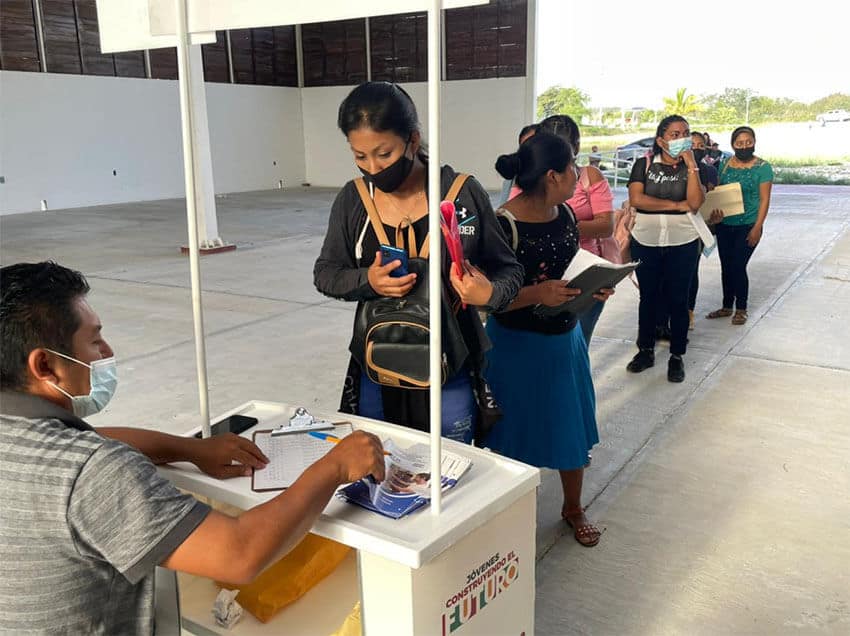
"Mobile offices," like this one in Campeche, are designed to help youth and businesses who want to participate in the program begin the application process.
“Mobile offices” like this one in Campeche are designed to help youths and businesses who want to participate in the program begin the application process. Facebook, Jóvenes Construyendo el Futuro

El Universal said that one complaint made in 2020 described the operation of an alleged corruption network whose raison d’être was to milk the apprentices’ money. Similar networks were described in other complaints, it said, adding that companies and government officials were also involved.

“There is a leader who organizes people [in each network]. They find small [business] owners who lend themselves to the scheme. … They then find scholarship holders [apprentices] to register them in the [JCF] system. … The leader keeps the [bank] cards and when the … [monthly payment] comes he distributes the money between the young people, the [business] owners and an official who lends himself to this scheme,” one complaint said.

Another complaint said that a political group created a phony company and registered it as a JCF work center. Twenty young people were registered as apprentices and each agreed to give 2,600 pesos per month to the group. The young people weren’t actually required to work or complete any training, according to the complaint. The money the political group received was allegedly used to fund a municipal-level political campaign.

Eight other complaints said the apprenticeship program had been misused to benefit political causes.

Another way in which the rules were violated was through identity theft. In one case outlined in a complaint, the victim was the owner of a dog-grooming business.

The owner said she received a WhatsApp message in late 2019 from a person who purported to be a servant of the nation, as some low-ranking, on-the-ground federal officials are called. The message said the dog-grooming business would be removed from the JCF program unless the owner provided the details she used to register it in the scheme as well as her RFC tax number. It called for an “URGENT RESPONSE.”

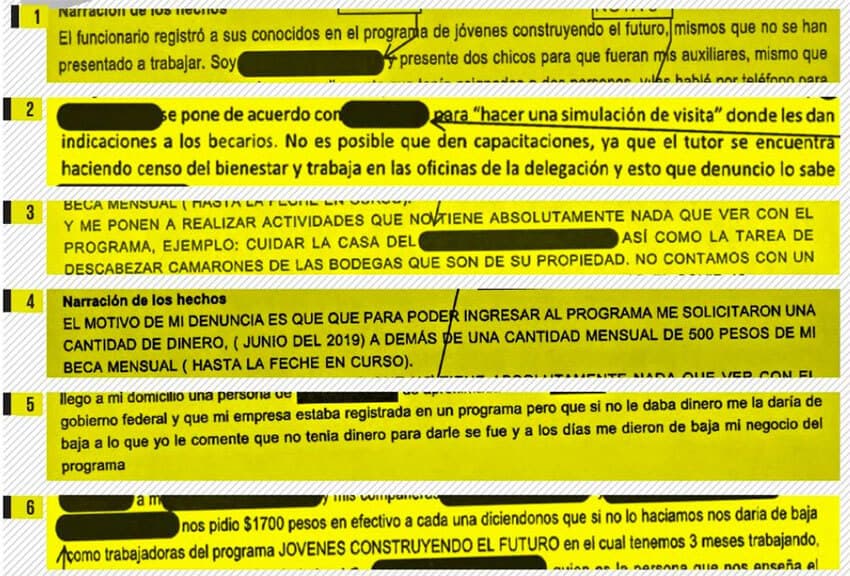
Redacted complaints about the JFC program, which <i>El Universal</i> obtained through a government transparecy request.
Redacted complaints about the JFC program, which El Universal obtained through a government transparency request. Twitter @silbermeza

The owner, whose business had been training two apprentices for four months, provided the information requested. A couple of weeks later she tried to log into the JCF platform but was unable to do so because her user name and password had been changed. She later recovered her account and discovered that her personal details had been changed and her dog-grooming business had been turned into a graphic design agency with 75 JCF apprentices.

“There is a different company registered in the program with my RFC,” she said, complaining that her personal details had been improperly used to facilitate an “improper exercise of public resources” –  in other words, corruption.

El Universal said there were 15 other cases among the 155 complaints that involved identity theft, threats and harassment. The perpetrators in some cases were purportedly servants of the nation or Labor Ministry officials.

“A representative of the program showed up in my business,” one complaint said. “He asked me, ‘How many young people do you have?’ I told him three [and] he said I needed to give him 1,000 pesos for each one or he would de-register me. I didn’t take it seriously but I received an email today saying that my company had been de-registered. I don’t know what to do, I hope you can help me.”

Some young people were registered in the apprenticeship scheme without their knowledge or consent, and didn’t receive the monthly payments that the government made to accounts apparently opened in their names.

A Guanajuato university student was contacted by people who purported to be from a civil society association. They said he was eligible for a 1,000-peso monthly payment to cover his travel costs to university. He consequently provided the people with his personal details including his CURP identity number. The student later grew suspicious about the offer and decided to turn it down before he received a payment.

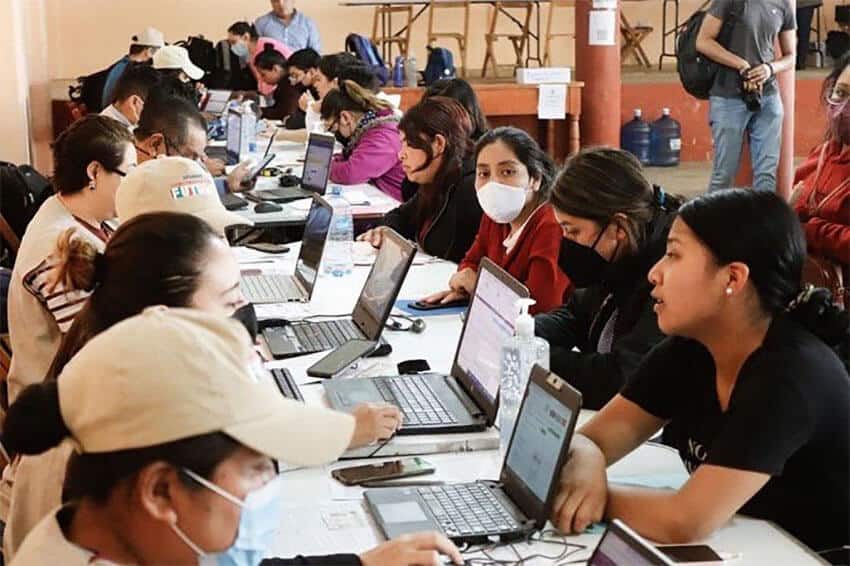
Government workers help youth in San Cristóbal de Las Casas, Chiapas, sign up for the JFC program.
Government workers help youths in San Cristóbal de Las Casas, Chiapas, sign up for the JFC program. Twitter @GuillermoSRguez

While completing paperwork at the Mexican Social Security Institute at a later date, he discovered he had been enrolled in the JCF scheme for three months even though, as a student, he didn’t qualify.

“I looked up JCF information on the internet and tried to register but I saw a caption that said I was already registered. I didn’t know I was a beneficiary and I haven’t received any benefit,” he told El Universal, which corroborated information in the complaints through interviews.

El Universal said that 25 of the complaints it reviewed said the JCF scheme had been used to benefit family and friends of government officials. There is plenty of scope for corruption given the size of its budget and the number of young people registered in it. The program’s 2022 budget is 21 billion pesos (just over US $1 billion) and it’s estimated that there are over 400,000 beneficiaries.

The complaints analyzed by El Universal were first made to a range of authorities before being passed on to the SFP. Some 60% were submitted via a federal government anti-corruption platform, while others were sent to President López Obrador’s office and the National Human Rights Commission. Some people even called 911 to report irregularities in the program.

The complaints the newspaper reviewed were redacted by the SFP – the government’s internal corruption watchdog – meaning that the names of people who allegedly committed the illegal acts and the locations where the wrongdoings occurred were not visible.

The Labor Ministry, which manages the apprenticeship scheme, didn’t respond to El Universal‘s request for comment on the alleged corruption, while the SFP said it is investigating over 160 cases of violations of the program’s rules. However, the ministry also said it doesn’t have the authority to take action against people who are not public servants.

Mexicans Against Corruption and Impunity (MCCI), a non-governmental organization, and the newspaper Reforma have previously reported that the JCF program is sullied by corruption.

Reforma reported last year that the scheme was used to divert large amounts of public money in the Nuevo León municipality of Linares and the metropolitan area of Monterrey, while MCCI said in a 2019 report that it had detected the probable existence of “phantom” work centers and discrepancies between the number of persons enrolled in the employment scheme and the number who are actually undertaking training.

With reports from El Universal 

JFK, the American School of Querétaro: where passionate teachers shine

0

I first arrived to Querétaro, Mexico, in 1990 from London, England. Though Querétaro is now one of the fastest-growing and modern cities in the country, at the time it was still a quite a small state capital. I initially worked in some other schools, but after a few yearsand on the recommendation of some friends, I applied for a job at the local American school, John. F. Kennedy, and was hired to teach Ecology and Geography in the high school section.

From the beginning, I could tell something was different about this place. While I’d found other private schools I taught at in the area to focus extensively on earnings and customer-satisfaction, JFK kept its focus squarely on the children: their learning and development were clearly the most important outcomes.

My colleagues’ enthusiasm for building a strong school full of happy children was clear, and I was delighted to have been accepted as part of the team. At JFK, I found the perfect balance between the ability to use my creativity in the classroom and a well-balanced, structured curriculum. While permitting teachers to “do their own thing” in the classroom always seems like a good idea and is quite popular, without a solid framework based on researched best practices, the enthusiasm and popularity of it doesn’t usually result in great academic improvement. 

JFK had clearly struck the right balance, and the success of many of our students – among them, doctors, engineers, scientists, artists, athletes, politicians, architects, and many other professionals – is a testament to our success as educators.

At JFK, I grew professionally and was honored to be a part of a community that truly cared about education. I also got to work on a beautiful open and green campus with well-behaved, respectful students and a supportive staff. The community was both supportive and international with a good mix of staff and students from both the Americas as well as other countries around the world. Our cultural differences enriched us, and I have been enjoying that companionship ever since.

That was 22 years ago, and I’ve never looked back. Now the director, I am prouder and more enthusiastic than ever about the quality of our school. JFK has grown significantly since then and is now one of the most prestigious K-12 schools in the country.

What makes JFK so special? We are an IB (International Baccalaureate) School that provides high-quality instruction from K1 to Grade 12. We are also fully bilingual and truly international (24% of our students are from outside of Mexico), well–known among schools in Mexico as the best of the best. We are dedicated to helping newly-arrived international students with special programs like “School Within a School” that help them to quickly reach the levels of English and Spanish as their peers.

To accomplish all of this, we have a unique mix of local and foreign teachers, exposing students to a myriad of ideas and ways of seeing the world and their place in it. We challenge our staff to truly the embody the adage to think global and act locally to make a positive impact on our students and our communities.

That’s the reason foreign teachers – like me – have always had a special place at JFK. As the school has grown, so has our international teaching staff. To ensure that we are able to continue attracting the best teachers, we offer housing and utilities, a travel allowance, worldwide health and life insurance, immigration, and professional development and support in addition to their regular full-time salaries.

Generations of teachers have now taught at JFK while exploring Querétaro, a fascinating combination of Mexican tradition and modern city in which you can walk in the colonial downtown to witness centuries-old traditions and nightly cumbias before taking an Uber to pop into Costco, as well as its surroundings.

Among those surroundings are San Miguel de Allende with its American Expat community, artisans and great restaurants, Tequisquiapan with its local crafts and leisurely strolls, and Bernal with its 3rd largest granite monolith in the world. México City, south of Querétaro, offers a quite long list of shopping, museums, art exhibitions, and theatre productions. To the north is the Sierra Gorda, a magical mountain range that starts in Texas and ends in southern Mexico and offers unique camping spots, beautiful lakes, and breathtaking waterfalls.

Some teachers have fallen so much in love that they’ve become locals themselves (like me!), sending their children to our school to give them the opportunity to discover and achieve the extraordinary through a world-class international education.

The mission of our school? To lead, serve and create beauty. If you would like to do us the honor of helping to carry that mission out, we would love to hear from you; please contact Dulce Rojas at drojas@jfk.edu.mx.

Adrian Leece is general director of John F. Kennedy, the American School of Quéretaro.

Mazatlán: a breakfast lover’s paradise

0
Allegro Caffe Mazatlan
Yum! Eggs Benedict at Allegro Caffe.

Breakfast has become a “thing” here in Mazatlán’s historic center.

Whereas just a few years ago, there were maybe a handful of places to go for desayuno, now there are many, many more: the other day I counted 30 within walking distance of my apartment.

Since I’m one of those people who likes — i.e., loves — to go out for breakfast, I’m reveling in this abundance. Whether I want a hearty taco or omelet de camarón (shrimp omelet), classic chilaquiles or apple-cinnamon crepes, a full English breakfast or just bacon and eggs, all can be easily and affordably found.

Mazatlán’s centro historico is a busy combination of bustling city offices, shops and businesses, the big Mercado Pino Suárez, the Catedral Basílica, a handful of plazas and parks and Olas Altas, an oceanfront neighborhood bookended by two hills. Somehow, it’s noisy and peaceful and beautiful all at the same time.

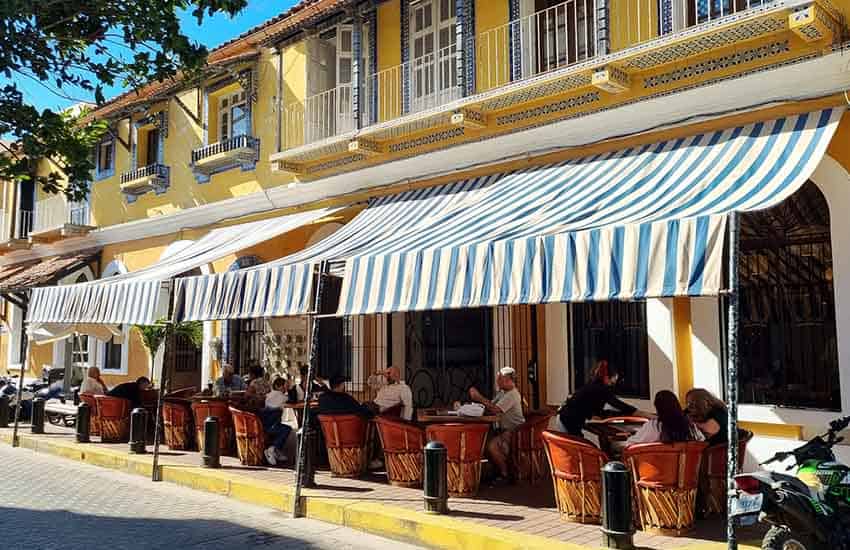
The Plaza Machado — arguably the most charming of the plazas — is surrounded by restaurants and cafés, and the streets radiating out in every direction have filled with all sorts of charming eateries, many in restored colonial houses. If you’re visiting, start there and wander till you find a place that strikes your fancy.

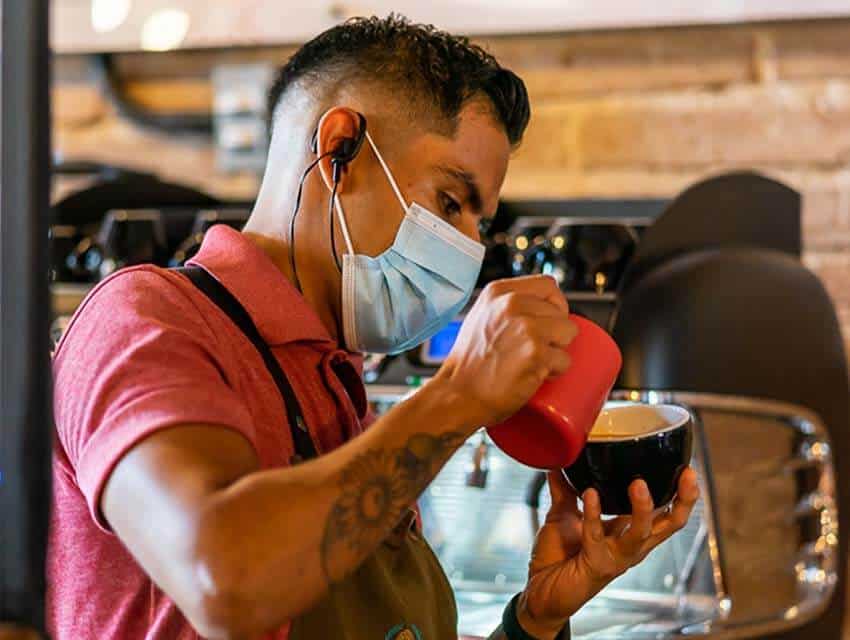
Cafferium in Mazatlan
A barista carefully pours a customer’s beverage at the modernist Cafferium.

A few tips: weekends, especially Sunday mornings, can be crowded. Best to go on a non-holiday weekday if you can or ask if they take reservations. Also, restaurants (particularly since COVID) are notorious for sudden changes of hours and days of operation. To avoid disappointment, always check in person or by phone. Facebook pages and websites can’t always be counted on to have current information.

Everyone has their own druthers, and my favorites may not be yours. Not to worry! There are so many breakfast options in Mazatlan’s center, you’ll surely be able to satisfy whatever your cravings are.

Here are a handful of the places I frequent the most, a few category winners and a list of what’s around. As we say in Mexico: provecho!

Via Condotti, named after Rome’s most busy, fashionable street, is a satellite of the super-popular Hector’s Bistro next door. European-style breakfasts include the chef’s house-baked breads, bagels and pastries while traditional Mexican dishes include classics like enmoladas — chicken-filled enchiladas bathed in a spicy mole sauce. The coffee alone brings me back, day after day, and even a lowly bowl of oatmeal is somehow decadent here.

Allegro has been my go-to favorite for years: consistently delicious and well-made food, reasonable prices, attentive waitstaff and really good coffee. Standouts: Eggs Benedict (traditional or vegetarian), apple pie and the Gringo Waffle. They also serve half-orders of some menu items, a boon for small eaters like me.

Minchopi / Taquiza del Cheff / La Chilanga: want tacos for breakfast? Maybe a tlayuda, gordita or quesobirria? Head to any of these three eateries and settle in for a good meal. A little off the beaten path, they’re worth finding.

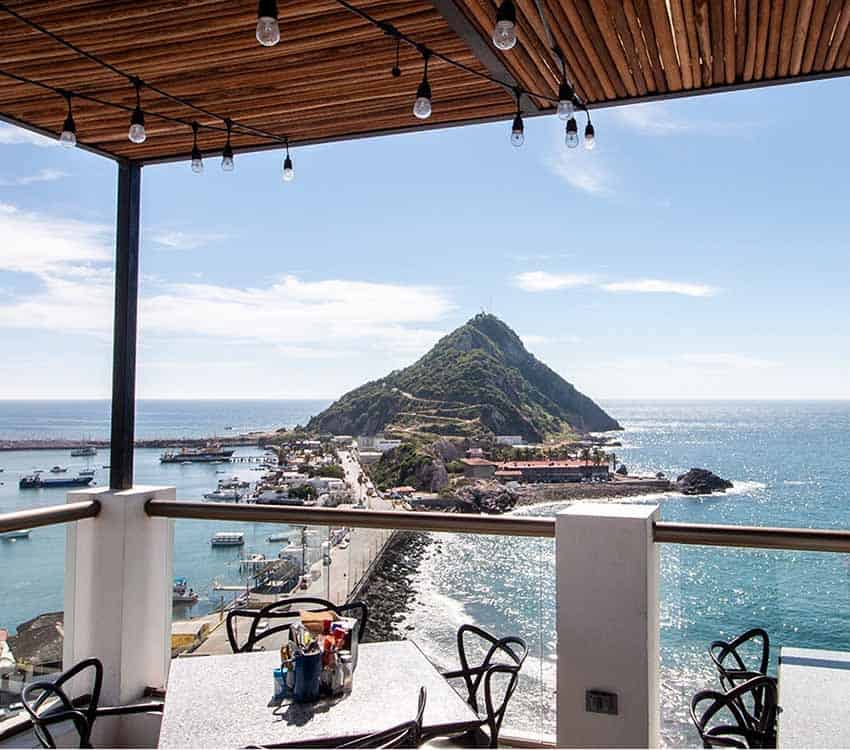
La Marea restaurant in Mazatlan
One of the joys of Mazatlán being a port city is breakfasting with a view like this.

La Chilanga has the biggest menu, with a smorgasbord of regional dishes. Taquiza del Cheff woos with handmade corn tortillas and a dozen or more taco fillings (including some vegetarian ones). Minchopi’s tacos (Wednesdays offers 3 for 2 prices) and chilaquiles will keep you coming back for more. All get big props for consistency in ingredients, spotless kitchen and dining areas and more-than-reasonable prices. Tip: you might want to bring your own coffee unless you’re OK with Nescafé.

Casa Hindie Mazatlán, a relative newcomer, is a tea house by name but in reality so much more. Yes, there are umpteen types of unusual, imported teas and accoutrements, but breakfasts — served all day — are wonderful here (as is the coffee). A nice menu of breakfast classics offers some surprises too: matcha drinks, nonalcoholic tea cocktails, chai pancakes and avocado toast. My favorite is the huevos a la cazuela, two eggs atop refried beans, bacon and crispy tortilla strips, swimming in a warm guajillo sauce that’s so irresistible, I’m always tempted to lick the bowl.

La Marea, perched on the top of Lookout Hill, overlooking Centro, Stone Island and the glittering Pacific, offers elegant dining with to-die-for views. While you don’t have to dress up, you do need more than your swimsuit. French toast, egg dishes and traditional Mexican favorites, plus espresso drinks and a full bar (ahem) when a little hair o’ the dog is what’s needed.

On any given morning, the Plaza Machado — the center’s main square — is quiet and peaceful. Palm trees sway in the breeze, and the only sound is the shush-shush of sweepers cleaning the cobblestones from the revelry of the night before.

Raices de Mar, tucked under a tree in the center of the shady Machado, is a lovely place to sit. It offers a big, well-executed menu of regional dishes that includes barbacoa, shrimp tlayudas and smoked marlin tacos. The beautifully restored building is also a small boutique hotel.

Finally, in addition to the above, some recommendations for specific cravings:

Via Condotti mazatlan
European- and Mexican-style breakfasts, plus a full line of artisan breads make Via Condotti hard to resist.

Great coffee: Via Condotti, Rico’s, Looney Bean, La Olivia, Allegro, Casa Hindie

Authentic Mexican traditional: La Chilanga, La Fonda Chalio, Totem, Taquiza del Cheff, Casa Mayora, Minchopi, Panamá

Unique menu offerings: La Olivia, Casa Hindie, La Antigua (crepes, crepes, crepes), La Chilanga, Euro Bakery (THE BEST croissants), Totem

Ambiance: Raíces (Plaza Machado), Totem (rooftop), Casa Hindie (minimalist elegance), La Olivia (Old World elegance), Esinti (rooftop), La Marea (ocean views), Casa Lucilla (almost oceanfront), Cafferium (modernist)

Those are just the highlights. In alphabetical order, here’s a more complete list of options for breakfast in Mazatlán’s historic center:

  1. Allegro Caffé
  2. Belisario
  3. Cafferium
  4. Casa Amarilla
  5. Casa Hindie
  6. Casa Lucilla
  7. Casa Mayora
  8. Coffee Bean
  9. Dolce Mami
  10. El Portal de San Juan
  11. Esinti
  12. Euro Bakery
  13. Helarte Sano
  14. La Antigua
  15. La Chilanga
  16. La Fonda
  17. La Fonda Chalio
  18. La Marea
  19. La Olivia
  20. Looney Bean
  21. Macaws
  22. Marée Crepe at La Roosevelt
  23. Minchopi
  24. Panamá (2 locations)
  25. Papagayo (in the Hotel Central)
  26. Raices de Mar
  27. Rico’s
  28. Taquiza del Cheff
  29. Totem
  30. Trópico
  31. Upstairs @ the mercado
  32. Via Condotti

Janet Blaser is the author of the best-selling book, Why We Left: An Anthology of American Women Expatsfeatured on CNBC and MarketWatch. She has lived in Mexico since 2006. You can find her on Facebook.

Construction sector faces some steep price increases

0
construction

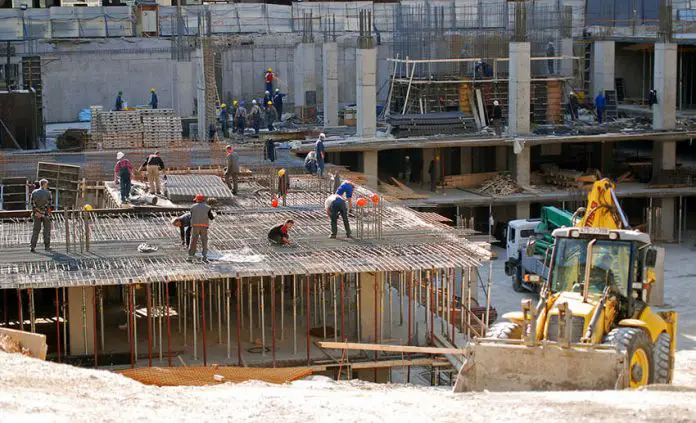
Recent increases in the cost of building materials have caused problems for construction project budgets and affected the recovery of the sector in at least one state.

According to the vice president of the Mexican Chamber of the Construction Industry (CMIC), the cost of building materials such as cement, rebar and steel has increased by 15% to 25% since December.

Quel Galván Pelayo said that budgets formulated last year will be too low in many cases given the increases. That could leave some public and private sector projects short of the resources they need for completion, he said.

“If you drew up a plan without taking the increase into account, you’re going to take a hit this year,” Galván said.

He warned that the war in Ukraine could causes the cost of materials such as steel and rebar to increase even further.

CMIC Tijuana president Jesús Octavio Ruiz Vargas asserted that the cost of materials – up by 17.4% annually in December, according to national statistics agency INEGI – has increased by as much as 100% over the past year.

He told the news website Uniradio Informa that steel had doubled in price over the past 12 months, concrete had risen 40% and wood had increased by 20%. Ruiz also said that the cost of labor had gone up by 20%.

Despite the increased costs, construction in Tijuana hasn’t slowed, he said.

“Medical tourism projects haven’t stopped, vertical housing projects haven’t stopped, … industrial developments and commercial developments haven’t stopped. There is still demand in Tijuana despite the increase in construction prices,” Ruiz said.

It’s a different story in Puebla, where the recovery of the construction sector from the pandemic-induced downturn has stalled due to the increase in the cost of building materials, according to CMIC Puebla president Héctor Alberto Sánchez Morales.

He said the war between Russia and Ukraine has affected both the availability and cost of materials such as steel, aluminum, paint, glass and cement.

Sánchez said there had been “a little bit of activity” and “a little bit of growth” in the construction sector but the increase in the cost of materials ended the recovery in the first quarter of this year.

The price of many other products has increased in Mexico as higher global demand for goods, ongoing supply chain disruptions, and the war in Ukraine, fuel inflation. Mexico’s annual inflation rate was 7.72% in early April, a 20-year high well above the central bank’s target of 3% give or take a percentage point.

With reports from El Sol de Mazatlán, La Jornada de Oriente and Uniradio Informa