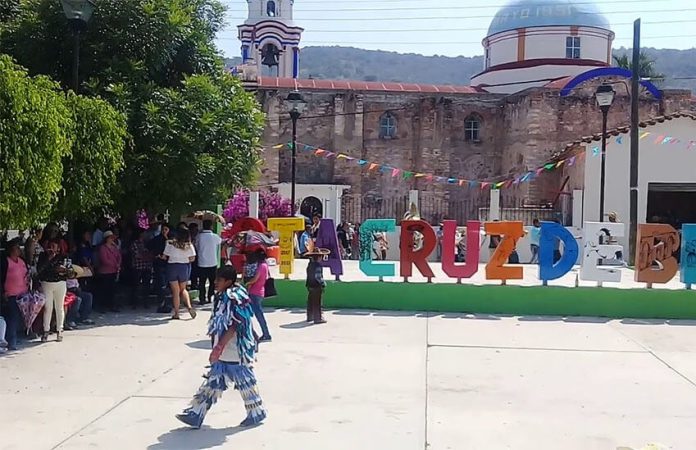
A festival day in Santa Cruz de Bravo, Oaxaca, in 2019. The municipality would go on to be one of few without reported cases of COVID-19.
Mexico has recorded over 5.7 million confirmed coronavirus cases but none has been reported in 30 of Mexico’s almost 2,500 municipalities.
The national social development agency Coneval found that 98.8% of the country’s 2,469 municipalities had recorded at least one COVID case by May 14. That leaves 30 COVID-free municipalities, which Coneval didn’t identify.
Among those identified by Mexico News Daily are San Miguel Piedras, Santa Ana Tavela, San Juan Yatzona, San Bartolomé Yucuañe, San Juan Diuxi and Santa Cruz de Bravo, all of which are in Oaxaca.
Coneval said in a report that the COVID-free municipalities “are located in mountainous regions with low population density” and few paved roads.
Coneval also said that 230 municipalities haven’t recorded a single COVID-19 death. Over 70% of those – 167 – are in Oaxaca while 30 are in Chiapas and nine in Puebla.
That means that 9.3% of the nation’s municipalities haven’t recorded a COVID fatality. Almost 325,000 have been officially recorded in the rest of the country, although that figure is widely accepted to be a significant undercount.
Coneval said the territorial distribution of COVID has been heterogenous due to factors such as the concentration of the population in urban centers, the connectivity of the highway network, people’s mobility and socioeconomic characteristics.
“The dispersion of the disease has followed a pattern from urban areas to peripheral areas [before] finally spreading to rural localities,” the social development agency said.
Mexico City has maintained the unenviable title of Mexico’s coronavirus epicenter throughout the pandemic, with about 1.4 million of the country’s 5.76 million confirmed cases, or 24% of the total, detected there. México state, which includes many municipalities that are part of the greater Mexico City metropolitan area, ranks second for total cases with more than 570,000.
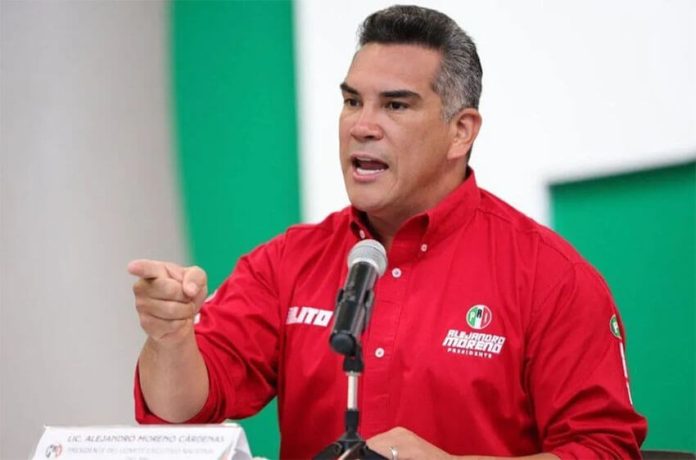
Senator Alejandro Moreno is the national leader of Mexico's once-dominant PRI party. (File photo)
A callous remark about journalists has earned the national president of the Institutional Revolutionary Party (PRI) a rebuke from the press freedom advocacy organization Article 19.
Campeche Governor Layda Sansores on Tuesday released audio of Alejandro Moreno saying that journalists should be allowed to die of hunger.
“Journalists shouldn’t be shot to death, they should be killed of hunger,” Moreno said in expletive-laden audio broadcast by Sansores during her weekly social media program Martes del Jaguar.
The PRI chief, who is also a federal deputy, apparently made the remark to a colleague while he was governor of Campeche between 2015 and 2019. It was unclear how Sansores obtained the audio, but Moreno has pointed his finger at the Campeche attorney general.
The politician’s disparaging comment is considered especially insensitive because Mexico is one of the most dangerous countries in the world for journalists. Eleven Mexican journalists have been murdered so far this year.
In the audio released by Sansores, Moreno didn’t elaborate on his proposal to allow journalists to die of hunger, but many media outlets depend on government advertising revenue to survive and would fold if that income dried up.
Article 19 categorically rejected Moreno’s remark, saying in a statement that it “denotes the relation of violence and subjugation between political authorities and the press as well as intolerance of criticism and public scrutiny.”
The organization said it wasn’t Moreno’s first attack on the press, citing other cases when he was a candidate for governor in Campeche and after he took office in the Yucatán Peninsula state.
Qué terrible y doloroso, esta frase no se olvida: “A los periodistas no hay que matarlos a balazos (…); hay que matarlos de hambre”.
Grábenselo, compañeros periodistas, para que se den cuenta del verdadero valor que tienen para él. pic.twitter.com/Vc4wuTMp6L
Campeche Governor Layda Sansores shared the recording on Twitter, in addition to airing it on her weekly online program, Martes del Jaguar.
“The political leader is also linked to the imprisonment and torture of the journalist Miguel Ángel Villarino Arnábar. In 2018, Villarino Arnábar, one of the journalists that the government of Moreno Cárdenas pursued and labeled as ‘enemies of Campeche’ was imprisoned for 58 days,” Article 19 said.
“… The ‘kill them of hunger’ [comment] emphasizes a problem of structural violence against the press: job insecurity,” it added.
The organization demanded an “exhaustive, impartial, objective, professional and serious investigation” into “acts of censorship perpetrated” in Campeche while Moreno was governor and urged the PRI leader to offer a public apology to the press and acknowledge the fundamental work it does in a democratic society.
“Finally, we make a vigorous call to all political parties to commit to respect of freedom of speech and the free exercise of journalism,” Article 19 said.
Moreno claimed Tuesday that recordings broadcast by Sansores – the governor has also transmitted other damning remarks – were edited and constitute a smear campaign orchestrated by the federal government and the ruling Morena party, which the Campeche governor represents.
“It’s time to clear up some points amid the attempts of the Morena government to create division and confrontation between the opposition, the media and civil society,” he wrote on Twitter.
“The federal government and Morena, through the governor Layda Sansores, have launched a campaign to discredit me, publishing audio that is clearly illegally obtained recordings that have been vilely edited for the purpose of making up phrases and conversations that didn’t exist,” Moreno said.
He claimed that some of the audio disseminated by the governor featured remarks made by “fake voices” that were presented as if they were made by him.
The current governor of Campeche, Layda Sansores.
The PRI chief charged that Morena had used a tactic employed by dictatorships. “We can’t succumb to their smokescreens and lies,” he wrote.
“If the audio presented by the governor of Campeche … had a shred of truth, … [the government] would have gone to the authorities to file a complaint. As this isn’t the case, they prefer to publish them on an insipid program based on gossip and lies,” Moreno said.
“We knew that these attacks would occur, it’s their way of operating. They’re not familiar with dialogue … [nor] freedom of speech and thought. With me this authoritarian government will run into a wall. I will confront them with truth and justice. We will not allow them to establish a dictatorship,” Moreno wrote.
He also said he would file a complaint with the federal Attorney General’s Office (FGR) against those “disseminating false information and lying to citizens.”
On Wednesday, Moreno said that an independent expert analysis of the incriminating audio will be carried out to expose the “manipulation and fabrication of events.”
“All the audio is obtained and manipulated with an espionage system, which was never delivered to the Federal Police and was ‘stolen’ by the current attorney general of Campeche [Renato Sales],” he wrote on Twitter.
“The supplier is an Israeli company and a ‘little bird’ just said the attorney general (formerly the national security commissioner) has it. The ‘robbery’ of this equipment worth more than 800 million pesos has already been reported to the FGR by the ASF [Federal Auditor’s Office],” Moreno said.
He published the ASF complaint and accused the federal government of “inventing conspiracies, … crimes and now audio.”
With the espionage system, Moreno said in another tweet, “they say that they’re spying on the entire opposition, journalists and businesspeople.”
In addition to broadcasting Moreno’s remark against journalists, Sansores has disseminated audio in which the PRI chief (or at least a person presented as him) is heard discussing 25 million pesos in questionable campaign funding the PRI apparently received from cinema chain Cinépolis.
Among yet more compromising recordings released by the Campeche governor is one tape in which Moreno discusses a facial botox procedure with a plastic surgeon. The former governor offers to fly the surgeon to Campeche on his private plane for a three or four-day all-expenses-paid trip. “I’ll provide my plane, … I have an apartment [you can use],” Moreno said.
The collaborators sought to paint a balanced portrait of Rivera's life.SelfMadeHero
How would you depict Diego Rivera’s renowned and complex mural The History of Mexico in a space as small as a graphic novel?
This question challenged the Mexican duo of writer Francisco de la Mora and artist José Luis Pescador as they worked on their biography Diego Rivera, recently published by SelfMadeHero in comic book format.
“[Pescador] recreated the whole thing,” de la Mora marveled in a joint Zoom interview. “You can see the whole mural. He recreated every single element of [it] … It’s [Rivera’s] most important work, in many ways.”
The book is part of a series on art masters, from Rembrandt to Picasso. The latter artist had an important but stormy relationship with Rivera in the early 20th century, reflected in the rainstorm the duo walk through in Paris in one panel.
“Rivera was creating murals before he met Frida, but I think Frida gave him connections to a different universe, like a shaman,” de la Mora said. SelfMadeHero
The biggest important but conflicted relationship the Mexican muralist had, however, was, of course, with fellow artist Frida Kahlo, his third and most famous wife. “He fell in love with her,” de la Mora said. “No doubt, the relationship was one of the most amazing relationships in the history of art. Frida was part of Rivera’s life forever.”
To underscore this in the graphic novel, Rivera gives a poignant reflection on their relationship after her death.
“Rivera was creating murals before he met Frida, but I think Frida gave him connections to a different universe, like a shaman — a shaman connecting with forces we don’t understand,” de la Mora said. “I think it’s what she provided for Rivera. In my opinion, it was mutual. Rivera was very important for Frida as well.”
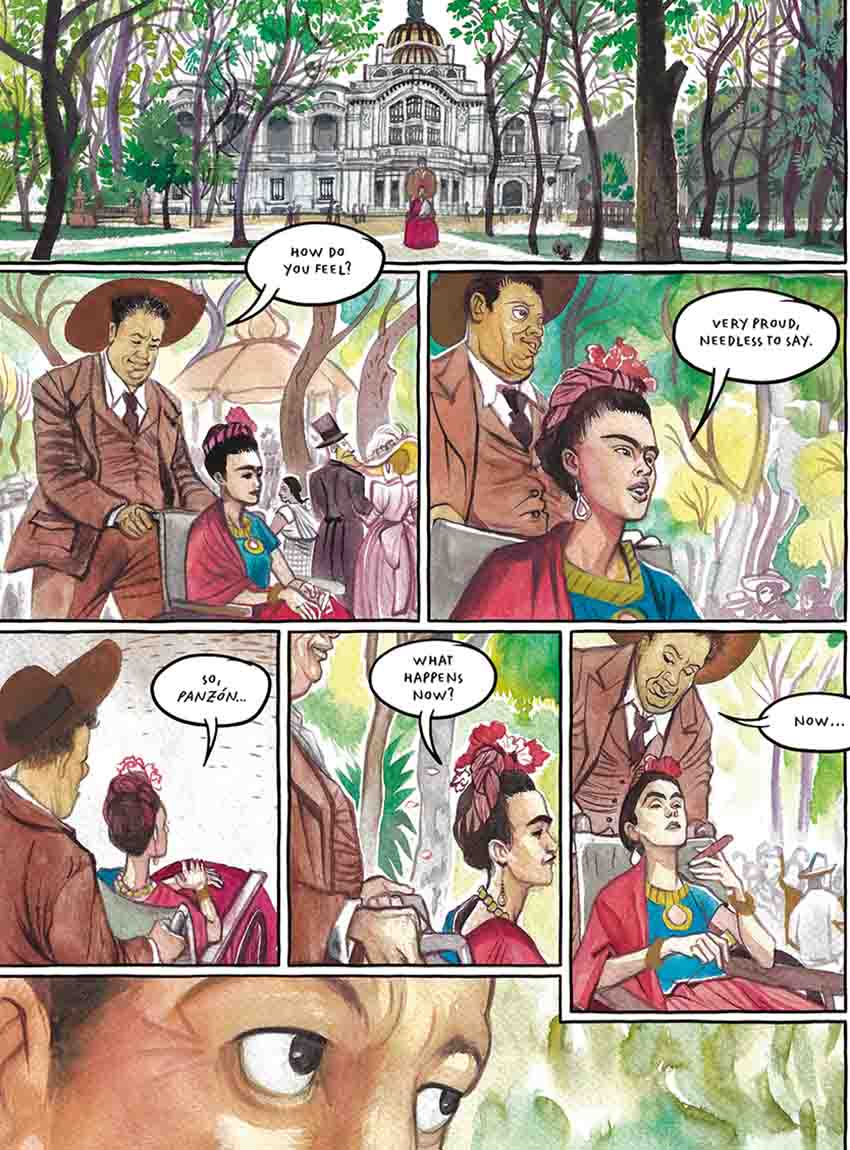
But the book also depicts the playful side of the relationship: he called her the playfully mocking endearment “Friducha,” and she nicknamed him the equally playfully mocking “Panzón” (big belly). The graphic novel also shows the controversial side of Rivera’s life – including his affair with his wife’s sister Cristina Kahlo and, before that, his abandonment of his first wife, Angelina Beloff, after the loss of their baby son in Paris during World War I.
Rivera, a genius but also an inveterate womanizer, “[wouldn’t] have lasted three days in the #MeToo movement,” de la Mora said. SelfMadeHeroIt also portrays the divorce from his second wife, Guadalupe Marín, with whom he had two daughters.
“I don’t think he would have lasted three days in the #MeToo movement,” de la Mora said.
The book does not devote much space to his final marriage to Emma Hurtado.
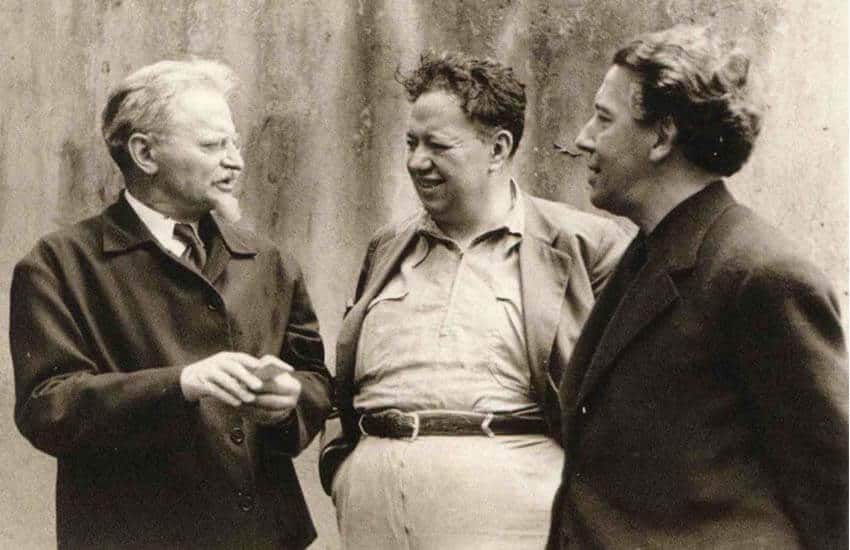
The collaborators sought to paint a balanced portrait of Rivera’s life on a canvas that stretched from Guanajuato to Paris to Mexico City. Throughout, Rivera painted multiple masterpieces while interacting with a collage of great artists and personages of the period – as well as notorious political figures such as Leon Trotsky.
From left to right: Leon Trotsky, Diego Rivera and Andre Breton in 1938.
“Trotsky came [to Mexico] as a refugee,” de la Mora said. “[Rivera] embraced him in many ways, helped him come, at a time [when] nobody really offered him a hand.” However, he added, “Rivera always had an agenda. The agenda did not really help him the way he was expecting it to work. He stopped supporting him, abandoned him.”
Whether it was with Trotsky or Trotsky’s nemesis Joseph Stalin or the power couple of Rivera and Kahlo, Pescador said he filled the pages of the graphic novel with “many personalities and characters” over “a big, long period,” spanning a half-century.
In depicting Rivera himself, Pescador focused on a central feature of the artist’s face.
“The key is the eyes,” he explained. “Like Frida Kahlo said, Diego Rivera has flat eyes. I think this is very important to represent [him]. His eyes are the key.”
One of Pescador’s biggest challenges was recreating the entirety of Rivera’s mural The History of Mexico onto the page in miniature. Courtesy of José Luis Pescador
Pescador also said, “My goal was to … get inside the mind of Diego Rivera, try to recreate his mind. This is my intent for the color palette.”
He used watercolors throughout. “It reflected, tried to copy, to recreate Diego Rivera’s style of painting,” Pescador said. “This is very important about creating the style to remember the paintings, the murals of Diego Rivera.”
The image of the mural that hangs in the National Palace in Mexico City spans two pages in the book. “It was so difficult because I had to do the correct placement of all the figures of Diego Rivera,” he said. “It took him six years to do this [from 1929 to 1935]. I did this in around 20 days.”
A creatively designed panel in the book depicts the Mexican intelligentsia reflecting on Riviera’s debut mural in 1923 with a diversity of opinions. “[Rivera] was so confident; he was so aware of his own genius,” de la Mora said. “At the same time, he made a lot of enemies in his life.”
“[Rivera] was so confident; he was so aware of his own genius. At the same time, he made a lot of enemies in his life,” de la Mora said. Francisco de la MoraIn Mexico, he noted, “he suffered from time to time because he always had enemies. Sometimes commissions were canceled. He needed a lot of support to be able to put these kinds of huge paintings on the walls of some of the most important buildings in a city, in a country.”
This extended abroad: Rivera worked on an ambitious project for Henry Ford’s son Edsel Ford in Detroit, known as the Detroit Industry murals, which raised public outcry, while in the Soviet Union his ideas never even got off the ground.
“He ended up fighting with the people who paid for the murals [in the U.S.]. He was not always very politically intelligent,” de la Mora said. “He ended up being the enemy of all the rich people in the U.S. who commissioned projects … Every genius in the arts has to deal with this kind of thing.”
Asked which Rivera works are their favorites, the collaborators had differing responses: Pescador mentioned the National Palace mural, while de la Mora is fascinated by the Detroit Industry murals, as well as some of his conventional paintings.
The novel uses Rivera and Frida Kahlo’s pet names for each other to show the playful side of their relationship. SelfMadeHero
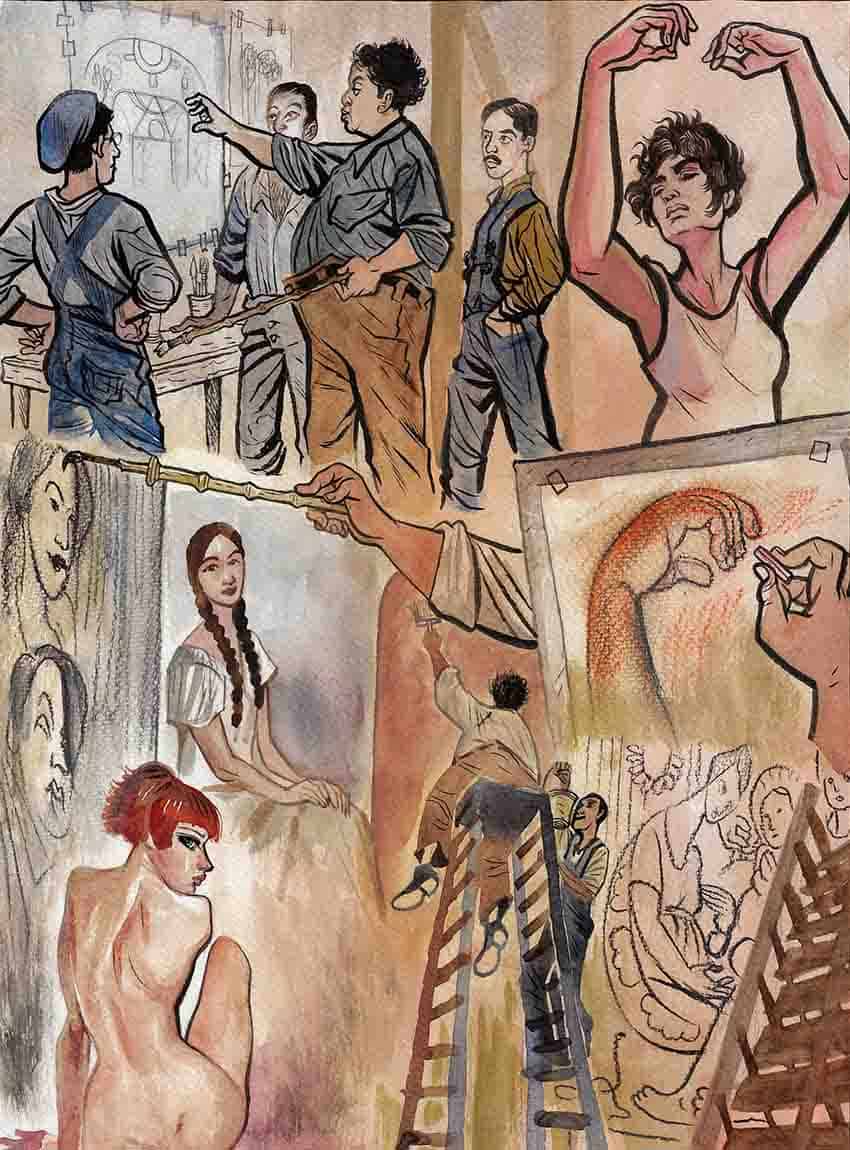
The collaborators also explore the extent to which José Guadalupe Posada might have made an impact when Rivera was an up-and-coming artist yet to embark on a decade-long sojourn in Europe. The book envisions a meeting between Posada and Rivera that may or may not have happened, with Pescador emulating Posada’s catrinas.
“He learned from Posada,” de la Mora said. “He visited his studio many, many times. It’s probably true, the influence that Posada had.”
De la Mora asked Pescador to “come up with a couple of pictures of Diego in Posada’s studio, to take Posada’s style, borrow from the period, the idea of Diego to Posada’s eye. Many things in the graphic novel never happened the way Diego put them.”
And yet, the scenes with Posada reflect a larger truth, he said – “how we Mexicans interpret not just art but life and death. It was really important for us to transmit that in the book.”
Rich Tenorio is a frequent contributor to Mexico News Daily.
Juanita Alonso: 'It is easy to go to prison, but it is difficult to get out.'
An indigenous Guatemalan migrant who was imprisoned in Mexico for more than seven years without a trial was freed last weekend.
Juana Alonzo Santizo, a Mayan Chuj woman, was jailed in 2014 after she was arrested in Reynosa, Tamaulipas, on kidnapping charges.
A court ordered her immediate release last Saturday and she returned to Guatemala on Sunday.
Netzaí Sandoval, head of Mexico’s federal public defenders office, said the court found that there was no consistent evidence against Alonzo, who left the Guatemalan town of San Mateo Ixtatán in 2014 to migrate to the United States to find work.
Sandoval, whose office defended Alonzo, said the charges she faced were not translated into her native language of Chuj until this year. The 35-year-old didn’t speak Spanish when she was detained, but learned the language during her lengthy stay in pre-trial detention.
Sandoval also said that Alonzo was tortured and forced to sign a confession she didn’t understand.
Her release comes after a campaign for her freedom that was supported by her family, her community in Guatemala, Mexican and international groups and President López Obrador. The Tamaulipas Attorney General’s Office eventually dropped the charges against her.
The Centro Prodh human rights organization, one of the groups that supported the “Freedom for Juanita” campaign, said the work of the media in documenting the case and in doing so “putting a face to this story of injustice” played an important role in obtaining justice for Alonzo.
It also said the United Nations played an important role by confirming “the abuses committed against this honorable indigenous woman and migrant.”
Sandoval described Alonzo’s case as “totally aberrant,” asserting that her rights were violated because she is a woman, an indigenous person, a migrant, poor and didn’t know Spanish.
The Associated Press reported that an emotional Alonzo was met at the Guatemala City airport by her family last Sunday. After collapsing into her father’s and uncle’s arms, she changed into traditional Mayan Chuj clothes, AP said.
“It is easy to go to prison, but it is difficult to get out of it,” Alonzo said in hesitant Spanish.
“Her crime was being unable to speaking Spanish,” said her uncle, Pedro Alonzo. “Who is going to pay for that scar?”
There are thousands of people in Mexico’s prisons who have never been convicted of a crime. Official statistics show that over 40% of the prison population is made up of people who have not been convicted or sentenced.
One person determined to put an end to the common practice of incarcerating people for months or years before they face trial is Supreme Court Chief Justice Arturo Zaldívar, who said earlier this month that there has been an “abuse” of preventative prison in Mexico.
El Vani was allegedly a lynchpin of a cattle trafficking operation, but was arrested last year on drug-related charges in Mexico City. insight crime
Ranchers from Mexico’s eastern state of Veracruz know a way to buy cheap cattle: Drive to a remote part of the Chiapas-Guatemala border and purchase cows being brought illegally across. But behind the smugglers and the brokers, those who allow this thriving business to exist hide in the shadows.
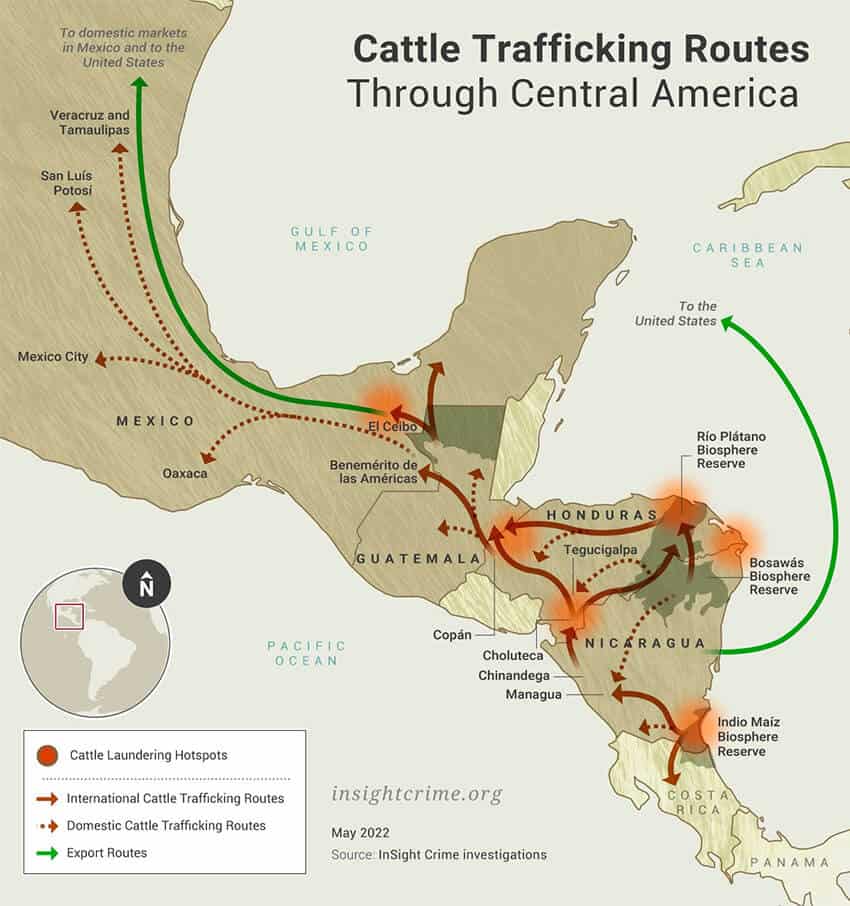
Benemérito de las Américas may be one of the most isolated towns in Mexico. Sitting on a remote part of the Mexico-Guatemala border along the Usumacinta River, hundreds of kilometers away from the nearest city, the town has no customs presence and no formal border crossing. It has one gas station, one supermarket, one hotel and a few restaurants.
Yet it is a thriving hub for a growing transnational economy: cattle smuggling.
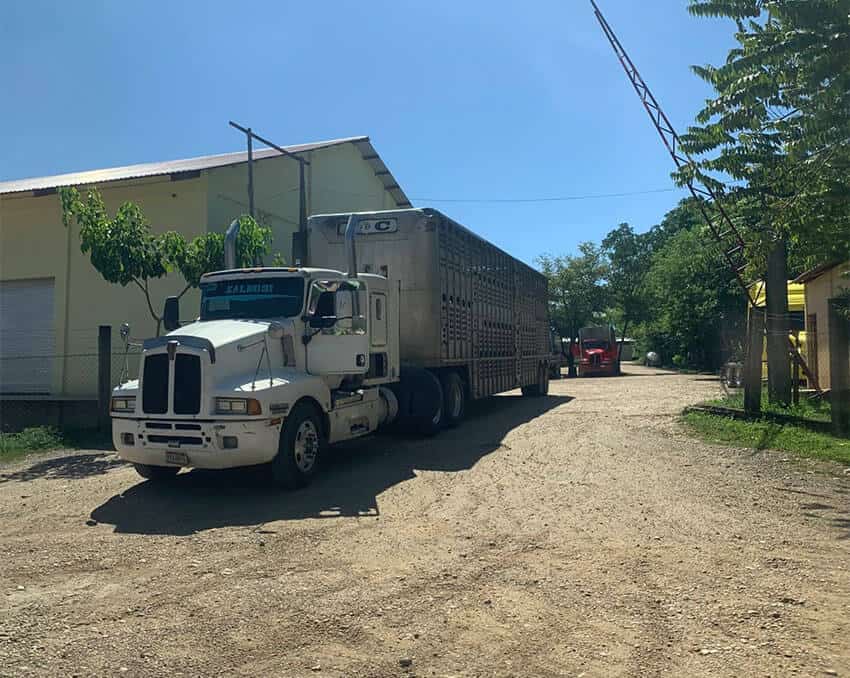
The river near Benemérito is crowded with a large number of boats carrying cattle and other types of contraband from Guatemala to collection points dotted along the Mexican side, usually at ranches. Dozens of tractor-trailers, loaded with cattle, wait to fuel up at the gas station or are parked outside the offices of the local cattle ranchers’ union.
One rancher, Eduardo, heard of the brisk cattle business in Benemérito and decided to travel there from his home in the south of Veracruz state. He wanted to see first-hand the level of competition he was up against.
“Buyers prefer to go there [to Benemérito] because it is cheaper. The cattle that come from Central America are not subject to the controls that we are forced to have,” he told InSight Crime.
Eduardo was in an ideal position to profit. As a member of Mexico’s National Confederation of Livestock Organizations he believed he had the contacts needed to get access to ranches in Guatemala where the cattle are collected before being moved to Mexico. The reality was a letdown. According to Eduardo, just before entering the center of Benemérito, a small road leads down to the Usumacinta River. Long, wooden canoes, carrying dozens of cows and calves, arrive there and unload their cargo. Eduardo appraised the cows as “old and rough.”
Crossing into Guatemala to inspect the cattle proved impossible. “The cattle come from Nicaragua and are gathered in Guatemala to bring them to Mexico,” he said, having learned this during his trip. “Armed people guard the transfer of cattle. They told us not to go any farther. Criminal groups are taking care of this business,” Eduardo added.
The routes through Central America used by cattle smugglers. insight crime
Another source from Veracruz, Gilberto, had been buying cattle in Benemérito for eight years. He was tasked with procuring cattle from Guatemala for a number of farms up the coast of Veracruz in eastern Mexico and delivering them to their buyer.
Gilbert told InSight Crime that ranchers seek to increase their production levels with cattle from Central America, since production in Mexico is low while demand is always increasing. “That area [Benemérito] is very tricky. You deal with bad, bad people. Many heads have fallen in this business. But if you show up and respect the deals, you won’t have a problem,” he told InSight Crime.
In all that time, Gilberto never met those who actually owned the cattle being sold. He only dealt with brokers. “It is very difficult to reach [the people who sell the cattle]. You will never talk to them, you will never know who they are,” said the rancher.
Gilberto never asked any questions. He bought the cattle and left.
The entire cattle trafficking industry is shrouded in secrecy. During field work in Benemérito, InSight Crime learned that the identities of those who own the ranches near the town are also hidden. “The town has no formal customs or tax office. But it has a different sort of ‘customs’ presence,” said one source in the town, who is connected to cattle trafficking but requested anonymity.
Several large properties along the river through which the cattle pass in both Mexico and Guatemala are owned by one person, referred to as La Aduana (Customs). “They call him Customs because his lands are half in Guatemala and half in Chiapas,” explained the source, who added that ranchers frequently quip that “they brought animals through Customs.”
The well-worn path
It is no coincidence that the ranchers InSight Crime spoke to were from Veracruz. This state, which takes up much of the coast of the Gulf of Mexico, is a cattle powerhouse. One of the main beef-producing areas in the country, it is also a major corridor for the transport of cargo from southern Mexico to the United States.
Truck parked outside the local ranchers’ union in Benemérito de las Américas. insight crime
And in August 2021, cattle ranchers and smugglers alike in southern Veracruz took notice when they heard about a specific arrest. On August 15, authorities in Mexico City announced the capture of a man identified only as Jovanni “N,” alias “El Vani.” His arrest document listed him as a member of the Familia Michoacana, an important if dwindling criminal group from the western state of Michoacán. He faced a raft of charges, including kidnapping, extortion, drug trafficking, criminal association and possession of firearms exclusively for use by the army. When police went to arrest him, he allegedly tried to bribe them with $2 million Mexican pesos (around US $100,000) to let him go.
There was no mention anywhere of El Vani being involved in cattle trafficking. Yet, according to multiple interviews carried out by InSight Crime, El Vani was the lynchpin of the entire cattle trafficking operation between Benemérito and Veracruz.
“If you want to know about cattle from Central America being trafficked to Mexico, he is the key,” one source from Coatzacoalcos, in southern Veracruz, told InSight Crime shortly after El Vani was arrested.
One rancher, respected as a leader in his community, only agreed to speak about El Vani if no details were given about where the interview took place. “He was not famous among the population, only among certain circles of ranchers. He dealt with the most powerful ranchers, those at a very high level. He didn’t give the little ones any attention,” he told InSight Crime.
Controlling the local cattle trafficking trade had made El Vani a wealthy and influential man. Hailing from the town of Carranza, right on the Veracruz-Chiapas border, his house is the most famous building around, so ostentatious it is known locally as “Disneyland.” Residents of Carranza also said that the nickname El Vani may have been invented by authorities because locally he is known as “El Gallo” (The Rooster), a nickname given to brave or aggressive people.
In addition to the Disneyland mansion, Carranza has many cattle ranches, where thousands of animals are fattened up and sold each year.
One rancher, who is also a member of one of the 19 vigilante groups in the region, recalled an instance where one of their colleagues was kidnapped by a local criminal group and El Vani, not the authorities, helped to free him. Like all those who dared to speak about El Vani, he requested complete anonymity.
When El Vani’s brother was similarly kidnapped, the community rallied to help. “We brought a group to help him, and they quickly released the brother. El Vani thanked us personally,” said the rancher.
Another source in Veracruz, who described El Vani as a good friend, said “you could deal with him when he was good and healthy [meaning sober]. The problem was that when he got drunk, the devil got in him. He would start shooting and doing ugly things.”
But beyond these glimpses and personal stories, it proved very difficult to gain a clear picture of exactly how El Vani’s business worked. The scale of this criminal economy though was evident.
Mexico’s National Agricultural Health and Safety Service (SENASICA) estimates that around 800,000 head of cattle annually are smuggled into the country from Guatemala, though no data has yet been published. These cattle are sent to states across the country, where they both complement national meat production for consumption in Mexico and exports to the United States.
Ranchers interviewed in Veracruz and Chiapas told InSight Crime that each animal introduced from Guatemala is sold for approximately $400. This means that cattle being smuggled in could potentially be worth around $320 million a year.
El Vani’s arrest temporarily slowed this business down. A leading rancher from Veracruz told InSight Crime that after he was detained, those rounding up the cattle in Guatemala and bringing them into Mexico were forced to adjust. “Today, [the business] has slowed down, not so many cages [vehicles with cattle] are entering. It’s complicated,” he said.
“Does the slowdown have to do with El Vani’s arrest?”
“Yes, yes. But they are regrouping. While they are reorganizing and reaching new deals, it’s slowed down. But [this pause] won’t last long because there are a lot of interests here.”
Those other interests soon became clear. The entry of cattle from Central America to Mexico also serves as a shield to bring in cocaine. “The entry of livestock is a very, very sensitive and dangerous issue because it is in the hands of organizations who do not generally deal with livestock. It is a façade, behind which other things can be brought in,” he explained.
Ranchers and local officials in southeastern Mexico confirmed to InSight Crime that cocaine is often smuggled in alongside the cattle. The way in which the smuggled cattle are then “laundered” in Mexico and enter the legitimate supply chain also offers drug trafficking operations a chance to launder money. “It is a double business [livestock and drug trafficking]. It’s very, very big,” said the rancher, who is a member of the vigilante groups.
The arrest
And suddenly, the circumstances of El Vani’s arrest may begin to make more sense. Statements from authorities made zero mention of any involvement in cattle smuggling, claiming that he was engaged in “drug trafficking inside and outside the country.”
Some more light was shed on El Vani’s possible connections to La Familia Michoacana. One rancher from Carranza told InSight Crime that El Vani had many friends from Michoacán and that many ranchers in Veracruz hailed from the western state.
In fact, InSight Crime learned from interviews in the region that one of the most prominent ranchers in southern Veracruz, who is close to El Vani, is the brother of one of the foremost gang bosses and drug traffickers in Michoacán. This rancher did not respond to several interview requests and there is no evidence to date that he is involved in any illegal activity.
Yet authorities have remained quiet about any connections between El Vani and cattle. At the time of his arrest, Veracruz state Governor Cuitláhuac García publicly stated that local prosecutors were investigating the case, but never once referred to livestock.
InSight Crime tried to dig deeper. Requests for information from prosecutors in Veracruz, Chiapas and Tabasco, all key states for cattle smuggling, came up empty. The local Attorney General’s Office in Mexico City, where El Vani was arrested, said it was not looking into his case and that the federal Attorney General’s Office was handling the investigation. They did not respond either.
Finally, InSight Crime turned to Mexico’s National Transparency Platform to request any documentary evidence about El Vani. The request was denied, and the information deemed confidential.
This is the second article in a three-part investigative series by InSight Crime, a foundation dedicated to the study of organized crime. The series looks at how cattle produced in Central America are smuggled into Mexico and laundered in a variety of ways to enter the legal food supply chain before beef products are consumed in both Mexico and the United States. Read the full investigation here.
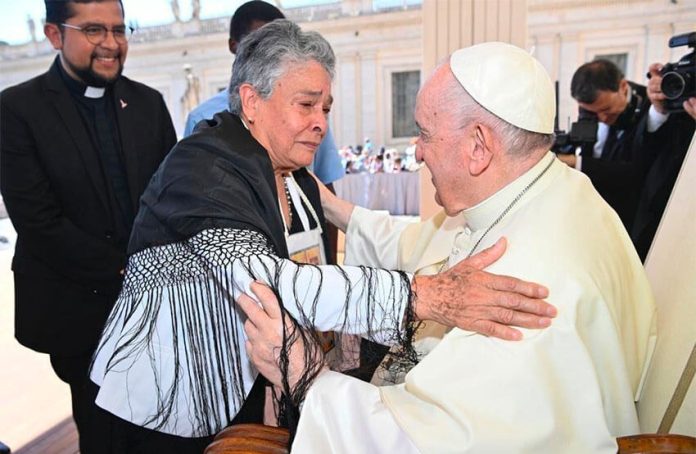
María Herrera meets Pope Francis on Wednesday. Centro Prodh
Pope Francis met Wednesday with a Michoacán woman whose four sons are among Mexico’s more than 100,000 missing people.
María Herrera Magdaleno traveled to Vatican City to meet the pontiff on behalf of the large number of Mexicans whose loved ones have disappeared.
Jesuitas México and the Centro Prodh human rights organization said in a statement that the pope greeted and blessed Herrera, who hails from Pajacuarán, a municipality near Michoacán’s border with Jalisco.
Representatives of those two groups traveled to Rome with the mother of eight, whose sons Raúl, Salvador, Luis Armando and Gustavo have been missing for over a decade.
“The meeting occurred in the context of Mexico reaching more than 100,000 missing people, according to official statistics,” the statement said.
“In representation of thousands of Mexican families, María Herrera delivered information about this painful reality as well as the forensic backlog of more than 50,000 unidentified bodies and remains. On the person of Mrs. Herrera, the Holy Father blessed all the mothers and families who are looking for their disappeared loved ones.”
Jesuitas México and Centro Prodh said the meeting constituted “a call to governments to look for all missing people, identify people who still haven’t received a dignified burial due to the forensic crisis and adopt effective public policies to reduce violence.”
“It is also an invitation to churches, communities of faith and society to develop greater empathy with the victims of violence,” they said.
Herrera’s meeting with the pope came after she wrote to him earlier this month and after the United Nations Committee on Enforced Disappearances said in a report that abductions of children, adolescents and women are on the rise and that impunity in missing person cases is “almost absolute.”
In her letter, Herrera noted that Mexico’s missing persons count had passed 100,000 and that her four sons were among those whose whereabouts are unknown.
“In the face of the indifference of our governments mothers have to go out and look [for our children with] our own hands, picks and shovels,” she wrote.
“Don’t forget us,” Herrera implored. “Pray for us and call on our governments to look for the missing and stop the violence, on our pastors to accompany us more and on society to be more empathetic with our pain,” she wrote.
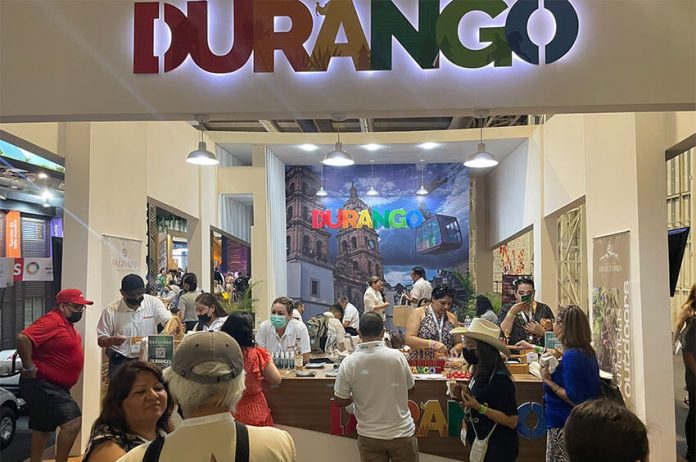
The Durango display at Tianguis Turístico, Latin America's biggest tourism show.
International tourist numbers will come close to reaching pre-pandemic levels this year, federal Tourism Minister Miguel Torruco predicted Sunday.
Speaking at the inauguration of the Tianguis Turístico tourism industry event in Acapulco, Guerrero, Torruco predicted that Mexico will receive 40 million international visitors in 2022, which would be just 5 million short of the 45 million record set in 2019.
He predicted that tourism-generated revenue will be US $24.25 billion and declared that tourism in Mexico will have recovered “almost 100%” by the end of the year.
Torruco asserted that the recovery is possible thanks to actions implemented during the pandemic such as the application of vaccines on a massive scale and the establishment of virus mitigation measures in businesses.
“All these actions have allowed the recovery of the sector to occur more quickly,” he said.
The minister predicted that the sector will generate 8.3% of Mexico’s GDP in 2022, which would be just 0.3% lower than 2019. He noted that foreign investment in the sector totaled $2.05 billion last year, or 6.5% of total foreign direct investment.
“This data is encouraging and speaks of increasingly solid tourism activity that will continue strengthening with the different infrastructure actions … [of] the federal government such as the recent inauguration of the Felipe Ángeles International Airport,” Torruco said.
He also noted that the airport in Chetumal, Quintana Roo, has been upgraded and engineering studies are underway for the construction of an airport in Tulum in the same state. The Tepic airport in Nayarit is being modernized and the Copper Canyon Airport in Creel, Chihuahua, will soon begin operations, Torruco added.
“Air connectivity is fundamental to boost tourism,” the tourism minister said.
With regard to tourism sector employment, Torruco observed that job numbers have already exceeded pre-pandemic levels. Almost 4.4 million people were employed in tourism-related jobs in the first quarter of 2022, a 3.3% uptick compared to the same period of 2019 and a 19.1% increase compared to a year earlier.
Torruco said 8.6% of all Mexican workers are employed in the tourism industry.
In a meeting with the president of the Mexican Association of Hotels and Motels, the tourism minister highlighted that average hotel occupancy in 70 monitored tourism destinations in the first quarter of the year was 50.6%, a 22.8% increase compared to the same period of 2021.
His meeting with Juan José Fernández Carrillo was one of a huge number of encounters between tourism sector stakeholders at this year’s Tianguis, Latin America’s largest tourism industry event.
The Tourism Ministry said in a statement that more than 65,000 “business appointments” would take place at the four-day event, which concludes Wednesday.
The airline's CEO said moving more flights to AIFA was good business. deposit photos
The budget airline Volaris will soon add 10 additional flights from the new Felipe Ángeles International Airport (AIFA), located north of Mexico City in México state.
Starting in July, the low-cost carrier will fly from AIFA to Acapulco, Guadalajara, Huatulco, La Paz, Mérida, Mexicali, Oaxaca, Puerto Vallarta, Puerto Escondido and Los Cabos. It already operates services from AIFA to Tijuana and Cancún.
The airline announced the new routes Tuesday at the annal Tianguis Turístico tourism industry event in Acapulco.
AIFA, located about 50 kilometers north of downtown Mexico City, opened in late March but currently has few commercial flights. The Toluca airport, located about 60 kilometers west of the capital, has no commercial services.
However, Volaris announced that it will resume services in August from that airport to Tijuana, Puerto Vallarta, Cancún, Guadalajara, Los Cabos and Huatulco.
There are 30 million potential passengers in the greater Mexico City area and that market will benefit from the airline’s “redistribution” of its services, he said. Millions of people live in closer proximity to AIFA or the Toluca airport than to the AICM.
Beltranena said Volaris will be able to offer 1 million extra seats annually on flights out of the Mexico City metropolitan area as a result of its use of three different airports.
“I want to reiterate our commitment to the strengthening of the [aviation] industry to take air travel to more Mexicans,” he said at a Tianguis Turístico event attended by federal Tourism Minister Miguel Torruco.
“More than 1.2 million customers travel with us for the first time every year and 84 of our 190 national routes are exclusive because our cost model competes with buses and transforms the economy and air transport,” Beltranena said.
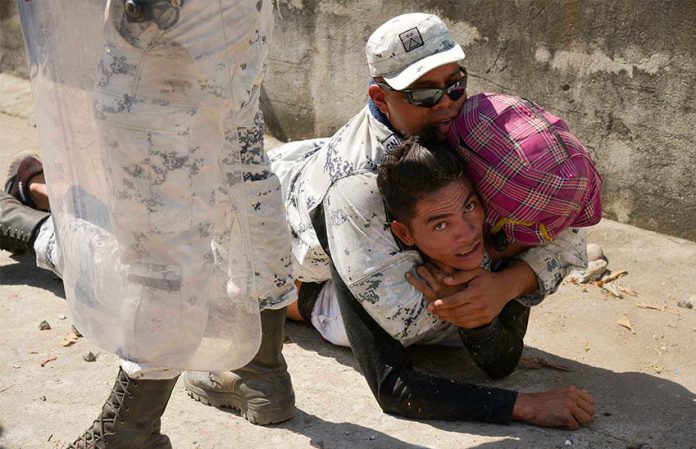
A National Guardsman wrestles a migrant to the ground.
Arbitrary detentions, excessive use of force and sexual violence are among the abuses committed against migrants by the armed forces and the National Guard, according to a new report by six non-governmental organizations.
The Bajo la Bota (Under the Boot) report by the Foundation for Justice and the Democratic Rule of Law and five other groups examines the militarization of migration policy in Mexico and compiles testimonies from scores of migrants.
“Mexico has opted for the implementation of a migration policy without a human rights focus, making use of the National Guard and other military forces as an apparatus of migration control even when this goes against migration regulations and international human rights law,” the report said. “… The National Guard members [carrying out] migration tasks don’t act as guarantors of rights but as agents of contention and deportation or even as generators of risks for migrants and their families,” it said.
As a result of interviews with 76 migrants from African, Latin American and Caribbean countries, the NGOs documented cases of arbitrary and illegal detentions, racial profiling, violence against women and the excessive use of force.
“I’m always very scared of the police and the National Guard – when we go to buy things, when we’re walking, at any time of day or night. It’s a fear of being taken to the [detention center]. They don’t care if you’re an asylum seeker, they don’t care if you have children and a wife. The National Guard doesn’t care about anything,” said a Haitian migrant in Tapachula, Chiapas, a hub for migrants who have crossed the border with Guatemala.
“Every time I walk I see the police arresting people. The police asked me for identification and took it from me. They said it wasn’t valid. They searched me, they touched my body,” said a migrant from Cameroon.
A Nicaraguan woman recalled being detained in Chiapas along with her three young children even though they had been granted humanitarian visas. National Guard members and National Immigration Institute (INM) agents subsequently took them to a town on the border with Guatemala and dumped them in the middle of the night with the expectation they would leave the country. They and other migrants were warned they would be sent to a detention center if they entered Mexico again.
“My children were crying. They were afraid that the guards were going to shoot us with the big guns they were carrying,” the woman said. “… They took us to Talismán and threw us out like rubbish.”
The report says militarized migration policy has heightened the risks for migrants.
The report said the use of the National Guard to combat the flow of migrants through Mexico is “one of the main institutional legacies” of the pressure imposed by the administration of former United States president Donald Trump on Mexico. Mexico deployed troops to its southern and northern borders in 2019 after Trump threatened to impose blanket tariffs on Mexican exports to the U.S. if the Mexican government didn’t do more to stem migration.
The six NGOs, among which are also Sin Fronteras (Without Borders) and Derechos Humanos Integrales en Acción (Comprehensive Human Rights in Action), said the militarized migration policy pursued by the current government “has deepened the risk contexts for migrants and asylum seekers, … especially those who are more vulnerable due to reasons of gender, race and ethnicity.”
“In addition, it forces migrants to travel along clandestine routes, making them more vulnerable to different kinds of human rights violations and crimes such as enforced disappearances, kidnapping, extortion, human trafficking and corruption as well as racial and ethnic discrimination, extreme climate situations and accidents,” the report said.
Bajo la Bota also said that the National Guard makes arbitrary arrests based on racial profiling and harasses people of color. “Migrant women of African descent in Mexico are exposed at all times,” said a Haitian woman.
“We can’t hide, our skin color is visible, our skin color annoys the racists. The National Guard and the INM treat us like prostitutes, make rude gestures to us, follow us when we’re walking, follow us inside stores. In stores, … we have to walk with our hands up to show them we’re not stealing,” she said. “… We’re not human beings for them, we’re trash. … We walk on large avenues, never on small streets because … the police and troops could attack us.”
The report also documented abuses committed against women at detention centers, including a case of a Honduran woman who was detained in Ciudad Juárez, Chihuahua. Guardsmen “strip women, put their fingers in their vaginas or put a gun in them,” the woman said.
The report said that 44% of the abuses occurred in Chiapas, the main entry point for migrants, most of whom intend to travel to the United States. Citing data from January, it also said that over 28,000 soldiers, National Guard members and INM agents – including almost 14,000 guardsmen – were deployed to the southern and northern borders to stop migrants, a strategy that ensures that many never reach their desired destination.
Hundreds of thousands have been detained in recent years, with many deported to their countries of origin.
The NGOs made numerous recommendations to the federal government, among which were to withdraw military forces and the National Guard from migration control tasks and to stop detaining and effectively incarcerating migrants.
They also called on the government to terminate any policies or agreements with the U.S. government that violate the human rights of migrants and refugees. The international principle of non-refoulement – which prohibits returning a person to a country where their safety or life could be threatened – must be respected, the NGOs said.
Several major media outlets have done stories on the Azulik Tulum hotel and the innovative design of its new art museum, SFER IK.
Written about in the Financial Times, Vogue, Travel and Leisure and countless other media outlets, the Azulik Tulum hotel and its new art museum SFER IK have been called “boundary pushing” and an “international melee of creativity.” SFER IK’s creator himself is quoted as saying everything in the museum is “sustained by magic.”
The Instagrammable biophilic design has caught the attention of artists and influencers around the world who are now making the trek out to a previously unknown village 40 minutes west of Tulum for a glance at what some consider Mexico’s hottest new cultural attraction.
But does it live up to the hype?
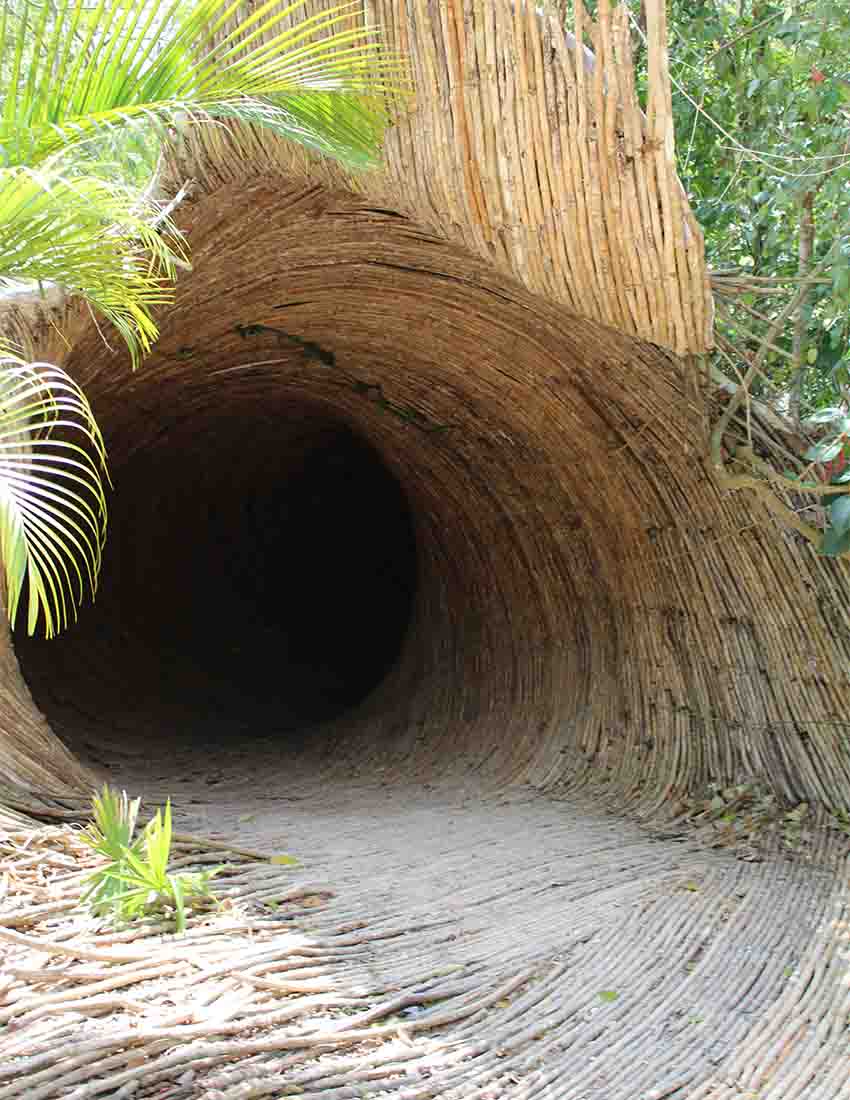
Entering through a birth canal-like tunnel lined with curved bejuco (liana) wood, you come upon a wild-looking bridge, dappled with sunlight and overlooking the towering white domes that peek their heads up above the tree line of the Maya jungle. The entrance of the SFER IK Museum at the end of the bridge is a massive circle of glass, pivoting open to reveal an expansive room, with polished walls that wrap and undulate around the room’s interior, the color of the sky before it rains.
SFER IK was imagined as a space that would force people “to feel and play in the space before interacting with art,” according to project coordinator Fernanda Ordaz.
Vining pothos plants hang from the ceiling, draping from the various trees that have been left to grow within the museum’s rooms, holes left in the ceiling for their treetops. Pools glisten below and ethereal music plays in the speakers throughout this jungle gallery.
It’s truly stunning until you have to take your shoes off.
Then the idyllic setting transforms into a test of tolerance for sheer pain and you wonder if the architect might have a masochistic streak. Built in 2018, SFER IK was imagined as a space that would force people “to feel and play in the space before interacting with art,” I was told by Fernanda Ordaz, one of the project’s coordinators via email, “a different way of approaching the aesthetic experience, one that feels more connected because is more natural.”
I’m not sure how natural it felt to gouge my feet on the knotted and shellacked rope net above a drop of about five meters or to have my soles pinched ever so painfully as I walked across the wood slate bridge connecting one area of the museum with another. But after 45 minutes of walking across a floor made of bujeco vines, my feet felt like I had walked a pilgrimage barefoot for some promise made to the Virgin. I thought I went for art, but maybe I went for penance.
The museum is the brainchild of Eduardo Neira Sterkel, better known as “Roth,” who also designed and built Tulum’s Azulik hotel – another incredibly beautiful space with mixed reviews from its guests. Roth was out of town when I visited, and so apparently was anyone else with basic knowledge of the project since my guide, who had only been on site for two months, could answer very few of my questions.
In what has been called by some the “Mayan Guggenheim,” there are two current displays. MEXX by Japanese flower artist Azuma Makoto is an eight-meter giant sculpted from vines, concrete, fiberglass and living plants that attempts to observe how living art can integrate itself into the surrounding environment over time. My guide pointed to a few of the pothos plants that were draped over the sculpture as an expression of that integration, but when I asked if they had been placed there by the museum or had grown there naturally, she demurred.
The other piece was Every Tree is a Civilising Entity by Brazilian visual artist Ernesto Neto, a combination of woven fibers, stones and other natural materials that hovers over the room like a forest canopy from outer space. The piece is a continuation of what Neto has referred to as bringing “the voice of the forest” to the viewers of his work. This piece somehow felt perfectly suited for the upended indoor-outdoor narrative of the museum.
SFER IK has been hailed in many outlets as having no carbon footprint and being one with the surrounding nature, but there seemed to me some conspicuous incongruencies: while the area’s zapote trees were preserved during the building process and no machines were used in the construction, water was being continuously pumped into the museum’s dozens of low-lying pools, the pothos plants that decorated the walls and draped into the space are not endemic to the area and the tropical plants around the grounds were being watered by gardeners. When I probed a little further for ecofriendly aspects to the project – thinking I must have missed solar energy or water recycling or even composting – I was told just that the building materials used to make the structures were organic – an argument for concrete I’ve never heard before – and that they worked with the local Maya community on the construction.
The birth canal-like tunnel you use to enter the museum.
This “City of Arts,” as it is called by its residents, includes four workshops where architects, designers and a few locals – although the percentage of that last group was not forthcoming from my guide – make pieces for the museum’s restaurant and grounds as well as the Tulum Azulik hotel. The beauty of those decorative pieces was undeniable – the intricate macrame wall hangings, or the one-of-a-kind ceramic pieces used in the restaurant, but access to the workshops is limited to the folks who work there and is not open to the public. My guide told me that there were no artist residences, but it was later confirmed that they do host artists three or four times a year.
The restaurant of the museum, Jungle Cuisine, is just as lovely as the museum itself, with small, bubbling pools, more draping vines and bossa nova covers of pop songs playing over the loudspeaker. The cuisine is supposedly based around traditional ingredients and regional cooking techniques, but I’ll never know since I was also told that I couldn’t eat there. Turns out that even if you have traveled over an hour and the 25-odd tables are empty — and especially if you are a lowly reporter — you’ll need a reservation.
When, hot and sweaty, I suggested that I might then just have a drink before heading back to Tulum in the midday broil, I was handed a bottle of water and scooted out the door.
On the way back into Francisco Uh May, the small town where the museum is located, I asked my motorcycle taxi driver what the locals thought of the museum. He said they were content – it had brought some jobs and raised the value of everyone’s land around it. But had he or anyone he knew ever been inside the museum? I asked, No, was the reply. As far as community involvement, Ordaz says there is an art school for community kids that happens once a week, but no one mentioned that during my visit.
Aesthetically speaking, the hype surrounding the SFER IK Museum is understandable; there is no denying that its beauty and its limited art collection is visually stunning. But if you go to SFER IK looking for something more – an institution that’s integrated into the local community, an exemplar of ecoconscious luxury or a bastion of bohemian hospitality – I’m afraid you might be disappointed.
Lydia Carey is a freelance writer and translator based out of Mexico City. She has been published widely both online and in print, writing about Mexico for over a decade. She lives a double life as a local tour guide and is the author of Mexico City Streets: La Roma. Follow her urban adventures on Instagram and see more of her work at www.mexicocitystreets.com.