The central bank has raised its 2021 growth forecast for the Mexican economy by 0.2% to 6.2%.
The Bank of México (Banxico) said in its April-June quarterly report that the main reason for the upward forecast was higher than expected growth in the second quarter of the year.
“Furthermore, due to the advance in the vaccination process and a context of greater mobility and the opening of various [economic] activities, mainly in the service sector, the expectation that the gradual reactivation of economic activity will continue in the second half of the year is maintained,” the bank said.
Banxico also expects that the recovery of the economy in the United States will spur economic activity in Mexico, even as the country faces a large third wave of the coronavirus pandemic fueled primarily by the spread of the highly contagious delta strain.
Bank of México Governor Alejandro Díaz de León acknowledged that the pandemic continues to pose a risk to the economy but asserted that vaccination is offsetting that risk.
“We have two elements, a risk … that could affect the rhythm of economic activity and a mitigating influence that is the vaccination process,” he told a press conference on Monday.
The bank’s 2021 growth forecast is just below that of the International Monetary Fund (IMF), which is predicting a 6.3% expansion.
The World Bank and the Organization for Economic Co-Operation and Development (OECD) are more pessimistic, with both forecasting growth of 5%. The Finance Ministry is expected to revise its growth forecast to 6% when it delivers its 2022 budget next week.
Mexico’s GDP slumped 8.5% last year as the pandemic and associated restrictions ravaged the economy. That was the country’s worst contraction since the Great Depression.
Banxico’s growth forecast for 2022 was unchanged at 3%, more than a point below the IMF prediction of a 4.2% expansion but on par with the World Bank outlook. The OECD is slightly more optimistic, predicting a 3.2% upturn next year.
The central bank also revised its outlook for job creation in 2021, predicting that as many as 840,000 jobs will be added this year, up from a previous maximum forecast of 570,000. As many as 700,000 positions could be added in 2022, the bank said, up from a maximum prediction of 590,000 three months ago.
With regard to inflation, Banxico expects that the rate at the end of 2022 will be 5.7% and predicts that the rate will remain above 5% in early 2022.
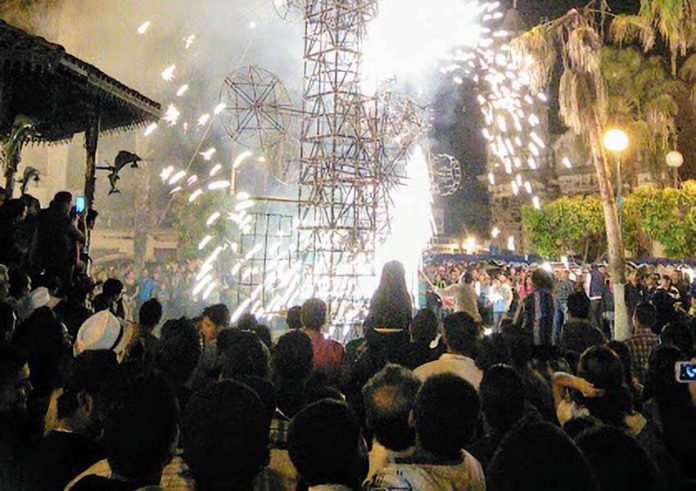
The Feast Day of San Blas' grand finale is an impressive, and not entirely safe, fireworks display that spins and sputters and occasionally topples over. photos by Yvonne Konar
Silhouetted against the inky night sky, the rickety metal structure some 25 meters tall is now fully ablaze.
Fireworks are spinning off in every direction over the town’s square, sending a shower of sparks onto the laughing crowd jammed together in celebration in the town’s plaza. Amid the craziness and the settling haze, a man taps us on the shoulder.
“Amigo,” he says, pointing upward. “Sometimes it topples over!”
Ah, Mexico! How we’ve missed you. It’s good to be back.
Like the long-lost friend or lover you’ve never forgotten, Mexico has welcomed us back with a bang. Her touch — the gentle probe and sensuous dance she offers — is hard to resist.
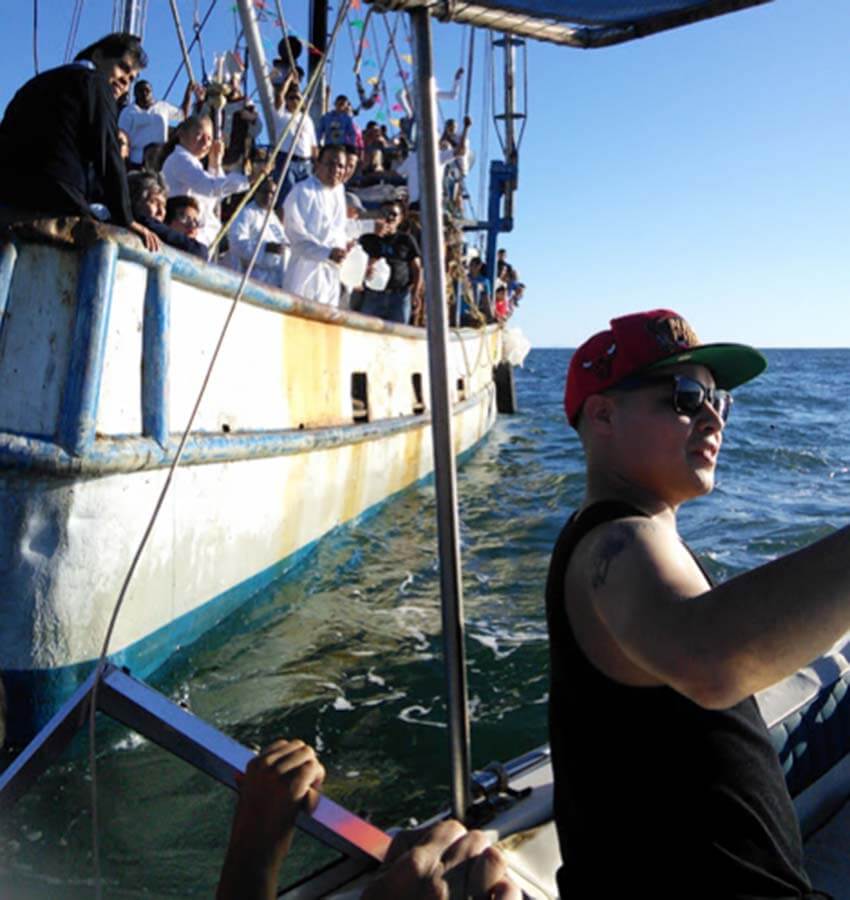
As part of the celebrations, a priest awaits in a boat to bless other boats owned by San Blas fishermen.
Located some 150 km north of Puerto Vallarta on the coastline in the state of Nayarit, San Blas is dubbed the Mexican Venice for the number of waterways that flow through and around it. Filled with lush growth, it’s a mecca for birdwatchers since many species use the sheltered waterways as rest stops on their migratory routes. We had arrived there the evening before a wild and crazy festival of water and fire known as the Feast Day of San Blas was to take place.
Truly, if the coastline of Mexico is her necklace, then places like San Blas are the gemstones that frame her voluptuous body. Filled with hidden coves and glistening bays, her shoreline dazzles and shines, showcasing stunning curves and offering passageways to hidden valleys.
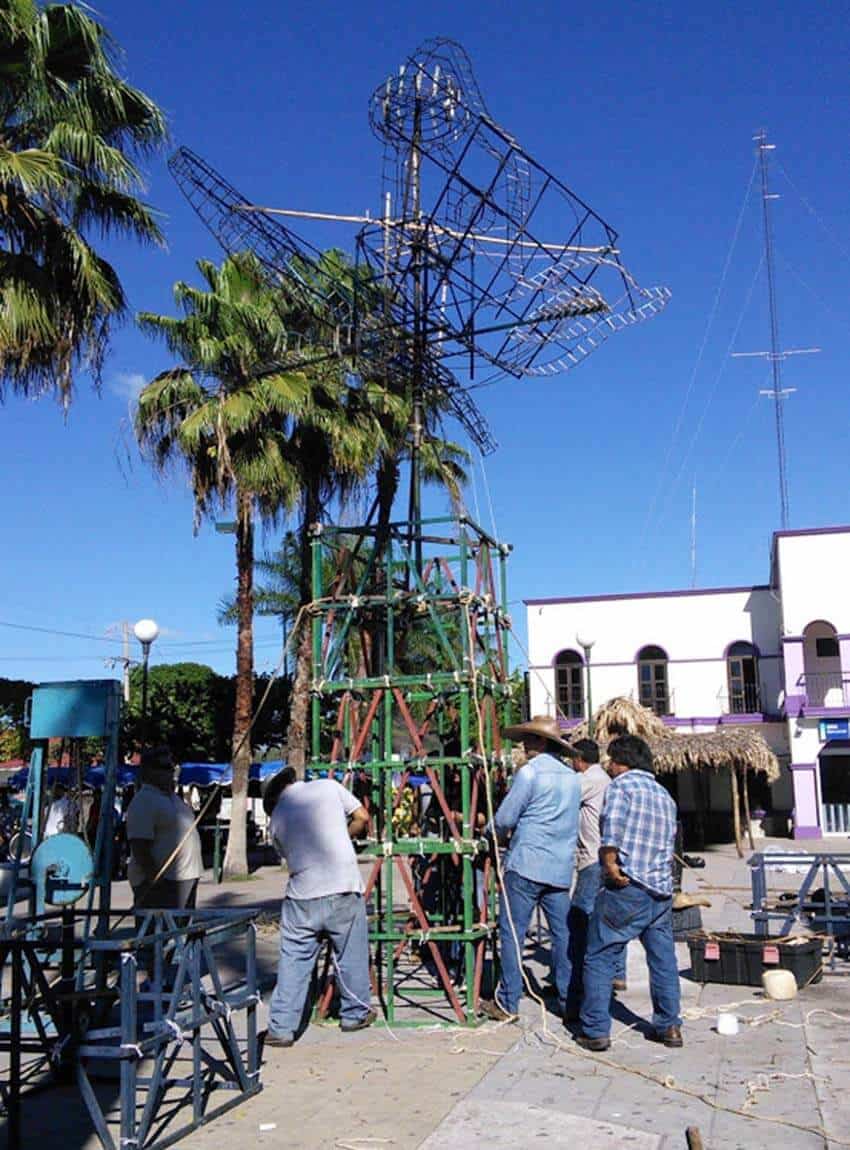
Over breakfast on the morning of the festival, we watch workers build a tower in the town’s square. A young man named Hector responds to my sneeze with a “salud” (bless you).
“Gracias,” I reply.
He tells us that the metal structure will be used for the finale of the daylong celebration. “The whole day will be fun,” he says. “Don’t miss it!”
That afternoon, we gather back at the steps of the 300-year-old church along with locals, dancers in indigenous dress and musicians. Everyone is waiting for Día de San Blas to begin.
Suddenly, the church doors open up and the local priest walks out. Behind him, parishioners carry a two-meter-tall statue of the town’s patron saint, San Blas, down the steps.
The procession winds its way through the crowded spectator-filled streets. We join in and are jostled along as the parade heads toward the town’s docks. There, the priest and entourage climb aboard a waiting shrimp boat.
Around us, people are frantically searching for seats on various waiting panga boats. The narrow channel that heads to the ocean is awash with boats, many loaded heavy with passengers. All are following the lumbering shrimp boat making its way out of the protected passageway.
As we crowd onto the dock’s edge, wondering how to get our own ride, our friend Hector appears.
“Hola, mis amigos canadienses! Are you wanting to get on a boat?”
“Sí!” we reply.
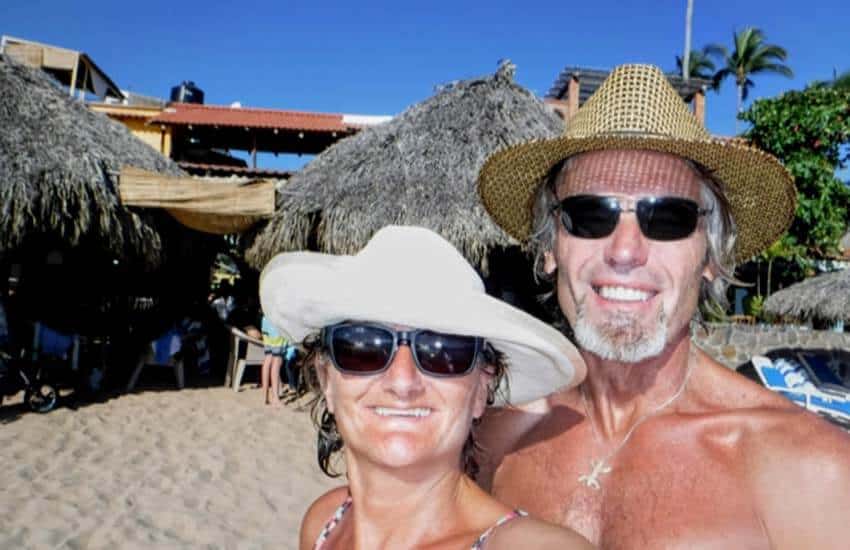
The writer Shayne Konar, right, with Yvonne Konar.
Immediately, Hector turns his attention to one of the captains docked on the rocky shoreline. “… and my Canadian cousins,” he finishes, pointing to us. We score rides with Hector on a waiting speedboat.
More suited for summer-lake fun than an oceangoing adventure, the approximately seven-meter-long boat has managed to squeeze 12 of us on board. The only person wearing a lifejacket continually clasps her hands in prayer. At that point, the only thing I’m believing in is that we have a Titanic-size chance of going under.
The ragtag flotilla that’s assembled on the water looks like some madcap rescue operation.
Craft of all sizes — some decorated, many overcrowded, most without lifejackets and stuffed with families and grandmas holding babies — chase after the lumbering shrimp boat. We take the bow seats and are immediately drenched by the rolling seas crashing over into our boat.
We start bailing as prayers grow louder. I’m praying we won’t be soon going under. But if there needs to be a rescue, boats are literally within an oar’s length of us.
Our destination is a rock outcropping some two kilometers offshore, white from the droppings of nesting birds. We slowly gather around the rugged poop-stained peak in the middle of the bay.
Boats dart in every direction, bouncing over the waves. Someone has managed to scale the 30-meter-high rock and seems prepared to jump off. Everyone jockeys in closer for a better view.
Shouts of “Jump, jump!” fill the air along with “uno, dos, tres!” The crowd waits in anticipation for the circus-like finish to the mayhem.
Our captain senses that retreat might be the wiser of directions. Could it be the constant bailing or the smoke rising from the overworked motor that has him frowning? We turn and start back toward shore.
Now, as if sinking in the high seas didn’t seem like enough fun, our captain decides that getting crushed should do the trick. We head toward the growing line of boats waiting to receive a dousing of holy water from the priests aboard. This is a traditional blessing for another prosperous and safe fishing season.
It is almost our end as we struggle to come alongside the much larger shrimp boat. Our bow end bounces squarely into the side of the towering steel-hulled shrimper. The vessel’s booms loom scant meters above our heads, swinging from side to side.
Our captain manages to avoid one disaster, only to have the stern end of our undersized and badly overloaded craft smash off the side of the shrimp boat and narrowly miss getting caught in the larger boat’s wake. Feeling blessed at having avoided a high seas catastrophe, we chug back to shore.
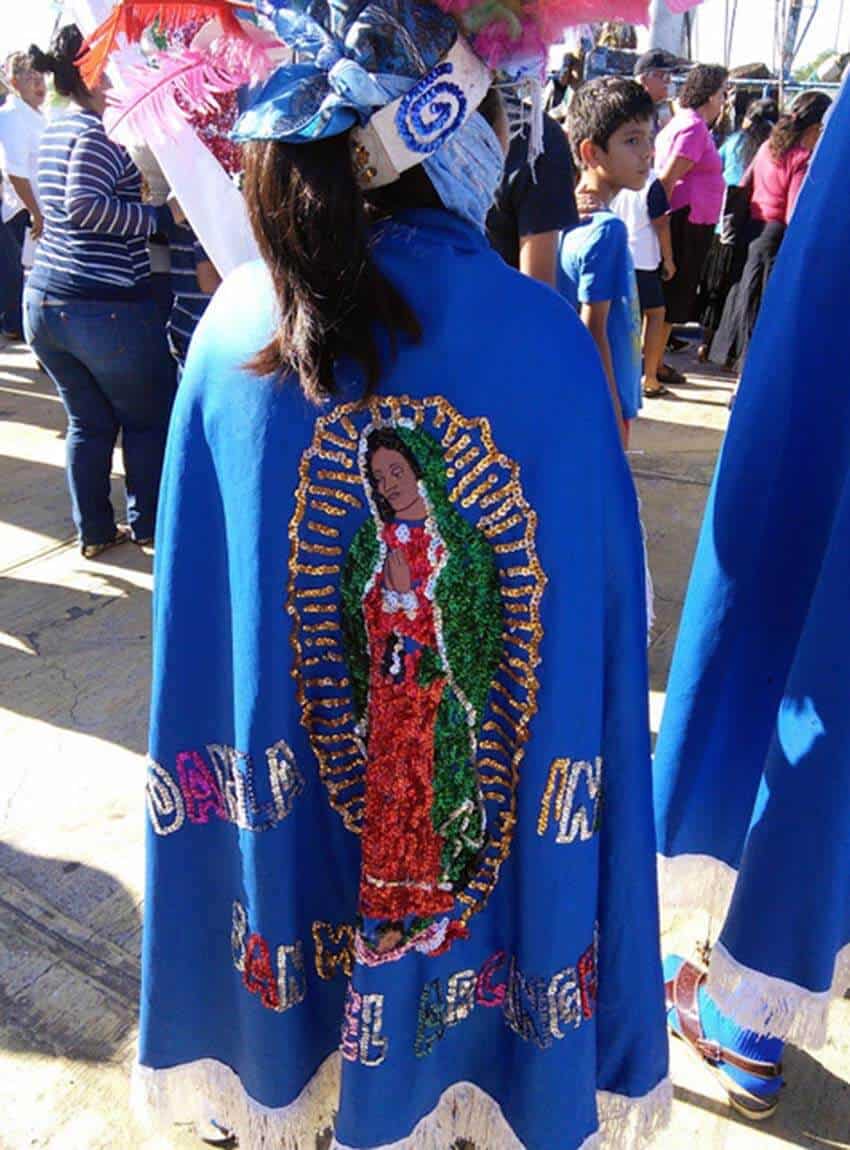
Even the religious procession in honor of San Blas is a lively affair, with musicians and dancers.
On the dock, we say goodbye to Hector and promise to return in the evening for the finale.
That night, we crowd into the town’s plaza with hundreds of townspeople to watch the fireworks display.
The 25-meter tower of incendiary items seems secured by ropes tied to palm trees standing in each corner of the square. Fireworks line its sides. Spinning wheel designs and a fireworks-filled wire in the shape of a butterfly at the tower’s top await their moment.
The crowd roars as a Roman candle rockets from the church steeple. The fireworks on the tower are lit.
Children dance under the sparks and around the tower as if enjoying a warm rain from a summer’s night storm. Without safety barriers, people edge closer.
Above their heads, fireworks continue to screech and whirr, climbing ever higher up the tower. It is a spectacular show of light, smoke and noise. Through the smoke now settling over the plaza, Hector just nods and points to the tower.
We have our escape route, just in case.
The finale to Día de San Blas sees the butterfly ablaze, spraying a mammoth-sized shower of sparks in a wide arc.
The craziness of the night even extends to the church as fireworks explode down one wall and a last crescendo of Roman candles are sent from atop the steeple. Hector laughs. “Sí, no problemo!”
Sí!
This is the Mexico we look for.
From the fragrance of her land, to a stroke of her finger on the back of our necks, to the joyous laughter of children and smiles of families visible through the settling smoke of a fireworks display, this is a passionate, humid land, the people proud, kind and generous.
The preparation of the fireworks tower for that evening is a complex affair.
It’s a place where locals like Hector stop to talk to you and, if you are lucky, find you a seat on a boat ride. It’s a place with adventure and heart.
Sí, Mexico, no es problema!
Shayne and Yvonne Konar are retired teachers who have traveled extensively with only carry-on packs. To read more about their adventures check out their blog,Backpacks and Flipflops.
August was easily the worst month of the pandemic in Mexico in terms of case numbers with more than half a million new infections reported.
Paradoxically, estimated active case numbers have been on the wane for a month and there are “clear signs” that the third wave of the pandemic is receding, Deputy Health Minister Hugo López-Gatell said Tuesday.
The Health Ministry reported 11,146 new cases on Tuesday, lifting the total for August to 504,158, or an average of 16,263 per day. The accumulated tally for the entire pandemic currently stands at 3.35 million.
Reported case numbers were 15% higher in August than January, which was the worst month for both case numbers and COVID-19 deaths.
An additional 835 COVID-19 fatalities were reported Tuesday, increasing the August total to 18,420, or an average of 594 deaths per day. The official death toll stands at 259,326, a figure the government has accepted is a significant undercount.
Despite the record case numbers reported this month, COVID deaths were 44% below the January peak, indicating that vaccination is saving lives.
There are currently 105,632 active cases across the country, according to Health Ministry estimates, a 15% decline compared to a week ago.
López-Gatell, who has led the government’s pandemic response, said the estimated number of active cases began to fall a month ago, even as Mexico was recording some of its highest daily case totals since the coronavirus was first detected here in early 2020.
“As we have been saying during the last five or six weeks, the epidemic curve of estimated cases started to decline a month ago,” he told reporters at President López Obrador’s morning press conference.
“Today we have clear signs that [the third wave] is in a process of reduction and we anticipate that this reduction will continue throughout the coming weeks,” López-Gatell said.
“… At the moment, 30 of the 32 federal entities have a declining epidemic curve,” he said, adding that the figure is up from 17 a week ago.
While it would appear incongruent that the number of active cases was able to decline during a month in which a record number of new infections were reported, the government has long said that not all of the cases reported on a daily basis were necessarily detected that day. Therefore, some of the cases reported in August would actually have been detected in July, or even earlier in the pandemic.
The deputy minister also said Tuesday that hospitalizations of COVID patients are also trending downward in 30 of 32 states.
In other COVID-19 news:
• Serious COVID-19 illness and death is not a major threat to children, López-Gatell said Tuesday.
The coronavirus point man presented data that showed that accidents were the leading cause of death among Mexican children in all age brackets last year with the exception of babies aged less than one year, for whom the most common cause of death was birth complications.
COVID-19 ranked as the 10th most common cause of death among babies aged less than one; ninth among children aged one to four; 10th among children aged five to nine and 10 to 14; and seventh among adolescents aged 15 to 19.
“The key message for mothers and fathers is that COVID-19, compared with the reality that all minors live, is a very low, very small, cause of mortality, … 10 or 20 times lower [than accidents],” López-Gatell said.
• Puebla and Hidalgo currently have the highest occupancy rates for general care beds in COVID wards, federal data shows. Just over 70% of such beds are in use in both states. Seven other states have rates above 60%. They are Tlaxcala, Durango, Oaxaca, Veracruz, San Luis Potosí, Tabasco and Nuevo León.
Colima is the only state where more than 70% of beds with ventilators are taken. The occupancy rate in the small Pacific coast state is 71%. States with rates above 60% are Tabasco, Mexico City, Oaxaca, Jalisco and Nuevo León.
• Foreign Minister Marcelo Ebrard said the total number of vaccine doses received by Mexico would exceed 100 million on Tuesday. “The next goal to achieve [is to] end 2021 with 150 million doses,” he said.
Just over 84.5 million vaccine doses have been administered, according to the most recent data. The Health Ministry said Monday that 57.5 million people, or 64% of all adults, have received at least one dose. Of that number, 33.6 million are fully vaccinated, meaning that they have had both required doses of a two-shot vaccine or were inoculated with the single-shot CanSino or Johnson & Johnson vaccine.
Mexico City, Quintana Roo, Querétaro, Sinaloa and Baja California have the highest vaccination rates in the country with 80-92% of all adults having had at least one dose.
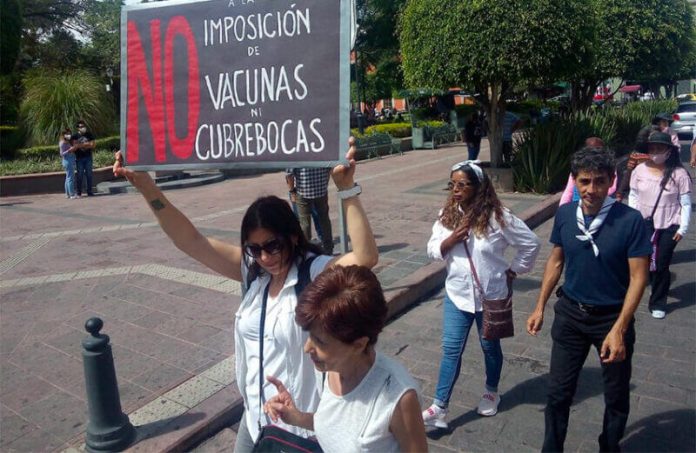
• Abut 50 people staged a protest in downtown Querétaro city on Sunday against coronavirus restrictions, rules requiring the use of face masks and the application of COVID-19 vaccines.
“We want to breathe” and “We want freedom” were among the slogans chanted by people who participated in a protest march from the central square to a nearby park.
The protesters espoused vaccine conspiracy theories such as one that claims they contain microchips and cause human magnetism. They also asserted that COVID-19 vaccines are causing large numbers of deaths.
The protest was held in response to a call on Facebook from a group called Abogados por la Verdad México, or Mexico Truth Advocates. The group has also summoned people to protest in other states around the country.
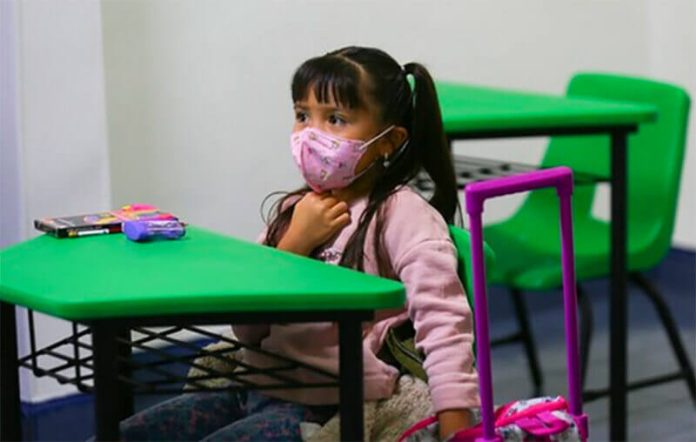
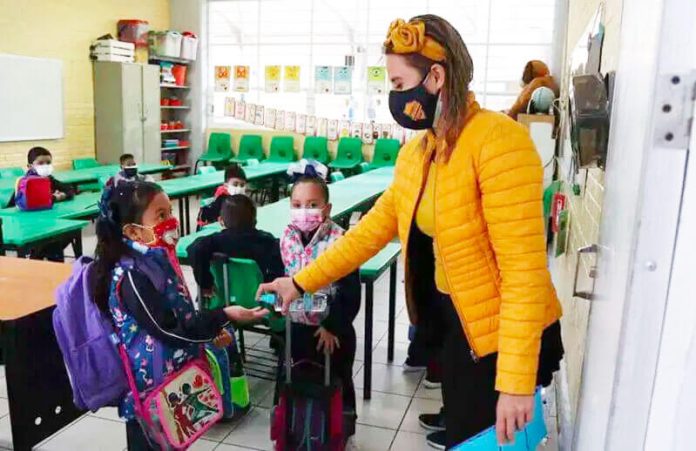
Six-year-old Andrea Ortiz was one of the millions of students who attended classes Monday in Mexico.
Fewer than half of Mexico’s 25 million pre-school, primary school and middle school students returned to the classroom on Monday, according to preliminary data, but the federal education minister believes that the real number of returnees is much higher.
Education Minister Delfina Gómez said Tuesday that schools reopened in 30 states with the only exceptions being Sinaloa and Baja California Sur due to the lingering presence of Hurricane Nora.
Preliminary data showed that 119,497 schools were open on Monday and more than 970,000 teachers and just over 11.4 million students – about 45% of the total – were in attendance, she said.
However, more than 20 million students were expected to have returned to the classroom by Tuesday, Gómez said.
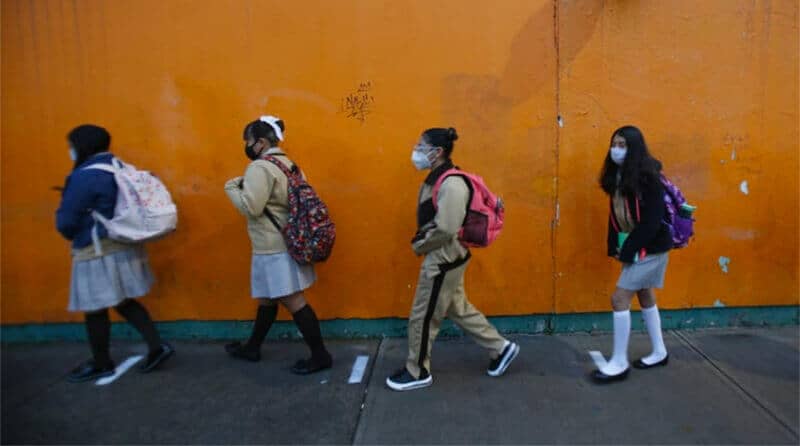
Face masks in place, students make their way to school Monday morning.
“… There are children who didn’t show up yesterday but they’ll turn up today,” she told reporters at President López Obrador’s morning press conference, explaining that some schools are only receiving half their student body on any given day.
“… This week we’re going to be in the data confirmation process,” Gómez said. “We don’t want to give erroneous data, we want to give very precise data.”
The education minister said that she spoke to some of the students who returned to classes on Monday and their overwhelming emotion was one of excitement.
“Some little pre-schoolers said: ‘Is this a school?’ because they’d never been. Others were in third grade when [schools closed], … now they’re in fifth grade. So it was a very exciting situation,” Gómez said.
Many will have a lot of catching up to do now they are back in the classroom.
Gómez said authorities will also seek to get students who dropped out of school during the pandemic back to the classroom.
“In that the participation of UNICEF will be very important, it has been supporting us [in that area],” she said.
Despite the risk of coronavirus outbreaks in schools as Mexico faces a delta variant-driven third wave of the pandemic, Gómez expressed confidence that the return to in-person learning will be a success.
“If each of us does what he or she has to do – parents, teachers, authorities – … I believe there will be very good results,” she said.
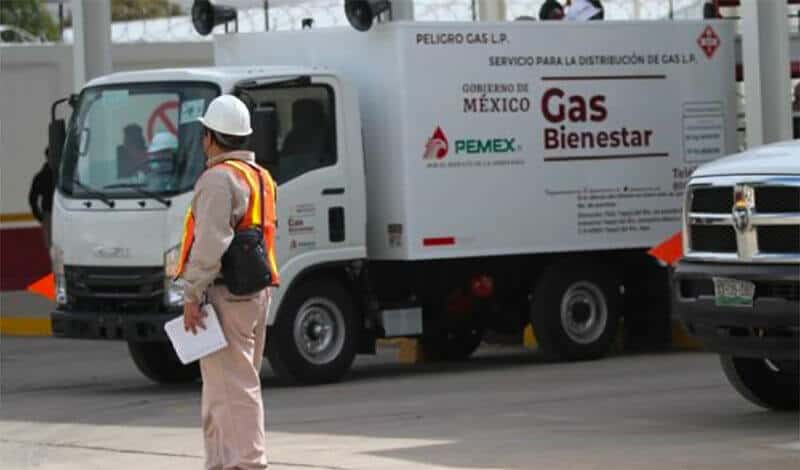
The new state-owned LP gas distribution company began operations in Mexico City on Tuesday.
Pemex CEO Octavio Romero announced that Gas Bienestar (Well-being Gas) would begin delivering 20 and 30-kilogram cylinders of gas in Iztapalapa, a sprawling, working class borough in the capital’s east.
Romero said Gas Bienestar, created as a new division of the state oil company, will soon begin operations in Azcapotzalco, Gustavo A. Madero, Milpa Alta, Xochimilco and Tláhuac and subsequently expand to other Mexico City boroughs.
Appearing via video link from Iztapalapa, Mayor Claudia Sheinbaum said Gas Bienestar will be operating in all 16 boroughs by January. Romero said the aim is to be delivering gas to 1.2 million Mexico City homes by that month.
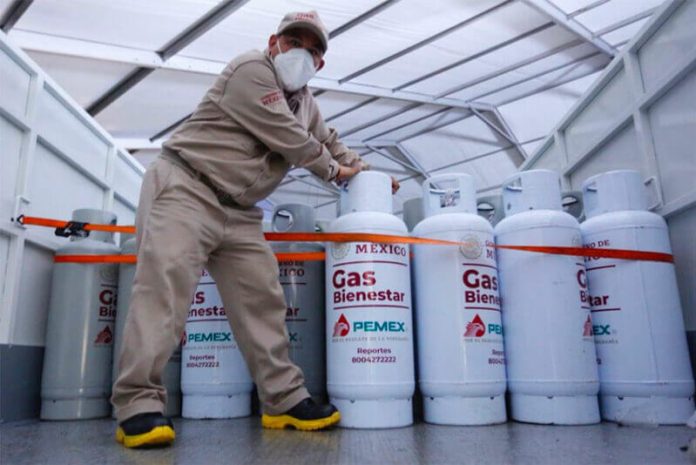
Gas deliveries have begun in Iztapalapa.
That number of customers would give the new distributor 43% market share in the capital.
A three-day distribution trial that concluded Monday demonstrated strong demand for gas supplied by Gas Bienestar, with 98% of just over 9,500 available tanks sold.
Announcing the creation of the new state company last month, López Obrador said that gas prices were particularly high in the capital and for that reason Gas Bienestar would begin operations there before expanding to other parts of the country. Prices across Mexico have risen “unjustifiably” beyond inflation due to a lack of competition in the market, the president said.
But Gas Bienestar will sell LP gas – which most Mexican households use for cooking – at low prices, he pledged.
Romero said Tuesday the Pemex division will sell a 20-kilogram cylinder of gas for 400 pesos (US $20) this week while a 30 kilogram cylinder will cost 600 pesos. Those prices are almost 11% below this week’s price ceilings set by the Energy Regulatory Commission.
In addition to low prices, the Pemex chief outlined three other benefits of purchasing gas from Gas Bienestar. Firstly, every cylinder sold will contain exactly the amount of gas it should, Romero said.
“To guarantee that there is no milking from these tanks, they’ll have an airtight seal,” he said.
Secondly, Gas Bienestar will deliver gas in new cylinders and rehabilitate the old ones it collects by removing rust, changing their valves, painting them and labeling them with the state company’s logo, Romero said. Cylinders that can’t be rehabilitated will be removed from circulation, he said.
Thirdly, gas supplied by Gas Bienestar will last longer than other gas, the CEO claimed. “We’re taking care of the quality of the gas. We’ve done tests against other brands and the Bienestar gas has greater calorific power,” Romero said.
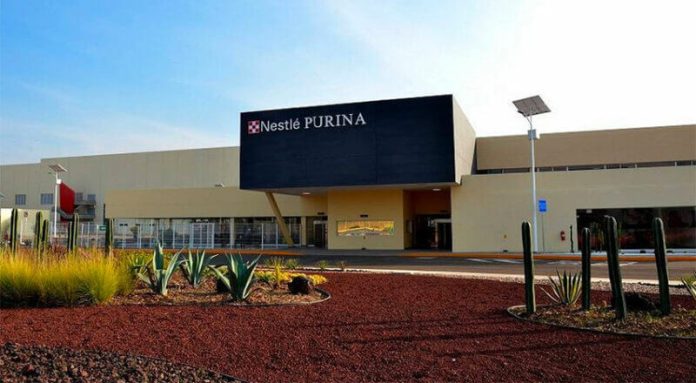
Swiss multinational Nestlé has confirmed that it will invest US $160 million in its pet food plant in León, Guanajuato.
The public confirmation came after Guanajuato Governor Diego Sinhue Rodríguez Vallejo met with Nestlé executives in Geneva, Switzerland, on Monday. The company first announced its intention to invest in the plant in October 2020.
The investment will allow Nestlé to increase its annual production of dry food by 33% to 285,000 tonnes. Wet food production will increase 108% to 25,000 tonnes annually.
The Guanajuato government said in a statement that the $160 million injection will generate more than 200 direct jobs and over 1,700 indirect ones.
“… This investment makes provision for the integration of high-technology equipment, control systems, automatization, tools focused on the digitalization of data and systems that will increase [Nestlé’s] production capacity,” the government said.
“… the expansion will generate new work opportunities in the operation of new processing lines, meeting Nestlé’s focus to boost the employability of Mexican talent in locations such as Silao, Irapuato, Romita, León, Celaya, Cortázar, Salamanca, San Luis de la Paz and [Guanajuato city].”
The plant is located in the Guanajuato Puerto Interior, a dry port facility about 25 kilometers southeast of downtown León.
Sinhue said that confirmation of Nestlé’s investment is good news for Guanajuato, asserting that it was a sign of the reactivation of the state’s economy.
“We’re working to continue generating better employment conditions for Guanajuato residents,” the National Action Party governor said.
Sinhue said that Nestlé, which has been operating in Mexico since 1930, could invest additional resources in the state in the future.
Laurent Freixe, Nestlé’s Americas chief, said the company has a long-term commitment to Mexico and its people.
“… Investments like this … as well as future investments and the main initiatives of the company are a sign of the confidence we have in the potential of Mexico and its people,” he said.
Another European company that is betting that Guanajuato – an industrial hub (and Mexico’s most violent state) – is a good place to manufacture its products is the Italian firm Proma, which makes components for the automotive sector.
Sinhue announced on Twitter on Tuesday that he had visited the firm and that its executives committed to investing 130 million pesos (US $6.5 million) to build a plant in the state.
“This project will generate more than 250 direct and indirect jobs in an initial development of 5,000 square meters in its first stage,” Sinhue wrote, adding that the plant would be eventually be triple that size.
“The Proma management team acknowledged that Guanajuato has the technology and innovation ecosystem for the operation of the company,” he wrote.
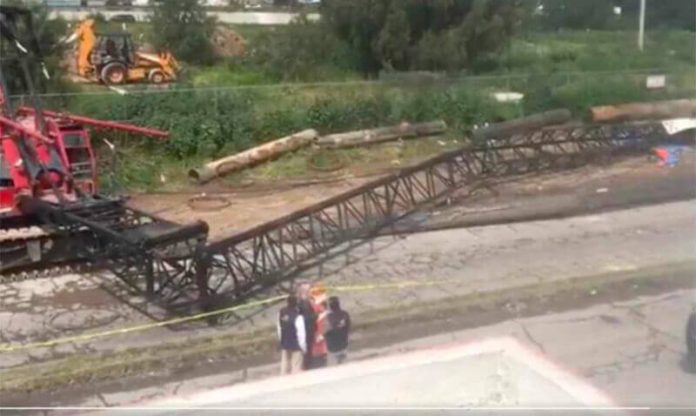
Five workers were killed and two others were injured on Monday when the boom of a crane fell on them at a construction site in Ecatepec, México state.
The accident occurred at about 9:30 a.m. at a site where an elevated section of road that will be part of a new route to the new Mexico City airport is being built.
The federal Ministry of Communications and Transportation (SCT) said on Twitter that the accident occurred when the boom gave way while lifting reinforcing steel, apparently because the load was too heavy.
The steel fell next to the road where the men were working but didn’t harm anyone or cause damage to vehicles, the SCT said.
Ecatepec Civil Protection chief Victoria Arriaga said the injured workers were taken to the Las Americas Hospital in Ecatepec, a municipality that borders Mexico City and is located about 20 kilometers south of the Santa Lucía Air Force base where the new Mexico City airport is currently under construction. Their injuries were not life threatening.
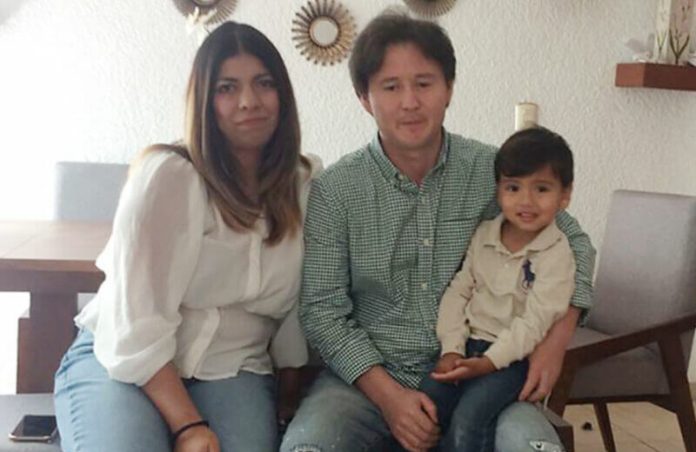
Khalil Bakhtiyari and Fernanda Olivares with their son Alexander at their home in Mexico City. ann deslandes
Mexico made headlines last week when 24 journalists and their families arrived from Afghanistan along with five members of that country’s world-beating girls robotics team. The Afghan arrivals were aided by volunteers and colleagues outside the country to fly to Doha, Qatar, from where they boarded a plane to Mexico City, arriving on Wednesday morning as holders of humanitarian visas granted by the Mexican government.
Foreign Minister Marcelo Ebrard said Mexico was committed to providing refuge for people fleeing Afghanistan since the country fell to the Taliban on August 15.
From his home in Mexico City, Kahlil Bakhtiyari watched the news closely. Perhaps his twin brother Yasin, in hiding in Kabul with his young family, could have the same chance to escape.
The Bakhtiyari family is Hazara, a persecuted ethnic minority in Afghanistan that is a target of the Taliban. On Monday, local media reported a massacre of 14 Hazaras in the center of the country.
Yasin Bakhtiyari also faces grave risk due to having been a captain in the national army. Kahlil says his brother was captured with around 1,000 other soldiers when the Taliban took control of Helmand province in the south of the country.
Yasin escaped to Kabul with some of his fellow soldiers.
“I don’t know how he managed but he escaped. And he called me and said please, please just do something to help us get out of the country,” Khalil Bakhtiyari told Mexico News Daily.
Khalil remembers being a young child in Afghanistan under Taliban rule 20 years ago. “They were killing innocent people. They were totally against women. It is going to be the same story again.”
Indeed, Khalil is worried for the women of his country, saying women colleagues he trained with in dentistry with jobs in hospitals and their own dental clinics have stopped working and are staying at home and living in fear.
With his wife Fernanda Olivares, 31-year-old Kahlil has lived in Mexico City since 2019. The couple have a 3-year-old son, Alexander. They met in India where Kahlil studied dentistry and Fernanda worked in international business.
As the situation continues to deteriorate in Afghanistan, Fernanda and Kahlil have been frantically working on options to get Yasin and his family out of Kabul, as well as Kahlil and Yasin’s sister who is also there with her young family.
Fernanda and Khalil contacted Guillermo Puente Ordorica, Mexico’s ambassador in Iran, who advised that if the family in Kabul could get to Iran, they could receive humanitarian visas to travel to Mexico.
Kahlil also decided to make a video for sharing on social media to raise some of the costs of getting their family out of Afghanistan.
The video has been shared over 500 times and some donations have been received.
Fernanda Olivares said she is glad that the journalists working for U.S. media and the girls robotics team members are now safe. She said the key was that they were able to get out of Afghanistan to another country to receive travel authorization and take a flight to Mexico. “Right now it is the people inside Afghanistan who need the most help, they have the most risk,” she noted, saying it is harder for “an ordinary family” to access asylum.
The airport has been the only way out since the fall of Kabul, and getting there has been an extremely complex and uncertain prospect, with Yasin fearing interception by the Taliban if he travels. On Saturday a suicide bomber attacked the crowds of people trying to get out, killing 169 Afghan civilians and 13 U.S. soldiers and shutting down the terminal.
A large group of countries have since secured an agreement with the Taliban to let people leave Afghanistan. Further, Fernanda and Kahlil were informed Monday by the Foreign Affairs Ministry in Mexico that Yasin’s family could receive a travel authorization to come to Mexico if they are able to get to the airport.
Fernanda and Kahlil have also approached the Australian Embassy in Mexico to see if the family in Kabul could secure asylum in that country.
“My brother was trained by Australian army officers and has many friends there,” he said.
Kahlil Bakhtiyari says his brother also worked closely with U.S. and German army personnel.
The U.S. finished withdrawing all forces from Afghanistan Monday as reports from the streets of Kabul showed Taliban fighters brandishing weapons and celebrating victory.
Khalil and Fernanda say that while violence and insecurity in Mexico is a concern, they feel positive about a future in the country, especially compared to what their family in Afghanistan is going through.
Khalil Bakhtiyari is clinging to hope that his family can get to the Kabul airport this week.
“We don’t have much time. Day by day, the situation is getting worse. If they catch my brother, they will kill him.”
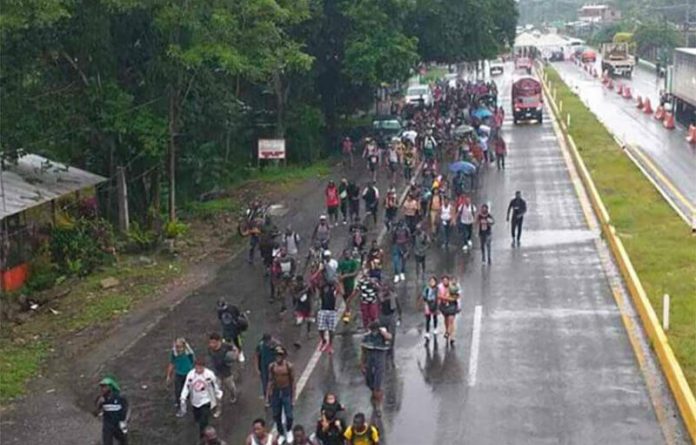
Two immigration agents have been suspended for acting aggressively against migrants who were traveling on foot in Chiapas on Saturday.
The National Immigration Institute (INM) said in a statement that the Chiapas-based agents were suspended for “improper conduct” during an operation on the Tapachula-Arriaga highway near the community of Cruz de Oro. Brutal aggression would be a more accurate description of their conduct.
Video footage posted to social media showed one INM agent kicking and attempting to stomp on the head of a migrant who had been tackled to the ground and punched by another agent.
The caravan members left Tapachula on Saturday after staging protests for several weeks to demand that their asylum cases be extradited. Dozens were detained during the confrontation on Saturday, while others avoided authorities and either returned to Tapachula or continued on their journey northward.
The INM said the decision to suspend the two agents was based on a clause of the Migration Law that states that institute officials must always act in accordance with principles of legality, objectivity, efficiency, professionalism, honesty and respect for human rights.
The agents were formally notified of their suspension on Sunday, the INM said. It reiterated that it won’t tolerate any conduct that doesn’t comply with its protocols and policies.
INM agents and National Guard agents confronted members of the same migrant caravan for a second time on Monday. A group of men that led the caravan was detained by authorities about 10 kilometers south of Mapastepec, a town about 100 kilometers north of Tapachula.
Women begged not to be detained while children were shouting and crying as their fathers were immobilized by INM agents, according to a report by the newspaper El Universal. The detained men were put on buses bound for El Ceibo, a community on Tabasco’s border with Guatemala.
Federal authorities made a second attempt to detain migrants after the caravan had advanced another two kilometers down the highway, but most managed to escape via a nearby mango plantations, El Universal said.
About 200 migrants made it to Mapastepec, where they spent Monday night, and were expected to continue traveling north on Tuesday.
Another caravan of some 400 migrants left Tapachula on Monday morning and a third is expected to depart on Wednesday. Their passage is also likely to be blocked by federal security forces and the INM.
Deputy Interior Minister Alejandro Encinas said Monday that Mexico cannot allow the free transit of undocumented migrants through the country to the United States. He also said the government would not offer transit visas to migrants that would allow them to legally travel to the northern border.
The government has previously issued such visas but stopped granting them after agreeing to the United States’ 2019 request for it to do more to stem the flow of migrants to the Mexico-U.S. border.
Even so, large numbers of migrants have arrived on the United States’ southern border this year. A monthly record of more than 212,000 would-be asylum seekers were detained by U.S. authorities after illegally crossing the border in July.
Students returning to in-person teaching Monday in Mexico City.
Schools across Mexico reopened on Monday 17 months after closing due to the onset of the coronavirus pandemic.
More than 25 million pre-school, primary school and middle school students were due to return to in-person classes but the actual number of returnees was expected to be lower because attendance is voluntary and online learning will continue for the foreseeable future in many states. Approximately 2 million teachers and other educational and administrative staff were also set to return to school.
“It’s a very important day because girls, boys and adolescents are returning to public and private schools. The school year is starting, a great effort has been made,” President López Obrador, a fierce advocate for the reopening of schools, told reporters at his morning press conference.
He predicted that the majority of students would return to in-person classes because “school is irreplaceable” – a place not just of learning but also a center of conviviencia (coexistence or togetherness).
“It has to do with the feelings that boys and girls express to each other,” the president said.
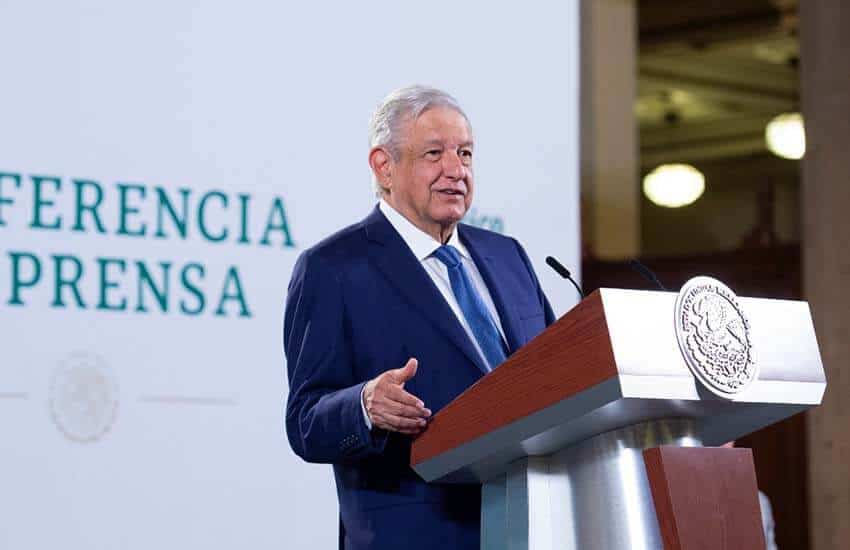
President López Obrador stressed the social importance of students’ return to classrooms at his Monday press conference.
The government forged ahead with the plan to reopen schools on Monday despite Mexico being amidst a delta variant-driven third wave, with daily case numbers currently higher than at any other time of the pandemic.
The Ministry of Public Education (SEP) drew up a range of guidelines aimed at ensuring a safe return to the classroom — among which are social distancing, wearing face masks and frequent handwashing – but it remains to be seen whether students will follow them and school outbreaks will be avoided.
Increasing the likelihood of transmission is the fact that the highly contagious delta strain spreads more readily among children than earlier variants of the virus.
The only states where schools were not scheduled to reopen on Monday were Michoacán – where authorities believe the risk is currently too high — Sinaloa and Baja California Sur. Authorities in the latter two states postponed the resumption of classes due to the passing of Hurricane Nora, which brought heavy rain and flooding to several states over the weekend.
Some teachers were also not expected to return to the classroom on Monday. The CNTE teachers union said that its members wouldn’t be offering in-person classes in Mexico City, Guerrero, Chiapas and Oaxaca because of the risk of infection.
Another obstacle to a smooth reopening is that almost one-quarter of public schools don’t have running water, according to the National Parents Union.
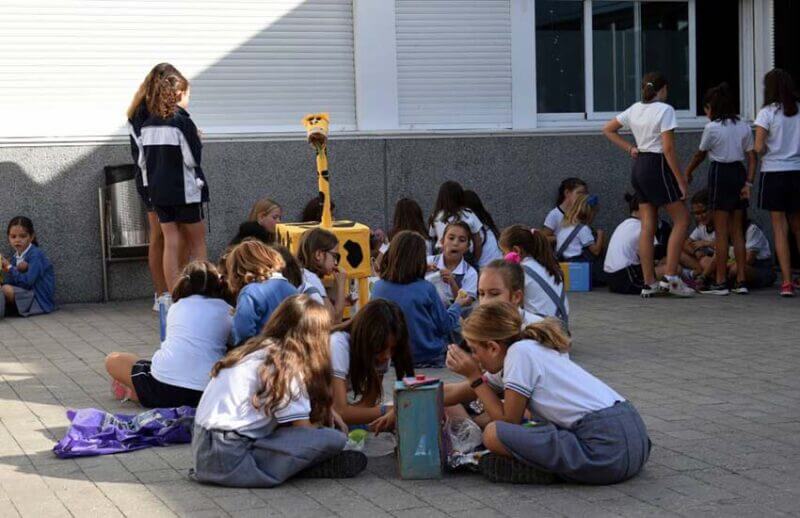
One new issue teachers will face is monitoring that students follow social distancing rules and not congregate closely as seen here in this pre-pandemic photo.
Education Minister Delfina Gómez conceded last Friday that the number of schools lacking the basic conditions required to safely welcome back students and teachers was unknown.
Francisco Landero, an education expert, told the newspaper El Universal that students of different schools will face different situations upon their return to in-person learning. Parents have to make a decision about whether to send their children back to school or not “in the face of the lack of an orderly, systematic and well-thought-out strategy by the federal government,” he said.
Landero noted that federal authorities haven’t contemplated the use of COVID-19 testing for students and teachers as part of their strategy to avoid the spread of the virus. However, some state governments, including those in Jalisco and Querétaro, are planning to do so.
“What is expected is that a large percentage of schools will open on Monday to comply with the presidential mandate, but a lot will move to the hybrid model in about two weeks,” Landero said, referring to a mix of in-person and online classes.
“… The protocols that SEP established don’t guarantee there won’t be infections,” said Rosa María García Jiménez, an education academic at La Salle University in Mexico City.
“Working with children and young people is always a risk,” she said, adding that teachers will not only have to worry about teaching but also monitor students to ensure they don’t hug each other.
The federal government previously said that schools could only reopen in states that are low risk green on the coronavirus stoplight map, a condition currently met by just one state – Chiapas. However, the government recently changed its position, concluding that the benefits of reopening schools outweighed the risks.
“Starting classes is very important. We celebrate that it’s happening because many [students] have been through very difficult … situations. But we’re now heading toward normality and we have a lot of faith,” the president said.
“… I had to wake Jesús up at six in the morning to go to school,” he added, referring to his 14-year-old son.