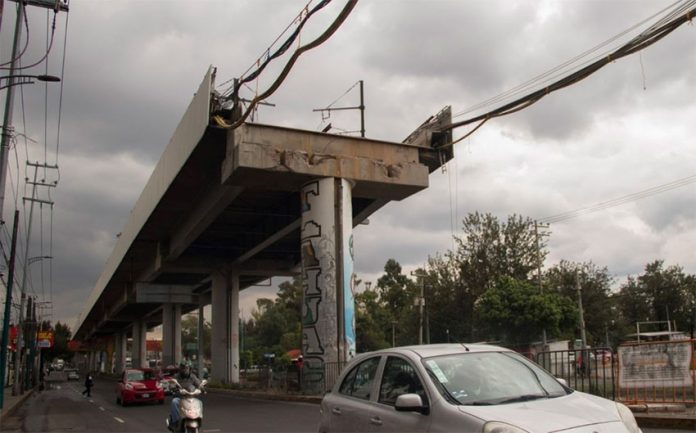
Debris has been removed from the collapsed section of the Metro's Line 12.
The families of 26 people who died in a May 3 accident on Line 12 of the Mexico City Metro system will receive compensation of almost 2 million pesos, more than double the amount previously announced.
The Mexico City government announced Saturday that the families will receive a total of 1.92 million pesos (US $96,800) and outstanding money will be paid this week.
Mayor Claudia Sheinbaum previously announced that families of people who died in the accident – caused by the collapse of an overpass on the elevated section of Line 12 – would receive a total of 700,000 pesos (US $35,300): 650,000 pesos from Metro operator STC and 50,000 pesos from the Mexico City government.
The payout from the STC was raised to 870,000 pesos per family and the Mexico City government’s Executive Commission for Attention to Victims (CEAVI) will contribute an additional 1 million pesos.
“We will send the notification and in the course of this week we will begin to deliver the amount of this additional 1 million pesos,” CEAVI chief Armando Ocampo told a press conference.
He said that 23 of the 26 families have already received 870,000-peso payments from the STC. The city is also providing educational scholarships and jobs to family members of people who were killed or injured in the Metro disaster.
Lawyers for victims’ families said last month they would seek compensation payments of tens if not hundreds of millions of pesos. Cristopher Estupiñán, a lawyer with the Nuevo León law firm Carbino Legal, said he and The Webster Law Firm of Houston, Texas, would seek large payments for their clients via legal action in the United States.
The firms intend to sue the three companies that built Line 12: Grupo Carso, owned by billionaire businessman Carlos Slim, Grupo ICA of Mexico and Alstom of France, all of which have offices in the U.S.
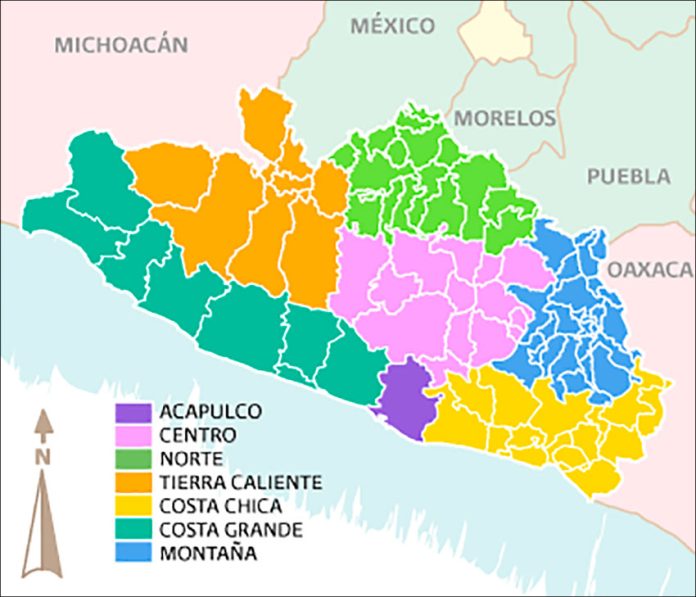
The Tierra Caliente region of Guerrero is indicated in orange.
Organized crime achieved their electoral objective in the Tierra Caliente region of Guerrero: the candidates they backed – most of whom represented Mexico’s once omnipotent Institutional Revolutionary Party (PRI) – won the June 6 elections.
In the region located in northern Guerrero on the border with both Michoacán and México state, criminal organizations only allowed certain candidates to campaign in the lead-up to the elections, according to a report published Monday by the newspaper El Universal.
“And they were the ones who won the June 6 elections,” the report said. “Some people were not even allowed to register, others couldn’t start their campaigns and a few more quit halfway [through the campaign period] due to pressure. There were no murders but there were kidnappings, torture and intimidation as well as threats against aspirants and candidates.”
Criminal groups also told the region’s businesspeople whom they should support in the elections, El Universal said.
According to Guerrero and federal authorities, the Jalisco New Generation Cartel (CJNG), the Familia Michoacana and a cell of the Caballeros Templarios, or Knight’s Templar cartel, are among the crime groups that operate in Tierra Caliente. The two latter groups are allied and dominate Guerrero’s “hot lands,” El Universal said.
The newspaper reported that halfway through the campaign, a Tierra Caliente politician – who spoke to El Universal on the condition of anonymity due to security concerns – predicted that the PRI would sweep the elections in the region.
“He didn’t make the prediction according to electoral preferences at the time, his reasoning was more primitive: survival,” the report said.
“They [the criminal groups] have already given the indication that only the PRI candidates will be allowed to campaign, and in [the municipality of] Tlalchapa, Morena [is the preferred party],” the politician said, adding that other candidates were warned they would face “problems” if they didn’t follow the order to stay off the campaign trail.
As the unnamed politician predicted, the PRI – along with its ally, the Democratic Revolution Party – did indeed sweep elections in the region, prevailing in all municipalities except Tlalchapa and Zirándaro, where Morena won.
PRI candidates also won the state and federal electoral districts that are located in the area and the party’s candidate for governor, Mario Moreno Arcos, was more popular among Tierra Caliente voters than Morena’s Evelyn Salgado, who triumphed in the gubernatorial race.
Asked before the elections what would happen if a candidate not endorsed by organized crime won, the unidentified politician responded: “Nothing, they’ll sit him [or her] down and tell him [or her] what to do.”
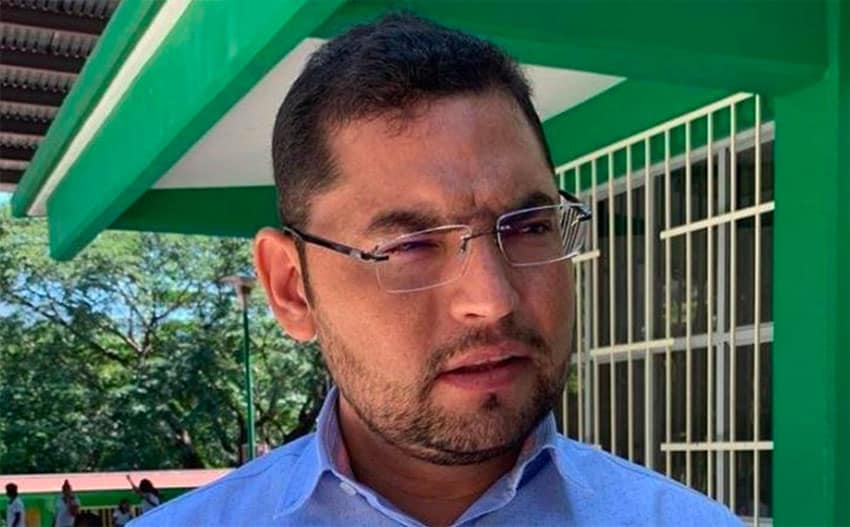
Zirándaro’s Mayor Portillo: ‘The majority of the councils are controlled by crime.’
If elected officials such as mayors are going to be controlled by crime groups even if they weren’t their preferred candidates, why intimidate them in the first place, the politician was pressed by El Universal.
“Surely they owe favors to those from the PRI,” he responded. “What favors?” the newspaper probed. “Protection,” the politician replied.
In Zirándaro, Morena party Mayor Gregorio Portillo was kidnapped in March, allegedly by the Familia Michocana, and told not to stand for reelection.
“They abducted me, they tortured me to oblige me not to seek the candidacy for reelection for one reason: they’re annoyed because we didn’t give them money,” he said.
“Installing someone who will follow their orders, who will yield to their rules is necessary for them. In my case, as there was no way to do that through dialogue, there was the necessity to show me they have the capacity to kill me,” said the mayor, who was released but hasn’t set foot in Zirándaro for two months out of fear for his life.
Portillo told El Universal that he was caught in the middle of a dispute between the CJNG – a cartel to which he reportedly has links – and the Familia Michoacana.
“What they asked me was to use the government to move the army from one place to another. At that time, they didn’t ask me for money, they asked me to intervene, to negotiate with the army, to ask for security in certain areas that benefited them. As I didn’t do it, they got annoyed,” the outgoing mayor said.
“… Tierra Caliente … is the only region where there is such extreme [criminal] control that other candidates [not endorsed by organized crime] are not allowed to participate [in the elections]. It’s understandable – the municipalities are a source of funding [for narcos]. The majority of the councils are controlled by crime,” he said.
While Portillo was ordered not to stand for reelection, Morena remained the favored party of at least one organized crime group in Zirándaro. The PRI-PRD candidate, Jaime Torres García, had to flee the municipality halfway through the campaign due to threats, El Universal said.
In the neighboring municipality of Coyuca de Catalán, Morena mayoral candidate Rey Hilario Serrano was also threatened by organized crime and ultimately forced out of the election. The same thing happened to Morena candidate Francisca Baltazar Bravo in Pungarabato.
In Cutzamala, Citizens Movement (MC) party candidate Marilú Martínez Núñez was kidnapped along with her two children, her mother and two members of her team just days before the election. She was released but only after her captors forced her to withdraw from the election.
Rosa Jaimes López, the PRI candidate and wife of current Mayor Timoteo Arce Solís, won the mayoral election in Cutzamala. The head of the MC in Guerrero, Adrián Wences Carrasco, claimed that Arce could have been behind the abduction.
Four MC candidates were forced to withdraw their candidacies in the Tierra Caliente region due to threats by organized crime, according to Wences.
Criminal groups also interfered in the elections in other parts of Guerrero, El Universal reported, noting that 55 candidates had to be accompanied by police as they campaigned due to fears they could be the target of attacks. Two mayoral pre-candidates, one who aspired to the PRD candidacy in Chiapa and a Morena party hopeful in Pilcaya, were murdered in Guerrero late last year.
Despite the well-documented political violence in the southern state, President López Obrador claimed last Thursday that “no candidate suffered an attack” in Guerrero during the election season.
The day after the elections, the president asserted that organized crime groups “behaved very well” as citizens cast their ballots, while just days before voters went to the polls, he claimed there was “peace and tranquility” in the entire country.
However, the campaign period leading up to the elections was the most violent on record in Mexico, according to risk analysis firm Etellekt, which tracks electoral violence, with more than 1,000 acts of aggression against politicians and candidates, including more than 100 murders.
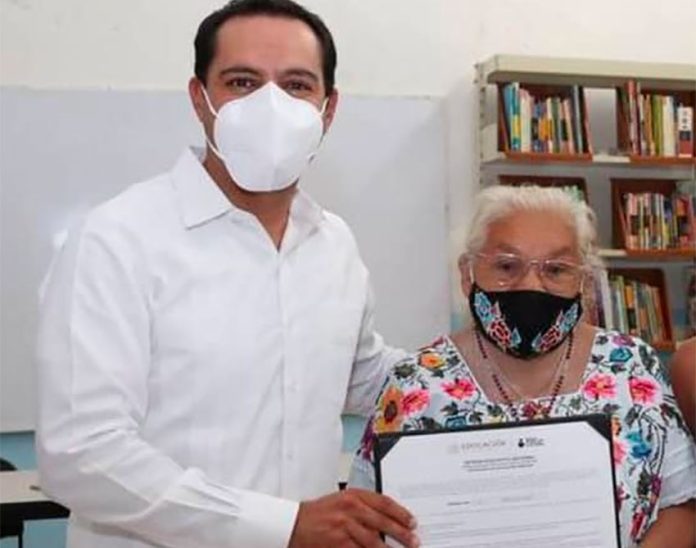
Primary school grad María Luisa Paredes and Governor Vila.
A woman who went back to school in her 60s has graduated from primary school at the age of 70.
María Luisa Paredes Durán from Muna, Yucatán, was motivated to join the program for older learners so that she could learn to read and study the Bible without help from others.
State Governor Mauricio Vila Dosal surprised Paredes by being present to award her certificate at the offices of the state’s adult education institute, which runs the program.
Paredes joined 29 other older learners on the three-year program in 2018 in which they studied reading, writing and basic mathematics. She found out about the opportunity thanks to a local teacher, who was a loyal customer where she sold tamales and other dishes.
The great-grandmother of 10 said she was born into a culture where education wasn’t seen as a priority. “I never believed that I could finish primary school, because when I was a child my mother and grandmother taught me to dedicate myself to housework. I was inspired to enter school because I wanted to be able to read the Bible alone,” she said.
She added that she appreciated being able to help younger family members with their homework, and was delighted to meet the governor. “I feel very proud of this achievement that brings joy to my family. Before, my grandchildren or my son helped me to read the Bible, but now I can engage with their homework and I understand it. It is a great opportunity that they offer to old people like me. In my 70 years I have never had the fortune of meeting a governor in person and I’m really grateful for his support,” she said.
Governor Vila offered his congratulations to the new graduate. “It is a great achievement, and that is why I came to give you your certificate and tell you that we are very proud of you, because we know that it is not easy,” he told her.
Paredes also offered words of motivation for other people her age. “It is never too late to learn and going to this school has changed my life. Now, activities like reading, running errands and other things have become much easier,” she said.
This small wedding in March, including Zapotec nuptials, was for a couple who, due to the pandemic, couldn't have a traditional wedding. Oaxaca Ancestral
Slowly, ever so slowly, people are thinking about returning to the business of living after over 1 1/2 years of the pandemic — and that includes weddings.
All of Mexico’s tourism sectors were hit hard by the pandemic. But destination weddings were devastated, with over 80% of nuptials canceled or postponed since the health emergency began, according to Mexico’s Tourism Ministry in February.
Mexico suffered a double whammy since not only did people not want to travel great distances, harsh restrictions on group gatherings made putting on weddings difficult to impossible.
Before the pandemic, Oaxaca ranked fourth in Mexico for destination weddings, providing couples from out of state and internationally a romantic backdrop to their vows. In Mexico, where federal tourism authorities have been promoting such weddings since 2014, such events were a relatively recent but fast-growing phenomenon. They increased by 50% between 2011, when the government started tracking such weddings, and 2016.
In 2019, the website Destination Weddings listed Mexico as topping the list of foreign wedding locations for “many happy couples who are headed for the altar.”
Large wedding reception before the pandemic held at the Catedral de Oaxaca restaurant in Oaxaca city. Catedral de Oaxaca
The majority of couples who typically choose Oaxaca as their nuptials staging ground are from Mexico, but the state is seeing an increasing share of the Americans, Canadians and even Europeans who come to Mexico for the wedding of a lifetime. Oaxaca and the rest of Mexico have been particularly popular with couples looking to elope (the type of wedding that suffered the least during the pandemic), but large weddings and even renewals of vows ceremonies had been steadily increasing.
The paralysis of this industry in 2020 left about 200 businesses in dire straits statewide that are only now starting to recover. Wedding licenses are still being issued in Oaxaca but with strict restrictions related to crowds.
The uptick in bookings for the future gives some hope that these restrictions will soon ease.
Mexico is famous for two types of destination weddings: those by the ocean and those among the majestic buildings of colonial cities. Oaxaca is one of few states that offers both. And despite being a conservative state, some areas of Oaxaca have also been open to gay weddings since 2014 — and more so after the state Congress approved legal weddings of this type in 2019.
Huatulco is the most popular Oaxaca destination for those looking for an oceanside wedding. One reason is its abundance of all-inclusive resorts such as Dreams Huatulco and Secrets Huatulco, which allow for everything to be provided in one place.
One of Huatulco’s unique advantages is its ecotourism, with nine beautiful bays, 36 beaches and lush tropical vegetation. The smaller coastal resort town of Zipolite (famous for its clothing-optional beach) is popular with couples looking for alternative ceremonies and, increasingly, gay weddings.
Many who come to get married in Oaxaca want to get married by the ocean: a wedding at Punta Cometa on the Oaxaca coast. Mazunte Pueblo Mágico
The inland city of Oaxaca, the state capital, is the main attraction for those looking for backdrops of pre-Hispanic and colonial buildings made of centuries-old massive stone blocks. The city offers sophisticated accommodations and cuisine such as what is found at the Catedral de Oaxaca restaurant, located in a former 19th-century mansion next to the main cathedral.
Coastal weddings in Oaxaca are still more popular among foreigners than those in the state capital, but Adriana Aguilar Escobar of Catedral de Oaxaca says this is changing, with more foreigners returning to the city after being enchanted by it from an earlier visit.
Some hardy souls who have decided not to wait have opted for alternatives such as “pop-up” weddings, initially made popular in Lisbon, Portugal. These are very small affairs of about 15 people lasting only a few hours at most, with the idea that the larger celebration would be held later after the pandemic is over. They have been more common in the Caribbean and San Miguel de Allende, but this type of wedding has been celebrated in Oaxaca as well.
One interesting accommodation of the pandemic was an event sponsored by Oaxaca wedding planner Nancy Romero and the BADABUN video company. Romero is very active in an organization called Oaxaca Ancestral, a non-profit organization seeking to protect and preserve native cultures. They put out a call to couples unable to have a traditional wedding due to the pandemic and offered them a traditional Zapotec ceremony presided by someone accredited by his community to perform it.
Various couples applied. One was chosen based on their reasons for wanting the ceremony.
Such ceremonies are not legal in Mexico (only the civil registry can perform legal weddings), but they are an option for those who feel the need for something spiritual.
A traditional Zapotec ceremony that was offered to a couple unable to have a traditional wedding.
Getting married in Oaxaca is legal and recognized worldwide, but there are certain requirements, both by Mexico and the state of Oaxaca. These requirements vary depending on whether one or both persons are foreigners. Wedding planners are recommended as the process can seem daunting despite the federal requirements being available online in English.
There is no reason to believe that the destination wedding industry in Oaxaca won’t eventually rebound. Mexico continues to be an attractive destination because it has the ability to accommodate large parties traveling to the same place, and Oaxaca offers most of what is available just about anywhere else in Mexico, including pristine beaches, extreme sports, majestic architecture and even Pueblos Mágicos (Magical Towns), which are growing in popularity as wedding backdrops.
In addition, the state offers some of the best-preserved indigenous and other traditional cultures that few other areas in Mexico can match.
Leigh Thelmadatter arrived in Mexico 18 years ago and fell in love with the land and the culture in particular its handcrafts and art. She is the author of Mexican Cartonería: Paper, Paste and Fiesta (Schiffer 2019). Her culture column appears regularly on Mexico News Daily.
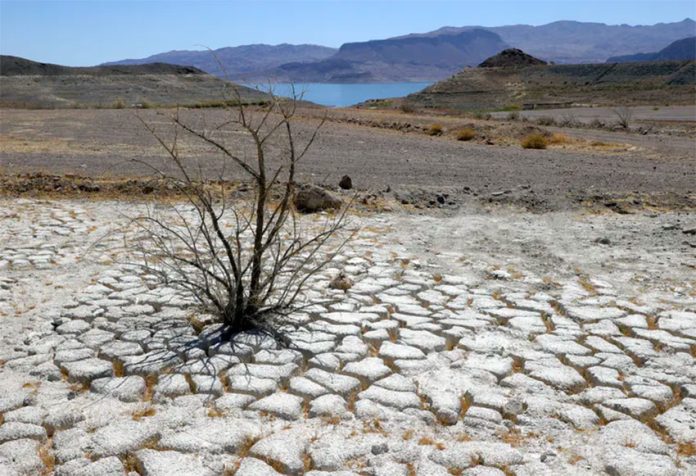
Lake Mead, which serves seven U.S. states and three in Mexico, is drying up. Ethan Miller/Getty Images
The United States and Mexico are tussling over their dwindling shared water supplies after years of unprecedented heat and insufficient rainfall.
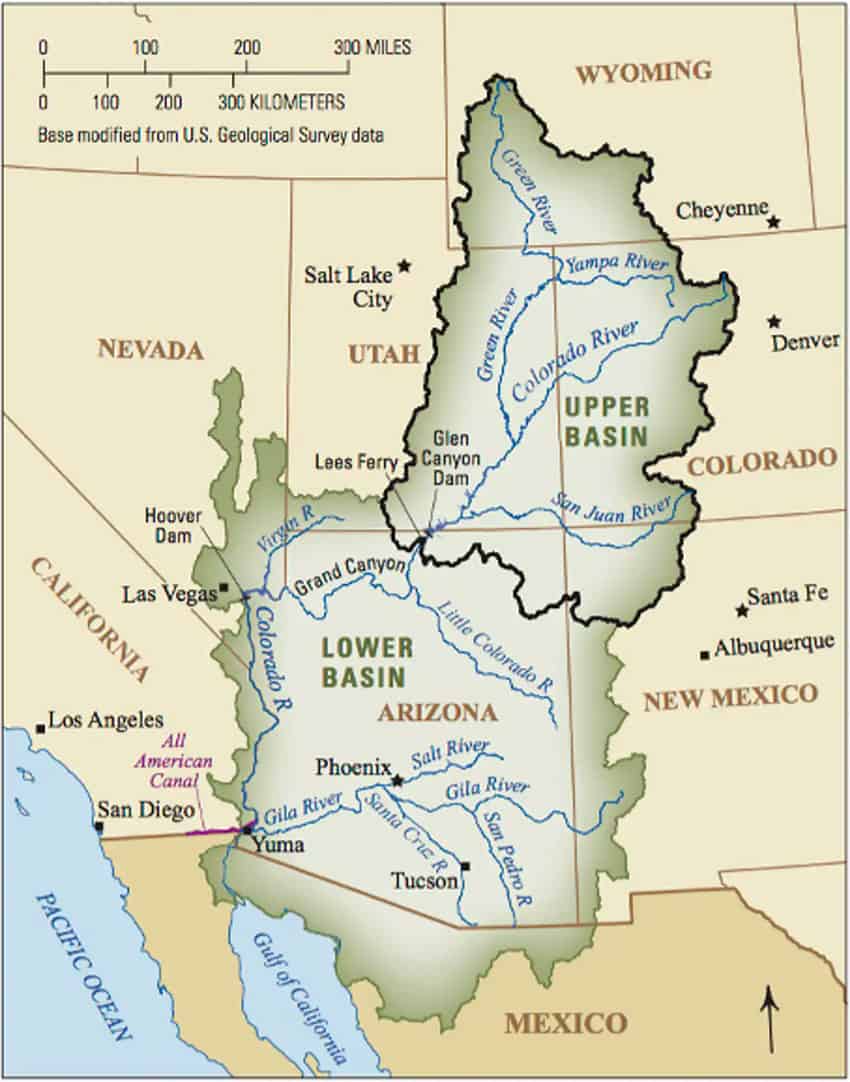
Sustained drought on the middle-lower Rio Grande since the mid-1990s means less Mexican water flows to the U.S. The Colorado River Basin, which supplies seven U.S. states and two Mexican states, is also at record low levels.
A 1944 treaty between the U.S. and Mexico governs water relations between the two neighbors. The International Boundary and Water Commission it established to manage the 450,000-square-mile Colorado and Rio Grande basins has done so adroitly, according to our research.
That able management kept U.S.-Mexico water relations mostly conflict-free. But it masked some well-known underlying stresses: a population boom on both sides of the U.S.-Mexico border, climate change and aging waterworks.
The mostly semiarid U.S.-Mexico border region receives less than 18 inches of annual rainfall, with large areas getting under 12 inches. That’s less than half the average annual rainfall in the U.S., which is mainly temperate.
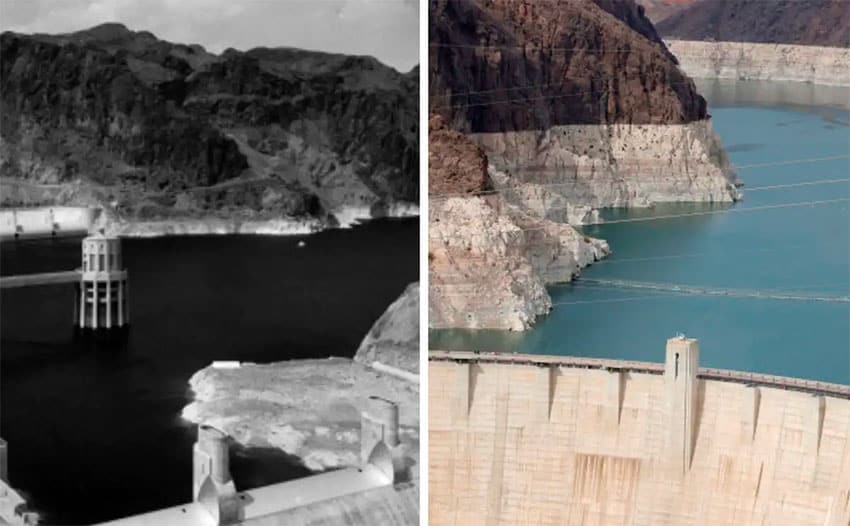
Lake Mead circa 1950, left, and Lake Mead in June 2021. The surrounding cliffs show the substantial drop in water level. William M. Graham/Archive Photos/Getty Images and Ethan Miller/Getty Images
The 1940s, however, were a time of unusual water abundance on the treaty rivers. When American and Mexican engineers drafted the 1944 water treaty, they did not foresee today’s prolonged megadrought.
Nor did they anticipate the region’s rapid growth. Since 1940 the population of the 10 largest pairs of cities that straddle the U.S.-Mexico border has mushroomed nearly twentyfold, from 560,000 people to some 10 million today.
This growth is powered by a booming, water-dependent manufacturing industry in Mexico that exports products to U.S. markets. Irrigated agriculture, ranching and mining compete with growing cities and expanding industry for scarce water.
Today, there’s simply not enough of it to meet demand in the border areas governed by the 1944 treaty.
Three times since 1992 Mexico has fallen short of its five-year commitment to send 1.75 million acre-feet of water across the border to the U.S. Each acre-foot can supply a U.S. family of four for one year.
In the fall of 2020, crisis erupted in the Rio Grande Valley after years of rising tensions and sustained drought that endanger crops and livestock in both the U.S. and Mexico.
In September 2020, Texas Gov. Greg Abbott declared that “Mexico owes Texas a year’s worth of Rio Grande water.” The next month, workers in Mexico released water from a dammed portion of Mexico’s Río Conchos destined to flow across the border to partially repay Mexico’s 345,600-acre-foot water debt to the U.S.
Frustrated farmers and protesters in the Mexican state of Chihuahua clashed with Mexican soldiers sent to protect the workers. A 35-year-old farmer’s wife and mother of three was killed.
Mexico also agreed to transfer its stored water at the Amistad Dam to the U.S., fulfilling its obligation just three days before its October 25, 2020, deadline. That decision satisfied its water debt to the U.S. under the 1944 treaty but jeopardized the supply of more than a million Mexicans living downstream of Amistad Dam in the Mexican states of Coahuila and Tamaulipas.
The U.S. and Mexico pledged to revisit the treaty’s Rio Grande water rules in 2023.
The drought dilemma on the Colorado River is similarly dire. The water level at Lake Mead, a major reservoir for communities in the lower Colorado River Basin, has dropped nearly 70% over 20 years, threatening the water supply of Arizona, California and Nevada.
In 2017, the U.S. and Mexico signed a temporary “shortage-sharing solution.” That agreement, forged under the authority of the 1944 treaty, allowed Mexico to store part of its treaty water in U.S. reservoirs upstream.
The Colorado River Basin. U.S. Geological Survey
Water shortages along the U.S.-Mexico border also threaten the natural environment. As water is channeled to farms and cities, rivers are deprived of the flow necessary to support habitats, fish populations and overall river health.
The 1944 water treaty was silent on conservation. For all its strengths, it simply allocates the water of the Rio Grande and Colorado rivers. It does not contemplate the environmental side of water use.
But the treaty is reasonably elastic, so its members can update it as conditions change. In recent years, conservation organizations and scientists have promoted the environmental and human benefits of restoration. New Colorado River agreements now recognize ecological restoration as part of treaty-based water management.
Environmental projects are underway in the lower Colorado River to help restore the river’s delta, emphasizing native vegetation like willows and cottonwoods. These trees provide habitat for such at-risk birds as the yellow-billed cuckoo and the Yuma clapper rail, and for numerous species that migrate along this desolate stretch of the Pacific Flyway.
Currently, no such environmental improvements are planned for the Rio Grande.
But other lessons learned on the Colorado are now being applied to the Rio Grande. Recently, Mexico and the U.S. created a permanent binational advisory body for the Rio Grande similar to the one established in 2010 to oversee the health and ecology of the Colorado.
Another recent agreement permits each country to monitor the other’s use of Rio Grande water using common diagnostics like Riverware, a dynamic modeling tool for monitoring water storage and flows. Mexico also has agreed to try to use water more efficiently, allowing more of it to flow to the U.S.
Newly created joint teams of experts will study treaty compliance and recommend further changes needed to manage climate-threatened waters along the U.S.-Mexico border sustainably and cooperatively.
Incremental treaty modifications like these could palpably reduce the past year’s tensions and revitalize a landmark U.S.-Mexico treaty that’s buckling under the enormous strain of climate change.
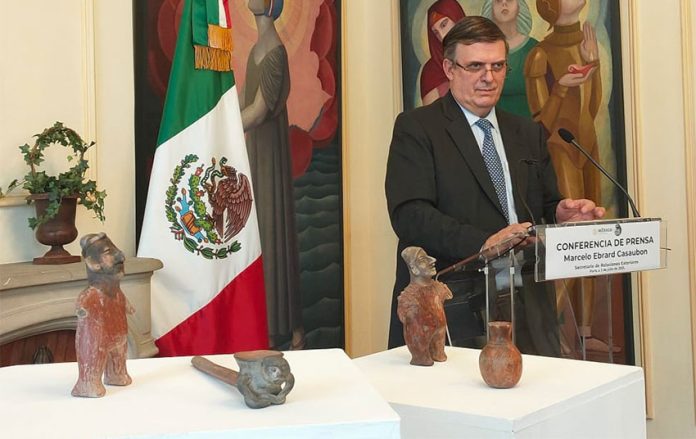
Foreign Minister Ebrard and the four pieces on display at a ceremony Friday in Paris.
A French family returned four pre-Hispanic clay artifacts to Mexico in a ceremony held Friday in the Mexican Embassy in Paris.
Foreign Minister Marcelo Ebrard, who attended the ceremony, said the figurines, vessel and pipe – which are possibly more than 2,000 years old – will be placed in the care of the National Anthropology Museum in Mexico City.
Three of the pieces are believed to be from western Mexico and one likely originates in the country’s Gulf region, according to Íngrid Arriaga of the Cultural Institute of Mexico in France.
The two human-form figurines probably came from shaft tombs that were used in parts of the country where the modern day states of Jalisco and Nayarit are located.
Arriaga told the news agency AFP that the bulbous vessel returned by the family is typical of artifacts from western Mexico, while a pipe in the form of a zoomorphic figure is typical of the Gulf region, home to the Olmecs, widely regarded as creators of the first civilization in Mesoamerica.
Tres piezas período clásico occidente (Nayari) y otra, más antigua, proveniente del Golfo de México nos fueron restituidas hoy. Avanzamos cada día para dificultar el tráfico ilícito y recuperar nuestro patrimonio histórico y cultural. pic.twitter.com/Qb9CP5YVWO
“Being able to recover these goods is a great thing for us,” Ebrard told a press conference in the French capital.
“We’re making progress every day in making illegal trafficking more difficult and recovering our historical and cultural wealth,” said the foreign minister, who shared a video of the recovered pieces on his Twitter account.
The family who returned the artifacts requested anonymity. The day before they were given back, Mexican and French officials signed an agreement committing to strengthen bilateral cooperation against the illegal trafficking of cultural artifacts.
Mexico has increased efforts in recent years to recover pre-Hispanic artifacts that left Mexico – some of which were looted from archaeological sites – and found their way to private collections, as well as the auction block in some cases. But it has had difficulty recovering pieces from France due to the laws in that country.
The auction house Christies sold 36 of 39 Mesoamerican and Andean artifacts that went on the block in Paris in February, including 30 Mexican pieces. The auction, which raised more than US $3 million, went ahead despite protests by the Mexican government.
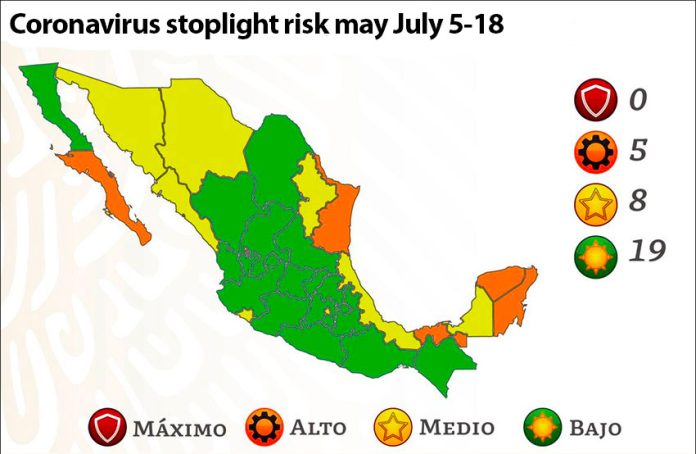
Nineteen states will remain low risk green until at least July 18, eight will stay at the yellow light medium risk level and five will maintain their orange light high risk status.
In the green light category are Aguascalientes, Baja California, Chiapas, Coahuila, Durango, México state, Guanajuato, Guerrero, Hidalgo, Jalisco, Michoacán, Morelos, Nayarit, Oaxaca, Puebla, Querétaro, San Luis Potosí, Tlaxcala and Zacatecas.
The yellow light states are Campeche, Chihuahua, Colima, Mexico City, Nuevo León, Sinaloa, Sonora and Veracruz, while the orange light entities are Baja California Sur, Quintana Roo, Tabasco, Tamaulipas and Yucatán.
Although the lights didn’t change, two states recorded new records.
Two of the orange light states – Quintana Roo and Yucatán – recorded new daily records for coronavirus cases this week, with more than 400 confirmed in the former state on Thursday and over 300 in the latter on Friday. The highly infectious Delta strain of the virus is circulating in both Quintana Roo and Yucatán as well as many other Mexico states, according to health authorities.
Nationwide, the federal Health Ministry reported 5,879 new cases on Friday and 177 additional Covid-19 deaths, pushing the accumulated tally to 2.53 million infections and 233,425 fatalities. New case numbers have trended upwards recently, raising fears that Mexico is in or entering a third wave of the pandemic.
Meanwhile, updated Health Ministry excess mortality data shows that more than 447,000 fatalities are attributable to Covid-19, an increase of almost 130,000 compared to data published in March. The figure is almost double the official death toll.
An analysis published in May by the Institute for Health Metrics and Evaluation (IHME) at the University of Washington School of Medicine showed that more than 617,000 people had likely died from Covid in Mexico.
Reported Covid-19 deaths had decreased every month since February after almost 33,000 were recorded in January – the worst month of the pandemic – but spiked 42.3% in June to 9,479 from 6,661 in May.
Just under 32 million people have received at least one shot of a vaccine, of whom 19.7 million are fully vaccinated, according to the most recent Health Ministry data. The former figure represents 38% of the adult population but it doesn’t include Mexicans who have traveled to the United States to get vaccinated.
According to The New York Times vaccinations tracker, Mexico ranks 72nd out of 182 countries listed for doses administered per 100 people. Mexico has given 36 shots per 100, the tracker shows, and 25% of the entire population – adults and children – has received at least one dose.
The camp at Chaparral in a photo taken in early May.
Conditions at informal migrant camps on the northern border are worsening, becoming increasingly unsanitary and crowded as more north-bound migrants arrive, according to a report by the Associated Press.
U.S. President Joe Biden has ended former president Trump’s “Remain in Mexico” policy, which forced asylum seekers to wait for their immigration court appointments in Mexico. President Biden also eased, but did not end, pandemic restrictions that prevent migrants from seeking asylum in the United States. But many migrants still have not been able to enter the U.S., and more keep arriving at the border.
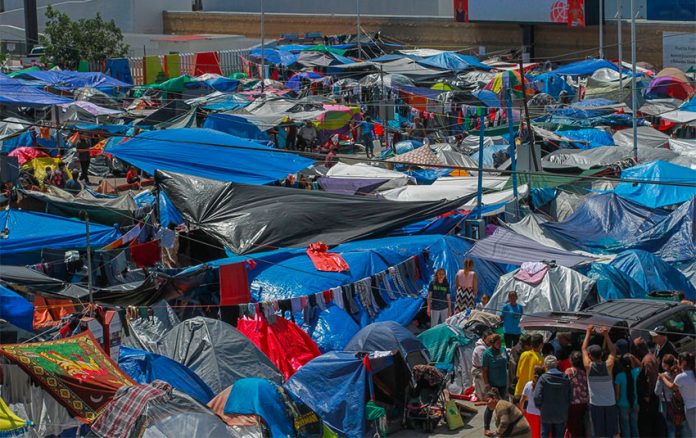
One such camp is El Chaparral near the Tijuana-San Diego border crossing. Hundreds of families live under plastic tarps without bathrooms, and vulnerable to the weather and criminal gangs.
“The children are getting sick with diarrhea, they’re getting fevers and infections because there are a lot of flies around,” said Karitina Hernández, 63. “There is no sanitation, there is garbage around, excrement, urine.”
Hernández fled violence in Guerrero after a gang killed one of her sons and threatened her. She and her family have been living for weeks in a tent in El Chaparral. Her neighbors include roughly 2,000 migrants from Mexico, Haiti and Central America.
The Mexican Human Rights Commission issued a warning weeks ago about conditions in the camps and municipal authorities want to shut it down. But migrants fear that if they leave, they could miss their chance to enter the U.S.
A similar camp of asylum seekers in Matamoros, near Brownsville, Texas, was shut down in March. But more migrants keep arriving. Shelters in Tijuana ran out of room and migrants had nowhere to go.
The migrants are vulnerable to kidnapping and extortion by gangs, said Nicole Ramos, an activist with the migrant aid group Al Otro Lado.
“The United States says its laws and programs are there to protect the migrant community from traffickers, but now they are doing even more business,” Ramos said.
Another migrant, Armando Hernández, fled violence in Michoacán with his two sons. He expressed frustration with the admissions process.
“What proof do I need? To come here with my guts shot out?” he asked.
The year was 1821 and Mexican military leader Agustín de Iturbide had just signed the document that gave Mexico its independence from Spain.
As de Iturbide and his army passed through Puebla, the nuns of the convent of Santa Mónica decided to serve him a special meal to celebrate their new country, and chile en nogada was born. Now, 200 years later, Puebla is celebrating the dish with a variety of festivities from now until September 15.
The traditional Puebla dish features the colors of the Mexican flag: green chiles stuffed with meat and fruit in a white nut-based sauce, garnished with red pomegranate seeds. To celebrate the tricolor dish, Puebla has organized master classes with international chefs, food festivals in Calpan and Tehuacán, and the unveiling of a commemorative plaque, among other activities.
There will be a screening of a documentary about chile en nogada and the dish will participate in New York’s international chile festival. The period of festivities will also include the publication of a book on the subject, a traveling exhibition on the origin of the ingredients and to wrap it all up, a concert by the state symphonic orchestra.
And chile en nogada is not just a delicious local specialty. It also bring economic benefits to the region, according to Puebla restaurant association president Olga Mendéz. She said that more than 15,000 restaurants in Puebla serve the dish and that in 2021, the sale of chile en nogada will bring in 800 million pesos (US $40.5 million).
Other states including Querétaro, Oaxaca and México state have expressed interest in promoting the dish among their residents, leading the restaurant association to offer presentations on the Puebla method for preparing chile en nogada, so that more people can enjoy a tasty part of Mexican history.
Gas burns on the ocean surface in the Gulf of Mexico on Friday.
The ocean was ablaze in the Gulf of Mexico on Friday after a Pemex underwater gas pipeline ruptured and caught fire.
The fire started around 5:15 a.m. when a 12-inch gas duct sustained a valve failure. The accident occurred 150 meters from the Ku-C drilling platform in the Ku-Maloob-Zaap extraction complex, located on the Bank of Campeche. The Ku-C platform was unoccupied at the time and there were no injuries reported.
Pemex closed the duct and dispatched fire control boats to pump water over the flames that boiled up from the deep. While the accident did not affect the operations of Ku-Maloob-Zaap the extent of environmental damage caused is unclear.
The incident drew widespread criticism from environmental groups.
“The frightening footage of the Gulf of Mexico is showing the world that offshore drilling is dirty and dangerous,” said Miyoko Sakashita, oceans program director for the Center for Biological Diversity. “These horrific accidents will continue to harm the gulf if we don’t end offshore drilling once and for all.”
Reportan incendio en ducto marino en plataforma KMZ de Pemex en Campeche
Greenpeace Mexico called the accident a clear example of how the current fossil-fuels-based mode of energy production is unsustainable and presents grave risks to the environment.
Pemex has experienced several accidents in the course of the past year, including an explosion at the refinery in Salina Cruz, Oaxaca, in January and another at the Cadereyta refinery in Nuevo León in December 2020.