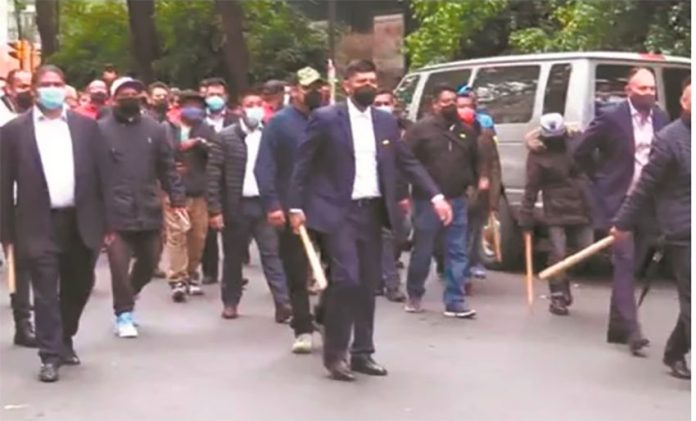
Armed with clubs, dissident party members march on PRI headquarters in Mexico City.
There were divisions within the Institutional Revolutionary Party (PRI) after its rout in the 2018 elections, and the most recent vote did nothing to soothe angry members.
A 20-year-old man was wounded by a gunshot and two other people received blows to the head in violent scenes at party headquarters in Mexico City Tuesday.
A 120-strong, six-hour protest that demanded the resignation of leader Alejandro Moreno due to the party’s poor showing in the June 6 elections ended in a bloody altercation. The party leadership and a rival faction blamed each other for the violence.
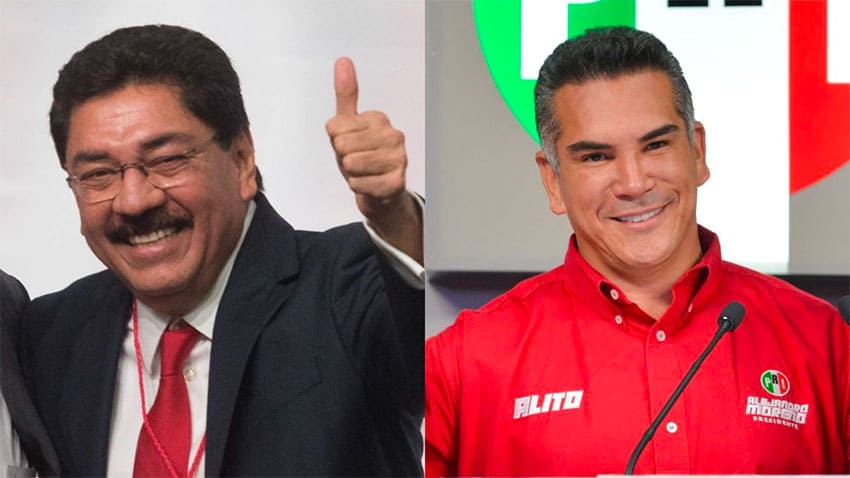
The former blamed the ex-governor of Oaxaca, Ulises Ruiz Ortiz, and Nallely Gutiérrez, a one-time PRI federal deputy, for provoking violence. “They are part of an armed command that came to attack our members … On the orders of Ulises Ruiz and Nallely Gutiérrez an armed commando … [attacked] hundreds of militants who were peacefully gathered supporting the leadership,” read official Twitter posts.
Moreno continued his criticism on his personal Twitter account. “They represent everything that the PRI does not want … These are the practices that have no place in the PRI,” he wrote.
Rival party members Ulises Ruiz, left, and president Alejandro Moreno.
However, Ruiz blamed Moreno and other party leaders, and said they were “responsible for any aggression suffered by the militants who are peacefully holding the PRI to account,” he wrote.
“This is a matter of politics,” he added.
Protesters hold Moreno responsible for leading the party to defeat in eight races for governor in the midterm elections.
Paramedics treated two people at the scene, a man and a woman, who had suffered blows to the head. The man who was shot was wounded in the back and was taken to hospital. His current condition is unknown.
The clash triggered the deployment of 150 police officers. Security officials said video footage was being reviewed to find out who had fired the shots.
Enmity between Ruiz and Moreno dates back to at least 2019, when the former unsuccessfully contested the party leadership.
Ruiz was at the center of a violent conflict while governor of Oaxaca in 2006. During six months of protests by members of the CNTE teachers union and others, there were 30 extrajudicial killings, 311 arbitrary detentions, 381 wounded, 248 cases of torture and the forced disappearance of two people, according to the findings of a 2016 truth commission.
The commission found Ruiz responsible for the crimes but he was never prosecuted.
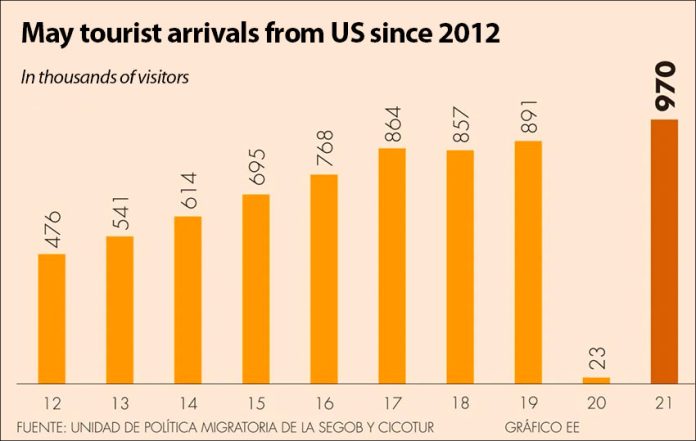
A record number of tourists arrived by air from the US last month. el economista
United States citizens flocked to Mexico in May as high Covid-19 vaccination rates in the U.S. spurred international travel.
Just over 970,000 Americans arrived on flights last month, a record for May, according to the Center of Research and Tourism Competitiveness at Anáhuac University.
The figure accounted for 83% of all international air arrivals last month and represents a whopping 4,117% increase compared to May 2020, when just 23,000 U.S. tourists came to Mexico. It’s 9% higher than May 2019, when 891,000 United States tourists flew into the country, and 13% higher than the same month of 2018, when U.S. visitors numbered 857,000.
Virginia Messina, senior vice president at the World Travel and Tourism Council (WTTC) and a former Mexican government tourism official, said that high vaccination rates in the United States are aiding the recovery of Mexico’s tourism sector.
About 63% of adults in the United States have received at least one shot of a Covid-19 vaccine, while the figure in Mexico is about 35%.
Messina said flight bookings show that foreign arrivals to Mexico during the summer will be close to 2019 levels.
“Looking at air reservations into the country between June and August of 2021 compared to [the same months of] 2019, we’re more or less at … 86%, which is very significant. When we look at different regions of Europe, for example, [flight] reservations are about 40% [of 2019 levels],” she told a press conference.
International travel to Mexico has been encouraged by the absence of restrictions for arriving visitors, who don’t have to provide evidence of a negative Covid-19 test result or go into mandatory quarantine.
Messina said that the WTTC expects other countries to ease restrictions on travelers. The European Union, for example, is set to begin welcoming United States tourists who can prove they have had an E.U.-approved vaccine, among which are the Pfizer, Moderna and Johnson & Johnson shots.
“We don’t expect borders to close again because we’re not where we were a year ago,” Messina said, although the pandemic is considerably worse in some countries where vaccination rates are low and more contagious strains of the virus are circulating.
“Today, not only have vaccines helped, the Covid-19 testing technology has as well. [Testing] was more difficult a year ago, today it’s faster and the results are as well. We’ll treat Covid-19 like the flu at the end of the year,” she said.
The WTTC official played down the impact insecurity might have on Mexico’s tourism recovery, noting that the problem has persisted for years but international visitors have continued to come. Insecurity is not a major problem in many popular tourist destinations, Messina said.
The United States government is currently warning U.S. citizens not to travel to five states – Colima, Guerrero, Michoacán, Sinaloa and Tamaulipas — due to crime and kidnapping, while there are 11 level 3 “Reconsider Travel” states including Jalisco, where the resort city of Puerto Vallarta is located, and Guanajuato, home to popular expatriate and tourism destinations such as Guanajuato city and San Miguel de Allende.
Quintana Roo, where Cancún, Playa del Carmen and Tulum are located, and Baja California Sur, home to Los Cabos, are among 14 Level 2 “Exercise increased caution” states, while Yucatán and Campeche, both of which are also popular with tourists, are the only states deemed Level 1, or “Exercise normal precautions.”
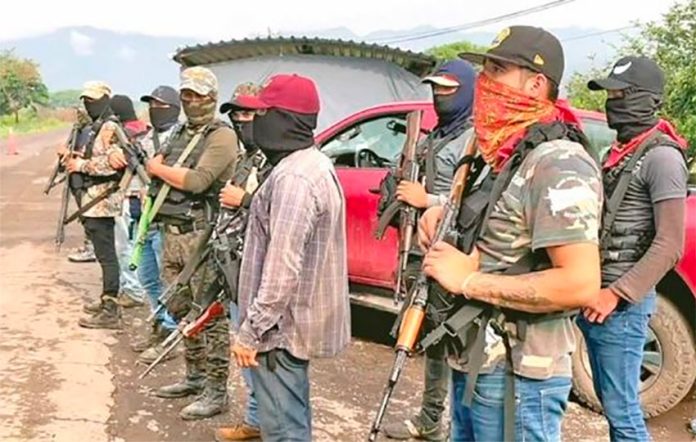
Members of Pueblos Unidos, farmers who have vowed to defend themselves against organized crime.
Michoacán authorities are planning a joint operation with the army to combat organized crime in four municipalities where avocado and blackberry producers have armed themselves in defense, according to the state security minister.
Some 3,000 farmers and farmhands from Salvador Escalante, Ario de Rosales, Nuevo Urecho and Taretán have taken up arms over the past eight months amid attacks by criminal organizations and extortion, the newspaper Milenio reported lat Friday.
Given that Michoacán police and the army intend to deploy to the municipalities, the farmers must lay down their weapons, Security Minister Israel Patrón said. They will be forcibly disarmed if they refuse, he said, adding that they are “flagrantly” violating the law.
Patrón acknowledged that armed men are manning roadblocks designed to keep criminals out of the four municipalities but denied that they number 3,000.
The security minister claimed that not all members of the armed group – called Pueblos Unidos, or United Towns — have genuine interests, suggesting that the group could be “contaminated” by criminals.
He didn’t provide specific details about the planned security operation, such as the number of soldiers and police that will deployed or when it would begin.
A Pueblos Unidos commander told Milenio that farmers would be prepared to disarm if authorities were able to guarantee their security. If the authorities can’t do that, the producers should be given permission to legally bear arms, he said.
“They should give us permission to defend ourselves,” the commander said. “We also don’t want to be disarmed, and we want to be respected. … They should do the work we’re doing, and maybe we’ll withdraw.”
Meanwhile, the federal government’s Financial Intelligence Unit (UIF) has blocked the bank accounts of 153 members and collaborators of six cartels that operate in Michoacán, UIF chief Santiago Nieto announced on Twitter.
Citing authorities close to the investigations, Milenio reported that the 153 people were members of or had links to the Jalisco New Generation Cartel, the Caballeros Templarios (Knight’s Templar Cartel), the Familia Michoacana, the Viagras, Cárteles Unidos and a cell of the Beltrán Leyva organization known as El Independiente.
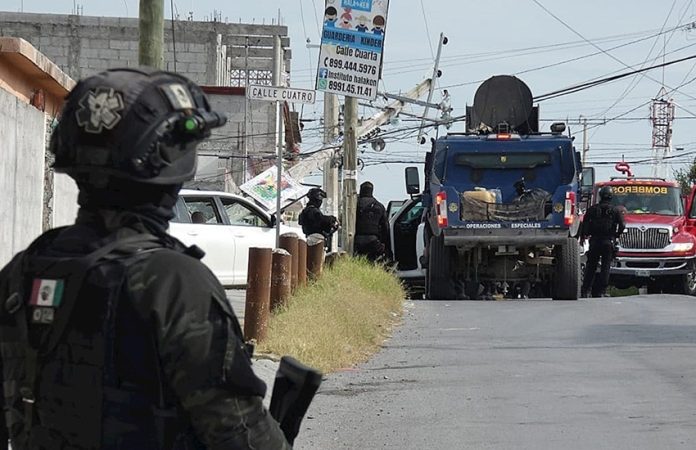
Authorities respond to confrontation in Miguel Alemán, Tamaulipas.
Nine people were killed overnight in a clash between criminal groups in a border municipality of Tamaulipas.
Two gangs engaged in a gunfight in Los Guerra, a community on the outskirts of Ciudad Miguel Alemán, located across the border from Roma, Texas.
Several media outlets reported that the confrontation was between the Northeast Cartel and the Gulf Cartel, which have clashed previously in the municipality of Miguel Alemán. Which organization the slain men belonged to was unclear.
Televisa News reported that the two cartels are engaged in a turf war over drug trafficking and migrant smuggling routes.
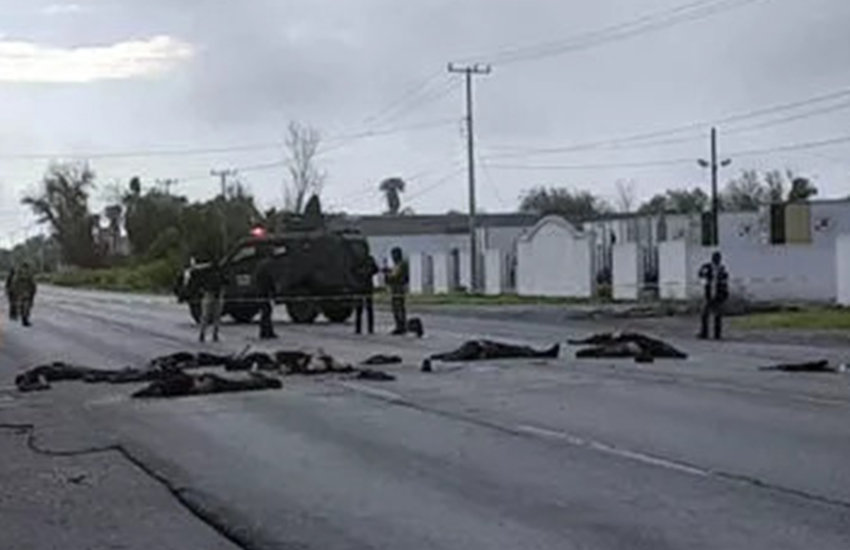
Los Guerra residents posted videos and photographs to social media that showed lifeless bodies strewn across a road in Los Guerra on Tuesday morning. Soldiers and members of the National Guard attended the crime scene, the newspaper El Universal reported.
In the aftermath, images of the dead bodies left on the street on Tuesday morning in Los Guerra circulated online.
The violence came just 10 days after at least 19 people were killed in Reynosa, located about 100 kilometers southeast of Ciudad Miguel Alemán. Most of the victims were innocent civilians who were apparently targeted at random by armed men.
Following the attacks, Tamaulipas Governor Francisco García Cabeza de Vaca, accused by the federal government of ties to organized crime, called on municipal, state and federal authorities to work together to combat violence. The objective, he said, was to avoid a repeat of the June 19 rampage in Tamaulipas or anywhere else in the country.
President López Obrador took office in late 2018 pledging to reduce violence with a security strategy that addresses the root causes of crime. But a new record for homicides was set in 2019 with more than 34,000 victims and murders declined only 0.4% in 2020.
The National Statistics Institute (Inegi) has conducted a study to define the middle class, despite the notorious difficulty of categorizing populations into class brackets.
Quantifying the middle class in Mexico: an exploratory exercise highlights that 42.2% of households can be categorized as middle class, which house 39.2% of the population.
In urban areas, the middle class resides in a majority of households, at 50.1%, which covers 47% of the population. In contrast, only 28.1% of households and 26% of the population in rural areas belong to the sector.
The upper class is a minute portion of society, counting for only 1.7% population nationally, and 2.5% of households.
Some characteristics were found by Inegi to be indicative of a middle class family. According to the study, a middle class household is likely to have a computer, and a married couple in a four-person family.
The head of the household is likely to have a high school education, be a property owner or mortgage payer, and work in the private sector.
In terms of spending, a middle class credit card is used for expenses of 1,660 pesos (around US $84) per month, and food and drink bought outside the home is likely to cost the household about 4,380 pesos per quarter.
Another study by the Organization for Economic Cooperation and Development (OECD) suggested that the middle class is becoming an increasingly exclusive social bracket. Under pressure: the reduction of the middle class published in 2019 showed that young people are ever less likely to join it.
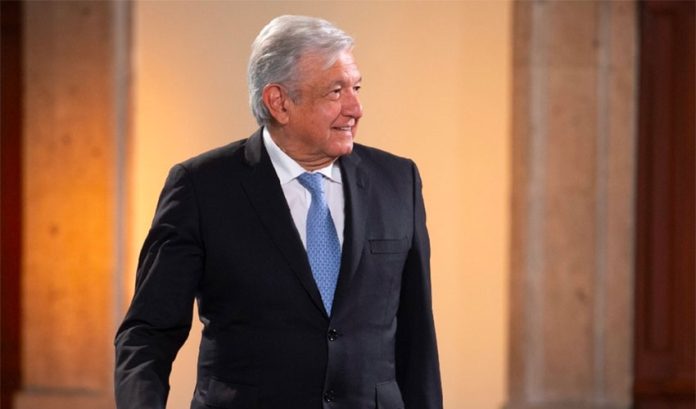
After the June 6 elections the socioeconomic segment became a target for criticism by President López Obrador, who branded it “aspirational and selfish” and prepared “to succeed at all costs.” He also said a manipulated middle class was what allowed Adolf Hitler’s fascism to grow in Germany, and supported the dictatorship of Augusto Pinochet in Chile.
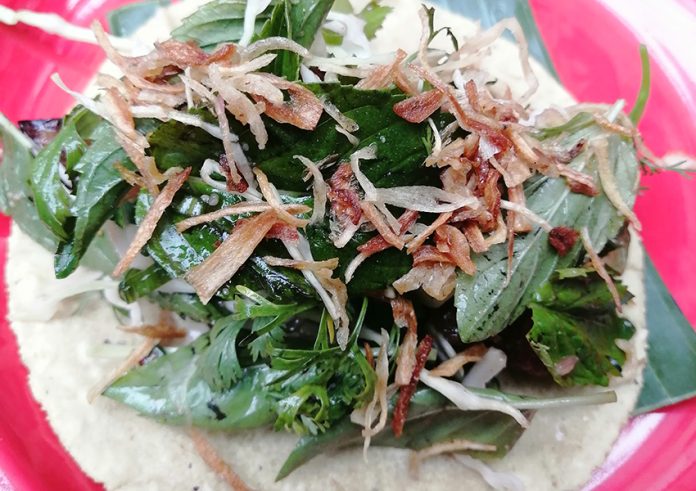
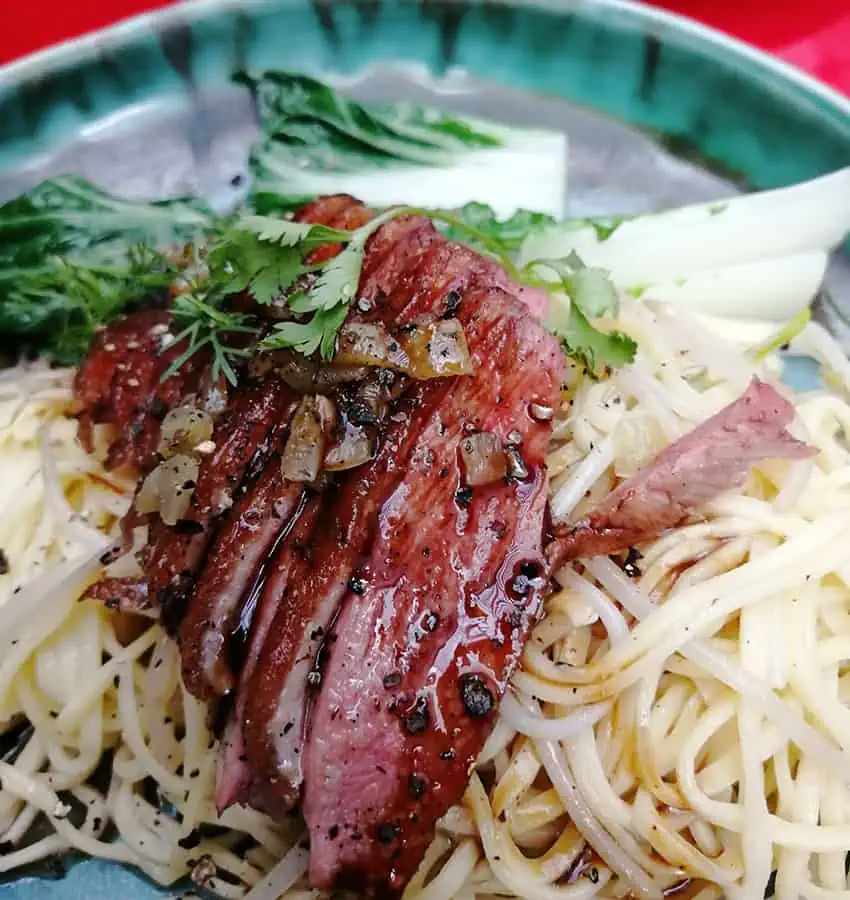
East meets West in this Asian-inspired dish from Cariñito Tacos in Mexico City's Roma neighborhood.
As I stand on the streets of Mexico City, checking the address of another hidden restaurant, I sigh, resigned, knowing I am bound for an eating experience that I’m going to have to figure out using context clues and possibly napkin drawings.
I know that this kind of thing (vague directions, hidden entrances, secret handshakes) leads some to believe that they are enjoying a kind of exclusive, in-crowd experience, but you can’t help but wonder, do they really want us to eat here?
That said, there’s not much I wouldn’t do for good grub, so don’t let the obtuse nature of some of the new dining I’m about to mention keep you from the food; it’s good, and once you get past the imposed awkwardness, you can almost appreciate the ambiance.
It’s already been an uncomfortable year and a half, so it makes sense that your first trip back into the restaurant world would follow the trend.
Here are three new restaurants in Colonia Roma that are worth venturing out for:
One of Makan’s small but significant culinary delights is its house-made noodles.
Makan
Standing outside of #11 Queretaro in Colonia Roma, there is nothing to indicate that three restaurants and a bakery are just inside the open doorway. Thankfully, a security guard (who was on his phone and might have just been a passerby but I asked him anyway) directed me to Makan – an itty-bitty restaurant in a greenery-filled patio at the center of one of the colonia‘s old turn-of-the-century mansions.
They have a limited daily list of Singapore small-plate dishes created by chef and owner Maryann and a more extensive wine list that includes orange wines and ciders from around the world.
As a neophyte to Singaporean food, I can only tell you that what I ate was simultaneously delicate and rich, a pleasure to consume under the covering of the open-air patio, surrounded by draping plants. The encurtidos (pickled items) — cabbages, carrots, cauliflower, pineapple with sambal and sesame — were the perfect marriage of sour and sweet and immediately brightened my attitude toward the waitress who schooled me the moment I sat down that I actually needed a reservation and should remember that for next time.
By the first mouthful of the crispy duck over house-made egg noodles, I found my tolerance expanding, and by the subtly sweet apple dumplings, I was OK, even happy, if I do say so myself.
Choza
Choza, in contrast, doesn’t allow reservations. In fact they’ve created several obstacles to eating there, as again, there is no sign and not even an open door — just a guy looking out the second-story window every five minutes to see if anyone is waiting.
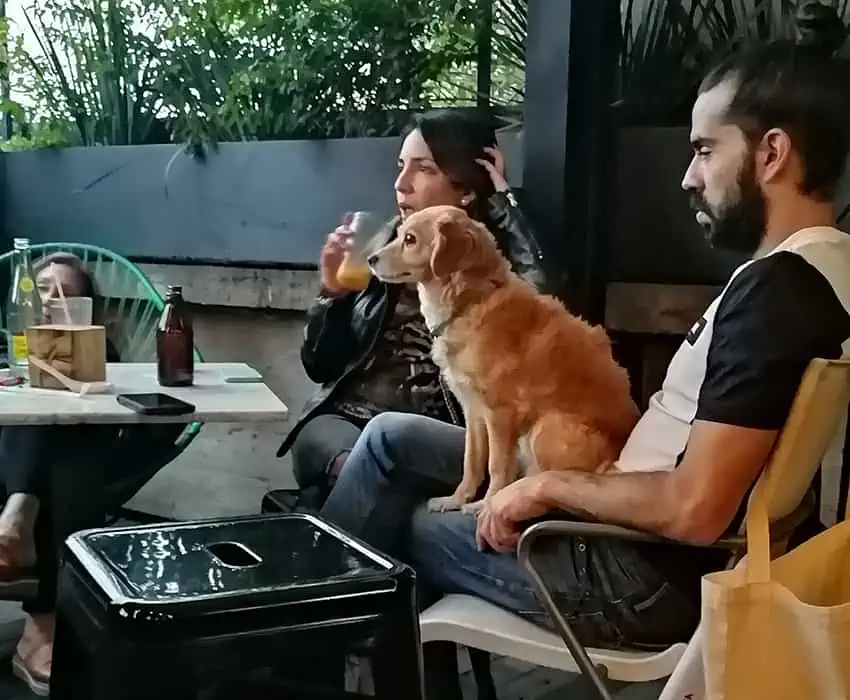
Despite the no-reservation policy, it didn’t take long to get a seat in the summertime-vibe bar upstairs with its high-beamed, semi-thatched roof and basketball rim mounted to the wall. Regularly packed with eaters and their furry friends lounging in hammocks, pet-friendly Choza is only open during that weekend sweet spot of 2–9 p.m.
No instructions were provided beyond you can go up now, so we sat at a random table to wait for someone who never came. After a few painful moments, our consequently very nice — waiter? busperson? — explained that we were supposed to order at the counter, then pay at the cashier and then she would bring our order to the table.
She told us to make sure to look at the menu in front of the glassed-in kitchen, not the one on the wall, because as things run out, they get crossed off the list.
All our effort did pay off in the form of a green-mango salad that would have made even the most confusing of situations suddenly logical. Bright and tangy, it was paired with a sweet, cinnamony coconut rice and caramelized pork that might be the most coherent thing I’ve eaten this week.
The jackfish ceviche was a nice second, with mounds of lime and onion, but the Wagyu sandwich brought up the rear and was underwhelming and oily. Looking on as other people chowed down, we jealously contemplated the whole fried fish that came out looking like a delicious monster and vowed to order it next time (yes, we’re going back, gluttons for punishment and food that we are).
At Choza, the vibe is casual, with even pets allowed.
The drinks were the only true letdown. They included a cheap-tasting mango daiquiri and some tiny Carta Blanca beers, whose taste lives up to their usual 8-peso grocery store price tag but definitely weren’t worth the 50 pesos Choza was charging. We didn’t try the mezcal, which we were told comes from small producers in Oaxaca and Guerrero; that might have been a mistake.
Cariñito
Then there is Cariñito, with its colorful storefront that you absolutely won’t miss and a short menu of Asian-inspired tacos that you won’t want to. (There is just a lot of Asian influence happening in Mexico City’s food scene right now).
Opened just two months ago, Cariñito is still in that giddy phase where the owners meet you out front and everyone is titillated by the menu. And why not? Their tacos delight and surprise with flavors of Laos, Thailand, China and other far-flung cuisines, all piled on to thick homemade corn tortillas with very fresh ingredients and balanced combinations of sweet and sour and spicy and mild.
The recipes were obviously created by a thoughtful chef and someone not afraid to experiment with combining cuisines, techniques and tastes. The undeniable star is a shyly spiced confit eggplant with bolted cilantro, crispy-fried shallots, fresh mint and basil, followed closely by the Cantonese pork belly with pickled cucumbers, sesame seed, hoisin sauce and homemade sriracha – sweet, spicy, and acid all in one gulp.
Two or three types of beer, including some craft beer options, and natural wines and mineral water are the extent of beverages available but, really, that feels appropriate for the pared-down menu — it’s a short, sweet list but satisfyingly so.
The streetside vibe keeps things lively, and a regular string of special food events will likely make Cariñito a popular neighborhood hangout.
Dozens more dining spots have opened and closed in Roma during the pandemic’s upending of the local economy, so keep an eye out for future reviews of the neighborhood’s best eating and drinking.
Lydia Carey is a regular contributor to Mexico News Daily.
CORRECTION: The earlier version of this story misspelled the name of one of the three restaurants. It’s Makan, not Wakan. We regret the error.
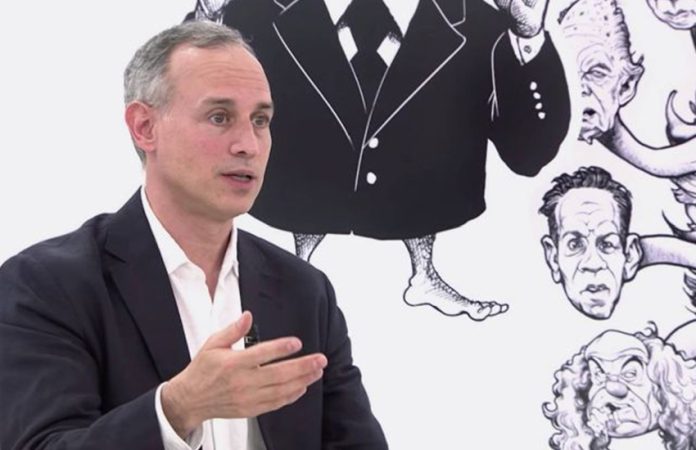
Deputy Health Minister Hugo Lopez-Gatell in the interview in which he linked medication shortage protests with international right-wing groups.
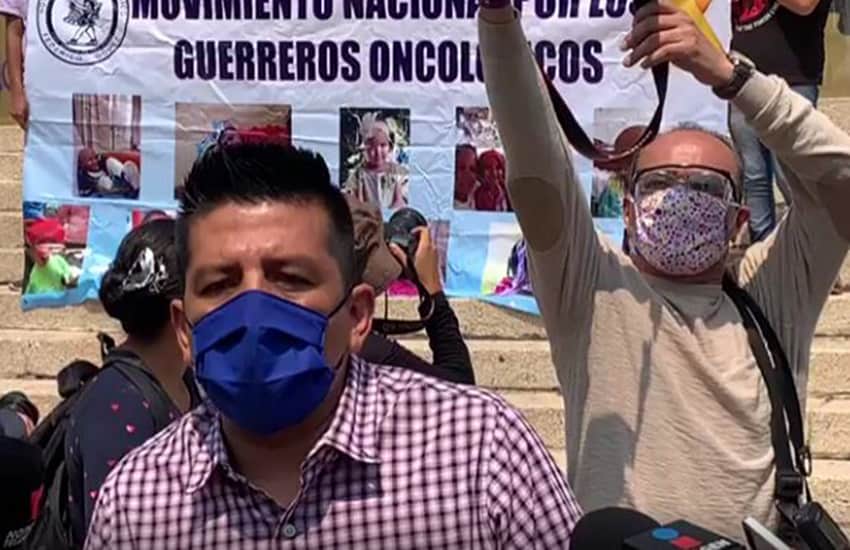
Protests against medication shortages led by parents of children with cancer are linked to international right-wing groups with a mentality that borders on coup plotting, according to Deputy Health Minister Hugo López-Gatell.
“I would like to issue a kind of alert,” the official said during a television interview broadcast on Sunday.
“This type of generation of coup narratives has sometimes been connected in Latin America, in the history of Latin America, with coups, coups d’état. And this idea of children with cancer who don’t have medications, we increasingly see it positioned as part of a campaign … of international right-wing groups that are seeking to create this wave of sympathy among Mexican citizens that has a vision that is almost one of coup plotting,” said López-Gatell, who rose to national prominence in 2020 as the government’s coronavirus point man.
The deputy minister said it was regrettable that cancer patients are being used as pawns in a protest movement against President López Obrador and his administration. He also denied that there is a lack of cancer drugs, even though parents have protested countless times against shortages since the current government took office in late 2018.
If there are widespread shortages, why “do we only see 20 people at protests … at [the Mexico City] airport,” López-Gatell asked.
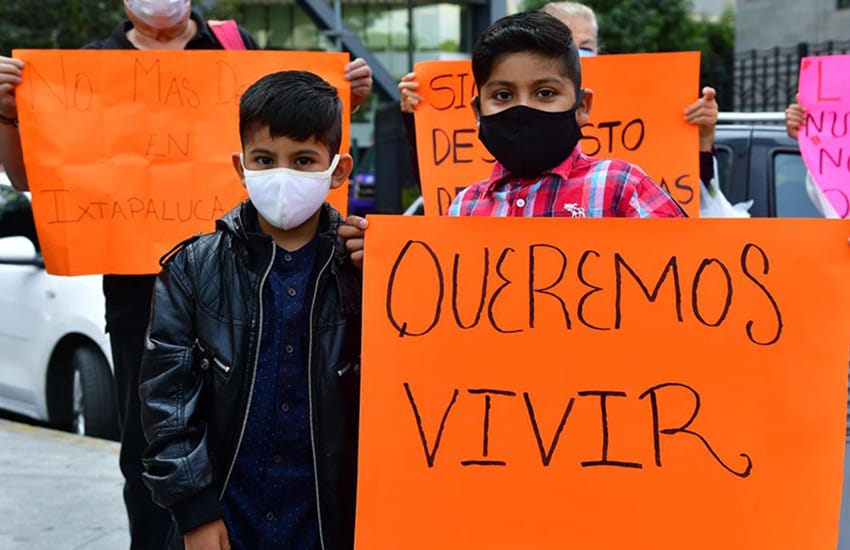
The faces of right-wing extremism? Children at a medications shortage protest.
“They’re the same people [who have been protesting] since the start of the government’s six-year term. One realizes that they’re fabricated groups,” he said before raising the possibility that people are being paid to protest.
Facing widespread criticism for his remarks, López-Gatell on Tuesday backtracked on some of his claims, telling reporters that parents’ concerns about a lack of cancer medications for their children were “absolutely legitimate.”
“What I said and what I maintain is that the phenomenon of cancer in itself is regrettable, tragic and painful. That girls and boys suffer from it is doubly or many times more painful. That these same people lack medications is also painful,” he said.
“… We believe that fathers, mothers or family members of children with cancer have a legitimate reason to have concerns, it’s absolutely legitimate,” López-Gatell said.
“… What I said last Friday on the [television] program … that was broadcast Sunday and which I sadly maintain [is that] human pain is exploited by economic, business and political interest groups that want to profit from human pain. Let it be very clear, our sympathy, our solidarity goes to fathers and mothers or any family members of children with cancer or any other illness … and that’s why we’re working tirelessly to get the medications,” he said.
His coup plotting remarks were described as “regrettable” by Andrea Rocha, a lawyer who represents the parents of more than 200 children with cancer who have been affected by drug shortages. She claimed that the government is trying to discredit the protest movement to distract from its own failure to purchase sufficient medications to put an end to shortages.
Omar Hernández says López-Gatell has tried ‘to vilify our movement’ during two years of protests against shortages. File photo
Omar Hernández Ibarra, president of an association of parents of children with cancer, said that López-Gatell can say whatever he likes, but the group he heads will remain focused on pressuring the government to resolve the shortages.
“It doesn’t matter what the man has said. … In two years, he’s only been to one meeting with parents of children with cancer. … He’s tried to vilify our movement the whole time, but what matters today is that they didn’t keep [the promise] to get medicines to hospitals [last weekend],” he told the newspaper El Universal. “That’s what worries us and what we must occupy ourselves with.”
Hernández said that another protest would be held today at the Mexico City airport, stressing that only parents of children with cancer who are currently affected by drug shortages will participate.
“We don’t want this movement to be politicized because that only causes damage. It takes credibility away from our demands. For us, the only thing that is important is for the government to comply with the supply of medications. We don’t want anything else, and we don’t want the [political] parties to join and use us for political gain,” he said.
Parents of children with cancer and civil society organizations have also called for a national protest against drug shortages on Wednesday. It has been confirmed that protests will take place in Guadalajara, Veracruz city and Mexico City, the newspaper Reforma reported.
Another national protest to demand that the government resolve drug shortages is scheduled for July 24. Parents of children with cancer and people with HIV/AIDS who have been affected by shortages of antiviral drugs are among those set to take to the streets.
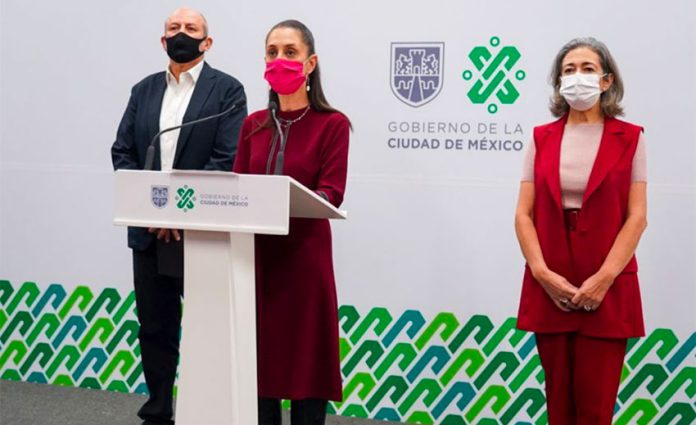
Mayor Claudia Sheinbaum announces a change at the helm of the Metro.
Exactly eight weeks after the Mexico City Metro disaster that claimed the lives of 26 people, the chief of the subway system was replaced on Monday.
Mayor Claudia Sheinbaum announced that Florencia Serranía, who became general director of Metro operator STC in 2018, had been replaced by Guillermo Calderón Aguilera, a veteran transport official.
The announcement came a week after Sheinbaum met with President López Obrador and businessman Carlos Slim to discuss plans to repair Line 12, an elevated section of which collapsed on May 3, causing two train carriages to plunge toward a busy road below. Slim’s company Carso Infrastructure and Construction partially built the line, the newest of the 52-year-old Metro system.
“We want to thank Dr. Florencia Serranía for all the effort and work … she has put into the Metro,” Sheinbaum told a press conference.
“… As of today, the engineer Guillermo Calderón Aguilera takes over the management of STC Metro. He is a specialist in the management of projects and processes who specializes in the implementation and operation of urban transport systems,” the mayor said.
Calderón, a former director of the capital’s Metrobús system, said Sheinbaum asked him to focus on delivering a safe and efficient Metro system.
“I want to share that the first instruction I have received from the mayor is to continue with the efforts to guarantee a safe and efficient Metro for passengers,” he said.
With regard to Line 12, the priority, Calderón said, will be to continue to attend to the victims of last month’s tragedy and their families, and to support DNV, a Norwegian company contracted by the government to carry out an independent inquiry into the cause of the accident.
López Obrador pledged last week that the entirety of Line 12, which primarily serves poor neighborhoods in Mexico City’s southeast, will reopen within a year.
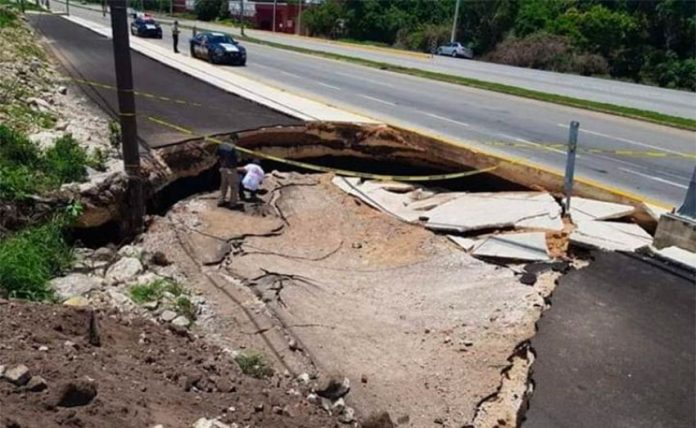
A diversion on the Cancún-Playa del Carmen highway will be finished in two months, the governor of Quintana Roo said.
The four-lane, 22.7-kilometer route will help relieve traffic build-up resulting from lane closures due to ground movement below the tarmac. Deep maintenance work is critical to ready the road for construction of a section of the Maya Train in the same location.
Governor Carlos Joaquín González explained the urgency to build the alternative route. “On the federal highway from Cancún to Playa del Carmen there are a lot of delays that are caused by intense traffic. It’s due to damage that the road has in some of its lanes as a result of the ground below caving in.”
Joaquín said Fonatur [the National Tourism Promotion Fund] is building the road.
He called for residents to be patient while the work is carried out.
Last week, a Fonatur representative explained that thousands of drivers were being endangered every day by the ground movement beneath the surface of the highway. He added that experts in civil engineering, geology and geophysics were assessing and implementing repairs.
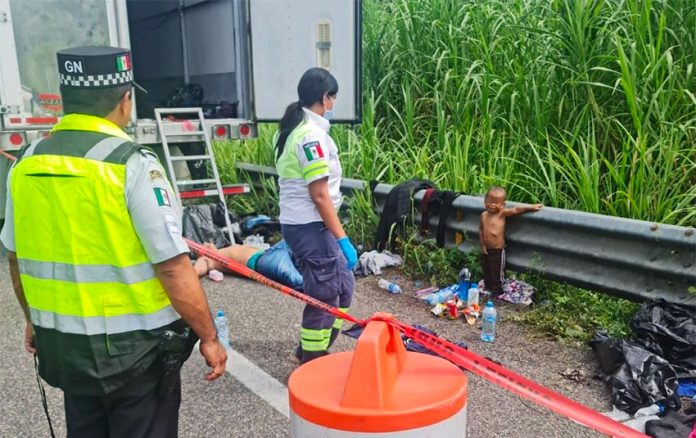
Security officials and the young child who was found near a semitrailer on Monday.
A boy believed to be two years old was among more than 100 migrants abandoned on a highway in southern Veracruz on Monday after traveling in suffocating conditions in a semitrailer, the National Immigration Institute (INM) announced.
A man traveling in the trailer that was transporting the migrants on the highway between Ocozocoautla, Chiapas, and Las Choapas, Veracruz, was found dead at the same location, having apparently suffocated in the crowded vehicle.
The INM said in a statement that along with members of the National Guard it provided assistance on Monday morning to eight Central Americans who had been traveling in the crowded semitrailer, including the two-year-old boy.
All showed symptoms of dehydration and asphyxiation, the INM said. “Unfortunately, the lifeless body of a young man was found,” the institute said, adding that he was approximately 25 years old.
The INM released a photo of the boy that showed him standing on the shoulder of the highway surrounded by half-filled water bottles, empty snack packets, strewn clothes and black trash bags. The child was shirtless and appeared to have his hands on his face in the partially blurred photo. The INM also published a second photo showing the boy fully dressed and sitting on an immigration worker’s lap.
None of the adults assisted by the INM said they were relatives of the boy. The institute said it notified Veracruz child protection authorities about his discovery so that they would take him into their care, adding that a Guatemalan consulate was contacted because there were indications that the boy might be of that nationality.
The migrants assisted by the INM said that some of their traveling companions had fainted while traveling in the crowded trailer because of a lack of air and heat. Others shouted and banged on the doors of the vehicle to urge the driver to stop, the institute said.
The semitrailer eventually stopped and “one of the people smugglers, or supposed ‘guides’ opened one of the doors,” the INM said, adding that most of the men and women jumped out of the vehicle and fled.
“Eight people couldn’t escape,” the INM said, adding that some got out of the semitrailer to lie on the side of the road, while others remained inside the vehicle, apparently because they were too weak to move.
They were taken to a nearby INM facility, where they were given medical treatment and food.
Federal authorities launched an operation to locate and arrest the people transporting the migrants but no arrests were reported.
Fleeing violence and poverty at home and encouraged by the arrival of United States President Joe Biden in the White House, large numbers of Central American migrants have traveled through Mexico this year to seek asylum in the U.S.
Thousands of unaccompanied minors crossed into the United States in 2020, according to U.S. Customs and Border Protection.
During United States Vice President Kamala Harris’ visit to Mexico City earlier this month, Mexico and the United States signed a memorandum of understanding to establish a strategic partnership to address the lack of economic opportunities in northern Central America, namely Guatemala, El Salvador and Honduras.