Home Blog Page 1380

New Covid case numbers spike by nearly 11,000; vaccinations in December?

0
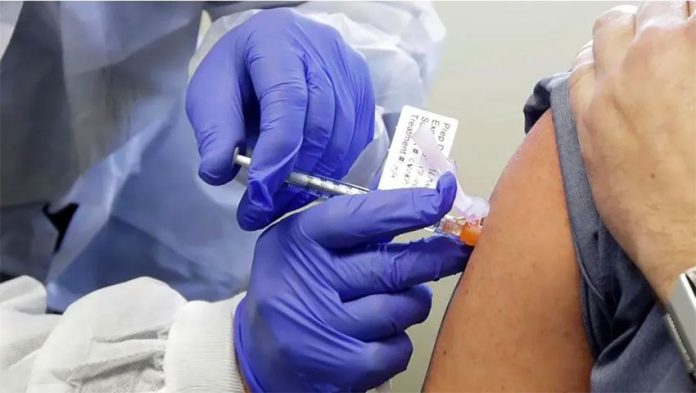
The Pfizer/BioNTech coronavirus vaccine has an efficacy rate of 95%.

The federal Health Ministry reported 10,794 new coronavirus cases on Tuesday, the second highest single-day tally since the start of the pandemic.

The only day on which health authorities reported a higher number of cases was October 5 when the tally increased by 28,115 due to a change in the methodology used to determine whether a person is infected.

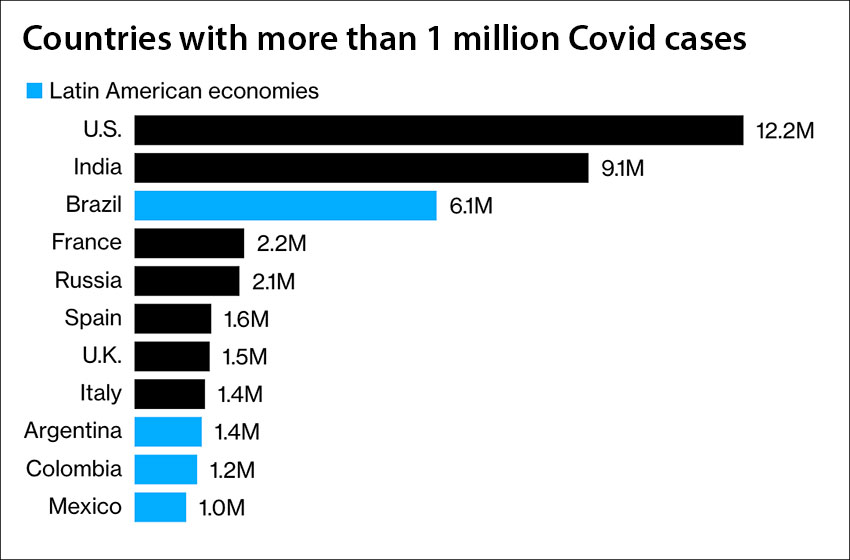
With the almost 11,000 additional cases registered on Tuesday, Mexico’s accumulated tally rose to 1,060,152 – the 11th highest in the world.

Director of Epidemiology José Luis Alomía reiterated that the new cases registered weren’t detected in the preceding 24 hours.

Some of the infections occurred a month or even two months ago, he said, explaining that there is a significant lag between when tests are carried out and when their results are reported to the Health Ministry.
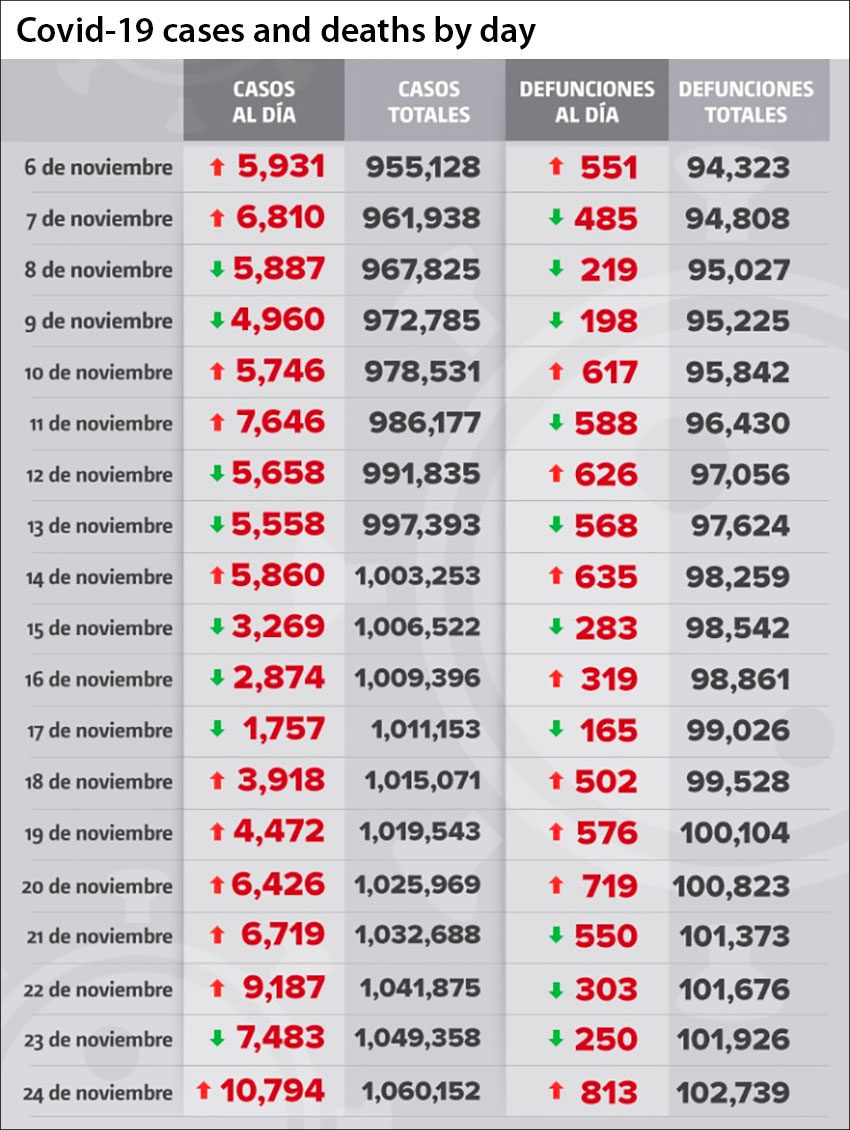
Coronavirus cases and deaths in Mexico as reported by day
Coronavirus cases and deaths in Mexico as reported by day. milenio

Therefore, the case numbers reported on a daily basis are not indicative of the current situation in the country, Alomía said.

The Health Ministry also reported 813 additional Covid-19 fatalities on Tuesday, lifting the official death toll to 102,739 – the fourth highest in the world. As is the case with the new infections reported, the additional deaths didn’t necessarily occur in the preceding 24 hours.

The Health Ministry estimates that there are currently almost 50,000 active cases across the country, more than 13,000 of which are in Mexico City. Nuevo León and México state, both of which have more than 4,000 estimated active cases, rank second and third, respectively.

Earlier on Tuesday, Foreign Minister Marcelo Ebrard said that administration of the Pfizer/BioNTech coronavirus vaccine – which was found in phase 3 trials to have a 95% efficacy rate – could begin in Mexico as soon as December.

Speaking at President López Obrador’s regular news conference, Ebrard noted that the companies submitted an application to the United States Food and Drug Administration for emergency use authorization on November 20.

He said Pfizer would submit a similar request to Mexico’s health regulatory agency Cofepris on Wednesday.

If approved for use in Mexico, the vaccine will be rolled out here in December, Ebrard said.

Pfizer would be responsible for transporting the vaccines – which have to be kept at -70 C – to the point at which they will be administered while the Health Ministry will be responsible for inoculation, the foreign minister said.

“[Health Minister Jorge] Alcocer has his vaccination plan ready. … It’s very good news for Mexico,” Ebrard said, adding that inoculation against the coronavirus here will in all likelihood begin shortly after it commences in the United States.

Source: Milenio (sp), El Universal (sp) 

Victim of Covid: Best Buy announces it’s pulling out of Mexico

0
best buy

Consumer electronics chain Best Buy announced Tuesday that it will close all of its Mexican stores, saying that the coronavirus pandemic has had a “profound” negative impact on the company.

The chain shut down eight of its stores earlier this year and will begin closing its remaining 41 on December 31. Best Buy México president Fernando Silva announced the decision in a call with investors.

“The effects of the pandemic have been very profound and it’s not viable for us to maintain our business in Mexico,” he said.

Silva praised the company’s employees and said they will be given severance pay and benefits beyond what is required by the law.

“We should feel very proud about what we achieved at Best Buy México: we built an extraordinary team and we established an exceptional culture,” he said.

“We transformed the way in which Mexicans interact with and are inspired by technology. … We built the No. 1 brand in technology … [and] our customers honored us with a growing market share. I don’t have anything left [to say] other than to thank with all my heart the workers and commercial partners who were part of this adventure during almost 13 years.”

The successes in the Mexican market outlined by Silva were evidently insufficient to keep Best Buy here. It apparently took a big financial hit from having to close temporarily its brick-and-mortar stores due to the pandemic even though its online store remained open and demand for electronics increased as people made the shift to working and studying at home.

The company said in a statement that it will deliver all orders that have already been placed, adding that the Best Buy México website will continue to operate until all existing stock is sold.

Best Buy’s decision to close its stores comes after a successful 2019, during which the company opened several new locations. Just a year and a half ago, Silva said that online sales were on the rise and that the company was “very committed to Mexico.”

The coronavirus pandemic and associated restrictions have taken a heavy toll on the economy, with GDP slumping almost 20% in the second quarter of the year compared to the same period of 2019 and close to 9% in the third.

Source: El Financiero (sp) 

58% of Mexicans oppose legalization of marijuana: poll

0
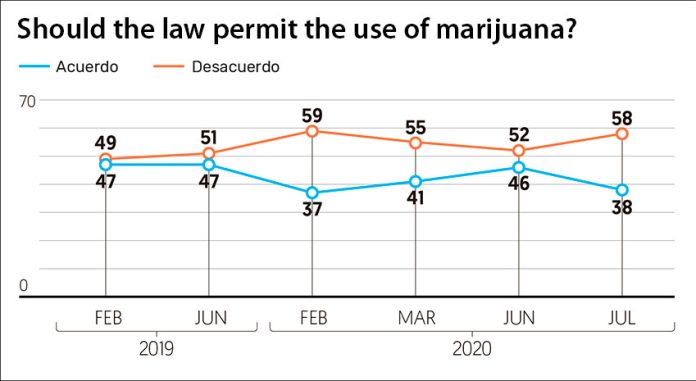
Five of six marijuana polls showed a majority opposed legalization of marijuana.
Five of six marijuana polls showed a majority opposed legalization. The blue line indicates support; orange the opposite. el financiero

The probable legalization of recreational marijuana before the end of the year will not sit well with tens of millions of Mexicans, a poll suggests.

Conducted by the newspaper El Financiero in July, the poll found that 58% of people were opposed to legalization. Only 38% of respondents said they were in favor.

The percentage of people opposed increased 7% compared to June last year while support for legalization decreased by 9%.

El Financiero republished its poll results on Tuesday, five days after the Senate passed a bill to legalize recreational use. The lower house of Congress is expected to approve the bill before a December 15 deadline set by the Supreme Court, which ruled last year that laws forbidding the use of marijuana are unconstitutional.

El Financiero found that different subgroups of society have different views about marijuana legalization. In six polls conducted between February 2019 and July 2020, the percentage of men who supported it was higher than women in all of them.

In the most recent poll, 43% of men said they were in favor of legalization while only 34% of women said the same.

The survey results also show that young people are more likely to support legalization than older people. Among the respondents to the most recent poll aged 18 to 39, just over half – 51% – said they agreed with legalization. Only 29% of respondents aged 40 or over said the same.

In June, the percentage of young poll respondents who supported legalization – 62% – was exactly double the percentage of older people who favored making pot legal.

Support for legalization is also much stronger among people who have completed higher levels of education. The July poll found that 61% of people who have at least completed high school believe that recreational marijuana use should be legal.

Among respondents who didn’t study past middle school, only 23% supported legalization. Support among that cohort declined 19 points between February 2019 and July 2020, while it increased 12 points in the same period among those with higher levels of education.

The July poll, which surveyed 410 adults in all 32 states, also found that support for legalization was 15 points higher among people who identify as left-wing on the political spectrum than among those who lean to the right.

Source: El Financiero (sp) 

Baja beer route: 70 artisanal breweries to visit in Baja California

0
Cervecería Ícono
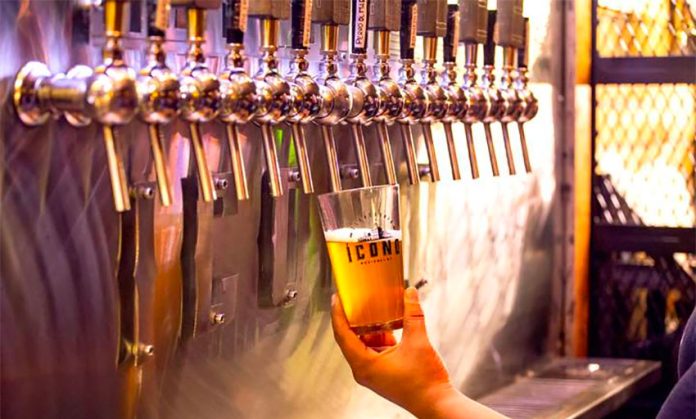
Cervecería Ícono is one of Baja's many artisanal beermakers.

Wine routes guiding tourists from vineyard to vineyard are already popular in various Mexican states as a tourism booster, but in Baja California tourism officials have gone their own way, creating a “beer route” that spotlights the state’s microbreweries and artisanal beer culture.

Once an underground network of hobbyist beer makers sharing their products only within a close inner circle of friends and family, craft beer in Baja California has bloomed into a multimillion-dollar industry, one that state tourism officials have recognized as a growing economic powerhouse and a tourism magnet.

Tourism Minister Mario Escobedo Carignan told the newspaper El Sol de México that there are 196 breweries in tourist destinations alone. Despite undeniably heavy competition from giants like Grupo Modelo and Cuauhtémoc Moctezuma, the Mexican Association of Beer Makers has predicted that the number of craft beer artisans statewide will reach over 1,000 in 2020.

“Artisanal beer in Baja California represents 17% of Mexico’s [craft] beer production,” Escobedo said.

Not unlike wineries, many of these craft breweries were already set up to become part of a route, Escobedo said, with sampling rooms and restaurants; some offer pairings that highlight regional dishes made by top-notch chefs.

To make it easy to find Baja California’s breweries and brewhouses and related tourism sites, the tourism ministry has worked with the Baja California Beer Makers Association and beer conglomerate Grupo Modelo to create a mobile application, Ruta de La Cerveza, that allows visitors to find artisanal beer makers nearby.

Celso Guzmán, marketing manager with the Wendlandt brewery in Ensenada, is a believer in the app. He says it will encourage state tourism and point visitors toward the beers that the region has to offer. He likes that the app focuses on a whole tourism experience that doesn’t just point visitors to breweries but to a variety of places where they can enjoy visiting the state.

“[For example], many people already know our beers,” he said, “but they don’t know that we have two taprooms in Ensenada with a menu featuring dishes typical of Baja,” he said.

App users can peruse the profiles of the more than 70 breweries listed in the app and add them to a map function that creates their own personalized beer route map based on where in the state they are. It also provides information on hotels, beer museums, bars, and other tourism-related sites near the user. There is also educational information about beer terms and ingredients, the culture of artisanal beer, and the process involved in making it.

The initiative also has a website with much of the same information.

Source: El Sol de México (sp), San Diego Magazine (en)

UN officials signal human rights violations by Maya Train

0
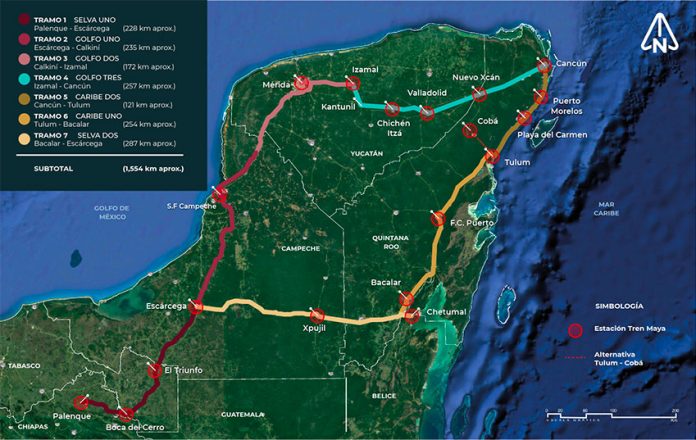
The Maya Train will run through five states in Mexico's southeast.

A group of United Nations officials has written to the federal government to express concerns about possible human rights violations related to the construction of the Maya Train in Mexico’s southeast.

Six UN special rapporteurs in areas including human rights and indigenous rights told the government they are concerned about possible impacts of the US $8-billion railroad project on indigenous communities in the five states – Chiapas, Tabasco, Campeche, Yucatán and Quintana Roo – through which the train will run.

They said that indigenous people’s land rights, including the right not to be evicted, and their right to health could be adversely affected by the train, the federal government’s signature infrastructure project.

The rapporteurs also said they were concerned about “information indicating that the environmental impact study for the project has been inadequate.”

An inadequate assessment entails “risks of environmental damage,” the letter said, explaining that there could be negative impacts on biodiversity and water sources in the regions through which the tourist train will run.

The UN officials also said that it has been confirmed that the consultation process that preceded the approval of the Maya Train project, including a vote that found 92% support for it, violated people’s rights.

They said there is information that shows that the process was imposed on residents even though the decision to approve the project had already been taken.

The special rapporteurs also said the consultation process was not “culturally adequate” and that “complete, adequate and impartial information about the project and its potential impacts” was not presented to residents because the necessary environmental impact and social studies had not been completed.

The United Nations said shortly after the vote was held last December that it failed to meet all international human rights standards.

The rapporteurs said the UN has received reports of people being harassed if they sought more information about the project or more time to make up their minds about it, or if they expressed opposition to it.

Human rights defenders that have filed legal action against the Maya Train have been criminalized, defamed and discredited, they said.

The officials also expressed concern about the “possible militarization” of Mexico’s southeast while the railroad is under construction because the government has announced that the army will build two sections of it.

They requested a range of information from the government including details about the process to acquire land and an explanation as to why the decision was taken to make use of the military in indigenous territory.

The special rapporteurs also sought a guarantee that there will be no aggression against people who oppose or question the project.

Construction of the Maya Train was officially inaugurated by President López Obrador on June 1. The 1,500-kilometer train line is slated to have 18 stations in the five states through which it will run.

Numerous environmental concerns have been raised about the project and injunctions obtained by indigenous communities have halted parts of it, at least temporarily.

The government says the construction and operation of the railroad won’t cause any major environmental damage and López Obrador has pledged that it will spur economic and social development in Mexico’s long-neglected southeast.

The president said in June that the project will be finished in 28 months, or by October 2022, stressing that no excuses will be accepted for delays.

Source: Reforma (sp) 

Baja initiative enrolls tourist police in English classes

0
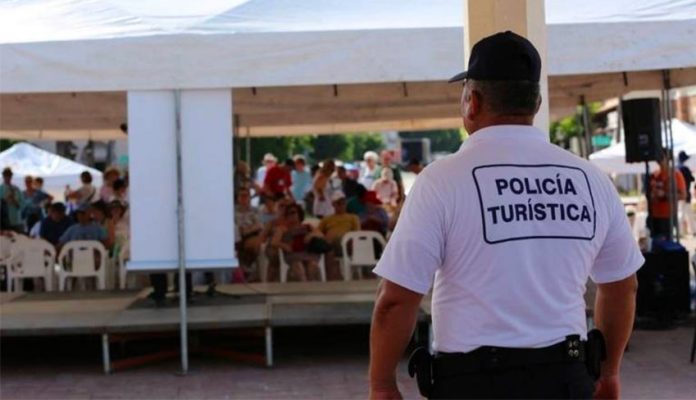
Police are boning up on their English.

In an attempt to reactivate tourism in Baja California Sur after the precipitous drop this year due to the coronavirus, state tourism officials in La Paz and Los Cabos have spearheaded an initiative to give tourism police a better command of English.

The pandemic and its resulting drop in tourism numbers prompted the state to rethink what it needed to do to be competitive in the hospitality sector, the Tourism Minister Luis Humberto Araiza López said.

His department is working with the Baja California Sur Autonomous University to offer free professional development classes in English to the two cities’ tourism police force members.

One way to get tourists back is by offering more and better services to the state’s biggest group of tourists — Americans, he said.

The initiative is being partly paid for the U.S. Consulate General in Tijuana, which supported the cost of the classes’ teaching materials and also teacher training, in recognition that the state is one of the biggest travel destinations for U.S. citizens and in recognition of the importance of Mexican law enforcement authorities having a good command of the English language.

Consul General Sue Saarnio and Araiza met on November 17 to discuss what Baja California Sur is doing to implement health protocols to prevent the spread of Covid-19.

Source: El Sudcaliforniano (sp)

Murder of girl, 12, triggers angry protest in Zacatecas

0
Fires burn at municipal headquarters in Fresnillo.

Protesters in Fresnillo, Zacatecas, demanding justice in the murder of a 12-year-old girl set fire to the city’s municipal palace Sunday.

The victim, identified only as Sofia, disappeared from her home on November 11. Her body, found Sunday, showed signs of torture and sexual assault.

Demonstrators also called upon Fresnillo Mayor Saúl Monreal to do something about increased violence in the municipality. In an unrelated case, the bodies of five men were found on October 31 in a home in the city. Authorities said they had been tortured with sharp objects.

When Monreal did not appear to address the protesters Sunday, they entered the municipal palace by force and set it on fire, destroying doors and windows. State anti-riot police and the National Guard were called to regain control of the situation.

According to local media accounts, Sofia was kidnapped after being tricked to leave her home. She reportedly received a call at home from a man posing as her teacher who made an appointment with her to go over homework.

State Public Security Minister Arturo López said Sunday that city law enforcement officials were working with the state to obtain justice for the girl.

“I promise we are working in conjunction with the state Attorney General’s Office to find those responsible,” he said.

Nevertheless, protests continued Monday.

In a separate incident, a group of people spray-painted graffiti messages containing the Gulf Cartel’s initials outside Mayor Monreal’s home.

Source: Milenio (sp)

Where is the worst place to be in coronavirus era? Mexico ranks last among 53 countries

0
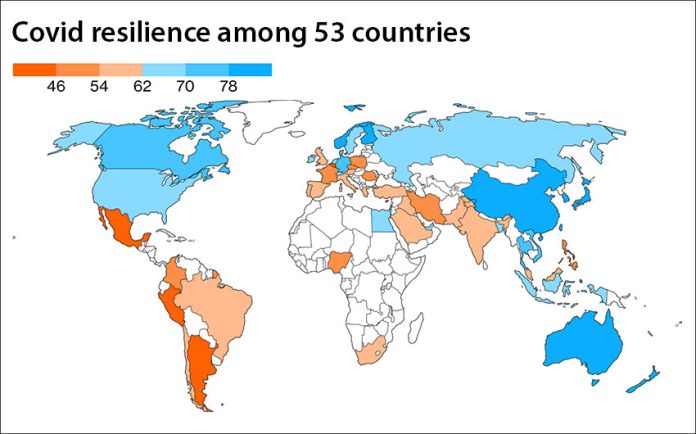
Covid resilience map
Covid resilience map shows countries with the lowest ranking in orange and the best in dark blue.

Mexico is the worst country to be in during the coronavirus pandemic, according to an analysis conducted by the Bloomberg news agency.

Using 10 different indicators including growth in coronavirus cases, Covid-19 mortality, testing capacity and the vaccine supply agreements governments have reached, Bloomberg graded 53 countries with economies larger than US $200 billion to determine where the virus has been handled most effectively with the least amount of disruption to business and society.

Mexico ranked 53rd with a “Covid resilience” score of just 37.6 out of 100.

Among the other indicators Bloomberg considered were the capacity of the health system in each of the 53 countries, the impact of coronavirus restrictions on the economy and citizens’ freedom of movement.

Mexico was graded particularly poorly for its Covid-19 fatality rate over the past month (8.6 deaths per 100 cases, according to Bloomberg), positivity rate (62.3%) and “lockdown severity” (the federal government never enforced a strict lockdown).

One positive Bloomberg identified is that the Mexican government has reached three separate vaccine supply agreements.

New Zealand, where the government has largely achieved the elimination of the coronavirus, came out on top with a “Covid resilience” score of 85.4. Japan and Taiwan ranked second and third, respectively.

The “Covid resilience” score for Mexico – where confirmed coronavirus cases and Covid-19 deaths recently passed 1 million and 100,000, respectively – was 3.5 points lower than that of Argentina, which ranked second last, and four points below that of Peru, which ranked third last.

Despite having the highest case tally and death toll in the world, the United States ranked 35 places above Mexico in 18th spot with a score of 66.5. Mexico’s other North American trade partner, Canada, ranked 13th with a score of 73.2.

In a brief written explanation of why Mexico ranked last, Bloomberg said “the nation’s latest available positive test rate is a whopping 62%, suggesting undetected infection is widespread.”

It also noted that “Mexican officials have acknowledged that the country’s death toll is likely significantly higher than official data, due to limited testing.”

Countries with the highest number of coronavirus cases.

In addition, Bloomberg said that President López Obrador, like Donald Trump of the United States and Jair Bolsonaro of Brazil, has “repeatedly downplayed the coronavirus threat.”

The news agency also noted that Latin America is the most urbanized region in the world and that social distancing is difficult for many people because they live in crowded conditions. “The high proportion of people who rely on informal work and daily wages means that few are willing to stay home,” it added.

According to the International Monetary Fund (IMF), most Latin American countries won’t see economic growth return to pre-pandemic levels until 2023 and per-capita income won’t recover until 2025.

Among the 53 countries assessed by Bloomberg, the IMF forecasts that Mexico will see the 10th biggest economic downturn in 2020 with a 9% recession predicted.

Bloomberg said its rankings are not indicative of  “a final verdict” on the impact of the coronavirus and countries’ response to it, acknowledging that they could never be due to “imperfections in virus data and the fast pace of this crisis, which has seen subsequent waves confound places that handled things well the first time around.”

It said that its scores and rankings “will change as countries switch up their strategies, the weather shifts and the race intensifies for a viable inoculation.”

However, with winter approaching here, a recent increase in case numbers and the federal government ruling out any possibility of implementing strict lockdowns and a nationwide face mask order, it appears highly unlikely that Mexico will rise in the rankings any time soon.

“The gap that has opened up between those economies at the top and those at the bottom is likely to endure,”Bloomberg said, adding that there will potentially be “lasting consequences in the post-Covid world.”

Source: Bloomberg (en) 

San Miguel Writers’ Conference goes online, but works to retain its intimacy

0
Geraldine Brooks and Lawrence Wright are among the guest writers at the San Miguel writers' conference.
Geraldine Brooks and Lawrence Wright are among the guest writers at the annual conference.

Like many gatherings in this pandemic year, the Writers’ Conference and Literary Festival in San Miguel de Allende had to make the decision to go virtual. But organizers have decided to see the upside of the virtual format, which will be done completely on Zoom video conferencing this season.

“Maybe the best feature of these historic online interviews is that everyone has a front-row seat along with the opportunity to “go up on stage” afterward for a personal chat with the author,” says conference cofounder Susan Page.

For an event that attracts attendees from around the world and prestigious guests every year, the conference is known for being an event where the barriers between attendees and guests are thin. Most guest speakers hang out after their event and talk with audience members. The conference is also known for its relaxed atmosphere of interaction and networking among attendees, with many connections and friendships made.

So organizers have worked to preserve as much of that intimate atmosphere as possible. For example, the usual question-and-answer events now have an option to submit a question for the speaker at the time of registration. Also, thanks to the Zoom format, the usual “chat with the author” opportunity is just a screen away and attendees can still interact virtually between events.

This year, the conference features an impressive line of guest speakers and interviewees — Margaret Atwood, Diana Gabaldon, Isabel Allende, Geraldine Brooks, Lawrence Wright and many more. The guest list includes three Pulitzer Prize winners, three Giller Prize winners, an Emmy winner, and two authors with No. 1 books on the New York Times bestseller list.

Besides the headlining guests, the conference for writers and lovers of literature will also feature 24 skill-building workshops for fiction and nonfiction writers, also to be conducted on Zoom.

The Writers’ Conference and Literary Festival runs until next March.

Mexico News Daily

Ricardo Anaya: ‘Government caused economic crisis, not coronavirus’

0
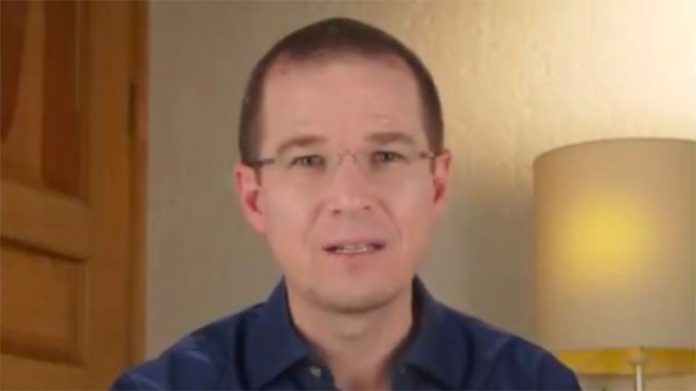
ricardo anaya
Anaya: 'The government invests poorly in things that make no sense, like the absurd Dos Bocas refinery.'

The runner-up in the 2018 presidential election has slammed President López Obrador for the government’s response to the coronavirus pandemic and associated economic crisis as well as its broader management of the economy.

In a video posted to social media, former lawmaker and National Action Party (PAN) leader Ricardo Anaya charged that Mexican families are suffering an “unprecedented economic crisis” and that the government is deflecting blame for it by saying that the coronavirus came here from abroad.

“Two things must be clarified. Firstly, it’s true that the pandemic isn’t López Obrador’s fault but the terrible management of it is his fault,” Anaya said four days after Mexico became the fourth country in the world to record 100,000 Covid-19 deaths.

“It’s a little bit like the captain of a ship that has to navigate in the middle of a storm. The storm is not his fault but the decisions he takes at the helm are his responsibility,” he said.

“Secondly, the economic problem started well before the pandemic. In other words, when this started the ship was already damaged because in the first year of López Obrador’s government we had our worst [economic] growth in a decade,” Anaya said.

The former candidate, who finished a distant second to López Obrador in the 2018 election and is now positioning himself as a leading voice of the conservative PAN, claimed that the president doesn’t understand that economic growth is needed in order for people’s living standards to improve.

“Although the president doesn’t understand it, the reality is that there is not a single country in the world where … people’s wellbeing has improved without economic growth,” Anaya said.

“… If the course is not corrected, this will be the first time in history in which the Mexican economy will be smaller at the end of the [government’s] six-year term than when the six-year term started.”

The former PAN leader said that major factors in the lack of economic growth even before the pandemic are that the government is not using public money wisely or creating investor confidence.

“Our government invests poorly, in things that make no sense like the absurd Dos Bocas refinery that will always lose money,” Anaya said.

“There is something that is key for there to be investment, something that takes years to get and which can be lost in an instant: confidence,” he added.

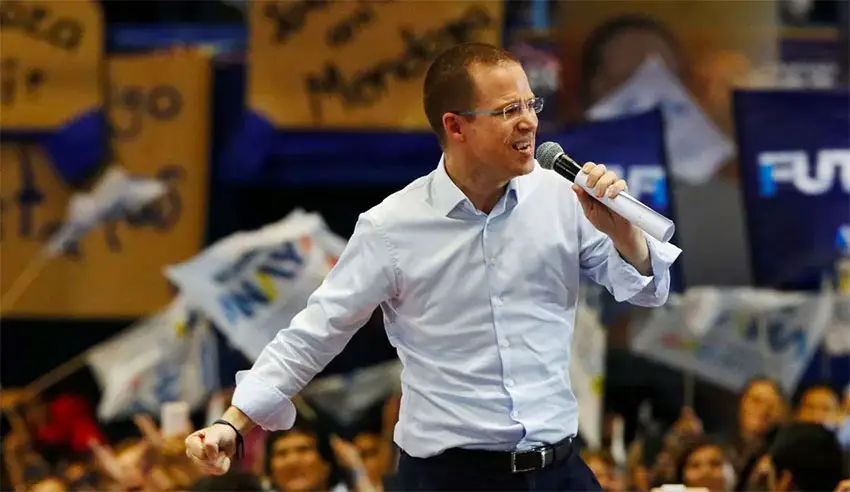
Anaya during the 2018 election campaign.

“Perhaps the biggest mistake of all the mistakes of this government in economic matters is the fact that both Mexican and foreign investors have lost confidence [in Mexico].”

Anaya charged that investors have lost confidence because “bad decisions were taken,” citing the cancelation of the former government’s Mexico City airport project and arbitrary changes to investment rules in areas such as renewable energy.

He criticized the government’s cancellation of oil block auctions and the “illegal consultations” it has held prior to suspending projects such as the airport and a brewery that was under construction by a United States company in the country’s north.

“With López Obrador in government investment is at its lowest level in more than 20 years,” Anaya said, citing data from the national statistics agency Inegi.

“This is very serious because the investment of the government certainly matters but that of companies matters a lot more,” he said.

“This is what López Obrador never understood: in Mexico for every peso that the government invests, private companies invest six. That’s why it’s so important for the government to create an environment of confidence, to invite private investment, because if there is no investment, there won’t be growth, employment and wellbeing.”

Anaya, who announced his return to public life in September, also said that it is “unforgivable” that “the government left people and businesses to their own fate” amid the coronavirus-induced economic downturn.

“Among the 20 largest countries of the world, Mexico helped businesses and companies affected by the pandemic the least. More than half a million [businesses] have gone bankrupt, a lot of people were left without work,” he said.

“The question is what can we do to grow [the economy] again. The immediate key is to control the pandemic,” Anaya said before citing 10 areas where changes are needed.

He said the government needs to ensure the rule of law and combat corruption, improve public security (Mexico is on track to record its most violent year on record), build infrastructure that makes the country more competitive, increase investment in scientific research, education and public health and improve tax collection and the way public money is spent.

Anaya also said the government needs to provide certainty to investors, promote clean energy, reduce inequality, ensure economic stability, promote regional development and implement policies to boost productivity.

“We’re a country of very hard working people,” he said.

“The only thing that Mexicans need to prosper is an environment that encourages investment – clear rules, access to quality education. In Mexico we can achieve it but we need a government that allows us to work and helps us to prosper instead of dedicating itself to getting in the way.”

Mexico News Daily