Home Blog Page 1381

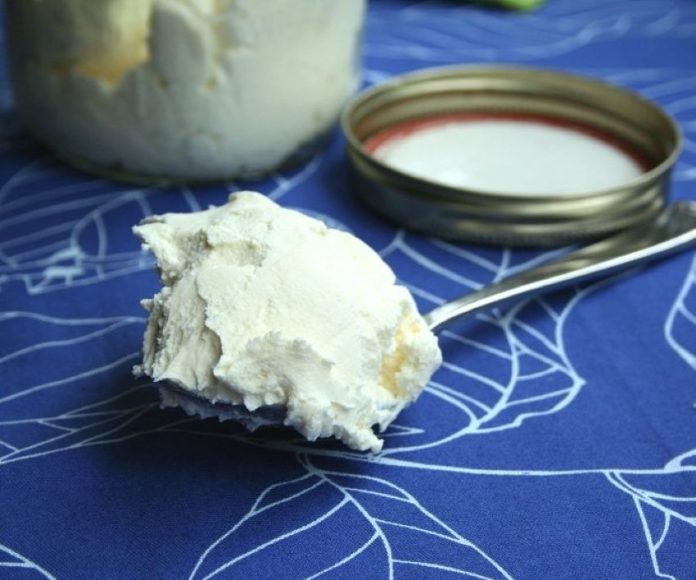
Cream cheese brings a subtle decadence to many dishes

0
Cream cheese is often known in Mexico as queso philadelphia, a cultural nod to the Kraft company's version. It shows up in many Mexican recipes.

Recently Profeco, Mexico’s consumer protection agency, cited many of the country’s most popular cheese brands for dishonest labeling and false claims “to the detriment of consumers and with information that could cause them to be deceived.” The much-beloved Philadelphia brand cream cheese was included on that list.

I’ve long wondered whether the Philadelphia cream cheese sold in Mexico has a different formula than the one sold in the United States. Both are made by Kraft Foods, but the texture and consistency in Mexico seemed much more rubbery than the one available north of the border. While I don’t eat a lot of queso crema, every time I do, I’m a little disgruntled.

So I embarked on what turned out to be almost a fruitless endeavor, calling the Kraft Foods customer hotlines numerous times in both Mexico and the U.S., only to hear recordings that no one was available. I sent multiple emails in both languages to customer service reps in both countries with no response, although I did learn that unopened regular cream cheese in its original packaging can be frozen for up to two months.

In the meantime, I examined the ingredients on packages from both sides of the border. They do indeed have different ingredients and different percentages of milk fat and moisture. In Mexico, cream cheese contains locust bean gum and xanthan gum and has less milk fat and moisture content than permitted in the U.S.

It’s also a smaller package — 180 grams or 200 grams as opposed to 220. U.S.-sold Philadelphia cream cheese contains whey, whey protein concentrate and carob bean gum—thickeners that result in a more natural texture. Hmmm. Searching the website once more, I discovered a chat option. Although it took a rep more than 24 hours to answer, at long last I was able to chat live with someone.
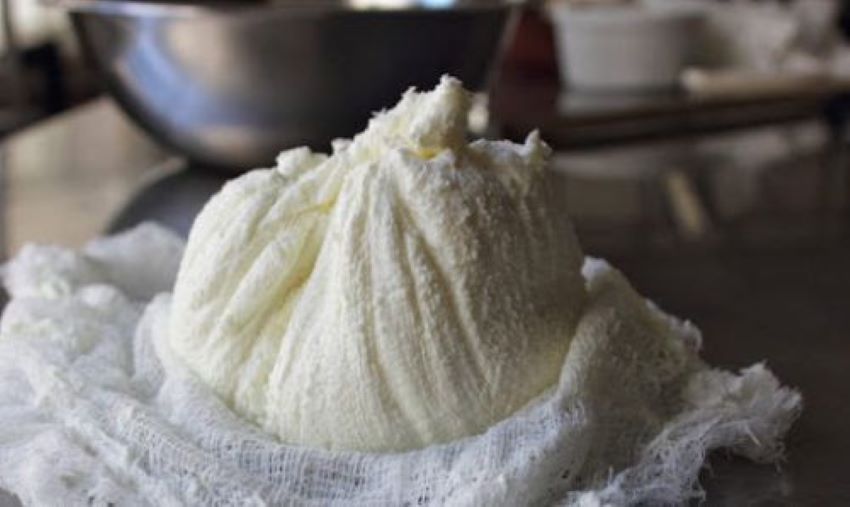
With DIY cream cheese, you can control the amount of milk fat it contains.

She had no comment about the Profeco situation — and indeed, Philadelphia cream cheese continues to be sold even after it was supposedly removed from shelves — but she did shed some light on the formulas. Yes, she confirmed, “our portfolio is dynamic. Each region has its need for products, and there may be slight changes in them.”

So there you have it, folks. But wait — what about making it yourself? Si se puede! DIY cream cheese is easy! See the recipe below.

Cream Cheese

Don’t use ultrapasteurized milk or cream — it won’t curdle properly.

  • 1 cup heavy cream
  • 1 cup milk
  • 1¼ cups plain yogurt
  • ½ tsp. salt
  • 3 Tbsp. white vinegar

In a large saucepan over medium heat, whisk cream, milk, yogurt and salt. Bring to a boil, stirring constantly, for about 2 minutes. Add vinegar, bring to a rolling boil for 30 seconds, then lower heat to simmer for 3 minutes. Remove from heat. Cool in the pot for 1 hour.

Line a fine-mesh strainer with a clean cotton tea towel (or three layers of cheesecloth) over a bowl. Pour mixture into strainer; cover top with plastic wrap and refrigerate to drain for 6-8 hours or overnight. (Longer than this may dry out the cream cheese, in which case you can fold in a bit of cream or milk.)

Discard liquid from bowl and spoon cream cheese into an airtight container, stirring until smooth. Makes about 1 cup. Store, refrigerated, for up to two weeks.

Cream cheese adds a nice, thick consistency to homemade Alfredo sauce.

Perfect Alfredo Sauce

This tastes so much better when you make it yourself!

  • ½ cup butter
  • 1 (8 oz.) package cream cheese
  • 2 tsp. garlic powder OR 2 cloves minced fresh garlic
  • 2 cups milk
  • 6 oz. grated Parmesan cheese
  • ⅛ tsp. black pepper
  • ¼ cup minced fresh parsley

Melt butter in medium non-stick saucepan over medium heat. Add cream cheese and garlic, whisking until smooth. Whisk in milk a little at a time; add Parmesan, pepper and parsley.

Cook carefully until sauce is desired consistency. Toss with hot pasta to serve.

Cream cheese is the secret ingredient in these decadent cookies.

Cream Cheese Cookies

  • ½ cup unsalted butter, room temperature
  • 4 oz. cream cheese, room temperature
  • 1 cup granulated sugar
  • 1 egg
  • 2 tsp. vanilla
  • 1¾ cups all-purpose flour
  • ½ tsp. baking powder
  • ½ tsp. salt

Whisk together flour, baking powder and salt; set aside. Cream butter and cream cheese with a mixer. Add sugar; beat until light and fluffy. Beat in egg and vanilla till thoroughly combined.  Add dry ingredients to butter mixture. Beat until just combined. Cover. Chill for an hour.

Preheat oven to 375 F. With damp clean hands, portion dough into balls of about two tablespoons. (Dough will be sticky.) Place two inches apart on a parchment paper-lined baking sheet.

Bake 8-10 minutes until edges set and beginning to turn color.
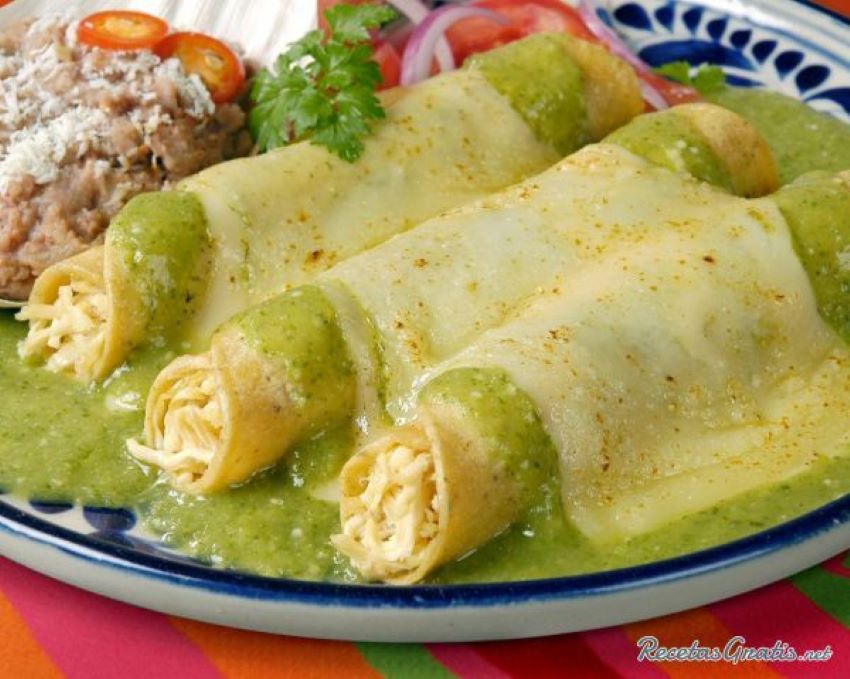
This version of Enchiladas Suizas uses a whole package of cream cheese.

Chicken Enchiladas Suizas

Feel free to use your own homemade salsa verde.

  • 3-4 cups cooked, shredded chicken
  • Salt & pepper
  • 2 Tbsp. butter
  • 1 onion, minced
  • 2 jalapeños, seeded and minced
  • 1 (8 oz.) package cream cheese, cut into small chunks
  • 4-6 garlic cloves, minced
  • ½-1 tsp. red pepper flakes
  • 1 (28 oz.) can green enchilada sauce
  • 7 flour tortillas
  • 8 oz. shredded Chihuahua or Jack cheese, divided

Heat butter in large nonstick skillet over medium heat; cook onion and jalapeños about 5 minutes; stir in cream cheese and cook till it melts and softens. Add fresh garlic, red pepper flakes and chicken; remove from heat.

Pour half the green sauce into bottom of a 9 x 13-inch baking dish. Spread a line of chicken mixture down the center of each tortilla, sprinkle with cheese, roll up and place into baking dish, seam side down. Pour remaining sauce over the enchiladas. Sprinkle remaining cheese over the top.  Bake until filling is hot and bubbling and cheese has melted, 30-35 minutes.
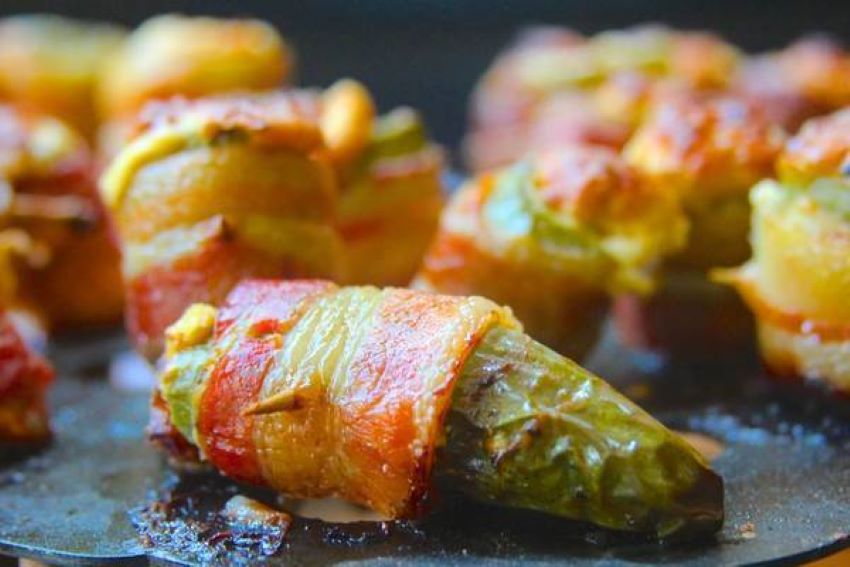
 

Cream cheese balances the spicy kick of these jalapeño poppers

Grilled Jalapeño Poppers

  • 12 large jalapeño chiles
  • 4 oz. cream cheese
  • 1 cup shredded smoked Gouda or Cheddar cheese
  • Salt
  • 6 slices bacon
  • Toothpicks

Heat a gas grill for medium direct cooking. Cut jalapeños in half lengthwise, leaving halves connected at the stem. Remove seeds and ribs. Cut bacon slices in half. Mash cheeses in a bowl with a little salt. Fill jalapeño halves evenly and press halves back together to close. Wrap each with a half-slice of bacon. Secure with a toothpick if necessary.

Put jalapeños on grill directly over the fire. Close lid and cook, carefully turning once, until peppers have softened and browned (it’s okay if they char in spots), cheese has melted, and bacon is crisp. 8-15 minutes.

Janet Blaser has been a writer, editor and storyteller her entire life and feels fortunate to be able to write about great food, amazing places, fascinating people and unique events. Her first book, Why We Left: An Anthology of American Women Expats, is available on Amazon. Contact Janet or read her blog at whyweleftamerica.com.
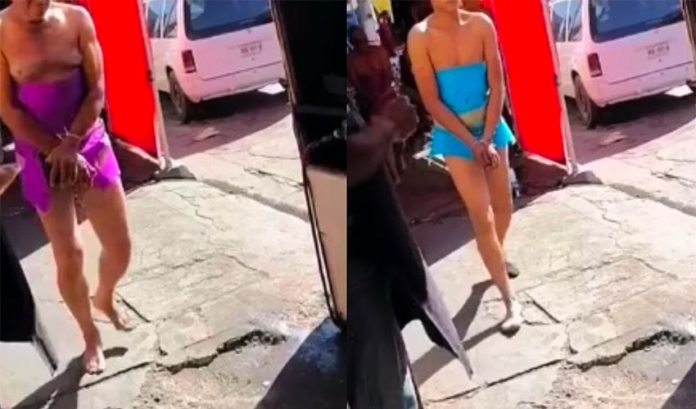
Young men forced to parade semi-nude in Guasave, Sinaloa

0
The two men who were paraded on the streets of Guasave.

For the third time this year, video has emerged on social media of unknown persons forcing young men to walk semi-nude through the streets of Guasave, Sinaloa, with their hands tied and bearing written messages implicating them as disloyal gangsters.

On Saturday, two young men were taken to the city center with their wrists tied in front of them and forced to walk through the streets wearing little clothing.

Declarations that they were chapulines (grasshoppers), a cartel term for gang members who join another, rival gang or who are caught profiting on their own, were written on their backs and on cardboard taped to their bodies.

According to witnesses, police observed the incident but did not intervene.

Local authorities interviewed by the newspaper El Universal said that they had received no reports of Saturday’s incident.

Witnesses also said the two men bore evidence of physical blows to the buttocks. On social media, commenters claimed that the two young men were captured in the nearby town of Batamote before being taken to Guasave.

This is the third time a similar event has happened in the city this year. On October 7, unknown persons forced three young people to walk nude through the Guasave’s city center with their hands tied behind their backs and cardboard signs taped to their chests declaring they were chapulines.

On March 12, photographs appeared on social media of a completely nude young man, his hands tied behind his back, showing evidence of blows to his back and buttocks, forced to walk in the center of Guasave followed closely by a vehicle.

According to witnesses at the time, police did not intervene in the two previous incidents either.

Source: El Universal (sp)

Of 2,246 people tested in Mexico City Friday for Covid, 336 were infected

0
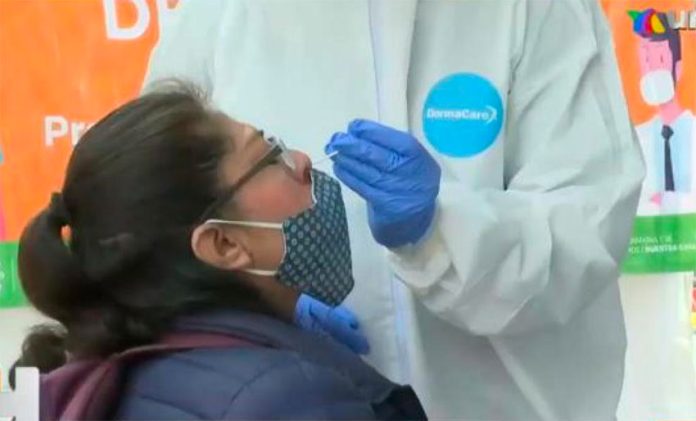
A woman is tested for Covid at a Mexico City testing station.

New Covid-19 rapid testing stations set up by the Mexico City government are proving to be popular.

The government last week established 26 new testing points where residents of the capital can be tested free of charge. On Friday, the first day of operation of the so-called “macro-kiosks,” a total of 2,246 people were tested including 336 citizens who were found to have the coronavirus.

About 150 people lined up in a socially distant way to get tested at a macro-kiosk outside the Etiopía Metro station in the capital’s Navarte neighborhood.

“I don’t feel unwell but I go out to the street a lot for my work,” one man told the newspaper Reforma when asked why he decided to get tested. “My main concern is my family,” he explained.

A woman lining up to get tested also told Reforma that she didn’t feel sick but explained that she was exposed to the virus and wanted to find out if she was infected.

“I’m here because I had contact a week ago with someone who had Covid and I want to be responsible and find out if I have it or not,” Gabriela Arellano said.

She said that the free testing stations were a good idea because not everyone has the means to pay for a test at a private clinic.

Another woman who did have coronavirus-like symptoms also said that providing free testing was a good idea. Mónica Torres, who recently lost a loved one to Covid-19, said she believed that the virus was becoming more prevalent in the community.

A total of 10 people tested positive at the macro-kiosk outside the Etiopía station, Reforma reported.

Dr. Mónica Ramírez, a health official in the Benito Juárez borough where the station is located, said that some of those who tested positive “went into denial or even questioned the reliability of the test.”

Authorities also detected 74 new coronavirus cases among just over 500 people who had free rapid tests on Friday at government healthcare centers.

Mexico City health chief Jorge Alfredo Ochoa Morena described the introduction of rapid testing as a “breakthrough.”

“People no longer have to wait several days for their results. Now in 15 or 20 minutes maximum it’s known if a person is positive or negative,” he said.

Ochoa said the macro-kiosks will each perform about 150 rapid tests every day of the week except Sunday. He said that people should only get tested if they have coronavirus-like symptoms or if they are aware they had contact with an infected person.

With the new testing stations now complementing government clinics and smaller health kiosks set up in hotspot neighborhoods of the capital, Mexico City authorities will carry out 10,000 tests per day, the health chief said, explaining that 7,000 will be rapid tests and the other 3,000 will be gold standard PCR tests.

Mexico City leads the country for confirmed coronavirus cases and Covid-19 deaths with 187,229 of the former and 16,870 of the latter. The capital recorded 1,316 new cases and 44 Covid-19 deaths on Sunday.

The national coronavirus case tally is just over 1 million, while more than 101,000 people have officially lost their lives to Covid-19.

Mexico has a very low testing rate compared to most other countries and as a result both case numbers and deaths are widely believed to be much higher than official statistics indicate.

Source: Reforma (sp), El Universal (sp) 

Mexico City mariachis issue plea for help: ‘We’re a species in terminal decline’

0
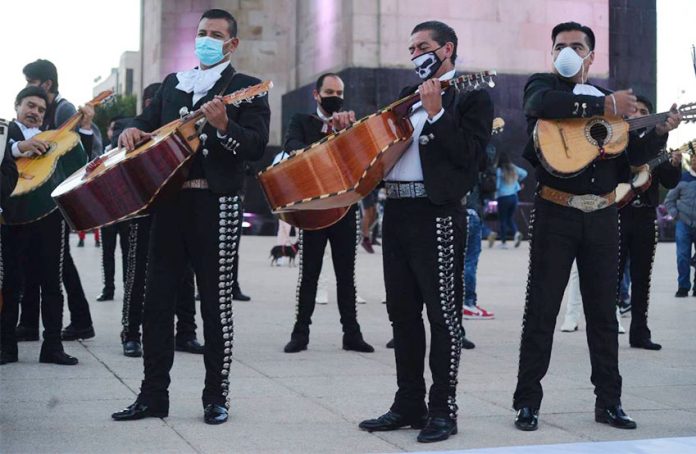
Mariachis give a concert in Mexico City
Mariachis give a concert in Mexico City to draw attention to their plight.

They are one of the enduring symbols of Mexico, with their distinctive black suits and oversized sombreros. But, say the mariachis of Mexico City, the people behind the symbol won’t endure much longer if something isn’t done to help them during the coronavirus pandemic, which has dealt the city’s traditional musicians an economic death blow.

“We are at the point of dying,” says Hermino, a Mexico City mariachi and member of Salvemos al Mariachi (Let’s Save the Mariachis), a group of the city’s traditional musicians who gathered Sunday at the city’s Monument to the Revolution in the city center to give a free, socially distanced concert to publicize their cause.

“We feel alone and isolated from a policy that [Mayor] Claudia Sheinbaum said would be inclusive, but it’s not.”

The group wants the city to give financial help it promised to ease the economic plight that Covid health protocols prohibiting public gatherings have forced upon them.

The city’s mariachis are famously a fixture at places like Garibaldi Plaza, public gathering spots in the historic center that normally attract tourists who pay to hear the musicians play Cielito Lindo and El Rey. But these sites have been closed to the public since March due to Covid.

Even worse, the real bread and butter of these musicians is large private gatherings like weddings or birthday parties, which have been prohibited for months.

Musicians have been clinging to hope after government promises of economic support were made to them early in the pandemic, but money has been slow in coming or nonexistent, they say.

Andres Navarro says the city’s labor department has failed to come through with financial payments it promised nine months ago. He also accused the Cuauhtémoc borough government of having convinced 18 mariachi groups to perform for the public on Independence Day, September 15, without paying them.

“It’s unfair that they made us work and at the end of the day, they haven’t given us a peso,” Navarro said.

The choice of yesterday’s date for the gathering was not an accident: on November 22, Mexico City normally hosts a free mariachi concert in Garibaldi Plaza each year in honor of Santa Cecilia, the patron saint of musicians. The event attracts thousands of people for dancing, drinking, partying, and singing. Naturally, the event did not happen this year.

It is a day that would normally employ many a mariachi.

They may symbolize Mexico, say Hermino and his fellow musicians, but mariachis been largely forgotten. About 5,000 families are believed to be dependent on Mexico City’s mariachis, he said, but they haven’t been able to work for half a year.

“The authorities haven’t given us the necessary support. They don’t even know how many we are … We already don’t have Garibaldi, we don’t have anything. We are a species in a terminal phase if things don’t get better or [the pandemic doesn’t] end soon,” he said.

Source: El Universal (sp)

Senate approves bill that would make Mexico world’s biggest marijuana market

0
Social Encounter Party Deputy Nayeli Salvatori
Social Encounter Party Deputy Nayeli Salvatori lights up a pipe of marijuana to celebrate last week's Senate vote.

Mexico is one step closer to becoming the world’s largest legal marijuana market after the Senate passed a bill last week to legalize the recreational use of the plant.

Eighty-two senators voted in favor of the legalization of pot while just 18 voted against it. The bill now needs to be approved by the lower house of Congress to become law.

That is expected to occur before a December 15 deadline set by the Supreme Court, which ruled last year that laws forbidding the use of marijuana are unconstitutional.

Most lawmakers with the ruling Morena party, which has a majority in both houses of Congress, as well as some from opposition parties support the legalization of marijuana so the bill’s final passage is expected to be a mere formality.

With a population of almost 130 million, Mexico would become the most populous country in the world to legalize the recreational use of marijuana nationwide.

The bill passed by the Senate allows the possession of up to 28 grams by adults but they would be prohibited from smoking in front of children. People would be permitted to grow up to six plants at home and a licensing system for large-scale production and sale would be established.

One critic of the bill is the Catholic Church. The Archdiocese of Mexico said in a statement on Sunday that the lower house of Congress should modify it to “emphasize health and public safety.”

“The bill that was approved does not address the health damages that arise from an ever increasing use of marijuana, does not address the effects on families due to young people’s consumption of drugs, and does not contribute to reducing and inhibiting exposure to drugs,” the council said.

“Public health and welfare are no longer the priority,” the bishops said, charging that the bill cedes to “the tastes of individuals, even though they may damage others.”

The council also said that “the demands for irresponsible liberty for a few are placed above the common good and health.”

Although the bill received strong support in the Senate, not all pro-cannabis senators were happy about it.

Zara Snapp, marijuana activist
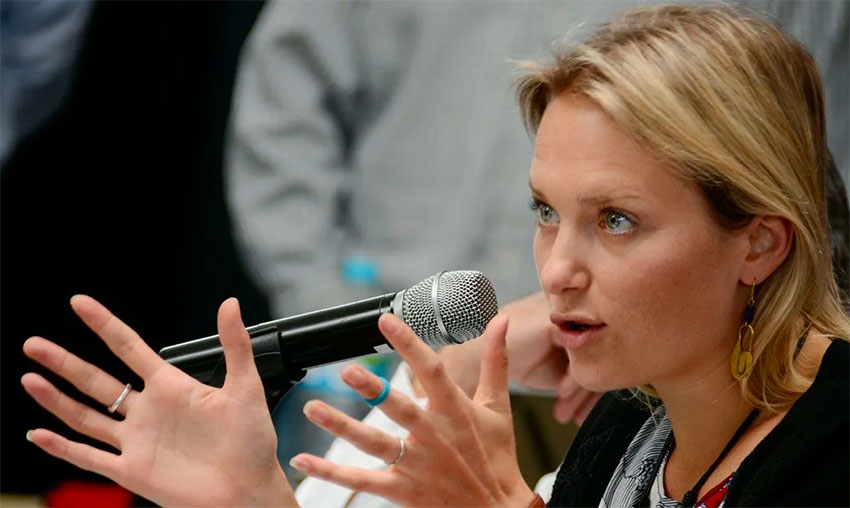
Zara Snapp, marijuana activist: ‘A historic step in the right direction.’

The day before it was approved, Emilio Álvarez Icaza, an independent, and Indira Kempis Martinez of the Citizens Movement party, held a bizarre press conference to announce that they would vote against the bill.

Appearing alongside the senators at the press conference in an outdoor patio of the Senate was prominent marijuana activist José Rivera, who compared prohibition to a “subtle holocaust” over the past century and asked for forgiveness from the Jewish community.

He compared to the federal government to Nazis because the legalization bill requires licenses to be obtained in some instances and doesn’t allow smoking in public places.

A live stream of the press conference on the official Twitter account of the Senate was abruptly cut off when Rivera lit a joint.

Although his remarks were not entirely coherent, Rivera’s protest “reflected a growing dissatisfaction with the bill,” Vice News said, noting that it has been revised on numerous occasions in recent weeks and months.

Zara Snapp, a pro-marijuana activist and co-founder of the Mexican research and advocacy organization Instituto RIA, said that “Mexico has taken a historic step in the right direction” in moving to legalize recreational pot.

But she added that “we are passing a law that does not fully decriminalize the activities related to the plant before regulating it.”

Snapp said that some aspects of the bill, including limits on the number of plants people can grow at home and where they can smoke, constitute a restriction on rights.

Some advocates of legalization argue that changes to the bill were designed to make it more favorable to wealthy Mexican investors and large foreign marijuana producers interested in entering a new, large and potentially very lucrative market. According to Vice News, the advocates say there will be limited business opportunities for “humble marijuana-cultivating communities, small Mexican entrepreneurs, and local home aficionados.”

Snapp highlighted that there was a late modification to the bill which removed limits on “vertical integration.”

The bill had stipulated that businesses could only be licensed to participate in one of four parts of a legal cannabis industry – cultivation, transformation, research or commercialization. Only poor residents of communities who have long grown marijuana would be eligible for multiple licenses.

However, as a result of a last-minute modification, everyone – even big businesses – will have the opportunity to participate in multiple parts of a legal weed market.

Additional addendums could be made to the bill before the Chamber of Deputies votes on it but that would appear unlikely because a new vote would also be needed in the Senate.

Nevertheless, Snapp said that “we will continue to push for this to be a better bill until the last moment,” adding “then we will work on the implementation.”

“[We] believe that drug policy reform is one of the crucial steps towards peace building in the country,” she said. “And if we do it with a social justice focus it will have the impact that we all desire here in our country.”

Source: Vice News (en), The Associated Press (en) 

Coronavirus leaves record 45% of population in poverty, up from 36% in January

0
poverty
Nearly half the population is now considered poor.

Poverty has increased to record levels this year due to the economic impact of the coronavirus pandemic.

Between the first quarter of the year and the third, the percentage of the working-age population considered poor increased to 44.5% from 35.7%, according to the national social development agency Coneval. It is the highest percentage since 2005 when Coneval began keeping comparable records.

People are deemed to be living in poverty if their monthly income is insufficient to purchase a canasta básica, a basic selection of foodstuffs including beans, rice, eggs, sugar and canned tuna. The monthly cost of the canasta is about 1,700 pesos (US $84) in urban areas and 1,200 pesos in rural parts of the country.

The increase in poverty is attributed to the loss of jobs, a reduction in incomes and an increase in the price of the goods that make up the canasta básica.

Over a million formal sector jobs were lost due to the pandemic, although a recovery is now underway, and millions more who work in the vast informal sector also became unemployed or saw their incomes drop or dry up completely. Wages have decreased 6.7% in real terms compared to 2019 and people’s purchasing power declined 12.3% on average between the first and third quarters of 2020.

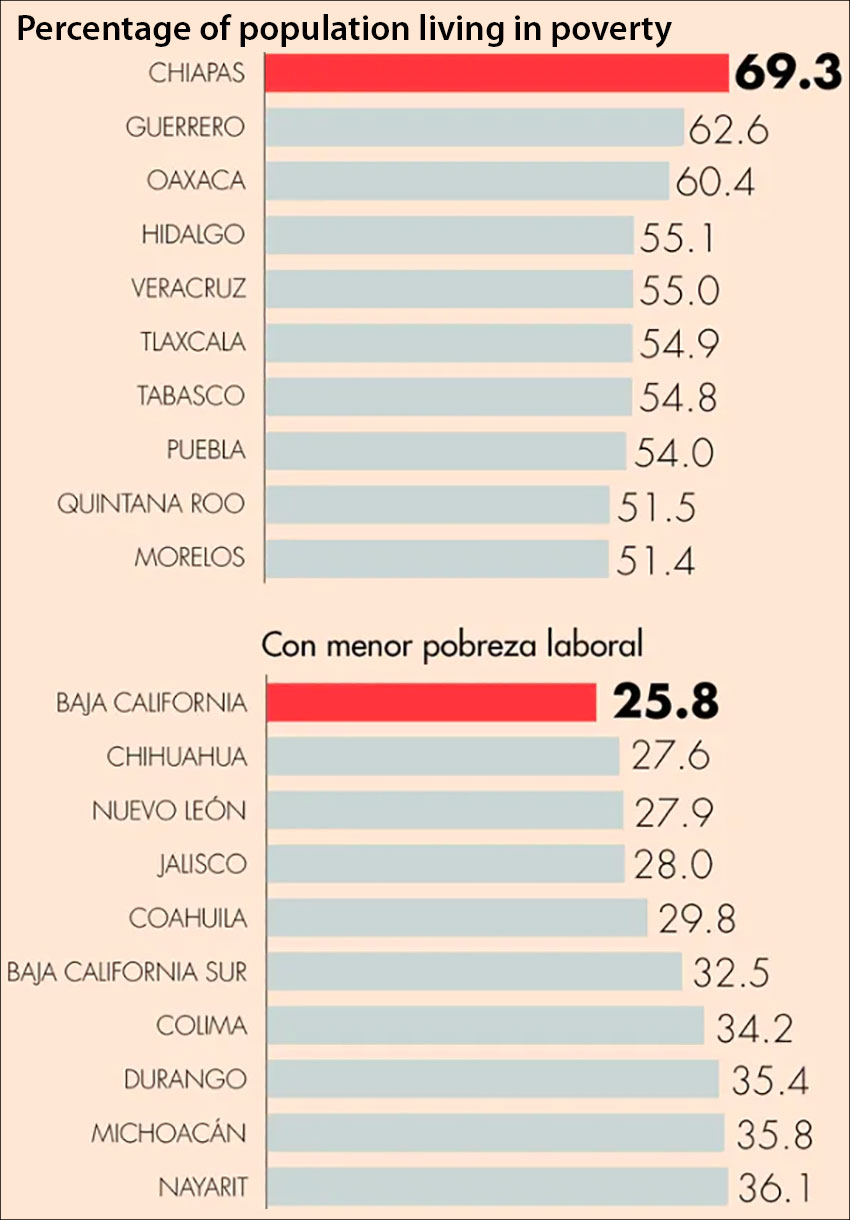
poverty levels by state
At top, states with poverty levels over 50% as of the end of September. Below them are those at the other end of the scale. el economista

Annual inflation was 3.9% in the third quarter, 0.6% higher than in the same period of 2019. Higher prices for fruit and vegetables, which are included in the canasta básica, are partially responsible for higher inflation.

Among Mexico’s 32 states, Chiapas has the highest levels of poverty among working-age people, according to Coneval. In the third quarter of the year, 69.3% of people in the southern state earned incomes below the value of the canasta básica.

Guerrero, Oaxaca, Hidalgo and Veracruz had the next highest poverty levels at 62.6%, 60.4%, 55.1% and 55%, respectively.

Poverty has increased across the country this year but Quintana Roo, which is heavily dependent on tourism, saw the biggest spike. Just over half the residents of the Caribbean coast state – 51.5% – were living in poverty in the third quarter, a 23.1% increase compared to the first quarter.

Mexico City saw the next biggest increase, with poverty levels spiking 16.7% to 45.1%, followed by Tabasco, where the percentage of poor residents rose 15.9% to 54.8%.

Coneval also determined that income inequality has significantly increased this year. In the third quarter of last year, the average income of the richest 20% of the population was 34.3 times higher than the average wage of the poorest 20%.

In the third quarter of 2020, the average salary of the richest 20% was 146.3 times higher that that of the poorest quintile, Coneval found.

There is also a significant difference in the incomes earned by indigenous and non-indigenous Mexicans.

In the third quarter, the average income of residents in mostly non-indigenous municipalities was 4,253 pesos (US $211) per month whereas in mainly indigenous municipalities it was just 1,999 pesos (US $99).

Average incomes declined 218 pesos between the first and third quarters in mainly indigenous municipalities, while they only fell 155 pesos in non-indigenous ones.

Source: El Universal (sp) 

Narco-submarine abandoned off Oaxaca coast

0
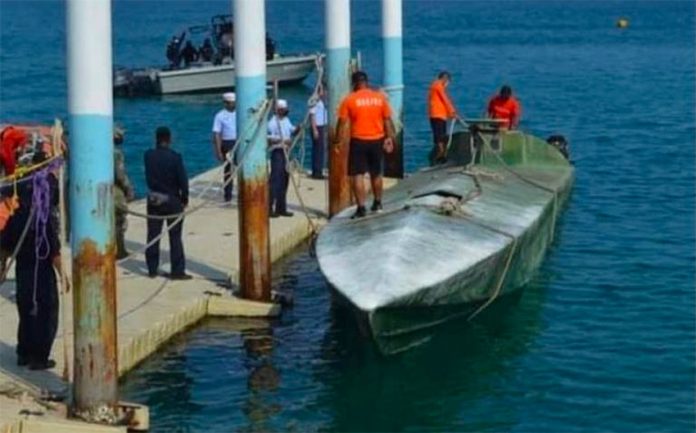
The submersible vessel found off the coast of Oaxaca.

An anonymous tip led navy personnel to an abandoned makeshift submarine on the Oaxaca coast that is believed to have belonged to drug traffickers operating between South America and Mexico.

It is not known which criminal organization it belonged to and neither people nor drugs were found on the vessel, which had appeared near the town of Barra de la Cruz, located about 30 kilometers east of Huatulco.

Drug traffickers frequently use various marine routes to transport a myriad of drugs from Central and South America to destinations all over Mexico within five to 15 days. Authorities believe that in this case, traffickers were intending to transport cocaine or amphetamines on the submersible vessel.

It first became evident that cartels were building DIY submarines to transport drugs by sea in 2005. Authorities believe the submarines are built in Columbia, Ecuador or Guyana.

In December 2019, a submarine carrying over a tonne of cocaine bound for Mexico was caught off the coast of Peru with a Columbian, Ecuadorian, and a Mexican aboard. At the time, authorities said the vessel had been loaded in Ecuador near the border with Peru and that it was the first such drug-trafficking submarine ever caught in Peru.

According to the country’s anti-drug agency, the majority of Peru’s cocaine is exported via maritime routes.

Source: Milenio (sp)

Health authorities highlight decline in Covid fatality rate from 9.8 to 3

0
hospital patient
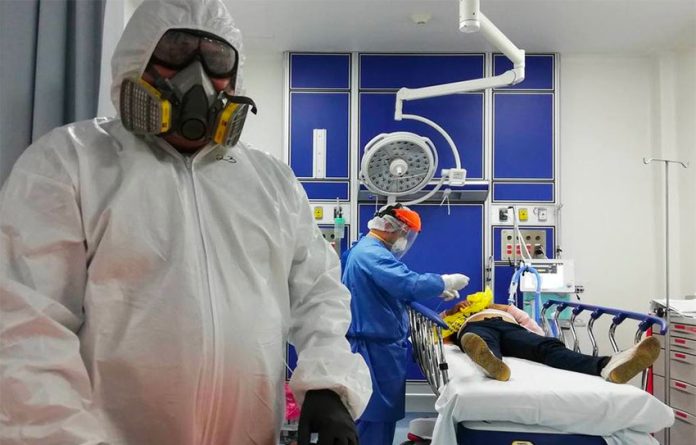
About 50% of Covid hospital beds are unoccupied, the president said.

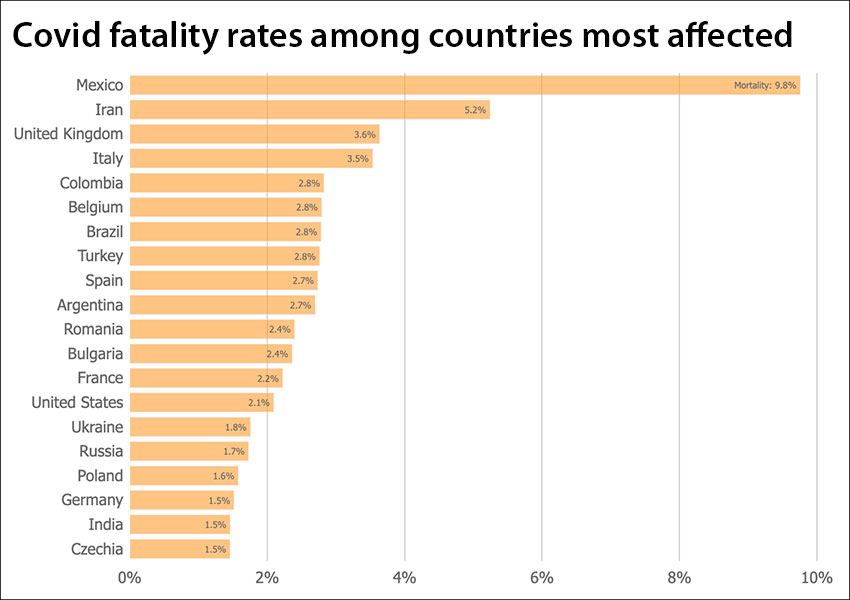
With 9.8 deaths per 100 confirmed coronavirus cases, Mexico has the highest fatality rate among the 20 countries currently most affected by Covid-19, according to Johns Hopkins University.

But Health Ministry Director of Epidemiology José Luis Alomía said Sunday that the fatality rate has been on the wane since July and was about 3 deaths per 100 confirmed cases in recent weeks.

He said the availability of hospital beds for coronavirus patients and the resultant capacity to provide timely medical care were factors behind the reduction in the rate.

“Always having a hospital bed available can help to reduce the death rate,” Alomía told reporters at the Health Ministry coronavirus press briefing.

At the opening of a new hospital in Texcoco, México state, earlier on Sunday, President López Obrador said that no coronavirus patient has been unable to access medical treatment or a hospital bed because the health system hasn’t been overwhelmed during the pandemic.

Mexico has led in terms of the fatality rate among countries most affected.
Mexico has led in terms of the fatality rate among countries most affected. johns hopkins university

“Of course it’s a pandemic of a terrible virus that has caused a lot of damage, a lot of pain and suffering but we’re overcoming it because the management [of the health crisis] was good, because people behaved very well,” he said.

The president said that about 50% of beds in the approximately 1,000 Covid hospitals across the country are still available despite a recent increase in infections. Mexico last week became the fourth country in the world to record 100,000 Covid-19 deaths but López Obrador said that doctors are now able to save more seriously ill patients.

“It’s a new stage now, … medical personnel have more experience [in treating Covid-19], we’re choosing the best hospitals [as designated Covid hospitals] so that patients can recover and [we can] reduce the number of deaths. That’s the main aim now,” he said.

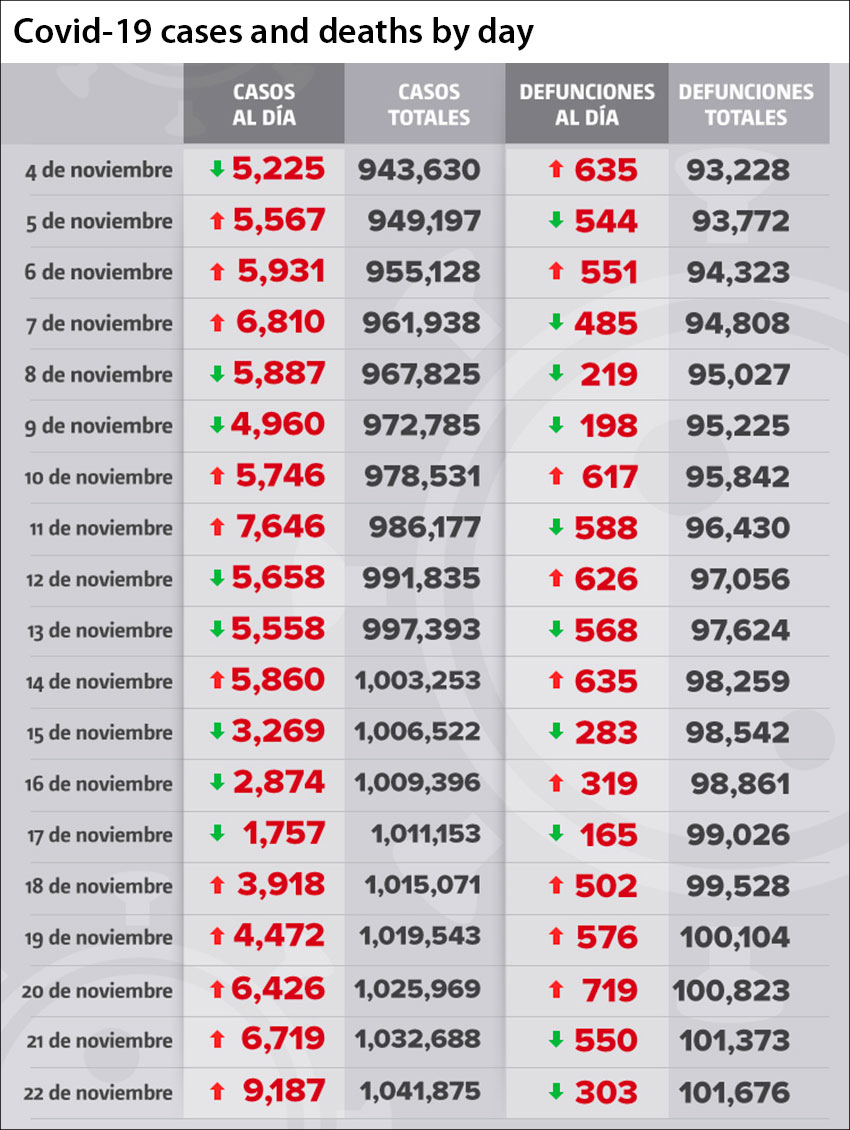
Alomía reported 373 additional Covid-19 fatalities at the Sunday night press conference, lifting Mexico’s official death toll to 101,676. It was the first day since last Tuesday that the daily reported death toll was below 500.

Alomía also reported 9,187 new coronavirus cases, increasing the accumulated tally to 1,041,875. The daily tally was the second highest of the pandemic excluding the 28,115 cases reported on October 5 due to a change in the methodology used to determine whether a person is infected.

Mexico City leads the country for confirmed cases and deaths with 187,229 of the former and 16,870 of the latter.

Coronavirus cases and deaths in Mexico as reported by day.
Coronavirus cases and deaths in Mexico as reported by day. milenio

Campeche, one of two states classified as green light “low” risk on the federal government’s coronavirus stoplight map, has recorded the lowest number of confirmed cases among the country’s 32 states with 6,703 as of Sunday. Baja California Sur has recorded the lowest number of Covid-19 deaths with 652.

The Health Ministry estimates that there are currently 45,445 active cases across the country. More than a quarter of the estimated cases – 12,683 – are in Mexico City, where an increase in hospitalizations of coronavirus patients triggered the implementation of slightly stricter restrictions.

Guanajuato ranks second for estimated active cases, with 3,444, followed by Nuevo León and México state, where 3,441 and 3,327 people currently have coronavirus symptoms.

Campeche has the lowest number of active cases with just 65, while Chiapas – the other green light state – has 108, according to Health Ministry estimates.

Source: Milenio (sp) 

AMLO to G20 leaders: ‘Priority for the poor,’ universal access to medical care

0
lopez obrador
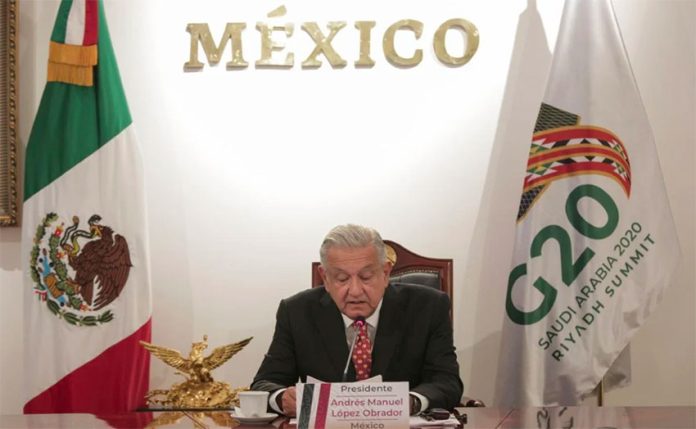
The president at the G20 summit on the weekend.

President López Obrador advocated free and universal access to vaccines and declared that the poor must be prioritized in the government response to the coronavirus-induced economic crisis, in an address to the G20 leaders’ summit on Saturday.

López Obrador delivered a five-point speech to his fellow G20 leaders at the virtual event, saying that the dual health and economic crises precipitated by the coronavirus pandemic have caused “suffering and calamities” but also provided “important lessons.”

The first lesson learned, he said, is that “health is a fundamental human right that the state has to guarantee, putting the desire to profit to one side.”

Medical care, vaccines and medications must be free and available to all citizens, López Obrador said, noting that 179 countries supported a resolution to that effect that was put forward by Mexico at the United Nations early in the pandemic.

Secondly, “prevention is better than cure,” the president said.

For that reason it is important to promote a healthy diet, he said, recommending that people avoid foods with excessive salt, sugar, fat and chemicals.

“Those most affected by the pandemic have been patients with hypertension, diabetes and obesity,” López Obrador said. “These chronic diseases … are caused by poor diet and a lack of physical exercise and sports.”

In a sermon-like address to leaders including United States President Donald Trump, German Chancellor Angela Merkel and Russian President Vladimir Putin, the president said the third lesson of the pandemic is that the family should be considered “the main institution of social security.”

López Obrador advocated the avoidance of family breakdown and said that senior citizens should not be “abandoned” in nursing homes. As comfortable as they might be, “they will never be a substitute for the love offered by loved ones,” he said.

Fourthly, there should be more confidence in people’s capacity to be responsible, and freedom must be guaranteed in all circumstances.

As the pandemic continues, governments should “abandon the temptation to impose authoritarian measures” such as unreasonable lockdowns and curfews, he said, adding: “Nothing by force, all by persuasion and reason.”

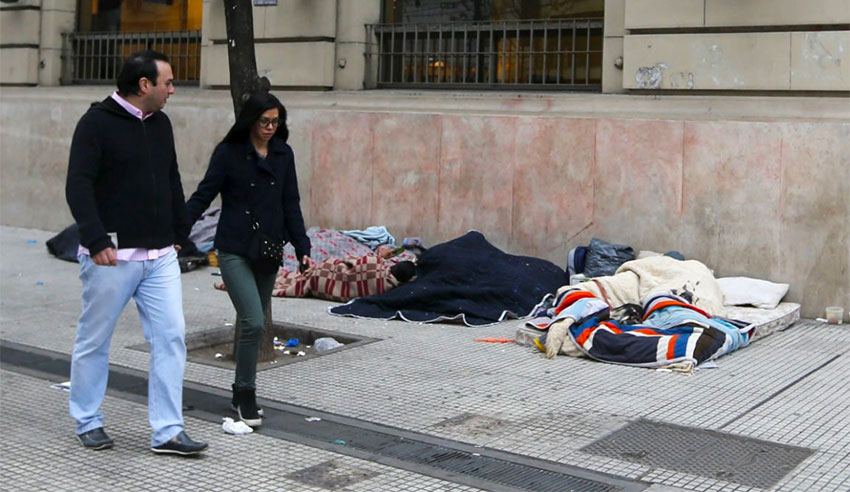
poverty mexico
Focus on the poor first, AMLO tells world leaders.

Finally, governments should focus their economic recovery efforts on the poor, López Obrador said.

“The economic rescue should be done from the bottom up. Help the poor first and don’t focus government actions only on allocating public funds to companies and bankrupt financial institutions,” he said.

The president also said that private debt should not be converted into public debt, adding that governments should avoid debt altogether, especially if it is taken on for the benefit of a small number of people and to the detriment of many.

In a second G20 video address on Sunday, López Obrador proposed the elimination of external debt for poor countries in order to give them greater capacity to respond to the coronavirus-induced economic downturn.

“Our proposal consists of … making a reality the commitment to remove sums of debt and debt-servicing to the poor nations of the world,” he said.

The president also urged G20 leaders to “guarantee that middle-income countries can access credit at interest rates equivalent to the current ones in developed countries.”

It was the first time that López Obrador has participated in the annual G20 summit after choosing not to travel to Japan last year because he had more pressing issues at home and didn’t want to be drawn into a “direct confrontation” between the United States and China with respect to their trade war.

He was the only G20 leader absent at last year’s summit. This year’s event was originally planned to be held in Riyadh, Saudi Arabia, but was moved online due to the pandemic.

Source: El Universal (sp) 

Mazatlán leading tourism recovery with strong domestic visitor numbers

0
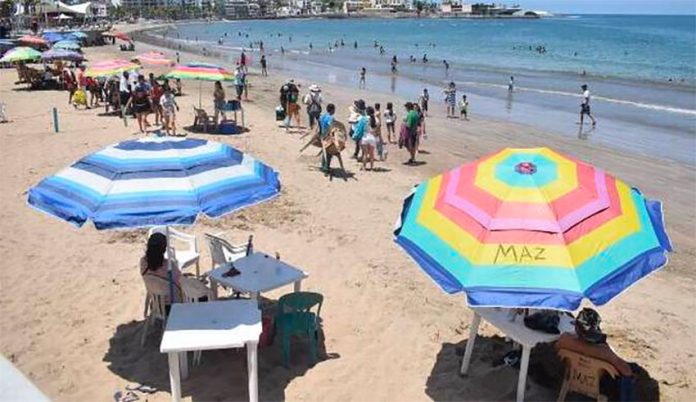
Eight out of 10 tourists in Mazatlán were Mexican.
Eight out of 10 tourists in Mazatlán have been Mexican.

Mazatlán, Sinaloa, is leading Mexico’s tourism recovery thanks to an influx of visitors from other parts of the country.

The Pacific coast resort city had the highest hotel occupancy among Mexico’s main tourism destinations during the November 13-16 Revolution Day long weekend.

Figures from the federal Tourism Ministry (Sectur) showed that average hotel occupancy in Mazatlán over the long weekend was 72%.  By comparison, occupancy in Puerto Vallarta, Los Cabos and Cancún was 56.8%, 52.6% and 50.2%, respectively.

Some 225,000 people descended on the “Pearl of the Pacific” and injected 300 million pesos (US $14.9 million) into the local economy, according to municipal tourism authorities.

Mayor Luis Guillermo Benítez Torres told the newspaper El Universal that Mazatlán is more fortunate than most tourism destinations because the majority of visitors arrive by car rather than on flights.

“We had greater luck in Mazatlán because most visitors arrive via land thanks to the Matamoros-Mazatlán highway, the super highway,” he said.

Benítez said the city welcomed tourists from states including Tamaulipas, Sonora and Nayarit as well as people from other parts of Sinaloa. Municipal tourism chief Luis Terán Tirado said people also flocked to the city from Guadalajara, Jalisco.

The mayor said the pandemic’s impact on tourism hasn’t been felt as acutely in Mazatlán as other destinations.

Mexican visitors are driving the tourism recovery in the city. Since hotels reopened after closing in April, May and June due to the coronavirus pandemic, eight of 10 tourists staying in Mazatlán hotels have been Mexicans, according to Sectur.

Thanks to the support of domestic tourists, the city will be the first in Mexico to recover fully from the pandemic-induced downturn, Benítez asserted. Tourist numbers in 2021 could be even higher than in 2019, he said.

“We’re leading the tourism recovery; we’re even ahead of Acapulco, the Riviera Maya and Los Cabos,” Benítez said. “I estimate in a month or two months maximum that we’ll reach 100% air connectivity,” he added.

Statistics show that just under 64,000 domestic passengers flew into the Mazatlán airport in October, the highest level since February. Flights are also currently arriving from United States and Canadian cities including Los Angeles, Phoenix, Dallas and Edmonton but international arrivals remain below pre-pandemic levels.

Other destinations that are more dependent on international tourists and haven’t recovered as strongly as Mazatlán look set to get a boost next week from American Thanksgiving travelers. Air traffic departing the United States will be significantly lower than during the Thanksgiving break in recent years but those who do travel are likely to be visiting Mexico.

An analysis by the insurance company Allianz found that Cancún, Los Cabos and Puerto Vallarta are, in that order, the top three international destinations for Thanksgiving tourists.

Source: El Universal (sp), El Sol de Mazatlán (sp)