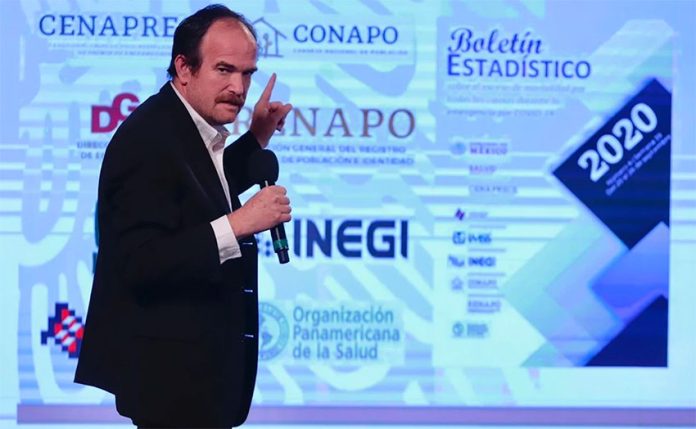
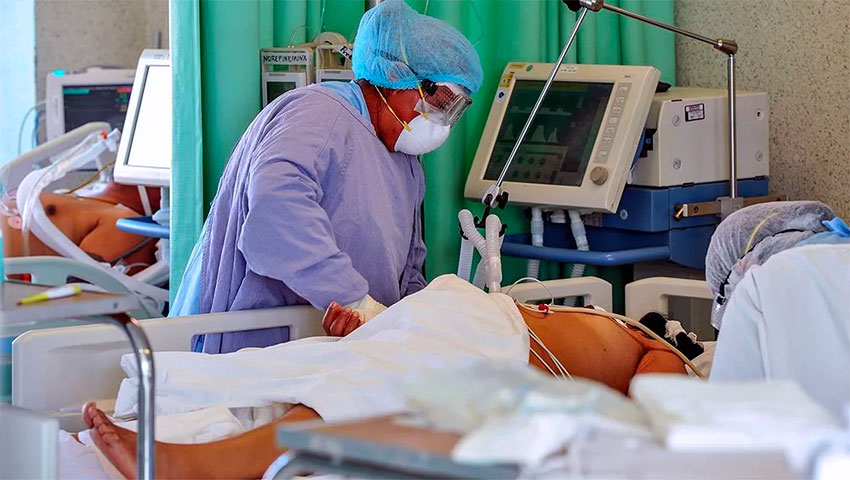
The Health Ministry's Ruy López provides death statistics during Sunday's coronavirus press briefing.
There were 193,170 excess deaths in Mexico between January 1 and September 26, more than 70% of which are attributable to Covid-19, the Health Ministry reported Sunday.
Ruy López Ridaura, director of the Health Ministry’s National Center for Disease Prevention and Control Programs, told Sunday night’s coronavirus press briefing that 139,153 of the excess deaths – or 72% – were judged to have been caused by Covid-19.
The figure is 50,224 higher than the official Covid-19 death toll, which currently stands at 88,924. The main reason for the discrepancy is that Mexico has an extremely low testing rate, and many suspected Covid-19 patients have died without being tested.
López said the figure of 139,153 Covid-19 deaths comes from a preliminary analysis of death certificate databases. The figure includes fatalities for which Covid-19 symptoms were mentioned on death certificates even if they were not identified as the cause of death.
López said the excess death figure was obtained by comparing the number of fatalities between January 1 and September 26 this year to the average number in the same period between 2015 and 2018.
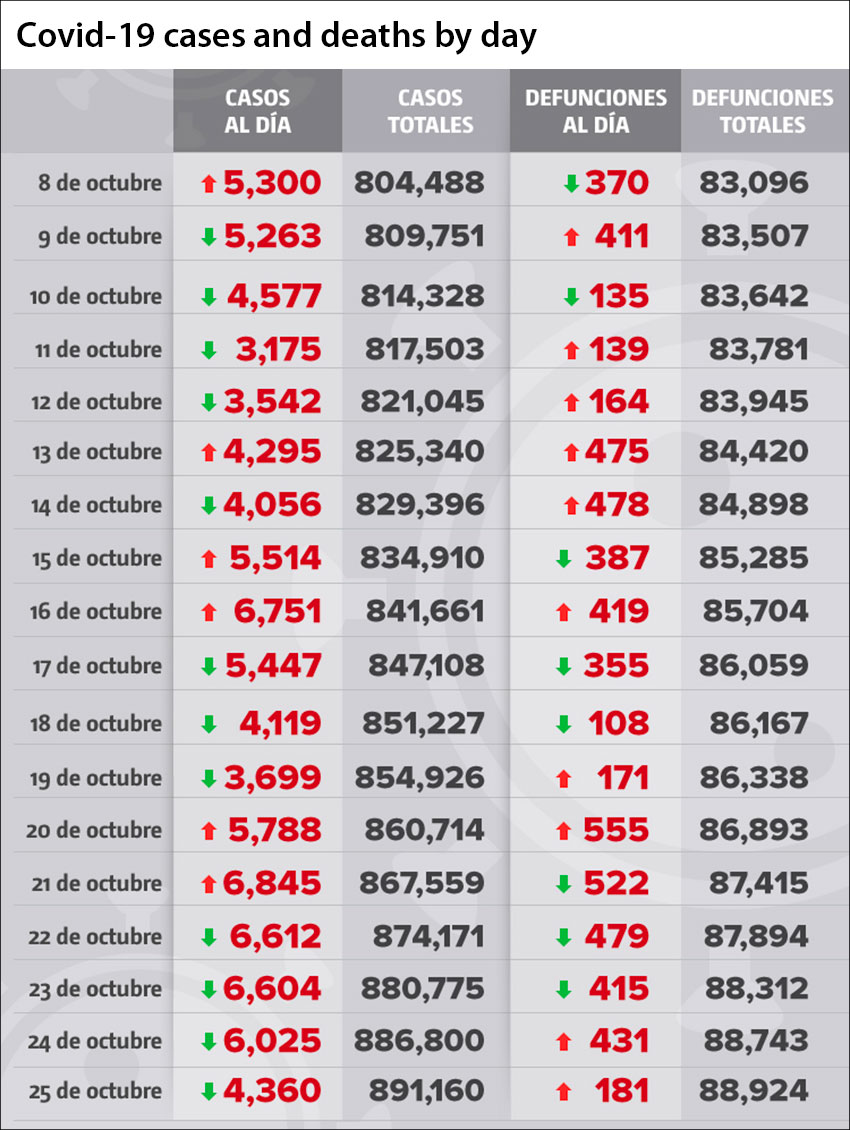
Coronavirus cases and deaths in Mexico as reported by day. milenio
There were a total of 718,090 deaths in the almost nine-month-long period, 193,170 — or 36.8% — more than the 2015-2018 average.
Once the excess deaths attributable to Covid-19 are deducted, there were 54,017 additional fatalities above the average level.
López didn’t explain the causes of the other excess deaths but experts in other countries have said that crowded hospitals may be a factor in more people dying from illnesses not related to Covid-19.
Another possible reason is that some people didn’t seek timely treatment for illnesses that turned out to be fatal out of fear of being infected with the coronavirus at the hospital.
The excess mortality rate was highest this year among Mexicans aged 45 to 64, with 63% more deaths than in previous years.
There were 33% more fatalities among citizens aged 65 and above, while the excess mortality rate for those aged 20 to 44 was 18%.
Campeche, the only state with a green light “low” risk rating according the federal government’s coronavirus stoplight system, had the highest excess mortality rate between January and September, with 65% more deaths than the average for previous years.
México state, which ranks second among the 32 states for Covid-19 deaths, ranks second, with an excess morality rate of 64%.
Mexico City – which leads the country for both confirmed coronavirus cases and Covid-19 deaths – and Quintana Roo follow, each having an excess mortality rate of 60% between January and September.
Every state recorded more deaths in 2020 than in previous years but five had excess mortality rates below 10%. They were Durango (4%), Chiapas (5%), Nayarit (6%), Guerrero (8%) and Yucatán (9%).
López said the excess morality rates cannot be used to assess the effectiveness of the pandemic response in each state.
Therefore authorities in states with lower rates haven’t necessarily done a better job in controlling the virus than those with higher rates.
Meanwhile, Mexico’s accumulated case tally rose to 891,160 on Sunday with 4,360 new cases registered by health authorities. The official Covid-19 death toll rose to 88,924 with an additional 181 fatalities reported.
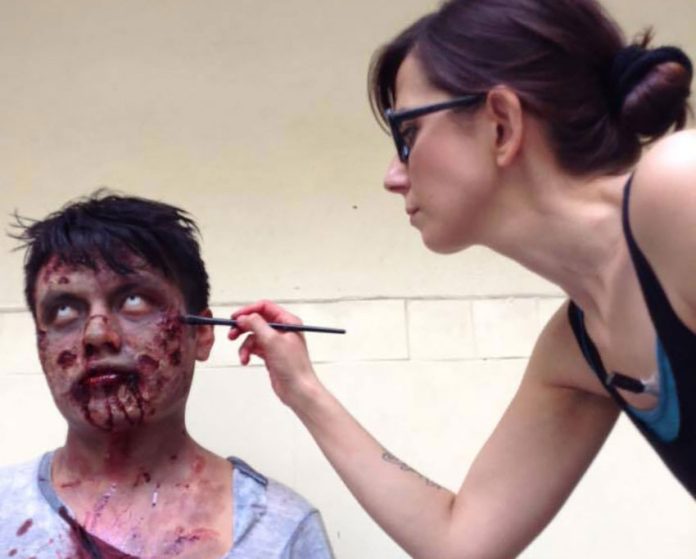
Francesca Dalla works on a zombie figure for a movie prop.
Artist Francesca Dalla Benetta’s story shows how an even seemingly fragmented past can come together to make something truly amazing.
Despite being born and raised in Italy, a place synonymous with fine art, Dalla states that the country is “stuck in the 17th century aesthetically, with a culture that is all but dead.”
Although Dalla knew she wanted to be an artist and graduated from art school in Italy in 2003, she says she was unfocused and began working in stage scenery and special effects. However, the field is tightly controlled in Italy, she said. Without the right connections, it would be impossible to go far.
But Hollywood and Mexico gave her a new option: she landed a six-month gig in 2006 working on Mel Gibson’s movie Apocalypto, which was shooting in southern Veracruz. She was part of a multinational crew but found herself mostly hanging out with Mexicans and learning Spanish. The experience gave her contacts, and she found it quite possible to support herself in Mexico as a freelancer.
She spent many years in Mexico’s film industry, mostly making masks, arm and leg protheses, and fake cadavers. She met and married a Mexican man.
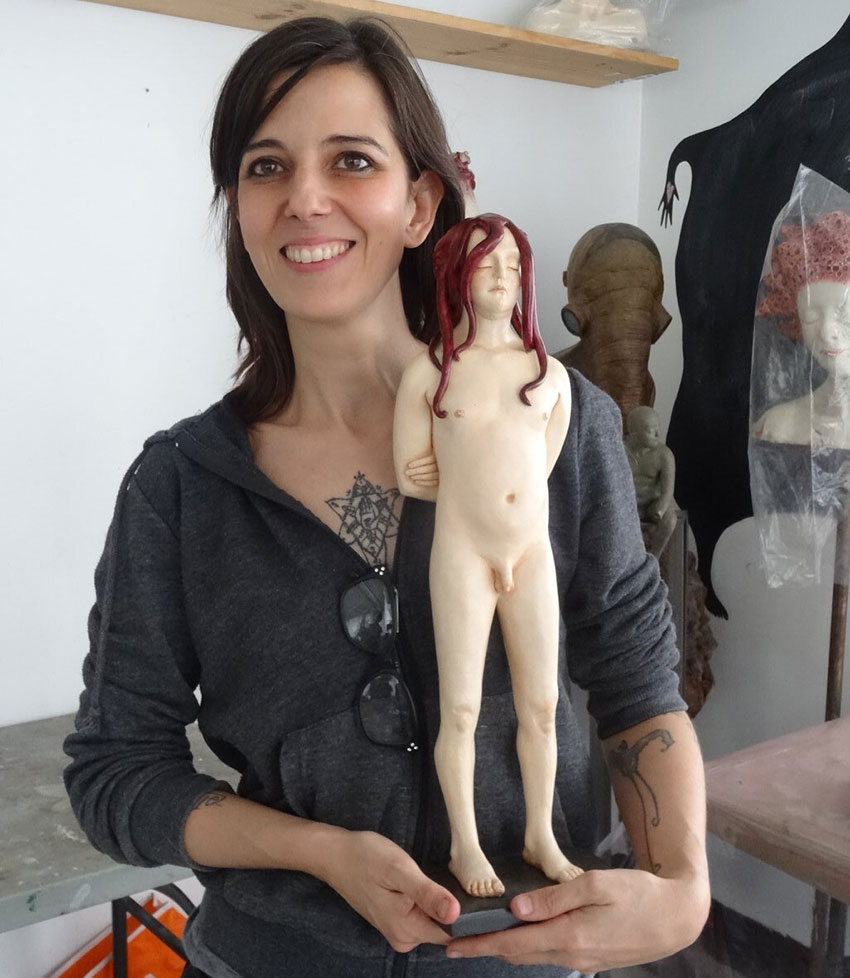
Dalla with one of her sculptures.
In 2009, her work caught the attention of an Italian wax museum, which hired her to make figures. She considers it a major break because during that period, she created entire figures depicting the living and her first work in sculpture.
At the same time, the long hours and extreme competitiveness of movie work was wearing her down. She even ran into Mexicans that resented her as a foreigner working in the country.
She shifted into teaching to pay the bills and began to sculpt. Her first experiments were based off the fantastic creatures she made for the movies, essentially taking what she learned there and applying it to fine art. She began to show her sculptures in 2012. By 2017, they were selling.
She decided that if she was going to be a “real artist,” she needed to move to Mexico City and so left Veracruz. Her home and workshop today are in the working-class barrio of Colonia Moderna, east of the more trendy areas of the city.
She prefers this neighborhood in part because it allows her to have more space at a reasonable price and because the area is less affected by earthquakes, a consideration after Mexico City’s 2017 quake.
Dalla has found success with a particular kind of surrealism. The Italian influence on her work is seen in the traditional European anatomy, with a preference toward the slightly plump figures of Renaissance art.
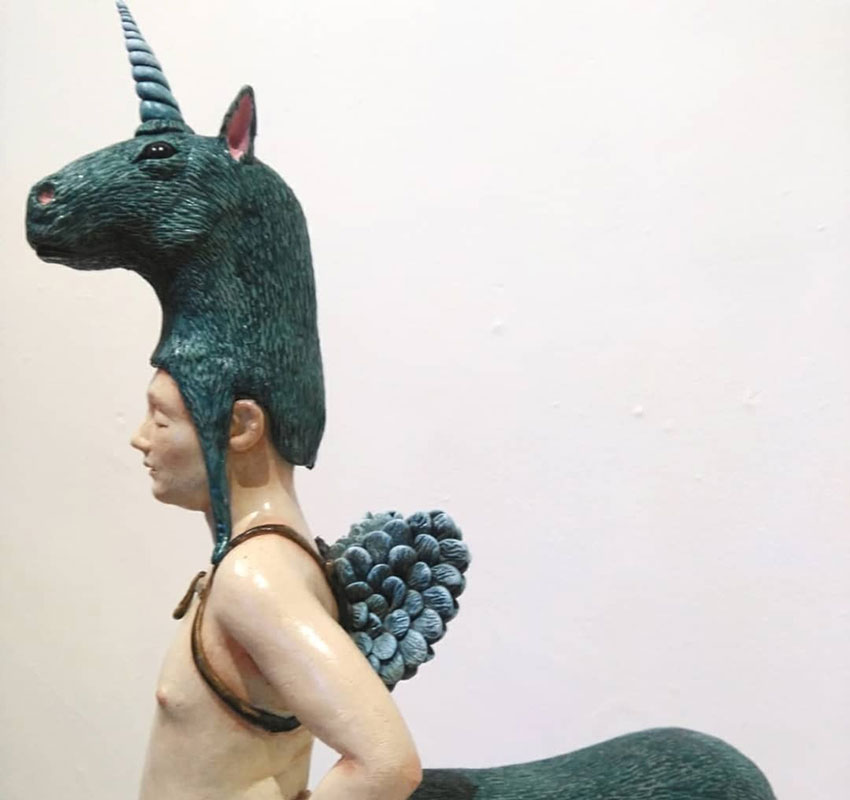
A nagual-inspired figure.
However, she emphasizes that while proportion is important to her, she tries not to fall into the “trap” of Old European perfectionism. Elements are added to create an otherworldliness.
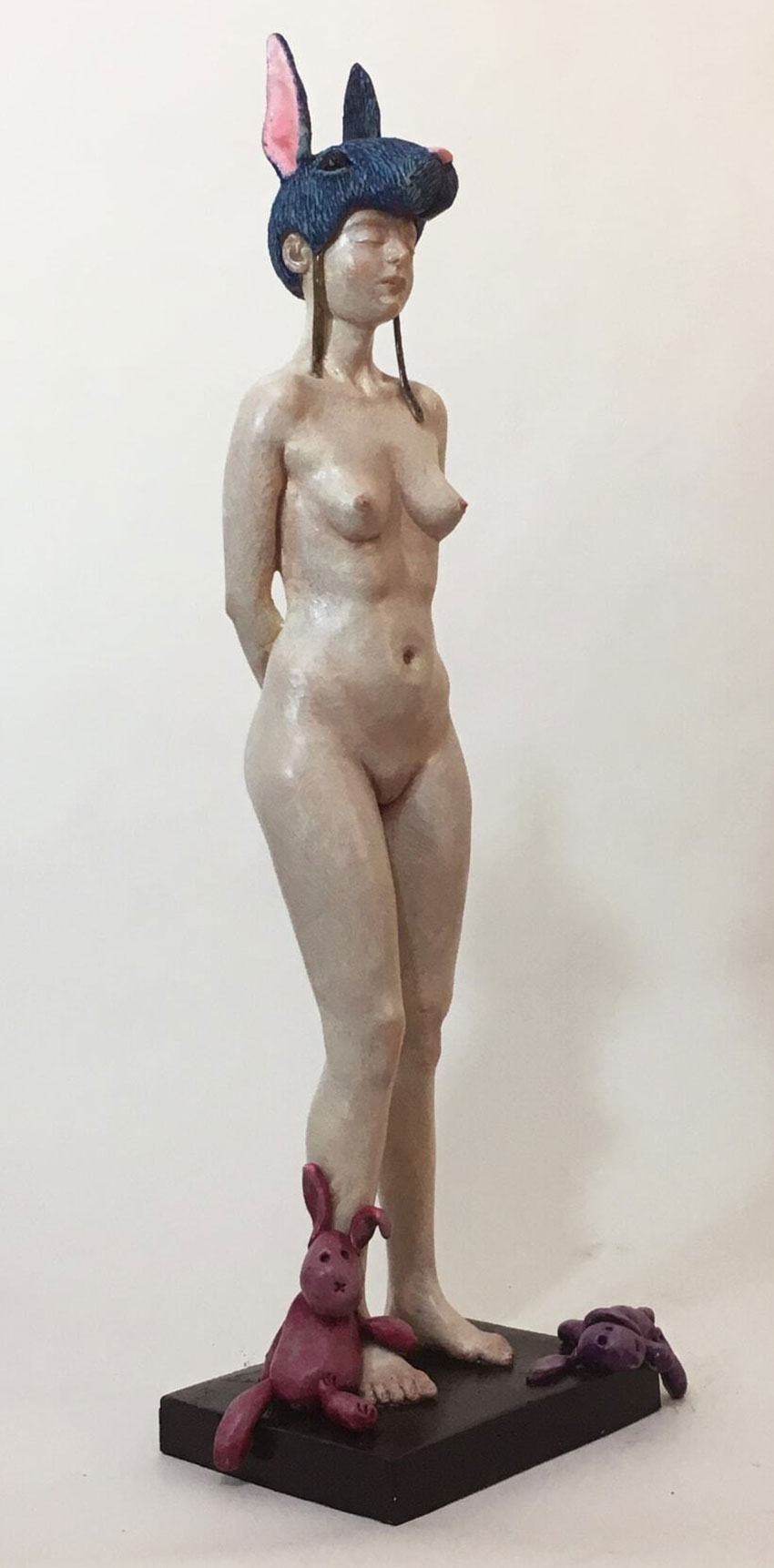
In one series, there are human figures with animal heads or animal masks. They represent how we present ourselves to the outside world, either to disguise who we are or to demonstrate it. One interesting example is “Little Red Riding Hood,” a figure of a young girl with a wolf’s mask.
Other series have human figures, wholly or in part integrated with flowers and inanimate objects. Considered together, her work creates a kind of personal mythology. Some works have more than a hint of the Mexican concept of a nagual (a shapeshifter), whether that is conscious or not.
Unlike the vast majority of foreign artists I have met in Mexico, Dalla has contemplated conscientiously what it means to be a foreigner in this country. In 2012, she began a project to research the stories of other Italian immigrants to Mexico, in part due to a personal crisis that questioned her resolve to continue living in the country.
Her thought was that if she could find out how other Italians adapted and thrived in Mexico, she could, too. The project interviewed 50 people in the Mexico City area, focusing on questions of identity, resulting in 14 busts and 28 drawings. In the end, it served as a way for her to make peace with the cultural clashes she had been experiencing.
The trials and tribulations of being a stranger in a strange land can often bear artistic fruit. Dalla has taken the best of being both Italian and Mexican to combine them into something that speaks to the human psyche. Despite any complaints she may have about living here, she fervently believes that Mexico allowed her to come into her own.
A recent work which incorporates everyday objects as part of the figure “Guess who I am.”
“Mexico is the place that gave me the opportunity to develop myself as a sculptor and as a mature artist, an aesthetic concept, a career …”
She calls Mexico a “super fertile land,” and while she admits it is clichéd, she finds Mexico surrealist.
“There is something in the air here that makes one realize that anything is possible.”
Leigh Thelmadatter arrived in Mexico 17 years ago and fell in love with the land and the culture. She publishes a blog called Creative Hands of Mexicoand her first book, Mexican Cartonería: Paper, Paste and Fiesta, was published last year. Her culture blog appears weekly on Mexico News Daily.
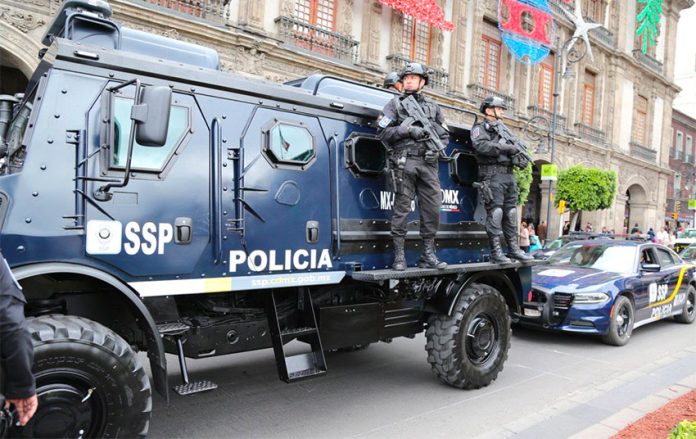
An armored police vehicle on patrol in Mexico City.
Despite having long played down the presence of the powerful Jalisco New Generation Cartel (CJNG) in Mexico City, a series of recent moves is making such denials increasingly pointless.
In recent weeks, signs have emerged that the Jalisco cartel is expanding its presence in the capital, largely by allying itself with the Fuerza Anti-Unión to take on the capital’s largest criminal gang, La Unión Tepito.
On October 3, a shoot-out in the borough of Azcapotzalco left six dead and four wounded, with one of the arrested perpetrators telling police they were hired by the CJNG to attack drug dealers associated with the Unión Tepito, according to the newspaper El Universal.
An early October raid at Mexico City’s Central de Abasto wholesale market found tunnels used to move drugs and weapons. City officials said these belonged to the Fuerza Anti-Unión and that they were being supplied with weaponry by CJNG.
Officials have recently made somewhat contradictory statements about the CJNG. On September 18, Security Minister Alfonso Durazo stated that the CJNG had been making incursions into Mexico City and maintained “fragile” agreements with local gangs.
But earlier in September, Mexico City’s Secretary of Citizen Security, Omar García Harfuch, claimed that the CJNG had no significant presence in the capital and that local gangs, such as the Unión Tepito and their enemy the Fuerza Anti-Unión, had been broken up into “atomized cells.” More recently, he identified 14 criminal groups operating in the capital – without including the CJNG.
García’s comments came mere months after his attempted assassination on June 26, when CJNG gunmen shot up his car, hitting him three times and killing his bodyguards as well as a passerby.
InSight Crime analysis
Mexico City officials are sticking to a long-held narrative that the capital remains a cartel-free bastion of safety.
But this is belied by any number of reports: that the CJNG supplies microtraffickers with drugs in nine of Mexico City’s 16 boroughs, that CJNG members are directly extorting businesses in the historic center and that the new Fuerza Anti-Unión leader reportedly maintains strong ties with the CJNG.
Cementing a power base in Mexico City would be a significant step for the group, bringing it one step closer to having a presence in every part of the country.
According to Óscar Balderas, a Mexican journalist and expert on organized crime, the capital has clear attractions for the CJNG. “The country’s logistics are controlled from here … you have the historic center, which is the richest itinerant trade area in all of Latin America, the most important airport in Latin America to be used for drug trafficking and human trafficking, you have financial areas where money can be laundered,” he told InSight Crime.
Pinpointing how long the CJNG has had a presence in the capital is challenging. Suspicions of ties between the CJNG and the Fuerza Anti-Unión have existed since at least 2017, when the National Center for Planning, Analysis and Information for Combating Crime first warned about it.
And this “divide-and-conquer” approach has worked elsewhere. Its nationwide success can be partly attributed to its common tactic of forging alliances with local groups, as seen in Tamaulipas with Los Metros or in Tijuana with remnants of the Arellano Félix organization, who have rebranded themselves as the Tijuana New Generation Cartel.
But displacing the Unión Tepito will not be a simple task. To do so, the CJNG “must break the very deep ties – even familial ones – that La Unión Tepito has in the center of Mexico City … Their only alternatives would be to buy loyalties, and the CJNG has plenty of money to do so, or to force them out with violence,” explained Balderas.
But, he suggested, a violent approach would likely provoke a firm response from law enforcement and spoil one of Mexico City’s key criminal advantages: “the ability to go unnoticed while controlling some of the most profitable criminal businesses in the country.”
Reprinted from InSight Crime. Alessandro Ford is a writer with InSight Crime, a foundation dedicated to the study of organized crime.
People have lost their fear of the disease, says analyst.
October is on track to be the second worst month of the pandemic for new cases of the coronavirus. But the increase in cases this month is not due to a new outbreak of the virus, according to experts who spoke to the newspaper El Universal.
The federal Health Ministry reported 137,559 new confirmed coronavirus cases in the first 23 days of October for an average daily tally of 5,980.
If the same average is maintained during the final eight days of this month, there will be a total of 185,380 new cases in October.
Compared to September, when 143,656 cases were reported – just 6,097 more than the current October total – the average daily case tally is up 25% this month. October’s accumulated tally has already exceeded that of June when health authorities reported 135,425 new cases.
Covid-19 deaths have also increased compared to last month. Health authorities reported 10,666 fatalities in the first 23 days of October for an average daily death toll of 463. The average is 5% higher than in September.
If the same average number of daily reported deaths continues for the remainder of the month, there will be 14,353 Covid-19 fatalities in October, which would be the fourth highest total after July (18,919), June (17,839) and August (17,726).
According to a teacher and analyst at the National Institute of Public Health, the increase in new cases this month is not attributable to a new outbreak of the coronavirus.
“To use the term ‘new outbreak’ is a mistake because the reality is the country never brought the [epidemic] curve down,” said Carolina Gómez Vinales. “Yes, there was a reduction in cases but it wasn’t enough” to keep infection levels down, she said.
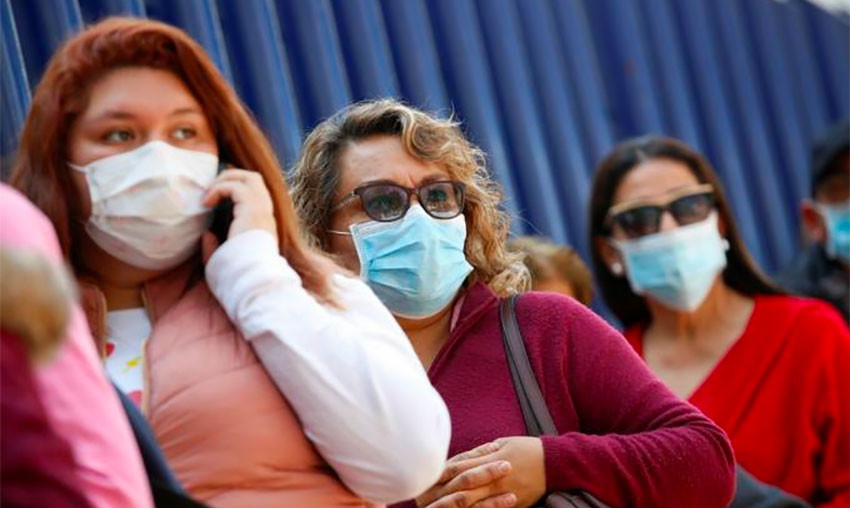
Gómez said she believes that the increase in case numbers in October – Mexico’s accumulated tally is now approaching 900,000 – is the result of the relaxation of coronavirus mitigation measures and the failure by many people to follow social distancing recommendations.
“It appears that people have lost their fear of the disease; the streets are full, there is traffic similar to that before the [March to May] national social distancing initiative, there are people in restaurants, in [town] squares, in public places,” she said.
Authorities need to insist on the use of face masks, urges infectious disease specialist.
“We mustn’t forget that we’re in a pandemic, that this isn’t over and if we don’t take care of ourselves it won’t end.”
Alejandro Macías, an infectious disease doctor and member of the coronavirus commission at the National Autonomous University (UNAM), also said that the October increase is not indicative of a new outbreak.
“The increase in the incidence rate … simply corresponds to an uptick [in the current outbreak] because a new outbreak is the reappearance of a disease after control has been achieved,” he said.
Macías acknowledged that control of the virus hasn’t occurred in large parts of Mexico and therefore the increase in new case numbers is not attributable to a new wave of the pandemic.
The doctor, who headed up the government’s response to the 2009 swine flu pandemic, echoed the calls of many experts in saying that authorities need to insist on the use of face masks to help slow the spread of the coronavirus, noting that “there is scientific evidence” that they work.
Macías also urged the government to pay attention to the positivity rate (the percentage of Covid-19 tests that come back positive) in addition to case numbers and hospitalizations, asserting that it is a key indicator of the intensity of the pandemic.
Mexico’s positivity rate is currently just over 40%, a figure that is extremely high compared to many other countries. The rate is elevated because most testing here is targeted at people with serious, coronavirus-like symptoms.
María Luisa Ponce López, a UNAM academic and public health expert, urged people to follow health measures to help slow the spread of the virus. In addition to wearing face masks, she recommended that people refrain from speaking while using public transit to reduce the probability of droplet transmission.
Ponce said the government should only consider issuing a new stay-at-home order as a last resort because of the social and economic ramifications a lockdown would have.
“Reordering a lockdown is an extreme measure; it can’t be ruled out, … other countries are doing it, but stopping economic and social activities can generate problems,” she said.
The academic added that many people would be unlikely to respect a new stay-at-home order because, in addition to the economic need of going out to work, people are “exhausted” with the pandemic and associated restrictions.
“That’s why it’s better to highlight the need to wash your hands, … avoid crowded places and use a face mask if you go out,” she said.
Each year as winter descends on the United States and Canada, millions of monarch butterflies migrate as far as 4,500 kilometers to the oyamel forests in central Mexico.
But thousands do not make it to their destinations in Michoacán and the state of México as they end up killed by cars on the Saltillo-Monterrey highway.
Researchers in 2018 counted 11,280 dead monarchs in five 500-meter sections of the highway, leading them to believe that as many as 127,689 monarchs were killed in a 14-kilometer stretch of road over a 19-day period.
The group of researchers from the Autonomous University of Nuevo León (UANL) and the University of Western Ontario in Canada also studied another area of the highway known as La Muralla where they studied six sections of the road over 14 days and counted 601 dead butterflies, leading them to extrapolate that 23,520 butterflies were killed in that area.
Between the two areas, scientists estimate that at least 151,200 monarchs did not manage to complete their journey.
In an interview with the newspaper Milenio, Rogelio Carrera Treviño, coordinator of the wildlife laboratory at the Faculty of Veterinary Medicine and Zootechnics at UANL, noted that the deaths of butterflies on highways is a phenomenon that researchers are just beginning to examine. The only previous study that exists was carried out in Texas, but it is expected that monarch mortality in Mexico is much higher.
“In a previous study that was done with data from 2016 and 2017 in the state of Texas, they found 580 butterflies run over in those two years. With that they made a model to determine or predict how many monarch butterflies are killed in total on all roads (in that country), they estimated that depending on some variables, between 3 and 10% of the total population of butterflies was killed.
“However, that estimate was made only with data from Texas, precisely what we are trying to do is to do it with data from Mexico,” Carrera said.
According to Carrera, when crossing into Mexican territory, butterflies are concentrated in a funnel-shaped swarm and fly low to the ground so they can rest and feed, leaving them particularly vulnerable to being killed by cars.
Carrera said there is still a long way to go to understand the phenomenon of butterfly roadkill, and there may be actions that can be taken to mitigate mortality, such as the installation of infrastructure in sections of the road where the highest number of butterflies are killed to force them to fly at a higher altitude to avoid colliding with vehicles.
In Taiwan, nets have been erected along a highway in the migratory path to direct purple crow butterflies away from cars and deaths have dropped 80% as a result.
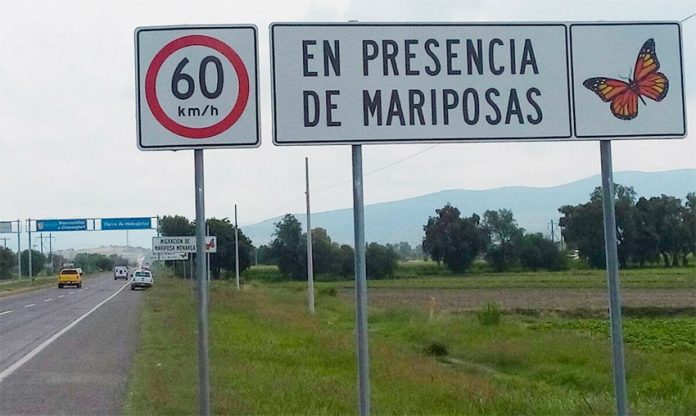
Another proposal is that during the migration, which only lasts a few days, the speed limit on the highway be reduced to 60 kilometers per hour with police enforcement.
“If they travel [at speeds of] 60 kilometers or less, even if the butterfly is in front of the car, it is able to avoid it,” Carrera said.
That speed limit is already in effect in some areas of Mexico, where signs have been posted advising that the limit is 60 km/h when monarch butterflies are present.
Soon he will be launching a new study in collaboration with Texas A&M University to study the monarch mortality rate on other highways in Mexico, including those of Coahuila, Nuevo León, Tamaulipas, San Luis Potosí and Zacatecas.
Monarch populations have dwindled 80% in the past two decades mainly due to loss of habitat, but roadkill may also be playing a part, scientists now believe.
Treatment means isolation, for patients and family.
My husband Alejandro has officially been diagnosed with Covid-19 and it has been nothing short of a nightmare.
For months now, health authorities have been telling us to take Covid seriously. But how seriously do they take it? If my husband’s case is any indicator, I have a big question mark.
Because of life decisions over the past 17 years, I live very much like most middle-class Mexicans — read: my Mexican husband and I do not have the economic resources that many expats have. We make do with resources such as IMSS, the Mexican government insurance system.
I learned long ago to skip them for the little stuff. I am fortunate to be able to pay for a doc when I have an earache or such and thus can skip the long waits that usually come with IMSS.
But one constant praise IMSS always got was that the doctors were good, even if the administration was horrible. IMSS was best used for minor emergencies and major medical issues that needed attention right away, like a car accident. And to be fair, I had used the Urgencias satisfactorily, getting treated better as a human being than in my local clinic.
I have to rethink all of that now.
We both fell ill near the beginning of the month, but with different symptoms. At our local clinic on different occasions, he was diagnosed with tonsilitis and I with an upper respiratory infection. Neither of us were tested for Covid; it was not considered necessary. Again, to be fair, October is the beginning of the cold and flu season, and all of these illnesses share symptoms.
After our treatments, we both were getting better. Since the clinic’s Covid section cleared us, I even went to Guadalajara to do some research. I felt tired there, but more worrisome was coming back the following Monday to find my husband sick again. He was coughing and had a fever on and off.
Back he goes to the Covid squad, who then told him he had bronchitis. He received new antibiotics and stuff for his lungs. They did not believe he had Covid, but since he is 60 and mildly diabetic, they gave him the test anyway. We were told to wait five working days for the results — which meant a week.
His condition got somewhat worse but never critical. As we approached the date that his test results were due, he was actually getting better – he had more energy and was eating some. Nevertheless, he went back to the clinic to check and get a doctor’s note to extend his time off from work.
Neither of us anticipated what came next: I start getting frantic calls from him and the clinic to tell me he needed to be hospitalized and that I needed to go to the clinic NOW. This is where the nightmare begins.
Over the past 72 hours, I have lost track of how many times I have been told that “this is serious,” but …
At the clinic, we waited over five hours for a “special ambulance” to take my husband to our assigned hospital. During that entire time, I had no communication with Alex or his doctor at all after the first statement saying he needed to go to the hospital.
At the hospital emergency room, I got all kinds of misinformation about how I could visit my husband and get updates on his condition. By the time I said goodbye to Alex before going upstairs, all I knew for certain was to return to the hospital at 1:00 p.m. and bring a clear plastic bag with toiletries and even toilet paper. No one had taken my phone number or email. My head was so fuzzy from the stress and not eating all day that I had not thought of it.
At the hospital on that first day, they let only one family member enter. I went in, and there were signs everywhere at Reception with rules: talking to the patient only via video call system entirely within the hospital. No use of the internet. Updates on the patient’s condition once a day only – by email.
I ask the receptionist to check that they have my contact info. The woman looks at me like I’m an idiot but finally agrees. But the name and room number is not enough to pull the file; I must have his IMSS number, and I’m an idiot for not having his carnet (a 20th-century relic of a booklet that serves as both ID and a medical tracking document).
Now I’m in a dilemma. I can go and get the IMSS number — and miss my chance to talk to Alex, or I can talk to Alex and risk not getting back in time with the number so that they can take my email. No one will help me work this out. It is my fault for not having the carnet.
Luckily, I get a call to tell me my brother-in-law was outside. We decide to switch places. I will go home and get the information, and he will wait and do the call if I do not get back in time. I get the number, but he has to do the call and give my email to the receptionist. The waiting time is two hours to get one minute to talk to Alex.
I suspected that I would not get the promised daily email on Thursday — and I am not disappointed. I have no idea how he has been for the last 36 hours, no idea what treatment he has had and no idea of a prognosis.
We won’t even go into the fact that the staff assumes that I am supposed to speak perfect Spanish. Maybe it is too much to ask for an English speaker, but no one has any patience for someone struggling to understand.
One day later …
A light at the end of the tunnel: on Friday we finally have some news, but from my husband, not the system. As I suspected, my email was entered wrongly. It was re-entered, and I immediately got an email that allowed me to enter a website IMSS has set up to “inform” patients’ families.
The information given was laughable, basically his name, his IMSS identification information, in what area of the hospital he is being treated, his bed number, the date of his last checkup by the doctors, and a one-word description of his condition: “serious.”
The receptionist was able to give me the results of his most recent vital signs check (not even available online), but no idea of context.
The real and best news today came from my husband himself. He is responding well to treatment and the only reason he is still in the hospital is that he still needs supplemental oxygen. His doctor feels that he can likely go home after three days or so.
For some reason, after seven months of pandemic, the government cannot figure out how to put that information online. My one minute with Alex was taken up almost entirely by this explanation, but I admit I feel much better.
In case you are wondering: no, I have not had a Covid test. The doctor at the clinic said that as long as I do not have symptoms, I do not need one.
Yes, that is ridiculous, but I would not take one now even if they asked me. I will just assume I had/have it, go out as little as possible and when Alex is better, assume I am in the clear.
Overall, this system creates a very strong sense of isolation, both for the patient and for the family. There is no news, and I cannot have anyone with me to help deal with the bureaucracy.
To put some salt in the wound, on the day Alex was admitted the Mexico City government sent him a message on his cell phone, saying his test results were ready. The following day, someone called. I cackled and gave the guy an earful. He hung up almost immediately after hearing that Alex was in the hospital.
One serious problem is that most Mexicans accept this as normal. Alex’s family and friends tell me so and, yes, while it is “disgusting,” as one put it, there is nothing to be done. I also saw this attitude at both the clinic and the hospital, with family thanking low-level administrators as if they were gods.
I have no doubt that the way IMSS isolates patients to such an extreme has something to do with its lousy treatment record with hospitalized Covid patients.
OK, one more shot at being fair. This situation is not what I have seen at IMSS hospitals in the past. This is my first rodeo in having a close family member in the hospital, but Alex’s experience with his family over the years always had meant having someone in the room with the patient, with IMSS taking advantage of this by having family doing a lot of the work other countries use orderlies and aides for.
But from here on in, I will have to be within shouting distance of Saint Peter before I let them admit me. I refuse to put Alex through anything like this, and I refuse to be cut off from the few people who can give me support emotionally and linguistically.
Leigh Thelmadatter is Mexico News Daily’s culture writer.
Daylight saving time is ending once again and on Sunday most of Mexico will move the clocks back one hour, a tradition that is not without controversy.
Last April when daylight saving time began, some legislators asked President López Obrador to eliminate the time change, arguing that the coronavirus pandemic and resulting economic crisis, together with the confinement measures and the time change, could generate anxiety and stress.
Studies from the National Autonomous University’s Faculty of Medicine show that turning the clock back or forward can affect people physically, emotionally and intellectually. In addition, it can alter children’s sleep cycles and appetites, and cause insomnia and anxiety in older adults.
Baja California Sur, Sinaloa and Mexico City have all requested to be allowed not to observe daylight saving time, but their arguments have gone unheeded.
The practice was first implemented in Mexico in 1996 during the administration of President Ernesto Zedillo Ponce de León to make better use of daylight hours and conserve electricity.
The official time change occurs at 2 a.m. on Sunday, although most people set their clocks back one hour on Saturday night before going to bed.
But citizens of Sonora, Quintana Roo and 33 municipalities along the northern border with the United States will not be changing their clocks.
Sonora will remain on the same time as Arizona, which does not observe daylight saving time, the result of an agreement reached in 2016 to create a cross-border commercial region. Border cities in Tamaulipas, Nuevo León, Coahuila, Chihuahua and Baja California will set their clocks back on November 1, observing the same schedule as the rest of the United States.
Quintana Roo elected to adopt the same time zone as the east coast of the United States in 2015 in order to offer tourists one more hour of sun and its clocks will remain unchanged.
President López Obrador has a long history of challenging daylight saving time, dating back to when he was mayor of Mexico City. Some have speculated that his administration might put the matter to a referendum, but no such move has been made.
Professional soccer player Joao Maleck has been found guilty of two counts of aggravated homicide resulting from a traffic accident in 2019.
The son of Jean-Claude Maleck, a French-Cameroonian soccer player who came to Mexico in 1998 to play for the Tecos soccer club, Joao Maleck plowed his Ford Mustang into a car at 9 a.m. on June 23 in Zapopan, Jalisco, killing a newlywed couple who had married the night before.
Maleck, who was playing for the Seville Athletic Club at the time and vacationing in his hometown of Guadalajara, had posted numerous photos to social media the night before from a nightclub where he had been partying until very late.
Maleck, 20 at the time, was found to have been speeding and had alcohol in his system at the time of the accident.
The soccer star, who has been jailed in Guadalajara since June 24, 2019, was found guilty Friday after a three-day trial. His sentencing will take place on October 30, and he could face a 10-year sentence minus time served, although his lawyers are hoping for four years of probation.
Maleck will also have to pay a fine for damages to the couple’s relatives that is expected to be between 800,000 and 1 million pesos, or US $38,300 to $47,900.
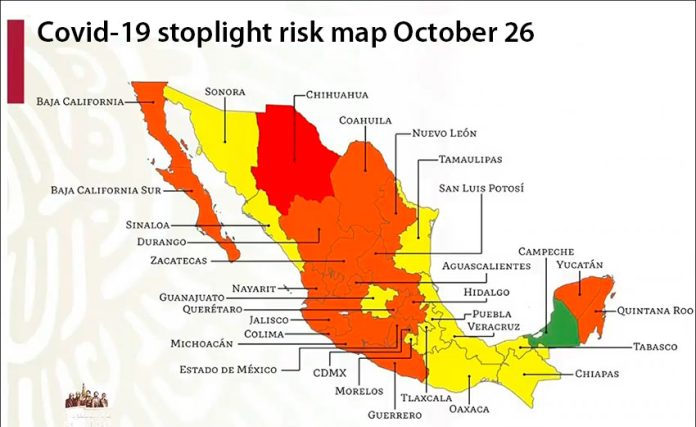
Coronavirus risk levels by state effective Monday. Red indicates extreme risk, orange is high risk, yellow is medium and green is low.
Three northern states are at risk of regressing to the red light “maximum” risk level on the federal government’s coronavirus stoplight system, health authorities said Friday.
Presenting an updated stoplight map that will take effect Monday, federal health promotion chief Ricardo Cortés said that the orange light “high” risk states of Coahuila, Durango and Nuevo León will turn red if their coronavirus outbreaks don’t wane.
As of Monday the coronavirus risk level will be orange light “high” in 19 states, an increase of two compared to the current number, and yellow light “medium” in 11, a decrease of three.
Five states will switch from yellow to orange on Monday. They are Baja California, Baja California Sur, San Luis Potosí, Quintana Roo and Michoacán.
They will join Aguascalientes, Mexico City, Coahuila, Colima, Durango, México state, Guerrero, Hidalgo, Jalisco, Nayarit, Nuevo León, Querétaro, Yucatán and Zacatecas, which are already orange light states.
The yellow light states as of Monday will be Sonora, Tamaulipas, Guanajuato, Veracruz, Puebla, Tlaxcala, Morelos, Chiapas, Tabasco, Oaxaca and Sinaloa.
The first nine states are already yellow and will remain at the same risk level for the next two weeks while Oaxaca and Sinaloa will make the switch back to the “medium” risk level after regressing to orange two weeks ago.
Campeche, which switched to green at the end of September, will maintain its “low” risk status for the next fortnight while Chihuahua, for the time being at least, will be the sole red light state.
The Health Ministry uses 10 different indicators to determine the stoplight color allocated to each state including the Covid-19 effective reproduction rate (how many people each infected person infects), the weekly positivity rate (the percentage of Covid-19 tests that come back positive) and hospital occupancy levels.
It also recommends coronavirus restrictions for each risk level but several states ease and tighten rules according to their own criteria rather than that of the federal government.
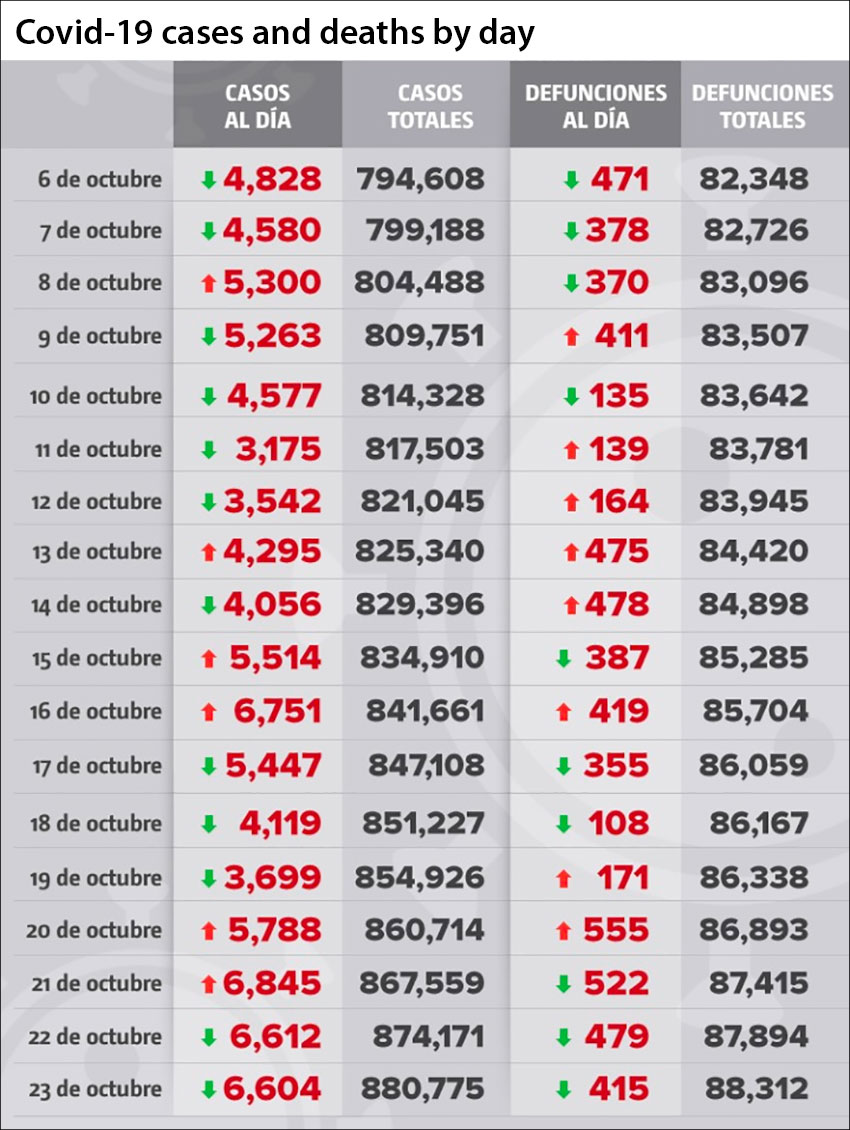
Coronavirus cases and deaths in Mexico as reported by day. milenio
Prior to the presentation of the new stoplight map at Friday night’s coronavirus press briefing, Health Ministry Director of Epidemiology José Luis Alomía announced that Mexico’s accumulated case tally had increased to 880,775, an increase of 6,604 cases compared to Thursday.
It was the third consecutive day that the single-day tally of new cases was above 6,000. The Health Ministry estimates that there are currently 51,532 active cases across the country.
The official Covid-19 death toll rose to 88,312 with an additional 418 fatalities registered. Mexico ranks fourth in the world for total Covid-19 deaths and 10th on a per capita basis with 70 fatalities per 100,000 inhabitants, according to Johns Hopkins University.
The per capita rate here is slightly higher than that of the United States, which has recorded 68.5 Covid-19 deaths per 100,000 inhabitants.
“The strategy is the general plan and it already considers the possibility of having a favorable scenario, with a reduction of cases, hospitalizations and deaths, as well as the least favorable [scenario]. All scenarios … were considered from the beginning of the pandemic,” López-Gatell said.
“It’s not about changing the strategy but rather implementing specific interventions that the strategy provides for when the scenario changes.”
The government has been heavily criticized for not testing widely for Covid-19, not enforcing a strict lockdown early in the pandemic and not being forceful enough in its promotion of face masks.
López-Gatell, who has been dismissive of the value of widespread testing, gave no indication that the government plans to ramp up testing and stressed that it would not seek to implement restrictions with force.
“We need to maintain harmony and act by persuasion, not social coercion,” he said.
Mascota's history goes back well before the Spanish arrived in the Americas.
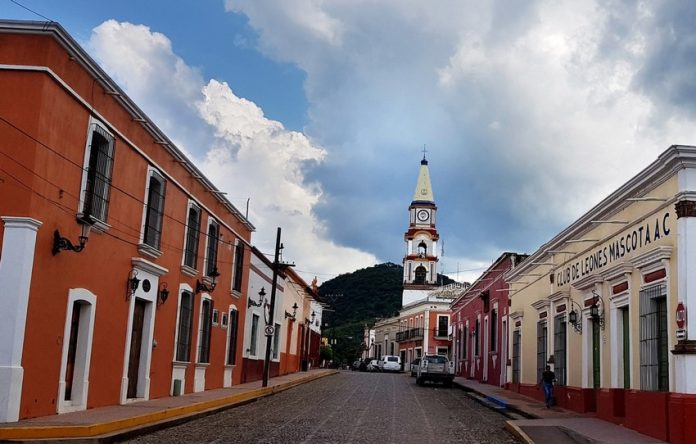
Mascota, Jalisco, is a charming little town located three-fourths of the way between Guadalajara and Puerto Vallarta as the cuervo flies, with a history that goes back countless centuries, long before the Spaniards arrived.
Twenty years ago, guide books like the Lonely Planet series had not a single word to say about Mascota, no doubt due to the ever-twisting, bone-rattling, rock-strewn, dirt road that used to connect the town to the rest of Mexico, inevitably smothering the traveler for endless hours in great clouds of choking white powder.
Nowadays, this road is beautifully paved, and despite its twists, more and more people are discovering that Mascota definitely deserves the title Pueblo Mágico, or Magical Town, which Mexico’s Tourism Ministry officially gave it in 2015.
The name of the town has nothing to do with the Spanish word mascota (pet or mascot) but seems to come from the Náhuatl word maza-ocotl-atl, meaning “place where you find deer, pines and snakes.”
Last weekend, I headed for Mascota with the intention of scouting out nearby El Malpais Volcanic Park, a lava field said to contain some of the world’s youngest minettes.
El Mesón del Refugio was Mascota’s first casona to be licensed as a hotel.
A minette is defined either as “a beautiful French girl” or as “an igneous rock with phenocrysts of biotite, hornblende, augite and olivine.” I figured we’d be happy if we ran into either one or both in the hills outside Mascota, so off I went with a group of friends interested in doing something different.
If you drive to Mascota from Guadalajara, there are two delightful spots you may want to visit along the way. One is the little town of Guachinango, whose gloriously shimmering church is covered with thousands of shards of porcelain plates, cups and saucers.
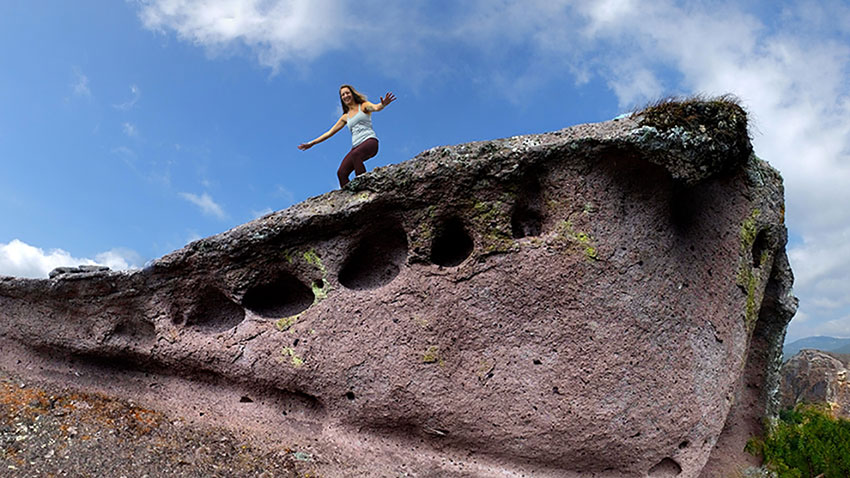
The second site is a small but surreal mountain called La Campana, or The Bell, situated right next to the highway and decorated with bizarre, wave-like rock shapes. Although you can walk from the bottom to the top in 20 minutes, most people spend a couple hours on La Campana, soaking up its good vibes.
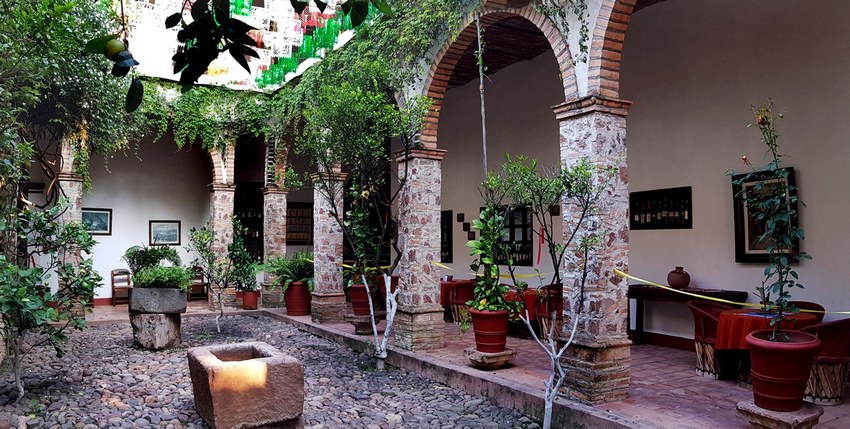
At midday, we reached our hotel: El Mesón del Refugio, a fine example of Mascota’s attractive casonas, grandiose old buildings which now serve as hotels.
El Mesón del Refugio was, in fact, the very first casona in Mascota to be licensed as a hotel. Built in 1847, it has a delightful patio surrounded by big rooms with thick walls. The ceilings are so high, you need a fire truck to change the light bulbs. Don’t be surprised when you’re handed a room key so big it won’t fit in your pocket!
We ate lunch at Restaurante Navidad, located near the plaza, said to be the most popular place to eat in Mascota. Afterward, we wandered over to the Centro de Cultura (Culture Center) to visit one of the very best small-town museums in all Mexico. The treasures you will find here are mainly thanks to the archaeological skills and hard work of Dr. Joseph Mountjoy, who lives in Mascota and has been exploring its surroundings for many years.
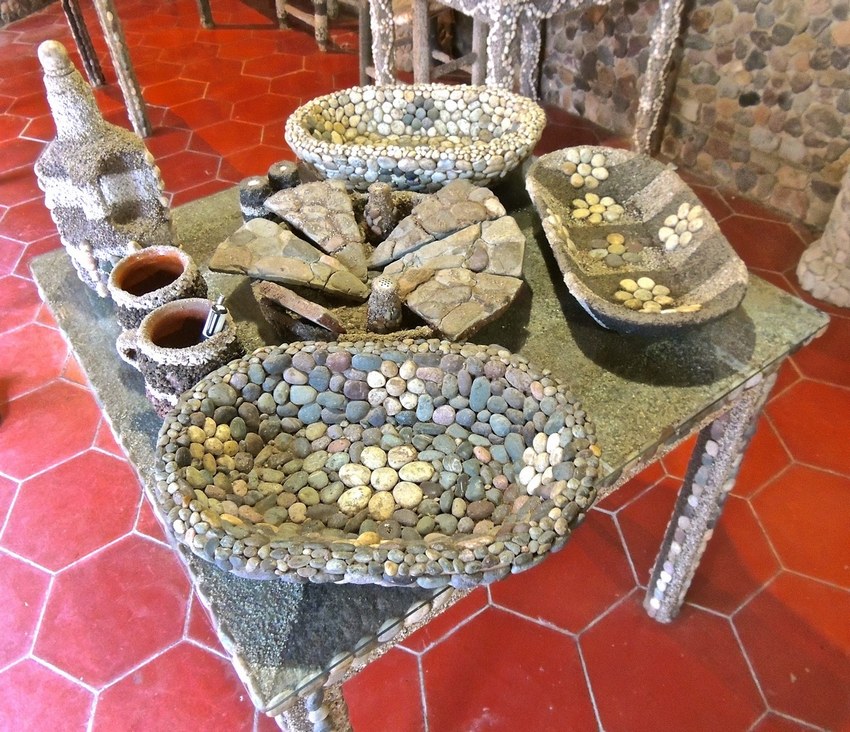
A stone pizza at Mascota’s quirky Museo de Piedra. Photo: Jim & Carole Cook.
Because the area abounds in petroglyphs, you’ll find a whole room of the museum dedicated to them, with excellent pictures taken by National Geographic photographers. Here you will also have an opportunity to gaze upon a genuine patolli, a pre-Hispanic version of the game of Snakes and Ladders, chiseled onto the surface of a large and flat horizontal rock.
Many of the extraordinary finds presented in this museum are well described in Jim and Carole Cook’s excellent blog, which also takes you on a tour of the town’s very curious Museo de Piedra (Stone Museum).
Next, we headed north out of town towards Parque Municipal Petrificado el Malpais, guided by Google Maps. We followed reasonably decent country roads for five kilometers and then found our way blocked by a locked metal gate. Next to the gate stood a rancher.
“Is this the way to Parque el Malpais?” we asked him.
“¡Este parque no existe!” said the farmer: “This park does not exist!”
My eye wandered up the hill behind the gate where even my poor old eyes could see the lava field we were looking for.
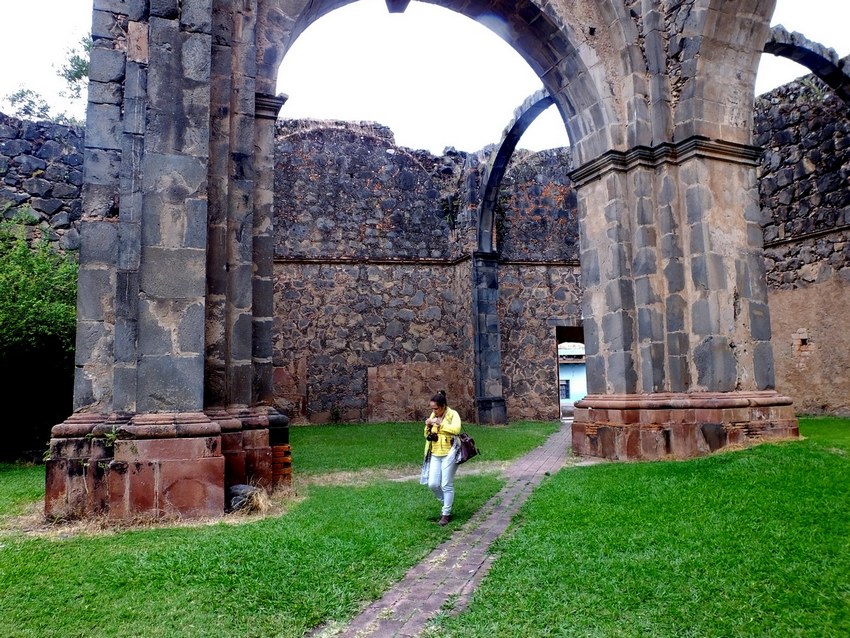
The Unfinished Temple of the Precious Blood’s towering arches leaves visitors awestruck with its scope and beauty.
“How about if we park outside your gate and go up on foot?” we tried.
“No existe este parque,” repeated the man, “and therefore there is nothing to see.”
So ended our excursion to El Malpais. I suggest you cross it off your bucket list and instead, perhaps, go for a walk around the grounds of Mascota’s Templo Inconcluso de la Sangre Preciosa (Unfinished Temple of the Precious Blood).
I doubt if you’ll find any minettes there, but you will surely be awestruck as you wander beneath its great arches and towering walls never joined together or roofed — a monumental wonder sprung from the mind of its architect.
Work on this church started in 1905, and as its name indicates, was never finished, although the builders certainly gave it their best shot.
Before leaving Mascota, we decided to pay a visit to Juanacatlán Lagoon, which lies 12 kilometers northeast of town and nearly 800 meters above it. The lagoon is the showplace of the Sierra Lago Resort & Spa, which I heard was beautiful and expensive but which I had never had a chance to visit.
Riding a rock wave on La Campana Mountain.
The road to Sierra Lago starts off paved with four strips of concrete. These are soon reduced to two strips, and at the end you are on cobblestone or dirt. The gain in altitude guarantees dramatic changes in flora and fauna, and the higher you go, the more breathtaking the scenery.
More than once, we stopped just to get out of the car and gawk at the extraordinarily tall pine trees and the gorgeous madroños (strawberry trees). There are also plenty of “sad pines,” Pinus lumholtzii, considered rare or endangered in many places.
Of course, one can’t gawk too long because the road is rather narrow and it’s no fun to meet a car coming the other way, especially at one of those points with a steep cliff on one side and a 200-meter drop on the other.
After driving 17 kilometers from Mascota, we reached the imposing gate to Sierra Lago, which we were told we could enter. However, we wouldn’t be allowed use of any of the facilities, including the restaurants, which are reserved for paying guests.
The moment we saw the lake down below, we were hooked by its beauty. Strolling along its shore simply enraptured us.
The Sierra Lago people have gone to great lengths to make the place even more attractive, circling the kilometer-long lagoon with a wide malecón (shoreline sidewalk) dotted with elegant sculptures and benches.
[soliloquy id="126397"]
Dressed for hiking through lava rubble, we felt a bit out of place in this posh setting, but Juanacatlán, like every other body of water in Mexico, is federal property, and so Mexicans, as well as foreigners, have a perfect right to jump into the water or stroll along the lagoon’s perimeter.
Recognizing this, Sierra Lago has even designated an area where the public can camp free of charge.
I am delighted to add Juanacatlán Lagoon to my list of Mascota’s secrets, and I definitely plan to continue investigating all of them, even the ones that “don’t exist.”
The writer has lived near Guadalajara, Jalisco, for more than 30 years and is the author of A Guide to West Mexico’s Guachimontones and Surrounding Area and co-author of Outdoors in Western Mexico. More of his writing can be found on his website.