Home Blog Page 1439

More dead sea lions, turtles found on Baja Sur beach

0
Loreto is the location for a new Netflix film called Baja.

More dead sea lions have turned up in the same area where 137 sea lions washed up on the beach earlier this month in Baja California Sur.

In San Juanico, Comondú, the bodies of 21 sea lions were discovered last week, some clinging to life before bleeding out from their snouts.

This brings the number of dead sea lions to 183 this month alone, BCS Noticias reports.

The fishermen who discovered the bodies say there were no marks from nets or boat propellers, so no official cause of death has been determined. 

A total of 351 loggerhead turtles have also been found dead from January to June this year in the same area, more than in all of 2019, the Center for Biological Diversity and the Mexican Center for Environmental Law report.

The non-profit organizations say that under Mexican regulations, if more than 90 turtles die commercial fishing with gillnets and longlines must be suspended for the rest of the year.

Last year 331 loggerhead turtles, 10 dolphins, 15 sea lions, 131 black sea turtles, eight olive ridley turtles and six whales were found dead on beaches along the Gulf of Ulloa.

Gangster thought to have met with politicians

Tamaulipas Governor Francisco Javier García Cabeza de Vaca had a series of meetings with former security minister Genaro García Luna in February 2012 in Los Cabos. 

At one of those, ex-drug lord Joaquín “El Chapo” Guzmán is thought to have also been present.

According to a declassified memo from Tobin Bradley, United States Consul General in Matamoros, the suspected meeting between El Chapo, García and the Tamaulipas governor was held in Cabo San Lucas where text messages entered into evidence during the trial of the one-time boss of the Sinaloa Cartel reveal he was hiding out at the time. 

García was arrested in the U.S. last year and is awaiting trial on charges of taking millions of dollars in bribes from the Sinaloa Cartel when he was in charge of Mexico’s Federal Police. El Chapo is serving a life sentence at a Colorado supermax prison.

Intelligence on the meeting comes from the Drug Enforcement Administration and the FBI. The memo, dated Wednesday, June 17, 2015, says that “Joaquín Guzmán Loera was the same day and in the same city and due to the closeness between Mr. Guzmán Loera and Mr. Genaro García Luna, everything indicates that he met the subject.”

Workers’ hospital woes

Members of the State Workers’ Social Security Institute (ISSSTE) union in San José del Cabo held a protest last week demanding improvements to the government’s health care system. 

General secretary José Ángel Ruíz Ceseña said government workers health clinics in Los Cabos lack even basic medicines such as insulin, and are not equipped to provide tomography, hemodialysis and laboratory services.  
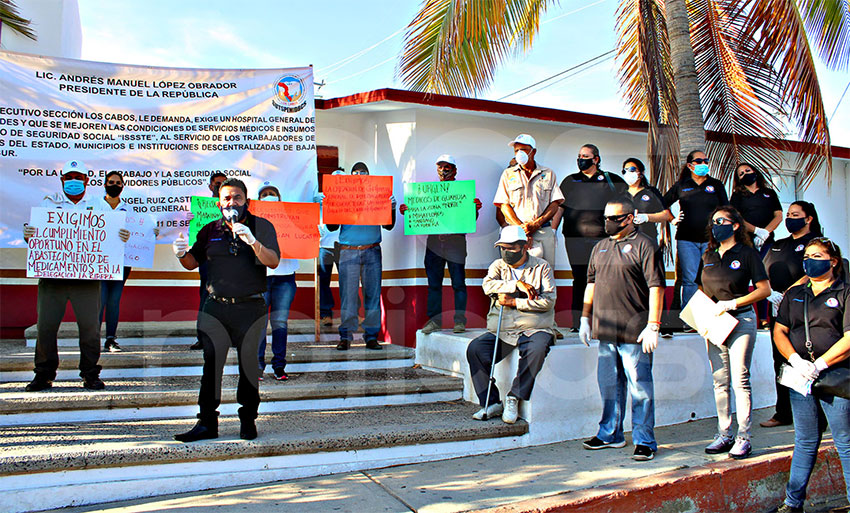
ISSSTE workers protest in San José.

“It should not be allowed that this clinic continues to be a white elephant,” Ruiz said, charging that patients are dying as a result. Others are being forced to go to private hospitals, which can cost up to 100,000 pesos (US $4,738) a day, because of the lack of quality care at ISSTE clinics, BCS Noticias reports. 

Staff members at the ISSTE clinic in La Paz also denounced poor working conditions last week, saying that coronavirus patients are not being isolated from patients who do not have the disease, and more than 100 workers have become infected.

As of Thursday, data from the federal government shows 9,226 accumulated cases in BCS and 424 deaths.

Celebrity perks

Celebrities who come to Los Cabos are not paid by the Los Cabos Tourism Trust (Fiturca), but they do enjoy special perks that Fiturca helps organize, director Rodrigo Esponda Cascajares says. 

His office helps organize up to 10 different activities for visiting stars each month, including meals in restaurants, yacht trips and camel rides, BCS Noticias reports, in exchange for things like Instagram posts. 

Recently, supermodel Winnie Harlow and ex-Olympic skiing champion Lindsey Vonn have posted photos to their accounts showing them enjoying a number of activities in the destination. 

Model Winnie Harlow rides a camel in Los Cabos.

Tonnes of trash

BCS produces almost 30,000 tonnes of plastic garbage each year, which amounts to around 45 kilos of plastic trash per person per year. Globally, Tribuna de Los Cabos reports, the average is 22 kilos a year.

Hans Herrmann, a marine ecologist with 30 years of experience in the field of biodiversity, conservation and natural resources and current president of The Mare Nostrum Global Initiative, shared the information with a group of business owners this week. 

Much of the waste is generated by food products, such as condiments and soft drinks. Diapers and candy wrappers are also heavy plastic waste producers.

Herrmann urged the government, tourism sector and residents to come together to make BCS a plastic neutral tourist destination

Shots in La Paz

An irate navy lieutenant in La Paz who wanted to keep the beer flowing at a restaurant after being cut off decided that firing several shots into the air was a reasonable course of action.

The man wanted to continue drinking on Wednesday and when a waiter told him he couldn’t serve him beer without food, the lieutenant pulled out his gun. Establishments that serve alcohol and not food are not able to open under coronavirus restrictions.

No one was injured in the incident, but the restaurant and several others nearby were closed down while police investigated, Diario El Independiente reports. 

Shot in Loreto

Loreto is the location for an upcoming Netflix film Baja which will premier on the streaming network at the end of this year, Metropolimx reports. 

The movie will be filmed within the municipality of Loreto, including the interior of the former Hotel Presidente in Nopoló and at the port.

The film focuses on a group of young American travelers who journey down the Baja peninsula from San Diego, California, and their misadventures along the way. Shooting will also take place in Tijuana, Rosarito and Ensenada, Baja California. 

Loreto was also the location of another film, Paloma’s Flight, the story of a photo-journalist, Paloma Ramirez, who loses her husband, a U.S. Navy SEAL, in a botched raid in Afghanistan and travels to Mexico to capture the country’s spirit and beauty. That film is set for release in 2021.

Mexico News Daily
Tiny school in Nuevo León is among beneficiaries of plane raffle

0
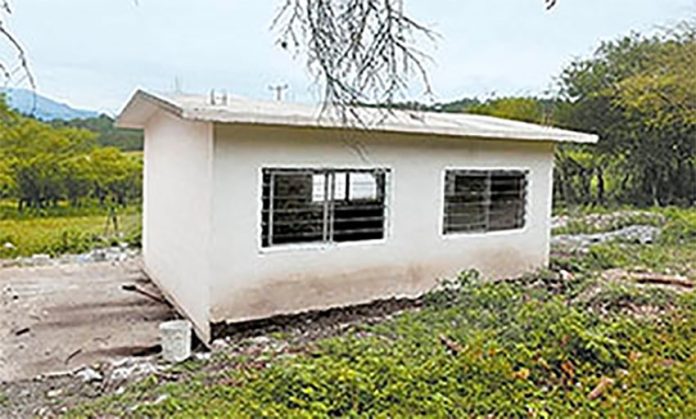
The recently completed school in El Yerbaniz has newfound resources to finish and furnish it.

A tiny school in a poor farming community in Nuevo León was one of the lucky winners of 20 million pesos (US $950,000) in the “presidential plane” raffle, drawn in Mexico City on Tuesday.

Located in El Yerbaniz, a community in the northern state’s mountainous southeast, the Gustavo Díaz Ordaz school was gifted eight tickets in the raffle by Grupo Vidanta, a real estate conglomerate.

The National Lottery printed 6 million tickets for the raffle, in which 100 20-million-peso prizes were up for grabs.

Along with several hospitals and other educational facilities, the school in El Yerbaniz held one of the winning tickets.

According to the newspaper Milenio, residents of the community have just completed the construction of two classrooms at the school. Prior to their completion, seven preschool students and five primary school students all studied together in a 65-year-old dilapidated hut.

Now, the school is expected to be upgraded further and there will likely be money left over to make improvements to the community, home to 60 residents from 16 families whose main economic activity is growing corn and beans.

Almost no one in the town has a television or running water, Milenio said.

Azucena Reyna, a fifth grade student, said she was happy because extra amenities will be added to her school and “it’s going to very beautiful.”

Nuevo León Governor Jaime Rodríguez congratulated the school for its win and said he would provide advice to educational and municipal authorities about how to use the money only if they asked him to do so.

Three schools in indigenous communities in mountainous regions of Puebla also won 20-million-peso prizes in the raffle as did three telesecundarias, or distance education schools, two in marginalized areas of Veracruz and one in Oaxaca. The schools in Puebla were gifted their tickets by the federal Welfare Ministry.

Among the other winners were hospitals in Zacatecas, Michoacán, México state, Veracruz, Tamaulipas, Sinaloa and Morelos.

Revenue raised by the raffle, whose total prize pool is roughly equivalent to the unwanted presidential plane, will be used to purchase medical equipment for hospitals.

Source: Milenio (sp) 

Los Morosos and Los Tramposos, or The Deadbeats and The Tricky Ones

0
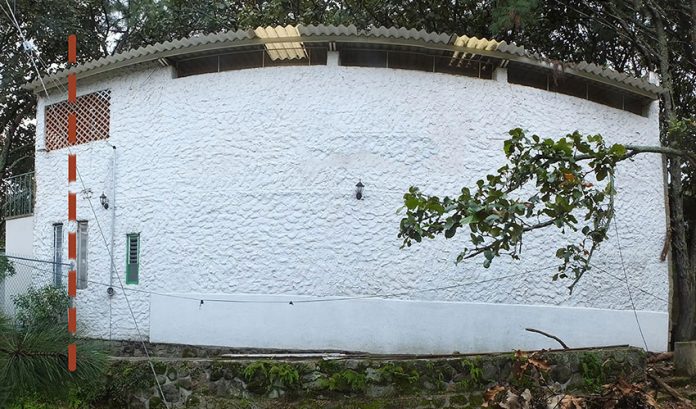
Dotted red line indicates portion of squash court built on public land.

Today let’s meet a group of clever people who, I am told, may be found in many rural communities in Mexico, not just my own. These folks are widely known as “Los Morosos” in Spanish, meaning defaulters or delinquents, but perhaps the expression could be best translated as “The Deadbeats.”

Los Morosos may represent a substantial portion of the community and they are so-called because they refuse to pay the annual service fee which keeps the community running. The cuota, as they call it in Spanish, pays for road maintenance, street lighting, gate guards, office upkeep, staff salaries and in the earlier days of my community, also included the distribution of piped water to each home for three hours every day.

Throughout the 50-year history of my community, Los Morosos benefited from these and many other services without paying anything. Why did they do that? Replies to this question varied over the years. The most common excuse was: “I’m sure the mesa directiva (board of directors) is pocketing some of the money they collect, so I will contribute nothing.”

Enter on the scene a presidente de la mesa directiva, whom I will call Don Horacio, though that was not his name.

Don Horacio was one of very few presidentes of this community who actually got involved in things. While most presidentes would rarely be seen outside of a meeting, Don Horacio was right there in the middle of it all, talking to the maintenance crew and checking up on what the Telmex man was doing on top of the pole.

Cutting off water is one possible way to encourage Los Morosos to pay up.

Of course, running a community where half the people don’t pay the service fee poses certain problems and Don Horacio decided he was going to do something about it. His strategy to get The Deadbeats to pay was very simple: cut off their water supply.

No sooner had the maintenance men disconnected Los Morosos from the water distribution system, than the police arrived, looking for our presidente in order to arrest him.

Thus I — as well as Don Horacio — learned that Mexico has a law forbidding anyone to cut off somebody’s water supply.

“It’s a humanitarian law,” I was told. “In Mexico it’s also illegal to evict people. It’s considered inhumane to throw families into the street the way we see it done all the time in Hollywood movies.”

El presidente turned the water back on and didn’t go to jail, but didn’t admit defeat either.

Instead he boned up on the law and devised a truly creative plan: he installed metal washers with tiny holes in them into the water pipes of Los Morosos, reducing their water supply to a trickle.

Thanks to an external staircase, the court's balcony is now accessible to the community.
Thanks to an external staircase, the court’s balcony is now accessible to the community.

This clever strategy also failed — why I don’t know. Suffice it to say that during the 35 years I’ve lived in this community, there have always been Morosos and no one has ever managed to extract a centavo from them.

By this I do not mean to downplay the resourcefulness and persistence of Don Horacio. As a demonstration, let me tell you the story of the Wayward Squash Court.

This story involves another group of people living in my community whom I call “Los Tramposos,” the Tricky Ones.

These are sly people who devise endless ways to get around rules, regulations and laws. In our community, for example, homes may be only one story high and you can only put one of them on a lot.

These regulations, however, have posed no problems to Los Tramposos, some of whom have managed to squeeze three big, two-story buildings on one little lot. These folks are also knowledgeable about countless ways to obtain electricity without paying for it.

One of those Tricky Ones I’ll call Don Cuco, who had a small property with a house on it.

Living in a rural community may increase your appreciation for the basics of life.

Don Cuco loved to play squash and decided to build his own squash court, a beautiful one with a shower and a balcony big enough for two dozen people to watch the action.

Since there was no room on his property for more than one meter of the huge building he was envisioning in his mind, he decided to put the rest of it on public land which adjoined his own, and like so many of his fellow Tramposos, he managed to pull that off without a hitch.

Well, that is, until Don Horacio came along …

“Don Cuco, what’s this? Almost all of your lovely squash court is sitting on community property.”

Querido amigo,” gushed Don Cuco, “let’s sit down and discuss this over a bottle of bootleg tequila I got from a friend. It really is “100% agave” unlike what you get in all the commercial brands.”

“Don Cuco, your squash court is on community land, so we’re going to make it a community squash court. You’re going to have to share it with the rest of us in the future.”

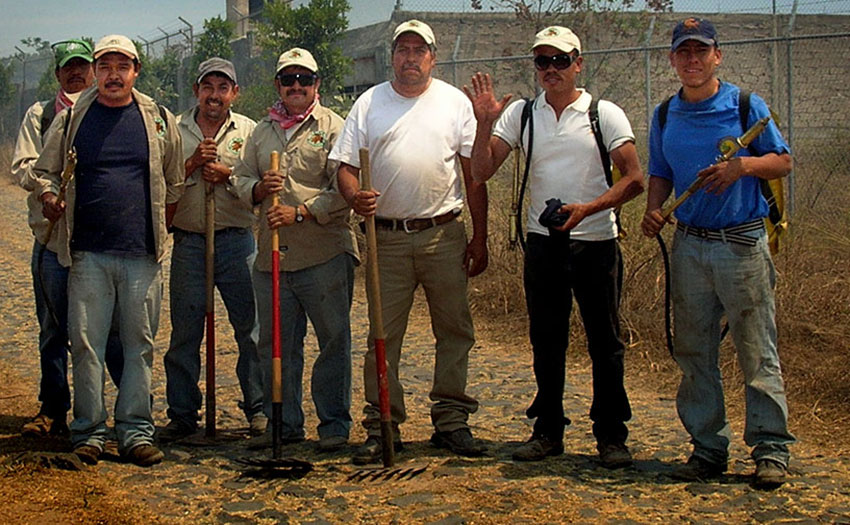
Maintenance men are often transformed into firefighters during the dry season.

I found it amazing that Don Cuco adamantly refused to share his court with anyone else. Even more amazing was what Don Horacio did next.

One day, the maintenance crew — under orders of el presidente — smashed a huge hole in the wall of that squash court. In went a gang of albañiles — bricklayers, who proceeded to build a wall inside the building, from floor to roof, separating Don Cuco’s 7% from the rest of the court.

Fuming, Don Cuco tried applying Mexico’s two standard problem solvers: la palanca (influence) and la mordida (bribery), but to no avail. Don Horacio would not be moved.

In fact, he who moved was Don Cuco. He sold his house (and his 7% of the squash court) and went far away. When the new owner was asked whether he would sell his part of the building to the community, so it would have a complete squash court, he said, “No, I think that 7% will make a nice house for my dogs. I’m going to keep it.”

So it is we ended up with the world’s only squash court featuring a glorious balcony to which there was no access whatsoever.

This curious building is where I play racquetball today, always with a fond memory of that extraordinary, incorruptible presidente who has passed on to the celestial community whose pearly gates should welcome neither Morosos nor Tramposos … but who knows? I hear they just invited San Pedro to try a heavenly bootleg tequila.

• This is the third installment in my Life in Rural Mexico series. The first was called Bugs, birds, bats and beasts and dealt with the joys, surprises, advantages and drawbacks of living shoulder to shoulder, so to speak, with creatures you might never see in the big city.

The second chapter in the series was entitled When the thunder rolls, the lights go out and focused on the myriad effects of power outages, surges, fluctuations and brownouts together with an examination of just how they are handled by the electricity commission.

The writer has lived near Guadalajara, Jalisco, for more than 30 years and is the author of A Guide to West Mexico’s Guachimontones and Surrounding Area and co-author of Outdoors in Western Mexico. More of his writing can be found on his website.

Homicides down 0.5% in August at 2,973; Guanajuato still leads

0
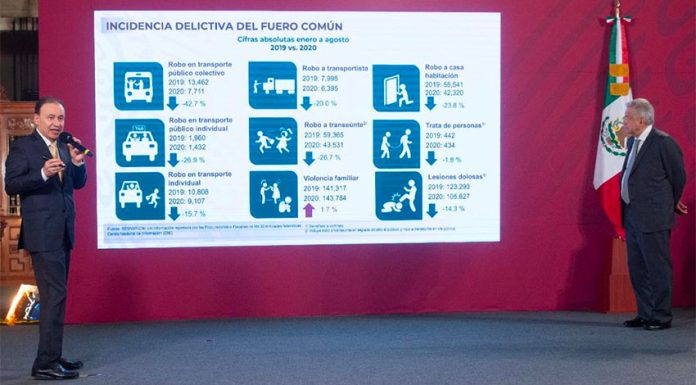
The security minister presents crime data Friday morning.

Homicides decreased slightly in August compared to July but murder numbers for the first eight months of the year are 1.5% higher than in the same period of 2019, Security Minister Alfonso Durazo said Friday.

Presenting crime data at the president’s morning news conference, Durazo said that there were 2,973 homicides in August, a reduction of 0.5% compared to the 2,987 murders in July.

There were 23,471 homicides in the first eight months of 2020, a 1.5% increase compared to the same period of 2019, which was the most violent year on record in Mexico.

Durazo said that homicides decreased in 21 states in the eight-month period to the end of August but increased in the other 11.

They increased 64.1% in Zacatecas, 61.3% in Yucatán, 50.2% in San Luis Potosí, 34% in Michoacán, 32.1% in Guanajuato, 26.5% in Sonora, 15.7% in Hidalgo, 11% in Chihuahua, 10.6% in Campeche, 6.9% in Aguascalientes and 2.5% in Durango.

Some of those states, such as Yucatán, Aguascalientes and Campeche, recorded low numbers of homicides last year, meaning that significant percentage increases can be recorded even when murder figures remain relatively low in comparison with many other states.

In sheer numbers, Guanajuato was the most violent state in Mexico between January and August with 3,002 homicides. Chihuahua ranked second, with 1,946, followed by Baja California, México state and Jalisco, where there were 1,924, 1,902 and 1,704 murders, respectively.

Durazo said that homicides in Guanajuato, where the Santa Rosa de Lima Cartel and the Jalisco New Generation Cartel are engaged in a vicious turf war, have declined since the capture of José Antonio Yépez Ortiz, leader of the former organization, on August 2.

The government can’t “sing victory” yet but there have been days with very low numbers of homicides in the Bajío region state, the security minister said.

Durazo also reported that femicides – the killing of women and girls on account of their gender – increased to 78 in August from 74 in July and that cases of kidnapping rose to 86 from 80.

There were 645 femicides in the first eight months of the year, a 2.2% increased compared to the same period last year, and 704 cases of kidnapping, a 39% reduction.

Durazo highlighted that federal offenses committed by organized crime increased 53.8% in the first eight months of the year but asserted that the government is working to reduce their incidence.

Federal organized crime offenses include terrorism, arms trafficking, human trafficking, trafficking of human organs and sexual crimes against children.

There were 123 cases of such crimes between January and August, 43 more than in the same period of 2019.

Source: Reforma (sp), El Financiero (sp), Expansión Política (sp) 

Tunnel work proceeds on Oaxaca-Puerto Escondido highway

0
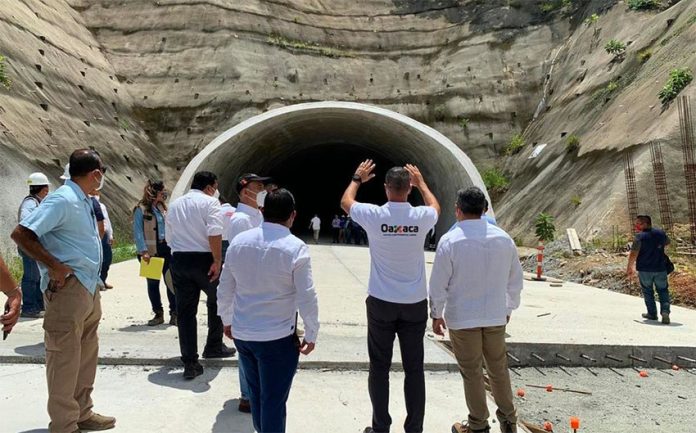
Governor Murat at the 224-meter-long Santa Martha tunnel.

Work on two tunnels on the third section of the Oaxaca-Puerto Escondido highway is nearing completion.

Governor Alejandro Murat Hinojosa inspected the site of the 224-meter-long Santa Martha tunnel, which is 95% complete. 

A second tunnel, San Antonio, which will be 11.8 meters high and 5.5 meters wide, is currently being excavated and is expected to be completed next month. 

The 6.8-billion-peso (US $324-million) Barranca Larga-Ventanilla highway will shorten the distance between the state’s capital and the popular beach community. In March 2022, when the 104-kilometer-long highway is to be completed, the trip will take 2 1/2 hours, four hours less than the trip takes on two other narrow and winding mountain highways.

An expected 4,253 vehicles per day are expected to travel the new road, although that figure is double the number that has been given in the past.

“Once again, it can be seen that the federal, state and municipal governments are working so that Oaxaca continues to build, and we continue to grow together,” said Murat, who reported that the 24 kilometers that comprise section three are on schedule for a March 21, 2022 inauguration.

President López Obrador announced in June 2019 that the highway would be completed during his administration, as well as the Mitla-Tehuantepec highway.

The projects were begun many years ago but had floundered under previous administrations as former presidents Felipe Calderón and Enrique Peña Nieto both made commitments to complete the highways but never followed through. 

The Barranca Larga-Ventanilla highway is a major undertaking and will have 10 bridges, a viaduct, three tunnels, nine junctions and two toll booths. In addition to benefiting tourists by providing a faster way to reach the coast, the highway will also serve the more 100,000 residents of the region it traverses.

The project is providing 1,800 direct and 3,500 indirect jobs in the southern sierra region

“What we want is not just to give you a highway, but to change your lives so that you can live better. The strength of Mexico is in what we can do for ourselves today, and that is what we are doing, trying to transform the country, day by day with our efforts,” Governor Murat said at his site tour yesterday.

Source: Milenio (sp)

‘This must stop:’ 650 intellectuals accuse AMLO of sowing ‘hatred and division’

0
president's press conference
The president frequently uses his weekday press conferences to attack his critics.

More than 650 academics, journalists, poets, scientists, artists, writers, filmmakers and other intellectuals have put their name to a statement that accuses President López Obrador of sowing “hatred and division” among Mexicans.

Titled “In Defense of Freedom of Speech,” the document asserts that the principle is under attack in Mexico and that the nation’s democracy is at risk as a result.

“President López Obrador makes use of a permanent discourse of stigmatization and defamation against those he calls his adversaries,” says the document endorsed by historian Enrique Krauze, poet and peace activist Javier Sicilia, physicist Julia Tagüeña and writer Sara Sefchovich among many other prominent Mexicans.

“In doing so he offends society, degrades public language and reduces the presidential platform from which tolerant discourse should emanate,” it continues.

The document charges that the president, who frequently uses his weekday press conferences to attack his critics, passes judgement and spreads falsehoods that “sow hatred and division in Mexican society.”

“His words are orders: censorship, administrative sanctions and judicial threats against media and independent publications that have criticized his government have followed them [as has] the warning that the choice for critics is to shut up or leave the country,” it says.

The last of the stated consequences was a reference to advice that Paco Ignacio Taibo II, head of the government-affiliated, non-profit publishing group Fondo de Cultura Ecónomica, recently gave to Enrique Krauze and historian and publisher Héctor Aguilar Camín.

Published online on Thursday by sociologist Roger Bartra and political scientist Francisco Valdés Ugalde, the statement also says that López Obrador has shown contempt for women’s protests and the pain of victims of violence.

In addition, it says that the president has ignored environmental complaints, reduced the budgets of autonomous government bodies, tried to humiliate the judicial power and damaged cultural, scientific and academic institutions.

“And now he is seeking to undermine freedom of speech. Finally, let’s remember that people and organizations are not stigmatized … [by the president] without placing them at risk. … This has to stop,” the document concludes.

Its release coincided with the publication of an interview with the Mexico representative of the Committee to Protect Journalists, who said that López Obrador’s frequent attacks on the media threaten freedom of expression.

The president dismissed the intellectuals’ accusations at his regular news conference on Friday morning.

“Why do they feel offended? They should apologize because they remained silent when the country was looted,” López Obrador said, referring to the alleged embezzlement of public resources by past governments.

He charged that they didn’t speak out against past governments because they were “well attended” by them.

Responding to the claim that his government is attacking freedom of speech, the president asserted that his administration will never seek to prosecute its critics.

“We’re not authoritarian. We’re not the same as those who censored Carmen Aristegui,” López Obrador said, referring to the journalist who was fired from her radio job in 2015 after exposing a scandal involving former president Enrique Peña Nieto.

“We’re not going to affect the free expression of ideas, it’s good that there is debate. …  [The intellectuals who endorsed the statement] are a group of conservatives and it’s understandable that they act in this way. … They dedicated themselves to applauding and burning incense for the neoliberal governments [but] now is another time.”

Source: El Universal (sp), DW (sp), Reforma (sp) 

Michoacán railway blockade now in its 24th day

0
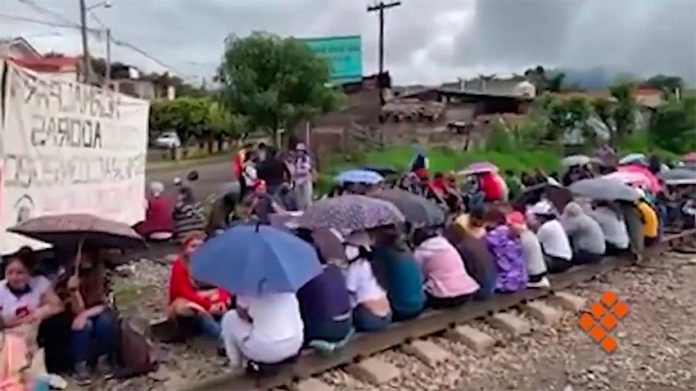
A railway blockade in Michoacán.
Protesters block the tracks in Michoacán.

More than 70 teachers and teachers in training continue to blockade railway tracks in Michoacán, halting the movement of freight to and from the port of Lázaro Cárdenas.

The tracks between Caltzontzin and La Vinata have been obstructed for 24 days, affecting the Kansas City Southern de México (KCSM) rail traffic which mainly consists of steel, petroleum and automotive products. 

The teaching students are demanding the release of those they consider political prisoners, job stability, the payment of scholarships the government allegedly owes them and teaching positions for more than 2,000 recent graduates, among others.

“We understand what they are asking for, but it is an issue outside the railroad. There may be reasons to protest, some are valid, but in the strict sense, there should be no impact on third parties,” said Óscar del Cueto, president of KCSM de México and the Mexican Association of Railways.

So far in 2020, Del Cueto said, there have been 95 days of blockades on tracks used by KCSM, the highest number ever.

“We had one in Sonora, we have one in Chihuahua and this one in Michoacán. There are already 92% more cases than in 2019, there are demonstrations that have nothing to do with the railroad, but they use the blockade of federal communication channels to seek to address other problems,” Del Cueto explained.

In Meoqui, Chihuahua, residents are protesting a 1944 water treaty with the United States whose terms call for sending water to the U.S.

That blockade began on August 26 when residents placed mounds of dirt on the tracks between the United States and Mexico. That blockade has already cost Mexican industry more than US $10 billion.

Michoacán’s industrialists estimate that for each day the tracks are blocked in that state, losses are in the neighborhood of 50 million pesos (US $2.39 million).

Teaching students also blocked the tracks in Michoacán and Puebla in March of this year, as well as in October 2019.

The protesters say their activities will intensify until the federal and local governments meet their demands.

Source: Reforma (sp), T21 (sp)

CORRECTION: The earlier version of this story gave an incorrect US dollar value for the estimated daily losses caused by blockades in Michoacán.

Chihuahua water protest: Mexico has just 38 days to pay 74% of this year’s water quota

0
The La Boquilla dam, where farmers have protested the release of water to the US.

Mexico has just 38 days to send 319 million cubic meters of water to the United States in order to meet its commitments under a 1944 bilateral water treaty.

According to the agreement between the two countries, Mexico is required to deliver just over 431 million cubic meters of water annually during the current five-year cycle that will end on October 24.

Over the five-year period, Mexico’s obligation adds up to 2.158 billion cubic meters of water.

But according to the International Boundary and Water Commission, it had only delivered 1.839 billion cubic meters as of Thursday, leaving it with a 319-million-cubic-meter water debt to be settled in less than six weeks.

Efforts by the National Water Commission to divert water north from a dam in Chihuahua have been met by numerous protests by farmers in the northern border state, where many municipalities are in a state of drought.

With time running out for Mexico to meet its obligations, Texas Governor Greg Abbott wrote to United States Secretary of State Mike Pompeo on Tuesday to urge him to ensure enforcement of the 1944 treaty.

“The Mexican-controlled waters of the international Rio Grande Basin are vital to ensuring that Texas’ water right holders can irrigate crops, supply water to municipalities, and conduct industrial operations along the Rio Grande,” he wrote.

But “as we approach the end of the current five-year cycle on October 24, 2020, Mexico once again has a significant deficit in its delivery,” Abbott said.

“Unfortunately, Mexico ended the last cycle in a debt and has not remained current on its treaty deliveries, as only limited progress has been made to ensure that this cycle does not end in a deficit,” he wrote.

“Only recently, after the peak irrigation season, has Mexico begun to make minor progress on deliveries through direct transfers of water from the international reservoirs. Significant work remains and time is of the essence.”

The governor highlighted that the United States continues to meet its treaty obligations by sending “significantly more water to Mexico than we receive in return.”

Texas Governor Abbott: 'Mexico must deliver more water immediately.'
Texas Governor Abbott: ‘Mexico must deliver more water immediately.’

Indeed, the United States sends four liters of water to Mexico for every one it is supposed to receive from its neighbor.

Abbott asked Pompeo to emphasize three points to the Mexican government.

“Mexico needs to end the cycle without a debt. Mexico ended the last cycle, as well as several previous cycles, in a debt. This trend cannot continue,” he wrote.

The governor also said that “with only six weeks remaining, Mexico must deliver more water immediately.”

“Mexico currently has enough water within its interior reservoirs and international reservoirs, which could be utilized to meet treaty requirements,” he wrote.

Thirdly, Abbott said that the United States section of the International Boundary and Water Commission “must remain steadfast in their refusal to take water from the San Juan River [a tributary of the Rio Bravo] to fulfill treaty obligations, as Texas needs the ability to store treaty waters within the international reservoir system to maximize the resource.”

“Accepting offers of water deliveries from the San Juan River in the Lower Rio Grande, which cannot be stored and is outside of the six named tributaries within the treaty, is not advantageous to Texas.”

The National Water Commission (Conagua) called on Chihuahua Governor Javier Corral, who has opposed the diversion of water, to support the efforts to settle the debt to the United States.

“It’s time to work together toward a common goal: Mexico meeting its binational commitments and guaranteeing the continuity of an agreement that is highly beneficial for Mexico,” it said in a statement.

Conagua said it has met its commitments to ensure the success of the current agricultural cycle for farmers in Chihuahua, adding that it is prepared to address Corral’s concerns about the illegal use of water in the state.

“With regard to the concern expressed by Governor Corral about water theft in different parts of the state, the National Water Commission is ready, once security conditions allow it, to restart the inspection of wells and presumably illegal water extractions in the Conchos River basin.”

Source: Milenio (sp), Reforma (sp) 

High-impact crimes down 50% in Mexico City, says mayor in annual report

0
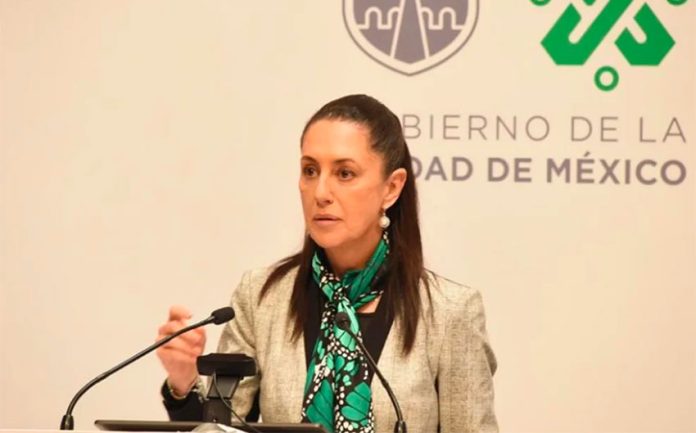
Mayor Sheinbaum
Her government has stamped out the corruption in the granting of permits for real estate projects, Mayor Sheinbaum said.

Mexico City Mayor Claudia Sheinbaum highlighted a 57% reduction in homicides in her second annual report on Thursday as well as her government’s efforts to combat corruption.

During a virtual address to the Mexico City Congress, Sheinbaum said the number of homicides per day in the capital was 2.6 in August compared to 4.9 in January 2019 and 6.1 in May last year.

“There was a 57% reduction in homicide victims,” she said referring to the difference between the daily figures for May 2019 and last month.

The mayor said that high-impact crimes, which include homicides, kidnapping, extortion, vehicle theft and robberies, declined 50% between January last year and August, dropping from 168 per day to 84.

Violent vehicle theft declined 40% in the 20-month period, vehicle theft without violence fell 39%, violent robberies of businesses decreased 64% and robberies on the Metro dropped 84%, according to figures cited by Sheinbaum.

Robberies on public buses declined 72% and muggings of people after they withdrew money from a bank declined 47% to just one incident per day last month, she said.

Despite the reductions, the mayor said that her government still has work to do to reduce the incidence of some crimes, noting that home burglaries have not declined since she took office in December 2018.

Sheinbaum acknowledged the work of her security cabinet in improving the security situation in the capital, particularly that of Police Chief Omar García Harfuch, who was wounded in an armed attack in June that killed three people.

“In the face of adversity, he always puts in his best effort. … In the name of the residents of the city, thank you very much Omar. You are an example of courage and honesty and a role model for all members of the police,” she said.

Sheinbaum told lawmakers as well as a select number of guests who attended her address at the government palace in person that her government has stamped out corruption that previously flourished in the granting of permits for real estate projects.

Projects approved by the previous government were canceled and criminal complaints have been filed against those involved in the corruption, she said.

A select group of people attended the mayor's presentation in Mexico City Thursday.
A select group of people attended the mayor’s presentation in Mexico City Thursday.

“There was so much corruption that today there is an arrest warrant against the former minister of urban development and housing,” Sheinbaum said.

The mayor said that her government’s wider efforts to eliminate corruption and put an end to the privileges previously enjoyed by high-ranking officials generated savings of 25 billion pesos (US $1.2 billion) in her first year in office.

The savings were directed to education, infrastructure projects and to increasing the salaries of police and administrative workers, Sheinbaum said.

“This is only achieved with a policy of austerity and without corruption. In my case I donated two months of my salary and my entire end-of-year bonus as did many other public servants,” she said.

The Morena party mayor, a close ally of President López Obrador, acknowledged that the coronavirus pandemic has hit the capital hard both in terms of lives lost – Mexico City’s official death toll is currently 11,403 but the real figure is almost certainly much higher – and economically.

Some 215,000 jobs were lost and government revenue has dropped about 8% due to the pandemic, Sheinbaum said.

“We’re living through difficult times. The Covid-19 pandemic hit the city very hard, … it’s up to all of us to not drop our guard [and] continue with the fundamental health measures,” she said.

Confronted with the dual health and economic crisis, the government redirected 4.7 billion pesos to healthcare and financial support for citizens and business, Sheinbaum said.

The mayor also spoke of the infrastructure projects her government is carrying out including the expansion of public bus lines and the construction of five high schools.

In addition, Sheinbaum announced that she has sent an initiative to the Mexico City Congress that proposes that when a woman suffers domestic abuse, the perpetrator of the violence must leave the family home.

“There’s no reason to send a woman and her children to a shelter; she must [remain in] her own house … where she has greater security. … The aggressor must leave the home,” she said.

The mayor’s remarks came after women in Mexico City and several states protested against gender violence this week as Independence Day celebrations were taking place.

Source: Milenio (sp), El Universal (sp) 

School’s owner found guilty in deaths of 26 in 2017 earthquake

0
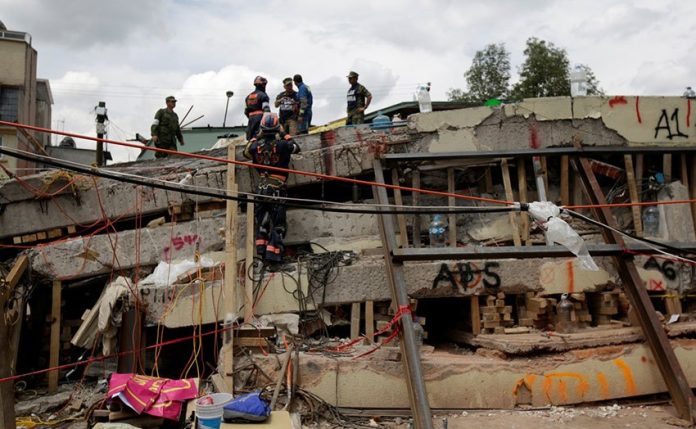
The Enrique Rebsamen school after it collapsed in the 2017 earthquake.
The Enrique Rébsamen school after it collapsed in the 2017 earthquake.

The owner and director of a Mexico City private school at which 26 people died during the 7.1 earthquake in 2017 has been found guilty of manslaughter. 

After 10 hours of court proceedings yesterday, judges declared Mónica García Villegas, former owner of the Enrique Rébsamen school, guilty of manslaughter in the deaths of 19 children and seven adults during the September 19 quake. 

Shortly after the collapse of the school, authorities filed a criminal complaint against García, alleging she was negligent in constructing an apartment for her personal use on the roof of a wing of the building. 

Previous remodeling at the school had already damaged the building’s structural stability, of which García was well aware.

But after a warrant was issued for her arrest in 2017, García went into hiding and an Interpol red notice was issued for law enforcement worldwide to assist in her apprehension. 

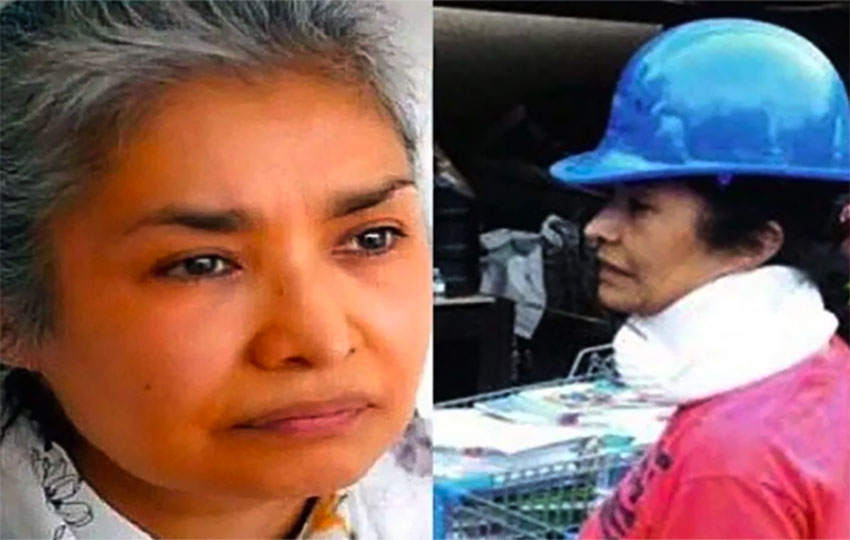
miss monica
Miss Mónica, left, during an interview with a reporter before her arrest and, right, supervising construction at the school.

She was taken into custody in a Mexico City restaurant in May 2019 after her brother alerted authorities to her location and collected on a 5-million-peso reward.

The trial of the woman students called “Miss Mónica” began on August 12 in Mexico City’s superior court. 

According to a statement from the prosecutor, evidence in the case “was conclusive to establish that the woman was remiss by not complying with the provisions established in construction regulations and urban development law,” which put at risk the school’s students and faculty. 

“It should be noted that the defendant was not only the general director of the private school but also served as senior partner and administrator, ranging from preschool education to secondary education; According to the accusation, she failed to comply with the provisions established in the aforementioned regulations and law,” the statement read.

Mexico City’s Attorney General’s Office requested a 57-year prison sentence. She could face between two and five years for negligence in the deaths of each of the 26 victims, plus a five-year sentence for her culpability in her role as supervisor of the construction project.

The sentence will be handed down on Monday.

Parents of 10 of the dead children addressed the court, demanding justice and urging the judge to hand down a precedent-setting sentence “that makes it clear that no one plays with people’s lives.”

García was remanded to Santa Martha Acatitla women’s prison in Iztapalapa where she has remained since her arrest. She was found guilty two days before the third anniversary of the quake, in which 370 people were killed and more than 6,000 injured.

Earlier this month Mexico City Mayor Claudia Sheinbaum announced that a memorial for those who lost their lives at the school will be constructed.

Source: El Financiero (sp)