Day of the Dead parade faces the coronavirus challenge.
Mexico City is exploring holding virtual Day of the Dead celebrations in the fall in order to maintain traditions in the face of the coronavirus pandemic.
Some two million people attended the Day of the Dead parade last year on November 2, which was also broadcast live, said the director of Mexico City’s tourism promotion fund, Paola Félix Díaz.
Now the city is looking to other large cities around the world for ideas on how to carry on traditional practices safely. Her office is also exploring options such as Day of the Dead drive-in theaters, or tours by car as alternatives to dense crowds in the streets.
A UNESCO-protected celebration, the Day of the Dead as it is celebrated today has its foundation in the deeply rooted Mesoamerican traditions of the indigenous peoples of Mexico and Catholic ritual introduced in the 1600s.
While every region of the country has its own particular way of celebrating the event, the common denominator is the remembrance of a family’s departed loved ones, who are visited at cemeteries and honored by an altar that includes the meals, drinks and vices favored by the deceased.
Mexico City held its first government-sponsored Day of the Dead parade in 2016, inspired by the opening sequences of the James Bond film Spectre, where 007 can be seen chasing a villain through a crowded Day of the Dead celebration.
Initially, hopes had been to grow the parade to the size of Carnival in Rio, although that is unlikely to happen anytime soon.
Armored vehicle that appeared in one of the cartel's videos is believed to be a modified Ford F-250 Super Duty XLT.
Two cartel videos posted online in recent days are courtesy of the “elite group” of the Jalisco New Generation Cartel (CJNG), National Defense Minister Luis Cresencio Sanddoval said Tuesday.
One video shows scores of heavily-armed and masked men shouting support for CJNG leader Nemesio “El Mencho” Oseguera Cervantes while standing alongside a long convoy of armored vehicles.
The other video, which also shows armed men and military-style vehicles, is narrated by a man who directs a threat at José Antonio “El Marro” Yépez Ortiz, leader of the Santa Rosa de Lima Cartel, which is engaged in a bloody turf war with the CJNG in Guanajuato.
The narrator says that the CJNG’s dispute in Guanajuato is not with the people or the government but with the “filthy, innocent-slaying” Yépez.
“Marro, understand once and for all that all of Guanajuato has an owner and it’s the CJNG,” the narrator says before giving voice to a threat to kill all members of the Santa Rosa de Lima Cartel, a fuel theft, drug trafficking and extortion gang.
Speaking at the president’s news conference on Tuesday morning, Sandoval said the release of the first video last Friday coincided with the birthday of Oseguera, Mexico’s most wanted drug lord.
Army chief Sandoval presents a report Monday at the presidential press conference.
The army chief said that the aim of both videos is to show off the firepower of the elite group of the CJNG, considered the most powerful and dangerous criminal organization in Mexico.
Sandoval said the government has information that the cartel’s elite group was formed last year and is led by Juan Carlos González, a man also known as “El 03.”
The leader of the elite group in Jalisco is Ricardo Ruiz Velazco, alias “El Doble R,” he said.
Sandoval said that the CJNG elite group is the only one of its kind in the country and that it operates in parts of Michoacán, Guanajuato and Zacatecas.
In response to the threat against Yépez and the crime group he leads, the army chief said that security will be bolstered in Guanajuato – the most violent state in the country – and all other states where the CJNG operates in order to avoid “any situation that could have a negative impact” on the general population.
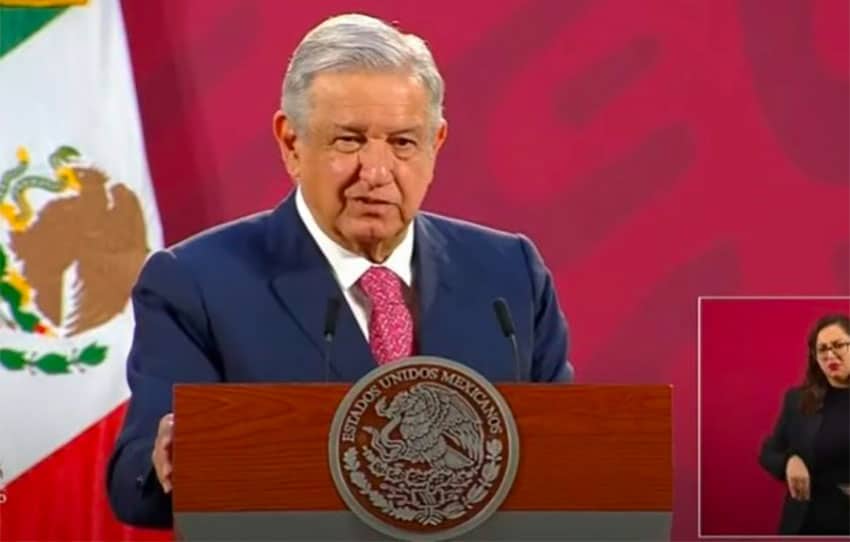
For his part, President López Obrador asserted that his administration “won’t declare war” on drug cartels in response to the two CJNG videos even though they are seen by some analysts as a challenge and threat to the authority of the government.
“Declaring war is not the solution, we already know what that causes,” he added, referring to the huge number of deaths in the almost 14 years since former president Felipe Calderón launched the so-called war on drugs by sending the military into combat against cartels.
The president said that the cartel videos are also a legacy of the security strategies implemented by past governments and renewed his commitment to combatting violence with a non-confrontational approach that respects people’s human rights.
“I continue to call on everyone to behave well, let there be hugs not bullets,” López Obrador said.
“An eye for an eye, a tooth for a tooth, the law of retaliation, no!. … I don’t agree with the retaliation law. If we resort to that, we’ll be left one-eyed or toothless,” he said.
“We have to convince, persuade [people to stop the violence]. Peace and tranquility are the fruits of justice. Violence cannot be confronted with violence, fire isn’t put out with fire, evil cannot be confronted with evil; evil has to be confronted by doing good. So we’re not going to change [our strategy].”
The president did, however, publish a decree in May that ordered the armed forces to continue carrying out public security tasks for another four years, effectively perpetuating the militarization model he frequently rails against.
The sewer system at Terminal 2 of Mexico City’s Benito Juárez International Airport has been called a sanitary disaster, as employees and passengers must put up with a foul stench in hallways, gates, parking lots and outside areas near the terminal.
Leaking sewage containing fecal matter tends to accumulate near Gate 4, on one side of the terminal.
The putrid odor may be attributed to a faulty sewer system with leaky pipes, the terminal’s proximity to a garbage dump, and various construction projects taking place inside the building.
Employees report that the smell is more noticeable in the afternoons, and after it rains.
“The wind and heat bring that foul odor. There are days when it is very strong and affects sales,” said Sandra, who runs a sandwich shop.
“It rains, there are a lot of leaks, travelers get upset, and then they tell you to clean and clean, but the water rises up out of the drain. The pipes break and all the stink comes out,” said Monica, a cleaning lady at the facility.
Airport officials had put out a call for bids on fixing the problem.
“The leaks increase in the rainy season, so when they accumulate and stagnate they give off bad smells in a large part of the terminal, affecting users and causing a bad image,” the rules for the bidding process explained.
Properly repairing the faulty system at Terminal 2 would take about sixmonths, airport officials estimate, and would involve installing six submersible pumps and removing 1,593 cubic meters of earth, among other projects.
However, authorities were forced to close down the bidding process on June 22 after only two companies submitted proposals that were called inadequate, offering to fix the sewage leaks for around 11 million pesos, or US $492,000.
The raccoons of Playa Miramar in Ciudad Madero, Tamaulipas, are feeling the effects of the coronavirus: their main source of food — tourists — has become scarce.
The beach-dwelling raccoons lost their natural habitat in the nearby forest due to construction and moved down to the jetty several years ago. There, they frolic on the rocks and delight visitors who are quick to offer them a snack and snap a photo of the furry mammals, which will eat just about anything you offer them and do so from right out of your hand.
As a result, raccoons have become a major tourist attraction.
Hortencia Ruvalcaba Infante, president of the seven-year-old Miramar Raccoon Protection and Preservation Board, says that her agency has stepped in to help the creatures, keeping them fed until tourists are able to return and the beaches have reopened.
“Since there are no people at Miramar beach, we have given ourselves the task of redoubling efforts to be able to visit them and bring them food that is normally obtained through the generosity of tourists,” she said.
Some 200 raccoons are fed by local volunteers.
This amounts to some 130 liters of water and 120 kilos of food daily, representing an expense of more than 4,000 pesos (US $179) a week to keep the approximately 200 raccoons provided with tortillas and kibble. Ruvalcaba says she also has a veterinarian who offers his services to wildlife at no charge.
To help support their work, raccoon advocates have sold food, held raffles and made coronavirus masks emblazoned with the image of a raccoon that became very popular in the area and were sold on the group’s Facebook page for 60 pesos each.
But it’s mainly the love for these and all animals that drives Ruvalcaba, a retired Pemex worker, and her fellow raccoon lovers.
“Sometimes I spend up to 18 hours of my day to help the Miramar beach raccoons as well as other defenseless animals, but this work would not be achieved without the support of the same citizens” who buy masks that help buy food, she said.
Morena legislator Leticia Estrada Hernández has proposed a law that would ban lodging apps such as Airbnb in Mexico City.
The bill was put forward on July 15 in an effort to reform zoning laws in the capital, despite the fact that such hosting platforms are a viable alternative to hotels for travelers due to the coronavirus pandemic.
The proposed amendment to zoning law article 17 states that all private residential property be prohibited from carrying out “industrial, commercial or service activities, and for no reason may they be intended for temporary accommodation, as offered by the Airbnb platform and other similar platforms.”
The proposal also includes other types of prohibitions, such as carrying out activities that affect the tranquility of condominium owners, such as nighttime construction and maintenance without prior approval.
The bill proposes that those who violate its terms could be subjected to fines between 4,344 and 26,064 pesos (US $195 to US $1,667).
In addition, the bill proposes that a vigilance committee be formed to make sure neighbors are complying with regulations.
Estrada said the proposal came from the desire to protect property owners and cited unknown individuals entering buildings and others who are “constantly having parties.”
The president of Mexico City’s congressional tourism commission, Patricia Báez Guerrero of the National Action Party (PAN), came out against Estrada’s proposal, saying it would destroy all the work that has been done by the Ministry of Tourism to regulate digital lodging.
Báez also pointed out the importance of Airbnb in Mexico City. With about 17,229 rooms for rent, between houses and apartments, the service generates around 4.34 million pesos per year in tax revenue, about US $194,000.
Homeowners in Mexico City who rent out their properties on Airbnb and other apps earn an average of 38,000 pesos a year, she said.
“These deputies [from Morena] want to end everything that generates some money for the capital. Especially now that so much is needed with this contingency,” Báez said.
Director of Epidemiology José Luis Alomía reported 5,172 new cases on Monday. milenio
Six states are close to recording zero growth in new coronavirus cases, Deputy Health Minister Hugo López-Gatell said Monday as total cases across the country approached 350,000.
López-Gatell told reporters at the Health Ministry’s coronavirus press briefing that new case numbers have begun to stabilize over the past three weeks in Mexico City, México state, Baja California, Chiapas, Michoacán and Sinaloa.
He predicted that those states will subsequently reach a phase in which new infections plateau at zero growth in percentage terms. After that case numbers will start to decline, he said.
López-Gatell said the coronavirus epidemic in Mexico continues to grow but emphasized that the pace at which it is growing is slowing.
“Reconciling the two ideas causes a little bit of confusion. … Do we have more cases today than yesterday? Yes, … but the difference in cases between today and yesterday if we compare it with the today and yesterday of last week and the week before is that it is less,” he said.
The daily tally of coronavirus cases and deaths. Deaths are numbers reported and not necessarily those that occurred each day. milenio
“The jump [in case numbers] between one day and the next is becoming proportionately smaller,” López-Gatell added, explaining that even when a large number of new infections is reported, the percentage increase in the size of the epidemic can continue to trend downward because the new cases are added to an increasingly larger number of total cases.
Earlier in the press briefing, Director of Epidemiology José Luis Alomía reported that Mexico’s accumulated coronavirus case tally had increased to 349,396 with 5,172 new cases registered on Monday.
The percentage increase in total case numbers from Sunday to Monday was 1.5%, while Mexico’s epidemic grew 1.56% in the same period a week earlier and 1.9% over the same two days the week before.
In the first 20 days of July, total case numbers increased by 54.5% whereas in the same period of June they grew by 93.2%.
Of the almost 350,000 confirmed cases, 29,549 are considered active, meaning that number of people tested positive after developing coronavirus symptoms in the past 14 days.
Alomía said there are also 79,112 suspected cases across the country.
Active coronavirus case numbers as of Monday. milenio
Based on past positivity rates, the Health Ministry estimates that Mexico’s accumulated case tally is 387,267 and that active cases number 46,820.
Alomía also reported that Mexico’s Covid-19 death toll had increased to 39,485 with 301 additional fatalities registered on Monday.
In the first 20 days of July, the Health Ministry reported a total of 11,716 Covid-19 deaths, an average of 586 per day. The death toll increased by 42% in the period.
By contrast, 10,851 Covid-19 deaths were reported in the first 20 days of June, an average of 543 per day. While the average number of deaths reported each day was lower than in the same period a month later, Mexico’s total number of Covid-19 fatalities increased by 109% between May 31 and June 20.
Mexico City continues to lead the country for Covid-19 deaths, with 8,253 as of Monday. México state ranks second, with 5,688 confirmed fatalities, followed by Baja California and Veracruz, where 2,361 and 2,188 people, respectively, have lost their lives to Covid-19.
The Catholic Church celebrated its first in-person Mass in four months in Morelos on Sunday by using a novel approach — inviting parishioners to a listen from their cars as if attending a drive-in theater.
Thirty-three cars showed up Sunday to attend the Cuernavaca diocese’s service, where Bishop Ramón Castro has been giving his homilies via the internet since Covid-19 closed churches and other public spaces throughout Mexico.
Congregants were able to park their cars, spaced a safe distance apart, facing a small stage set up so that Castro could conduct Mass in front of a projection screen, the type used at large-scale concerts. The faithful watched from their cars.
The church, said Roberto Carrasco, a vicar with diocese, decided to celebrate the drive-in Mass in recognition of the difficult times worshippers are going through without the comfort of in-person services and receiving the Eucharist, a core tenet of Catholics’ faith.
“Seeing other places that have set up these sorts of stages to watch movies, we thought, ‘Why not a celebration with the presence of the bishop?”
Instead of offering the Eucharist to attendees directly on the tongue, congregants received the wafer in their hands. All participants wore masks, and some used gloves and face shields as well.
Artemio Bello, who assisted during the ceremony, told Milenio that this method of hearing the word of God was new, but necessary in Mexico’s “new normal.”
Attendees like the Reyes family said the church should continue to conduct such services.
“It’s an example of how we are going to have to live in this situation.”
The event occurred despite six priests in Morelos having contracted Covid-19 during the pandemic and the state currently having an orange rating, the second highest rating on the federal government’s “stoplight” system. According to the state secretary of health, Morelos has recorded 3,741 confirmed cases and 792 deaths.
Oaxaca Governor Alejandro Murat has called on residents of the southern state to participate in a voluntary 10-day lockdown to curb the spread of the coronavirus.
In a video posted to social media on Sunday, Murat urged citizens to undertake “voluntary confinement” from 12:01 a.m. on Monday to 11:59 p.m. on Wednesday, July 29.
His stay-at-home advice came a day before the coronavirus infection risk in Oaxaca switched from “red light” maximum to “orange light” high, according to the federal government’s “stoplight” map.
Murat said that both Covid-19 case numbers and deaths have increased considerably in the past two weeks, especially in the Isthmus of Tehuantepec region and the Papaloapan basin area in the state’s north.
The governor directed a sharp rebuke at “some citizens” who, “against all principles of preservation of health and life,” have participated in “all kinds of celebrations” and attended large events.
“This cannot continue,” Murat said sternly while wagging his finger ominously. “I ask you once again to take care of yourself because taking care of yourself you look after all of us.”
After calling for a voluntary lockdown, Murat said that his administration was collaborating with municipal and federal authorities to implement urgent coronavirus containment and mitigation measures in the Isthmus of Tehuantepec and Papaloapan basin regions.
He also reminded Oaxaca residents that wearing a face mask in public spaces remains mandatory in the entire state, adding that authorities will be particularly vigilant in ensuring that the rule is followed in municipalities in the Isthmus and Papaloapan regions.
“This disease exists, it’s among us and it has no cure. Only you can stop it. I reiterate, don’t leave your home if you don’t have a reason to go out and step up the prevention measures. We’re going to take care of ourselves and we’re going to take care of others,” Murat said.
Also on Sunday, the municipal government of Juchitán, the Isthmus of Tehunatepc’s main hub, announced the closure of all businesses for five days due to the increase in Covid-19 cases and deaths.
Mayor Emilio Montero Pérez said the closure of all commercial establishments starting Monday was an urgently needed measure. He said the National Guard and municipal and state police will ensure that the shutdown order is strictly observed.
“In the face of the obvious increase in infections and deaths caused by the coronavirus, it’s not the time to look for people to blame but for each of us to do our part” to stop the virus’s spread, Montero said.
The mayor added that the five-day closure of businesses could be extended if case numbers continue to grow.
“Let’s forget all our differences, let’s apply the preventative measures, the protocols. … Let’s do it for Juchitán,” he said.
Juchitán has officially recorded 121 confirmed Covid-19 cases and 21 fatalities but municipal authorities claim that at least 82 people have lost their lives to the infectious disease.
Oaxaca has recorded 8,704 confirmed cases since the beginning of the pandemic, the 15th highest tally among Mexico’s 32 states. Just over a quarter of the cases – 2,249 – were detected in Oaxaca city.
The southern state has also recorded 824 confirmed Covid-19 fatalities, according to state data.
The oarfish found at Pichilingue, La Paz, last week.
An oarfish, a deepwater eel-like fish not generally seen in Mexican waters, has made another surprise appearance, turning up Friday in Baja California’s Pichilingue Bay in La Paz.
The discovery of the fish, believed in Japan to be omens of earthquakes, comes barely a month after another oarfish was caught June 11 in Cozumel.
David de Zabedrosky of the World Climactic Network revealed the Baja California sighting on his Twitter account Sunday, showing pictures of the large eel-like fish and estimating its length at about three meters.
The deepwater fish are not frequently seen in Mexico’s Pacific Ocean, although it happens occasionally. Last summer, also in La Paz, an oarfish washed up on El Coromuel Beach. Around the same time, another washed up on a beach in Los Cabos. In 2013, dead specimens washed up on California beaches in Oceanside and Catalina Island.
Although the plankton-consuming fish are believed to live at depths of 200 to 1,000 meters, they are sometimes sighted at the surface — and are believed to be the source of many legendary accounts of sea serpents and other sea monsters. In Japan, many believe they signal oncoming earthquakes and tsunamis.
In 2011, this belief was reinforced when supposed multiple sightings of oarfish on Japanese coasts occurred soon before the 6.6-magnitude earthquake in Fukushima that led to a tsunami and an accident at the Fukushima nuclear plant. They can occasionally be pushed ashore by strong currents and get stranded in bays like Pichilingue and end up dead or alive on beaches.
Jane Dill and her new book of quarantine cocktails.
Artist Jane Dill’s fun new book, Quarantine Cocktails: 50 Cocktails in 50 Days of Quarantine in San Miguel de Allende, Mexico, is exactly what the title says it is.
“It all started when my husband and I were having a cocktail on our roof deck in early April, talking about how ‘Happy Hour’ was making a comeback all over the world during quarantine,” she recalled. “It seemed to be a fun way for us to mark each day, to delineate between daytime and nighttime, what with all the days endlessly running together.”
Dill posted photos and descriptions of those first cocktails on her Facebook page, and within a week family and friends were clamoring for her to make them into a book. It got to the point where if she hadn’t posted the day’s cocktail by 8 p.m., her phone would be beeping with folks asking what was going on.
She never intended to turn her adult beverage creations into a book; the couple’s regular Happy Hour was just “a way to keep sane.” But without her regular teaching and gallery work, Dill said, “the one thing I had in abundance was time.”
Dill began researching cocktails on the internet, and became particularly intrigued by Prohibition-era mixed drinks like the Sidecar and the Gimlet. She started making a cocktail basic, simple syrup (50/50 sugar and water, cooked down to a syrup consistency), and then infusing it with herbs, chipotle, or jalapeños to add a Mexican flavor to her drinks.
Fifty cocktail recipes inspired by the coronavirus quarantine.
“We began on April 7 and ended on May 26,” she said. Her nightly posts of new cocktails were shared like wildfire. “I don’t even know how many people were enjoying cocktails with me.”
For those who may be leery of learning how to make cocktails at home, Dill has some simple advice.
“This is the antithesis of mixology bibles, fancy glassware and expensive booze,” she laughed. In fact, all of the drinks in the book are shown in the same two martini glasses, photographed on Dill’s rooftop deck in San Miguel de Allende. “We had just moved and downsized, and just didn’t have a lot of glasses. We’re very informal here!”
As an artist and calligrapher, color is important to her. Although at times she wouldn’t have the ingredients she wanted, like grenadine for a Tequila Sunrise, she figured out that blended frozen raspberries would give her the color and tart flavor she was looking for.
In the Chocohula Covfefe — a play on President Trump’s famous garble — she couldn’t find crème de cacao. On a whim, she used a Magnum chocolate ice cream bar, blending it with the other ingredients. The result was a delicious dessert cocktail, “best eaten with a spoon.”
“The idea is to improvise,” said Dill. “My philosophy of quarantine cocktails is to improvise, re-create and have fun experimenting with different spices, fruits and colors. Toss it in the blender, pour it in a nice glass and knock yourself out.”
This mocktail becomes a cocktail with the addition of vodka, rum or tequila.
Quarantine Cocktails: 50 Cocktails in 50 Days of Quarantine is available on Amazon as a paperback and ebook. If you’re in San Miguel, the book can also be purchased directly from the author and delivered to your door for a small fee. She’ll also ship within Mexico. Fifty percent of the profits from sales of the first 100 books go to a local non-profit, Feed the Hungry. Details can be found on Dill’s website.
All recipes make two cocktails. Feel free to leave out the alcohol for a “mocktail.”
Pina Frambuesa
Ice
½ cup fresh pineapple, cut in chunks
½ cup raspberries
1 cup coconut water
2 Tbsp. fresh lime juice
½ cup rum, vodka or tequila
Blend all ingredients in blender.
Chocahulua Covfefe
A delicious dessert cocktail, best eaten with a spoon!
Ice
1 cup strong coffee or espresso
½ cup vodka
¼ cup Kahlua
Half a vanilla/chocolate Magnum Bar or Dove Bar ice cream (or cocoa powder to taste)
Sprinkle of cinnamon or nutmeg
Blend all ingredients in blender.
Drunken Guayaba Slushy
Yes, you could use fresh guayabas, but a frozen bolis or paleta (popsicle) from your local tienda works just fine.
Ice
1 cup grapefruit juice
½ cup frozen strawberries
¾ cup coconut water
1 guayaba (guava) bolis or popsicle
½ cup vodka, rum or tequila
Blend all ingredients in blender.
Friskey Whiskey
A sweet and sour, hot and boozy combo.
Ice
½ cup Jack Daniels whiskey
½ cup orange juice
1 Tbsp. maple syrup
½ tsp. minced jalapeños
Splash of orange bitters
Blend all ingredients in blender.
Janet Blaser has been a writer, editor and storyteller her entire life and feels fortunate to be able to write about great food, amazing places, fascinating people and unique events. Her first book, Why We Left: An Anthology of American Women Expats, is available on Amazon. Contact Janet or read her blog at whyweleftamerica.com.