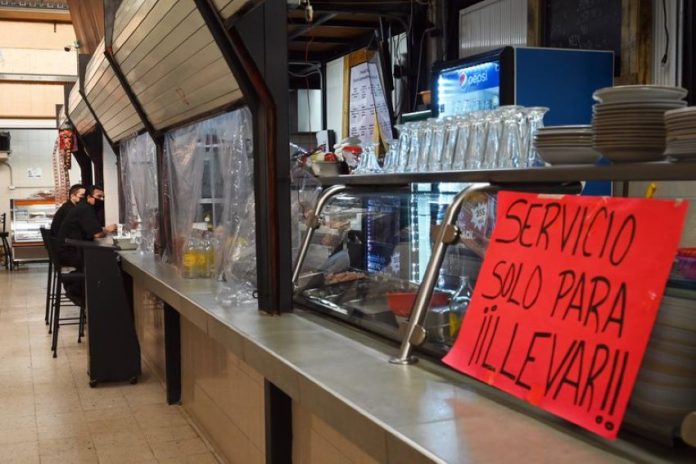
Crowds of people flooded the streets of three cities in Michoacán yesterday, flouting the plan to reopen gradually as the state begins lifting coronavirus restrictions and adjusting to the “new normal.”
According to the newspaper El Universal, Monday kicked off in virtual chaos in Morelia for both pedestrians and drivers as they flocked to businesses that did not respect the governor’s order to operate at 25% capacity. Neither did customers who chose not to respect the state’s recommendation to continue stay-at-home measures.
Banks saw lines up to two blocks long with people packed closely together, and restaurants and businesses opened their doors to the public for the first time in 2 1/2 months, although not all of them abided by coronavirus health protocols.
Department stores and shopping malls opened, but strictly enforced the wearing of masks. Customers were also made to apply hand sanitizer in front of security personnel.
About half of those on the streets were wearing masks, the newspaper reported, and most no longer fear the virus, adopting a “life goes on” attitude and welcoming the opportunity to get back to work.
Morelia resident Alejandro Arredondo spent Monday morning at a high-end shopping mall, then went to pay bills. He says he thinks reactivating the economy is important, as is adhering to health guidelines, noting that the coronavirus is not the only thing that can make one sick. Debt can as well, he said.
There were similar scenes yesterday in the cities of Zamora and Lázaro Cárdenas.
As of June 1, Michoacán had recorded 1,950 confirmed cases of the coronavirus and 169 deaths.
Launch of the new network on Monday in Mexico City.
A coalition of Mexican academics, researchers, artists and politicians has created a new network to fight the growing tide of violence against women, which they say has only been exacerbated by stay-at-home measures due to the coronavirus.
Called “Red Nosotras Tenemos Otros Datos,” or “We Have other Information Network,” it was officially launched on June 1 via a virtual press conference. Broadcast on Facebook Live, it has received over 31,000 views.
(The organization’s name is taken from a phrase used frequently by President López Obrador to counter information that puts the government in a negative light.)
The group called on citizens to join them in their demand for transparency, equality and the participation of women in government decisions, cofounder Patricia Olamendi said.
Their goal is to ensure that public policies exist that further the objective of achieving equality for women, especially on issues like health, employment and access to services where the gender gap is particularly pronounced, Olamendi explained.
“We are going to ask (citizens) to request information, that the authorities present clear and transparent reports and are held accountable for how resources are used.”
Activist Beatriz Cosío explained that the government must adopt specific measures and programs that guarantee the investigation and statistical compilation of the causes, consequences and frequency of violence against women.
Cosió offered data obtained from the Ministry for Public Security that shows that violence against women increased during the first four months of the year with respect to the same period in 2019. This despite a statement by President López Obrador last month that 90% of emergency calls related to violence against women are fake.
Of particular concern to Cosío is the gap between the number of calls for help relating to domestic violence and the number of cases under investigation. “It is important to know what course of action was given to the calls and whether they reached the corresponding authority,” she said.
But members of the network also emphasized that it is important to look at the people behind the numbers and to support victims, which is one of its core principles.
The network said that from now on it will be holding virtual press conferences on social media each Monday with information on violence against women, and will host a virtual cultural festival on June 6 called “We Have Other Information For a Life Free of Violence” where they will hear public testimony and share alerts and information on cases of violence against women across the country.
The president kicks off construction of the Maya Train.
President López Obrador has officially inaugurated construction of the Maya Train railroad, an ambitious infrastructure project that will link cities and towns in five southeastern states.
Accompanied by state and federal officials, López Obrador waved a starting flag on Monday for the construction of a section of track between Izamal, Yucatán, and Cancún, Quintana Roo.
At a ceremony in the Quintana Roo municipality of Lázaro Cárdenas, the president described the US $8-billion, 1,500-kilometer railroad as a historic and momentous project for the southeast of Mexico.
“A lot of years went by and this region wasn’t looked after. We’re going to continue supporting the north [of the country] the Bajío, central Mexico, the south and the southeast,” López Obrador said.
He said that construction of the Maya Train will help the economy recover from the coronavirus-induced crisis, asserting that it will create 80,000 jobs this year and 150,000 in 2021.
López Obrador pledged that the project will be finished in 28 months, or by October 2022, stressing that no excuses will be accepted for delays.
He added that the companies building the railroad should follow the example of the military engineers building the new Mexico City airport at the Santa Lucía Air Force base.
The Mexican company ICA will build the section between Izamal and Cancún, while a consortium led by billionaire businessman Carlos Slim won the contract for the construction of a stretch between Escárcega and Calkiní in Campeche.
A consortium led by Portugal’s Mota-Engil and the China Communications Construction Company won the contract to build a section of track between Palenque, Chiapas, and Escárcega, Campeche.
López Obrador said that he was “certain” that ICA, which was awarded a 25-billion-peso contract without having to participate in a competitive bidding process, will meet all of its commitments in the construction of the 257-kilometer section of track between Izamal and Cancún.
The section will have three stops between the two terminuses – one in the Yucatán municipality of Kantunil, one near Chichén Itzá, the ancient Mayan city, and one at El Tinte Holbox.
For his part, Quintana Roo Governor Carlos Joaquín described the Maya Train as much more than just an infrastructure project.
“In reality, it represents a new paradigm of economic integration, regional development and social equity,” he said.
Joaquín said that the train, which will run through the states of Tabasco, Campeche, Yucatán, Quintana Roo and Chiapas, will provide a boost to tourism in the region.
Rogelio Jiménez Pons also said that the construction and operation of the railroad will not have a negative impact on the environment, although experts have warned that the project poses risks to the region’s underground water networks and the long-term survival of the jaguar and several indigenous groups have opposed it on the grounds that it will adversely affect biodiversity and natural resources, including water.
Stores in the Medrano garment zone in Guadalajara remain closed.
It’s been a rocky economic restart for some businesses in Jalisco that were hoping to get back to work this week.
Governor Enrique Alfaro had announced that on June 1 some nonessential businesses that had obtained a state government health certification could reopen.
However, several such businesses expecting to open were asked to remain closed by municipal authorities, especially in areas of Guadalajara that are likely to draw large crowds such as the Medrano garment zone, the Obregón district where the San Juan de Dios market is located and the city’s historic center.
And in neighboring Zapopan, one of the wealthiest cities in Mexico, businesses were allowed to reopen whether they had the government health certification or not.
The resumption of nonessential economic activities is occurring despite the fact that the number of coronavirus cases in the state is on the rise, a trend that Alfaro says will continue at least for the next month. The state is still deemed to be at maximum risk by the federal government, much to Alfaro’s dissatisfaction.
In a statement posted to the state government’s website on Saturday, Alfaro claimed Jalisco had only 1.4% of the country’s deaths due to the coronavirus, despite being the third most populous state in Mexico.
“We said that first it was health and then the economy, and we fully complied with this principle, but our state cannot remain paralyzed,” Alfaro said. “Thousands of people lost their jobs and their source of income. Hundreds of businesses had to close or dramatically reduce their operating capacity. The blow has been brutal.”
Citizens need to get back to work and learn to live with the risk of infections, he added.
Nonessential businesses eligible for reopening include lumber yards, flower shops, furniture stores and beauty salons, although their status depends on approval from municipal authorities.
Schools, spas, movie theaters, nightclubs, casinos, gyms and shopping malls will have to wait, and social distancing measures are still in force. If people do not comply and the outbreak worsens in the future, the economy may have to be shut down again, Alfaro warned.
As of Monday, Jalisco had 1,802 confirmed cases of the coronavirus and had recorded 151 deaths.
The vehicle in which officers' bodies were found on Monday.
Authorities in Colima on Monday found a vehicle containing the dismembered remains of seven bodies believed to be those of a group of officers who disappeared in neighboring Jalisco last week.
Ten Colima state police officers were ambushed and kidnapped in Jalisco on Thursday after escorting a group of mining executives to the municipality of La Huerta.
The bodies were found in a white Chrysler Pacifica near a soccer field in the community of Cedros, north of Manzanillo, after police received a 911 call about an abandoned vehicle with a strong odor coming from it.
Colima authorities released a statement on Saturday confirming the kidnapping and claiming that “the officers … had the proper authorization to provide legal protection in the state [of Jalisco] and to carry their weapons.”
However, Jalisco Public Security Minister Juan Bosco Agustín Pacheco told a press conference that “I want to clarify that at no time did [the government of Colima] try to collaborate with us in the sense that they would notify us of the entry of the Colima police forces into the state, nor via an extraofficial phone call or other means of communication.”
For their part, neither the Colima Attorney General’s Office nor the state Public Security Ministry has issued an official statement to clarify or deny that the bodies found on Monday belonged to the missing police officers. Two other civilians were also reported missing in the region last week.
CORRECTION: The earlier version of this story identified Manzanillo as the capital of the state of Colima. In fact, the city of Colima is the state capital.
Although most of the country remains in the red on the government’s stoplight system for the reactivation of the economy, beer is back in production and on the shelves in several areas after a two-month drought.
Grupo Modelo halted production at the beginning of April, as beer was not considered an essential product by the federal government during the quarantine period, which ended on May 30.
Beer production and sales resumed on Monday in various states, as well as in Mexico City, where Grupo Modelo has a brewery. The company also owns and operates the world’s largest beer plant in Zacatecas, the only state in the country not in the red on the reactivation stoplight.
Supermarket chain Soriana and the convenience stores OXXO and 7-Eleven all announced that they were once again selling suds.
Beer sales also resumed online. Retailers Amazon and Mercado Libre added beer to their available products on Monday, charging around 430 pesos (US $19.75) for a case of 24 473-milliliter cans.
In Nuevo León, where the halt in beer production triggered panic buying in April, authorities announced that beer production would return to 50% capacity on the first day of the “new normal.”
Grupo Modelo and the country’s other large beer manufacturer, Heineken, have not released any information about the return to production.
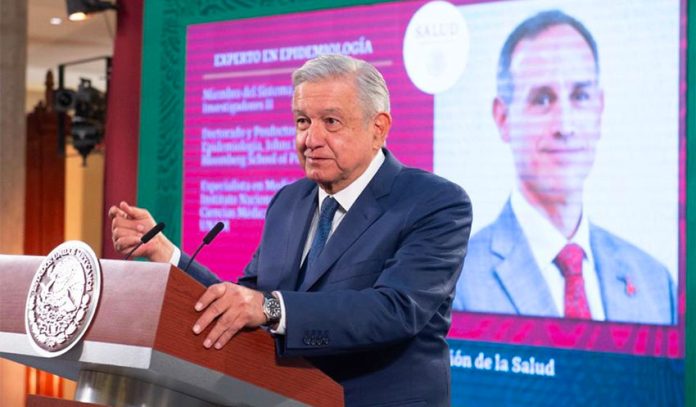
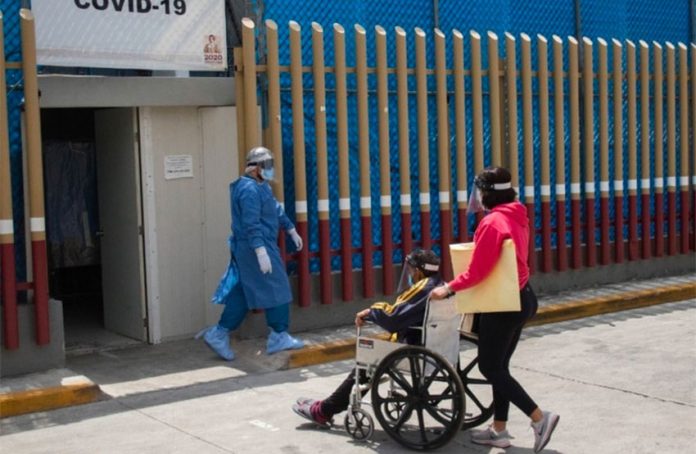
Hospital admissions of coronavirus patients have exceeded the projections of the Health Ministry in seven cities, Deputy Health Minister Hugo López-Gatell said on Monday, as Mexico’s Covid-19 death toll passed 10,000.
Speaking at the nightly coronavirus press briefing, López-Gatell said that intensive care hospitalizations of Covid-19 patients have exceeded forecasts for the Valley of México metropolitan area, which includes Mexico City and several México state municipalities.
Hospital admissions of seriously and/or gravely ill Covid-19 patients have also been higher than predicted in Villahermosa, Tabasco; Cancún, Quintana Roo; Acapulco, Guerrero; Culiacán, Sinaloa; Tijuana, Baja California; and Veracruz city.
López-Gatell said that Covid-19 cases are on the wane in the Valley of México, the country’s coronavirus epicenter, but are still above the numbers originally predicted.
The peak of the pandemic is still to come in several cities including Guadalajara, Jalisco, and Monterrey, Nuevo León, the deputy minister said.
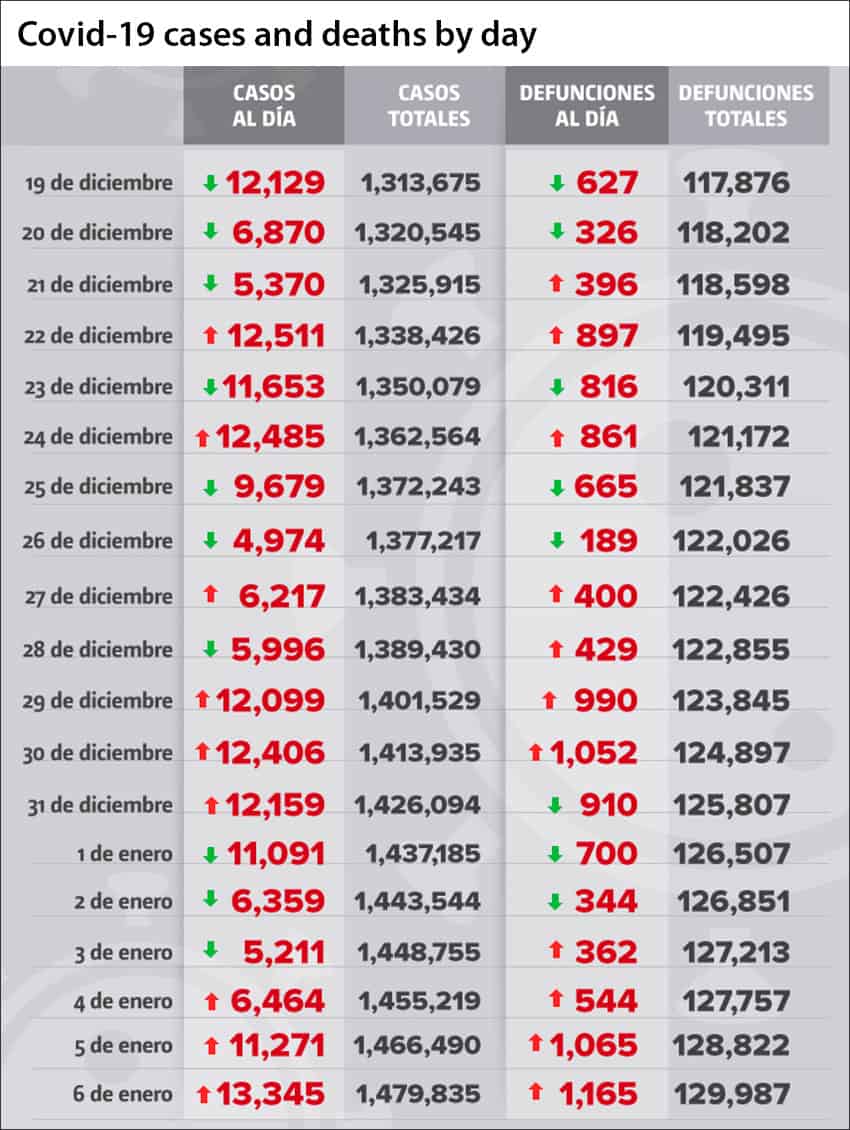
Coronavirus cases and deaths as reported daily. milenio
The peak in the Jalisco and Nuevo León capitals is several weeks away, he said, adding that the epidemics in the two cities “will be the last [in the country], according to the predictions” and could continue until October.
Earlier in the press briefing, Health Ministry Director of Epidemiology José Luis Alomía reported that Mexico’s Covid-19 death toll had increased to 10,167 with 237 additional fatalities registered on Monday.
The total number of deaths is also well over projections. López-Gatell said May 4 that 6,000 people were predicted to die of Covid-19.
Just over a quarter of those confirmed to have died from Covid-19 did not have any identified existing health conditions that made them more vulnerable to the disease, according to Health Ministry data. Of that number, 1,482 patients were aged under 60, meaning that their age didn’t make them more susceptible either.
Of the 74% of deceased Covid-19 patients with existing health problems, 42% suffered from hypertension, 38% had diabetes and 27% were obese. Other patients who died had a history of smoking and/or suffered from kidney problems, chronic obstructive pulmonary disease, cardiovascular disease, immunosuppression, asthma or HIV.
Mexico City has the highest Covid-19 death toll in the country, with 2,713 fatalities as of Monday, followed by México state and Baja California, where 1,168 and 871 people, respectively, have lost their lives to the disease.
The number of active cases yesterday was down by 659. milenio
Alomía also reported that Mexico’s accumulated case tally had increased to 93,435 with 2,771 new cases registered on Monday. Of that number, 16,303 are considered active, a decrease of 659 compared to Sunday.
There are also 38,497 suspected cases across the country while 282,089 people have now been tested.
Mexico City currently has the largest identified active outbreak with 3,975 cases, followed by México state and Tabasco, where there are 1,921 and 853 cases, respectively.
Seven other states currently have more than 500 active cases: Puebla, Chiapas, Veracruz, Jalisco, Sinaloa, Guanajuato and Baja California.
López-Gatell said that there has been an uptick in cases in Villahermosa, probably due to an increase in people’s mobility, and that the virus remains very active in Mexicali, the capital of Baja California.
At the municipal level, Mexicali has the fourth largest active outbreak in the country with 465 identified cases, while Centro (Villahermosa) ranks fifth with 408 cases.
The two largest municipal level outbreaks are in the Mexico City boroughs of Iztapalapa and Gustavo A. Madero, with 814 and 653 cases, respectively, while Puebla city ranks third with 476 cases.
The city is currently testing 657 people per 100,000 inhabitants.
The Mexico City government has announced that it will aim to double the Covid-19 testing rate in the capital as part of efforts to limit the spread of the disease as restrictions are eased.
Health Minister Oliva López told a press conference Sunday that the current testing rate is 657 per 100,000 inhabitants, meaning that authorities will aim to test just over 1,300 people per 100,000 instead.
As Mexico City has a population of about 9 million people – not including the México state municipalities that are part of the metropolitan area – it will have to test a total of almost 120,000 people to achieve the goal.
López said that authorities will conduct contact tracing operations in an attempt to identify people who came into contact with those who test positive.
For his part, the head of the government’s Digital Agency for Public Innovation said that Mexico City’s testing goal is on a par with the rate in Seoul, South Korea, a country that has won praise for identifying and isolating people with Covid-19.
José Merino said that 114 clinics and hospitals in Mexico City will be equipped to perform tests.
The announcement that testing will be ramped up in the capital came just days after Deputy Health Minister Hugo López-Gatell said that the federal government wasn’t interested in testing Mexicans en masse for Covid-19 because doing so would be “useless, impracticable and very expensive.”
He said on Sunday night that just under 275,000 people have been tested, a figure that equates to a nationwide rate of about 215 tests per 100,000 inhabitants, three times lower than the rate in Mexico City.
Mexico’s testing rate is dwarfed by those in scores of other countries including several in Latin America such as Chile and Peru.
As a result, the real number of Covid-19 cases is believed to be much higher than the 90,664 cases reported by health authorities on Sunday night.
Just over 25,000 of the confirmed cases were detected in Mexico City and 2,658 people have officially lost their lives to coronavirus in the capital, although the real death toll is believed to be much higher.
The federal government set the infection risk level in Mexico City at the “red light” or maximum level for this week but local authorities have nevertheless allowed some businesses to resume operations and parks will partially reopen on Tuesday.
Arte en Casa: artistic and cultural content through social networks.
Amid the repetition and drudgery of our current existence, it can be hard to conjure up even the very recent past. For the residents of Mérida, the Yucatán’s cultural hub, recalling the optimism of the “pre-virus” is an even more arduous challenge, and one that requires a level of cognition most of us have lost in the monotony of isolation.
There are, however, some leading lights of the city’s artistic scene that will remember the words of a still wide-eyed Mérida mayor, declaring that the capital of Yucatán will complete its journey to becoming a truly “avant-garde city.”
Big words. Slightly embellished words perhaps, but a reach that if not quite a confirmation of Mérida’s spot as the southeast’s city of art, certainly clinches the title for most ambitious. It’s this ambition that has recently set Mérida firmly on course to becoming a supportive and vibrant home to innumerous creatives; painters, musicians, filmmakers and artisans.
A formidable record remains from this self-belief in its own artistic capabilities with the first international art competition being confirmed back at the end of 2019, a large colonial house being reworked into a hub for incoming artists and cultural events, and an exhibition of 93 original Picasso works back in December. Over the last year especially, Mérida has constantly been applying one foot on the gas.
As the Covid-19 pandemic has developed, “nonessential” initiatives and programs in communities across the world have been put on the backburner. While local governments may be partially thankful for a scapegoat to blame for a lack of civic progress, they are also aware that the branding of the virus as a scapegoat in and of itself is an inherently ridiculous proposal — they need only point to its size and sharpened teeth to have these accusations laughed out of the door.
A formidable record: an exhibition of original works by Picasso took place in December.
But Mérida has avoided this discourse entirely, instead opting to propel its campaign of cultural programs through the crisis, giving them a fighting chance of surviving the next few months and emerging on the other side.
“Arte en Casa” (Art at Home) is one such vision being realized not only in exceptional circumstances, but possibly because of exceptional circumstances. When the building blocks of this project were initially slotted together, its deployment in the context of mass quarantine and social distancing was a use none of the creators could have fully imagined.
Despite this, in the month of June Arte en Casa will continue to diffuse artistic and cultural content through social networks so that the overflowing cup of Yucateco art can be appreciated and enjoyed from isolation. Three hundred and thirty-four projects have been selected to be included in the program’s plethora of content, supporting the work and creativity of artists throughout the city.
Arte en Casa is taking off, with 160,000 followers on Facebook already and each video posted reaching more eager eyes — but perhaps the demand shouldn’t greet us as such a surprise. Mental health during lockdown has become a hot-button topic over recent weeks, as more of us in quarantine have been coming forward with the unique pressures associated with a lack of stimulation. We may have found it refreshing to begin with, but psychologists and mental health professionals alike have been professing the benefits, even the necessity, of dynamic and engaging stimuli.
The power of art in these instances is appreciated and well renowned, proven to boost energy levels and feelings of satisfaction and happiness, combatting the declining mental health prospects threatened by prolonged distancing. We know now that we’re up against a tide of depression, anxiety and stress induced by everything from financial insecurity to health worries, and grief at losing those close to us.
In the shadow of this mental health crisis, it’s important not only to offer the tools of distraction, (the likes of which a few scrolls through the landing pages of Netflix will show us are ubiquitous) but also positive, constructive, affirmative content. Community art, local theater, and personal literature, if made widely available, has the power to offer those in lockdown the ability to feel, if only momentarily, free.
We are in the midst of an unprecedented experiment in mass human psychology, and the Mérida model won’t magically solve our problems. It will be very easy to turn up the nose and question the benefit of streaming productions of The Cherry Orchard to the masses because, yes, it sounds and seems at first glance to be ineffectual and even slightly tokenistic.
The truth is, however, that access to provocative, challenging, and vital art is currently a twisted hose. We can easily forget the constant contact we used to have with art before the pandemic, simply by existing in the outside world. By democratizing artistic materials in Mérida, a semblance of normality has been allowed to return, and really, isn’t that what is needed at a time like this?
It looks and tastes like an apple pie—but has no apples.
I have to say that apples – reliably crisp, sweet/tart, juicy – are one of the things I really missed when I moved to Mexico.
To be sure, there were mangos and papayas galore, incredible pineapples and fresh coconuts, but I still missed a good ol’ apple. Eventually, though, I discovered that “real” apples could indeed be found at certain times of the year, grown not in the hot coastal region where I lived but in the mountains a few hours inland.
(My guess is that those of you who live in those areas know this already.)
Granted, most of the apples you can find in Mexico are imported; like consumers everywhere, Mexicanos prefer perfect-looking fruit. These locally grown manzanas are smaller and not perfect, but have the flavor, crunch and aroma of an actual apple. Yay!
In a previous life I’d been the food writer at a daily newspaper in Santa Cruz, California, and my job sometimes included judging the apple pie contest at the local county fair. It’s not as fun as you’d think; people add all sorts of strange ingredients to their apple pies and you have no idea that the one you’re about to taste has, say, too much cumin in the filling. We learned to talk while smiling, to warn our judge-mates not to take too big a bite.
Imported apples are readily available; Mexican varieties at certain times of the year.
So when I learned about an apple-pie-made-with-no-apples-that-tastes-just-like-the-real-thing, I knew I had to make it and see for myself. It sure seemed like part of my job to test such an outrageous claim.
The Mock Apple Pie in question is made with Ritz crackers, and is apparently a Depression-era recipe. The crackers are soaked in a cinnamon-sugar syrup and baked in a regular pie crust – crumb, lattice, whatever. While you’re assembling it, it looks just like what it is: a cracker-filled pie shell. But once baked, it tastes like and has the mouth-feel of real apples. I kid you not! And with vanilla ice cream or whipped cream on top, it’s hard to tell the difference.
But don’t take my word for it. Since you’ve got all that time on your hands, try it yourself and see. Let me know what you think, OK?
Mock Apple Pie
You must use real Ritz crackers in order for this to taste its best – don’t substitute generic copycat crackers.
1 cup sugar (all white or half brown or piloncillo)
Mix sugar and cream of tartar in medium saucepan. Gradually stir in water. Bring to boil on high heat; simmer on low 5 minutes or until mixture is reduced to 1½ cups. Stir in juice; cool 30 min.
Heat oven to 425 F. Make pie crust: roll out one crust on lightly floured surface to 11-inch circle; place in 9-inch pie plate. Arrange whole crackers in crust. Carefully pour sugar syrup over crackers; dot with butter and sprinkle with cinnamon.
For top crust, make a crumb topping or roll out remaining crust to 10-inch circle; place over pie. Seal and flute edge. Cut several slits in top crust to permit steam to escape. Bake 30-35 minutes or until golden brown. Serve warm with whipped cream or vanilla ice cream.
Prawn, Jicama and Apple Salad with Mint & Dijon Dressing
Fresh lemongrass (hierba de limón) is available widely in Mexico not because of Asian cooking but because it’s traditionally used as an herbal tea.
1 cup matchstick-cut Granny Smith apple
1 cup matchstick-cut jicama
½ cup matchstick-cut carrots
½ cup fresh mint leaves
½ cup extra-virgin olive oil
3 Tbsp. sugar
2 Tbsp. white vinegar
1 Tbsp. Dijon mustard
1 tsp. chopped garlic
1 tsp. chopped fresh lemongrass (available in most grocery stores, or mercados)
2 sprigs cilantro
Cook shrimp in boiling water until pink on the outside and no longer transparent in the center, 3-5 minutes. Drain with cold water to cool completely. Peel, devein and slice shrimp in half lengthwise; set aside.
Toss apple, jicama and carrots together in a large bowl. Place mint, olive oil, sugar, vinegar, mustard, garlic and lemongrass in a food processor or blender and pulse quickly until slightly chunky. Pour dressing over apple mixture and toss gently. Cover and refrigerate salad and shrimp separately until ready to serve, then mix together and garnish with cilantro. –Allrecipes.com
Turkey Apple Sandwiches with Maple Mayonnaise
Say whaaat?! Yes, these flavors go together fabulously!
¼ cup mayonnaise
1½ tsp. maple syrup
½ lb. sliced turkey or smoked turkey
1 apple, thinly sliced
4 slices bread of choice
In a small bowl, combine mayonnaise and maple syrup; spread on bread, top with turkey and apple slices and then the remaining bread. –nytimes.com
An apple and turkey sandwich, a fabulous combination of flavors.
Quick Sautéed Apples
Serve for dessert with vanilla ice cream, as a side with pork or chicken, or for breakfast with granola or oatmeal.
4 apples, peeled and sliced (about 2 lb.)
½ cup firmly packed light brown sugar
1 tsp. cinnamon
¼ tsp. nutmeg
2 Tbsp. water
1 Tbsp. butter
Mix first four ingredients in a bowl or large zip-top plastic bag. Transfer to saucepan, add water and butter, and cook for 8-10 minutes, stirring occasionally, until apples are tender.
Janet Blaser of Mazatlán, Sinaloa, has been a writer, editor and storyteller her entire life and feels fortunate to write about great food, amazing places, fascinating people and unique events. Her work has appeared in numerous travel and expat publications as well as newspapers and magazines. Her first book, Why We Left: An Anthology of American Women Expats, is available on Amazon. Contact Janet or read her blog at whyweleftamerica.com.