Home Blog Page 1537

Violent protest in Guadalajara over death of man while in police custody

0
Protesters in Guadalajara yesterday.

A protest in Guadalajara, Jalisco, over the alleged murder of a man by municipal police after he was arrested for not wearing a face mask turned violent on Thursday, as protesters vandalized the state government building, clashed with police and set one officer on fire.

About 1,000 people took to the streets of the Jalisco capital to denounce the death of Giovanni López Ramírez, a 30-year-old construction worker who was arrested in the municipality of Ixtlahuacán de los Membrillos on May 4 for not wearing a face mask amid the coronavirus pandemic.

López was allegedly beaten and tortured by municipal police. He died in hospital on May 5 from a traumatic brain injury, according to his death certificate.

The protesters gathered in Guadalajara’s Revolution Park on Thursday afternoon after the demonstration was promoted on social media. Among those to promote it was Oscar-winning film director Guillermo del Toro.

From there they marched to the state government palace in the historic center of the capital while holding up placards condemning López’s death and chanting slogans such as “Giovanni didn’t die, Giovanni was killed.”
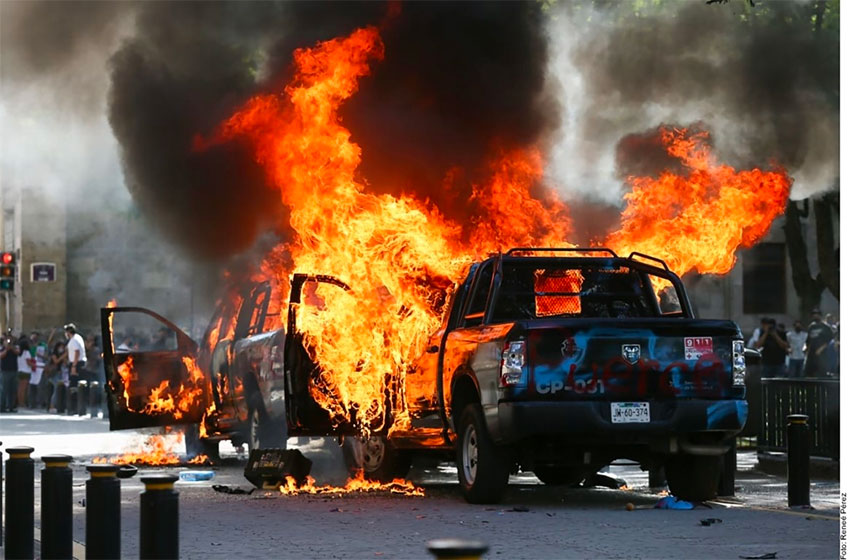
Vehicles burn during Thursday's violent demonstration in the Jalisco capital.
Vehicles burn during Thursday’s violent demonstration in the Jalisco capital.

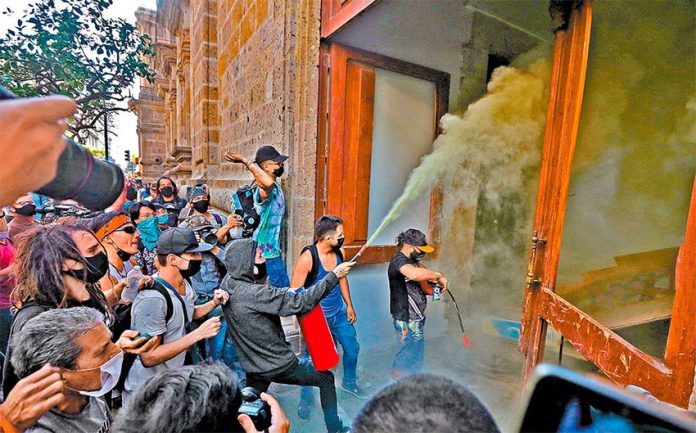
Some defaced the facade of the government palace with graffiti messages that demanded justice for López, described police officers as “pigs” and called for the resignation of Governor Enrique Alfaro.

Two police cars parked near the palace were spray-painted before they were set on fire.

A large group of protesters then turned their attention to breaking into the government palace, first attempting to kick down a door before using broken street signs and other objects to force their way in.

After gaining access to the building, they vandalized its interior, smashing office windows and destroying furniture, the newspaper Milenio reported.

After leaving the palace, they clashed with police in the street, and several demonstrators and officers sustained injuries. Some police officers kicked and threw punches at both protesters and journalists, Milenio said, noting that they also used tear gas to try to disperse the crowd.

As sirens wailed, one protester approached a state police officer who had arrived at the scene on a motorcycle, poured a flammable liquid on his back and set him on fire. A video posted online by the news outlet ZonaDocs showed the officer falling off his stationary motorcycle with his back aflame.

He rolled around on the street attempting to extinguish the flames before they were eventually put out with a bottle of water. The officer was taken to a hospital where he was treated for burns to his neck but was not in a serious condition.

Governor Alfaro said on Twitter that 27 protesters were arrested, including six minors.

He claimed that the protest was orchestrated from the “basements of power” in Mexico City, asserting that President López Obrador had sent people to infiltrate it and cause trouble.

“Behind everything that is happening in this case in Jalisco are interests [in] … Mexico City. What they’re seeking is to damage Jalisco,” Alfaro said in a video message posted to social media.

He defended the conduct of the police although video footage showed some acting aggressively without provocation. Alfaro said they had acted according to the circumstances and “didn’t commit any act of violence against the protesters.”

The actions of the latter, however, posed a risk to the lives of “working people” doing their jobs inside the government palace, Alfaro said.
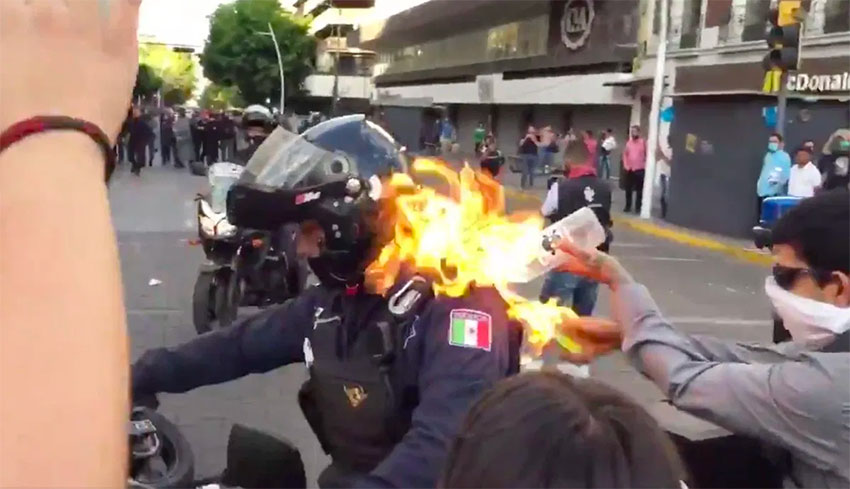
A police officer was set on fire during the protest on Thursday.

The governor denied that López was arrested for not wearing a face mask but gave no further details. Jalisco Attorney General Gerardo Octavio Solís said he was arrested for “aggressive behavior” but the man’s family denies the claim.

Video footage posted online this week showed López being forced into a police car by municipal officers wielding assault rifles. At the same time, citizens argued with the police about their excessive use of force and the rule requiring the use of face masks.

López was allegedly beaten at a local police station before he was taken to the hospital where he died.

Alfaro said earlier on Thursday that the man’s death was an “atrocity” and pledged that his government will apply the “full weight of the law” to whoever is responsible.

In a Twitter message on Friday morning, the governor said that the “first arrests” had been made in the case and that the state government would take control of the Ixtlahuacán municipal police.

He told a press conference later this morning that a police commissioner, a middle-ranking commander and a police officer had been arrested in connection with the case.

Meanwhile, Ixtlahuacán Mayor Eduardo Cervantes Aguilar is under investigation for obstructing the investigation into the alleged murder. Giovanni López’s brother claimed that through a third party the mayor offered his family 200,000 pesos (US $9,125) not to publish the video he recorded of the police aggression, which has circulated widely on social media and news websites.

He also said that Cervantes threatened to kill members of his family should the video come to light. The mayor has rejected the claims.

Alfaro had stressed that state police or authorities had no involvement in López’s death but the federal Interior Ministry (Segob) said in a statement that the tough measures the Jalisco government put in place to limit the spread of the coronavirus, including arresting people for breaking curfews, was a factor.

“This event came in the context of the restrictive measures implemented by the governor of Jalisco to fight the pandemic, which included the use of law enforcement forces, and which led to abuses by authorities,” Segob said.

The Mexico office of the United Nations High Commissioner for Human Rights (OHCHR) condemned the death.

“The allegations that the arrest of Mr. López Ramírez occurred in the context of the implementation of health emergency measures due to the Covid-19 pandemic and the obligatory use of face masks in Jalisco is a cause of concern for the OHCHR,” it said.

Source: Milenio (sp), El Universal (sp) 
Storm triggers evacuation of 2,000 in Yucatán; state of emergency in Campeche

0
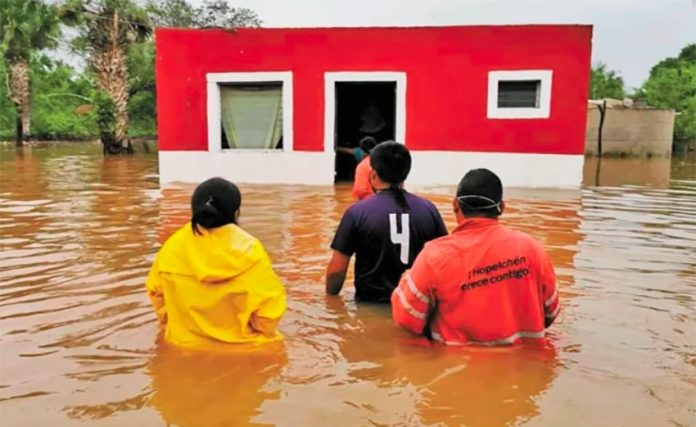
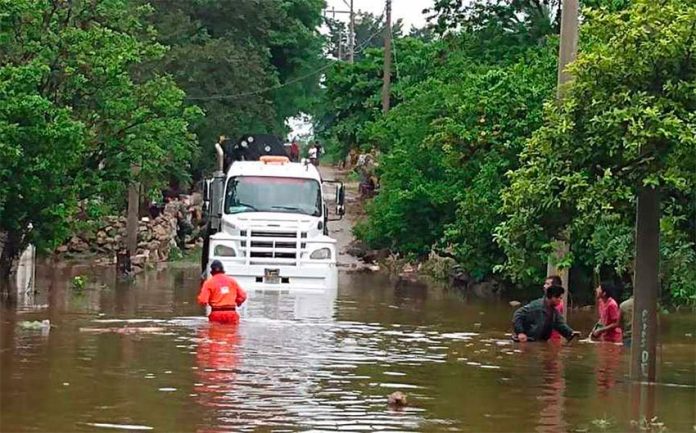
Flooding caused by Cristóbal in southeastern Mexico this week.

Cristóbal is a tropical storm once more after it was downgraded Thursday to a tropical depression.

The United States National Hurricane Center (NHC) said at 1:00 p.m. CDT on Friday that the storm had strengthened, triggering a tropical storm warning for the Yucatán peninsula between Punta Herrero and Río Lagartos.

It was located about 60 kilometers southeast of Mérida, Yucatán, and was moving north at 19 kph.

The storm inflicted extensive damage and relentless rains across seven states in southeastern Mexico, where thousands took refuge in shelters due to the devastation. 

By Friday morning it was located south of Campeche and maximum sustained winds had dropped to 55 kph.

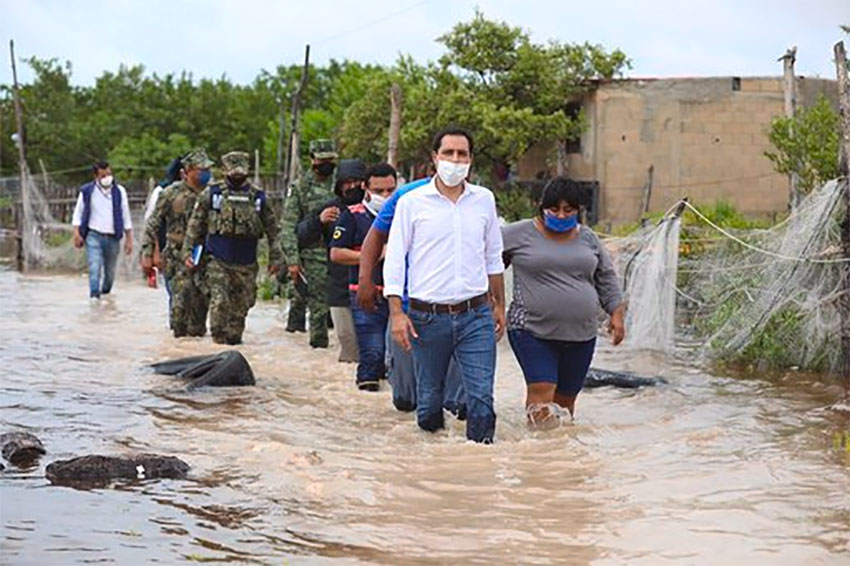
Yucatán Governor Vila wades through Celestún floodwaters Friday morning.

The storm affected 75 municipalities in seven states in the southeast, particularly on the Yucatán peninsula which has seen at least 65 centimeters of rain since the storm began. 

The NHC said Campeche, Quintana Roo, Yucatán, Chiapas, Tabasco and Oaxaca are expected to see more heavy rains — between 10 and 15 centimeters — through Saturday. 

Thousands of soldiers and National Guard members have been dispatched to affected areas and those still in the storm’s path. Thousands have been or are being evacuated to shelters. 

In Campeche, the governor is asking the federal government to declare a state of emergency after numerous highways and homes were flooded. More than 800 people are in shelters and damage to the hard-hit municipalities of Carmen, Escárcega, Candelaria, Champotón and Palizada is expected to be extensive. 

One person was killed by a falling tree in Chiapas, where the communities of Chicoasén, Bochil, Copainalá, Tecpatán, Ixtapa and Unión Juárez have all seen landslides and wash-outs due to the storm.

In southern Quintana Roo, the Mexican military is using two helicopters to airlift an estimated 450 people out of danger zones.

Yucatán, which is under an orange alert in some coastal regions and will continue to be battered by high winds and heavy downpours today, some residents have refused to leave their homes for shelters, despite the risk of flooding, as they are afraid of looting. 

Today Governor Mauricio Vila Dosal toured the shantytown of Celestún, also known as “Cartolandia” (Cardboardland), and went door-to-door pleading with residents to gather their belongings and move to shelters for their safety. Authorities were doing the same in the nearby port city of Sisal as they attempted to evacuate some 2,000 people in the area and bus them to five shelters in Mérida.

Cristóbal is expected to make landfall in the United States on Sunday, and flood watches are already in place in Louisiana, Mississippi, Alabama and Florida. 

The storm formed on June 2 from the remnants of Pacific Tropical Storm Amanda, which battered Central America leaving at least 22 dead in El Salvador and Guatemala, and was the earliest named storm in the Atlantic ever recorded. The previous record was set in 2016 when Tropical Storm Colin formed on June 5.

Source: Prensa Latina (sp), Milenio (sp), Jornada (sp)

God’s Bridge, Jalisco: a geological treasure far off the beaten path

0
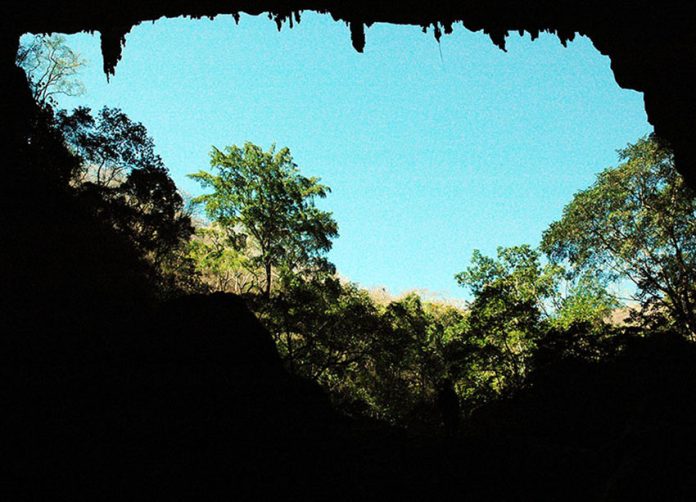
One of the cave entrances, seen from inside.

“El Puente de Dios is a natural wonder you have to see. It’s a kind of tunnel with two huge arches, through which a river flows … It’s truly a marvel, but, unfortunately, getting there is one big chinga.”

This is what people in the know told me — some years ago — about one of western Mexico’s most unusual natural attractions. Such words might have discouraged the boldest of adventurers, but not my friend Chale, even though he was well over 70 years old at the time. 

“I found the place on the topo map,” he told me. “It’s about 125 kilometers straight south of Lake Chapala, really in the middle of nowhere. Let’s go find it.”

Now if you look at a map of Jalisco, all you’ll see on its southernmost border is a big empty space, but Chale assured me there’s a little town there with the nearly unpronounceable name of Ahuijullo (ah-wee-HOO-yo). “That’s where we’re going,” said Chale, “and we’d better bring along enough food to last us five days, just in case.”

Unforeseen circumstances resulted in the postponement of our trip, but this did not stop Chale from driving 606 kilometers (round trip) of curvy roads “just for a preliminary look.” He came back with good news: “They’ve opened an iron mine near Ahuijullo and built a big wide road to it. We can easily get there from Michoacán.”

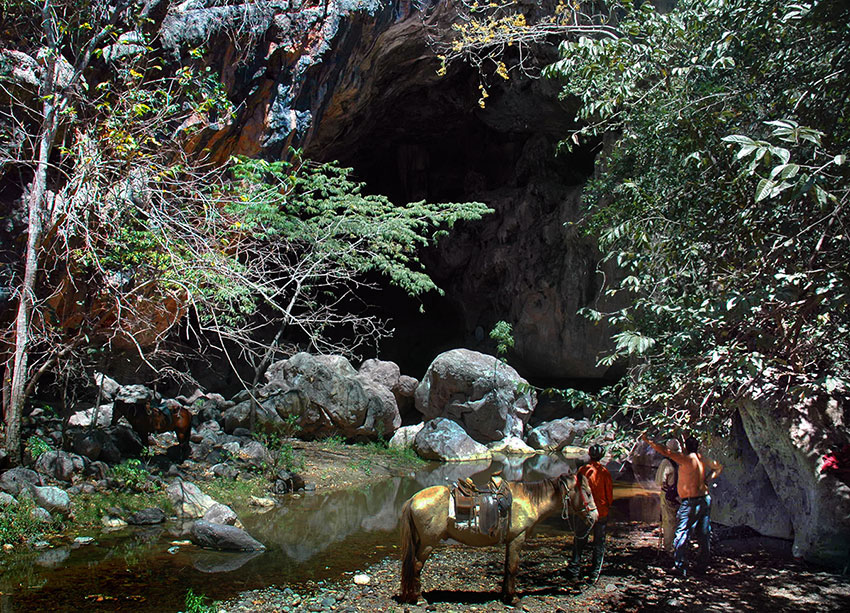
A river of cold, clean water flows from one of the dramatic arches of God’s Bridge.

So, off I went the following week with Chale and another willing hiker nicknamed Sobina. Sure enough, we found a graded road, wider than any autopista, leading from Tepalcátepec, Michoacán, to Ahuijullo, Jalisco. The only problem was that we had to share this road with 92 huge trucks which, in those days, were carrying iron ore 24-7 from the Piedra Imán Mine: trucks which raised enough dust to choke all of us to death if we hadn’t had air conditioning.

Our car was white when we left Tepalcátepec and brown by the time we reached the home of one Hernán Lomelí, whom Chale had contracted as a guide.

“You need a place to camp?” said Hernán. “You can share my pasture with the cows.” And so we did, only to discover at 3:00 a.m. that we were also sharing it with several thousand local roosters which seemed dead set on getting us up before dawn.

The next day we asked how long it would take us to walk to the Puente de Dios. “About two hours,” everybody told us, “está retirado [It’s pretty far away].” Well now I know that in rural Mexico the word retirado means “double whatever walking time they tell you.”

Our hike took us up and down golden hills and all along a bubbling stream which comes straight out of God’s Bridge and which we must have crossed 500 times, hopping from boulder to boulder. Along the way we saw a big black snake almost two meters long, papelillo trees with paper-like bark, ceibas covered with fluffy cotton balls and bonete trees full of fruits shaped like bombs, while overhead flew a flock of long-tailed magpies, which followed us for at least an hour, cavorting like lunatics.

Unlike us, our guide and his buddy were riding on horseback. Eventually they must have gotten tired of waiting for us at every crossing of the river, for suddenly they vanished. “They may be lost,” pronounced Chale, utterly calm, “but we are not. As long as we follow the river, we’ll reach the Puente de Dios.”

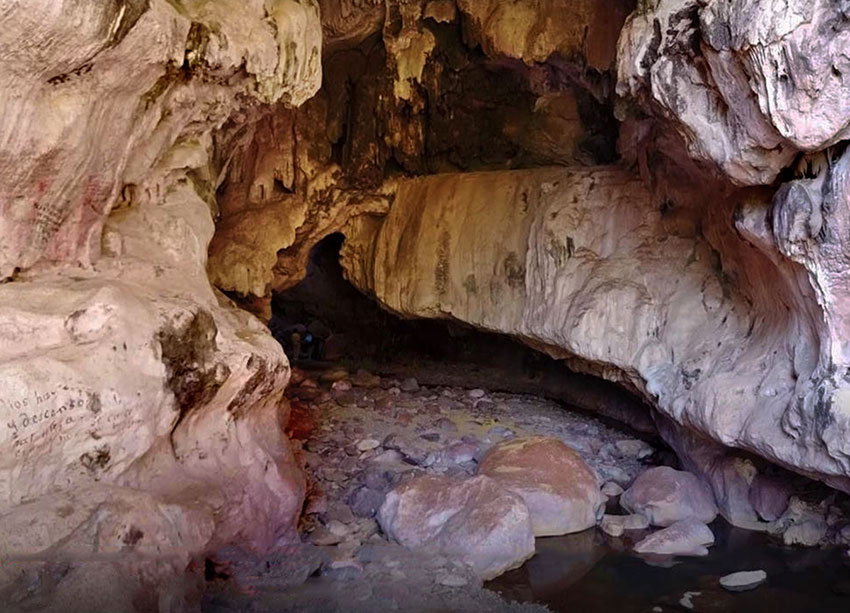
High walls and flowstone formations inside El Puente de Dios.

After a total of four hours of walking, we found our guides heating tortillas in front of the huge arch of a cave entrance. Sobina threw himself on the ground and declared he was never moving again. Chale and I, however, had just enough energy left to enter the cave, which has two spectacular arches a few hundred meters apart.

The river runs right through the cave and its high, cathedral-like roof — which sports a third impressive “skylight” entrance — is dripping with stalactites, curtains and flowstone.

Several beautifully decorated natural balconies were visible and our guides assured us it was possible to reach these lofty places because local people had already climbed up there in hopes of finding a wonderful treasure which supposedly had been hidden here … and in just about every other cave we’ve ever heard of in Mexico.

Unfortunately, visitors have succeeded in removing many of the stalactites by shooting them to smithereens, but in spite of this, the Puente de Dios is still an awesome sight and also of historic interest because a local bishop is said to have lived in it during the time of the Cristeros and the ghost of a famous brigand is supposed to haunt the place to this very day.

No doubt both of them enjoyed drinking the cold, unpolluted, river water as much as we did. Our canteens, in fact, had run dry long before we reached the cave and if that river water had not been safe to drink, we would certainly have known it. Local people, by the way, are proud of this place and organize a pilgrimage to the cave every May 1 and I bet even the abuelitas (grandmothers) get there faster than we did.

Well, the hike to God’s Bridge was one of the toughest of my life so I never included it among the sites listed in my Outdoors in Western Mexico books. Recently, however, I was alerted to the fact that adventurous souls in the town of Tecalitlán, Jalisco (a two-hour drive whether from Guadalajara or Ajijic), have been organizing visits to God’s Bridge utilizing all-terrain vehicles which get you there via dusty brechas (dirt roads) overhanging steep precipices.

[soliloquy id="113030"]

“You actually hiked all day long to visit El Puente de Dios?” exclaimed Ismael Orta of Tecalitlán Turismo. “Well, now it’s a walk of 20 minutes, maximum.”

So, if you love racing up and down steep slopes in a motorcycle or ATV, call Ismael and he can arrange the adventure of a lifetime for you, culminating in a stroll through God’s Bridge — if you survive the off-road journey, of course (just kidding). In case you are the owner of your own four-wheel-drive vehicle, you could choose whether to meet Ismael and friends at Tecalitlán (100 kilometers from the bridge) or perhaps at pretty little Ahuijullo, 14 kilometers from the Puente de Dios. Just ask Google Maps to take you there.

Maybe if you spend the night in Ahuijullo, you will even figure out how to pronounce it.

• For more information, call Ismael Orta at 331 436 2441. (Yes, you can use Whatsapp.) 

The writer has lived near Guadalajara, Jalisco, for more than 30 years and is the author of A Guide to West Mexico’s Guachimontones and Surrounding Area and co-author of Outdoors in Western Mexico. More of his writing can be found on his website.

Maya Train station added to provide Isla Holbox connection

0
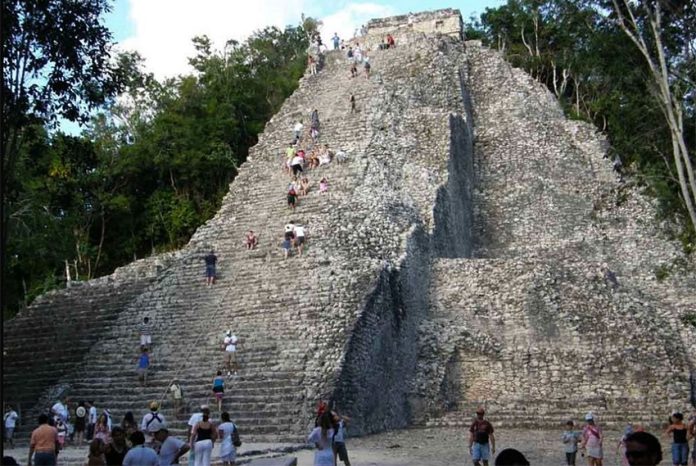
A pyramid at Cobá, which is expected to benefit from the addition of a Maya Train station at El Tintal.

A new station on the government’s US $8-billion Maya Train railway project has been added at El Tintal, Quintana Roo, which will allow tourists access to Isla Holbox, a small, car-free island with pristine beaches and a laid-back lifestyle. 

The planned El Tintal station is also near the Cobá archaeological zone, home to ancient Mayan ruins dating back to 600-900 A.D., and government officials say a light rail connection could be added between the two.

Both Agepro, Quintana Roo’s foreign investment promotion agency, and the National Tourism Promotion Fund (Fonatur) have assessed the project and determined that the terminal’s location will help generate economic development by bringing both tourists and cargo from Cancún to the region.

El Tintal, located in the municipality of Lázaro Cárdenas, has a population of around 1,000 and is 78 kilometers by road from the port of Chiquilá, from which ferries to Isla Holbox depart. 

President López Obrador inaugurated the train project and construction of a section of railway between Yucatán and Quintana Roo on June 1 at a ceremony in Lázaro Cárdenas, hailing the project as historic and momentous for southeastern Mexico. 

Quintana Roo Governor Carlos Joaquín called the Maya Train, which has drawn fire from environmentalists and indigenous collectives, “a new paradigm of economic integration, regional development and social equity.”

Quintana Roo is now the state with the most Maya Train stations, with a total of eight planned stops in Cancún, Puerto Morelos, Playa del Carmen, Tulum, Felipe Carrillo Puerto, Bacalar, Chetumal and El Tintal.

Source: El Economista (sp)

Airline, hotels campaign promotes 5 Pacific beach destinations

0
Destinations hope to see recovery in domestic tourism starting in July.

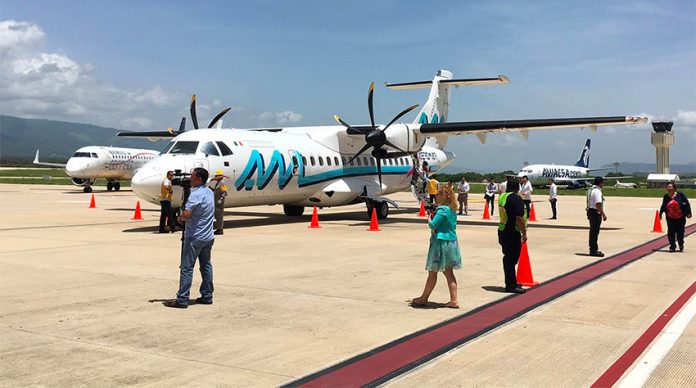
Mexico City-based airline Aeromar is partnering with hotels on the country’s Pacific coast in a new campaign to encourage visitors to visit five beach destinations. 

The marketing campaign, called “Frente del Pacifico,” or “Pacific Front,” offers travelers discounted air travel to Acapulco, Ixtapa-Zihuatanejo, Manzanillo, Puerto Escondido and Puerto Vallarta, as well upgrades and special rates on activities, hotels and restaurants at each of the five destinations.

Tourists only need to present their paper or electronic boarding pass at any of the 100 participating businesses. 

The tourism sector is hoping for an easing of restrictions in July, which is when they expect to see domestic tourism slowly start to rebound, with several destinations hoping to reach 50% hotel occupancy by December. 

Aeromar’s fleet of 10 turboprop planes will fly at 50% capacity, meaning fewer than 50 passengers per flight, until at least June 30 in order to allow for social distancing measures recommended by the International Air Transport Association, Aeromar executive director Juan Pablo Rosello announced. 

Planes will be thoroughly sanitized after each flight and antibacterial gel will be widely available, Rosello said. The airline will update flight schedules on a weekly basis depending on the coronavirus situation at each of its destinations. 

Flights start at US $44 and must be purchased by July 31 for travel anytime before December 31.

Source: El Universal (sp), Forbes (sp)

Covid-19 death toll could reach 35,000, says virus czar; worst case: 60,000

0
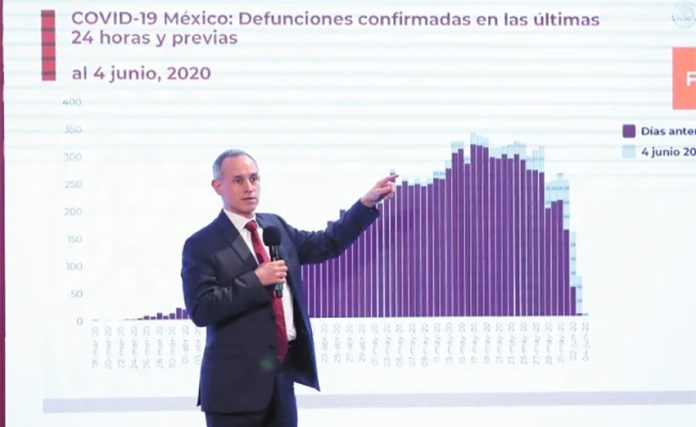
The deputy health minister presents the latest coronavirus report Thursday evening in Mexico City.

Mexico’s Covid-19 death toll could reach 35,000 or as many as 60,000 in a worst case scenario, Deputy Health Minister Hugo López-Gatell said Thursday after more than 800 additional fatalities were reported.

Speaking at the Health Ministry’s nightly coronavirus press briefing, López-Gatell said that estimates about the death toll could change depending on how the pandemic develops.

“We don’t rule out 30,000 or 35,000 deaths” he said. “In a catastrophic scenario, it could be 60,000.”

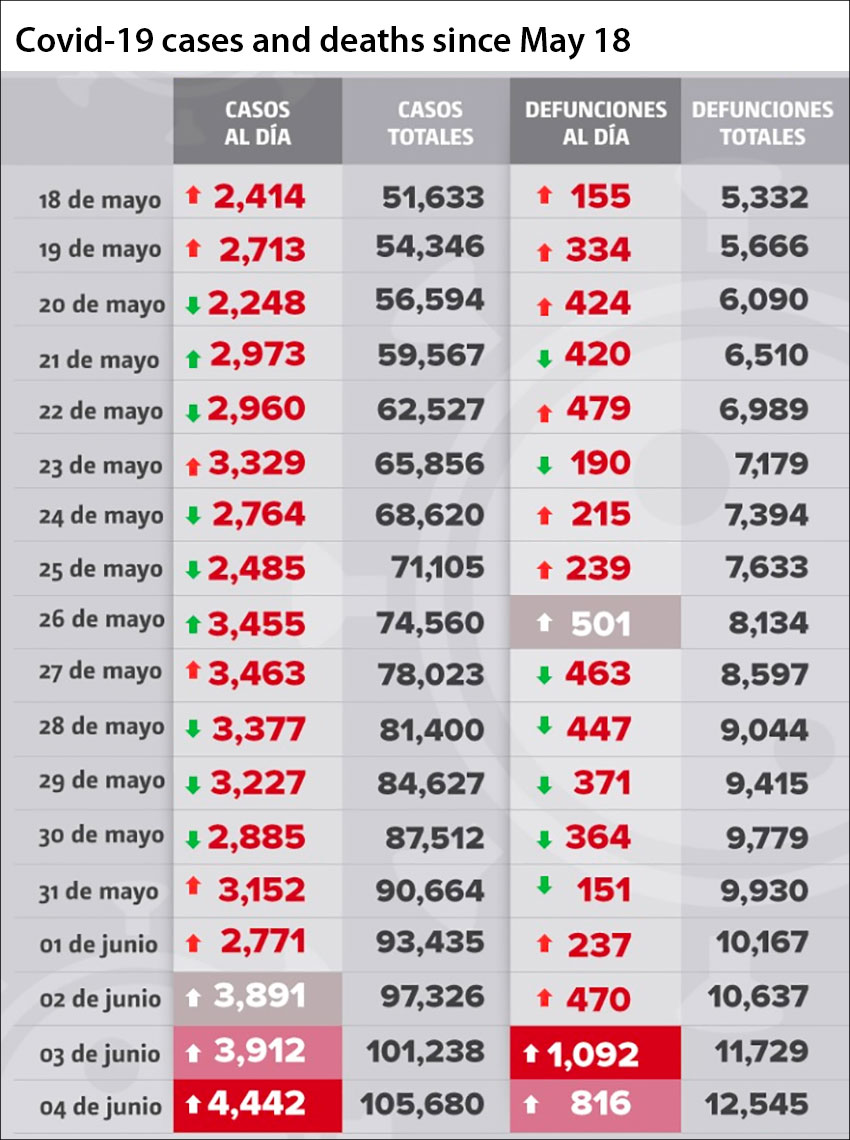
His remarks came after Director of Epidemiology José Luis Alomía reported that the coronavirus death toll had increased to 12,545 with 816 additional fatalities registered on Thursday.

The death toll has spiked sharply in the past two days with almost 2,000 additional fatalities reported on Wednesday and Thursday. López-Gatell reiterated that not all the new deaths reported occurred in the preceding 24 hours.

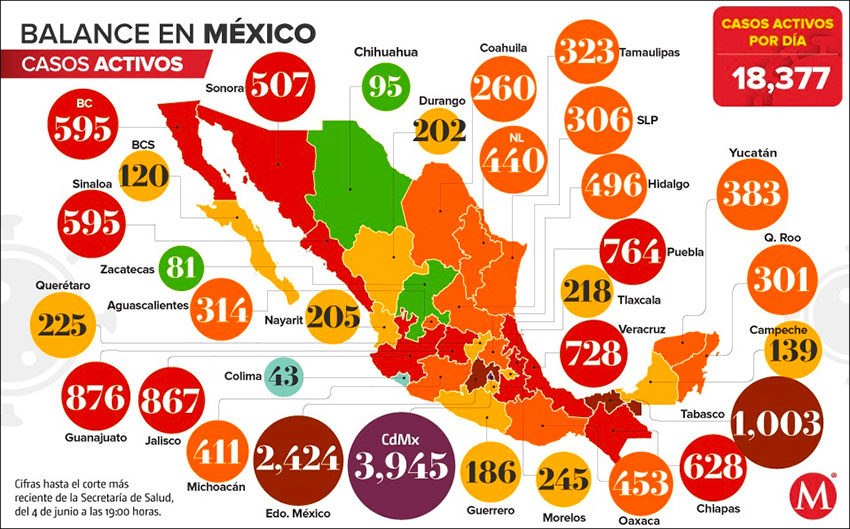
Active Covid-19 cases as of Thursday.
Active Covid-19 cases as of Thursday. milenio

More Covid-19 deaths occurred on May 17 than any other day since the start of the pandemic, he said, affirming that there were 340 fatalities on that date.

In addition to the more than 12,500 confirmed Covid-19 deaths, an additional 1,033 fatalities are suspected of having been caused by the disease but have not yet been confirmed.

If a suspected coronavirus patients dies without being tested, and is not tested post-mortem, a committee of medical specialists analyzes the case and decides whether there is sufficient evidence to attribute the death to Covid-19.

Some of the deaths reported on Wednesday and Thursday actually occurred in April but were not reported at the time because they hadn’t been confirmed as Covid-19 fatalities.

The coronavirus case tally has also spiked sharply in recent days with just over 15,000 confirmed cases reported since Monday.

Alomía reported that the case tally had increased to 105,680 with a record 4,442 cases registered on Thursday. He said that 18,377 cases are considered active, an increase of 1,548 compared to Wednesday.

Latest case and death figures as of Thursday.
Latest case and death figures as of Thursday. Death numbers are those reported on any particular day rather than those that actually occurred. milenio

Three federal entities have more than 1,000 active cases: Mexico City, with 3,945; México state, with 2,424; and Tabasco, with 1,003.

Alomía said that there are also 46,659 suspected cases across the country and that 314,063 people have now been tested.

Mexico’s per capita testing rate remains low compared to many other countries but the government has dismissed the need to significantly ramp up testing.

López-Gatell said Thursday that the government has no plans to purchase rapid tests because of doubts about their accuracy.

The use of rapid tests, rather than the “gold standard” PCR tests, could have “harmful consequences on the population,” the deputy minister said, because they could show false positives or false negatives and generate misplaced confidence or confusion.

Source: El Universal (sp) 

Police accused in death of man arrested for not wearing face mask

0
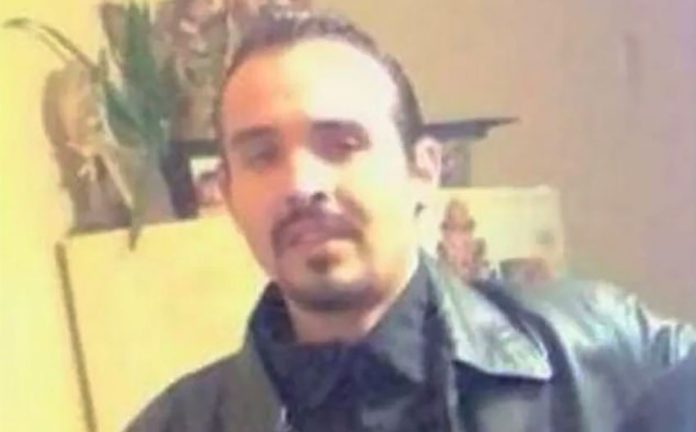
The death of Giovanni López while in custody has triggered several protests.

A 30-year-old man who was arrested in Jalisco last month for not wearing a face mask was beaten to death by municipal police officers, says his brother.

Christian López told the news website Latinus that his brother Giovanni López, a construction worker, was arrested in the municipality of Ixtlahuacán de los Membrillos on May 4 for not wearing a face mask amid the coronavirus pandemic.

“The policemen came to carry out a raid to arrest people who did not have face masks. We were going to dinner and they came and assaulted us,” he said.

“My brother was grabbed by like 10 policemen, myself as well, but I managed to get away and he was being beaten, tortured, choked there. At that moment I started recording,” López said.

López said that he later went to the local police station to ask about his brother but was only told that he was in hospital.

Por no usar cubrebocas, policía detiene a joven y lo regresan muerto en Jalisco.
Police arrest Giovanni López in Ixtlahuacán, Jalisco.


Giovanni López died the next day from a traumatic brain injury, according to his death certificate. He had also been shot in the foot, the newspaper Reforma reported.

Ixtlahuacán Mayor Eduardo Cervantes Aguilar said that an investigation is underway to determine what happened.

“We’re carrying out the necessary steps to shed light on this regrettable incident, [my] government always has and will continue to be a fair one,” he said.

Christian López claimed that through a third party the mayor offered his family 200,000 pesos (US $9,125) not to publish the video he recorded of the police aggression, which has since circulated on social media and news websites.

He also said that Cervantes threatened to kill members of his family should the video come to light. The mayor has rejected the claims.

“At no time did I offer 200,000 pesos or any amount in exchange for the silence of the family members, nor did I threaten them. On the contrary, from the beginning and until today I have instructed my municipal agencies to provide all the information to the state Attorney General’s Office,” he said.

“In my municipal government we do not tolerate police brutality, abuse of authority, and much less serious violations of human rights, such as deprivation of life,” Cervantes said.

Speaking on Thursday, Jalisco Governor Enrique Alfaro described the man’s death as an “atrocity” and said that a state government investigation is underway.

Alfaro said his government will apply the “full weight of the law” to whoever is responsible for Giovanni López’s death.

“What happened in Ixtlahuacán de los Membrillos is an atrocity, a product of the actions of municipal authorities. It has to be clarified that there was no participation of state police,” he said.

Meanwhile, the alleged murder of African American man George Floyd by a police officer in Minneapolis, Minnesota, last week, and the widespread protests it triggered, has placed renewed focus on another incident of police brutality in Mexico that resulted in a death.

In Tijuana, Baja California, a homeless man died on March 27 after two police officers arrested him at a gas station. A video of the incident shows one officer holding the handcuffed man down by stepping on his neck while the other placed his knee on his back until he stopped breathing.

The deceased man, Oliver López, had been throwing rocks at people at the gas station, according to a police statement. Baja California Governor Jaime Bonilla said on Twitter on Tuesday that there will be no impunity in the case.

The two officers have been stood down while an investigation takes place.

Police in San Pedro Garza García, Nuevo León, are also alleged to have acted aggressively toward citizens. Residents of the San Pedro 400 neighborhood were allegedly beaten by police after they were called out to a street brawl early Sunday morning.

The police aggression, like the two other incidents, was captured on video. A complaint against the police has been filed with the Nuevo León Attorney General’s Office.

Source: Reforma (sp), Milenio (sp), Latinus (sp), Daily Mail (en) 

Puerto Vallarta prepares marketing campaign to recover lost tourism

0
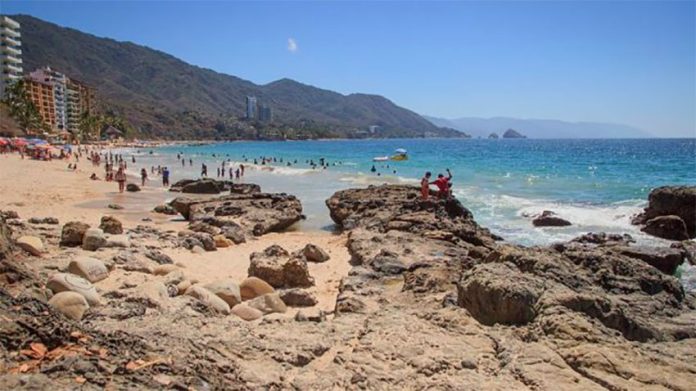
Puerto Vallarta seeks to bring back the tourists.

Puerto Vallarta, the premier tourist destination in Jalisco, is preparing a marketing campaign aimed at getting visitor numbers back to pre-pandemic levels by the end of the year.

The campaign will target potential tourists in the United States – the main source country for visitors to the Pacific coast resort city – Canada and Mexico’s largest cities.

The Jalisco government will contribute 100 million pesos (US $4.6 million) to the efforts to revive tourism in Vallarta, located on Banderas Bay just south of the Nayarit border.

Jalisco Tourism Minister Germán Ralis told the news website Forbes México that authorities are hopeful that tourists will start returning to the city over the summer.

However, the marketing campaign will try to attract visitors to Vallarta in the fall and winter months, he said.

Ralis said the campaign will primarily target potential tourists who live in cities where it takes no more than four flying hours to get to Vallarta given that there is unlikely to be much appetite for long-haul trips while Covid-19 remains a threat.

He said that Puerto Vallarta, “our star destination,” and other tourism hubs in Jalisco – among which are state capital Guadalajara and the town of Tequila – will be especially competitive in the United States market.

Ralis also said that Jalisco has signed an agreement with Zacatecas, Querétaro, San Luis Potosí, Guanajuato and Aguascalientes to encourage residents to take short interstate trips.

The tourism minister said that some Jalisco hotels will offer three-nights-for-two promotions and that some restaurants will also offer special deals to create an “integrated experience” for visitors from within Mexico and abroad.

Some nonessential businesses in Jalisco that were ordered to close due to the coronavirus pandemic have begun reopening but the state’s economic restart has been surrounded by confusion.

Jalisco had recorded 2,136 Covid-19 cases as of Wednesday of which 790 are considered active. The metropolitan area of Guadalajara has recorded more than 1,000 confirmed cases while 276 people have tested positive in Puerto Vallarta, according to the federal government’s Covid-19 municipal map.

Source: Forbes México (sp) 

Foundation hands out boxes of food to Mexico City organ grinders

0
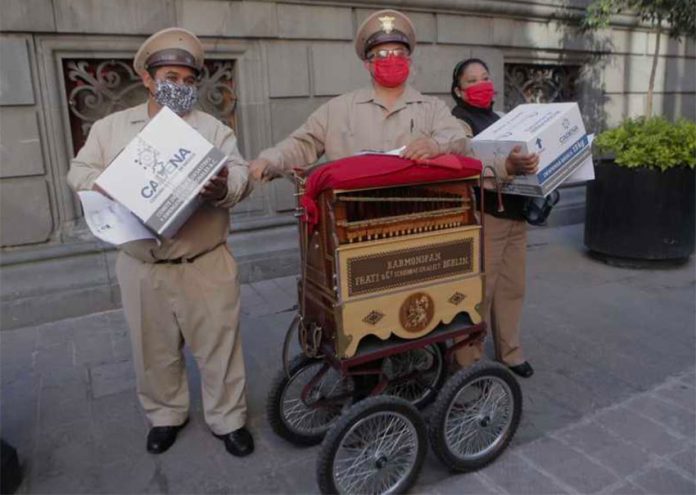
Organ grinders receive care packages in Mexico City.

About 200 Mexico City organ grinders gathered on Donceles Street today to receive food boxes containing rice, beans, tuna, oil and other items to help them get through the coronavirus crisis. 

The food was a gift from the non-profit aid association CADENA, which helps communities in more than 23 countries in times of crisis and disaster. 

Members of the organ grinders union lined up on the sidewalk wearing masks, practicing social distancing and playing music as they waited for their packages. 

One said they suffer abuse and discrimination but remarked “it’s a great job.”

Another said organ grinders are often ridiculed by younger crowds who don’t respect their craft or the traditions behind it.

“I am going to be 18 in December. I started because of the lack of work and because my father has always dedicated himself to being an organ grinder. He has left me with many wonderful experiences,” the young woman said.

“If you don’t like it, don’t mistreat us, ignore us, it’s our way to earn a livelihood.”

Organ grinders emigrated to Mexico from Europe in the late 1800s and are commonplace on the streets of the nation’s capital where they work for around US $10 a day, although even that has been hard to come by during the coronavirus pandemic. 

Since stay-at-home measures were enforced, many organ grinders have abandoned the street corners they usually stake out to travel to neighborhoods where they play for audiences confined to the balconies of apartment buildings.

Source: Milenio (sp)

Tropical Storm Cristóbal dumps heavy rains in six states

0
Flooding in Campeche has forced 138 people to flee their homes.

Tropical Storm Cristóbal has battered six states in Mexico, causing heavy rains, flooding, evacuations, landslides and damage to homes and highways in Yucatán, Quintana Roo, Veracruz, Chiapas and Tabasco before moving into Campeche where it was hugging the coast of the Gulf of Mexico on Thursday. 

Nine thousand soldiers and National Guard members have been dispatched to affected areas and those still in the storm’s path.

Cristóbal’s sustained winds dropped to 65 kph yesterday as it approached Ciudad del Carmen, and it was downgraded to a tropical depression earlier today with sustained winds of 56 kph. 

The U.S. National Hurricane Center said at 4:00 p.m. CDT on Thursday that the storm is expected to deliver extreme rainfall amounts through Saturday in Campeche, Quintana Roo and Yucatán.

Cristóbal is expected to regain strength as it moves over the warm waters of the Gulf of Mexico Friday night and heads northward where it could make landfall in the United States.

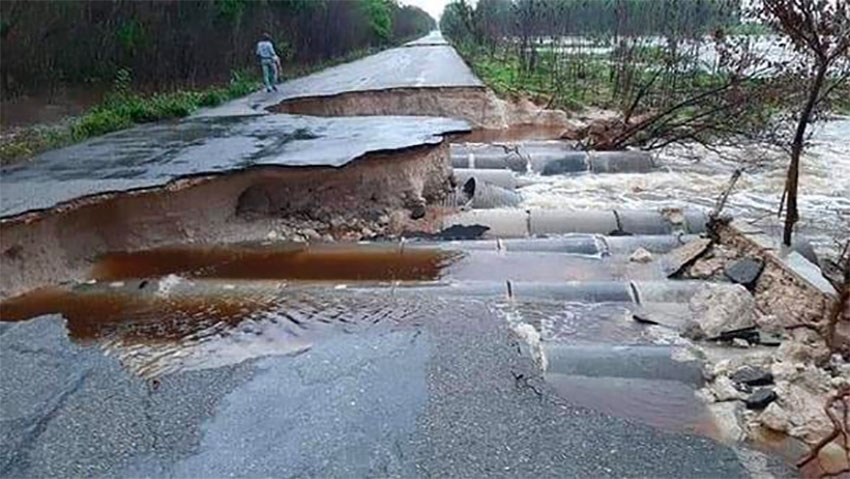
In Campeche, 139 people had to be evacuated by the army due to rising floodwaters that washed out highways and threatened residences. Two communities in the municipality of Centla, Tabasco, were also evacuated.

A highway is left impassable by Tropical Storm Cristóbal.

Yucatán officials declared a yellow alert due to the approaching storm, which could be raised to red by Friday. 

Mass evacuations could be carried out in Celestún, Maxcanú, Hunucmá, Opichén, Kinchil, Samahil, Santa Elena, Chocholá, Tekax, Kopomá, Muna, Oxkutzcab, Sacalum and Tzucacab if conditions worsen. Five thousand hectares of soybeans, squash, chiles and other crops have been lost to the flooding in Yucatán, where some areas have received up to 360 mm of rain since Sunday. 

In Quintana Roo, the Chetumal-Escárcega highway was closed due to flooding, with water levels reaching 80 centimeters, leaving the southern part of the state cut off. 

At least 12 municipalities in Veracruz were put on yellow alert due to strong winds and torrential rain. 

In Chiapas, Chicoasén, Bochil, Copainalá, Tecpatán, Ixtapa and Unión Juárez have all seen landslides and wash-outs due to the storm.

National Civil Protection coordinator David León said one person in Chiapas was killed by a falling tree.

Cristóbal was born on June 2 from the remnants of Pacific Tropical Storm Amanda, which battered Central America leaving at least 22 dead in El Salvador and Guatemala, and marks the earliest named storm in the Atlantic ever. The previous record was set in 2016 when Tropical Storm Colin formed on June 5.

Source: Milenio (sp), El Universal (sp), Accuweather (sp)