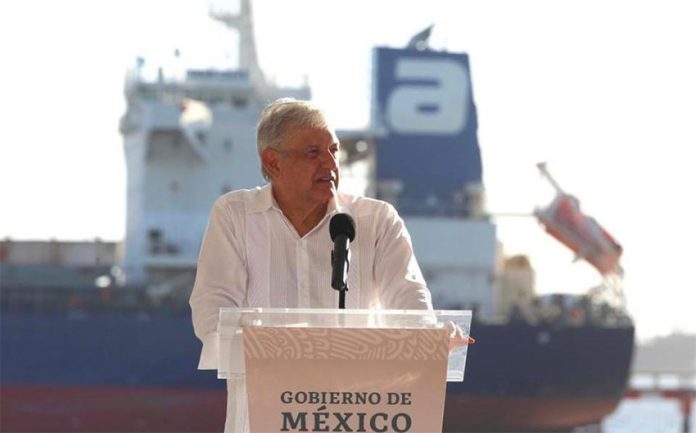
President López Obrador speaks Friday in Coatzacoalcos.
President López Obrador is hopeful that an infrastructure project in the Isthmus of Tehuantepec to connect the ports of Salina Cruz, Oaxaca, in the Pacific and Coatzacoalcos, Veracruz, on the Gulf of Mexico will become “a curtain” to stop the migration of Mexicans to the United States.
López Obrador made the comment on Friday as he toured one of the project’s construction sites in Coatzacoalcos.
The ambitious project involves the construction of a modern railway, highway upgrades, telecommunications infrastructure, expansion of both ports and the development of 10 industrial parks in the region.
Some 300 kilometers of track will be laid and modernized to accommodate an electric train that will transport both cargo and passengers.
Improvements to the Coatzacoalcos port alone involve building 130 meters of piers, construction of a rail yard and highway access among other improvements that will cost 854 million pesos, nearly US $40 million.
The president likened the rail corridor to a rail-based Panama Canal to transport goods from Asian countries to the east coast of the United States.
Fiscal incentives such as tax breaks businesses located along Mexico’s northern border receive and a reduction in the price of electricity and gasoline will be offered to entice companies to set up along the Isthmus corridor.
The isthmus project is designed to help develop the region by providing social and economic opportunities for residents as well as attracting international commerce to the area. The president is hopeful that new jobs created along the corridor will boost the economy in both Veracruz and Oaxaca and thus deter their citizens from migrating to the United States.
The total project represents an investment by the federal government of 20 billion pesos, more than US $927 million.
Friday, however, was a different story, when the tone of a second, separate protest took a violent turn and degenerated into a riot involving injuries, property damage and the deployment of some 500 police officers clad in riot gear.
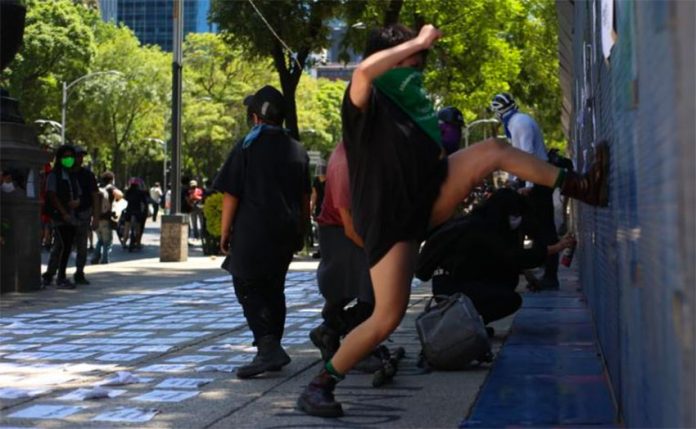
A Facebook live video posted midday Friday showed a small group of people pasting sheets of paper with the names of 420 victims of police brutality in the United States on the sidewalk in front of the U.S. Embassy.
Messages directed at U.S. President Donald Trump, calling him a racist and a pedophile among other things, were posted to the steel barriers that have been erected outside the embassy.
The group also posted several messages decrying the death of Giovanni López, who died after being arrested by police in Jalisco on May 4, apparently for not wearing a face mask.
Causan destrozos en Reforma y Polanco
As the afternoon progressed, the initial group of about 15 was joined by others wearing hoods and armed with Molotov cocktails, sticks, metal tubes and rocks.
They began banging on the embassy’s protective barrier and were soon joined by a larger group of people — described as anarchists by Mexico City police — as the violence escalated. The crowd hurled rocks, firecrackers and paint in the direction of the embassy until riot police were called out to disperse the crowd with what appeared to be tear gas.
From there, things spiraled out of control.
The group, now numbering around 100, left the embassy and headed toward Casa Jalisco, that state’s headquarters in Mexico City, shattering windows and vandalizing homes along the route, their focus now firmly on the death of López.
The protesters, many wearing helmets, carried anarchist flags and a large banner emblazoned with “Antifa,” for anti-fascist.
They were met by some 500 riot police as the protesters threw Molotov cocktails, tree branches and other potentially lethal projectiles in the direction of Casa Jalisco, shouting “Murderers!” as they clashed with police.
Six hours after the protest began, authorities managed to disperse the crowd.
More than 50 businesses and 60 apartment buildings along Paseo de la Reforma, Mariano Escobedo and Campos Elíseos were damaged.
Four journalists and six police officers reported injuries, and a 16-year-old girl was allegedly beaten by police.
Mayor Claudia Sheinbaum acknowledged that some officers acted inappropriately during the protest and strongly condemned any act of police brutality.
“I gave a clear and precise instruction to avoid provocation,” she stated on social media and specified that her orders were not fully obeyed.
“For my government, this is unacceptable. For this reason, I am requesting the Attorney General’s Office and the Mexico City Human Rights Commission to open an investigation, identify and punish those responsible, as well as their chain of command, regardless of rank,” she said.
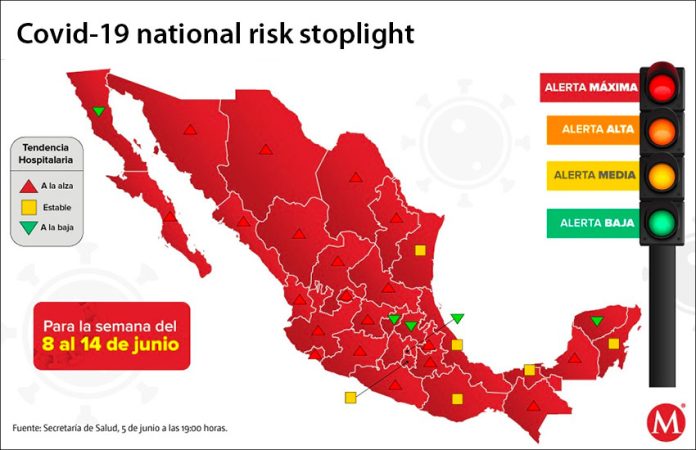
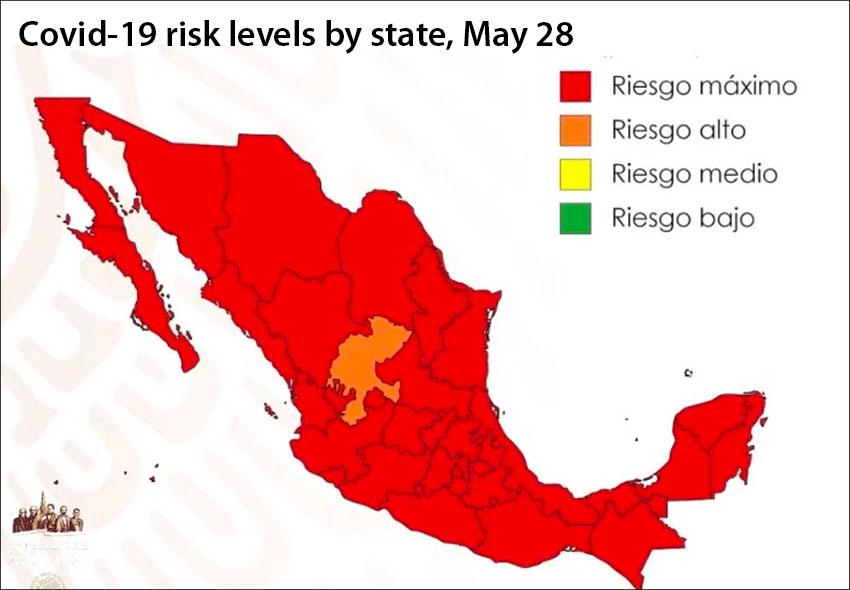
The Ministry of Health 'stoplight' map indicates high risk for the entire country.
All of Mexico has been painted red on the federal government’s updated “stoplight” map but state authorities have the freedom to decide which coronavirus restrictions can be eased, health officials said on Friday.
Health promotion chief Ricardo Cortés presented the new map, which shows that the risk of coronavirus infection has been deemed to be at the maximum level in the entire country. Every state will remain at the “red light” risk level until at least the end of next week.
A state is allocated a red stoplight even if just one of the four indicators used to determine the color is red, Cortés said.
The four indicators are case number trends (whether new infections are increasing, decreasing or stable), hospital admission trends for coronavirus patients, hospital occupancy levels and positivity rates (the percentage of people tested who are confirmed to have Covid-19).
Cortés said that Zacatecas, the only state allocated an “orange light” on the stoplight map in effect this week, had switched to red because Covid-19 cases numbers and hospital admissions are on the rise.
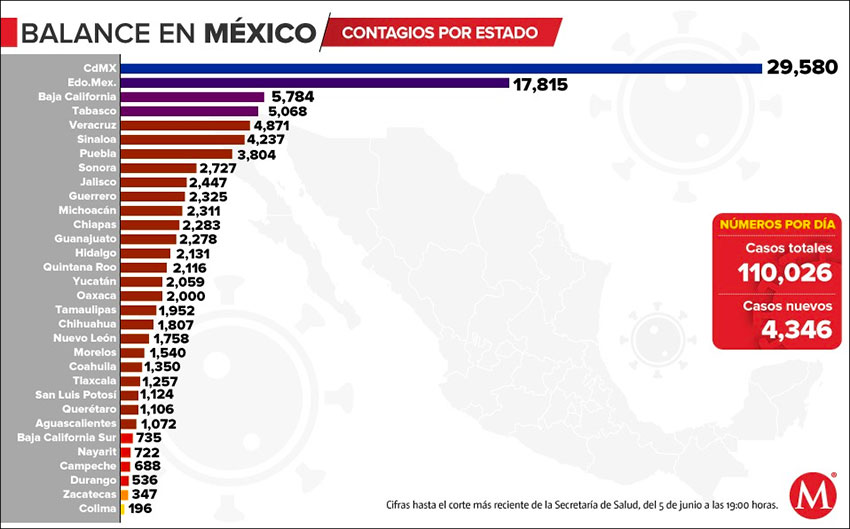
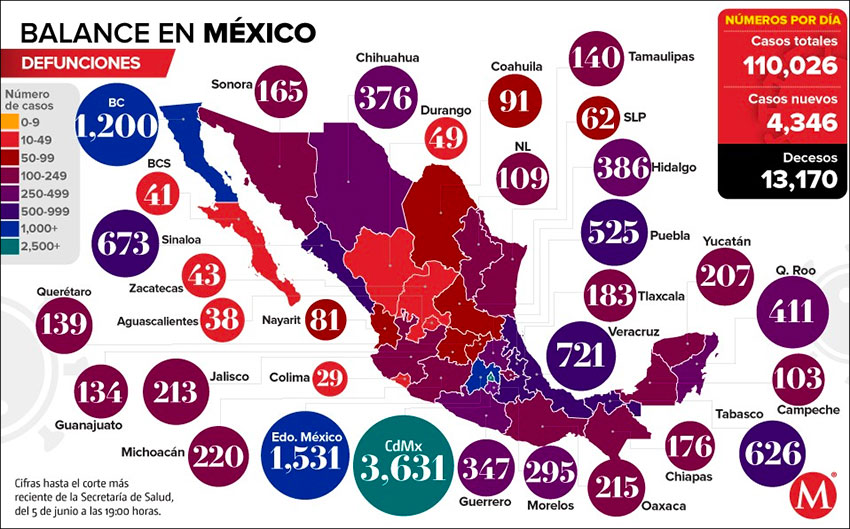
Virus cases as of Friday. milenio
He presented guidelines about which activities should be allowed at each of the four coronavirus risk levels.
At the “red light” or maximum risk level, hotels are permitted to reopen but should only accept guests who work in sectors that have been declared essential. Hotel occupancy levels shouldn’t exceed 25%.
Restaurants and cafes should be restricted to offering take-out and delivery. People wishing to have their hair cut should ask their hairdresser or barber to visit them in their homes.
Parks, plazas and other open public spaces are permitted to reopen, according to the federal guidelines, but their capacity should be limited to 25% of normal levels.
Cortés said that walking for exercise purposes is possible but people should take care to maintain a healthy distance from others. Markets and supermarkets should limit the entry of people to 50% of normal levels and one person per family, he said.
Gyms, sports centers, swimming pools, cinemas, theaters, museums, shopping centers, bars, nightclubs, amusement parks and places of worship should remain closed during the red light phase of what the government is calling “the new normal.”
Covid-19 deaths as reported by the Ministry of Health on Friday. milenio
Events attended by large numbers of people should not be allowed during both the red and orange light phases.
Cortés stressed that people should continue to stay at home as much as possible while the risk of coronavirus infection remains at the maximum level.
Deputy Health Minister Hugo López-Gatell, Mexico’s coronavirus point man, described the federal guidelines as examples of what states should do.
However, the health authorities of each state and Mexico City have the power to decide which economic and everyday activities can resume, he said.
The move will allow the reactivation of nonessential activities such as manufacturing, real estate services and professional services. Hotels and restaurants and retailers will be allowed to open, but with certain restrictions.
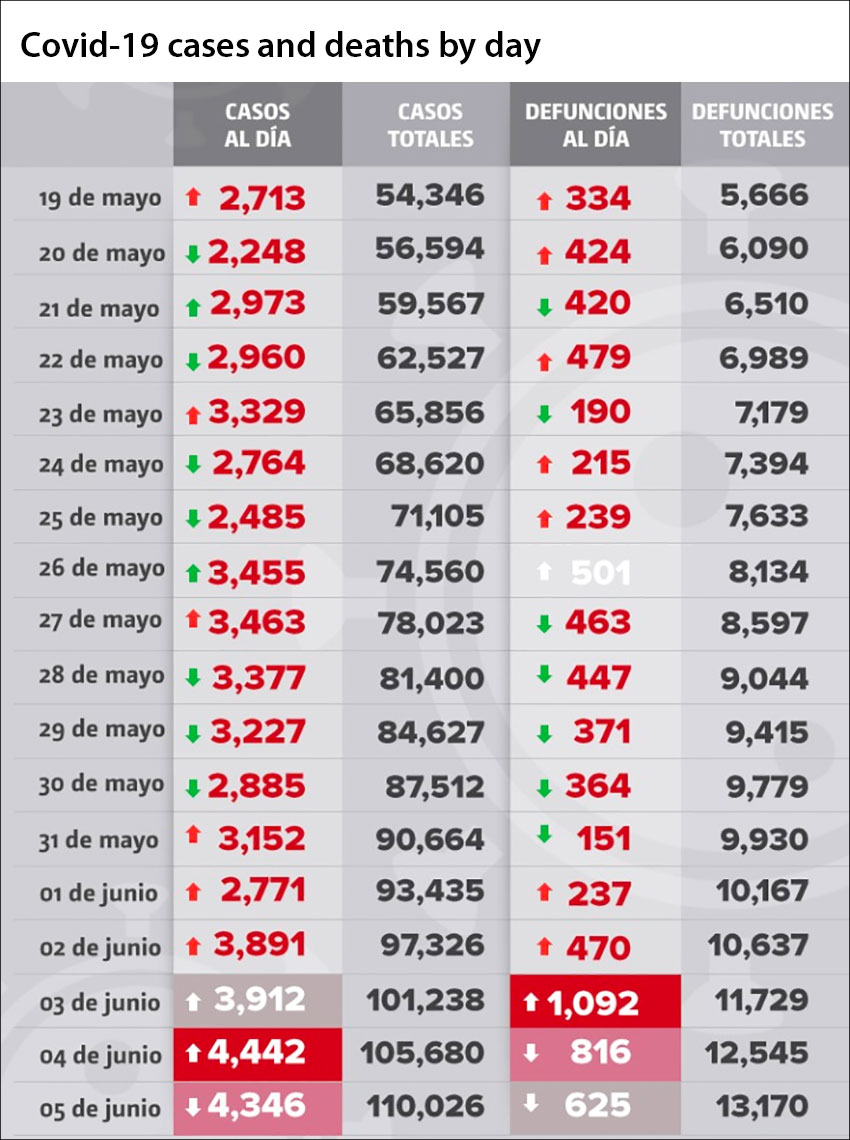
The current tally of cases and deaths, as reported each day since May 19. milenio
Earlier in Friday night’s coronavirus press briefing, Director of Epidemiology José Luis Alomía reported that Mexico’s coronavirus case tally had increased to 110,026 and that the death toll had risen to 13,170.
The Health Ministry registered 4,346 additional cases on Friday, the second highest single-day increase, and 625 Covid-19 deaths, the third highest spike since the start of the pandemic.
Alomía said that 19,015 of the confirmed cases are considered active, an increase of 638 compared to Thursday. He also said that there are 48,822 suspected cases across the country and that 324,897 people have now been tested.
Mexico City remains the country’s coronavirus epicenter, with the highest number of accumulated cases, active cases and deaths.
The capital has now recorded 3,631 coronavirus-related fatalities, according to the official count, a figure that accounts for 27.5% of all Covid-19 fatalities in Mexico.
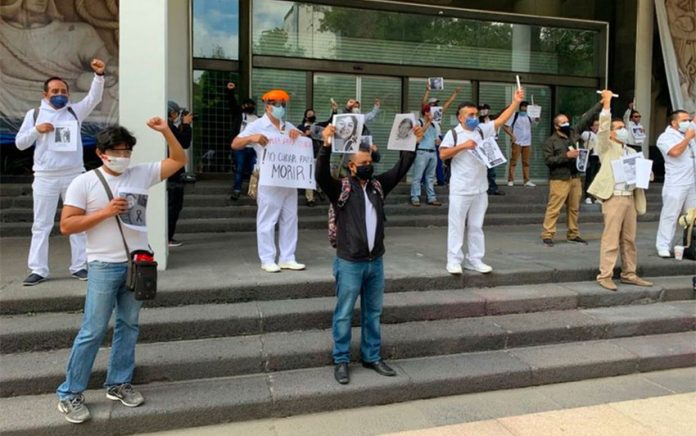
Friday's protest by IMSS health workers in Mexico City.
The public health system is woefully unprepared to deal with the coronavirus pandemic, says the bureau chief of Bloomberg News in Mexico.
In an article published on Friday, Nacha Cattan, originally of New York, writes that in the 15 years she has lived in Mexico she has “witnessed first hand what a truly crumbling public health care system looks like” and “it’s terrifying.”
Public hospitals in Mexico have a shortage of basic equipment, medication and personnel and some don’t even have soap, Cattan said.
She recounted the harrowing public hospital experiences of her husband’s grandmother and cousin, both of whom died.
Cattan wrote that “long before the coronavirus raced around the globe,” her husband’s 84-year-old grandmother spent a month in intensive care in a Mexico City public hospital after her lungs filled with water.
She acknowledged that she may have died even if she had received proper treatment but noted that “there was nothing proper about” the care she did receive.
Cattan said that her husband’s grandmother, Nina, was intubated but drifted in and out of consciousness because, as a nurse admitted, the hospital didn’t have enough medications to keep her sedated.
She wrote that Nina periodically experienced “violent spasms” because she wasn’t properly sedated while hooked up to a ventilator. When she needed a tracheotomy, the family had to track down and buy a tube at a medical supply store themselves, Cattan said.
She also wrote that when the hospital’s electricity went off one day, doctors gave Nina’s daughter a hand pump so that she could manually respirate her mother.
Whereas nightmare medical stories are the exception rather than the norm in the United States and Europe, improper and substandard medical treatment is commonplace in Mexico, Cattan said.
“I know there are plenty of medical horror stories in the U.S. and Europe. But – at least in pre-Covid times – such tales have elicited gasps and outrage because they were the outliers in systems that more or less functioned as they should. Here, in Mexico, the stories that cause eyes to pop are the ones where nothing goes wrong,” she wrote.
“In the current crisis, mistaken diagnoses and pure neglect are reaching new heights.”
Cattan also cited the experience of her husband’s cousin, Salvador, a diabetic who fainted while returning to Mexico on a flight from the United States.
She said that Salvador needed hemodialysis to filter waste from his blood but the public hospital to which he was taken upon arrival in Mexico didn’t have the required equipment.
“For three days, we tried to transfer him to a facility that did. The red tape was debilitating. When he was finally moved, he died less than two hours later,” Cattan wrote.
Her article noted that there are just 1.4 hospital beds per 1,000 people in Mexico, the lowest rate among OECD countries, and that the government spent only 5.5% of GDP on health in 2017, the most recent year for which World Bank data is available.
Guatemala, El Salvador and Haiti – the poorest country in the western hemisphere – all spent a higher percentage of GDP on health in the same year.
Amid the coronavirus crisis, the lack of investment in the public health system has come into sharp focus as medical personnel protest because of a shortage of basic yet essential equipment such as masks and gloves.
More than 20,000 health workers have been infected with the coronavirus, according to Health Ministry data presented this week, and 10,000 more are suspected of having Covid-19. Almost 300 doctors, nurses and other medical personnel have died after testing positive.
In that context, Mexican Social Security Institute (IMSS) health workers protested on Friday morning outside IMSS headquarters in Mexico City.
Holding candles and photographs of their deceased colleagues, the workers said that there is still a shortage of personal protective equipment in IMSS hospitals.
“We want to live to take care [of patients], not take care [of patients] to die,” said one nurse, according to the newspaper Reforma.
More than 100 IMSS health workers have died due to Covid-19, the protesters said. They also said that IMSS has refused to allow some health workers to be tested for Covid-19 despite having been exposed to coronavirus patients.
The protesters said they would submit a petition to the federal Health Ministry that sets out the demands of public health workers. A national protest is being organized for July 1, they said.
Just over three months after Covid-19 was first detected in Mexico, the disease has claimed 12,545 lives in Mexico, according to official figures, but the real death toll is believed to be much higher.
More than 105,000 people are confirmed to have been infected but as testing rates are low, the real size of the pandemic is undoubtedly much bigger.
Deputy Health Minister Hugo López-Gatell, Mexico’s coronavirus czar, said Thursday that as many as 60,000 Covid-19 patients could die in a worst case scenario, while a model developed by a Massachusetts Institute of Technology-trained data scientist is currently predicting that there will be 92,497 deaths by September 1, a forecast that is down from almost 137,000 a week ago.
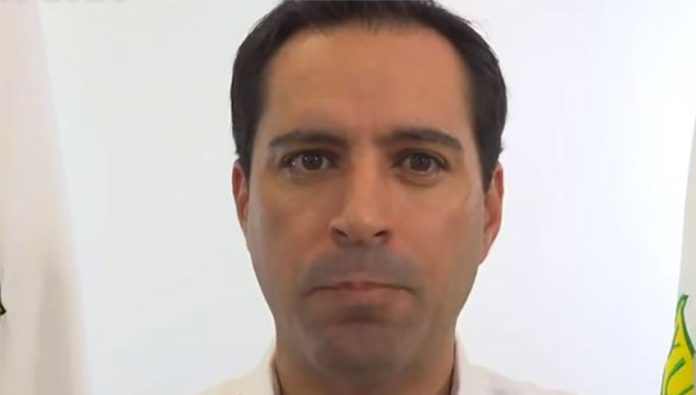
Governor Vila: decision won't be made in Mexico City.
The government of Yucatán has elected to make its own choice regarding coronavirus restrictions, declaring that it will set the state’s color in the stoplight system designed by the federal government.
That color, effective Monday, will be orange.
The move will allow the reactivation of nonessential activities such as manufacturing, real estate services and professional services. Hotels and restaurants and retailers will be allowed to open, but with certain restrictions.
Like most of the rest of the country, Yucatán was painted red last week on the federal government’s stoplight map. But the state and many others disagreed.
“We have decided that decisions about Yucatán will not be made in Mexico City,” that Yucatán experts will make them instead, Governor Mauricio Vila said, announcing the initiation of “the first wave of the new economic reactivation.”
López Obrador, left, and Calderón: the latter had to face swine flu fallout. Will the same fate befall the current president?
The federal government could pay an electoral cost at the 2021 midterm elections if the perception that it has mismanaged the coronavirus crisis grows, some pollsters say.
Since the poll was conducted, Mexico’s Covid-19 death toll has almost doubled from 6,510 on May 21 to 12,545 yesterday.
In a virtual forum organized by El Financiero, the newspaper’s chief pollster Alejandro Moreno suggested that President López Obrador and his administration could suffer the same fate as ex-president Felipe Calderón and his government suffered at the 2009 midterm elections when the swine flu epidemic was in full swing.
“In 2008, in June as well, President Calderón had an approval rating of 64%, four points higher than López Obrador’s rating today. His National Action Party [PAN] had 38% effective voting intention at that time. Today [Lopez Obrador’s] Morena has 37%. Then the epidemic came in 2009, the economic crisis came and the PAN fell 10 points at the elections. Will the same thing happen [with Morena]? I don’t know. I’m just putting the data out there for reflection,” he said.
The Institutional Revolutionary Party (PRI) attracted 37% of the vote at the midterm elections in 2009 compared to the PAN’s 28%. Three years later, the PRI’s Enrique Peña Nieto triumphed at the 2012 presidential election, winning 38% of votes to López Obrador’s 33%.
Morenos said that if dissatisfaction grows with the current government’s management of the health and economic crisis, “we can expect certain political costs both for the president and his party.”
The chief pollster of the media company Grupo Reforma said that polls show that more than 50% of Mexicans believe that the federal government hasn’t done enough to support vulnerable citizens and small businesses financially amid the economic crisis.
“If they’re already observing this lack of action on the part of the federal government, … sooner or later there will be a price to pay for this inaction,” Lorena Becerra said.
For his part, the director of polling firm Buendía y Laredo predicted that the coronavirus-induced economic crisis will have a significant impact on López Obrador’s approval rating.
As a result, there will be an opportunity for opposition parties to take advantage of his reduced popularity at the 2021 elections, Jorge Buendía said.
However, protest votes against the government for its management of the pandemic and associated economic crisis could be split between the PAN, the PRI and Citizens’ Movement party, he added.
“If that happens, … it won’t be so damaging for Morena … at the midterm elections,” Buendía said.
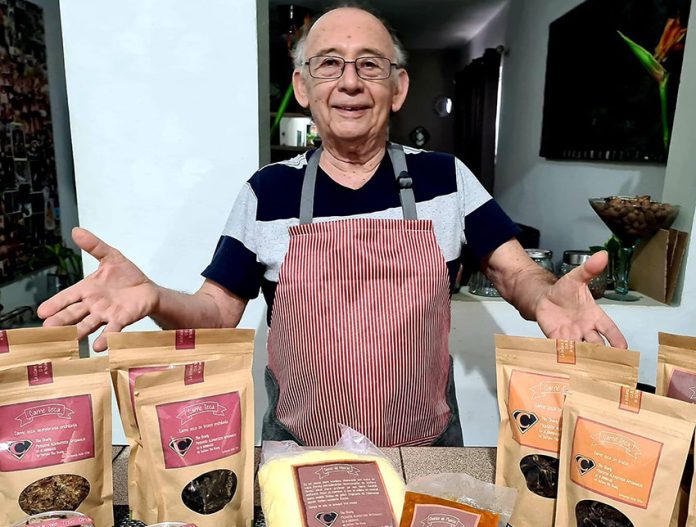
At almost 80 years old, Carlos “Tito Charly” Elizondo has gone from bagging groceries at a Monterrey supermarket to newfound fame as a YouTube cooking star and online salesman.
The spry senior offers up recipes for his more than 3,000 subscribers using ingredients such as cream cheese, chorizo, bacon and shrimp which he markets through his videos, taking orders via WhatsApp.
His most recent video, posted on June 1, shows viewers how to make snacks in celebration of beer’s return to store shelves, he says.
A father of three and grandfather of six, Elizondo lost his wife and then his daughters married and moved out. As he reached his early 70s he decided he needed to keep busy.
At the suggestion of a friend, he took a job as a grocery bagger at a nearby supermarket chain seven years ago where he worked a four-hour shift, but that ended due to the coronavirus pandemic. And once he hits 80 he will have to retire.
Receta de hoy "Botanas a la Tito Charly"
Tito Charly shares some recipes for snacks to go with beer.
So he decided it was time to start a new career online, which he has done with the assistance of family members. “My wife was a very good cook, my father-in-law as well. I learned more crazy ideas from them than I can think of,” Elizondo says of his culinary creations.
He sells the ingredients under his own brand, with his daughter filming the YouTube segments, helping him take and fill orders and aiding with technological challenges facing the octogenarian. Tito Charly products are sold in Monterrey, Saltillo, San Luis Potosí, Chihuahua, Torreón and Guanajuato. Orders are taken by WhatsApp at 811 102 6685.
Tito Charly posts a new cooking class each Sunday and says he hopes to reach 10,000 followers soon. “I have always been positive. I like to look ahead,” the newly-minted YouTube star says. “There are no impossibilities, there is always a way.”
Thursday's protest at the US Embassy in Mexico City.
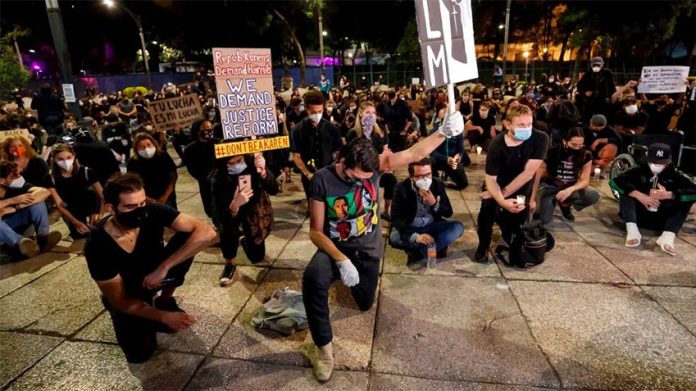
About 300 people participated in a peaceful protest against police violence and racism in the United States Thursday night at a candlelight vigil in front of the U.S. Embassy in Mexico City.
Dressed in black, wearing masks and holding candles, the assembled crowd of mostly young people paid tribute to George Floyd, the African-American man who was killed on May 25 in Minneapolis, Minnesota, allegedly by a police officer.
U.S. citizens, Mexicans and other foreigners expressed their solidarity with the Black Lives Matter movement and added their voices to protests that have occurred in all 50 U.S. states and in major cities around the world.
“We are here to remember the black lives that have been killed by the police in the United States where racism is an integral part of its systems and institutions,” said one of those attending the vigil.
“Your fight is my fight #BlackLivesMatter,” “Racism kills. I can’t breathe” and “Justice for George Floyd” read some of the signs hoisted by the crowd.
Participants constructed an altar decorated with candles honoring Floyd on one of the concrete benches outside the embassy. Using chalk they drew a portrait of Floyd and affixed a banner to the bench reading, “I can’t breathe,” Floyd’s last words as he lay in the street dying.
“I am fed up, and we are fed up with 500 years of oppression, violence and invisibility against us, we are fed up with the systematic murders of people,” said Ebony Bailey, an African American filmmaker from California who is studying in Mexico.
The issue of racial equality in Mexico also came up. At least one protester carried a sign reading “Justice for Giovanni” in reference to Giovanni López, who died after being arrested by police in Jalisco on May 4, apparently for not wearing a face mask.
“Just like our oppressions, our struggles are also linked. The anti-racist struggle in the United States is the same as that of Mexico and other parts of the world, the struggle of indigenous peoples is the same as that of blacks,” Bailey added.
Near the end of the vigil, the crowd took a knee in remembrance of Floyd for eight minutes and 46 seconds, the length of time a Minneapolis police officer knelt on Floyd’s neck until he was dead, despite the man’s protests that he could not breathe. They also read aloud the names of scores of black American victims of police brutality
The vigil occurred the same day as an emotional memorial service was held for Floyd in Minneapolis while the United States reels from a wave of violent protests and civil unrest.
A red light means restrictive measures remain in place.
Governors have not yet reached an agreement with federal authorities about the criteria for making changes to the stoplight colors allocated to each state to determine which coronavirus restrictions can be lifted.
Every state except Zacatecas was allocated a “red light” on the stoplight system last Friday. As a result, few if any changes were made to the restrictions implemented during the national social distancing initiative, although the construction, mining and automotive sectors were given the green light to resume their activities because they are now classified as essential.
The federal government was scheduled to update the stoplight map on Friday with the corresponding restrictions to take effect in each state starting Monday.
The government has said that four factors are taken into account to determine the risk level and corresponding stoplight color for each state: case number trends (whether new infections are increasing, decreasing or stable), hospital admission trends for coronavirus patients, hospital occupancy levels and positivity rates (the percentage of people tested who are confirmed to have Covid-19).
According to a report today by the newspaper La Jornada, some governors believe that their states should not have been allocated a red light.
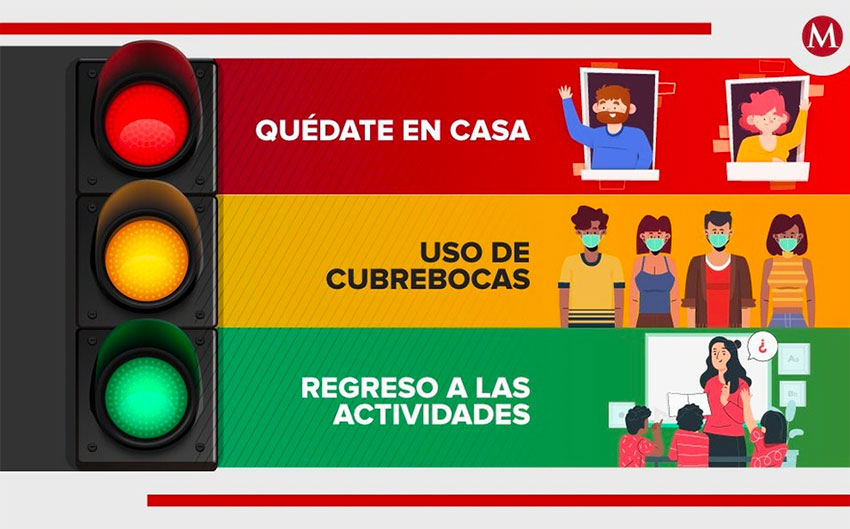
The stoplight system: in simple terms, red indicates stay at home, orange to use face masks and green back to (the new) normal.
Given that the coronavirus pandemic has not affected Mexico uniformly, it does appear odd that the risk of infection was deemed to be at the maximum level in 31 of the 32 federal entities.
Colima, for example, currently has just 43 active Covid-19 cases but shares the “red light” rating with Mexico City, the country’s coronavirus epicenter, which has almost 4,000 active cases. Only 8% of hospital beds with ventilators are currently occupied in Guanajuato but it has the same maximum level risk rating as Baja California, where 66% of such beds are in use.
Despite the discrepancies, a group of governors is in favor of each state’s stoplight risk rating remaining unchanged for next week, La Jornada said. If they get their way, the vast majority of Mexico will continue to be a sea of red on the stoplight map, with Zacatecas appearing as a conspicuous island of orange.
Other governors argue that the infection risk in their states is below the maximum level and therefore restrictions on economic and everyday activities should be eased.
The governor of Quintana Roo, where the tourism sector is preparing to reopen on Monday, said that reactivating the state’s economy won’t imply “dropping its guard” in the fight against coronavirus.
The first stoplight map, issued last week: a sea of red.
Four states where the red light is certain to remain in place next week are México state, Morelos, Puebla and Hidalgo.
Mexico City Mayor Claudia Sheinbaum said that authorities in those states have agreed to share the same risk rating as the capital because of their interconnectedness in terms of the movement of people and goods.
She said Friday that a red light will apply in Mexico City all of next week because hospital occupancy levels are still above 65%. More than 3,400 coronavirus patients are in general care beds in the capital and just over 1,000 are in intensive care on respirators.
Querétaro and Tlaxcala were also invited to be part of the central states to be allocated a sole color but their governors declined.
“We will continue … attending to the reality of our state during the evolution of the Covid-19 crisis,” said Querétaro Governor Francisco Domínguez.
His counterpart in Tlaxacala, Marco Antonio Mena Rodríguez, rejected the single stoplight proposal, asserting that each state in central Mexico is going through a different phase of the pandemic and that the capacity of the healthcare system in each one is not the same.
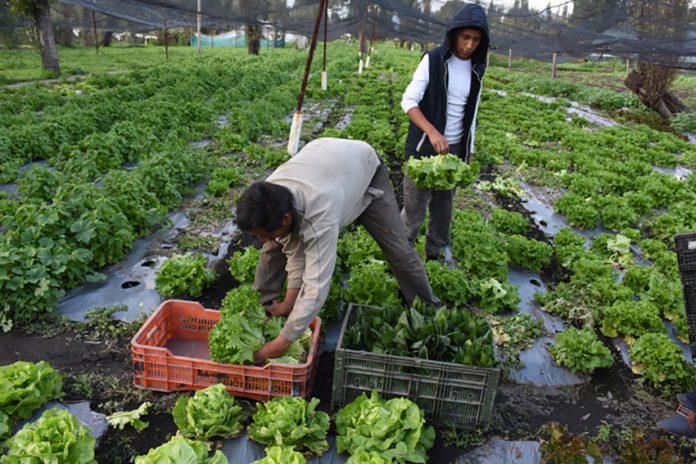
Erick Serralde and his son work their land in Xochimilco.
Walking into the chinampería, San Gregorio Atlapulco’s ancient agricultural area, is like walking into another world.
One minute you’re in the city with its traffic and noise — San Gregorio is part of Xochimilco, a borough of Mexico City — and then, crossing its main street, you walk a short distance and you’re in the middle of farmland. Rows of lettuce, radishes, spinach, cilantro, parsley and other vegetables and herbs seem to stretch on forever.
The chinampería consists of rectangular man-made islands, called chinampas, built in the shallow lakes of the Mexico basin. The area is often referred to as Mexico’s floating gardens but the chinampas don’t float, they’re firmly anchored to the lake’s bottom. They’re constructed by first sinking branches from the huejote tree (a species of willow that’s considered sacred) into the lake bottom, forming rectangles that are typically 10 x 100 feet, which are then filled in with mud and vegetation.
There’s archaeological evidence that the earliest chinampas were built between 5,000 and 6,000 years ago. The ones that are still farmed in San Gregorio are probably between 1,200 and 2,000 years old and were built by the Xochimilcas (who are also known as the Aztecs).
Canals between the chinampas allow for easy access by canoes and in Xochimilco, colorful boats known as trajineras take tourists for rides. “People know Xochimilco and the trajineras,” said Paola Casas González, one of a handful of women working in the chinampería, “but they don’t know this pueblo or these chinampas that produce tonnes of food for the country. There are people living in the city who only know the trajineras.”
Margarita Vega: ‘Before the virus we sold almost everything. Now we sell almost nothing.’
Chinamperos, as people who farm the chinampería are called, use farming techniques that are as old as the chinampas themselves.
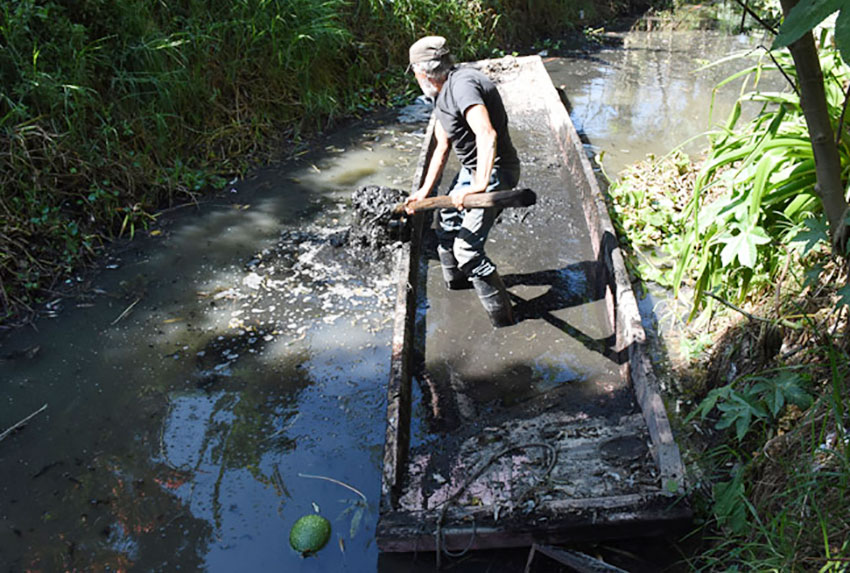
Martín Venagas Paéz stands in his canoe, using a long pole with a net at the end which he uses to dredge up mud from the bottom of a canal, dumping it into the boat’s bottom. He hauls the mud in buckets to a shallow rectangle that’s been dug in the ground and pours it in. The mud is allowed to dry for a day or two and then cut into tiny squares called chapines, into which seeds will be placed. Once the seeds sprout and the plants are big enough, they’ll be transferred to a chinampa. The land here is so fertile that it’s possible to have four or even five harvests a year.
The land that Juan Serralde and his brother Erick farm has been in their family for generations. “My great-grandfather, grandfather, and father all planted this land,” Juan said. They, like all chinamperos, work six or sometimes seven days a week. “We work every day, every day,” said Venagas Paéz, whose land is a short distance from Serralde’s. “Here there is no rest. I work, eight, 10, 12 hours a day.” He figures he earns about 150 pesos (about US $6) a day.
Given the difficult work and minimal earnings, it comes as no surprise that few young people want to work in the chinampería. Daniel López, like the Serraldes, works land his great-grandfather once did but is unsure if it will stay in his family. “Life here is hard,” he said. “My son does not want to work as a chinampero; he is studying computer technology. I will pass the land to my daughters and if they do not want it, they will sell it.”
Although the chinampería is still amazingly productive, chinamperos and their supporters are very concerned about its continued survival. Several issues are threatening it; first among them is Mexico City’s chaotic and unchecked growth.
According to Miguel Ángel Elizado, an attorney who has represented chinamperos for 18 years, the chinampería originally covered around 8,900 hectares. “Now there are only about 3,000 hectares,” he said. One day I drove with him through Xochimilco and he pointed out many streets that had once been canals.
Martín Venagas dredges mud for planting.
As Mexico City has continued to expand, taking land that had once been used to grow food, it has also taken much of the chinampería’s water to slake its residents’ thirst. Although water has been extracted from the chinampería for literally centuries, a canal built in 1905 to carry water from springs and rivers that fed the chinampería into the city center had a devastating effect, one that continues to this day.
“There is little water now,” said Erick Serralde. “In the past, the water was clean; we could swim, fish. This was 30 years ago. Now, the water is about 1.5 meters deep. Before it was five or six meters.” He pointed to a nearby canal. “This is a dead canal. Thirty years ago, it was young. We could use canals to deliver our produce. Now, we have to carry it on our backs to the loading dock.”
Although it’s illegal to build houses in the chinampería, people still do it. This mostly goes unpunished and has resulted in another problem: huge amounts of agua negra, untreated wastewater, being dumped into canals. The smell rising from them is almost overwhelming.
And if those problems weren’t enough to threaten the chinampería’s survival, chinamperos are now threatened by the coronavirus.
Many sell their produce in the Central de Abasto, a huge market in Mexico City that’s become a hot bed for the virus. A number of San Gregorio’s chinamperos and other people working in the market have been infected with Covid-19. When I asked Erick Serralde if he knew exactly how many in San Gregorio were sick, all he could say was “Many.”
The virus has also taken an economic toll on chinamperos.
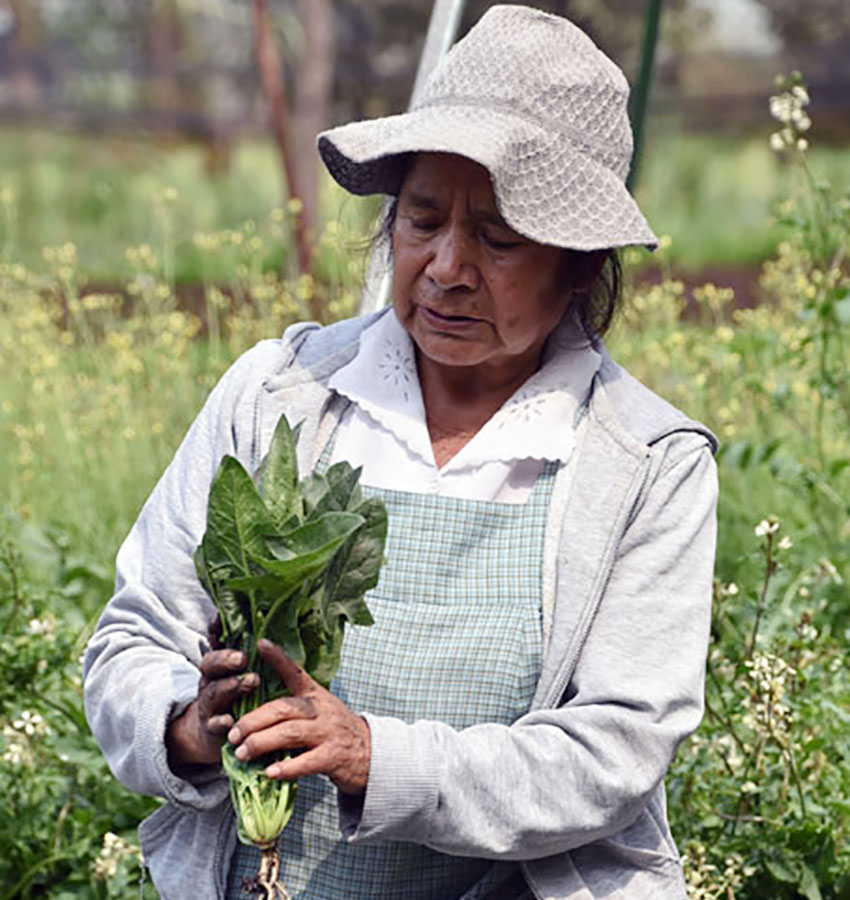
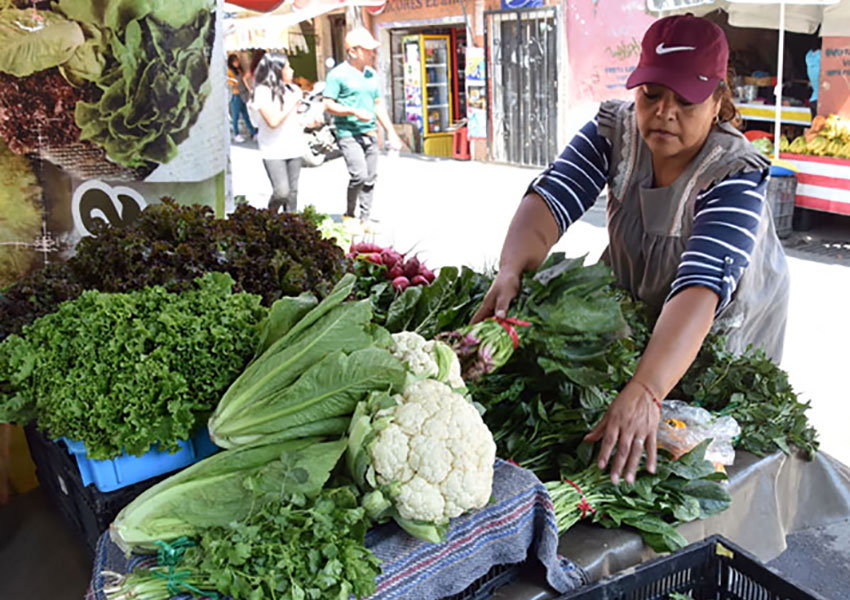
Chinampera Carmen Cruz sells her produce at the market in San Gregorio.
Margarita Vega Honorato has been working in the chinampería all her life. She pointed to a chinampa filled with row after row of lettuce that was going to seed and would have to be plowed under soon. Most of her produce was sold to restaurants in Mexico City, which have been closed for weeks.
“Before [the virus] we sold everything,” she said. “Now, we sell almost nothing.” She walks a short distance and points to another parcel of land. “We planted all this yesterday. We will see if we can sell that but, really, who knows?”
Leonel Rufino Vega, her husband, stepped forward and asked angrily, “Who will buy it? Who will buy it now?”
San Gregorio’s market is still open and although there are fewer people, stalls are still crammed with produce that was recently harvested in the chinampería. “This pueblo is dedicated to this, to selling vegetables,” said Carmen Cruz Sánchez, a chinampera. “This is how we live. Who knows how long we will survive?”
She said that she’s selling about half what she used to. “My family is surviving by buying only the basics,” she continued, “beans, rice, eggs, rarely meat.”
Mexico is now deep into phase three of the pandemic. Cases and deaths continue to rise. There’s no indication that it will end soon and it’s not clear what the government will do. “If they prohibit everything, we will still have vegetables here, we will have rice,” said Coat Rufino, Margarita’s son. “I do not know if we can sell what we have but we will keep working.”
Joseph Sorrentino is a frequent contributor to Mexico News Daily and lives in San Gregorio.