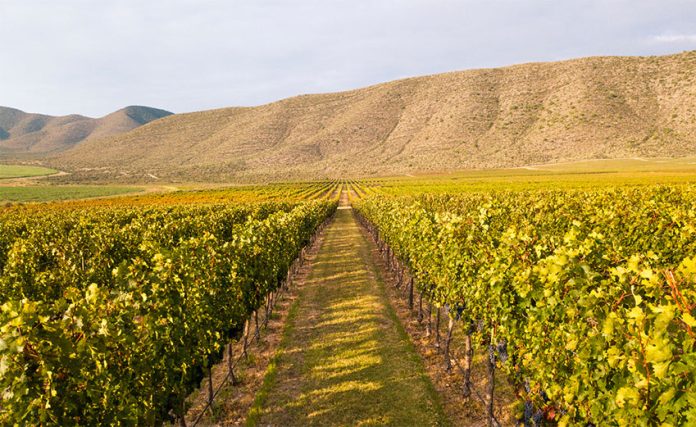
Looking for the world’s best cabernet sauvignon? You’ll find it in Coahuila, Mexico, at Vinos Don Leo in Parras de La Fuente.
This year the winery’s 2013 Cabernet Sauvignon Gran Reserva took first place at France’s International Cabernet Competition, in which French sommeliers blind-tasted wines from 25 countries.
Don Leo’s 2016 Cabernet Sauvignon/Shiraz also took home the gold this year.
“Quality is the goal and vision of our company, and right now it is being reflected with this distinction,” said Don Leo owner David Mendel.
Tasting notes by Eduardo Dingler of the Napa Valley Register, who visited Don Leo earlier this year, describe the award-winning wine as “generous, wise and intelligent showing its age in the glass but displaying a unique eloquence in the nose with layers of cigar, dried potpourri and leather with a slight touch of aged balsamic.”
He called the experience the oeneological equivalent of “playing 18 holes of golf with Sean Connery.”
The mid-sized winery was founded 20 years ago by the Mendel family, who named the vineyard after their forefather, a German Jew who together with his wife emigrated to Mexico in 1936 to escape the war.
The winery opened in 2000 with just one hectare, and has grown to 60 hectares of vineyards planted with 12 varieties of grapes, including shiraz, merlot and malbec.
Located at an elevation of 2,100 meters, making it the 11th-highest vineyard in the world, Don Leo enjoys a micro-climate offering hot days and cool nights which is ideal for growing quality grapes.
Coahuila Tourism Minister Azucena Ramos said the award further solidifies the region — where grapes were first planted in the 1500s — as the cradle of wine in Latin America and worldwide.
Currently, sales of the wine are almost entirely limited to Mexico, but that may change in the future as Don Leo continues to garner international accolades. The trophy-winning vintage goes for 983 pesos or around US $45.
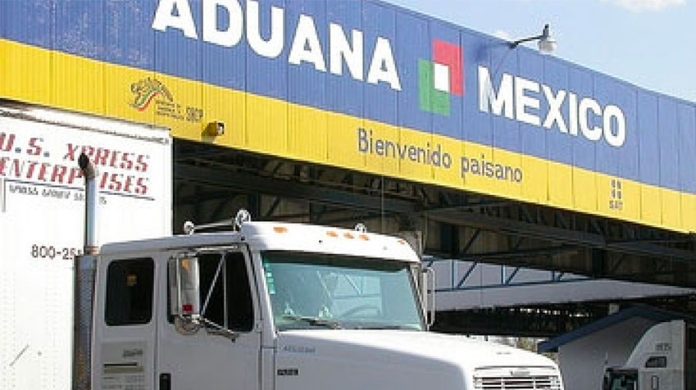
Efforts continue to eradicate corruption at Mexican customs.
The Financial Intelligence Unit (UIF) is investigating a network of Mexicali, Baja California, customs officials who are alleged to allow weapons and used vehicles to cross the country’s northern border, the newspaper Milenio reports.
At the center of their investigation is customs agent Roberto Ruiz Armas, who the UIF says granted hundreds, if not thousands, of irregular permits in exchange for money.
Complaints have been filed and agents suspected of corruption have had their bank accounts frozen due to suspicion of links to organized crime, said the head of UIF, Santiago Nieto.
Attempts to clean up corruption elsewhere have led to customs agents being fired for misconduct at the ports of Progreso, Tuxpan and Lázaro Cárdenas. Four other customs offices are also under scrutiny, Nieto said, although he declined to name them.
Last July the Federal Tax Administration agreed to the Ministry of Defense’s (Sedena) proposal to send 22 retired military personnel to manage half of the country’s customs offices, in the hopes that they would root out corruption. “The corruption problem at customs offices fosters organized crime activities such as the smuggling of arms, drugs, chemical precursors, cash and goods in general,” the proposal read.
Last year, Foreign Minister Marcelo Ebrard stated that 70% of crimes committed in Mexico are carried out with weapons brought into the country illegally from the United States.
And while illegal guns can lead to loss of life, illegally imported vehicles can lead to an important loss of revenue to both the Mexican government through taxes and importation fees, and the country’s auto industry, which claims that in the first trimester of 2019 alone 350,000 U.S. vehicles entered Mexico without the proper permits.
Often, in exchange for a bribe, corrupt customs agents will sign off on paperwork that severely undervalues a vehicle in order to lower the import tax.
Mexico’s customs chief resigned in April, less than a year after being appointed by President López Obrador to clean up corruption. Ricardo Ahued said he was leaving the post for personal reasons.
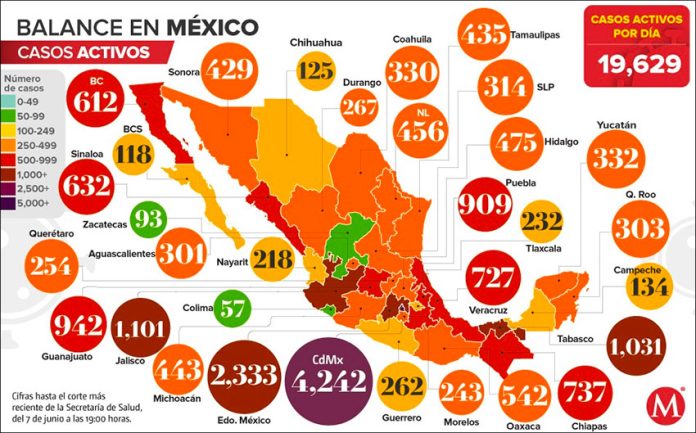
Active Covid-19 cases as of Sunday evening. milenio
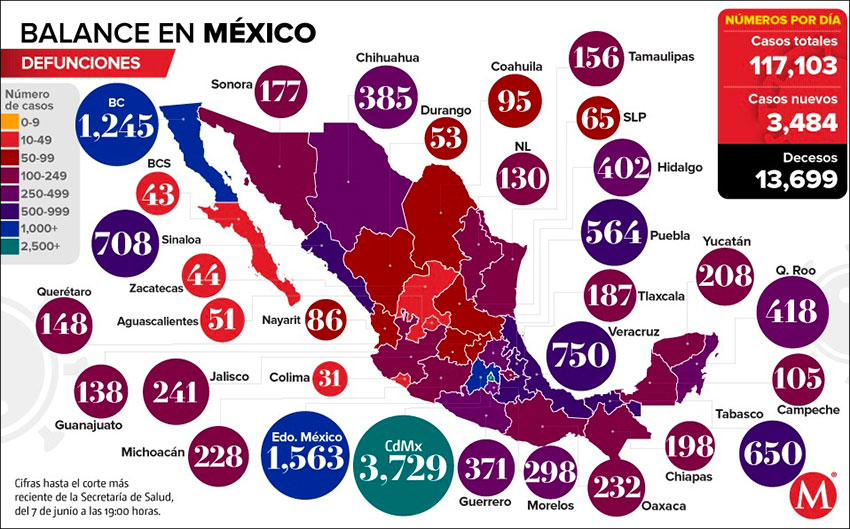
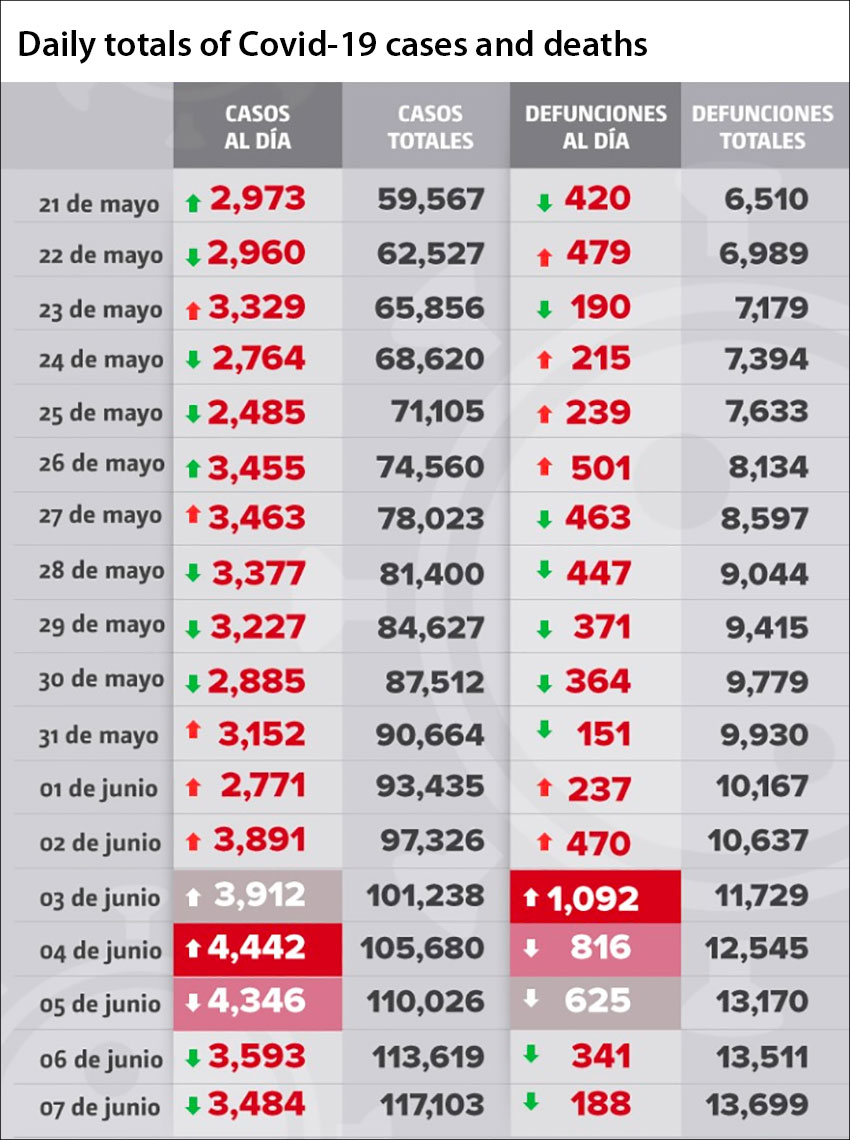
Mexico has recorded a total of 117,103 confirmed coronavirus cases and 13,699 deaths since the start of the pandemic, the federal Health Ministry reported on Sunday.
The case tally increased by 3,593 on Saturday and 3,484 on Sunday while 529 Covid-19 deaths were registered over the weekend.
The Health Ministry reported 341 deaths on Saturday and 188 on Sunday, figures much lower than those registered between Wednesday and Friday last week.
However, the number of Covid-19 deaths reported on Saturdays and Sundays in recent weeks has been significantly lower than on preceding days, indicating that there is a delay in confirming and/or reporting fatalities over the weekend.
Health Ministry Director of Epidemiology José Luis Alomía told a press conference Sunday night that 19,629 confirmed Covid-19 cases – one in six of the total – are currently active.
Covid-19 deaths reported by the Health Ministry on Sunday. milenio
He also said that there are 45,317 suspected cases across the country and that 336,395 people have been tested.
Mexico City and México state rank first and second, respectively, for coronavirus deaths, cumulative cases and active cases but there are signs that the situation is improving.
Coronavirus infections declined at the end of May in the greater Mexico City metropolitan area, which includes the 16 boroughs of the capital and 59 México state municipalities.
In the week of May 25 to 31, 4,769 new cases were registered in Mexico City, a decline of 359 cases, or 7%, compared to the preceding seven days.
A data analysis conducted by the newspaper Milenio found that new cases also declined in the last week of May in the México state municipalities that are part of the Valley of México metropolitan area, albeit by just eight cases or 0.3%.
The decrease in the number of new cases was much more pronounced in the northern border cities of Tijuana, Baja California, and Ciudad Juárez, Chihuahua.
Virus cases and deaths since May 21. Deaths are numbers reported and not necessarily those that occurred each day. milenio
New infections declined 44% in the former city from 222 in the penultimate week of May to 124 the following week, while they decreased from 194 to 109 in Juárez for a drop of the same percentage.
In contrast, Mexico’s second and third biggest cities recorded increases in case numbers in the during the same period.
New infections surged 117% in the eight municipalities of the metropolitan area of Guadalajara, Jalisco, to 579 compared to 267 the previous week.
And new cases increased 26% in the metropolitan area of Monterrey, Nuevo León, with 285 registered between May 25 and 31 compared to 226 in the preceding seven days.
Tuxtla Gutiérrez, Chiapas, recorded a 61% increase in new infections while Villahermosa, Tabasco, saw a 34% spike.
More than three months have passed since Covid-19 was first detected in Mexico and after just over two months of federally mandated social distancing, the country has now completed the first week of what the government is calling “the new normal.”
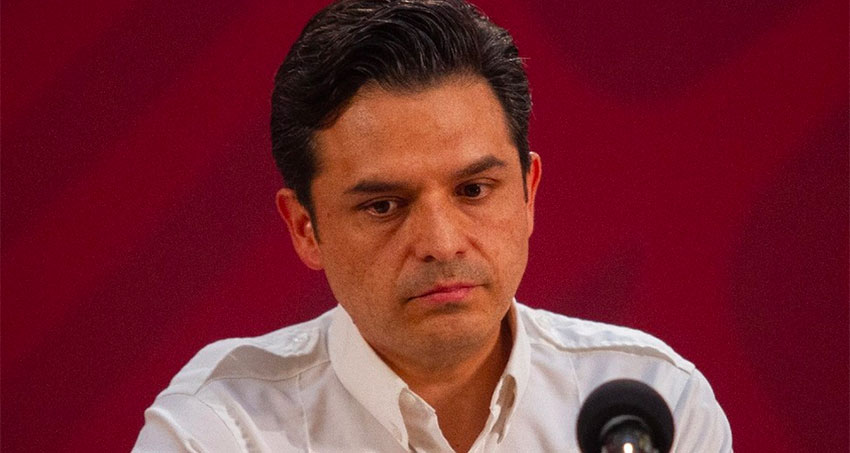
IMSS director Zoé Robedo was diagnosed with Covid-19 on Sunday.
Almost 30,000 Covid-19 cases and just under 4,000 deaths were reported in the week after the conclusion of the national social distancing initiative, figures far higher than in any other week since the beginning of the pandemic.
The Institute for Health Metrics and Evaluation at the University of Washington in Seattle predicts that the death toll will almost quadruple over the next two months. It projects that 51,912 people will have lost their lives to Covid-19 in Mexico by August 4, and that confirmed infections will reach 403,650 by the same date.
Meanwhile, the director of the Mexican Social Security Institute (IMSS), a large public health provider, said on Sunday that he had tested positive for Covid-19.
Zoé Robledo said in a Twitter post that he would continue working from home and follow the instructions of doctors.
IMSS said in a statement that Robledo developed symptoms of Covid-19 on Saturday but is nevertheless in good health.
“The people with whom he had contact were informed,” the institute said.
One of those people is President López Obrador, who appeared alongside Robledo at a press conference in Tabasco on Friday.
However, López Obrador said at his regular news conference on Monday morning that he hadn’t been tested for Covid-19 because he doesn’t have any symptoms.
“Fortunately I’m fine, … I look after myself and keep a [healthy] distance,” he said.
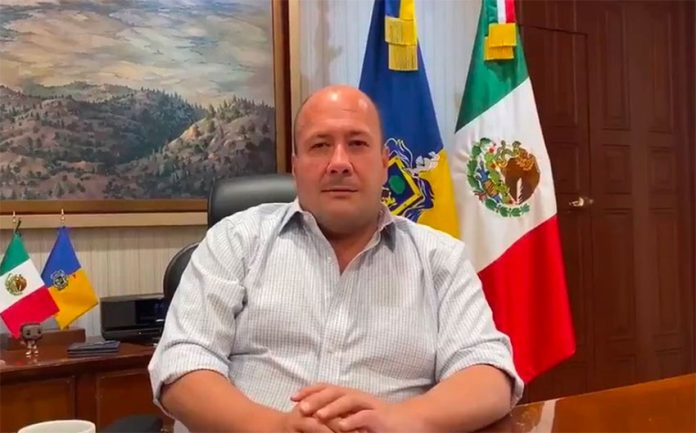
Governor Alfaro offers an apology in a video released Saturday.
Some 29 young people are still missing after two days of protests in Guadalajara against aggressive police behavior.
Ironically, police reacted with violence on both Thursday and Friday as hundreds turned out to protest the alleged murder by police of a 30-year-old man in Ixtlahuacán de los Membrillos on May 4.
On Friday, Jalisco Governor Enrique Alfaro referred to the behavior of some police as “irresponsible and brutal” and promised justice for those responsible.
On Saturday, he followed up with an apology for the behavior by police.
He also vowed that each one of the young people reported missing would be sought “one by one” until they were located.
The non-governmental organization Where Do the Disappeared Go (A dónde van los desaparecidos) said that as of early Saturday afternoon there were still 29 missing after they were forcefully removed from the protests and taken away in unmarked trucks.
Nineteen were detained during a second protest on Friday; the others were arrested the day before, according to the organization, which published their names on Twitter Saturday afternoon, and said their whereabouts remained unknown.
One of them is a 25-year-old law graduate whose family saw him last in a news video that showed him being violently arrested and taken away by five police officers during Thursday’s protest.
“It hurts me a great deal to see the abuse by police against citizens,” the governor said Saturday, but added that he was also hurt to see people attacking the police.
He repeated an accusation he made Thursday that the protest had been infiltrated by people whose intention was to destabilize state security. He blamed President López Obrador but later backed down on the accusation.
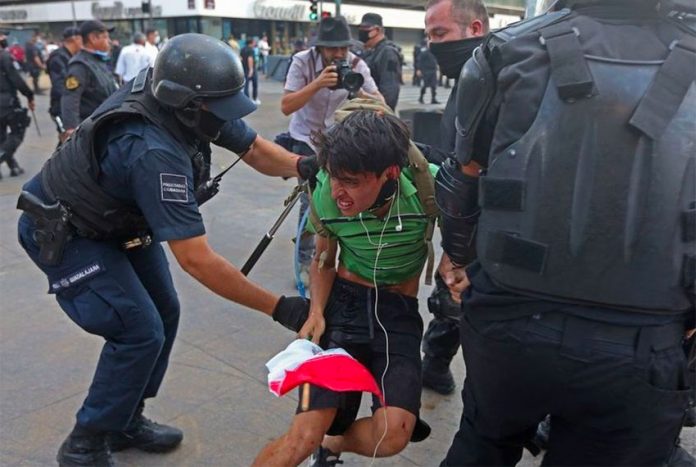
Police arrest Jesús Isaí Luna during the Guadalajara protest.
A 25-year-old law graduate and state judicial employee was arbitrarily arrested and beaten by police at a protest in Guadalajara, Jalisco, on Thursday, say the man’s mother and girlfriend.
Jesús Isaí Luna Martínez was arrested shortly after he arrived at the protest against the alleged murder of Giovanni López, who was supposedly beaten by police after he was arrested – apparently for not wearing a face mask – in the Jalisco municipality of Ixtlahuacán de los Membrillos on May 4.
Luna’s mother told the newspaper Milenio that video footage posted to social media shows that her son was not acting violently when he was arrested.
“He arrived and took out a Mexican flag to show that he was unhappy about the young man who was killed and that’s why they [the police] grabbed him,” Irma Araceli Martínez said.
“They arrested him without any reason,” she said, adding that videos posted to social media show her son being arrested by police who subsequently beat him, handcuffed him and put him into a police vehicle.
A video in which police arrest and beat Jesús Isaí Luna at Guadalajara protest.
“They kept beating him even when he was handcuffed. He fainted and they still kept beating him,” the man’s mother said.
“They completely violated the rights of the protesters. … He arrived 10 minutes earlier and this happened to him. He knew his rights and their limits and that he couldn’t be attacking anyone or spray-painting.”
Luna’s fiancée also said that he did nothing wrong. He joined the protest “peacefully” but was nevertheless attacked by state and municipal police, Laura Romo told the newspaper NTR.
“It was a very brutal attack, he was hurt very badly. At no time is he seen committing an act of vandalism. [In the video footage] he’s not spray-painting or shouting, he’s not doing anything like that. … The abuse of authority is undeniable,” she said.
Luna was hospitalized for injuries to his head, face and torso but was later discharged and returned to police custody.
Martínez said that she saw her son in the hospital but hasn’t had any contact with him since.
“He told me, ‘mom, I wasn’t doing anything, I took out my flag to protest and that was all I did until they [the police] grabbed me,’” she said.
Romo said that all of Luna’s family is worried about him as he remains in police custody. As of Saturday morning, no family members had been allowed to see him and it was unclear what charges, if any, he faces.
“We’re tremendously worried. We don’t know what’s going to happen to my fiancé,” Romo said, adding that the authorities haven’t provided any information to “calm us down.”
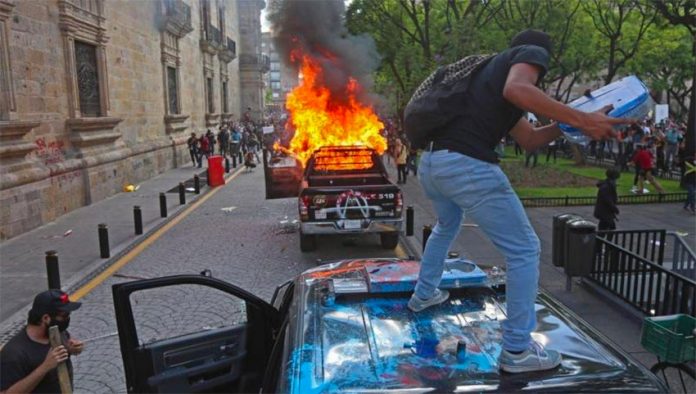
A total of 28 people were arrested at Thursday’s protest in the historic center of Guadalajara during which some demonstrators clashed with police, set police vehicles alight and broke into the state government palace.
Jalisco Governor Enrique Alfaro defended the conduct of the police, stating that they acted according to the circumstances and “didn’t commit any act of violence against the protesters.”
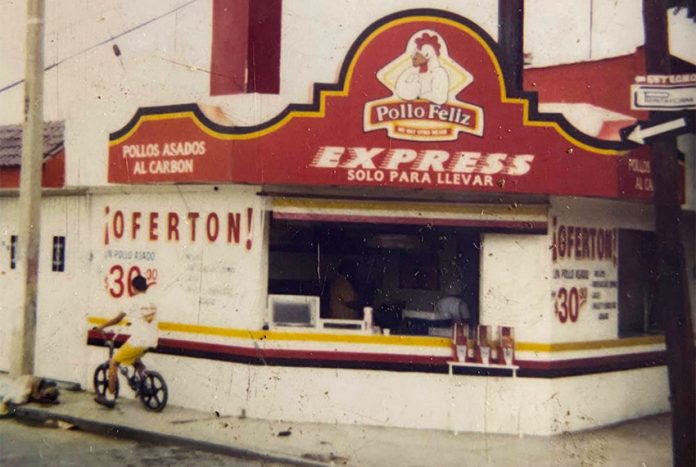
The first Pollo Feliz opened in Los Mochis, Sinaloa, in 1975.
If you live or travel anywhere between Baja California and Yucatán, you have almost certainly come across a Pollo Feliz restaurant. You may have even seen one in the United States.
As it’s a major corporation, I thought its story would be relatively straightforward to research. I was wrong.
Going through Mexican newspapers, the initial story I got was that Arnoldo de la Rocha was the founder. That was certainly the story published in Entrepreneur magazine, El Universal newspaper and others.
They talked at great length about his upbringing as a rural farmworker, one of 12 children in the Sierra Tarahumara, before going to the city of Chihuahua to sell grilled chicken the way his family made it. It looked like a story similar to that of Col. Sanders of KFC fame, from nothing to a fried chicken empire.
Then the story shifted inexplicably to the first restaurant opening in Los Mochis, Sinaloa. Confused by this, I tried to contact someone at company headquarters to clarify the story. This was difficult as the website was under construction, with no contact info. Even the Facebook page did not have a message button. This was odd for such a prominent business.
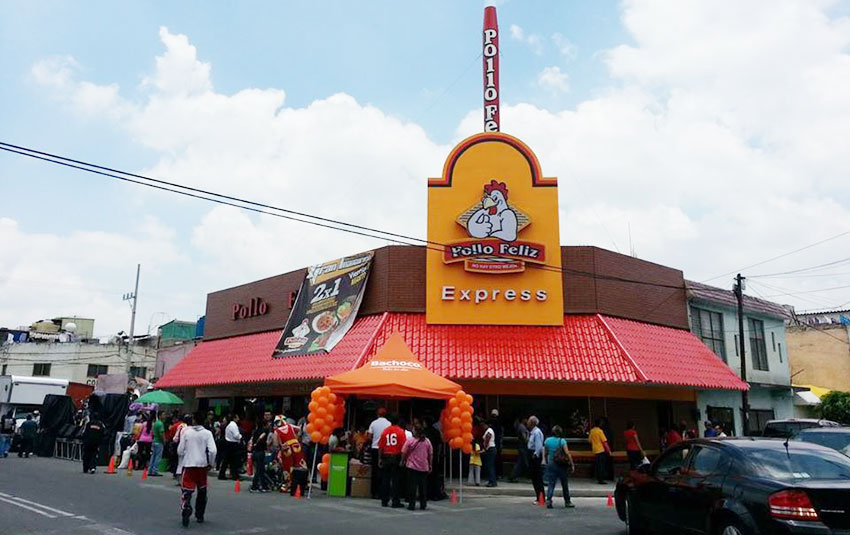
One of more than 1,000 Pollo Feliz restaurants.
But Arnoldo de la Rocha has a page, geared for presentations and talks. I reached his agent and had success reaching Don Arnoldo. I thought I’d just be clarifying some points and getting details, but it turned out to be more.
Long story short, I was told that the newspaper stories were wrong and based on his talks entitled “El Sueño Mexicano” (the Mexican dream). In reality, he is one of many founders and owners of the company — which seemed really strange as well.
I found his talk on YouTube and completely understand why the journalists got the story as they did. De la Rocha insisted that the “real” story was in his book, Tierra Perdida.
And yes, De la Rocha’s account in the book is quite different.
Perhaps the “real” founders are the Rocha Zazueta branch of the family which hails from the Sinaloa/Chihuahua mountains. They migrated to the coastal cities of Sinaloa to find work.
In Guasave they came across a former professional baseball player who had retired, stayed in Mexico, and began grilling and selling the citrus-marinated chicken popular in his native Caribbean. The recipe was not difficult to reproduce and modify, and imitators sprang up, including the Rocha Zazuetas.
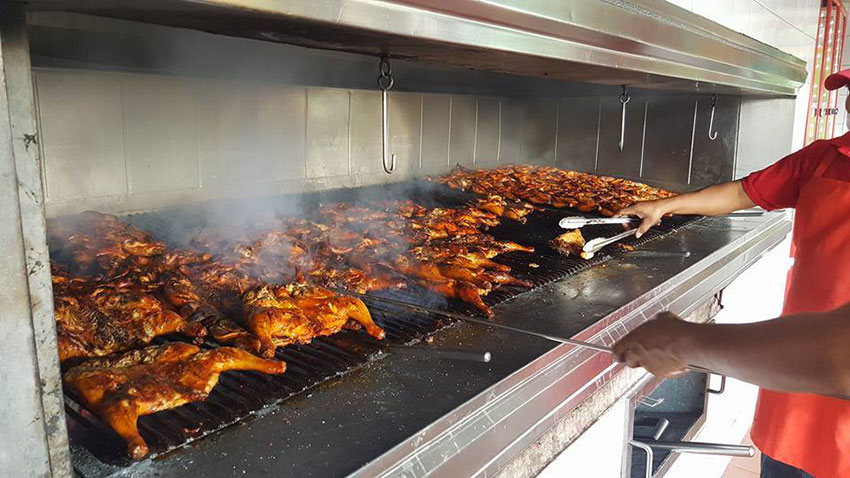
Chicken on the grill at Pollo Feliz.
In 1975, Guadalupe and Héctor de la Rocha Zazueta opened a stand selling this chicken in Los Mochis. It did not catch on at first, competing against the well established spit-roasted chicken. But eventually it did take off, and others in the Rocha clan were invited to work with the established restaurants and then open their own. Family-owned places sprang up in Sinaloa, Chihuahua and into Guanajuato, all independently owned and under various names.
In 1978, the Chinchillas Chavez family joined in, opening their first restaurant in Celaya, Guanajuato, calling it Pollo Feliz.
It might have remained like many other family businesses in Mexico except for the North American Free Trade Agreement opening up Mexico to international competition. To cope, members of the families met in 1990 and most decided to unite the restaurants into a single corporation under the name of Pollo Feliz.
The corporate image was crafted at that time and remains the same to this day. The move not only allowed them to compete with transnational chain restaurants, it also gave them national recognition.
By the mid-1990s, there were about 170 restaurants. Today, there are over 1,000, employing 15,000 people in Mexico. The first U.S. location was opened in 2001 in Tucson, Arizona, when a cousin with U.S. citizenship wanted to open a restaurant and was given permission to use the name.
There were not high hopes, but the food turned out to be a hit not only with the Hispanic population, but with the English-speaking one as well. Since then, the company has tried to register and grow Pollo Feliz USA as a registered franchise, but it has been difficult because of the start-up costs.
There are restaurants with the name in Houston, El Paso, Brownsville and Chicago, but all are owned by family members. Official franchising is on “standby,” according to Victor Manuel Rodríguez of the U.S. branch.
The confusion about who started Pollo Feliz comes about because most corporations start as a single proprietor which then takes on partners. Instead, there are over 100 people in the Rocha and Chinchillas families that are considered owners, although legally there are six.
Today, Pollo Feliz dominates the image of take-home chicken in Mexico with all the pros and cons that go along with that. But this story does highlight one Mexican cultural trait, the emphasis on family rather than the individual.
It was not one person who picked himself up by his bootstraps, but a group of family members helping each other.
Leigh Thelmadatter arrived in Mexico 17 years ago and fell in love with the land and the culture. She publishes a blog called Creative Hands of Mexicoand her first book, Mexican Cartonería: Paper, Paste and Fiesta, was published last year. Her culture blog appears weekly on Mexico News Daily.
A protester vandalizes a police vehicle before it was set on fire Thursday in Guadalajara.
The municipal police force of Ixtlahuacán de los Membrillos, Jalisco, was disarmed on Friday a month after a man was allegedly arrested for not wearing a face mask and beaten to death by officers.
Jalisco state police assumed responsibility for security in the municipality, located about 40 kilometers south of Guadalajara near Lake Chapala.
A municipal police commissioner, a middle-ranking commander and a police officer were arrested on Friday in connection with the alleged murder of Giovanni López, a 30-year-old construction worker who was arrested on May 4 and died in hospital of a traumatic brain injury the next day.
His alleged murder at the hands of police triggered protests on Thursday and Friday in Guadalajara.
In addition to being suspected of committing acts of abuse against citizens, 34 of 69 municipal police in Ixtlahuacán have not passed confidence tests that certify they don’t have links to organized crime.
Ixtlahuacán Mayor Cervantes is apparently AWOL.
Mayor Eduardo Cervantes Aguilar was summoned to appear before state law enforcement authorities on Friday to make a statement about the alleged murder but failed to appear. His whereabouts are unknown, the newspaper Milenio reported on Saturday.
Cervantes is under investigation for obstructing the investigation into the alleged murder. Giovanni López’s brother claimed that through a third party the mayor offered his family 200,000 pesos (US $9,270) not to publish a video he recorded of his brother’s violent arrest, which has circulated widely on social media and news websites.
He also said that Cervantes threatened to kill members of his family should the video come to light. The mayor has rejected the claims.
Jalisco Attorney General Gerardo Octavio Solís said the mayor has now been summoned to appear before authorities on Monday and should attend with a lawyer.
At a press conference on Friday, Jalisco Governor Enrique Alfaro said an investigation will determine what happened to Giovanni López. He asserted that the claim he was arrested for not wearing a face mask amid the coronavirus pandemic is a fabrication for “political purposes.”
Solís said he was arrested for “aggressive behavior” but the man’s family denies the claim.
[wpgmza id=”168″]
Alfaro also said that his government will do everything it can to hold to account a man who set a police officer on fire at the protest against López’s death in Guadalajara.
The governor accused President López Obrador of sending troublemakers to Thursday’s protest during which demonstrators clashed with police, set police vehicles alight and broke into the state government palace.
Alfaro changed his position on Friday but still accused the federal government more broadly of instigating violence.
“What I say to the president is that I still believe that he is a good person, … he’s not giving these instructions but I also clearly say to the president of Mexico that people close to him, people of his government and his party are betting on violence as a route to maintain power, to continue looking after their interests and personal agendas,” he said.
During Thursday’s protests, no one from the federal government called to inquire about the situation, Alfaro added.
The governor criticized Interior Minister Olga Sánchez and the deputy interior minister for asserting that López was arrested and beaten because he was not wearing a face mask in public. Both officials have spread lies about what happened, Alfaro said.
The governor on Thursday defended the policing of the protest even though video footage showed some officers acting aggressively toward demonstrators without provocation.
However, Alfaro said that some officers had overstepped the mark at a second protest against López’s death on Friday by attacking demonstrators with batons and sticks and even detaining some before abandoning them on the outskirts of Guadalajara.
He said the offending state police officers had failed to follow his instructions to act with common sense and caution and had already been arrested.
“A group of police … defied my instructions and acted in an irresponsible and brutal way that will not be forgiven. We will apply the full weight of the law against whoever is responsible. … Although we live in turbulent times, nothing justifies the excessive use of force.”
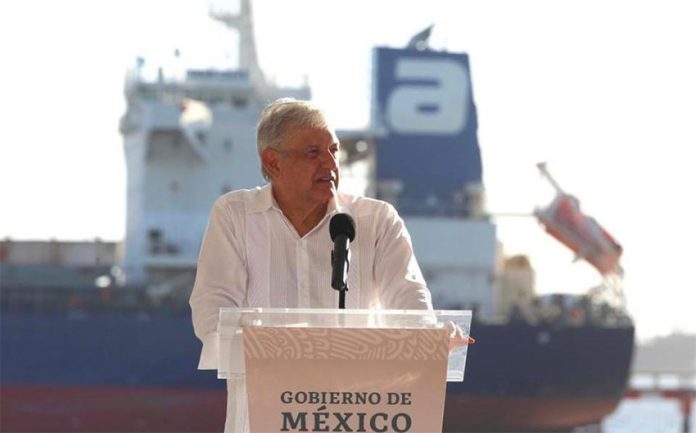
President López Obrador speaks Friday in Coatzacoalcos.
President López Obrador is hopeful that an infrastructure project in the Isthmus of Tehuantepec to connect the ports of Salina Cruz, Oaxaca, in the Pacific and Coatzacoalcos, Veracruz, on the Gulf of Mexico will become “a curtain” to stop the migration of Mexicans to the United States.
López Obrador made the comment on Friday as he toured one of the project’s construction sites in Coatzacoalcos.
The ambitious project involves the construction of a modern railway, highway upgrades, telecommunications infrastructure, expansion of both ports and the development of 10 industrial parks in the region.
Some 300 kilometers of track will be laid and modernized to accommodate an electric train that will transport both cargo and passengers.
Improvements to the Coatzacoalcos port alone involve building 130 meters of piers, construction of a rail yard and highway access among other improvements that will cost 854 million pesos, nearly US $40 million.
The president likened the rail corridor to a rail-based Panama Canal to transport goods from Asian countries to the east coast of the United States.
Fiscal incentives such as tax breaks businesses located along Mexico’s northern border receive and a reduction in the price of electricity and gasoline will be offered to entice companies to set up along the Isthmus corridor.
The isthmus project is designed to help develop the region by providing social and economic opportunities for residents as well as attracting international commerce to the area. The president is hopeful that new jobs created along the corridor will boost the economy in both Veracruz and Oaxaca and thus deter their citizens from migrating to the United States.
The total project represents an investment by the federal government of 20 billion pesos, more than US $927 million.
Friday, however, was a different story, when the tone of a second, separate protest took a violent turn and degenerated into a riot involving injuries, property damage and the deployment of some 500 police officers clad in riot gear.
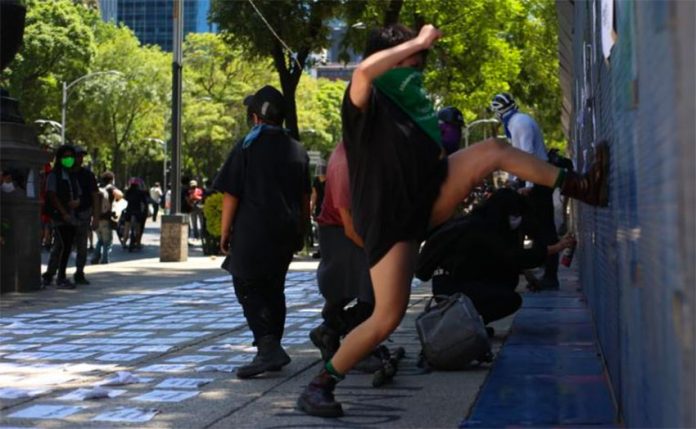
A Facebook live video posted midday Friday showed a small group of people pasting sheets of paper with the names of 420 victims of police brutality in the United States on the sidewalk in front of the U.S. Embassy.
Messages directed at U.S. President Donald Trump, calling him a racist and a pedophile among other things, were posted to the steel barriers that have been erected outside the embassy.
The group also posted several messages decrying the death of Giovanni López, who died after being arrested by police in Jalisco on May 4, apparently for not wearing a face mask.
Causan destrozos en Reforma y Polanco
As the afternoon progressed, the initial group of about 15 was joined by others wearing hoods and armed with Molotov cocktails, sticks, metal tubes and rocks.
They began banging on the embassy’s protective barrier and were soon joined by a larger group of people — described as anarchists by Mexico City police — as the violence escalated. The crowd hurled rocks, firecrackers and paint in the direction of the embassy until riot police were called out to disperse the crowd with what appeared to be tear gas.
From there, things spiraled out of control.
The group, now numbering around 100, left the embassy and headed toward Casa Jalisco, that state’s headquarters in Mexico City, shattering windows and vandalizing homes along the route, their focus now firmly on the death of López.
The protesters, many wearing helmets, carried anarchist flags and a large banner emblazoned with “Antifa,” for anti-fascist.
They were met by some 500 riot police as the protesters threw Molotov cocktails, tree branches and other potentially lethal projectiles in the direction of Casa Jalisco, shouting “Murderers!” as they clashed with police.
Six hours after the protest began, authorities managed to disperse the crowd.
More than 50 businesses and 60 apartment buildings along Paseo de la Reforma, Mariano Escobedo and Campos Elíseos were damaged.
Four journalists and six police officers reported injuries, and a 16-year-old girl was allegedly beaten by police.
Mayor Claudia Sheinbaum acknowledged that some officers acted inappropriately during the protest and strongly condemned any act of police brutality.
“I gave a clear and precise instruction to avoid provocation,” she stated on social media and specified that her orders were not fully obeyed.
“For my government, this is unacceptable. For this reason, I am requesting the Attorney General’s Office and the Mexico City Human Rights Commission to open an investigation, identify and punish those responsible, as well as their chain of command, regardless of rank,” she said.
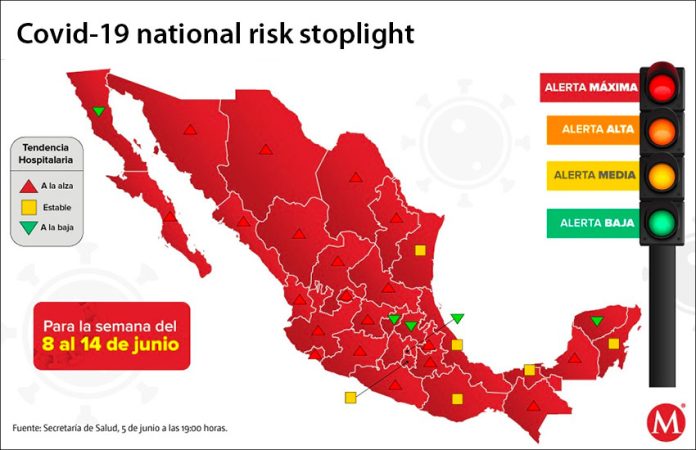
The Ministry of Health 'stoplight' map indicates high risk for the entire country.
All of Mexico has been painted red on the federal government’s updated “stoplight” map but state authorities have the freedom to decide which coronavirus restrictions can be eased, health officials said on Friday.
Health promotion chief Ricardo Cortés presented the new map, which shows that the risk of coronavirus infection has been deemed to be at the maximum level in the entire country. Every state will remain at the “red light” risk level until at least the end of next week.
A state is allocated a red stoplight even if just one of the four indicators used to determine the color is red, Cortés said.
The four indicators are case number trends (whether new infections are increasing, decreasing or stable), hospital admission trends for coronavirus patients, hospital occupancy levels and positivity rates (the percentage of people tested who are confirmed to have Covid-19).
Cortés said that Zacatecas, the only state allocated an “orange light” on the stoplight map in effect this week, had switched to red because Covid-19 cases numbers and hospital admissions are on the rise.
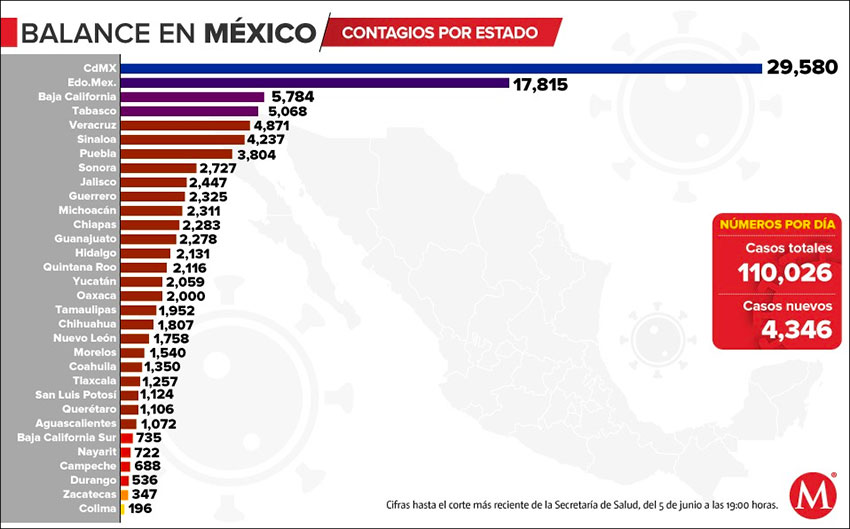
Virus cases as of Friday. milenio
He presented guidelines about which activities should be allowed at each of the four coronavirus risk levels.
At the “red light” or maximum risk level, hotels are permitted to reopen but should only accept guests who work in sectors that have been declared essential. Hotel occupancy levels shouldn’t exceed 25%.
Restaurants and cafes should be restricted to offering take-out and delivery. People wishing to have their hair cut should ask their hairdresser or barber to visit them in their homes.
Parks, plazas and other open public spaces are permitted to reopen, according to the federal guidelines, but their capacity should be limited to 25% of normal levels.
Cortés said that walking for exercise purposes is possible but people should take care to maintain a healthy distance from others. Markets and supermarkets should limit the entry of people to 50% of normal levels and one person per family, he said.
Gyms, sports centers, swimming pools, cinemas, theaters, museums, shopping centers, bars, nightclubs, amusement parks and places of worship should remain closed during the red light phase of what the government is calling “the new normal.”
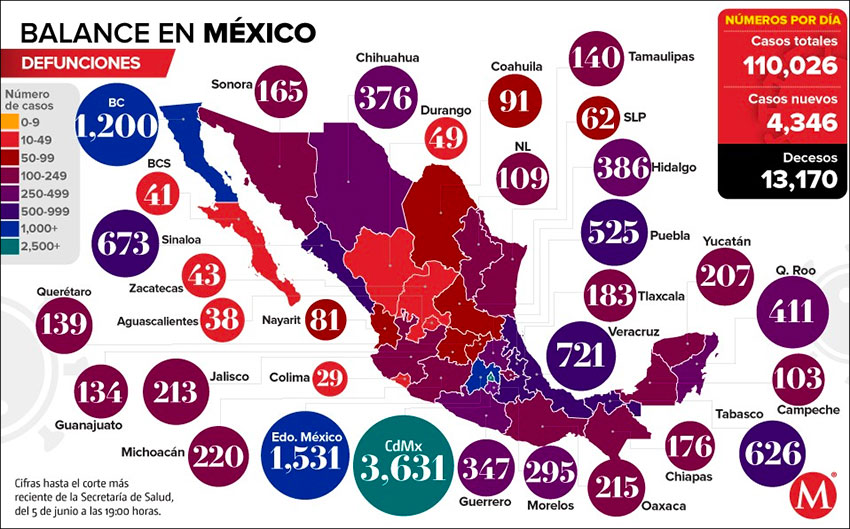
Covid-19 deaths as reported by the Ministry of Health on Friday. milenio
Events attended by large numbers of people should not be allowed during both the red and orange light phases.
Cortés stressed that people should continue to stay at home as much as possible while the risk of coronavirus infection remains at the maximum level.
Deputy Health Minister Hugo López-Gatell, Mexico’s coronavirus point man, described the federal guidelines as examples of what states should do.
However, the health authorities of each state and Mexico City have the power to decide which economic and everyday activities can resume, he said.
The move will allow the reactivation of nonessential activities such as manufacturing, real estate services and professional services. Hotels and restaurants and retailers will be allowed to open, but with certain restrictions.
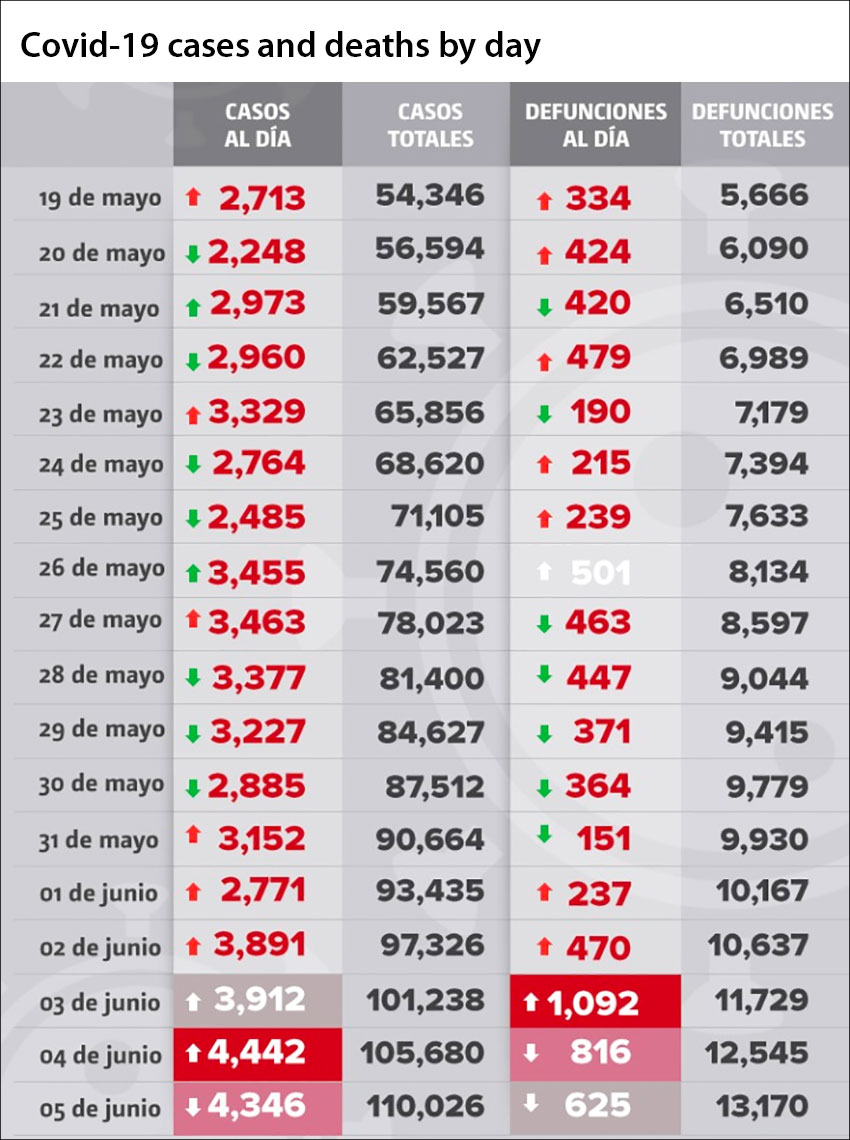
The current tally of cases and deaths, as reported each day since May 19. milenio
Earlier in Friday night’s coronavirus press briefing, Director of Epidemiology José Luis Alomía reported that Mexico’s coronavirus case tally had increased to 110,026 and that the death toll had risen to 13,170.
The Health Ministry registered 4,346 additional cases on Friday, the second highest single-day increase, and 625 Covid-19 deaths, the third highest spike since the start of the pandemic.
Alomía said that 19,015 of the confirmed cases are considered active, an increase of 638 compared to Thursday. He also said that there are 48,822 suspected cases across the country and that 324,897 people have now been tested.
Mexico City remains the country’s coronavirus epicenter, with the highest number of accumulated cases, active cases and deaths.
The capital has now recorded 3,631 coronavirus-related fatalities, according to the official count, a figure that accounts for 27.5% of all Covid-19 fatalities in Mexico.