Home Blog Page 1543

Most pilgrimages and sanctuaries are now Catholic but roots are pre-Hispanic

0
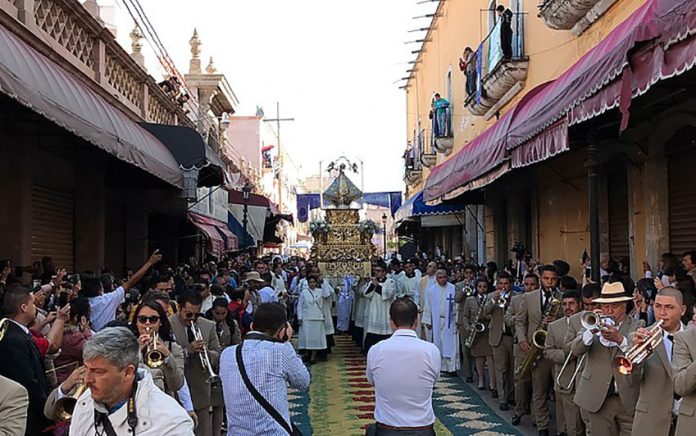
A procession at the basilica of the Virgin of San Juan de los Lagos in Jalisco.
A procession at the basilica of the Virgin of San Juan de los Lagos in Jalisco. Jaimec4fz

You have probably seen it on a Mexican road, a long line of people in cars, on bikes and on foot. It is like a procession, but the people obviously have been traveling for some time.

Mexico has the second largest Catholic population in the world and these pilgrimages and their destinations reflect the country’s history and culture from the pre-Hispanic period to the present.

The Spanish imposed Catholicism on their newly conquered lands, but pilgrimage was part of indigenous life for many centuries prior. Taking advantage of similarities, Christian structures and images replaced the old ones, and in many cases, kept the same purpose. The Virgin Mary replaced various goddesses, and Jesus in various manifestations replaced male gods. In rare cases, the original image was replaced by a saint or archangel.

Therefore it is no surprise to find that the highest concentrations of shrines, as well as the largest, are found in the territories of former Mesoamerican empires.

The process of replacement was accompanied by some kind of miracle story. They include the appearance of the Virgin Mary, a Catholic image replacing pre-Hispanic one by supernatural means or an otherwise ordinary image which gains a reputation for granting many miracles. Not surprisingly, the miracles date to shortly after the arrival of the Spanish, with the involvement of Spanish authorities.
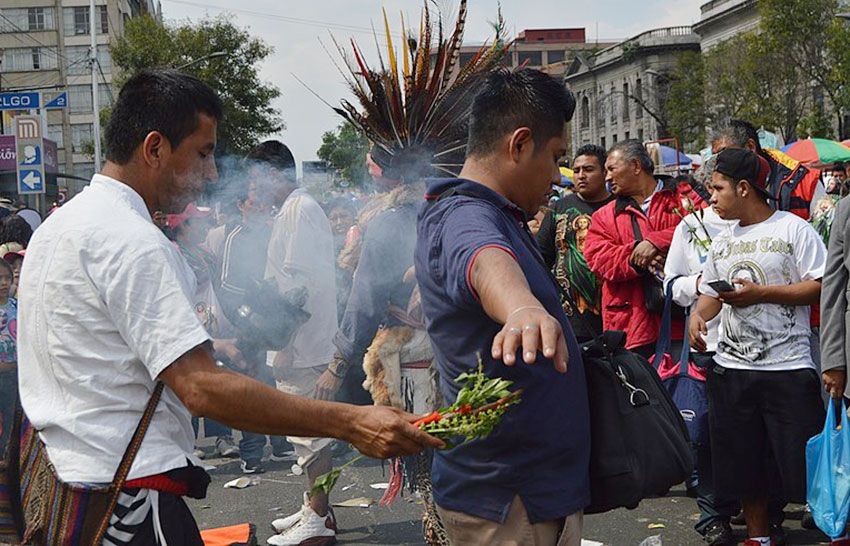
Ritual cleasing before entering the sanctuary of Jude the Apostle in Mexico City
Ritual cleasing before entering the sanctuary of Jude the Apostle in Mexico City. Roldán Feliciano

Not only are the Catholic sanctuaries in the same place as the old ones, pilgrims still use the same pilgrimage routes to get to them. Pilgrimages also include dances from the pre-Hispanic and early colonial period as a kind of meditation and prayer. This is likely because the evangelizers did not or could not eliminate the practice.

By far the most important pilgrimage site in Mexico is that of the Virgin of Guadalupe, located on Tepeyac Hill on the northern edge of Mexico City. It receives an estimated 20 million visitors each year from all over Mexico and elsewhere. The miracle associated with this site is the appearance of the Virgin Mary herself in 1531, which was sacred to Tonantzin, the mother goddess.

Proof of her appearance comes from her image on a maguey fiber cloth that was worn by Juan Diego Cuauhtlatoatzin and today hangs inside the newer Basilica built to handle the massive crowds. For Catholicism as a whole, it is a major Maronite site, just after Lourdes in France and Fatima in Portugal. The appearance of the Virgin as a dark-skinned indigenous was an extremely important factor in evangelization.

Guadalupe attracts large numbers of pilgrims and tourists year-round, but on her feast day of December 12, the city swells with thousands upon thousands, with groups of people completing their trek the night before along a road aptly named “Calzada de los Misterios” (Walkway of the Mysteries).

Despite the status of Guadalupe as religious and cultural icon, most of Mexico’s Catholic sanctuaries are dedicated to Jesus, either as infant, adult or on the cross. One subtype are crucifixes called Black Christs. These are images of Jesus on the cross where the human figure is darkened or completely black. Such crucifixes can be found from Central America into the southwest U.S. but the best known of these is in Chalma, a small town just west of Mexico City.

This image appeared in 1573, miraculously replacing the image of the god Ozoteotl, the god of caves, at his sanctuary. The image was brought to a church built in the 16th century, where it remains to this day. The site attracts thousands of pilgrims each year, especially July 1, January 6 and Ash Wednesday. Indigenous elements of pilgrimage remain important, such as dancing at the church and visiting a Montezuma cypress tree nearby.
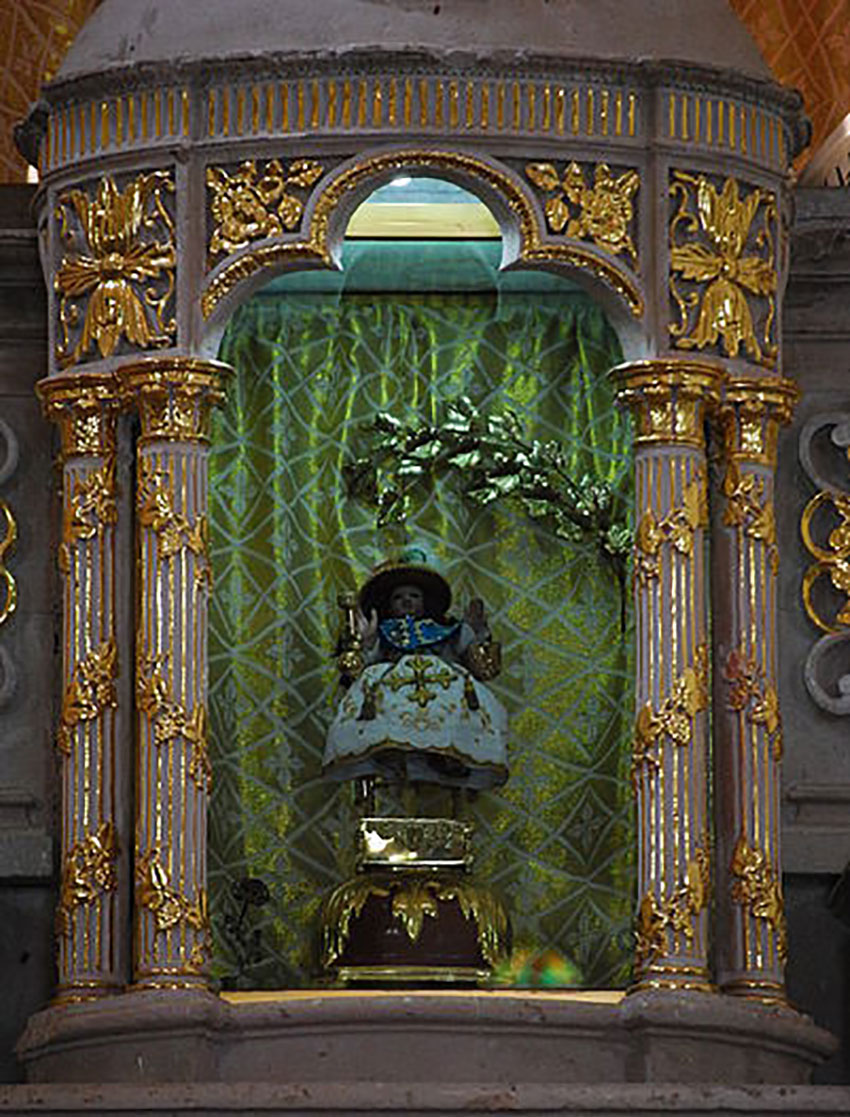
The Holy Child of Atocha in Plateros, Zacatecas.
The Holy Child of Atocha in Plateros, Zacatecas. leigh thelmadatter

The most important sanctuary dedicated to the infant Jesus is that of the Holy Child of Atocha in Plateros, Zacatecas, which has been registered as a World Heritage Site. The image here is a replica brought from Spain during the initial silver boom in the colonial period. During a major mining accident, according to the story, the image disappeared. Rescued miners told stories of how they saw a child come to them with food and water. After the emergency, the image reappeared. It is most strongly venerated in western Mexico up into the southwest U.S.

Another important category of sanctuary are those dedicated to specific images of the Virgin Mary, a physical object, not a supernatural appearance. There are many of these including the Virgin of Juquila in Oaxaca and the Virgin of Izamal in Yucatán, but the most visited is the one at San Juan de los Lagos, Jalisco.

The image was brought here in 1543 by Miguel de Bolonia. Her popularity rests on the many miracles attributed to this image, bringing about 5 million visitors each year from all over Mexico and Texas to the church that houses the image. Visitors come year-round but special dates are February 2, August 15, and December 8.

Sanctuaries dedicated to saints are rare in Mexico, but there is an important one dedicated to Judas Thaddeus or Jude the Apostle. Veneration of this image has taken on importance since the mid-20th century, mostly in Mexico City. The main sanctuary is the San Hipolito Church on the edge of the city’s historic center.

He is mostly venerated by the city’s poor, and interestingly, its criminal element, as misprints of his image had his staff in his left hand which represents evil, leading to the belief that he is the saint of good and bad alike. His feast day is October 2, when roads around the Hipolito become impassible, but large-scale veneration takes place each month on the 28th as well.

Another site of recent importance is Cubilete Hill just outside Silao, Guanajuato. This is home to a 20-meter bronze Christ located on the state’s highest point. The statue was completed in 1940, almost 20 years after the Mexican government stopped the attempt and banished the priest in charge of the project. At the time, the secular government was persecuting traditional Catholicism, an episode now known as the Cristero War.
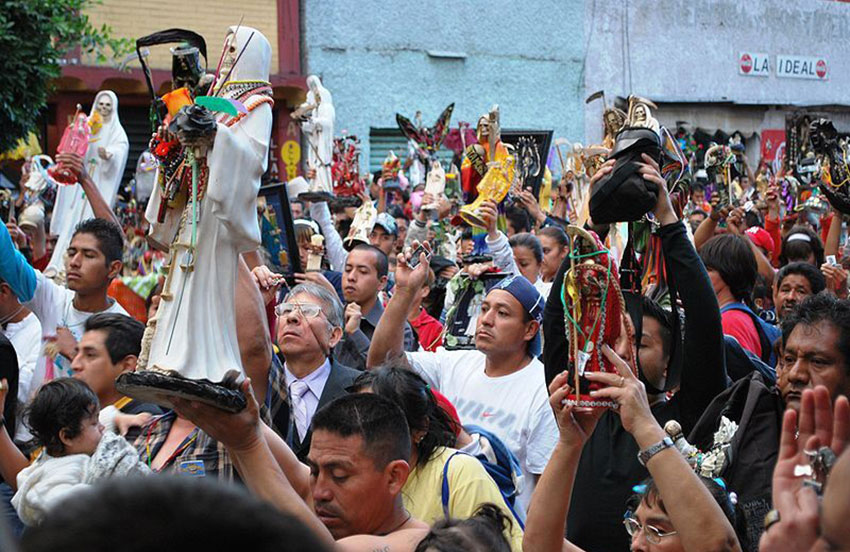
Pilgrimage to the shrine of the Santa Muerte in Tepito, Mexico City
Pilgrimage to the shrine of the Santa Muerte in Tepito, Mexico City. leigh thelmadatter

It is still a sore point for many in north-central Mexico, which remains one of the country’s most conservative areas. To underscore this, there is a museum dedicated to the conflict at the statue’s base.

There is one type of sanctuary and pilgrimage site that is absolutely NOT sanctioned by the Catholic Church. These are dedicated to an image called Santa Muerte (Holy Death). The figure is similar to the Grim Reaper, with scythe and globe, but the image is considered female, not male. Its veneration is most strongly associated with the poor and criminals, those who believe that there is no place in traditional religion for them.

The most important shrine for this image is in front of a small house in the very seedy Tepito neighborhood in Mexico City, established only a few decades ago. It attracts devotees daily with major gatherings on the first of each month and despite its non-sanctioned status, is venerated with Catholic rites such as crossing oneself and saying the rosary.

There are too many sites with spiritual significance even for a book, and a few have managed to keep 100% their indigenous character. Such sanctuaries have both religious and cultural significance, and attract visitors for both reasons. For the faithful, the trip is for penance, to ask a favor or to give thanks and can be profound.

For the visitor, it provides a look into a culture and way of life, often on a microcosmic scale. Visits to such places generally have rules and norms, and obviously should be respected even by non-believers.

Leigh Thelmadatter arrived in Mexico 17 years ago and fell in love with the land and the culture. She publishes a blog called Creative Hands of Mexicoand her first book, Mexican Cartonería: Paper, Paste and Fiesta, was published last year. Her culture blog appears weekly on Mexico News Daily.
Authorities to address cancer drug shortages; parents end protest

0
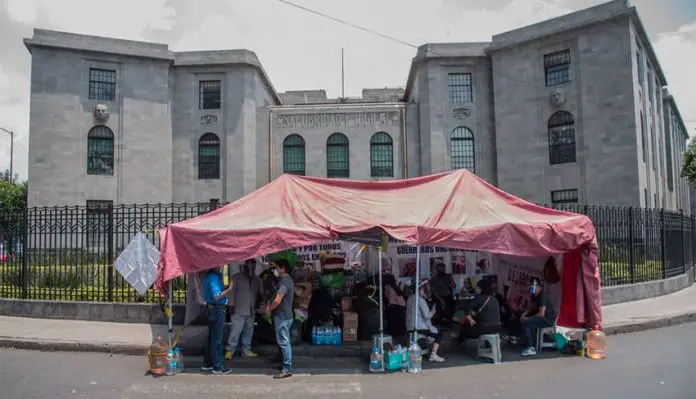
The parents shut down their protest after an agreement was reached yesterday with health authorities.

Federal health authorities agreed to end the shortages of several cancer medications that have plagued child cancer patients and their parents for at least two years.

In response to the Health Ministry’s promise to put its commitment into writing on June 8, nine parents who began a hunger strike outside the ministry’s Mexico City offices on Tuesday halted their protest in hopes of having found a solution.

“The Health Ministry remains totally open to dialogue and at all times has been addressing the problem,” it said in a statement.

The department also said that it held a meeting on Friday to review the acquisitions process for cancer medications in order to be able to guarantee parents and patients that they’ll have the medicines they need throughout the rest of the year.

Hospitals in need will soon be stocked by a shipment arriving on June 6 and containing 15,574 boxes of the cancer drugs cyclophosphamide, vincristine, fluorouracil and oxaliplatin. Health authorities are also in the process of purchasing more medications from Argentina, Germany, Cuba and Brazil, as well as setting up weekly shipments to avoid running out.

The cancer patients’ parents said that they have experienced shortages on average every three months for the past two years. The problem has been made worse by the coronavirus pandemic, putting the lives of over 20,000 children at risk.

Source: Sin Embargo (sp)

Several states unhappy with federal government’s stoplight system

0
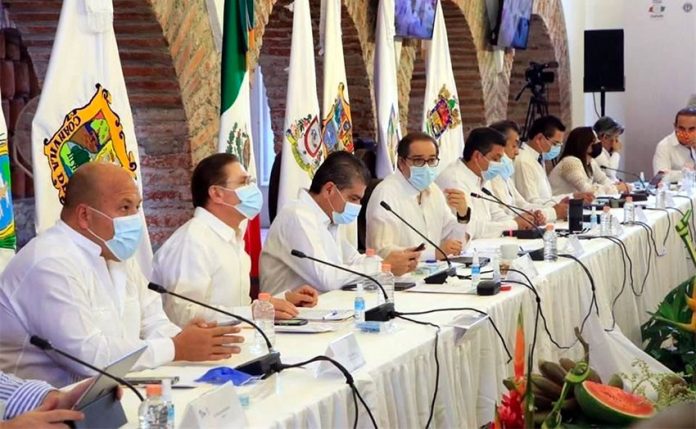
Seven governors met Friday in Colima, where they rejected the federal stoplight system.

Jalisco Governor Enrique Alfaro was one of several state leaders to voice their dissatisfaction with the federal government’s new “stoplight” map which paints most of the country red, the maximum state of risk for the coronavirus.  

In the 31 federal entities designated red — only Zacatecas achieved a better ranking — only essential activities will be permitted.

Publication of the map, which will be updated weekly, comes as federal coronavirus social distancing guidelines are set to be lifted on Saturday.

In a press conference Friday, Jalisco Governor Enrique Alfaro questioned the federal government’s criteria, methodology and intentions. He declared that it was “absurd” that his state should be given a red designation when only one of the four indicators was red.

Those indicators are the number of active and new coronavirus cases, hospital admission trends and hospital occupancy levels. When the system was announced, Deputy Health Minister Hugo López-Gatell explained that if a state scored red on any one indicator during a given week it would be given the red designation.

Alfaro, who also claimed that federal officials had not invited state input into the designations as planned, joins the governors of Colima, Michoacán, Durango, Nuevo León, Coahuila and Tamaulipas in rejecting the traffic light classifications. 

“We express our disagreement with and rejection of a red light that does not reflect the reality of our states. On the contrary, it seems that it has a political purpose, to hold the states responsible for the dead,” said  Michoacán’s Silvano Aureoles Conejo after the seven governors met Friday in Colima.

The states are taking various approaches to easing coronavirus restrictions, weighing the balance between economic recovery and the risk of higher levels of infection and making decisions independent of the federal government. 

The newspaper El Universal reported today what Monday’s “new normal” will look like in states that have announced plans for a partial reopening.

  • Aguascalientes: Some businesses will reopen but not movie theaters, bars, nightclubs or gyms.
  • Baja California: The automotive, aerospace, construction and mining sectors will reopen.
  • Baja California Sur: Government offices, construction and mining will start up again, but tourism will not and no date has been agreed upon.
  • Campeche: Construction businesses can resume operations. 
  • Chiapas: Although the government continues to advocate for stay-at-home measures, some businesses opened up anyway last week, and restaurants and bars in San Cristóbal de las Casas announced they will reopen as of Monday.
  • Chihuahua: The government says 30% of businesses will reopen on June 1 and follow health protocols.
  • Coahuila: Partial reopenings will take place in the automotive, restaurant and other business sectors.
  • Durango: Only the mining and construction industries will go back to work. 
  • Guanajuato: Some government offices will reopen, as will 30% of shoe and leather businesses. Plazas and shopping malls will partially reopen. 
  • Guerrero: The mining and construction industries will return to work. 
  • Jalisco: Nonessential businesses will reopen.
  • Michoacán: Economic activity will resume on a partial basis. 
  • Nayarit: The mining and automotive industries will start up again.
  • Queretaro: The aerospace, automotive and construction industries will reopen and follow health guidelines. 
  • Quintana Roo: The state will open for tourism on June 8.
  • Nuevo León: The mining, construction, aerospace, automotive, beer and hotel industries will reopen. 
  • San Luis Potosí: Some businesses will partially reopen, with priority given to the manufacturing sector. 
  • Sinaloa: Businesses and services will gradually reopen. Decisions on opening up the tourism sector will be made on a regional level. 
  • Tamaulipas: Around 25% of nonessential businesses will reopen.
  • Yucatán: Construction businesses will be allowed to get back to work. 
  • Zacatecas: Some businesses and government offices will reopen.

Source: El Universal (sp)

3,227 new coronavirus cases confirmed Friday for a total of 84,627

0
Dressed for the coronavirus, a cleaner wears a 'smile.'

On the eve of the official conclusion of federally mandated social distancing, the coronavirus continued to take its toll.

On Friday there were 3,227 new cases of Covid-19, for a total of 84,627, and 371 deaths, bringing that total to 9,415.

Mexico’s fatality rate is currently 11.1, significantly higher than the global rate of 6.2.

In all, 246,026 people have been tested for the disease in Mexico and the actual infection rate may be much higher. 

Deputy Health Minister Hugo López-Gatell told Friday’s coronavirus press briefing that there were 16,209 active cases, 4,027 of whom were in Mexico City. The total is down by 106 from Thursday.

México state followed with 2,071, Puebla with 751, Tabasco with 748 and Baja California 674.

The healthy distance initiative implemented March 23 comes to an end today, Saturday, yet most of the country remains at maximum risk for Covid-19 according to the federal government’s “stoplight” map.

Source: La Jornada (sp), Milenio (sp)

Eddie Mendoza and Direct Relief Mexico: a model for the new normal

0
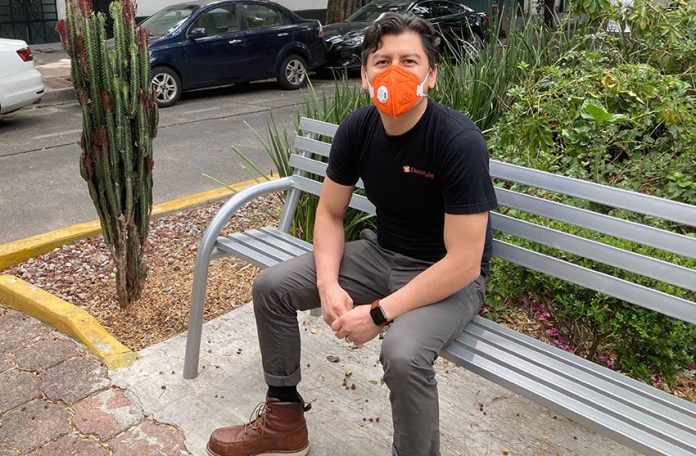
Direct Relief Mexico chief Eddie Mendoza.

It’s clear from the energy and detail in the stories he tells me that Eddie Mendoza has been cooped up for quite some time.

The head of Direct Relief Mexico has mostly spoken with his 11-month-old son, his wife and the doorman at his building in the last few months. All other talk has been diligent negotiating to get medical supplies to where they’re needed during the coronavirus pandemic.

So far the U.S.-based nonprofit dedicated to procuring medical supplies when disaster strikes has imported 350,000 surgical masks, 30,000 face masks and 10,000 goggles. The numbers on next week’s shopping list also run into the hundreds of thousands.

Eddie’s story truly is a paragon of how immigration should work in a system in which wealth inequality is an inevitable component. And it begins at the epicenter of the struggle for migrant workers’ rights in the United States.

Raised by migrant farmworkers in and around Delano, California — where labor organizers César Chávez and Dolores Huerta held their famous strikes that led to the founding of the United Farm Workers of America — Mendoza’s young life was a balance between working in the grape fields and school and extracurricular activities.

“My dad ended up finding us a little house, a little shack with one room, not even a kitchen, a radio console for a table and a bathroom,” he says with evident nostalgia. There were holes in the floor and no heat in the winter, but the five of them made lasting memories in that house.

He tells me the tragicomic anecdote of how his brother came to be nicknamed “El Mofles” (Mufflers) for the time their dad accidentally ran him over in the family car, hitting him in the head with the muffler (he survived, obviously). He puts me in that car with his dad early in the morning before the fog has cleared, on the way to pick grapes. Crimson, Thompson, seedless, red globe. He remembers all the names, remembers how to prune and graft.

He speaks fondly of the rich Mexican culture that found solidarity in the southern California migrant communities located in places with names like Linnell Camp and Earlimart.

And it’s this love for his Mexican culture, food and people that ultimately led him to where he is today: at the helm of Direct Relief’s efforts to get safe medical supplies and medications to the hospitals that need them most in order to fight Covid-19.

He actually led the entire initiative to bring the U.S. disaster relief nonprofit south of the border in 2014, after five years of liaising with governments, nonprofits, businesses and hospitals. Memories of road trips back to Zacatecas growing up led him to move to Mexico City to run the operation from there in 2016.

On his agenda next week: purchasing 285,000 surgical masks, 15,750 N95 masks, 610 boxes of gloves, 10,000 face shields and 80,000 surgical gowns. Not an easy task in a market rife with faulty products and money laundering schemes.

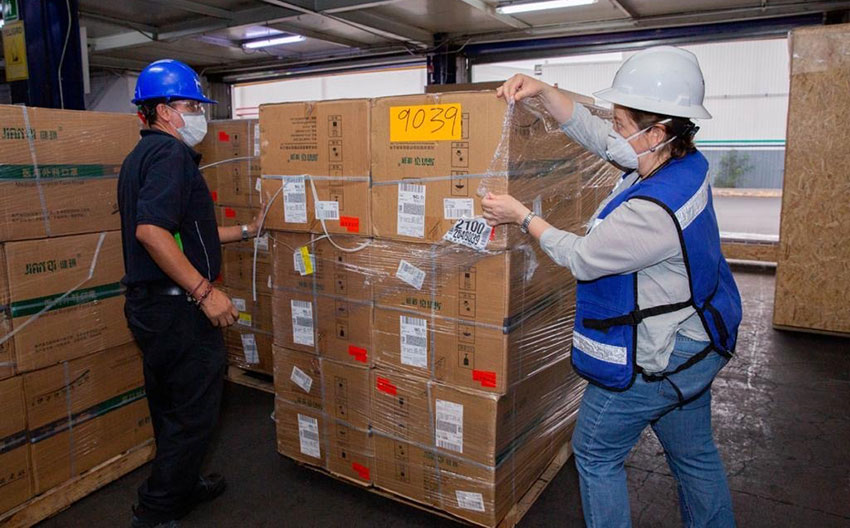
Boxes of medical supplies en route to hospitals in Mexico.

“During Covid, what we’ve been doing is validating vendors. There’s been a lack of product available in the market, and because of that there’s a lot of garbage product,” he said.

Direct Relief Mexico’s three-person team (including him) has to verify products and vendors all the way down the supply chain in order to obtain effective equipment.

“There are a lot of doctors trying to do good, but they don’t have the tools. You wouldn’t send a farmer out into the field without a hoe,” he says.

The other major disaster his organization has seen since coming to Mexico was the pair of earthquakes in September 2017, one of which left Juchitán, Oaxaca, in ruins. However, despite the magnitude of the damage, those two quakes killed 468 and injured over 6,300. According to the latest data, Covid-19 has killed over 9,000 people and infected over 84,000 in Mexico so far.

Direct Relief has also worked to get direly needed cancer medications during a protracted shortage that has gotten so bad that nine parents of kids with cancer began a hunger strike on Wednesday to demand the government finally fix the problem.

“Thank you for helping me get my medications,” says a young, smiling, noticeably healthy boy in a video Eddie shows me from his WhatsApp account. “I’ve finished my treatment. Thank you for everything.”

As the coronavirus pandemic lays bare those parts of the institutions of both countries rendered ineffective by everything from bureaucracy to political infighting to bruised egos, Eddie’s leadership during the crisis is a shining example of how the public and private sectors could behave and interact in order to get better results.

His approach is simple, but effective. Friendly, but professional. “Working in conjunction to create mutual strengths,” he describes it. And being detailed enough to make everything “stupid proof” so that the right supplies get to the right hospitals at the right time.

And the proof is in the hundreds of thousands of units of personal protective equipment his organization has procured for doctors and nurses in hospitals so understocked that staff have gone on strike to demand they be properly equipped.

Eddie emails me the following day to send photos and purchasing figures and says thank you for the opportunity for a regular conversation. I too am grateful for the chance to sit in the shade and tell stories from the past and muse on what we’ll do when we’ve returned to whatever normal is going to be.

All of us could take a cue from Eddie when it comes to how we interact with each other again. If we manage all of our relationships, from the personal to the inter-institutional, with good intentions and the ultimate goal of mutual benefit, we just might see large-scale positive results proportional to what he has achieved during the coronavirus pandemic.

“I want to show Mexico that if you trust, you can accomplish big things.”

Mexico News Daily

Jalisco boxer among 30 best paid athletes in the world

0
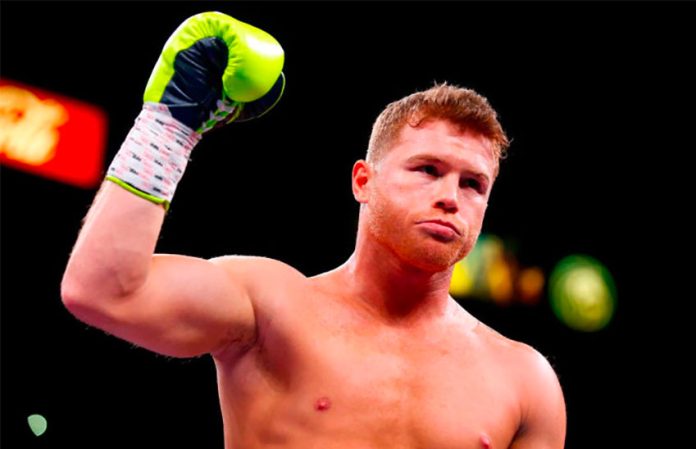
Álvarez is the highest paid Mexican athlete for the fourth year in a row.

Although the coronavirus pandemic has affected his 2020 earnings, professional boxer Saúl “Canelo” Álvarez ranked in the top 30 of the 100 highest-paid athletes in the world as compiled by Forbes magazine.

The 29-year-old pugilist from Jalisco pulled in US $37 million over the last 12 months, $35 million in salary and $2 million more in sponsorships.

Canelo’s only fight during that period was against Russian Sergey Kovalez on November 2 of last year. He won that fight to become the light heavyweight champion of the world and a four-division champion, having won titles in three other weight classes.

This is the boxer’s fourth year in a row as the highest-paid Mexican athlete in the world.

But he could have climbed a bit higher on the list had the coronavirus not brought the boxing world to a halt. Canelo earned $75 million in 2019, his highest-paying year since beginning his boxing career in 2005.

The coronavirus has affected Canelo Álvarez's earnings, which were down from $75 million in 2019.
The coronavirus has affected Canelo Álvarez’s earnings, which were down from $75 million in 2019.

He signed a $365-million, 11-fight contract in 2018 with online sports streaming service DAZN, a payday that comes out to just over $30 million per fight.

Despite such numbers, Canelo still has quite a way to go to reach the world’s top three. Although he hasn’t ranked No. 1 since 2018, Swiss tennis legend Roger Federer topped the Forbes list this year with a whopping $106.3 million in paychecks and sponsorships.

Soccer players Cristiano Ronaldo and Lionel Messi rounded out the top three with $105 million and $104 million, respectively.

Up against other boxers, Canelo comes in fourth after heavyweights Tyson Fury, Anthony Joshua and Deontay Wilder, all in the top 20 with earnings ranging from $46.5 million to $57 million.

As other popular fighting leagues like the WWE and UFC begin to organize closed-door events, the boxing world is hoping it can do the same, and there’s a possible Canelo fight in the works.

The tapatío (Jalisco native) was forced to postpone a fight scheduled for May 5, which he and promoter Golden Boy Promotions hope will take place in September, with or without an audience.

“We’re going to discuss it … with DAZN, with Canelo, with everyone involved … [and] if Canelo approves and is willing to do it and we can make it work for everyone involved, we’ll do it,” Golden Boy Promotions president Eric Gómez told BoxingScene magazine.

All that remains is to find Canelo an opponent. The most likely candidate is Englishman Billy Joe Saunders, who himself told BoxingScene that if they fight in an empty arena, it’ll be like competing on his home turf.

“He’s in my world. He packs stadiums. I fill half of Stevenage football ground. … Big fighters like that, … if he throws a shot and misses, the crowd can get behind him. That plays an effect with the judges and everybody watching the fight. But if it’s silent … you’ve got to focus on that fight even more,” said Saunders.

Meanwhile, Canelo hasn’t let his guard down for a second. Although he’s currently separated from his trainer Eddy Reynoso due to the pandemic, Canelo is continuing to work out at his training camp in San Diego, California.

Sources: Infobae (sp), BoxingScene (en)

Nearly 1 million stolen face masks located in México state warehouse

0
The México state warehouse in which hundreds of boxes of face masks were found.

The México state Attorney General’s Office (FGJEM) has recovered almost a million stolen face masks along with the semitrailer that had been transporting them.

The 638 boxes containing 957,000 N95 masks were found in a warehouse in an industrial park in Tultitlán, north of Mexico City. The stolen goods were valued at 60 million pesos (US $2.7 million).

The tractor-trailer was hijacked on Wednesday, for which the FGJEM opened an investigation and obtained a search warrant for the Tultipark II industrial park. The personal protective equipment (PPE) had been packaged with GPS locators, facilitating its quick recovery.

Search warrant in hand, the FGJEM coordinated with the National Guard and state and municipal police to carry out the search operation.

The Tultipark II industrial complex is jointly owned and operated by real estate developers Parks and E-Group. Mexico News Daily contacted the developers to ask how stolen PPE ended up in one of their warehouses, but both declined to comment.

Source: El Universal (sp)

More than half of ‘municipalities of hope’ have been dropped from the list

0
A steady increase in the number of Covid-19 cases has meant a greater number of less than hopeful municipalities.

The number of Covid-19-free “municipalities of hope” has shrunk by more than half in just 10 days as the infectious disease continues its incursion into virtually all corners of the country.

The federal government initially identified 324 municipalities that hadn’t recorded a single Covid-19 case and didn’t border any with known cases.

The municipalities were given the green light to lift coronavirus restrictions on May 18 and get back to work and school, although most chose not to.

Now, there are just 145 “municipalities of hope” left as the other 179 – 55% of the total – have either recorded a coronavirus case or adjoin one where the disease has been detected.

Thirty-seven of the erstwhile beacons of hope fall into the former category while the other 142 are in the latter.

As a result, Hidalgo, Michoacán, San Luis Potosí and Yucatán no longer have any “municipalities of hope.”

Of the remaining 145, 104 are in Oaxaca; there are nine in each of Guerrero and Puebla; Sonora has seven; five are located in Veracruz; Chihuahua, Jalisco and Nuevo León have three each; and there is one “municipality of hope” in each of Chiapas and Tamaulipas.

Manuel Suárez Lastra, director of the Institute of Geography at the National Autonomous University (UNAM), said that the reduction in numbers is evidence that the pandemic is continuing to expand across Mexico’s territory.

“The number of Covid-19 cases is increasing, … the contagion that started in urban areas has moved to rural areas,” he said, adding that it’s expected that the disease will eventually reach practically all of Mexico’s almost 2,500 municipalities.

Mauricio Rodríguez, an academic in UNAM’s Faculty of Medicine, said that residents of some communities in marginalized “municipalities of hope” have not been adequately informed about how they can protect themselves against infection.

A study by UNAM academics also found that 75% of Mexico’s municipalities are critically, very highly or highly vulnerable to an outbreak of Covid-19 because they have a high percentage of residents aged over 60, have large indigenous populations, lack hospital services and medical personnel and/or are economically disadvantaged.

Coronavirus case numbers and deaths have grown rapidly since the federal government declared the start of phase three of the pandemic on April 21. More than 80,000 people have now tested positive and just over 9,000 have succumbed to the disease, according to official data.

The national social distancing initiative concludes Saturday but every state except Zacatecas has been allocated a red light on the government’s stoplight system to determine which coronavirus restrictions can be lifted and where, meaning that nonessential activities will not recommence on Monday in the vast majority of the country.

Source: El Heraldo de México (sp) 

Workers in US are sending record money home despite shutdowns

0
currency
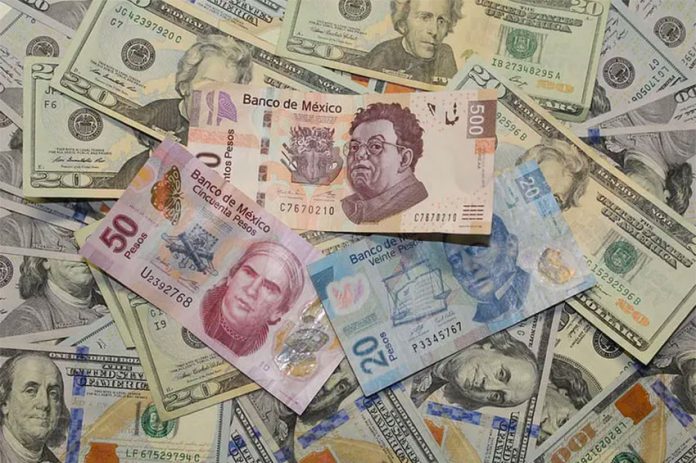
Mexicans living in the US sent US $4.02 billion home in March 2020, a 35.8% increase over March 2019. Jane Russell/WallpaperFlare, CC BY-SA

One might think Mexican immigrants in the U.S. would be sending less money home to their families as a result of the coronavirus.

The 11.2 million people of Mexican origin living in the United States together send upwards of US $38 billion to Mexico each year. This money, called remittances, supports the basic necessities and financial investments of 1.6 million Mexican households – some 10 million people.

In March, analysts at BBVA bank predicted that migrant remittances to Mexico could fall as much as 21% because of stay-at-home orders and record unemployment in the U.S. Instead, remittances reached a record high in early 2020, the Bank of México recently reported. Mexico received $4.02 billion in March 2020, a 35.8% increase over March 2019.

In early May President López Obrador, thanked “our migrant countrymen” for sending record remittances in this difficult period, calling them “living heroes.”

How is this possible, when the unemployment rate in the United States is 18.6% and swaths of the American economy are still shut down? My research on remittances finds three reasons.

With all the talk of the U.S. economy being “closed,” certain sectors are still going strong – particularly, as Mexican American community organizers Rodrigo Camarena and Lorena Korusias wrote in City Limits, those staffed by the Mexican workers doing “some of the toughest jobs in our economy.”

Mexican immigrants are more likely than other workers to be employed in the construction, maintenance, service and production industries, according to U.S. Census data. These are all “essential” sectors of the pandemic economy, though many pay barely above minimum wage.

Employment during this crisis has sustained households that are dependent on every paycheck, both in the United States and back home in Mexico.

These jobs – which require people to leave home and interact with other people – have also disproportionately exposed the Latino population to Covid-19. In New York City, the U.S. epicenter of the pandemic, 34% of all Covid-19 fatalities are Mexican or Latino, while Latinos make up just 27% of the city’s population.

As of May 23, 1,036 Mexicans living in the United States had died of the virus, according to Mexican consular records.

Community advocates attribute the disparate rates of infection and mortality among Latinos to their high-risk working conditions, lack of access to government aid, language barriers and discrimination. These issues are particularly acute for indigenous Mexicans in the U.S.

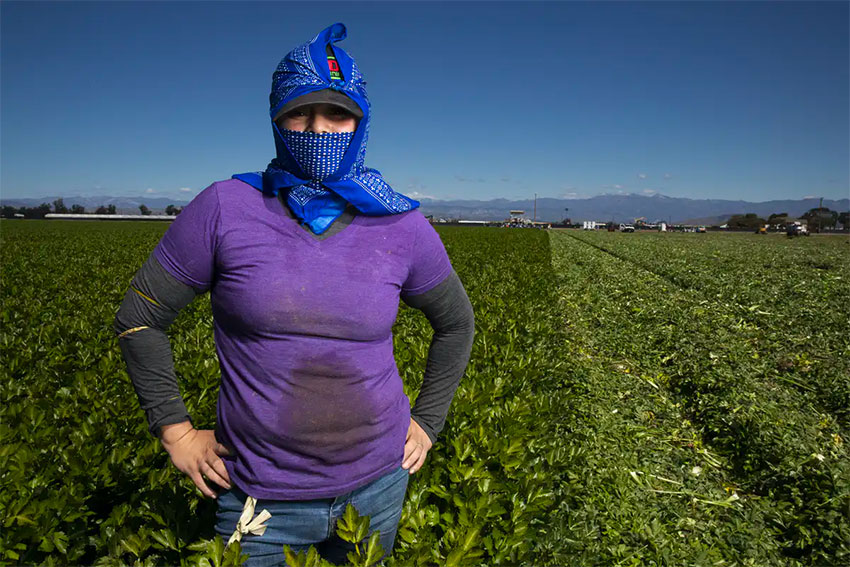
Juana González works 10 hours a day, six days a week alongside other agricultural workers to produce America’s pandemic food supply.
Juana González works 10 hours a day, six days a week alongside other agricultural workers to help produce America’s pandemic food supply.
Brent Stirton/Getty Images

The rise in remittances is also due, in part, to a steep decline in the value of the Mexican peso, according to a recent report by the Center for Latin American Monetary Studies, or CEMLA.

In early March, the purchasing power of $1 rose from 19.42 to 25.35 pesos, a 30.5% increase in just three weeks. That means every U.S. dollar sent to Mexico goes farther. During that same time, the CEMLA report says, the average remittance transfer by Mexican migrants in the U.S. increased from $315 to $343.

This particular increase in sending occurred before shelter-in-place orders took effect in major immigration hubs like California and Texas. In the report, CEMLA economic statistics manager Cervantes Gónzalez says migrants took advantage of favorable exchange rates before the economy began closing to maximize their families’ purchasing power.

On March 23, Mexico began its own gradual shutdown, with the government closing schools, halting many kinds of nonessential business and requiring most people to work from home.

That’s not possible for the estimated 56% of Mexicans who work as domestic laborers, in agriculture and in other informal jobs that lack social security. Their incomes have simply disappeared during the pandemic.

The decline in economic activity in Mexico may have compelled family members working abroad to send more money home, says Gabriela Siller, head economist at Banco Base, a Mexican bank.

Remittance senders have always felt obligated to their loved ones back home, research shows. It’s likely such feelings of care and responsibility would only increase in a crisis such as Covid-19.

In 2019, the World Bank estimated that global remittances exceeded $550 billion – a massive wealth transfer. And the U.S.-Mexico remittance corridor is one of the world’s most significant, with Mexico being the third-largest receiver of remittances.

So far, it’s also proving to be remarkably durable. Remittances from the U.S. are down in many other Caribbean and Latin American countries.

There’s reason to think cash transfers to Mexico will stay strong. Feelings of familial obligation won’t change due to the pandemic, and the exchange rate between the U.S. dollar and the Mexican peso remains favorable for remittance senders. These factors should keep funds flowing south.

But this financial relationship may still suffer as a result of Covid-19. Soaring unemployment in the U.S. is hitting Latino service workers and small businesses hard, as are Covid-19 infections. Eventually, wage loss and sickness could force even the most loving, responsible and reliable person to send less money back home.

Araby Smyth is a Ph.D. candidate and instructor in geography at the University of Kentucky This article is republished from The Conversation under a Creative Commons license. Read the original article.

Ikea plans to begin online sales in the fall but first store might be delayed

0
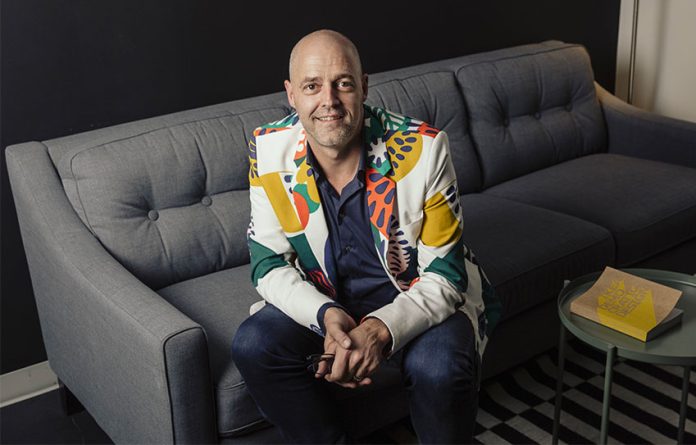
Ikea CEO Pruys.
Ikea CEO Pruys.

Swedish furniture and home accessories retailer Ikea will begin online sales in Mexico in the fall but it is unclear when the company’s first bricks and mortar store will open.

Malcolm Pruys, Ikea’s CEO in Mexico, told the news website Expansión that the company is going ahead with its plan to begin e-commerce sales in the fall but the opening of the first store in Mexico City could be delayed.

Pruys said last May that the company planned to open the store near the Benito Juárez International Airport in October of 2020. However, the CEO says now that he can’t say when the long-awaited store will open.

“If I gave you a date, I’d be lying,” Pruys said.

He said that the company is doing all it can to stick to the plan to open in October but added: “I can’t say that we won’t be delayed.”

Construction has been halted due to the coronavirus pandemic but Pruys said that hasn’t overly upset Ikea’s expansion into Mexico because the company always considers different eventualities in its plans.

He explained that the company’s 110-strong workforce is still working despite the coronavirus crisis, although they’re no longer in the office but in their homes.

Pruys said that he was aware that Ikea will arrive in the Mexican market at a time when the retail industry will be forced to make adjustments in order to operate in a Covid-safe economy.

However, the company has experiences in other countries that will help it in Mexico and has already developed protocols for contact-free home deliveries, he said.

Given that disposable income will fall for a lot of people as a result of the coronavirus-induced economic crisis, purchasing new furniture and other home accessories will likely not be a priority for many.

However, Pruys said that the coronavirus lockdown may have changed people’s relationship with their homes, so there will be an opportunity for Ikea to speak to them about how they can make improvements to their living spaces.

“A lot of people would have spent a lot more time at home and when you spend a lot of time at home you see it quite differently,” he said.

“I wonder if everything I have makes me happy, if I’m well organized, if I have a good couch, if I’m comfortable and relaxed. … There is a great opportunity for us to speak to people about how we can help them with this and how we can improve their homes,” Pruys said.

He added that Mexicans’ confidence in buying online appears to have increased as a result of the pandemic and stay-at-home orders.

“What I see most in the streets at the moment are the vehicles of companies like Mercado Libre and Amazon.”

Ikea is investing approximately US $500 million in Mexico to build its new store, an e-commerce warehouse and a production plant. The company’s retail project leader in Mexico said last year that the store will employ between 300 and 350 people.

Pruys has said previously that Ikea is planning to open more stores in other Mexican cities but didn’t specify when or where.

Source: Expansión (sp)