Home Blog Page 1551

Nearly 3,000 new Covid cases in one day; intensive care beds filling

0
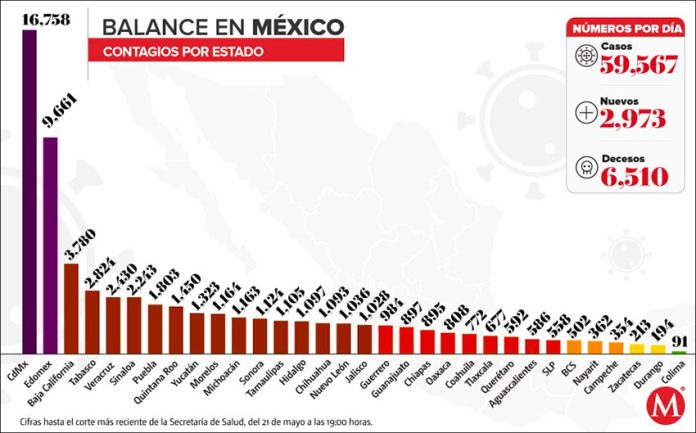
Covid-19 cases as of Thursday evening.
Covid-19 cases as of Thursday evening. milenio

The federal Health Ministry reported almost 3,000 new coronavirus cases on Thursday and more than 400 deaths as hospitals in Mexico City come under increasing pressure due to the influx of seriously ill Covid-19 patients.

Deputy Health Minister Hugo López-Gatell reported a new daily high of 2,973 confirmed cases at Thursday night’s coronavirus press briefing, increasing Mexico’s cumulative case tally to 59,567.

He also reported 420 additional Covid-19 fatalities, four fewer than Wednesday’s record of 424. There have now been 6,510 confirmed Covid-19 deaths since the start of the pandemic.

Based on confirmed cases and deaths, Mexico’s fatality rate is currently 10.9 per 100 cases, almost 70% higher than the global rate of 6.5.

In addition to the confirmed Covid-19 fatalities, López-Gatell said that 769 deaths are suspected of having been caused by the disease but have not yet been confirmed.
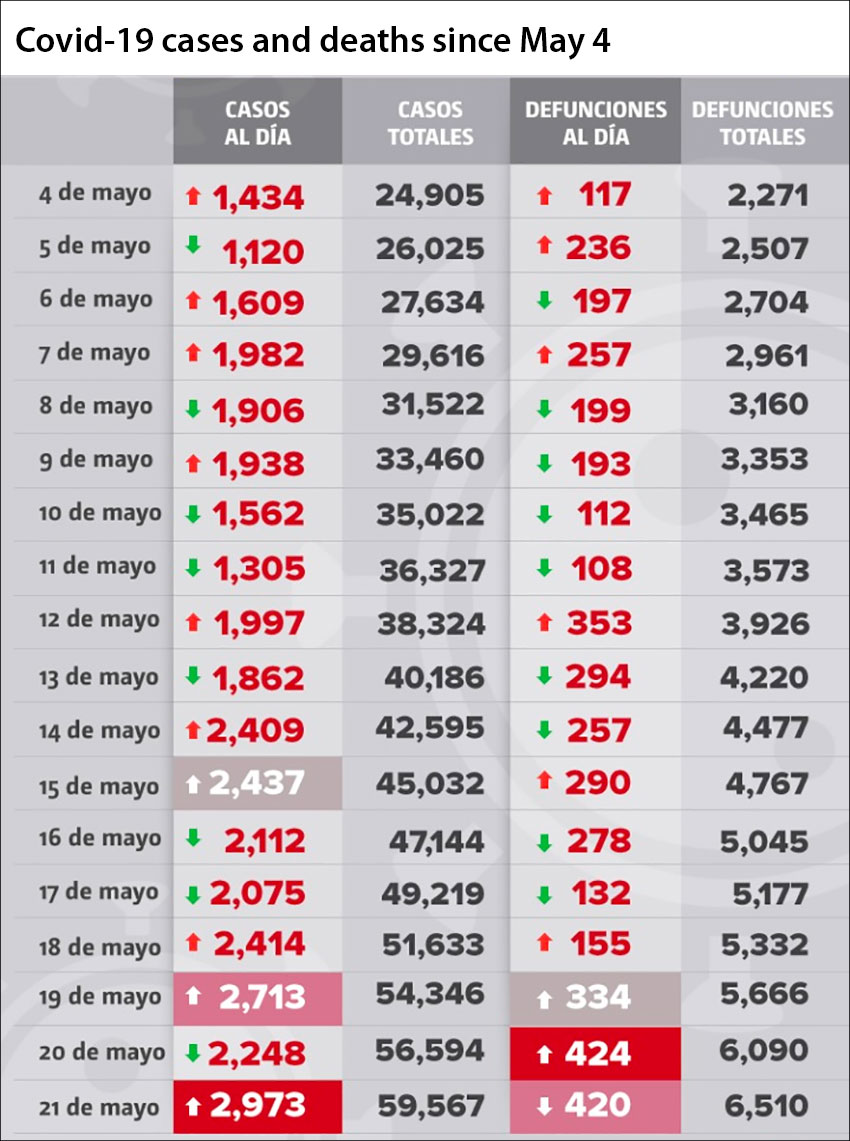
covid-19 cases and deaths
Columns 2 and 4 show the number of cases and deaths recorded each day since May 2. Columns 3 and 5 indicate total cases and deaths. milenio

Of the confirmed cases, 12,905 are considered active, the deputy minister said. There are also 33,291 suspected cases across the country, while the number of people tested has now passed 200,000.

The Valley of México metropolitan area continues to be the nation’s hotspot for active cases, with 3,339 in Mexico City and 1,376 in neighboring México state.

The Mexico City boroughs of Itzapalapa and Gustavo A. Madero rank first and second for active cases among Mexico’s almost 2,500 municipalities. Four municipalities that directly border the capital – Nezahualcóyotl, Ecatepec, Naucalpan and Tlalnepantla – rank first to fourth, respectively, for cases in México state.

As the coronavirus outbreak grows in the Valley of México – the combined number of active cases in Mexico City and México state increased by 24% over the past week – hospitalizations are on the rise.

López-Gatell presented data Thursday night that showed that 72% of general care beds set aside for patients with serious respiratory symptoms in Mexico City and 64% of those with ventilators are currently in use. Both percentages are almost twice as high as the nationwide occupancy levels.

The capital has the lowest availability of both general and critical care beds among Mexico’s 32 states while México state has the third lowest. Guerrero has the second lowest availability of general care beds while Baja California has the second lowest availability of beds with ventilators.

According to a map developed by the Mexico City government, intensive care beds are full at 31 of 44 designated Covid-19 hospitals in the capital and only one – La Villa Children’s Hospital – has “high availability” of critical care beds. The other 12 Covid-19 hospitals have a “moderate” amount of space available in their intensive care wards.

General care beds are full at 26 of the 44 hospitals and again only one has “high availability” of beds for new patients.

Mexico City has now recorded 1,754 coronavirus-related deaths, according to official figures, although media reports have claimed that fatalities in the capital are being drastically underreported.

The death toll in the capital is almost triple that of Baja California, which has recorded 637 fatalities, the second highest total in the country. México state ranks third for Covid-19 deaths, with 622 as of Thursday.

Mexico now has the 10th highest coronavirus death toll in the world, according to the John Hopkins University tally, having passed Canada after Thursday’s fatalities were reported.

With almost 95,000 Covid-19 fatalities as of Friday morning, the United States has the highest death toll in the world followed by the United Kingdom and Italy.

Source: Milenio (sp) 

Veracruz hospital workers battle Covid-19—and poor-quality equipment

0
Staples help prolong the life of a face mask at Veracruz hospital.

In Veracruz’s Covid-19 epicenter, health workers at one hospital say they are not just battling the contagious disease but also poor-quality personal protective equipment (PPE) that places them at increased risk of infection.

Health workers at the IMSS No. 14 High Specialty Medical Unit (UMAE) in Veracruz city told the newspaper Reforma that it has been a struggle to get any PPE at all but much of what they have received has been substandard.

“Since the [health] emergency started, it’s been difficult to deal with [IMSS] authorities to get equipment,” said one nurse.

“We had to protest twice so that they would pay attention to us. Then they finally gave us personal protective equipment but — what a surprise — it was of poor quality,” she said.

The nurse said that the medical goggles and Chinese-made face masks health workers received were not good quality, explaining that the masks tear easily. She also said that there is a lack of medical gloves at the hospital in the port city, where almost 40% of Veracruz’s 2,288 confirmed Covid-19 cases have been detected.

“If there are gloves, they’re large size ones. It’s very difficult to work with gloves that aren’t your size. It might seem like a little thing but it’s very hard to work like that,” the nurse said.

Due to the poor quality of the masks they were given, health workers have bought N95 masks using their own money and have even resorted to using staplers to repair damaged ones and thus extend the length of time they can be used, she said.

The nurse added that she and many of her colleagues have also had to purchase their own medical gowns.

As the healthcare staff have battled to save the lives of seriously ill Covid-19 patients, at least two of their colleagues have been infected and one of them lost his life to the disease.

An administrative worker died on Wednesday last week after testing positive for Covid-19, Reforma reported, and a nurse is hospitalized in a serious but stable condition.

The hospital also lacks other essential supplies such as rubbing alcohol and antibacterial gel, and some of the approximately 100 ventilators are faulty, a doctor said.

However, one thing the facility doesn’t lack is hospital beds, he said, explaining that 318 are currently available.

“Even though there are a lot of admissions, there are also a lot of deaths,” he said before questioning whether all Covid-19 fatalities are being reported by Veracruz health authorities.

“They’re not recording them properly; I think they lie in the statistics,” the doctor said.

According to the state government, 284 Covid-19 patients have died since the start of the pandemic, including 77 in Veracruz city.

However, the doctor claimed that there were more Covid-19 deaths at the UMAE during a two-day period earlier this month than those reported by the state Health Ministry for the entire city of Veracruz.

Despite the challenges and risks of working at the IMSS facility, one nurse responded bluntly when asked by Reforma whether she had considered “abandoning ship.”

“Abandon ship? Never! I love what I do and I feel happy to be able to help during this [pandemic].”

Source: Reforma (sp) 

AMLO prepares to launch new index, an indicator of happiness, well-being

0
Is everyone as happy as AMLO? His new index may provide the answer.

President López Obrador is preparing to launch an “alternative index” that will measure people’s happiness and well-being in addition to economic growth.

“I’m working now on an index to measure well-being, an alternative index to the so-called gross domestic product. I’m going to present a new parameter that will measure growth but also well-being and degrees of social inequality,” he told reporters at his regular news conference on Thursday.

“Another ingredient in this new parameter, this new paradigm, [will be] the happiness of the people. The technocrats won’t like it, … but if they don’t like it, it’s probably good for us,” López Obrador said.

“There are countries where the level of happiness is measured and that’s part of well-being. I’m making the formula, we’re going to apply it in Mexico. It’s a different measurement system and we’ll probably also contribute to having other parameters in the world in order to know if there really is well-being. … It’s not just about accumulating wealth and even less so if wealth accumulates in just a few hands,” he said.

“The distribution of income is what’s important, the distribution of wealth – well-being, in other words.”

In developing his new index, López Obrador said that he will consult with the United Nations Economic Commission for Latin America and the Caribbean and seek contributions from econometricians, mathematicians, economists, sociologists, anthropologists, psychologists and other experts.

“… It’s something new, an interesting contribution; thinking about the return to the ‘new normal’ [from the coronavirus pandemic], we can’t continue living in the same way,” he said.

The president has long railed against using GDP growth as a sole measure to assess the performance of the economy and in turn people’s economic and social well-being, although he embraced it as a target when he took office

Despite widespread poverty, violence and a range of other social problems that trigger frequent protests, López Obrador has claimed that the people are “happy, happy, happy” with their lot in life.

However, with the coronavirus-induced economic crisis predicted to push as many as an additional 10.7 million people into poverty, happiness soon might not be as widespread as he thinks.

More than 750,000 formal sector workers have already lost their jobs due to the pandemic and an untold number of those who toil in the informal economy have seen their incomes plummet if not dry up completely.

Analysts and financial institutions are forecasting a deep recession for the Mexican economy in 2020, providing López Obrador with added incentive to attempt to divert focus from GDP figures that will almost certainly make for reading that is more “sad, sad, sad” than “happy, happy, happy.”

Source: Reforma (sp) 

Investigation of Puerto Vallarta police urged for alleged abuse

0
The woman who disobeyed coronavirus rules in Puerto Vallarta.

The Jalisco Human Rights Commission (CEDHJ) has asked Puerto Vallarta Mayor Arturo Dávalos Peña to open an investigation after a video circulated on social media of police officers violently arresting a woman for not respecting coronavirus guidelines. 

The woman and a companion apparently went around police tape on the city’s closed waterfront area to take a selfie over the weekend and removed their masks to do so.

Officers asked the couple to leave the restricted area, which they say they were trying to do when they were arrested. 

A man filmed a 57-second video of the woman being forced into handcuffs while a female police officer had her in a chokehold, then shoved her into a seat in the back of a pickup while she shouted and complained that the female officers were hurting her. 

“Why are you arresting her?” the man filming the video kept asking a male police officer who tried to keep him away from the incident.

“It is requested that the Commissioner of Public Security identify the police officers that intervened in the events and, where appropriate, carry out the corresponding administrative procedure guaranteeing their right to a hearing and defense,” the text from the CEDHJ states. It also cautions that officers must be trained to avoid harassing, threatening or intimidating citizens for not adhering to coronavirus restrictions. 

The Puerto Vallarta police said in a statement on Tuesday that the couple were verbally aggressive toward arresting officers and had been drinking and disobeyed orders to leave the beach. Police said they paid a fine upon arriving at the police station and left in less than 40 minutes. 

The mayor’s office admitted the officers involved were at fault for using force but stated that they were only enforcing state health measures.

Source: El Occidental (sp), Uno TV (sp), Mural (sp)

Statistics agency reports ‘significant increase’ in corruption last year

0
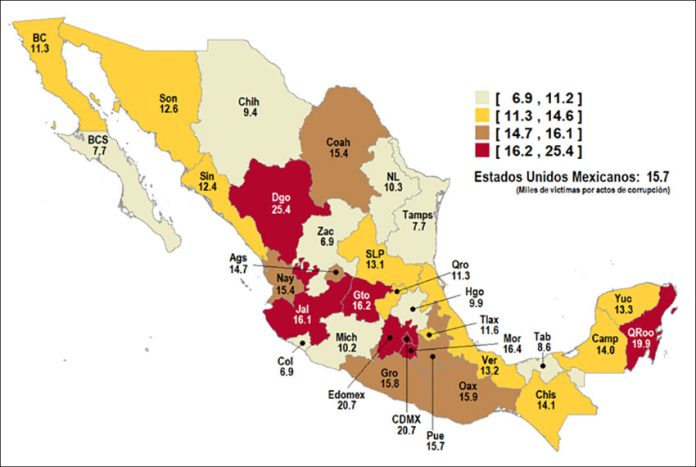
Victims of corruption per 100,000 inhabitants
Victims of corruption per 100,000 inhabitants (in thousands of victims). inegi

The federal government’s anti-corruption agenda has succeeded in reducing people’s perceptions of the scourge but has not actually curtailed it, according to a study by the federal statistics agency Inegi.

Published on Thursday, the biennial National Survey on Governmental Quality and Impact shows that 87% of those polled in 2019 believe that corruption occurs frequently in government institutions, a 4.1% decline compared to 2017, the second last year of the corruption-plagued administration led by former president Enrique Peña Nieto.

However, the Inegi study found that there was in fact “a statistically significant increase” in corruption in 2019 – the first full year of President López Obrador’s administration – compared to two years earlier.

Inegi found that 15,732 people per 100,000 inhabitants were victims of corruption in 2019, a 7.5% increase compared to the 14,635 victims in 2017.

The statistics agency also found that the incidence of corruption increased from 25,541 acts of corruption per 100,000 residents in 2017 to 30,456 in 2019, a spike of 19.2%.

corruption

Just under 60% of those acts were related to interactions between citizens and police, Inegi found. An example is a police officer asking for a bribe – the famous mordida – from a person who committed, or allegedly committed, a crime in exchange for not proceeding with a formal charge.

Inegi found that citizens also frequently experience corruption when completing bureaucratic procedures, such as applying for a new driver’s license or requesting a police clearance certificate, and in interactions with the court system.

A request to have the electricity connected or re-connected can also prompt a counter-request for a supplementary payment to ensure that the process runs smoothly, the statistics agency found.

Inegi determined that the total paid out by citizens in corruption-plagued transactions in 2019 was 12.77 billion pesos (US $555.6 million at today’s exchange rate). The figure is 64.1% higher than in 2017 when corruption-related payments totaled 7.78 billion pesos.

An average of 3,822 pesos (US $166) was corruptly plucked from the pocket of each person affected by corruption in 2019, Inegi said, a 56% increase compared to 2017.

The prevalence of corruption was found to be worst in Guerrero, Durango and Coahuila, where more than half the total population were found to be victims of corruption last year.

However, Guanajuato – Mexico’s most violent state – recorded the biggest increase in both the prevalence of corruption (the percentage of citizens affected) and the incidence of corruption (the number of acts of corruption per capita) between 2017 and 2019. The prevalence of the scourge increased 80.6% in the Bajío region state and the incidence surged 161.2%.

The prevalence of corruption also increased in Puebla and Durango but declined in Chihuahua, Tabasco and Zacatecas. The incidence of corruption went up in Puebla, Quintana Roo and México state but declined in Baja California Sur, Nuevo León and Zacatecas.

The data showing that overall corruption has not declined since the federal government took office is a blow for López Obrador, who has made combating the scourge the raison d’etre of his administration.

The government is “sweeping away” corruption from top to bottom like a staircase is cleaned, the president often quips.

But the Inegi data indicates that eradicating corruption – a practice engrained in many parts of government and society – is far easier said than done, even though López Obrador claimed last September that there was no longer any corruption within the federal government.

On a more positive note for López Obrador, satisfaction with the federal government increased to 47.2% of respondents compared to 45.5% in 2017 — when Enrique Peña Nieto was in power — and confidence in it doubled from 25.5% of those polled three years ago to 51.2% last year.

Source: La Jornada (sp) 

Baja businesses investigated for water theft, illegal sewage discharges

0
Governor Bonilla said the audit findings are 'the tip of the iceberg.'

Government officials are investigating transnational and local companies for the theft of water in Baja California. 

Those under scrutiny include Coca-Cola, Samsung and Hyundai, as well as the Fimbres chain of convenience stores and luxury apartment builder Guakil. In total, 400 companies are under investigation for water theft and illegal sewage dumping causing losses of 1.15 billion pesos, over US $50 million.

An audit conducted by the state government revealed that the companies defrauded the State Public Services Commission by consuming industrial quantities of water at household rates, installing illegal water taps and discharging sewage in defiance of regulations. 

So far, Governor Jaime Bonilla reports, the state has recovered some 330 million pesos, about US $14.4 million, from companies that negotiated with the government and agreed to pay back the money owed. Those who refused will be charged with theft from the nation, he warned, and reported to tax authorities.

The Morena party governor accused the offending companies to have been in collusion with the previous administration, which was under the control of the National Action Party (PAN), and that politicians have used the water utility to fund their electoral campaigns.

Making the list of alleged offenders are businesses owned by various political figures from opposition parties, including former Tijuana mayor Jorge Hank Rhon of the Institutional Revolutionary Party (PRI), former PAN governors Eugenio Elorduy Walther and Francisco Vega and others. 

They join businesses such as Pemex in Playas de Rosarito, movie theater chain Cinépolis, the Calimax supermarket chain, the Las Rocas de Rosarito hotel and the regional offices of the Pacific Airport Group which manages the Tijuana International Airport. 

Some water thefts go back 27 years, the government says. 

Even a church was found to be hooked up illegally to a sewer line. 

Bonilla says he will provide weekly reports each Wednesday on the progress of the investigation, which he calls the “tip of the iceberg.”

Source: Jornada (sp)

In 200 communities in Campeche and Yucatán, no one comes or goes

0
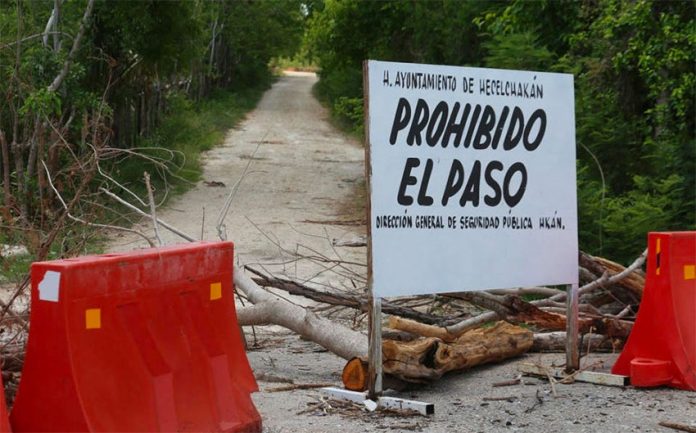
'Do not enter,' reads the sign outside Hecelchakán, Campeche.

The coronavirus lockdown is a serious affair in many communities in Campeche and Yucatán: no outsiders are allowed in and almost no locals leave.

Residents of about 200 communities in the two southeastern states have blocked access roads for almost two months using whatever they could find – rocks, tree branches and trunks, traffic cones, plastic barricades and even tarps and pipes.

With a lack of healthcare facilities that are capable of treating seriously ill coronavirus patients, the residents of communities located along the Campeche-Mérida highway are determined to stop the invasion of Covid-19 at any cost.

According to a report by the newspaper Milenio, no outsiders are allowed into the cordoned-off communities, not even distributors of food to local stores.

Instead, small groups of people, mainly men, periodically leave their communities to buy groceries and other essential items for all local residents. The designated shoppers scour markets, supermarkets and stores in order to tick off every item on their lists before returning to their communities.

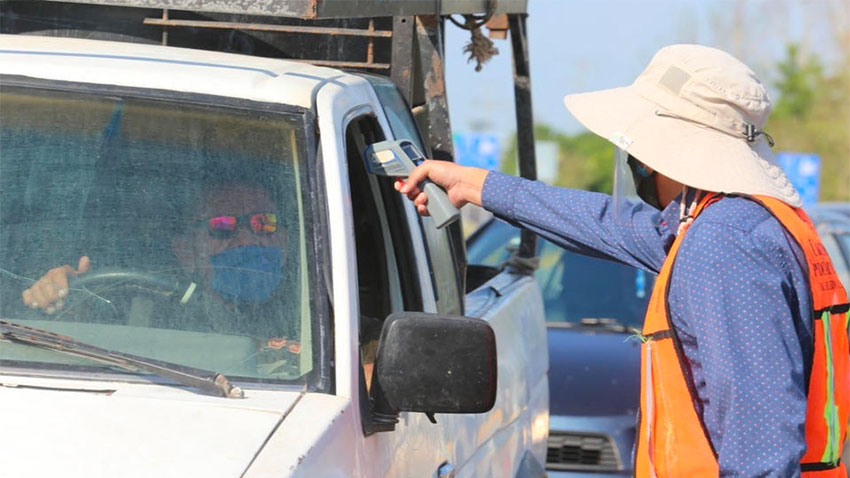
Travelers are subject to temperature checks.

Upon arrival, their vehicle is disinfected and each and every product purchased is painstakingly cleaned before delivery to local families, Milenio said. The shoppers themselves are required to shower before coming into contact with their families.

One person who has witnessed just how serious the residents are taking the coronavirus preventative measures is 35-year-old albañil, or mason, José Ictec.

He told Milenio that he was allowed into one community to collect his tools from a construction site but has been blocked from all others even when he was attempting to collect payments he is owed.

“That’s the way it is everywhere: Calkiní, Carmen, Champotón, Hecelchakán, Hopelchén, Palizada, Tenabo, Escárcega, Calakmul and Candelaria,” Ictec said, referring to 10 of the 11 municipalities in Campeche.

With so many communities blocked off and authorities continuing to urge people to stay at home, highway traffic is virtually nonexistent in Campeche but motorists who do venture out face temperature checks at checkpoints set up by state authorities.

Despite the efforts to keep the coronavirus at bay, only one Campeche municipality – Escárcega – is coronavirus-free, according to a federal government map, but two others, Tenabo and Hopelchén, have only recorded one case each.

The Gulf coast state has recorded a total of 328 Covid-19 cases since the start of the pandemic, with the highest number – 173 – detected in the municipality of Carmen. There have been 48 coronavirus-related fatalities in Campeche, the eighth lowest death toll among Mexico’s 32 states.

There are several coronavirus-free municipalities in Yucatán but the state has the ninth highest number of cases in the country.

Rural parts of the state are faring much better than the state capital Mérida, where almost 60% of Yucatán’s 1,244 cases have been detected. A total of 97 people have been confirmed to have lost their lives to Covid-19 in the state, a figure that accounts for just 1.6% of Mexico’s 6,090 coronavirus-related fatalities.

Source: Milenio (sp) 

Mexico has 1,900 species of bees and they’re all at risk: biologist

0
bees

All of Mexico’s 1,900 different species of native bees are at risk of extinction, says Ricardo Ayala Barajas, a National Autonomous University researcher based at the Chamela Biology Station in Jalisco.

Most of Mexico’s bees do not sting and only 47 species produce honey, but all native species are endangered, explained the researcher on the United Nations World Bee Day, May 20. 

In an interview with the newspaper Milenio, Ayala said that around the world there are approximately 20,000 different named species of bees, and like in Mexico, every one is threatened by the use of insecticides and deforestation.

“A great effort is required to try to reduce the use of insecticides and make more careful use of natural resources, for the future of humanity and to care for the bees that help plants reproduce and generate fruits and seeds,” Ayala said. “We must appreciate and understand them more in order to prevent them from disappearing,” 

Bee conservation is on the rise in Mexico, just as it is globally.

In Guanajuato, people who kill bees or harm their habitat can be fined up to 8,000 pesos (US $350). In Yucatán, the government and communities are collaborating on a bee conservation project after significant bee populations have died, thought to be a result of crop dusting. A similar campaign is underway in Campeche.  

Beekeeping in Mexico has been around for some 3,000 years, according to earth.com, and the nation’s beekeepers watch over some 2 million hives with annual honey export profits totaling some US $56 million per year.

Source: Earth.com (en), Milenio (sp)

Mexican-made ventilator ready for coronavirus patients

0
The new ventilator, made in Mexico.

After a month and a half of development, biomedical engineers at the National Institute of Health Sciences and Nutrition Salvador Zubirán are ready to roll out a new ventilator for the treatment of Covid-19 patients.

The engineers developed the VSZ-20 based on an older Mexican model and consulted with doctors to make sure their new version met needs specific to the treatment of coronavirus patients.

“We needed precision equipment that gives the exact pressure and volume of air we need from the ventilator,” said Guillermo Domínguez Cherit, deputy director of critical medicine at the institute, which is operated by the Ministry of Health.

“Having our own resource, developed in this country, offers the advantage of not having to be looking elsewhere,” said Cherit’s colleague David Kershenobich. 

Nearly all the ventilator’s parts were made in Mexico to circumvent the possibility of shortages on the global market in the future.

Engineers tested the ventilators on artificial lungs, as well as healthy pigs and pigs with pneumonia. The VSZ-20 has been approved by the Commission for Protection Against Sanitary Risk (Cofepris) and is ready to be used on people. Some 1,500 ventilators will be produced immediately for distribution by the federal government. 

Each unit costs US $10,000, which is significantly lower than the typical market price of US $30,000 to $50,000.  The ventilators were manufactured and assembled with the help of a team from the beverage company Femsa, automotive component manufacturer Metalsa and the Monterrey Technological Institute. 

“It is a very meticulous process,” said Carlos Guerra, Metalsa’s mechanical engineer, whose team worked long hours and weekends in order to get the prototype ready and will be producing the ventilators at their Nuevo León factory.

Another made-in-Mexico ventilator, scheduled for delivery May 15, has been delayed. The director of the National Council for Science and Technology (Conacyt) announced April 23 that at least 500 would be produced weekly, with the first delivery in mid-May.

The Ministry of Health said on Sunday that the machines had not yet been delivered.

Hospital occupancy in Mexico reached 39% yesterday, and 32% of all intensive care beds for critically ill patients requiring intubation were full. However, in hot spots those numbers are much higher. In Mexico City only 22% of intensive care beds are vacant, and in Guerrero that number is 40%, the news agency Infobae reported.

Source: Infobae (sp)

Two Bengal tigers seized in Tlaquepaque, Jalisco

0
One of two Bengal tigers seized by authorities in Jalisco.

Federal authorities seized two Bengal tigers from their owner in Tlaquepaque, Jalisco, after a video of men lassoing one of the big cats on a city street was posted on social media last week.

The federal environmental protection agency Profepa discovered that the owner of the tiger is a resident of Tlaquepaque, although no authority has been able to determine where the incident in the video occurred.

Profepa agents visited the owner’s property and observed the facilities in which the two tigers were being held. One male and one female, they appeared to be in good physical condition and showed no signs of maltreatment.

The owner presented the agents with the proper legal documentation for possession of the two tigers, which revealed that the male tiger is aged 10 months and the female two years, nine months.

Despite the authenticating paperwork, the Profepa agents seized the two animals for the owner’s failure to register them with the federal Environment Ministry (Semarnat). He had also failed to draw up a plan for caring for the animals and getting it authorized by Semarnat.

Profepa will hold the animals while their owner obtains the authorizations he needs. He will be able to take them back upon complying with all federal regulations.

Source: El Universal (sp)