Home Blog Page 1586

Academics predict coronavirus crisis to peak at 151,000 cases in mid-August

0
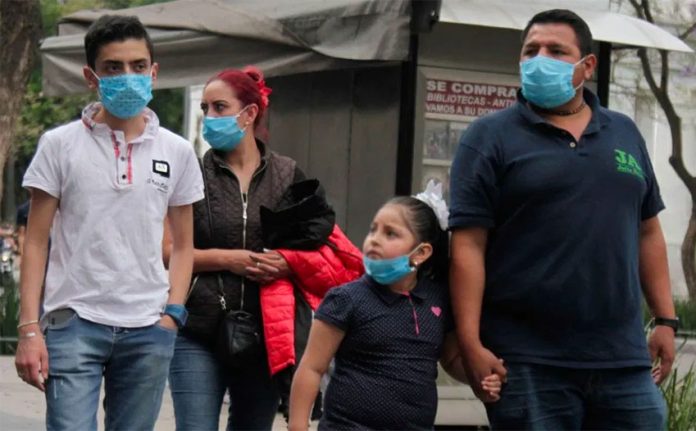
family with face masks

Coronavirus cases will peak in Mexico in the middle of August at more than 151,000 but the epidemic curve will start to fall in the middle of May, according to two researchers at Mexico City’s Metropolitan Autonomous University (UAM).

Roberto Gutiérrez Rodríguez, head of the economics school at the UAM Iztapalapa campus, and Marco Antonio Pérez, a doctor in social sciences, predict that Covid-19 cases will peak at 151,774 in approximately four months from now.

“If health conditions and the international environment allow it,” there will be no new infections “after that point,” the researchers said in a statement issued Monday that cites data from their essay entitled Modeling the Spread of Covid-19 in Mexico.

Gutiérrez and Pérez predict that the epidemic curve will continue to rise until the middle of May at which time they anticipate there will be 55,836 Covid-19 cases in the country, a figure more than 50,000 higher than the 5,014 confirmed cases reported by the federal Health Ministry on Monday.

They said that the nation’s health system will need to be well-prepared to respond to the high number of cases in the middle of May because, according to their modeling, more people will be sick at the same time then than at any other stage of the pandemic.

covid-19

The number of cases reported on a daily basis will start to decline in the second half of May, the researchers predict, a phenomenon that would allow the process of flattening the curve to begin.

Their mathematical modeling was based on public and private hospital data as well as the number of confirmed Covid-19 cases announced by the Health Ministry last Wednesday.

While the ministry reported that there were 3,181 confirmed cases that day, Deputy Health Minister Hugo López-Gatell said that data collected via a “proven, scientifically founded” epidemiological surveillance system suggested that the real number of cases in Mexico was more than 26,000.

The researchers said that they didn’t use the higher number for their modeling because doing so would imply changes to a range of other instructive data about the coronavirus pandemic in Mexico. The fatality rate, for example, would decrease from 5.47 per 100 cases (based on April 8 numbers) to 0.66, they said.

Gutiérrez and Pérez also offered a worst-case scenario for the coronavirus outbreak in Mexico, stating that as many as 6.3 million people could conceivably be infected with Covid-19 and 189,00 could die.

The academics said that their information “is important to determine the pace of growth of Covid-19 in society” but they acknowledged that the situation is fluid and therefore making predictions is difficult, “especially in the medium and long term.”

The “discipline of society” in terms of respecting social distancing recommendations and maintaining good hand hygiene, among other factors, will have an impact on the pace of growth of new Covid-19 infections, they said.

Given that “the infection rate is not constant or linear,” the academics said that they would update their predictions on a weekly basis.

Three week ago, when there were just 405 confirmed cases of Covid-19 in Mexico, López-Gatell said that authorities expected a “long epidemic that could extend until September or October.”

A group of specialists in emergency medicine predicted last week that as many as 10,500 cases of Covid-19 in Mexico will be serious and could require treatment in intensive care while the Pan American Health Organization said in March that there could be as many as 700,000 serious, potentially fatal cases of the disease.
Source: Notimex (sp), Infobae (sp) 

In Mexico, an unfolding presidential tragedy: Financial Times

0
The crisis has exposed 'new and dangerous weaknesses' in López Obrador's governance.

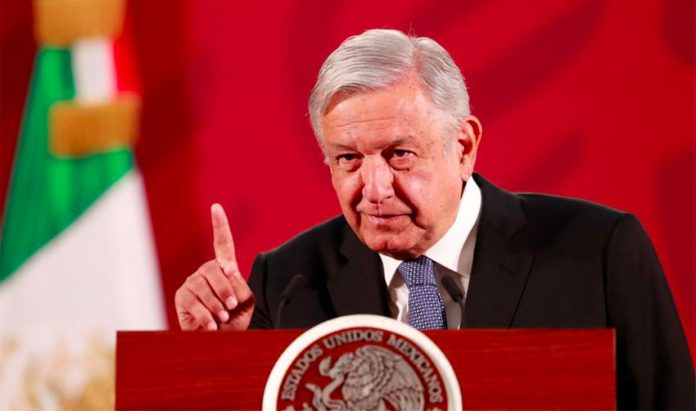
The business newspaper Financial Times has blasted President López Obrador for his response to the coronavirus pandemic, predicting that Mexico is likely headed for a much worse crisis in the coming years of his government unless he quickly changes course.

In an opinion piece published on Tuesday, the newspaper’s editorial board said that the coronavirus crisis has exposed “new and dangerous weaknesses” in López Obrador’s governance.

The board charged that he acted erratically in the first weeks of the pandemic, pointing out that he repeatedly violated his own government’s social distancing advice and even shook the hand of the mother of Mexico’s most infamous convicted drug trafficker, Joaquín “El Chapo” Guzmán.

It also noted that he urged Mexicans to continue eating out at restaurants and hug each other “long after the rest of the world locked down.”

The president even suggested that coronavirus “fits perfectly” with his plan to transform Mexico, the board added, claiming later in its editorial that López Obrador has been relaxed about the country’s “dire shortage” of hospital beds and a coronavirus-testing rate that is among the lowest in the world.

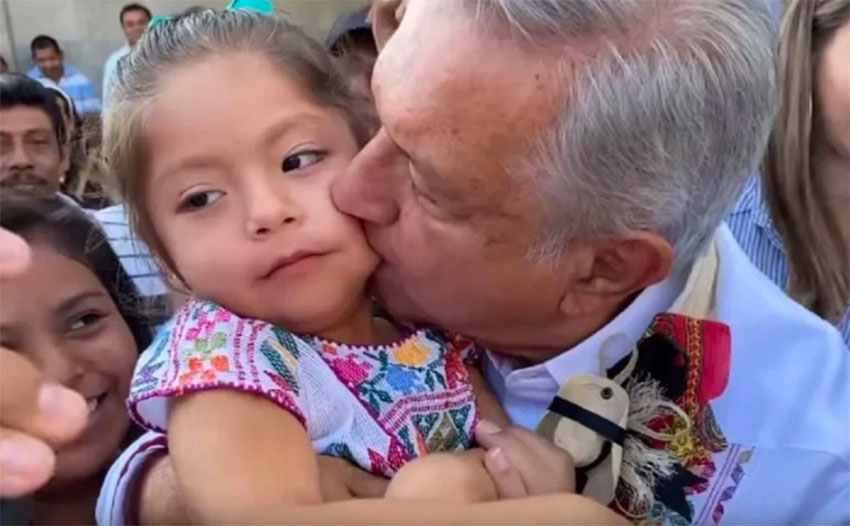
The president kisses a child in March, as the coronavirus outbreak was beginning.
The president kisses a child in March as the coronavirus outbreak was beginning.


“Mr. López Obrador’s bungled responses and erratic behavior in the first weeks of the pandemic suggest that the country is heading for a much worse crisis in the remainder of his six-year term unless there is a dramatic change of course,” the Financial Times said.

The board said that some of López Obrador’s behavior, “particularly the coronavirus denial and undermining of medical experts,” has been similar to the conduct of other populist leaders in the region, namely United States President Donald Trump and Brazil’s Jair Bolsonaro, who described Covid-19 as “a little flu.”

However, in denying the need for a large stimulus package to rescue the economy from an inevitable coronavirus-fueled recession, AMLO, as the president is best known, is “in a class of his own,” the opinion piece said.

Even though “the market consensus is that Mexico will be among the countries worst hit by the pandemic because of its reliance on U.S. manufacturing, tourism, remittances and oil,” López Obrador has “ruled out extra borrowing, tax breaks or bailouts,” the Times said.

Mexico’s stance contrasts with that of the United States and Brazil, both of which have announced large countercyclical stimulus packages, the board said.

It noted that AMLO is instead betting that greater government austerity, increased oil production and an ongoing commitment to his administration’s large infrastructure projects will help Mexico through the crisis.

However, as a result of the government’s economic and health policy response to the coronavirus pandemic,“more and more voices in Mexico’s elite are speaking of a looming tragedy,” the Times said.

“Business leaders have proposed an alternative virus response plan. The odd dissenting voice within Mr. López Obrador’s governing alliance can sometimes be heard. But Mexico has an imperial presidency and an imperious president. Time is perilously short.”

Politicians from all political parties as well as state governors and business leaders should together formulate a “comprehensive economic and health” plan to confront Covid-19 and “press it upon their president,” the editorial board said, adding that legal action should be taken against his “more questionable” polices.

“The appalling human catastrophe of Venezuela stands as a clear warning of what another four and a half years of Mr. López Obrador could do to Mexico,” the Times concluded.

Mexico News Daily 

The haves and the have-nots in an era of a global pandemic

0
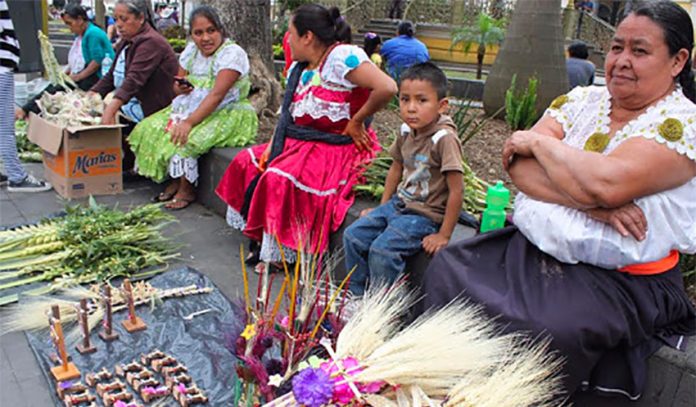
Street vendors in Veracruz
Street vendors in Veracruz: not fixated on their health.

In this unprecedented time of fear and economic fallout, borders have been closed and nations are taking extreme measures to battle the spread of Covid-19.

This is my first time witnessing a world crisis on this scale from outside the United States. The other week, this headline caught my eye: “Mexico cannot afford to close its border with the U.S.” This country simply cannot survive without goods crossing the border.

And, despite having fewer coronavirus cases than the United States, stopping all Americans from entering Mexico is also not a viable economic option.

But as a U.S. citizen, living in a country that cannot afford to take the same precautions as wealthier nations during a pandemic, I am reminded of not only the privilege I unconsciously take for granted, but also the economic reality of a country with fewer options available to it.

Headlines that talk about when U.S. citizens will be receiving their stimulus checks now strike me as a luxury. You can be certain that the Mexican government will not be mailing its citizens checks to cover their financial losses.

Yesterday, in the midst of walking down the street and spraying sanitizer on my hands, I passed a man sitting on the sidewalk and weaving mesh seats for chairs. The visual contrast between the two of us hit like a ton of bricks. Here I was, spraying hand sanitizer, fixated on germs and obsessing over the precautions people take when they have the resources and time to think beyond just daily survival. And here this man was, weaving chairs and hoping to sell enough of them to scrape by for that day.

I have no idea if the virus was on his radar at all. And if so, if it even mattered, given the necessity of needing to sell chairs to have enough money to buy food. Potential devastation is great for the poorest of the poor in Mexico’s small towns. They are some of the people who could be hit the hardest, in every possible way, by this pandemic.

The Mexicans I talk to have told me that the people here are generally worried about other things — economic uncertainty, loss of income, and violence — much more than the virus itself. Getting sick does not top their lists. The fixation on health is indeed a luxury of the upper classes.

Of course, health is directly related to people’s ability to work and to the economy. But you need a certain level of secure resources in order to give the full scope of your attention to warding off germs, monitoring how your body feels, and practicing the encouraged norm of social distancing.

Yet my experience of the Mexican people thus far is that, despite their country’s more precarious economic reality, they are exhibiting greater levels of peace than my American counterparts. There is a tangible sense of well-being in the Mexican culture, even in the midst of very real and difficult troubles. This is linked, at least partially, to an overall greater acceptance of life, including both illness and death.

There is less of a sense of self-preservation here than in the States. And I’m discovering that when there is less emphasis placed on self-preservation, there is less to be anxious about. Simply put, there is less to defend.

These cultural contrasts highlight a paradoxical connection between resources, wealth, and inner well-being. It seems that the more we have to defend, the more anxiety, stress, and intensity we will experience in defending it.

So as we continue to navigate our way through fearful media reports fixating on stock market losses, job losses, and other uncertainties that concern those who already possess quite a bit, let us not forget that entrenched privilege still rears its head in times of crisis and offers greater protection to some and not to others.

Let us be aware of the have-nots in our midst, whether in Mexico, the U.S., or around the globe, and work with greater urgency to address experiences of inequality. For compassion and care for all is the only way to move towards a truly healed planet and a more just world.

Karen Kinney is an artist and writer based in Los Angeles and San Miguel de Allende.

Sonora nopal farmer turns to Facebook in hopes of making more sales

0
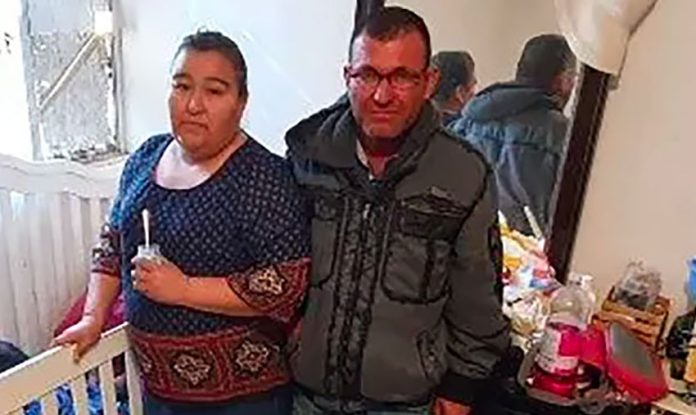
Nopal farmers Judith and Alfredo Rivera.

As the economic effects of Covid-19 have brought his business to a grinding halt, a Sonora nopal farmer has turned to social media in hopes of connecting with the customers he once found on the streets and in the market.

Alfredo Rivera has cultivated prickly pear cactus for its spongy, slimy pads and sugary fruits for 40 years on his farm in Hermosillo, and although the cactus is a staple in many Mexican households, his sales have dropped to almost nothing in the last few weeks.

“It’s very difficult to sell because the streets are empty,” said his wife Judith. “For us it’s hard because we live day to day and we don’t have other resources, so we struggle a lot.”

She said it has been extremely difficult for her and her family to lose not only the business but the trust of their regular customers who now don’t want to leave home or have any contact with others.

Judith assured their customers that her husband follows strict protocols when handling and delivering the product.

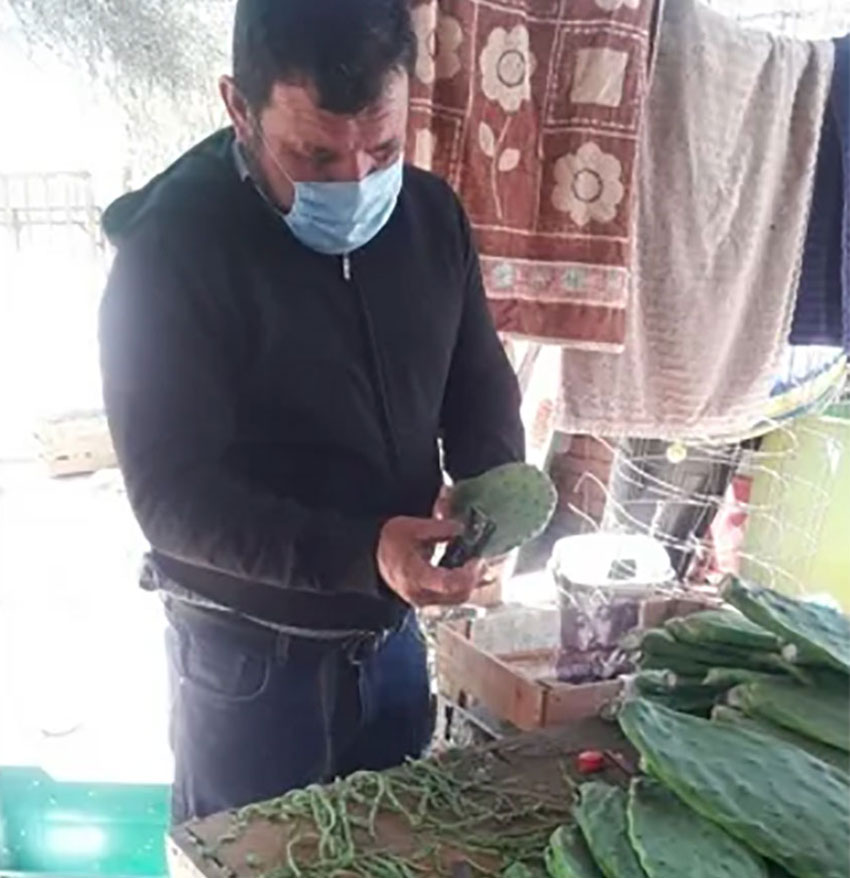
Rivera prepares nopal for sale.

“My husband is in charge of making the deliveries on his motorcycle and he takes with him face masks, hand soap, water for handwashing and antibacterial hand gel, which will serve to avoid contagion and should make people feel safe enough to receive their deliveries.”

But physical distancing isn’t the only thing keeping customers away, as the lack of work is a problem for many in the community. “Also, as some people from town aren’t working, they don’t have the funds to buy from us,” she said.

The lack of demand led Alfredo Rivera to start a Facebook page under the name Productos Rivera in hopes of reaching more customers, but the response has been tepid so far.

“Unfortunately there has been little response,” Judith said. Opened on April 5, the group had 83 followers as of Tuesday afternoon.

Although the mitigation measures have put their home finances in jeopardy, she said they are following them rigidly due to a number of underlying conditions that make them more vulnerable to Covid-19.

Her 21-year-old son Joel has a condition known as Sanfilippo syndrome, a degenerative disease affecting the brain and spinal cord that can cause facial dysmorphism, seizures, movement disorders and dementia later in life.

“That’s why we take care to avoid that he has any complications. Also, I’m diabetic, hypertensive and asthmatic, so we’re very vulnerable and run a high risk of contracting the virus,” she said.

The situation may be difficult, but the family still has hope.

“We’re going through a difficult moment, [but] we hope that soon everything will bounce back for the good of humanity … We’re going to endure it as best we can and [listen to] what God says.”

Source: El Universal (sp)

Coronavirus pandemic no barrier to Maya Train construction

0
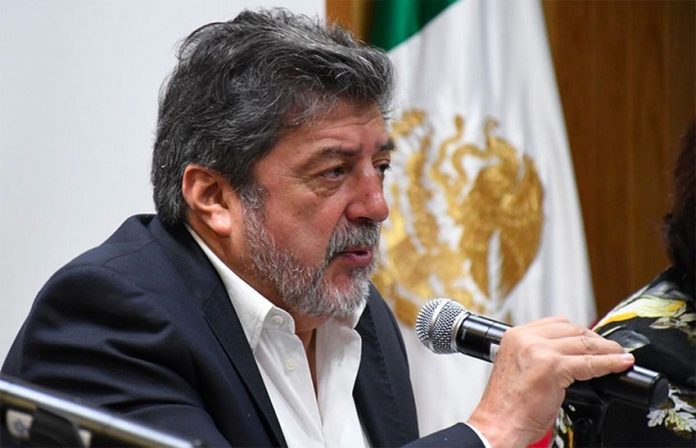
Fonatur chief Jiménez.

The coronavirus pandemic will not stop President López Obrador’s signature infrastructure project.

Rogelio Jiménez Pons, head of the National Tourism Promotion Fund (Fonatur), told reporters on Monday that the president ordered the continuation of the Maya Train railroad project during the worsening Covid-19 outbreak.

Speaking outside the National Palace after meeting with López Obrador, several cabinet ministers and the CEO of a company that will build part of the new railroad in the country’s southeast, Jiménez said that the president “wants all of us to be working” on the government’s infrastructure projects despite the suspension of nonessential activities announced on March 31 to limit the spread of Covid-19.

Fonatur is managing the US $6-$8 billion Maya Train project, which will link cities and towns in the states of Tabasco, Campeche, Yucatán, Quintana Roo and Chiapas.

“The fundamental message is that the [infrastructure] projects have to be done because they are [of] strategic [value] to the country,” Jiménez said.

He said that the construction company ICA, whose CEO Guadalupe Phillips attended the National Palace meeting, has almost completed the basic engineering work for a section of track it will build between Izamal, Yucatán, and Cancún, Quintana Roo.

ICA will build a double-track railway on the southern side of the Kantunil-Cancún highway and add two new lanes to the road, Jiménez said. The twin projects will cost about 3 billion pesos (US $127.8 million) and start on May 29, he added.

The Fonatur chief said that he will meet again with López Obrador, Communications and Transportation Minister Javier Jiménez Espriú and other top officials in two weeks to discuss the progress of the 1,500-kilometer project.

A judge last month granted a definitive suspension order against its construction to a group of Maya and Ch’ol people in Campeche but it only applies to one community in the municipality of Calakmul. The Fonatur chief said that he wasn’t aware of any other legal action aimed at stopping the project.

In addition to announcing that Fonatur will continue to work on the Maya Train through the coronavirus pandemic, Jiménez revealed that a deputy director of the project, Javier Carrillo, tested positive for Covid-19 two weeks ago.

“He doesn’t have a fever anymore but he says the headaches are insane,” he said.

Although he had contact with the official before he became sick, Jimenez said that he hadn’t experienced any coronavirus symptoms and consequently hasn’t been tested.

“What I do do is go out with a mask,” he said, explaining that he wanted to avoid any possibility that he might infect others.

Source: Reforma (sp) 

Family’s initiative to fabricate face masks has produced 40,000 to date

0
One of the masks produced by the family project.

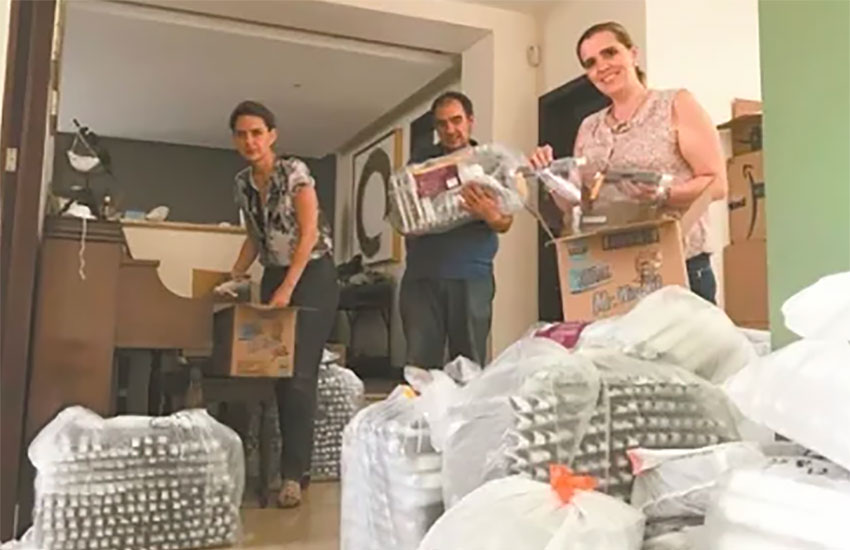
A nurse’s Facebook plea for empty, plastic one-liter soda bottles has turned into a home industry for Maribel Diez and her family.

Nurse Lourdes Rodríguez Santoyo recorded a video asking for people to donate the plastic bottles so she could make face masks for her colleagues at the Tacuba General Hospital in Mexico City to provide protection against the coronavirus. Diez not only took up the call, she did one better — make that 40,000 better — and counting. 

Diez and her siblings started a fundraising page on March 25 asking for donations to help fund a project to make the masks themselves. Each mask costs about 10 pesos (US $0.42) in materials, and Diez’s siblings and friends would provide the labor for free. 

“That’s the day I knew I could help,” Diez says. 

To date, 361 people have donated 200 pesos (about US $8.50) each via the website, and although the original goal when the campaign started was to make just 5,000 masks, by April 13 they had already made 40,000, with a new goal set at 80,000. The masks have been donated to over 100 hospitals and clinics across Mexico. 

Maribel Diez and her brothers, makers of face masks.
Maribel Diez and her brother and sister, makers of face masks.

Outside Mexico City, over 4,000 masks have been sent to Baja California, Coahuila, Colima, Guerrero, Hidalgo, Morelos, Nayarit, Querétaro, San Luis Potosí, Sinaloa, Tabasco, Tamaulipas and Veracruz. Around 150 more clinics have been placed on a waiting list as production ramps up. 

Teamwork and the simple desire to help others are what’s behind this heroic effort, and now more than 100 families have joined the Diez family’s project. Due to social distancing, most have never seen the other volunteers face-to-face. 

Those who want to help are sent an instructional video and each works on one of several steps in the production of masks before sending them on, similar to a production line. 

The Diez family’s niece, María José Robles, is a gynecology resident and helps connect the boxes and boxes of masks with healthcare professionals.

“We look for people who have direct contact with patients; nurses, doctors and medical residents,” she says. “Those are the people we feel will make the best use of these materials.”

The project’s Facebook page is full of photos of medical staff smiling from beneath the plastic masks, the result of one family’s initiative — adopted by scores of volunteers — that may actually be saving the lives of countless Mexican health workers and the patients they treat. 

“We’re not a success story,” says Diez. “We will be when Mexico beats this virus.”

Source: El Universal (sp)

With the gym out of bounds, try these hammock routines

0
Conchi León turns her hammock into a gym.

With gyms, yoga studios and public parks all closed, it can be difficult to find a way to stay in shape during the Covid-19 quarantine, but a Yucatán actress has come up with a clever way to do it.

All it takes is a hammock.

Actress Conchi León of Mérida looked at the hammock hanging in her home and saw an opportunity to get her heart rate up and perhaps shed a few pounds.

Christening her workout space Hammock Gym, León posted a video demonstrating the exercises on April 12 that went viral on social media and had garnered over 14,000 views by Tuesday afternoon.

“You are all telling me that you’re worried about getting fat during the quarantine,” she says from the comfort of her red and white striped hammock, dressed in a traditional embroidered frock decorated with designs unique to her region called a huipil.

Hamaca Gym (Sketch)

“So I’m going to show you this routine that even Bárbara de Regil doesn’t have,” she says in reference to the popular Mexican actress whose workout videos have also gone viral during the quarantine.

With names for her unique full-body exercises like Rocking Horse and Death’s Pass, León’s charisma and love for the camera shine through in the video as she cracks jokes and shouts at her viewers to “Smile! Smile! Smile!” during one strenuous move.

She ends the workout with a relaxing cross-legged pose she calls Flor de Elote, or cornflower, a play on the Spanish words elote, corn, and loto, lotus.

The laughs León generates might actually burn more calories than her three-minute Hammock Gym routine. After finishing up with a quick half minute of meditation, she smells lunch cooking and quickly ends the video.

Another Yucatán artist, singer Jesús Armando, also enjoyed social media popularity over the weekend when the video of his original song Jaranavirus went viral. The singer used the rhythm and melody of the traditional Yucatán musical genre jarana to urge people to abide by the government’s quarantine and physical distancing measures.

Source: El Universal (sp)

Doctors are ‘falling like flies’ in Tijuana, Baja California governor warns

0
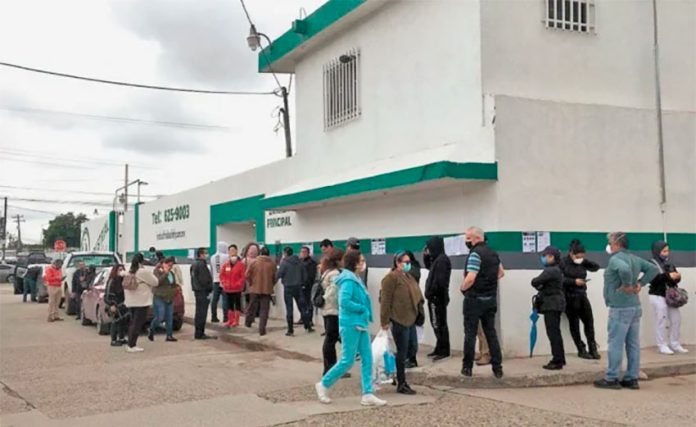
The Tijuana clinic where 21 workers have been infected with Covid-19.

The governor of Baja California has warned that doctors are “falling like flies” in Tijuana due to a lack of personal protective equipment (PPE) amid the worsening coronavirus pandemic.

Jaime Bonilla made the remark in a video live streamed to social media on Monday, stating he was particularly concerned because doctors at the Institute of Social Security (IMSS) public clinic No. 20 in Tijuana who have become ill with Covid-19 also work at the city’s IMSS General Hospital.

“What concerns me … is that the General Hospital has the same doctors as [the] Social Security [facility]. We’re seeing now that they’re falling like flies because they weren’t given protection,” he said.

According to the newspaper El Universal, 21 health workers at the IMSS No. 20 facility have tested positive for Covid-19 and 15 others are suspected of having the disease. There is one confirmed case among workers at the IMSS General Hospital and six others are suspected of being infected.

One health worker who asked not to be identified out of fear that he would lose his job told El Universal that when patients with respiratory problems first started arriving at the No. 20 clinic, employees were not told that they were suspected of having Covid-19.

Julio (not his real name) also said that that staff don’t have sufficient PPE to protect themselves while treating coronavirus patients, explaining that hospital authorities expect workers to wear the same mask for as long as 20 days.

“My colleagues have had to buy their own [protective] equipment, … there are long lines to buy gowns and masks because they’re not giving us enough,” he said.

Health workers at the No. 20 clinic have also taken to social media to complain about the lack of PPE. One was Dr. Faustino Ruvalcaba, who posted a letter to Facebook in which he outlined the situation.

Eugenio Derbez, a famous actor and comedian and friend of Ruvalcaba, read the letter in a video posted to Twitter on Sunday.

According to Derbez, the letter said that the hospital was overwhelmed with both confirmed coronavirus patients and people who have been diagnosed with atypical pneumonia.

“The public has no idea what is happening in the hospital. The third floor was prepared for the exclusive use of patients with coronavirus, but it is already full,” he said, reading from Ruvalcaba’s letter.

AMLO, left, and Derbez
AMLO, left, and Derbez: another conservative plot?

“We don’t have the equipment and material to be able to protect ourselves. … What we are using is equipment bought [with money] out of our own pockets. We’re spending more than a quarter of our salaries … to buy equipment,” the letter said.

Derbez begged for help for the public hospitals on Mexico’s northern border, calling on citizens to donate items such as masks, gowns and goggles.

In response, the IMSS chief in Baja California accused the actor of spreading fake news. Dr. Desirée Sagarnaga Durante said in a video posted to Twitter that there was no doctor by the name of Faustino Ruvalcaba at the IMSS No. 20 clinic, charging that the letter was made up.

Her video, which had been viewed 1.5 million times as of Tuesday morning, triggered a social media backlash against Derbez, The San Diego Union-Tribune reported.

Derbez countered with another Twitter video posted beneath a message that read: “No … it’s not fake news. It’s sad that more time is being spent trying to hide the truth than saving lives.”

“There have been a number of attacks against me and the doctors saying that this is all a lie,” he said in the video. “I just hung up with doctors at the clinic and I want to tell everyone that what I say is true. … I don’t like to get involved in politics. I’m not attacking anyone,” Derbez said.

A reporter for the news website Noticias Ya subsequently tracked down Ruvalcaba, interviewed him and shared the video on Facebook. He confirmed that the situation at the IMSS No. 20 clinic is indeed dire.

“The epidemic has completely exceeded our weapons [to control it]. That’s clear,” Ruvalcaba said.

Governor Bonilla also came to Derbez’s defense, saying in his video address on Monday that while he may not have the complete and exact information about the situation at the IMSS clinic, many health workers there have become ill with Covid-19. He said that he has been worried about the IMSS health system since the beginning of the coronavirus pandemic.

“I felt that our Achilles’ heel was going to be the social security [system], because I saw a lot of detachment. There was no concern. I did not honestly see the social security delegation concerned about the issues,” Bonilla said.

For its part, IMSS said in a statement on Sunday that it “promptly attended and controlled an external contagion in several workers” at the No. 20 clinic in Tijuana.

The outbreak “was not attributable to [a lack of] personal protection equipment, nor to the care of suspected or confirmed [Covid-19] patients,” it said.

President López Obrador, meanwhile, blamed his adversaries. He told Tuesday’s press conference that “the conservatives” have launched a disinformation campaign that co-opts well known personalities to relay their message and “stop the transformation of Mexico.”

He cited an athlete, a recording artist and a comedian as being among those who have been recruited in order to “maintain the system of corruption.” Soccer star Javier “El Chicharito” Hernández, singer Thalía and now Derbez have all been critical recently of the López Obrador administration.

There were 368 confirmed cases of Covid-19 in Baja California as of Monday but state Health Minister Alonso Pérez Rico has acknowledged that the real number of cases is probably much higher.

Alheli Calderón, a medical researcher at the College of the Northern Border, said earlier this month that it is not plausible that Mexico’s northern border states have so few cases of Covid-19 compared to the states they adjoin in the United States.

California had more than 24,000 confirmed cases of Covid-19 as of Tuesday morning, according to a New York Times database, almost 2,000 of which are in San Diego, located just across the border from Tijuana.

Source: El Universal (sp), The San Diego Union-Tribune (en) 

For 2,100 pesos, private medical lab offers home testing for Covid-19

0
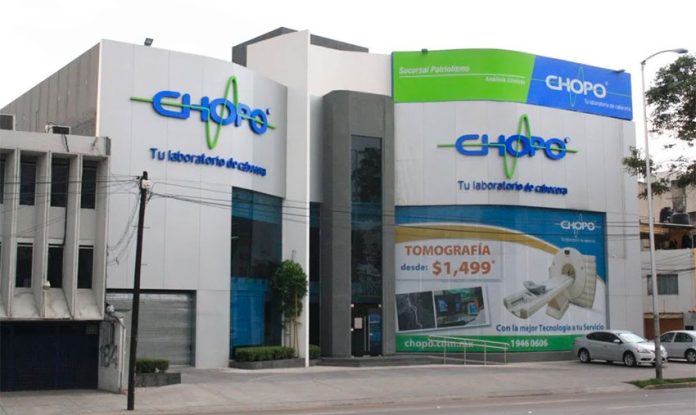
El Chopo will begin offer testing in the home on Wednesday.

A private medical laboratory has announced that it will begin offering Covid-19 testing in Mexico City and other urban areas across the country beginning on Wednesday.

Laboratorio Médico del Chopo expects to carry out as many as 350 tests daily, with 80-100 of those being administered in the home and the rest at El Chopo locations and at a mobile lab, said a spokesperson for parent company Grupo Proa.

Eduardo Arvizu Marín called the test’s 2,100-peso (US $89) price tag “very competitive” compared to what other labs have offered during the coronavirus crisis.

Some private hospitals in Mexico City were charging as much as 10,000 pesos (US $424) for coronavirus tests in March.

El Chopo said it will collaborate with sister company Laboratorio Carpermor to maximize its testing capabilities in México state, Puebla, Querétaro, Tlaxcala, Jalisco and San Luis Potosí, in addition to Mexico City.

The testing process will begin at the Laboratorios El Chopo website, where anyone who believes they have symptoms of Covid-19 can fill out an online form to determine if they are a viable candidate for testing.

The online form will separate possible candidates into three groups, informing patients that they should either see a doctor immediately, go to a hospital due to their symptoms or that they are a viable candidate for the test.

Viable candidates can make an appointment for El Chopo staff to visit their home and conduct the test there.

Arvizu said that the polymerase chain reaction tests are not the fastest screening instruments on the market and that will take 24-48 hours to yield results.

The lab’s strategy in the capital includes a mobile testing unit to which people who suspect they have Covid-19 symptoms can go for testing, but Arvizu noted that the unit will prioritize patients who are clearly showing symptoms.

To be located at Calle Homero 1910 in Polanco, the mobile testing center could be replicated in other cities, but Arvizu said that “for the moment, only [Mexico City] has the mobile unit.”

The federal government has been criticized for its response to the emergency, which experts said in late March has not involved sufficient testing for the disease.

Laboratorio del Chopo has more than 200 locations in more than half of Mexico’s 32 states.

Sources: Milenio (sp), Grupo Fórmula (sp)

Quintana Roo orders mobility restrictions, use of face masks

0
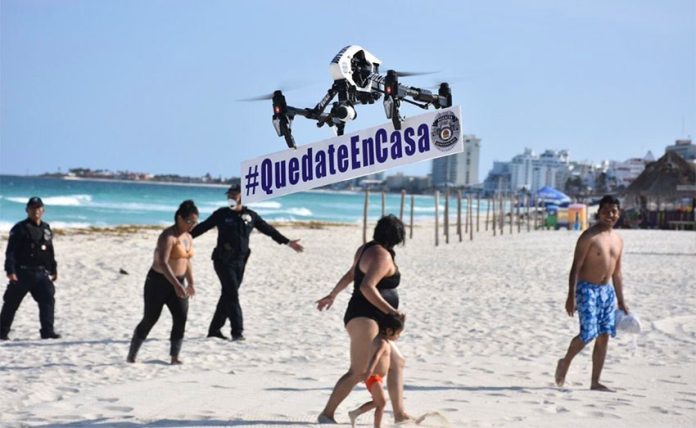
Quintana Roo has put police drones to work carrying the 'stay at home' (Quédate en casa) message.

As phase three of the coronavirus pandemic looms on Mexico’s horizon, Quintana Roo continues to tighten public health measures. 

The governor of the state has now made the wearing of face masks mandatory in public and limited vehicle occupancy to just one person when residents need to go out for supplies. 

The new restrictions were added to a list of coronavirus measures that already included road closures, health checkpoints, drone surveillance, limited hours for the sale of alcohol, and others designed to limit the spread of the pandemic. 

“It is necessary to apply more severe measures to save lives. We must guarantee the constitutional right to health for the people of Quintana Roo, there can be no doubts or hesitation, and we will not allow political haggling. Saving lives requires everyone’s absolute complete cooperation,” Governor Carlos Joaquín González announced Monday. 

State police will be enforcing the measures. 

Also, supermarkets and drug stores must implement social distancing policies while bars, casinos, beaches and non-essential businesses must remain closed. 

Alcohol sales have been further restricted and are now limited to 10 a.m. to 5 p.m. through the end of April.

Finance Minister Yohanet Torres Muñoz reminded citizens that the state has put in place certain measures to provide economic relief, including discounts on car registration fees and the issuance or renewal of driver’s licenses. In addition, some state taxes have been deferred.

Governor Joaquín called for unity during admittedly difficult times. “Let’s understand that we all need each other right now. These are moments of solidarity to preserve life. We must make sacrifices that we did not expect, but we need to face decisively this unfortunate pandemic which took humanity by surprise,” he said in an address to residents. “Only unity, solidarity and personal and collective discipline will allow us to save lives, protect our families and, in due course, recover our economic growth.”

Quintana Roo, with an estimated population of 1.7 million, currently has 239 confirmed cases of coronavirus and has recorded 22 deaths.

Source: Reforma (sp), El Economista (sp)