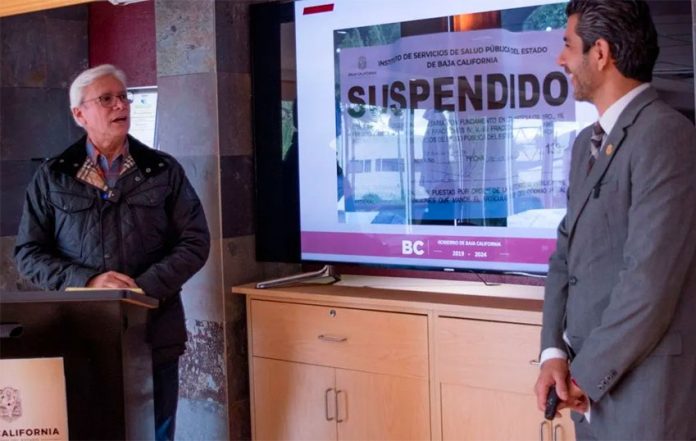
Bonilla, left, announces the closure of manufacturer Smiths Medical.
The Baja California government has temporarily closed a medical device company in Tijuana after it refused to sell ventilators to the state to treat Covid-19 patients.
Governor Jaime Bonilla Valdez announced the closure of the Tijuana facilities of the United States company Smiths Medical on Thursday during a live video address posted to social media.
“I established contact with Foreign Minister Marcelo Ebrard to reach an agreement with said company because it’s not just Baja California that needs ventilators but the whole country. The corporation’s response was that they set up [in Tijuana] to create jobs and that the ventilators assembled there are committed to other countries,” he said.
“The decision was taken that if … companies don’t support or contribute to the state … [during] the health emergency, they are considered [to be undertaking] nonessential activities,” Bonilla said.
While Bonilla railed against Smiths’ refusal to sell ventilators to Baja California, the president of a Tijuana-based business group said the company’s stance was justified.
Carlos Higuera of the industry group Deitac said that it would be illegal for Smiths to sell products to the state government because it is part of the government’s manufacturing and export services program known as Immex. Companies with Immex permits that allow them to operate in Mexico must export 100% of the products they manufacture, he said.
“Immex manufacturing companies by … law cannot sell products in national territory. … Their legal status obliges them to sell all that they produce abroad,” Higuera said.
“The state government is asking for something that goes against the law,” he said, adding that if it wants to buy ventilators from Smiths it should do so in the United States.
Higuera said that Smiths and any other companies that have been forced to close even though their business activities are considered essential according to the government’s definition have the legal right to seek compensation.
Smiths could be deserving of significant government compensation because it will be unable to manufacture for a certain period of time and as a result will be unable to meet its contractual obligations with customers, he said.
The Deitac chief charged that the decision to temporarily shut down the company’s Tijuana factory, and the federal government’s cancelation of Constellation Brands’ brewery project in Mexicali after a public consultation in March, will make it more difficult to attract investment to Baja California.
Whether at poolside or on the beach, e-readers work well in bright sunlight.
If you live in Mexico, finding good books in English is difficult in the best of times and a major headache when a pandemic has you under siege.
On March 20, my favorite bookshop in Guadalajara, La Perla Records and Books, closed its doors in solidarity with the stay at home coronavirus measure.
I would like to suggest e-books as an alternative, but if you are as old as I am, you probably have a firm prejudice against them. Still and all, I beg you to let me state my case in their favor. Bear with me!
The most common reaction to e-books (on the part of pre-millennials) is “I’m a romantic. I love the heft of a real book, the crinkle of real paper, the musty smell of a classic, riddled with wormholes … and besides, I can’t stand reading anything on a computer screen.”
I, too, had those feelings once upon a time, but curiosity got the better of me and I bought a flat little reader called a Kobo, into which I could download almost any book I wanted, often for free.
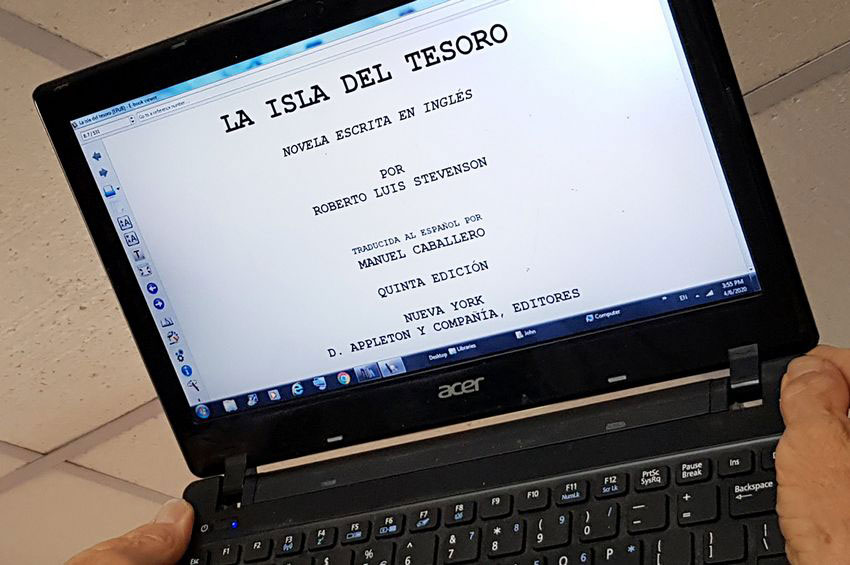
Install calibre in that old laptop and turn it into an e-reader!
I hate to say this, but I missed the crinkle and smell of paper for all of 15 minutes. As for the “heft of a real book,” only five minutes of reading in bed convinced me that most printed books are cumbersome and too heavy.Sorry, an e-reader weighs slightly less than a typical paperback, and turning its pages is far easier (just a tap on the screen will do the trick), but guess what? The screen of an e-book reader is not at all like a computer’s.
An electronic paper surface (such as E ink), for example, is non-glare, non-radiating and not lit from behind. I found it was as readable as paper and totally usable in the brightest sunshine. But the greatest argument for e-readers is, in my opinion, the ease with which you can instantly change the size of the letters to suit the needs of your own eyes.
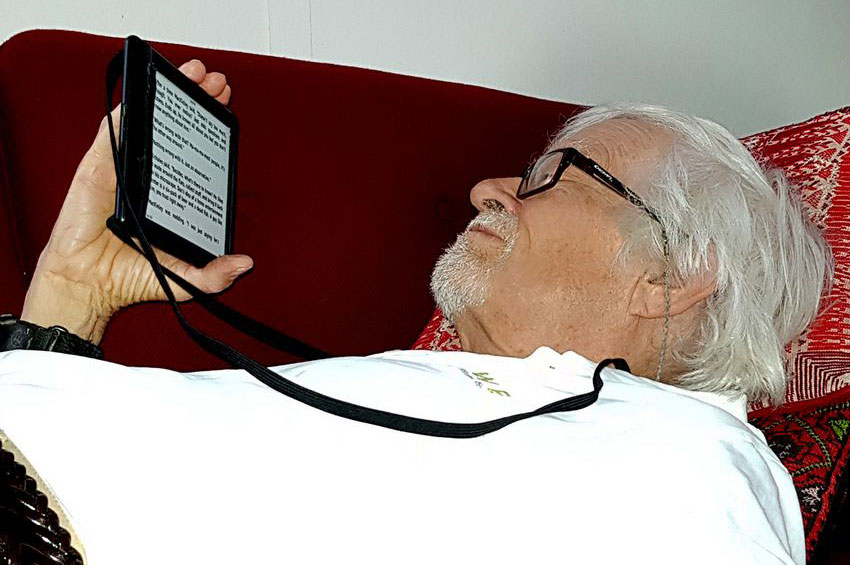
The one disadvantage I’ve found: if you fall asleep while reading, your Kindle may slide off you, hit the floor and never work again. Solution: make your own loop strap by attaching a long piece of elastic to the back of your device with a trusty, indestructible product like Shoe Goo.
If you opt for a Kindle, that bestseller you heard about will download into it (with no work on your part) a half-second after you pay for it on Amazon. Now, if you’re upset that e-books cost about the same as paper books, note that Amazon regularly drops the prices of certain e-books literally to nothing or almost nothing on certain days.
To find websites that announce these short-lasting bargains, go to Free Kindle Books & Tips, Kindle Nation Daily or Kindle Buffet. Each of these sources lists different bargain books.
Want to read the classics? You’ll find over 60,000 of them at Project Gutenberg, said to be the oldest digital library in the world and containing mostly older literary works published before 1924.
Attach a loop to your e-reader and there’ll be no problem if you fall asleep.
According to Encyclopaedia Britannica, Project Gutenberg is a nonprofit organization that got its start on the 4th of July, 1971, when a student at the University of Illinois, Michael Hart, decided to type the U.S. Declaration of Independence into the school’s computer system for distribution free of charge. Hart then went on to type in the works of William Shakespeare and the Bible.
It’s hard to believe, but it seems Hart transcribed around 100 books over the following 20 years and in time the project grew to include thousands of volunteers around the world. In the 1990s, scanning (with Optical Character Recognition) began to replace transcribing and the number of public works in the library grew to a thousand in 1997.
Optical Character Readers, of course, make mistakes and through an organization called Distributed Proofreaders, an army of volunteers work to correct them. Thanks to their efforts, nearly 40,000 properly scanned books have been added to Project Gutenberg which, by the way, now has works in 50 different languages.
As for me, the first book I downloaded from Project Gutenberg was The Gentle Grafter, a collection of great short stories with surprise endings by O. Henry. I enjoyed this book when I came upon it in the library of my high school all those many years ago. Today the slang is just a wee bit out of date, but many of the stories are as funny and entertaining now as they were then.
All the above sources are legal, but if you agree with Ben Franklin, who gave us the free public library, that good books ought to be shared, you might also visit Z-Library, a website “registered in Switzerland” (but who knows where it really is) with over 5,029,804 popular and scientific books and 77,498,431 articles. By the way, Google Safe Browsing Site Status Checker says this website is safe!
Speaking of Ben Franklin, lots of public libraries in the U.S.A. and Canada will be happy to lend you e-books on a regular basis — just check!
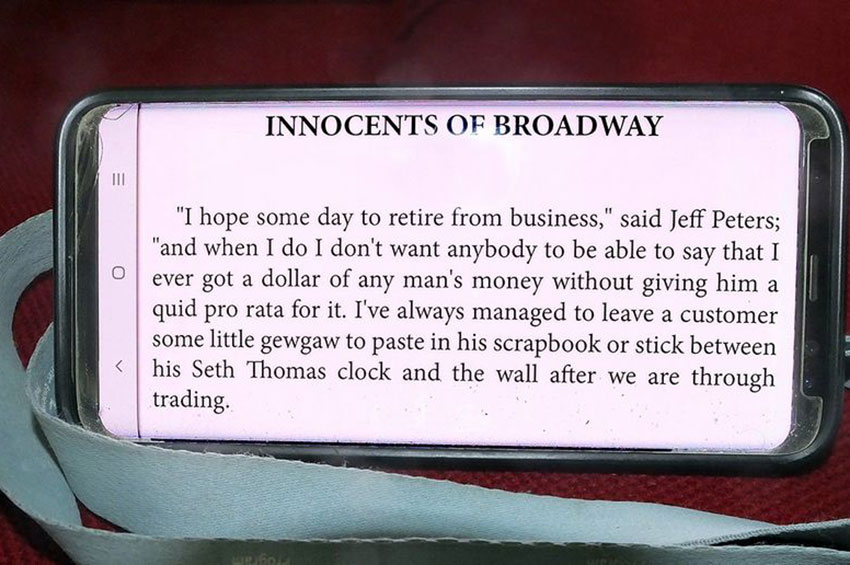
Reading an e-book on a mobile: just the thing when you’re standing in line.
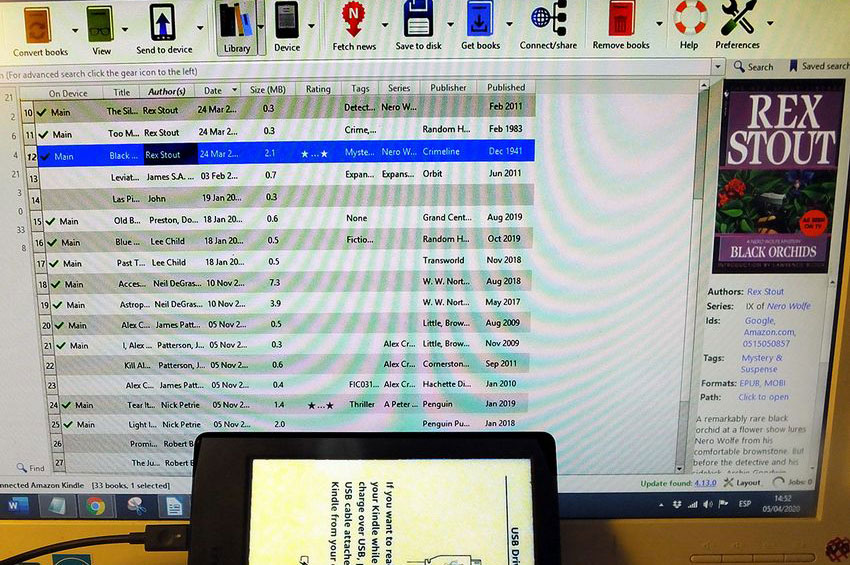
The best way for you to download the e-books mentioned above is with the help of a free program called calibre (yes, with a small c) and once you’ve got your new books, calibre makes it dead easy to download them straight into your Nook, Kindle, Kobo or whatever, converting each title into the proper format you need, no matter which brand of device you’re using.
But calibre does much more than that. It’s also your personal library catalog, listing all the books you have, authors’ names, descriptions and images of the covers. And if any of the data about a book are incorrect, you can click on the edit button and fix the mistake, or you can download correct info about your book from the internet, and maybe change the look of the cover to something you like better.
In addition to all that, calibre has its own built-in e-reader which, once again, is extremely easy to use.
This excellent program was developed by Kovid Goyal, a CalTech graduate with a doctorate in quantum computing who lives in Mumbai, India. Goyal works on calibre for about 80 hours a week and answers some 50 messages from users per day. Every time somebody suggests a well-thought-out improvement, Goyal updates calibre.
The result is is a truly intuitive program that everyone from small kids to grandmas find easy to to use. So it’s no surprise that calibre has been installed more than 18 million times since Goyal began working on it in 2009.
At this point you may be saying, “OK, I’m convinced it’s easy to read an e-book using calibre, but how much fun is it to read a novel while you’re sitting down in front of a computer? How about if I want to read The Gentle Grafter while I’m lying in bed?”
Calibre downloading an ebook into a Kindle.
Well, you could just buy yourself a Kindle. But if that’s not in your immediate plans, your smartphone will do almost as well.OK, the smartphone screen is pretty small, but you can instantly enlarge the text to the size you want and flicking to the next page is really easy.
All you have to do is download an app for reading e-books — Media365, for example, which is free. Through this app you can search the internet for great books and, with just a tap, download them from sites like Gutenberg or Amazon. Then, at last you can stretch out on your bed or sofa and begin reading The Gentle Grafter. But, of course, should you fall asleep, that could be the end of your mobile — but not mine because, as you may have guessed by now, I have a homemade strap attached to that, too.
Happy reading!
The writer has lived near Guadalajara, Jalisco, for more than 30 years and is the author of A Guide to West Mexico’s Guachimontones and Surrounding Area and co-author of Outdoors in Western Mexico. More of his writing can be found on his website.
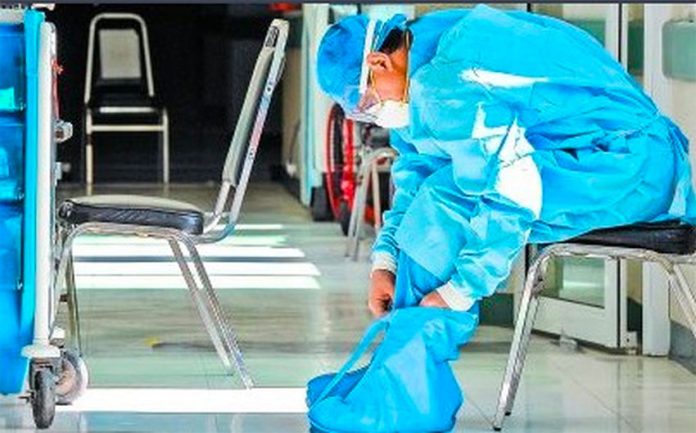
A healthcare worker in Toluca, México state, suits up with protective gear.
Mexico’s national health workers union has issued a plea for the immediate provision of additional personal protective equipment (PPE) to medical personnel as the number of those infected with Covid-19 continues to climb.
Union leader Arturo Olivares Cerda said that was essential that supplies purchased from China reach health workers “as fast as possible.”
He said it was regrettable that medical personnel have been infected with Covid-19 due to a lack of PPE such as face masks, gloves and gowns.
“There will always be a risk [of infection] but if we have all the [necessary] instruments to confront coronavirus, the risks decrease considerably,” Olivares said.
His appeal to health authorities comes after more than two months of silence from the union on the issue of PPE even as medical personnel across the country protested to demand adequate protection to treat Covid-19 patients.
Meanwhile, the number of medical personnel confirmed to have Covid-19 is increasing steadily as the number of coronavirus cases in Mexico also continues to rise.
The IMSS General Hospital in Monclova, Coahuila, has reported 32 cases among staff and three deaths while 19 resident doctors and seven interns from an IMSS facility in Tlalnepantla, México state, have tested positive. Medical personnel in Morelos, Guerrero, Querétaro, México state, Quintana Roo and Aguascalientes have also tested positive as have four public health officials in Baja California Sur.
The latest coronavirus fatality among health workers was that of a 59-year-old doctor and director of the emergency department at the La Perla hospital in Nezahualcóyotl, México state, who died on Thursday.
State authorities said that he caught Covid-19 during a recent working trip to Cuba but his colleagues – among whom there are at least 13 people confirmed to have Covid-19 – claim that he was infected at work.
They say that the infections are the result of a lack of protocols to manage possible coronavirus cases as well as a shortage of PPE.
Similarly, the doctors and interns at the Regional General Hospital in Tlalnepantla say that they were infected at work, contrary to the claims of IMSS General Director Zóe Robledo, who said that the outbreak did not originate in the facility.
The workers demanded an apology from Robledo in a letter directed to Health Minister Jorge Alcocer and Deputy Health Minister Hugo López-Gatell.
“Denying the presence of outbreaks in hospitals does not lead to them being managed,” they said, adding that more supplies are needed at the Tlalnepantla facility to treat both Covid-19 patients and people with other health problems.
The hospital has lacked general supplies for years, a situation “that is more evident now than ever,” the letter said.
The doctors and interns said they have to buy their own PPE as well as soap, anti-bacterial gel and wet wipes because there are not sufficient supplies in the hospital.
“The authorities told us that it was part of our commitment as doctors to obtain the resources [to buy supplies] by our own means,” they said, adding that authorities need to “learn quickly” from their mistakes to avoid more health workers becoming sick after being exposed to risks while at work.
“We want to work, we want to serve and we want to live to teach the next generations,” the letter concluded.
Tunnels are a waste of money, says deputy minister.
Whereas some governments are heeding the advice of Mexico’s Ministry of Health and removing disinfection tunnels thought to help control the spread of coronavirus, others are moving ahead with their installation.
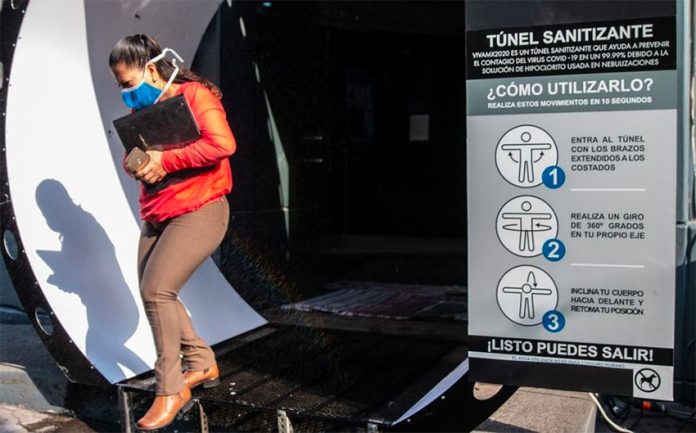
The automated tunnels, which spray people with ozone, are being removed across Mexico City at the behest of that city’s mayor, Claudia Sheinbaum. The decision comes on the heels of an April 8 warning that the tunnels are not only ineffective in preventing the spread of the virus, but may also aid in its transmission.
On April 8, the Health Ministry warned that “inhaling disinfectants can cause, among other things, damage to the airways, coughing, sneezing and irritation of the bronchi, triggering asthma attacks, producing chemical pneumonitis and irritation of the skin, eyes and mucosa,” the ministry stated.
A simple sneeze, according to the Deputy Health Minister Hugo López-Gatell, can propel the virus for a distance of up to 10 meters. “There are drops that are too heavy and fall two meters, there are drops that are light and fall six meters and there are drops that are lighter that fall 10 meters away, which can happen if I sneeze.”
“Those virus particles are going to be mobilized and if the sanitization time is not technically monitored, and that depends on the size of the person, the area to be covered and the intensity, … it will not be enough to inactivate the virus and would have the opposite effect,” López-Gatell cautioned.
But in Aguascalientes, the installation of 12 sanitization tunnels in markets, stores and public spaces is going forward, despite the federal warning. Octavio Jiménez Macías of that state’s Health Ministry assured that the installation of sanitation tunnels is common in cities across Mexico and the world, and is useful in flattening the coronavirus curve.
The product used as a component of the spray, he argued, is endorsed by the National Institute of Respiratory Diseases (INER), a hospital for the treatment and research of respiratory diseases which is also run by the Mexican government.
For his part, López-Gatell stands by the Health Ministry’s statement on the potential dangers tunnels pose. “If they didn’t represent a risk we wouldn’t have said anything,” he said, calling the tunnels “a waste of money.”
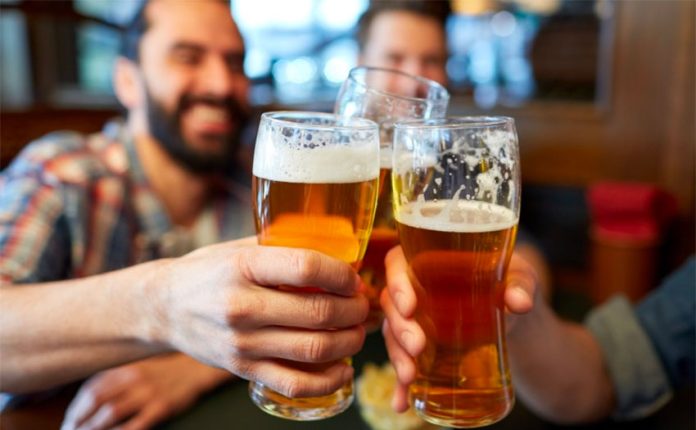
The federal government has invited the beer industry to resume production and distribution under the measures issued to mitigate the spread of Covid-19.
The federal Agricultural Ministry (Sader) advised the industry group Cerveceros de México that beer production is now considered an essential activity.
Signed April 6 by Sader publicity director Santiago José Arguello Campos, the letter invites the industry to continue with production and distribution, taking into account the safety measures issued by health authorities.
Beer makers didn’t have to be told twice. Grupo Modelo, which halted production on Sunday, has already begun to restock empty refrigerators in Oxxo and other convenience stores.
Heineken, which brews the popular brands Tecate, Indio, XX, Coors Light and Miller Lite among others, said it is preparing to go back to work.
The federal government’s coronavirus emergency declaration did not include beer production among so-called essential activities, forcing its stoppage across the country.
Beer making now joins food production, fishing, livestock farming, agro-industrial activities and the petroleum, chemical and transportation industries as essential.
However, its availability for sale is still not guaranteed in those states and municipalities that have implemented restrictions on alcohol sales. Nuevo León was one of the first to do so on the grounds that citizens cooped up in quarantine might get violent should they be allowed to imbibe.
However, a researcher in Yucatán claimed this week that the enforced abstinence from alcohol could well fuel physical violence.
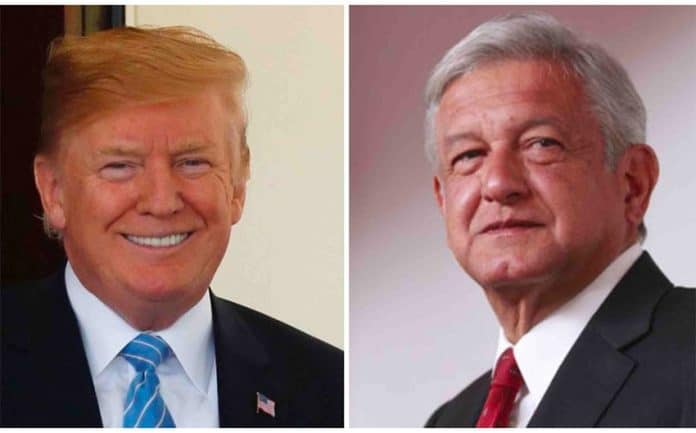
Trump and López Obrador spoke by phone on Thursday and resolved the oil production impasse.
The United States has agreed to cut oil production on Mexico’s behalf, President López Obrador said on Friday, a move that apparently ends an impasse on a deal to reduce global output to stabilize crude prices amid the coronavirus pandemic.
Mexico on Thursday refused to lower its daily output by the amount requested by the Organization of the Petroleum Exporting Countries (OPEC).
But López Obrador said that he spoke to United States President Donald Trump on Thursday night and that they agreed that Mexico would cut its production by 100,000 barrels per day (bpd) and that the U.S. would reduce its output by an additional 250,000 bpd.
He said that OPEC+, a group consisting of the organization’s 13 core member nations as well as 10 additional oil-producing nations, initially asked Mexico to cut its production by 400,000 bpd as part of a plan to reduce global output and stabilize crude prices that have fallen sharply as demand plummets due to coronavirus.
However, after Mexico refused, OPEC subsequently lowered its request to 350,000 bpd, López Obrador said. That reduction will be shared by Mexico and the United States.
Saudi Arabia, OPEC’s de facto leader, made the entire oil reduction deal dependent on Mexico’s agreement to cut its production by that amount. The kingdom’s energy minister, Prince Abdulaziz bin Salman, was adamant that the burden of the cuts – which will together reduce global oil production by more than 10% – must be shared as widely as possible among the OPEC+ nations.
However, López Obrador said that the cut Mexico was asked to make was unfair considering that its production is much lower than some other OPEC+ countries and that it is only just starting to recover from a prolonged decline in crude output.
“Producing 12 million barrels a day is not the same as the 1.786 million [barrels that Mexico is producing] and besides [we’re] coming out of a crisis … a production decline during 14 consecutive years. That’s why we couldn’t accept what was originally proposed and we resisted,” he said.
AMLO, as the president is widely known, said that Trump questioned Mexico’s refusal to cut its production when all other OPEC+ nations agreed.
“President Trump started to read out the names of all the countries that had accepted and he says, ‘only Mexico didn’t accept’ and I explained to him why and I made a proposal to him that he fortunately accepted,” he said.
López Obrador said that after he told Trump that Mexico could not cut its oil production by more than 100,000 bpd, “he very generously told me that they were going to help us with the 250,000 additional barrels.”
“For that, I thank him,” he added. López Obrador said that the cut to which Mexico has now committed represents 5.5% of daily production.
“From 1.786 million bpd on average in March, we’ll go down to 1.686 million barrels; this will apply from May onwards,” he said.
“With this we hope that the price of crude oil will go up … but we especially hope that it will help to stabilize the economy,” López Obrador said, adding that OPEC was notified of the deal struck between Mexico and the United States.
However, OPEC delegates said that they were unaware of the terms of the agreement to which he was referring.
The news agency Bloomberg reported that if the standoff between OPEC+ and Mexico has been resolved, as AMLO claims, “it opens the way for a historic effort to revive the oil market from a debilitating coronavirus-induced slump.”
It noted that the agreement to cut production is much larger than previous interventions and that it would put an end to the price war between Saudi Arabia and Russia that contributed to the slump in global oil prices.
In a series of Twitter posts on Friday morning before AMLO announced the agreement with Trump, the director of the Mexico Institute at the Wilson Center was critical of the government’s decision not to agree to OPEC’s request.
“We all know by now that the government is blindly committed to increasing production – nothing (not Covid-19, nor Pemex downgrades, nor endless expert advice) will change that,” Duncan Wood wrote.
“The failure to grasp an opportunity to stabilize oil prices at a time when it is costing much more to pump Mexican oil than the market price, is mind-boggling. At a time of such low oil prices it actually makes economic sense to import crude for domestic refining rather than increase production; why pump oil at a loss?”
After López Obrador’s announcement of the pact with Trump, Wood said that it was unclear how the burden-sharing arrangement will work.
“AMLO has just said that U.S. will be responsible for 250k barrels of Mexico’s cut? I am intrigued to see how that would actually happen!”
Antibacterial gel production at the university in Yucatán.
Professors, students and lab techs at the Autonomous University of Yucatán (UADY) collaborated to make and bottle 25 tonnes of hand sanitizer to support the state government’s efforts to mitigate the spread of Covid-19.
UADY rector José de Jesús Williams made the university community available to provide support to authorities and society at large since the health crisis began, the university said.
The director of the UADY School of Chemistry, María Dalmira Rodríguez Marín, said the lab follows a strict protocol to ensure that the hand gel does not become contaminated during bottling, including temperature controls, proper handling techniques and adequate personal protection equipment (PPE).
The university equipped a laboratory specifically for the purpose, designing a custom production line by which they’ve been able to store nine tonnes of hand gel in addition to the 25 tonnes they bottled.
UADY also manufactured over three tonnes of gel exclusively for university students, faculty and other essential personnel who continue to work on campus.
The hand sanitizer is made of 98% pure alcohol mixed with gel at a concentration of 70%, the rest being composed of distilled water, glycerin and the viscous organic compound triethanolamine.
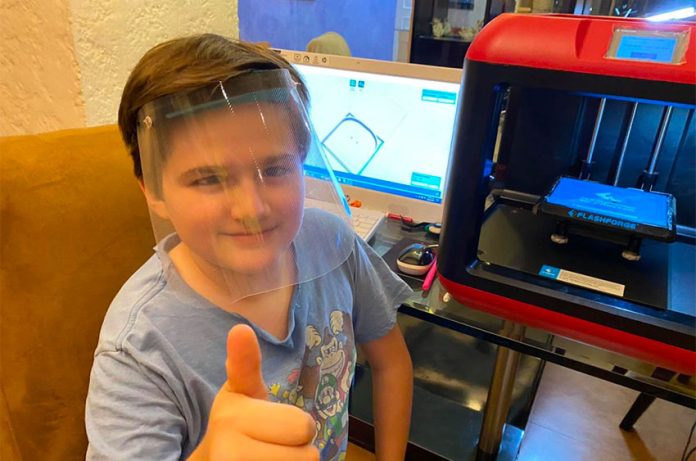
Designer Jorge Martínez with one of this face shields.
A secondary school student in Oaxaca has designed and produced face shields to donate to local doctors and nurses to protect them from contracting Covid-19 as they treat victims of the global pandemic.
Jorge Martínez, 12, said he was worried about the public health situation in Mexico and the rest of the world due to the lack of personal protection equipment (PPE) and other supplies for clinics and hospitals to face the global pandemic.
“The model I created aims to safeguard doctors facing the danger of the virus. … The face shield I made covers the eyes, nose and mouth of the person who uses [it],” said Martínez, who made the design on his computer before producing the face shields on a 3D printer.
“I’m sad because I see the news about our doctors and health workers complaining about the lack of personal protection equipment to treat patients with Covid-19. I hope this design helps them save lives and save the world,” he said.
Martínez’s product has been certified by Oaxaca health authorities and donated to the city’s children’s and specialty hospitals. He has received orders from the IMSS and ISSSTE social security hospitals in the state as well.
His story went viral on Facebook and Instagram and even went on to inspire a girl in New Delhi, India, to replicate his production process and make the products for health workers in that country.
Another crew of youngsters from Morelos took a similar initiative to fabricate PPE to help contribute to shortages across the globe. The makers of Changuitos face masks even found a market for their product as far away as China.
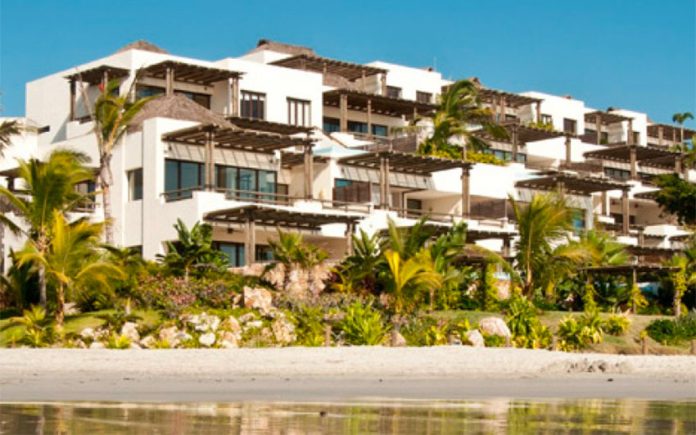
The Nayarit resort from which some guests escaped quarantine.
At least four vacationers at a luxury resort in Nayarit escaped a government-imposed coronavirus quarantine via helicopter on Wednesday, says César Guzmán Rangel, head of Civil Protection in that state.
The tourists from Guadalajara were among some 220 visitors at the beachfront resort Los Veneros. The quarantine was imposed when government officials learned that two of the guests at the luxury condominium development had tested positive for coronavirus before arriving at the resort, and the remaining residents refused to be tested.
The quarantine was enforced by the placement of a sanitary barrier to prevent the spread of the virus to other guests, workers and residents of Bahía de Banderas.
An official statement on the installation of the barrier claimed that “all health protocols are being followed, and it means that the 220 people who vacation in this luxury housing complex will be in quarantine; that is, no one can leave for at least 10 days, which is the minimum time to complete the 14 days of isolation that is required to rule out incubation of the disease.”
Los Veneros — where rentals go for around US $1,400 a night — is located on the road to Punta Mita and under normal circumstances, guests are drawn to its “37 enchanted acres along a stretch of almost 1,500 feet of white sandy beach frontage at renowned Playa de Estiladeras,” the resort’s website reads. “Entry is via gated access, with 24-hour welcome and security staff. Recreational amenities currently include inviting swimming pools, a chic oceanfront Beach Club with bar and grill, fitness, wellness and spa services, and an ocean activities center.”
Guzmán Rangel noted that, despite the breach on Wednesday, most of those quarantined supported the measure. “Most of those inside Los Veneros are in favor of what is being done to avoid contagion or to find out if they, too, have already been infected with this virus,” he said.
Governor Antonio Echevarría Garcia did not hide his contempt earlier this week for the two tourists who decided to continue with their vacation plans — it is Easter Week in Mexico — after testing positive for the virus. Tourists “are always welcome,” he said, “but not if they infect our people.”
In a Facebook post, the governor stated that he intended on winning what he called a war against coronavirus, and he would ask the state’s attorney general for help in dealing with those who refuse to abide by social distancing measures.
“If we have to bend the law a little to save the lives of the residents of Nayarit, I am going to risk it,” he said.
Nayarit currently has 18 confirmed cases of coronavirus and has recorded three deaths.
The number of confirmed coronavirus cases in Mexico increased by 260 on Thursday to 3,441 while deaths from the disease rose by 20 to 194, the Health Ministry reported.
Deputy Health Minister Hugo López-Gatell told reporters at the nightly coronavirus press briefing that two pregnant women were among the 20 people who lost their lives to Covid-19 in the preceding 24 hours.
One woman died after giving birth to a baby boy via caesarean section, he said, noting that the infant had respiratory problems for a brief period and remains delicate.
One of the women who died suffered from obesity and hypertension while the other was also clinically obese and had gestational diabetes, López-Gatell said. He said that pregnant women are particularly susceptible to complications from coronavirus infections and urged them to take special care.
López-Gatell recalled that pneumonia was the second most prevalent cause of death among pregnant women during the 2009 H1N1 influenza, or swine flu, epidemic whereas it normally ranks 12th or 13th.
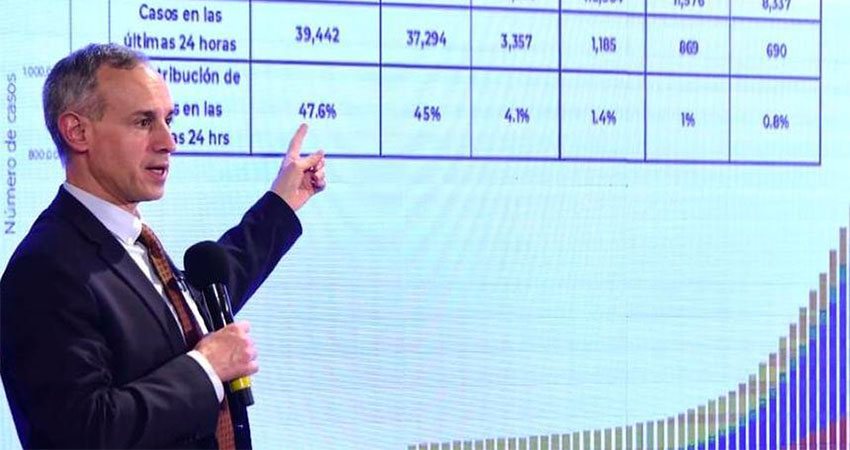
Deputy Health Minister López-Gatell gives the daily press briefing.
“We have to be very careful with pregnant women, they must be considered very susceptible to dying [from Covid-19],” he said.
Among the 194 people who have now died after contracting the new coronavirus, the most prevalent existing health problems have been hypertension, diabetes and obesity.
In addition to the 3,441 confirmed Covid-19 cases, López-Gatell said that there are 10,105 suspected cases and that 17,950 people have tested negative.
Three in 10 of those confirmed to have Covid-19 have required hospitalization while the other 70% have not. More than 500 patients are currently in serious condition in the hospital and another 123 are on ventilators.
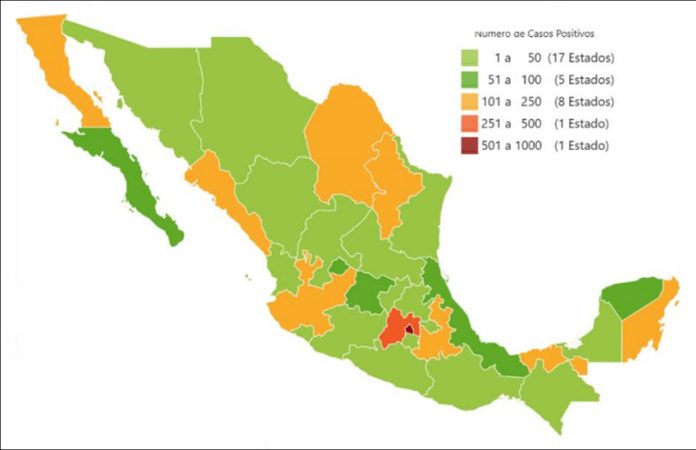
Mexico City continues to lead the country for both confirmed coronavirus cases and deaths with 909 of the former and 43 of the latter.
Mayor Claudia Sheinabum said earlier on Thursday that there were likely more than 6,000 cases of Covid-19 in the capital based on the Health Ministry estimate that there are more than 26,000 cases across the country. She asked Mexico City residents to wear a face mask while outside.
Coronavirus by state
State
Deaths
Cases
Suspected
Tested negative
Mexico City
43
909
2185
2972
Baja California
16
239
467
692
Sinaloa
15
138
390
415
Quintana Roo
12
159
217
336
Estado de México
11
399
831
1475
Puebla
10
198
409
517
Tabasco
9
113
360
459
Jalisco
8
139
814
1894
Coahuila
7
129
824
607
Hidalgo
7
47
63
309
Morelos
7
35
56
217
Nuevo León
5
107
687
1378
Guerrero
5
49
141
211
Michoacán
5
46
195
294
Sonora
4
48
194
329
San Luis Potosí
4
47
169
595
Durango
4
16
116
220
Yucatán
3
88
170
362
Veracruz
3
54
443
684
Tamaulipas
3
46
126
296
Nayarit
3
16
41
121
Baja California Sur
2
68
313
269
Querétaro
2
50
73
351
Zacatecas
2
11
61
201
Guanajuato
1
71
290
1213
Chihuahua
1
42
94
184
Oaxaca
1
40
81
263
Campeche
1
14
10
63
Aguascalientes
53
81
571
Chiapas
34
80
180
Tlaxcala
29
94
204
Colima
7
30
68
Deaths
Cases
Suspected
Tested negative
Total
194
3441
10105
17950
Figures released by the Ministry of Health at 7:00 p.m. Thursday.
Mexico has now been in phase 2 of the Covid-19 outbreak for almost three weeks after the government announced on March 24 that local transmission of the disease had begun. López-Gatell said that that phase 3, in which community transmission becomes widespread and case numbers escalate rapidly, could begin in 15 days.
Authorities continue to urge people to practice social distancing and remain at home as much as possible.
The director of the National Blood Transfusion Center also spoke at last night’s press briefing, explaining that there is not a shortage of blood in the nation’s blood banks but that donations have declined by between 60% and 70%.
Jorge Enrique Trejo Gómora said that more donations are needed to ensure that there is no shortage, adding that a call center has been set up so that blood donors can schedule an appointment at a certain time. By making appointments, health authorities will be able to avoid having large gatherings of people in blood banks, he said.
Trejo also said that research into the use of convalescent plasma – plasma from recovered coronavirus patients – to treat people suffering from the disease is promising. He said that Mexican Social Security Institute health facilities will begin collecting such plasma on Monday.