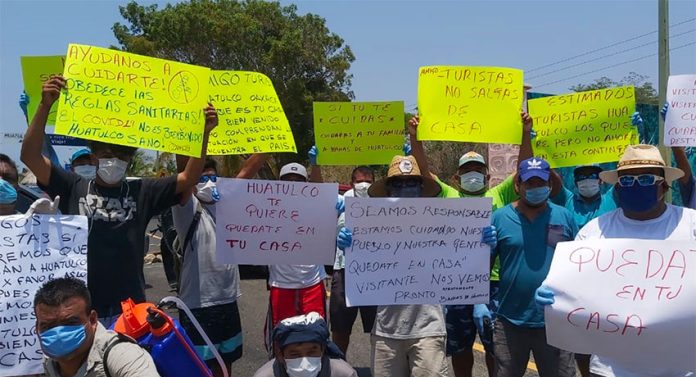
Tourists, please stay home, plead citizens of Huatulco.
Across Mexico fear of a coronavirus outbreak has towns shutting off access to outsiders and erecting blockades in the hope that isolation will keep the deadly virus out of their communities.
Visitors have been advised they are not welcome in places like Tecolutla, Zongolica, Tuxpan and Tamiahua in Veracruz; San Javier, Todos Santos, San Juanico and Mulegé in Baja California Sur; Sayulita in Nayarit; Santa Clara in Sonora; Solferino, Holbox and Chiquilá in Quintana Roo; San Juan Bautista, Oaxaca; Ocozocuautla, Chiapas; Río Lagartos, Yucatán; and Samalayuca, Urique and General Cepeda, Coahuila.
Many of these towns simply do not have the medical infrastructure necessary to care for coronavirus victims.
In Mulegé, a town of about 3,000 located midway up the Baja Peninsula, the mayor warned that residents who were irresponsible enough to take a vacation during the coronavirus crisis would not be welcomed back home until the danger of infection has subsided.
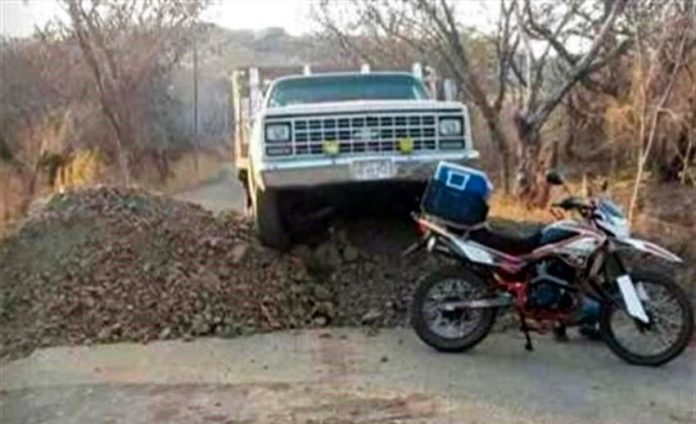
Further south on the peninsula, residents of Todos Santos took it upon themselves to close both northern and southern access roads into their town, blocking the roads with vehicles and hazard tape. Food and other supplies are still welcome in this Pueblo Mágico, or Magical Town. Tourists are clearly not.
In Tecolutla, a resort town on the Gulf of Mexico in Veracruz, the local government issued a statement warning that “for security reasons and to ensure the health of all, people and tourists are informed that vehicles and foreigners may not enter this municipality as part of coronavirus preventative measures. We appreciate your understanding and support, please postpone your trip, we will be waiting for you another time.”
In Huatulco, Oaxaca, residents blocked access to the airport using cars, tree trunks and large rocks, hoping to send a message to airlines to stop bringing tourists into their town. After one person in Huatulco was diagnosed with coronavirus, police closed access to Santa María Colotepec two hours up the road. Similarly, 26 other towns in Oaxaca have shut down access to non-residents.
One of two tourists who harassed and assaulted a reporter on a Puerto Vallarta beach.
Authorities in Puerto Vallarta, Jalisco, will beef up patrols on the city’s beaches to clear them of tourists who refuse to abide by the city’s measures to mitigate the spread of Covid-19.
Depending on the severity of the infraction, officers will be able to impose fines and even arrest those who refuse to follow the preventative guidelines.
The two men have since been identified as Terry Redue and Guy Carey of Vancouver, Canada.
“If people don’t want to leave [the beaches voluntarily], we will have to use public force to remove them,” Puerto Vallarta Mayor Arturo Dávalos Peña told a press conference on Wednesday.
In reference to Fidencio’s Restaurant, where Monday’s incident took place, he said he ordered it to be shut down, as well as “all those who are not respecting the health measures.”
Dávalos’ original order to close the beaches included patrols, but after navy officers whom Terrón asked for help did nothing to enforce the guidelines or ensure her safety, he said he recognized it was necessary to reinforce security operations on the beaches.
The reinforcements will marshal officers from Civil Protection, the fire department, police, National Guard and navy to ensure “the safety and, of course, health of all of us who live here in the municipality of Puerto Vallarta.”
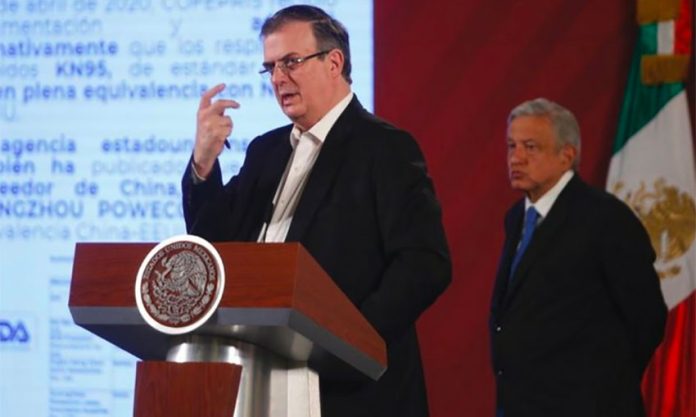
Ebrard announces the purchase of supplies from China.
Mexico will buy US $56.6 million worth of medical supplies from China to respond to the coronavirus pandemic, Foreign Affairs Minister Marcelo Ebrard said on Thursday.
Speaking at President López Obrador’s regular news conference, Ebrard said that an airbridge has been established between the two countries and that two to four flights per week will deliver supplies and equipment to Mexico. The first of 20 planeloads arrived in Mexico City on Tuesday night.
Ebrard said that another shipment of masks and gloves will arrive in Mexico on Friday night, and thanked China for responding promptly to Mexico’s request to purchase essential medical supplies.
“They shared information with us in a timely manner from the beginning. They sent us all their material translated into Spanish,” he said, adding that the company Meheco has been designated by the Chinese government as Mexico’s main supplier.
The foreign minister said that thanks to the good relations between the two countries, Mexico was able to secure a purchase of 11.5 million KN95 masks – Chinese-made masks that are very similar to the N95 model. Ebrard said that their use has been approved by health authorities in both Mexico and the United States.
He also announced that the government purchased 5,272 ventilators from a range of countries, although the only one he cited was Denmark. The new ventilators, bought with assistance from the United Nations, will start arriving next week, Ebrard said.
Enoch Castellanos, president of the National Chamber for Industrial Transformation, said last week that 35 companies in Mexico will contribute to a project that intends to manufacture 15,000 ventilators to treat coronavirus patients.
Pressure on Mexico’s healthcare system is set to increase as the number of coronavirus cases continues to rise steadily. The Health Ministry announced 396 new confirmed cases on Wednesday and 33 additional deaths, taking the respective totals to 3,181 and 174.
However, Deputy Health Minister Hugo López-Gatell said that authorities estimate that there are in fact more than 26,000 cases of Covid-19 across the country.
López Obrador on Thursday reiterated the call for people to stay at home as much as possible and to take extra care of the most vulnerable members of society.
“We’re behaving very well, … respecting the [social distancing] recommendations, we have information that [people’s] movement has decreased considerably. The fundamental thing is for us to avoid infections. The more we act with discipline … the fewer problems we’ll have with the disease,” he said.
“There hasn’t been an explosion [of the disease], it hasn’t gotten out of control and we hope not to have saturated hospitals.”
The recent slump in global oil prices as demand declines due to the coronavirus pandemic has led most producers to reduce spending and in some cases their output. But Pemex is taking a different approach.
The state oil company is aiming to almost double drilling this year to 423 wells, the news agency Bloomberg reported.
It also intends to accelerate development of 15 recent recent discoveries despite warnings that many of them are unprofitable due to the current low price for Mexican crude.
Bloomberg also noted that Pemex hasn’t announced any change to its goal of producing an average of 1.87 million barrels of crude per day this year – an 11% increase compared to 2019 – nor has it flagged any reduction in its planned investment of 270 billion pesos (US $11.4 billion) in exploration and production.
Mexico’s steadfastness contrasts with the flexibility shown by Brazil’s Petrobras and Colombia’s Ecopetrol, which have both slashed their capital spending.
Ruaraidh Montgomery, research director at oil consultancy Welligence, said the path chosen by Pemex – as demand for oil and prices remain low – “will most certainly” result in the company burning cash.
“Petrobras is genuinely run as an independent entity that is there to generate profits, but with Pemex, the government’s priority is production growth,” he said.
President López Obrador, who has pledged to rescue the heavily indebted state oil company, wants to boost production to reduce Mexico’s reliance on fuel imports, mainly from the United States. He announced on Sunday that Pemex would get a 65-billion-peso tax break as part of measures to mitigate the economic impact of the coronavirus pandemic.
Nevertheless, Anne Milne, a strategist at Bank of America, predicts that the state oil company will have negative cash flow of US $20 billion in 2020 if Mexican crude trades at $30 a barrel, well above Wednesday’s closing price of just under $18 and almost triple the 21-year low of $10.37 recorded in the last week of March.
Her dire prediction comes even though Mexico is expected to make a profit from its large oil hedging program. The government has locked in a price of $49 per barrel in its annual hedge that usually covers between 200 and 300 million barrels, while Pemex has its own hedging program that will apply to 85 million barrels this year.
CEO Octavio Romero hasn’t disclosed the price Pemex locked in but the state-run company announced in March that it had received its first payment from the program.
The government’s decision to build a new oil refinery on the Tabasco coast has also been questioned by experts who warn that the investment will divert funds from Pemex’s more profitable exploration activities. There is speculation that the cost of the project could increase significantly from the $8 billion estimate due to the slump in the value of the peso against the United States dollar.
According to Welligence’s Montgomery, Pemex should concentrate on cost control, becoming more efficient and protecting its bottom line by not spending money on growth for growth’s sake.
“You can only keep funding your operations through debt for so long,” he told Bloomberg. “The worst is yet to come.”
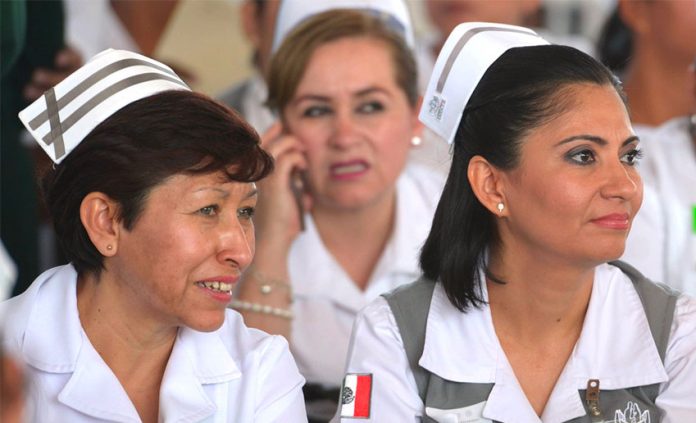
Nurses are in the front lines but not everyone respects them for it.
There has been another incident of aggression against a healthcare worker in Mérida, Yucatán.
A nurse was attacked on Wednesday by a man who threw hot coffee at her as she left a grocery store.
Ligia Kantun was wearing her nurse’s scrubs as she left a supermarket when a man shouted, “You’re going to infect us all!” and threw scalding hot coffee on her back and legs.
Kantun’s daughter denounced the attack on Facebook.
“I’m angry … Why don’t people understand that they are health professionals … who give their best every day to attend to your family, or even you who doesn’t follow the preventative guidelines,” she said on a post containing the photos of her mother after the attack.
She said her mother was “emotionally devastated” and “tired of the humiliation she receives from the people for whom she is fighting,” and directly addressed the person who attacked her.
“And to you, coward, who I know is reading this, I hope they don’t make you pay too dearly for what you did to my mother today,” she said.
This was not the week’s first instance of anger and violence directed at health workers in Mérida, where another nurse posted on Facebook that people on a motorcycle threw an egg at her while she waited for her ride to work.
In the last two weeks, residents of a small town in Morelos threatened to burn down their local hospital if it treated any Covid-19 patients, and the doors of a hospital in Sabinas Hidalgo, Nuevo León, were doused with a flammable liquid.
The number of areas off limits to outsiders due to the coronavirus pandemic continues to grow: state authorities in Colima and those in three México state municipalities are now restricting entry to people providing essential services.
Colima Governor José Ignacio Peralta Sánchez announced that only those who can prove that they have essential work to do in the state will be allowed to enter. He also said that residents are only permitted to be outside if they are carrying out essential activities.
In addition, the governor said that authorities will distribute 10,000 digital thermometers and large quantities of face masks and liquid soap to help residents detect possible cases of Covid-19 and prevent its spread.
As of Wednesday, there were just seven confirmed cases in Colima and 30 suspected ones. However, only about 100 people have been tested for the disease.
Peralta said that now is the time to start widespread testing because Colima has entered into a phase of local transmission – two of the seven people confirmed to have Covid-19 haven’t recently traveled abroad or had known contact with someone who did.
However, the governor said that the state lacked sufficient reagents to carry out testing en masse, explaining that federal authorities “are not sending us enough.”
In México state, authorities in the southern municipalities of Tlatlaya, Amatepec and Luvianos are only allowing the entry of vehicles making food deliveries or transporting health workers, the newspaper Reforma reported. The authorities said that their local hospitals don’t have sufficient personnel or supplies to attend to an influx of Covid-19 patients.
The mayor of Tlatlaya announced the measure on social media, local radio and via loudspeaker announcements.
“All residents of Tlatlaya are informed that the entry to and exit from our municipality is strictly prohibited. The main and alternate access roads will be blocked, you will not be able to enter or leave. The intention is to have not a single coronavirus case in Tlatlaya,” he said.
The move comes after communities in several other states took the decision to block entry to outsiders to combat the spread of coronavirus.
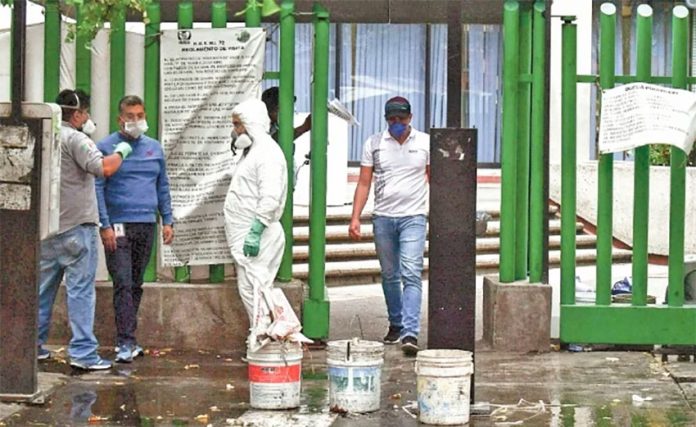
Workers disinfect the hospital in Tlalnepantla on Wednesday.
At least 97 workers at four hospitals operated by the Mexican Social Security Institute (IMSS) have been infected with Covid-19 and three others have died.
Another 24 employees are suspected to have been infected but have not yet been tested or their results of their tests are not yet known. Three others, including an emergency room doctor and the hospital’s administrative director, died after testing positive.
The doctor had treated the first known Covid-19 patient at the Monclova hospital, a truck driver who arrived at the emergency department on March 18 and died 10 days later.
Governor Miguel Riquelme said Wednesday that 76 health care workers across Coahuila have tested positive for Covid-19, a figure that represents approximately 60% of all cases in the northern border state.
In Baja California Sur, 42 medical and administrative workers at the IMSS General Hospital in Cabo San Lucas have also tested positive for the novel coronavirus. State IMSS director José Luis Ahuja Navarro said that all 42 staff members are currently in isolation at their homes. He rejected any suggestion that health authorities had tried to hide information about the outbreak.
The Cabo San Lucas hospital cases account for almost two-thirds of the 68 confirmed cases in Baja California Sur.
In Morelos, IMSS authorities reported that four emergency department workers – one doctor and three nurses – at the Cuernavaca General Hospital tested positive after treating a Covid-19 patient in March, while 19 doctors at the Regional General Hospital in Tlalnepantla, México state, have also contracted the disease.
Although IMSS General Director Zóe Robledo said that the Tlalnepantla cases did not originate in the hospital, medical personnel who work there have demanded the implementation of stricter safety measures to prevent the spread of the disease.
They say there are no temperature checks of patients and staff when entering the emergency department and that the hospital lacks alcohol-based gel for hand hygiene.
Despite the fact that the facility in Tlalnepantla — a municipality in the greater Mexico City metropolitan region — has been designated as a frontline hospital for Covid-19 treatment, staff say they lack sufficient supplies and personnel to attend adequately to all patients.
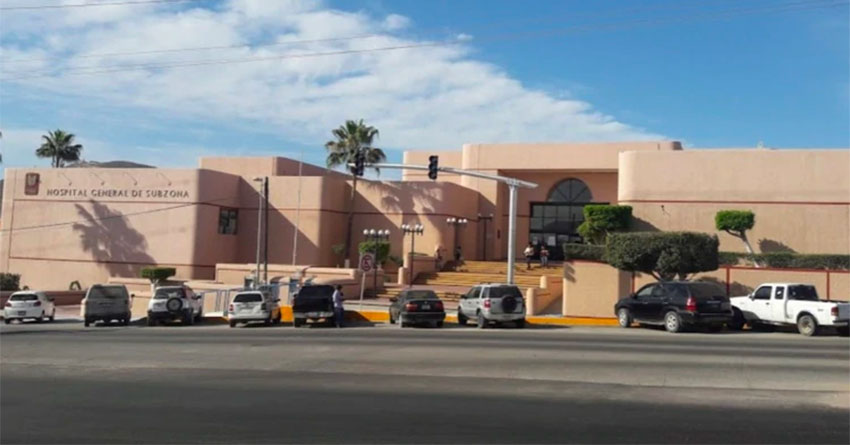
The IMSS hospital in Cabo San Lucas, where 42 workers have tested positive for Covid-19.
They also say that they have insufficient personal protective equipment (PPE) such as masks, gloves and gowns. Some nurses fear that they have been infected with Covid-19 and have subsequently passed the virus on to other staff members as well as patients’ family members.
“We’re afraid because we have family. Colleagues are falling sick every day. There are no tests [for employees] or very few. … Now there are 170 colleagues off work because they are suspected [to have Covid-19],” said one hospital employee.
A nurse said that authorities should take the decision only to accept Covid-19 patients at the facility to avoid infections among people with other health problems.
“The ideal would be to avoid … [admitting] patients who have other types of illnesses and send them to other … hospitals,” the nurse said.
A lack of PPE has left health workers in many parts of the country without adequate protection to treat Covid-19 patients, triggering widespread protests.
Healthcare workers at the IMSS facilities where employees have been infected told the newspaper El Universal that they are exposed to the risk of infection on a daily basis due to insufficient quantities of PPE.
“They send us to war without a gun,” said one worker. “We have to fight so that they give us face masks and gloves,” said another, adding that some have workers have made their own plastic face shields to wear while on duty.
The government has acknowledged that some public health care facilities don’t have sufficient PPE supplies but has committed to bringing 20 shipments from China to meet workers’ needs.
An Aeroméxico aircraft dubbed Missionary of Peace returned to Mexico from China on Tuesday night, touching down in the capital with the first shipment of medical equipment and supplies including 800,000 much-needed N95 masks and 1 million gloves.
It may look, smell and taste like cheese, but much of the creamy manchego on grocery store shelves in Mexico simply isn’t, according to the federal consumer protection agency Profeco.
The agency analyzed 46 popular brands found in supermarkets across the country and found that many do not give the consumer the product advertised on the label.
The study looked at the contents of 29 brands from Mexico, six from Spain, eight cheese imitation products, two processed cheeses and one made from goat’s milk. It found that the brand Sabores de Mi Tierra had too much added vegetable oil to be called cheese.
Other labeling problems the study found included incorrect nutritional value information, undeclared ingredients, omission of the country of origin of the ingredients and even brands that contained less product than stated on the label, among others.
The brands Walter and Cremería Covadonga failed to include the country of origin on the labels, as did Lalo on its regular and lactose-free manchego slices.
Eight of the products analyzed were found to contain less than the amount advertised on the label. These were all 200 to 400-gram packages of block, sliced, reduced-fat, lactose-free and imitation cheese from the brands Caperucita, Cremería Covadonga, NocheBuena, Portales de Prividencia, Zwan Premium, Capone’s and Aurrera.
Profeco went on to list a number of problems found in manchego labeling including the absence of fat or protein content and other nutritional information.
The original Spanish recipe for manchego calls for sheep’s milk, and produces a cheese wholly different to that in Mexico, which is basically Monterrey Jack.
The use of European names for Mexican cheeses has been an issue in the past but two years ago trade negotiations with the European Commission gave Mexican producers the OK for using the names manchego, parmesan and gruyere.
Profeco has also studied the risks to the consumer posed by the labelling and actual content of other foods, such as ketchup and popcorn, and found similarly untrustworthy and incomplete information for the consumer.
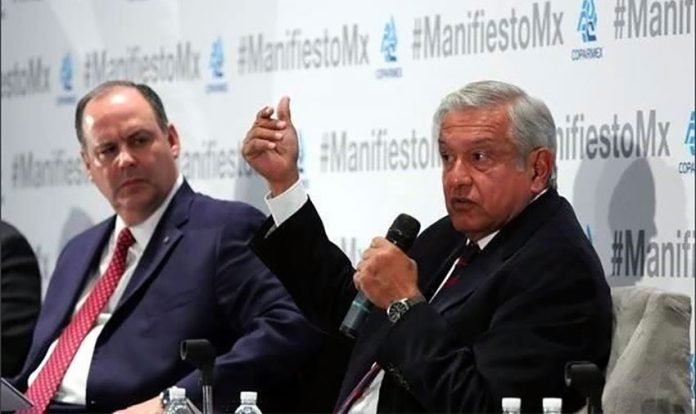
De Hoyos, left, and the president: they don't quite see eye to eye.
With nearly 350,000 jobs lost in the last month due to coronavirus, the Mexican Employers Federation is urging President López Obrador to take measures to help keep businesses afloat during the health crisis.
This appeal comes at the same time that Mexico City Mayor Claudia Sheinbaum warned businesses in the capital city that if they fire workers in response to the crisis, there may be consequences.
“If a large company that has the possibility of paying its workers and is laying off its workers, we could consider, for example, that they will no longer be able to operate these businesses in Mexico City because we can implement a scenario where only socially responsible companies can operate in Mexico City,” said Sheinbaum.
Gustavo de Hoyos, president of the Employers Federation, pleaded with the president to work with business owners to develop measures that will ensure their survival, rather than point fingers at those who have been forced to lay off workers.
The federation “invites President Andrés Manuel López Obrador to collaborate with measures that promote job protection . . . This is not the time to continue on the path of social polarization,” said de Hoyos.
He asked López Obrador for tax deferrals and breaks on paying government-run utilities such as water and electricity.
As for Sheinbaum’s warning, the federation said “these statements lack a legal and constitutional basis at a critical moment in the life of the country in which unity is required, rather than placing blame on those guilty of an economic reality.”
De Hoyos cited recommendations from the International Labor Organization (ILO), which reports that the coronavirus pandemic is poised to eliminate 195 million jobs globally in the second quarter of 2020 alone.
“Workers and businesses are facing catastrophe, in both developed and developing economies,” said Guy Ryder, ILO’s director-general. “We have to move fast, decisively, and together. The right, urgent, measures, could make the difference between survival and collapse.”
De Hoyos said this morning that the private sector is preparing a national strategy intended to preserve jobs and businesses. He said a national accord is being developed as a result of talks initiated by the Business Coordinating Council and will be presented to the government.
The latter organization, an umbrella group that represents the interests of the private sector in Mexico, has had a somewhat warm relationship with the federal government until this week, when it issued a strong criticism of the government’s economic plan and its president even suggested that revoking the mandate of President López Obrador, which is to be put to a vote in 2022, was an option to be considered.
De Hoyos, meanwhile, has been strongly critical of the president, to the point that some Coparmex members have questioned his political impartiality.
Their plan might not go far with an obstinate president who is firmly on the other side of the political divide.
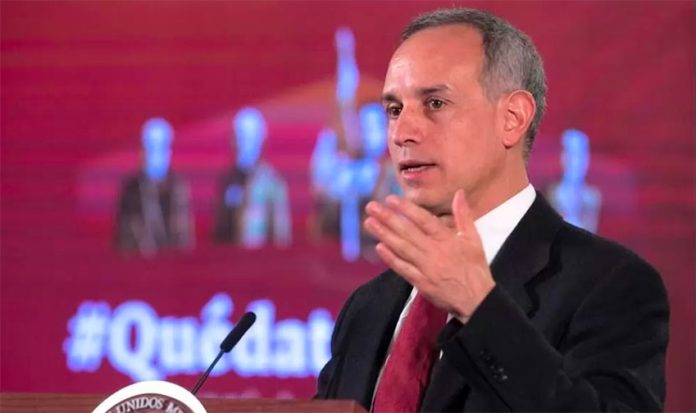
López-Gatell: estimates of case numbers were produced by sentinel surveillance system.
There are more than 26,000 people with Covid-19 in Mexico, according to Health Ministry estimates, a figure more than eight times higher than the number of confirmed cases of the disease in the country.
Director of Epidemiology José Luis Alomía reported Wednesday night that the number of confirmed Covid-19 cases had grown by 396 – the largest single-day increase – to 3,181. He also reported that coronavirus-related deaths had increased by 33 to 174, that there are 9,188 suspected Covid-19 cases in Mexico and that 17,209 people have tested negative for the disease.
Later in the coronavirus press briefing, Deputy Health Minister Hugo López-Gatell said that authorities estimate that the real number of people who have Covid-19 in Mexico is 26,519. He said that the estimate is derived from the sentinel surveillance system in which data about a disease is collected in certain locations and extrapolated to predict total numbers across the country.
López-Gatell said that health authorities are collecting data about confirmed and possible cases of Covid-19 at 375 different heath care facilities.
“The epidemic is eight times bigger” than the number of confirmed coronavirus cases, he said, adding, “that doesn’t change the decisions” made by authorities to contain the spread of Covid-19.
“When we had only 12 cases, with this systematic exploration [through the sentinel system] it was sufficient to take the decision … to begin the social distancing activities,” López-Gatell said.
He said that the surveillance system was established in Mexico in 2006 after collaboration on its development with the United States Centers for Disease Control and Prevention, the Pan American Health Organization and the World Health Organization.
The “proven, scientifically founded” system “allows us to assume the reality as it is and not how it is mistakenly thought to be in the sense that only what is seen exists,” the deputy minister said.
“We estimate 26,000 cases … so someone could say, you have a lot more cases than several Latin American countries that have a thousand and something cases. No, we explicitly acknowledge that we have 26,000; in any other country that only has [a figure for] observed cases, they also have to … multiply [that number] by a number … not identical to that in Mexico but by a similar one, 10 or 12 cases … for each [confirmed case],” he said.
“In the countries where very unfortunately they’ve had enormous epidemics, they also have to multiply their cases by a similar number, it’s specific for each country,” López-Gatell added.
Given that there are a large number of undetected cases of Covid-19, it is especially important that people continue to maintain a healthy distance from each other and stay in their homes as much as possible, he said.