Home Blog Page 1591

Virus protection tunnels not effective, say health authorities

0
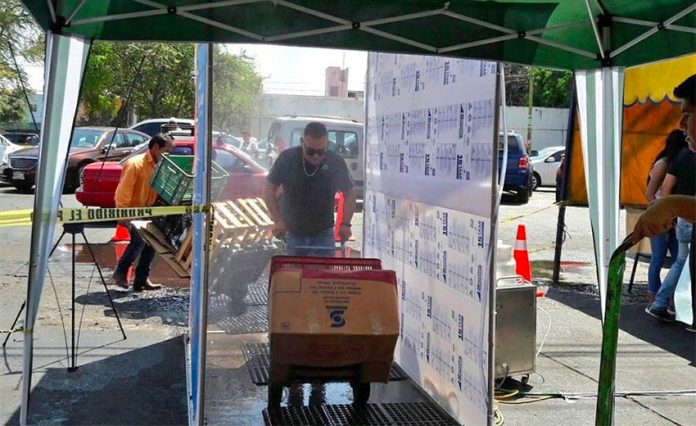
The disinfecting tunnel at Guadalajara's food market.

Automated sanitation arches and tunnels such as those erected outside Guadalajara’s outdoor food market last month have not proven to be effective in the fight against the spread of coronavirus, government officials say. In fact, they may actually help propagate the virus. 

The tunnels, which are being installed in many locations in Mexico, purport to sanitize those who pass through them by spraying people with a high concentration of ozone, which was thought to disinfect a person for up to one hour. 

As Salvador Hernández Navarro, president of the Grocery Merchants Union, told media when the tunnels debuted, “we took the initiative to launch this new technology and install this ozone tunnel to serve the large number of visitors we welcome daily. We are the second-largest supply center in the country, and we want people to have peace of mind knowing that we care about your health and the food that is consumed.”

But the reality is something else, says Mexico’s Ministry of Health. “Inhaling disinfectants can cause, among other things, damage to the airways, coughing, sneezing and irritation of the bronchi, triggering asthma attacks, producing chemical pneumonitis and irritation of the skin, eyes and mucosa,” the department said in a press release.

A simple sneeze, according to the Health Ministry’s Hugo López-Gatell, can propel the virus for a distance of up to 10 meters. “There are drops that are too heavy and fall two meters, there are drops that are light and fall six meters and there are drops that are lighter that fall 10 meters away, which can happen if I sneeze.”

Apart from provoking coughing and sneezing, the concentration of the oxygenated disinfectant may be insufficient to inactivate the virus, and the aerosol generated may help spread the virus, which could be present in tiny particles adhering to the clothes, hair or belongings of those who pass through the tunnel. 

People would be better served, says López-Gatell, by sticking with the basics of coronavirus recommendations, like social distancing, avoiding crowds, washing hands thoroughly and frequently and wearing masks in public. 

Rather than serving as a panacea for market-goers during the global pandemic, the automated tunnels create a false sense of security and could even be making things worse.

“Those virus particles are going to be mobilized and if the sanitization time is not technically monitored, and that depends on the size of the person, the area to be covered and the intensity, … it will not be enough to inactivate the virus and would have the opposite effect,” López-Gatell cautioned.


Source: Milenio (sp), El Norte (sp)

Rights commission issues alert over home delivery of sexual services

0
Now offering home delivery.

The National Human Rights Commission (CNDH) asked authorities on Wednesday to investigate strip clubs in Tlaxcala that offer home delivery of sexual services, such as table dances, when isolation measures and the suspension of non-essential activities due to the coronavirus pandemic are in force.

In a statement, the agency said that offering the services violates coronavirus health guidelines and women’s rights.

In ads posted on social media (that have since been removed), one Tlaxcala club offered color-coded packages featuring multiple women in various states of undress, from topless to totally nude. The entry-level blue package promised three girls and six dances for 4,000 pesos (US $170), whereas the high-end red package came with 13 women, 26 dances and 10 “surprise gifts” for 14,000 pesos (US $593). 

Reaction on social media ranged from those who criticized the stripper delivery service as irresponsible, to others who called it a “noble gesture.”

The CNDH was not amused. “This situation violates not only the right to health, but constitutes discrimination and possible trafficking in persons for the purpose of sexual exploitation,” it stated in a press release. 

The head of the Tlaxcala Attorney General’s Office (PGJE), José Antonio Aquiahuatl Sánchez, stated that his department has opened an investigation into the strip club for the probable commission of a crime threatening public health and a violation of measures imposed by the state government to prevent the spread of Covid-19. 

Tlaxcala currently has 28 confirmed cases of coronavirus with one death. 

Source: El Sol de Mexico (sp), Sin Embargo (sp)

Robbers steal gold, silver in air-land assault on Sonora mine

0
The Mulatos mine in Sonora.

A commando attacked from both land and air to steal an unspecified amount of gold/silver alloy from the Los Mulatos mine in Sahuaripa, Sonora, on Wednesday.

The company Minas de Oro Nacional, a subsidiary of the Canadian firm Alamos Gold, said the attack occurred a little before 8:00 a.m. when five armed men subdued the security personnel loading the bars called doré into an airplane contracted by a security company on the mine’s airstrip.

What appeared to be a Cessna 206 aircraft landed while they subdued the guards, and the thieves loaded the bars onto their own plane.

The heist took less than 10 minutes to carry out and ended with the plane taking off into the morning sky loaded with the stolen precious metals and the commando escaping to the mountains.

The company, which said no one was hurt in the robbery, implemented security and emergency protocols and alerted the authorities.

Theft of doré bars from mining companies has been a problem in Sonora for years, but usually on the highway during transportation. This may be the first instance of thieves using a plane to carry out a robbery.

An unspecified amount of doré bars were stolen from a pair of armored trucks contracted by the Canadian mining company Penmont on a Sonora highway as recently as March 23.

A similar operation took 47 doré bars also owned by Penmont in November, the loot valued at around US $8 million at the exchange rate at the time.

Source: El Universal (sp)

‘Money cannot be our god:’ AMLO accuses big business of laying off staff

0
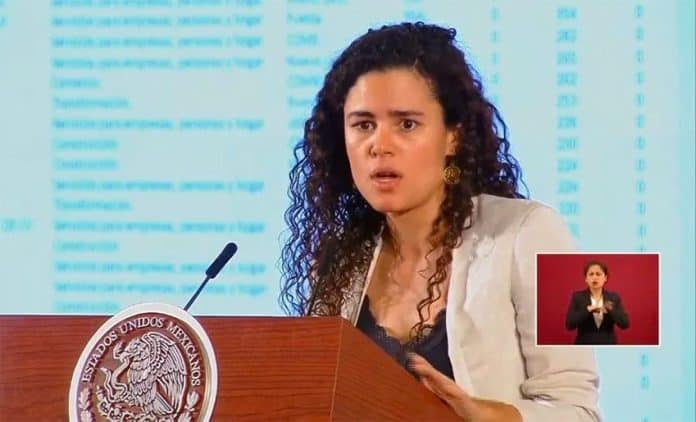
Labor Minister Alcalde: tourism-dependent Quintana Roo saw the highest number of lost jobs.

President López Obrador on Wednesday took aim at large businesses that have laid off workers due to the coronavirus pandemic, charging that they should put the wellbeing of their employees before profits.

“Small businesses … are resisting the crisis … small business owners, men and women, are acting very responsibly, heroically, because they’re the ones who are taking greater care of the employment of their workers, [the small business sector] is where there have been fewer dismissals,” López Obrador told reporters at his morning news conference.

In contrast, the president continued, some large companies – “not all of them, of course” – have dismissed workers despite the government’s directive to maintain their workforces and continue paying their full salaries even if they been ordered to close.

López Obrador called on large employers to avoid dismissals and show solidarity with their workers as Mexico faces a growing public health and economic crisis.

“Let’s all behave well. These are times for fraternity, solidarity, humanism, not selfishness, not for only thinking about material things,” he said. “It cannot be that our god is money, that is not what characterizes the majority of Mexicans,” he added.

“We don’t want the bad behavior of a few [companies that are dismissing workers] to be copied by others. We still have time to make a respectful call … to those who are doing this: correct [your decision], it’s wise to change your opinion.”

López Obrador claimed that some of the recent dismissals from large companies and a large number late last year are related to outsourcing.

“This is wrong, now that we are going through this health crisis it’s doubly wrong that … they’re acting in this way. How is it possible that from one day to the next, a company is left without a single worker [because] they dismissed 800? It’s incredible,” he said.

Labor Minister Luisa Alcalde said that almost 347,000 workers lost their jobs between March 13 and April 6, and that dismissals by businesses with more than 50 employees accounted for 85% of the total.

Quintana Roo, whose tourism industry has been decimated by the coronavirus pandemic, recorded the highest number of job losses in the period, with almost 64,000, followed by Mexico City, Nuevo León, Jalisco, México state and Tamaulipas. A total of 193,000 jobs, or 56% of the total, were lost in those six states, Alcalde said.

She said that there is no legal justification for companies to dismiss workers during the month-long health emergency period or not pay their full salaries. Foreign Minister Marcelo Ebrard said last week that employers that don’t comply with the government’s directive to keep workers on their books will face administrative sanctions or even criminal penalties.

For his part, the director of the Mexican Social Security Institute (IMSS) said Wednesday that those dismissed have already lost, or will soon lose, their IMSS benefits, including access to medical care.

“Small businesses have withstood [the crisis]; they have greater solidarity with their workers but large companies are always doing their [profit margin] calculations,” Zoé Robledo said.

Dismissing workers and and consequently taking away their medical benefits could place lives at risk, he added.

Source: Reforma (sp), La Jornada (sp) 

In Xalapa, people still out and about, despite the coronavirus emergency

0
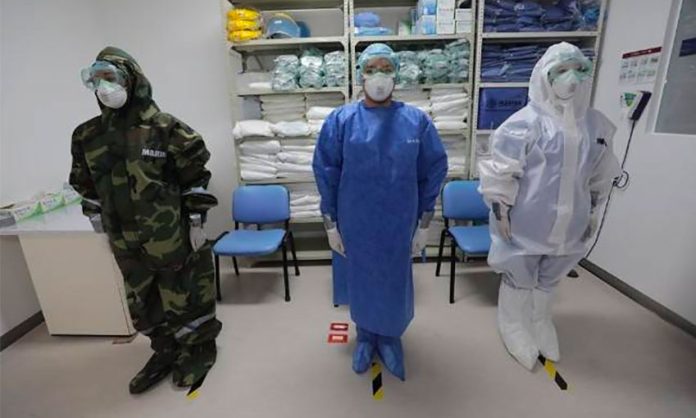
Navy medical personnel at the ready at a Mexico City hospital.

I went for a walk yesterday to the pharmacy. The closest one is a bit of a hike downtown, but I didn’t have the car and didn’t want to risk taking a taxi.

I was surprised to see quite a few people out and about, and plenty of cafes and restaurants open and only slightly less filled than they normally are.

Though restrictions have been put out for “nonessential business,” many people, and not just those whose livelihood depends on crowds, are ignoring what they consider “suggestions” from the government. I can’t help but wonder the extent to which López Obrador’s flippant attitude in the beginning has influenced the public at large.

On the other end of the spectrum, we have “news” that I can only assume is a bad joke: a declaration from Navy Secretary Rafael Ojeda that, “disciplined countries like Mexico are winning the battle against Covid-19.”

His evidence? That “… 40 intensive care beds have been prepared for Covid-19 patients at the hospital in the capitals south and that seven other navy hospitals in port cities will treat up to six patients each.” I think I speak for many here when I issue a drawn out and sarcastic “Woooooow, that many? Well, stop your worrying then, everyone!”

Dare I ask if there are medical personnel on standby to actually care for those patients? How about medicine and ventilators? Can we assume that, given the number of confirmed cases so far, they’ll be putting approximately 10 people in each bed?

Here are the facts: the numbers of Covid-19 diagnoses and deaths are growing exponentially by the day in Mexico, and are most certainly much higher than what’s reported since there are such narrow requirements for even getting tested in the first place.

According to superstar Deputy Health Minister Hugo López-Gatell, patients with diabetes are 95% more likely to develop complications or die as a result of the coronavirus. As Mexico has the distinction of being one of the top countries for diabetes and obesity, things aren’t looking too good on that front.

Pair with that the fact that hospitals weren’t prepared or able to cope with the work they already had. Especially after the closure of the Seguro Popular hospitals that were replaced with an ill-planned and mostly-on-paper healthcare scheme that is actually nothing like those in Canada or Europe as promised, we seem primed for a health disaster.

Overcrowded morgues have also long been a problem in many cities in Mexico, and I fear that we will soon be facing some of the same horrific scenarios that others in Latin America have. Guayaquil, Ecuador, for example, has been unable to avoid the terror of dead bodies simply being taken out to the sidewalk since their system is simply not equipped to handle that many deaths at once.

I know that Mexicans are not known for their collective willingness to follow instructions (or stand in line, for that matter). Many right now seem to be taking the position of those who stay behind in evacuated cities waiting for the hurricane to actually not hit, and I’ve been trying hard to understand the logic behind it.

I think a part of it is simply the well-known cultural trope “better to ask forgiveness than permission.” And of course, there are those who simply believe that everything is a hoax or a conspiracy, a proposition as maddening as it is eye-roll-inducing.

I’m not trying to be an alarmist. I’m well aware that most people won’t get it, and that most of those who do will recover. But “most” people don’t need to suffer in order for our entire health and economic system to be completely overwhelmed, and we seem to be heading there fast.

It’s not all bad news. In a recent survey, almost three-fourths of Mexico City residents said they were staying home as much as possible, and hand-washing and social-distancing is up.

And although AMLO was late to the game, he finally seems to be understanding the gravity of the situation, and has wisely ceded most of his comments to the Health Ministry. (Comments on his economic plan during this time are being saved for next week’s column.)

Part of the duty of a good leader is to surround yourself with honest, competent, and principled people who are smarter than you in areas that you don’t know much about, and I hope AMLO will continue leaning in this direction in all areas.

Plus, there’s the added bonus that those folks in the Health Ministry are very good looking — perhaps that will translate to higher ratings! (I can’t decide if I have a bigger crush on López-Gatell or Dr. de la Garza. But I digress.)

I just hope it’s not too late to avoid total disaster.

Sarah DeVries writes from her home in Xalapa, Veracruz.

Previously announced projects will contribute to AMLO’s job creation goal

0
The government has included jobs at the Santa Lucía airport among the 2 million it plans to create.

More details have emerged about how President López Obrador plans to create 2 million jobs by the end of the year to help reactivate the coronavirus-battered economy.

The president met with his cabinet on Tuesday to review the economic plan he presented in a televised address on Sunday.

The government intends to create a significant proportion of the new jobs via its large infrastructure projects, including the Maya Train railroad in the country’s southeast, the Santa Lucía airport north of Mexico City, the Dos Bocas oil refinery on the Tabasco coast and the Isthmus of Tehuantepec trade corridor between Salina Cruz, Oaxaca, and Coatzacoalcos, Veracruz.

Federal Electricity Commission (CFE) chief Manuel Bartlett said after the meeting that the heads of each ministry and agency involved in the government’s infrastructure projects outlined how many jobs were expected to be created.

“With the CFE plan, we’ll have significant job creation,” he said. “There will be a lot of jobs [in government projects], more than a million.”

Bartlett didn’t disclose how many jobs will be specifically created by CFE projects, such as the construction of power plants in Yucatán and Baja California Sur, but stressed that the utility has an “enormous investment program” that will strengthen the state-owned company.

Communications and Transportation Minister Javier Jiménez Espriú said that projects in which his department is participating, including construction of the new airport and an upgrade of the capital’s existing airport, are expected to generate 110,000 direct jobs and 240,000 indirect ones.

For his part, National Tourism Promotion Fund (Fonatur) chief Rogelio Jiménez Pons said that construction of the Maya Train through the states of Tabasco, Campeche, Yucatán, Quintana Roo and Chiapas will create 80,000 jobs.

He said that Fonatur, which is managing construction of the 1,500-kilometer railroad, is taking the necessary steps so that the project can commence as soon as Mexico has the Covid-19 outbreak under control. Construction had been expected to commence at the end of this month.

The general director of the state-owned Banco del Bienestar (Bank of Well-Being) told reporters that the construction this year of 1,350 branches of the so-called “bank of the poor” will also create jobs, although he didn’t cite a specific number.

Rabindranath Salazar said that more jobs will be created once the branches have been built because they will need employees to staff them. The government intends to distribute welfare payments to people living in rural areas via the new banks, which will have the largest network of branches in the country if the plan to build 2,700 by the end of 2021 comes to fruition.

Salazar highlighted that the other projects the government is building will also require large numbers of personnel once they are completed. However, none of the major projects – the airport, the refinery, the Maya Train – will be completed before 2022.

In his address Sunday, López Obrador said that 200,000 new jobs will be created via an expansion of the tree-planting program known as Sembrando Vida (Sowing Life) and that some 228,000 people will be employed to build 50,000 homes in marginalized areas of the country.

In a Twitter post on Tuesday, he reiterated that the three “basic objectives” of the government’s economic response to the coronavirus pandemic are to support 22 million poor people; provide 2.1 million loans between April and December; and create 2 million jobs in eight months.

López Obrador said on Wednesday that distribution of 25 billion pesos (just over US $1 billion) worth of loans to small businesses will commence in the first week of May. He said that 1 million small business owners in the formal and informal sectors will initially be offered loans, explaining that they will be distributed via three private banks that won’t charge any commissions.

“They will be distributed … where the epidemic is having the greatest impact and where the economy is most affected,” López Obrador said.

However, he added that the loan scheme will mainly benefit people in urban areas because other programs, such as Sembrando Vida, will provide employment opportunities and financial support to those in the countryside.

The president said that the loans will be repayable at the current Bank of México benchmark interest rate of 6.5% over a period of three years. The aim of the loans, he said, is to provide an injection of funds into the economy that will stimulate growth.

The federal Finance Ministry (SHCP) is predicting that the Mexican economy could shrink by as much as 3.9% this year due to the coronavirus pandemic while the Bank of America is forecasting an even more dire contraction of 8%.

Business groups and financial institutions have been critical of the economic plan announced by López Obrador, claiming that it will do little to help the economy through the biggest economic crisis in generations.

Source: El Economista (sp), Milenio (sp), La Jornada (sp) 

Tourists harass and attack reporter on Puerto Vallarta beach

0
Tourists vent their anger at a reporter on a beach in Puerto Vallarta.
Tourists vent their anger at a reporter in Puerto Vallarta.

Two foreign tourists verbally and physically assaulted a female Mexican reporter in Puerto Vallarta, Jalisco, as she filmed them in a report on visitors not following the government’s Covid-19 mitigation guidelines.

Doraliz Terrón was reporting on the situation at the tourist destination’s Los Muertos beach for the regional news outlet Paralelo Informativo on Monday when a foreign tourist approached her and used physical force to try and stop her from recording him.

“Nobody wants you filming us,” he says as he rushes to her and forcefully puts his hand over her phone.

“I want to tell you that you’re not supposed to be here,” Terrón says in English as the man interrupts her.

“Oh yeah?” he says, the camera shaking violently from his assault. “Fuck off!”

Agreden turistas a reportera por señalarlos de estar en la playa durante cuarentena

“We don’t want you here,” the man shouts angrily at the reporter.

Despite his threatening demeanor, Terrón didn’t back down. “I don’t care,” she says. “We are working here.”

“You are not working here. You are filming people on the beach,” he says, claiming that Terrón needed permission to film him in public.

When Terrón said she was going to report them to the authorities, another man shouted, “Report all you want, you stupid bitch!”

After the reporter spoke with two navy marines who were nearby, they approached the visitors, who agreed to follow the physical distancing guidelines.

But after the marines left, Terrón was approached once again by the man, accompanied by a woman, who repeatedly told her to “fuck off!”

“You’re a terrible person!” the man screamed as the two filmed each other.

After leaving the scene, Terrón said on camera that authorities would do nothing about the assault and that the tourists would carry on as if nothing happened.

“… it’s not a problem if they assault [people].”

Source: Infobae (sp)

220 tourists quarantined in Nayarit resort after refusing Covid-19 tests

0
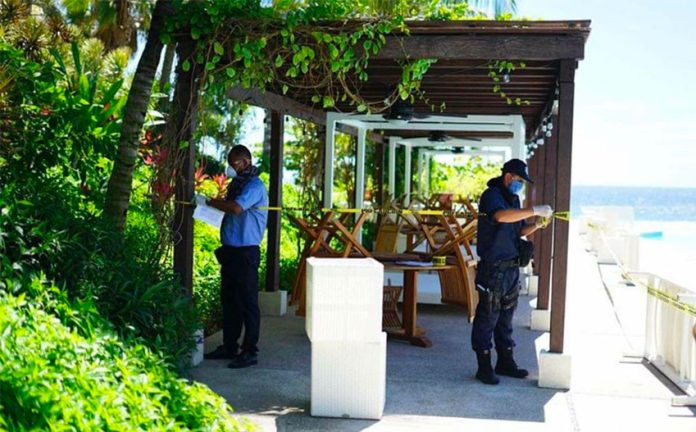
Officials put up a sanitary barrier around the Bahía de Banderas resort.

Some 220 tourists from Jalisco are under a government-enforced quarantine in the tourist destination of Bahía de Banderas after two vacationers from Guadalajara who tested positive for coronavirus arrived at a luxury resort on the weekend. 

Nayarit health authorities asked guests staying in 40 beachfront condominiums at Los Veneros resort to be tested for the virus, but they refused, officials say. 

As a result, in a joint effort spearheaded by the Health Ministry, Civil Protection and state Governor Echevarría García, the luxury complex was surrounded by a sanitary barrier in order to protect residents and workers from further spread of the virus. 

An official statement on the installation of the barrier claims that “all health protocols are being followed, and it means that the 220 people who vacation in this luxury housing complex will be in quarantine; that is, no one can leave for at least 10 days, which is the minimum time to complete the 14 days of isolation that is required to rule out incubation of the disease.” 

Los Veneros — where rentals go for around US $1,400 a night — is located on the road to Punta Mita and under normal circumstances, guests are drawn to its “37 enchanted acres along a stretch of almost 1,500 feet of white sandy beach frontage at renowned Playa de Estiladeras,” the resort’s website reads. “Entry is via gated access, with 24-hour welcome and security staff. Recreational amenities currently include inviting swimming pools, a chic oceanfront Beach Club with bar and grill, fitness, wellness and spa services, and an ocean activities center.”

Governor Echevarría did not hide his contempt for the two tourists who decided to continue with their vacation plans — it is Easter Week in Mexico — after testing positive for the virus. Tourists “are always welcome,” he said, “but not if they infect our people.” 

“I know who the people who have Covid-19 are, I know where they are staying. I don’t want to give their names so as not to out them, that’s not my style, but the police will do the proper thing,” he continued. “My responsibility lies with the people of Nayarit and I will take care of your health; these are difficult days, better times will come.”

Residents of the town of Sayulita, also located in Bahía de Banderas, set up roadblocks on the weekend to prevent tourists from visiting and spreading the coronavirus.

Source: La Jornada (sp), Entérate Nayarit (sp)

Thieves target portable handwashing stations in Hidalgo

0
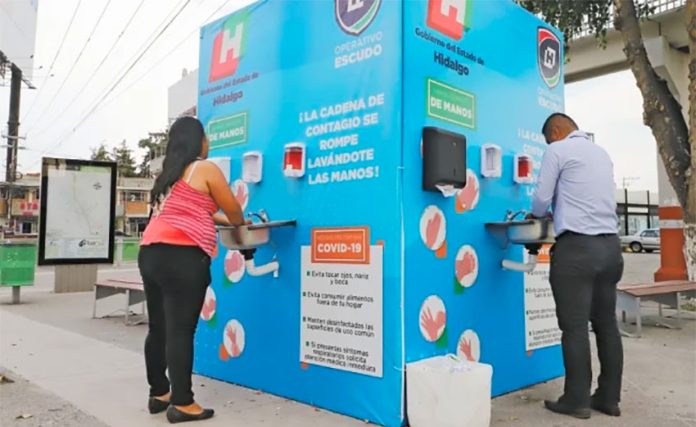
A handwashing station in Hidalgo.

Public handwashing stations installed to prevent the spread of coronavirus in a city in Hidalgo are not faring well: thieves are going after the accessories.

Thieves in Huejutla vandalized and stole accessories from four of 15 stations set up by state and municipal authorities.

In response, the state said anyone found harming the installations could spend a night in jail or be forced to pay fines to cover the damage.

The Huejutla municipal government announced that it had repaired the damage and replaced the soap and hand gel dispensers that were stolen over the weekend.

Handwashing stations were set up in a number of locations across the state, many of which saw use by the public.

A retail worker in Tula de Allende said the stations are a good resource to keep one’s hands clean when out of the house on essential business.

“Now there’s no excuse [not] to wash your hands frequently when in public, avoiding contagion,” he said.

Another resident said that she sees people using the stations almost all day and hopes the preventative measures will have the desired effect soon.

“Hopefully all of this comes to an end and we can continue with our normal lives,” she said.

Sources: El Sol de Hidalgo (sp), El Sol de Hidalgo (sp)

Doctors, nurses confront coronavirus—with long hours and low pay

0
doctors and nurses
They're substantially underpaid and work long hours.

Now more than ever medical personnel around the world are viewed as heroes, risking their lives and fighting tirelessly to combat coronavirus on the front lines of the deadly global pandemic.

Yet a new study commissioned by the Mexican Senate reveals that in this country doctors and nurses are substantially underpaid given the services they perform, their level of education and the long working hours. 

“Although they perform functions that make a difference between life and death and are among the most loved and respected professions, medical and nursing personnel’s compensation in Mexico is significantly lower than in other countries of the world and it is also less than other occupations that require fewer years of study,” the document states.

The study, released in March by Mexico’s Belisario Domínguez Institute, paints a grim financial picture of how medical personnel in this country are compensated. 

The study cites a 2019 Physician Compensation Report from the website Medscape revealing that, on average, Mexican doctors earn around 16,146 pesos (US $670) per month, about one-third of what doctors make in countries like Brazil and Italy. Doctors in the United States make 14 times the salary of their Mexican colleagues. 

Nurses, meanwhile, earn around 9,909 pesos (US $409) a month, a salary that lands them on the list of the 10 poorest paid professions in Mexico. Veterinarians, for example, are better paid than nurses, as are musicians. 

“It is not a question of undermining the morale of our health professionals due to the modest salary they receive, but rather of emphasizing and recognizing that at the moment there is an army of brave and committed women and men who are giving everything to save people’s lives and that they are doing it, fundamentally, out of a vocation for service and love of the profession,” said the study. 

The study also noted that although nurses and doctors are the third and fifth most respected professions in Mexico, there simply aren’t enough of them to go around. 

In July 2019, the Health Ministry announced that Mexico needed 195,000 more doctors and 730,000 more nurses to meet the country’s medical needs, and those numbers were pre-coronavirus.

“One of the lessons we must learn from this epidemiological crisis is the need to improve working conditions for the people who take care of our health,” the study concluded.

Mexico News Daily