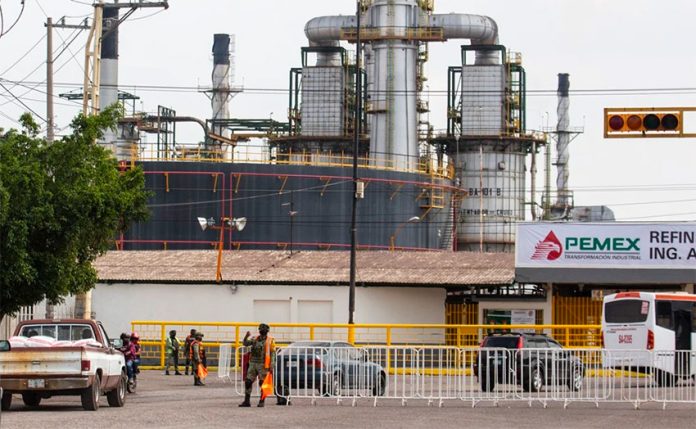
The Salamanca refinery was the target of a failed bombing attempt.
After cartel-related violence across Guanajuato last weekend and a thwarted bomb attack on the Pemex oil refinery in Salamanca on Wednesday, federal Security Minister Alfonso Durazo announced that 150 federal police officers will be dispatched to Salamanca for the next six months to help maintain order.
The municipal police force is composed of just 60 unarmed officers, who will now receive equipment and training from the army. The municipal force is a new one and its officers are all new and awaiting permission to carry arms.
They have been waiting since January.
In a security meeting between Durazo and mayors from around the state, an agreement was reached to increase funding and the use of technology to help combat crime.
The move comes after an abandoned vehicle containing 12 explosive devices was found near the Salamanca oil refinery Wednesday evening, an act thought to have been provoked by the arrest of dozens of members of the Santa Rosa de Lima cartel on Saturday in Celaya, including the mother, sister and cousin of cartel leader José Antonio Yépez Ortiz, alias El Marro.
After the arrests, Yépez ordered vehicles to be set on fire on several roads in the area, creating fiery blockades to hinder efforts to arrest him.
Blockades were established at 47 different points in 13 municipalities, Milenio reported, prompting the United States Embassy to issue a security alert warning its citizens to avoid highways in 10 Guanajuato municipalities.
President López Obrador called on the residents of Guanajuato who support the cartel to change their attitude toward the crime syndicate, which is involved in extortion and fuel theft, and separate themselves from illegal activities.
Mexico’s coronavirus case tally surged past 200,000 on Thursday with more than 6,000 new cases reported while the Covid-19 death toll exceeded 25,000.
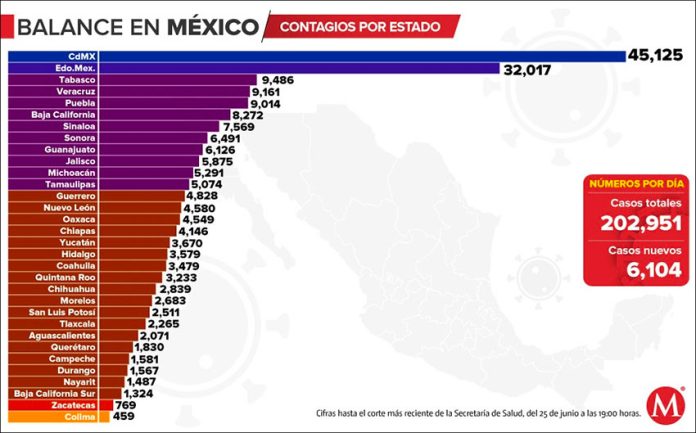
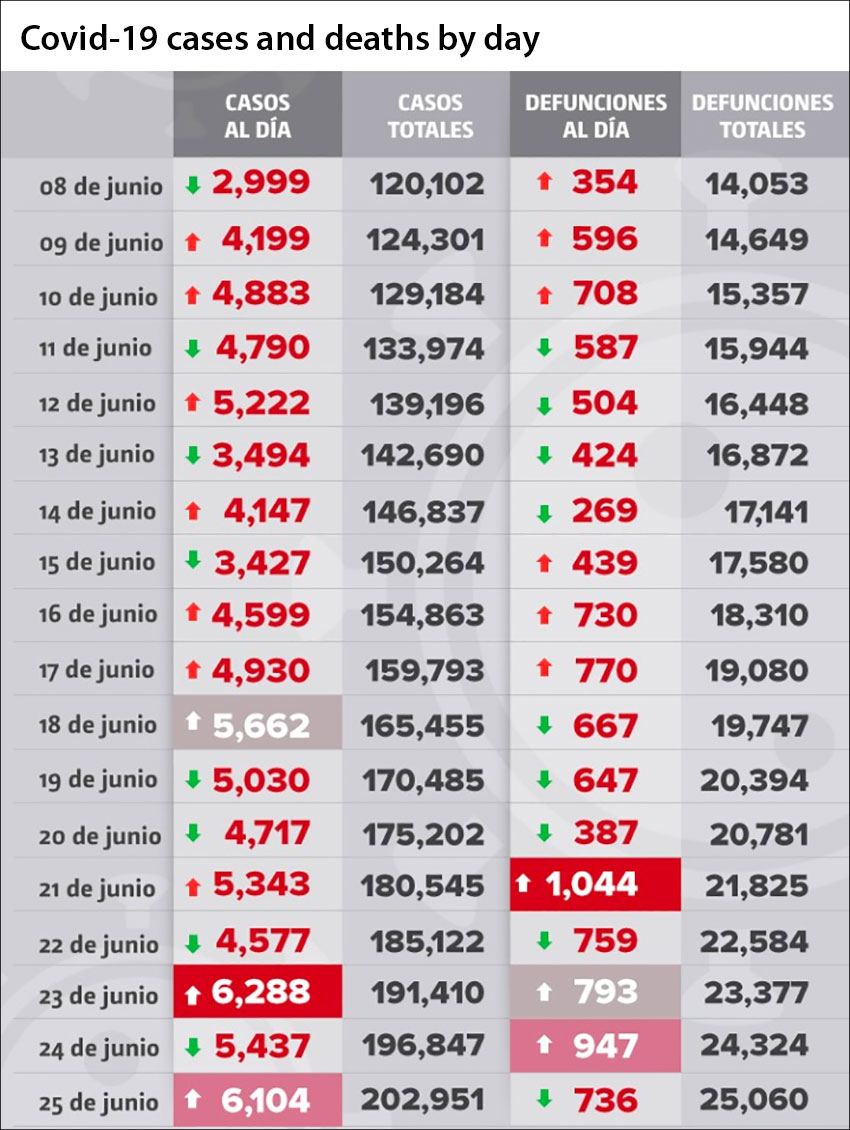
The federal Health Ministry reported that the accumulated number of confirmed cases since the beginning of the pandemic had increased to 202,951 with 6,104 new cases registered on Thursday.
It was only the second time that more than 6,000 cases were registered on a single day after 6,288 were reported two days prior.
Mexico now has the 11th highest coronavirus case tally in the world, according to data compiled by the Johns Hopkins University, having passed France on Thursday.
The Health Ministry reported that the official Covid-19 death toll had increased to 25,060 with 737 additional fatalities. An additional 1,966 deaths are suspected of having been caused by Covid-19 but have not yet been confirmed.
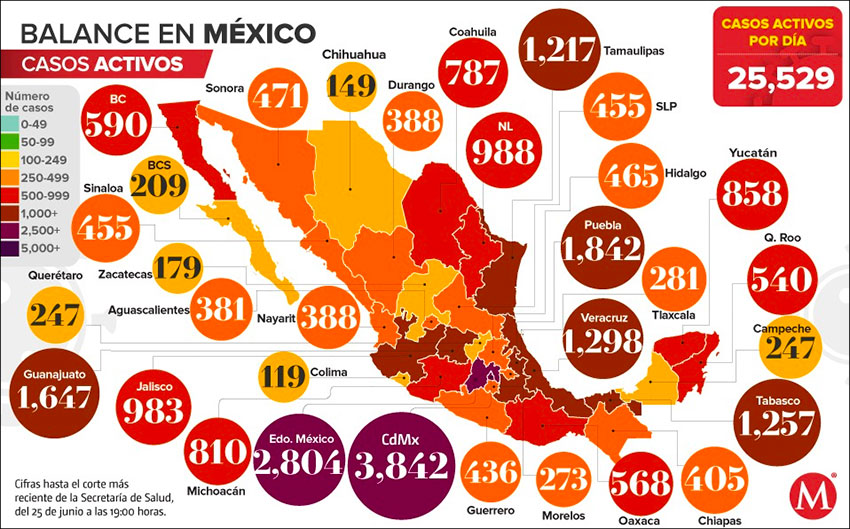
Active coronavirus cases as of Thursday. milenio
Today marks 100 days since the first Covid-19 death was reported on March 18 when Mexico had recorded just 118 confirmed cases.
If the average number of deaths reported each day thus far in June continues, the death toll will pass the former figure in the second week of July.
Of the more than 200,000 confirmed cases, 25,529 are considered active, an increase of 1,493 cases compared to Wednesday.
Health Ministry Director of Epidemiology José Luis Alomía said that there are also 63,583 suspected cases of Covid-19 and that 528,651 people have now been tested.
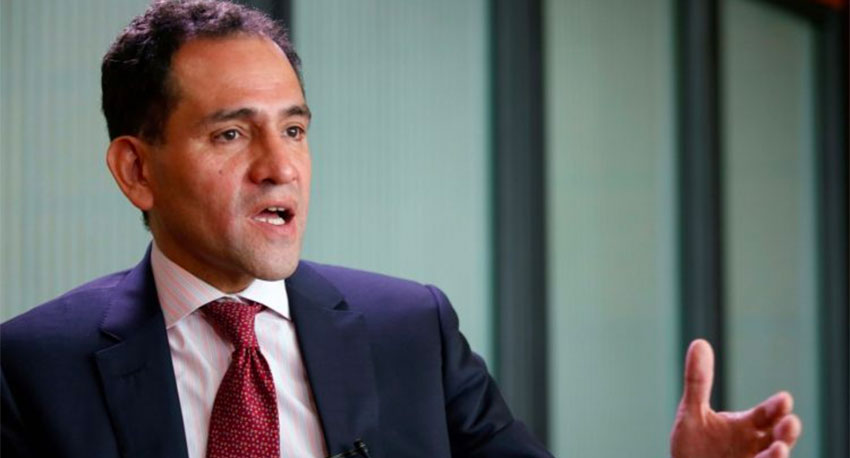
Among those who recently tested positive is federal Finance Minister Arturo Herrera, who announced the news on Twitter yesterday afternoon.
The daily tally of coronavirus cases and deaths. Deaths are numbers reported and not necessarily those that occurred each day. milenio
“I have just been told that I tested positive for Covid-19. I have very minor symptoms. From this moment I will be in quarantine, and will continue working from home,” he wrote.
Herrera is the fourth high-ranking federal official to have tested positive after Public Administration Minister Irma Sandoval, Consumer Protection Agency chief Ricardo Sheffield and Mexican Social Security Institute director Zoé Robledo.
The Finance Ministry said that contact tracing would be conducted to identify people who recently came into contact with the minister. One of those is President López Obrador, who met with Herrera in the National Palace in Mexico City on Monday.
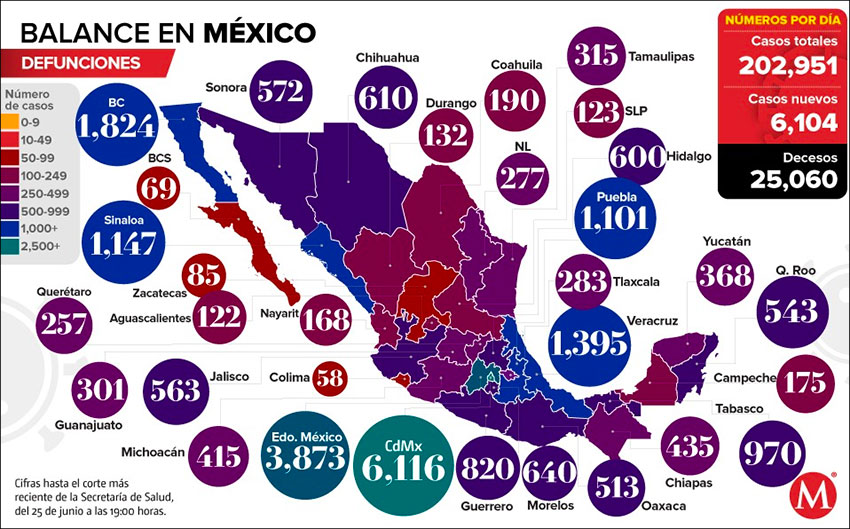
The capital remains the epicenter of the coronavirus outbreak, with 3,842 active cases, according to official data. Mexico City has recorded more than 45,000 confirmed cases since the start of the pandemic and its Covid-19 death toll passed 6,000 on Thursday.
México state ranks second for accumulated cases and deaths, with 32,017 of the former and 3,873 of the latter. It also has the second largest active outbreak in the country, with 2,804 cases.
Puebla, Guanajuato, Veracruz, Tabasco and Tamaulipas all have more than 1,000 active cases, while Baja California, Veracruz, Sinaloa and Puebla have each recorded more than 1,000 Covid-19 deaths.
Finance Minister Herrera has tested positive for Covid-19.
Almost four months after the first case of Covid-19 was detected in Mexico, the country is in the midst of a deadly pandemic with no clear end in sight.
In the middle of April, López-Gatell presented an epidemiological model that predicted that the coronavirus epidemic in the Valley of México metropolitan area would be virtually over by June 25 with 95% of cases having been recorded.
At Thursday night’s coronavirus press briefing, the deputy minister charged that some media outlets had misinterpreted the prediction because they reported that he had said that Mexico’s pandemic would be over by that date.
“We don’t assume that the journalists or their editors … or the media owners … have ill will. We assume that there is a misinterpretation of the information,” López-Gatell said.
He presented a video showing clips of various press conferences since February at which he asserted that the coronavirus epidemic in Mexico would be long.
On April 16, the date on which it was forecast that the Valley of México epidemic would be virtually over, López-Gatell qualified the prediction by saying that the outbreak would only come to an end if people followed the coronavirus mitigation restrictions.
Coronavirus deaths reported as of Thursday. milenio
He acknowledged last night that the mitigation measures are “tiring, uncomfortable, disagreeable” and cause anxiety but reiterated their importance and called on people to be patient.
Fifteen of Mexico’s 32 states still face “red light” restrictions because the risk of coronavirus infection is deemed to be at the maximum level in those states. The other 17 states were allocated an “orange light” on the Health Ministry’s “stoplight” map that will remain in effect until Sunday.
A new map will be presented at tonight’s coronavirus press briefing, with the stoplight colors allocated to each state and corresponding restrictions to take effect on Monday.
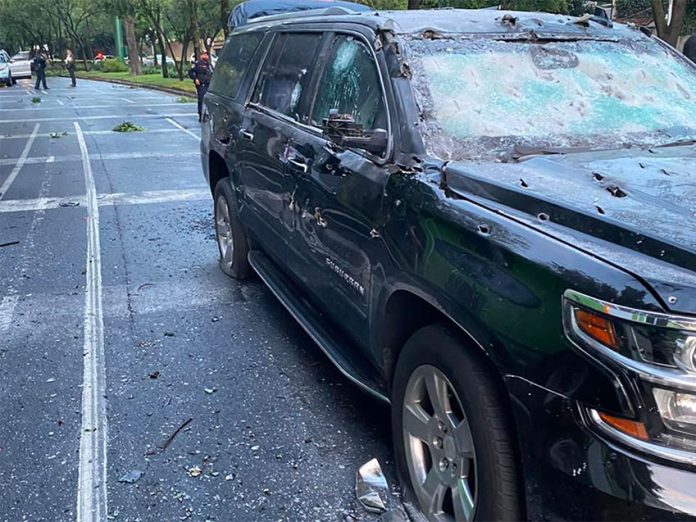
The vehicle in which the police chief was riding Friday morning.
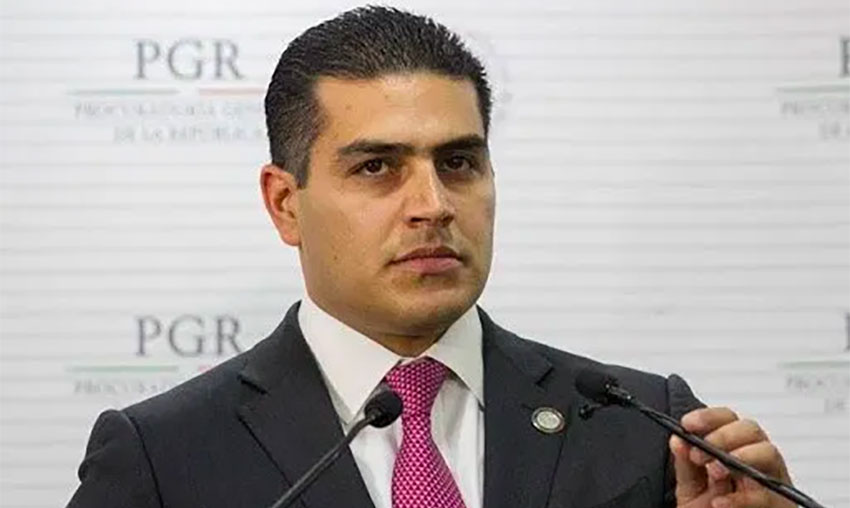
Mexico City Police Chief Omar García Harfuch was wounded this morning after he and his bodyguards were attacked by a group of armed men, Mayor Claudia Sheinbaum reported on Twitter.
The attack occurred just after 6:30 a.m. on Paseo de la Reforma in the Lomas de Chapultepec neighborhood as García, 38, was traveling in an armored Suburban to his regular morning briefing with Sheinbaum.
He and his entourage were fired on by a group of men in a truck who were equipped with body armor, pistols, Barrett .50 caliber sniper rifles and fragmentation grenades.
It is believed that García’s vehicle was blocked by another truck when several men jumped out of the first truck and opened fire, blanketing the Suburban in bullets.
One woman was killed while driving nearby and two of García’s bodyguards were shot dead during the attack, which was caught by surveillance cameras in the area.
Chief García: ‘We shall continue working’ to combat organized crime.
“To the families of these two brave police officers I send my condolences and say that they are not going to be abandoned,” Sheinbaum told a press conference this morning. She also said she has been in contact with family members of the female victim.
The chief was reported in stable condition and expected to recover.
He claimed via Twitter that the Jalisco New Generation Cartel orchestrated the attack.
“Our nation must continue to stand up against the cowards of organized crime. We shall continue working.”
Attorney General Ernestina Godoy said 12 arrests have been made in the attack thus far.
In his previous job as head of the investigation division of the Federal Police, García was responsible for the release of 186 kidnapping victims, the capture of 606 kidnappers and the dismantling of 56 criminal gangs, according to El Heraldo de México. García was named Mexico City’s chief of police in 2019.
President López Obrador made reference to this morning’s incident in his morning press conference, stating that the attack “has to do, without a doubt, with the work that García is carrying out to guarantee peace and tranquility both in Mexico City and around the country. We express our solidarity, and our total, complete and absolute support for the mayor and the members of the Mexico City public security team.”
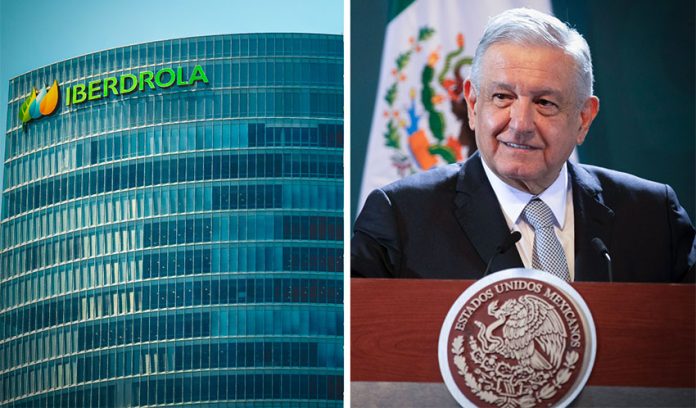
President López Obrador predicted Thursday that the government will reach an agreement with Iberdrola, a Spanish energy company that is reportedly canceling a US $1.2-billion power plant project in Veracruz.
The mayor of Tuxpan told the news agency Bloomberg and the newspaper Reforma that representatives of the firm told him that it was canceling its combined-cycle plant in the city because in nine months it has been unable to reach a natural gas supply agreement with the state-owned Federal Electricity Commission (CFE)
Veracruz Governor Cuitláhuac García tweeted on Wednesday that the Tuxpan plant will go ahead but the CFE will operate it.
But speaking at his regular news conference on Thursday morning, López Obrador said there is no official word that Iberdrola is canceling the project.
He said that he has received a letter from the company in which it expresses its desire to reach an agreement with the government and indicates that it wishes to continue investing in Mexico. López Obrador said that he had forwarded the letter to Energy Minister Rocío Nahle and CFE director Manuel Bartlett.
“There will be an agreement, the letter is for that purpose. They [Iberdrola] want dialogue, they’re even asking me for a meeting [but] I want the energy minister and the CFE director to attend to them first,” he said.
However, the president stressed that the government won’t sign an agreement that is unfavorable to Mexico and its people.
“Enough is enough, let it be well understood, let it be heard loud and far: Mexico is not a land to be conquered. They’re not going to come to loot us, that’s over. We have to look after the wealth of the Mexican people,” López Obrador said.
“It’s a disgrace that they took the energy minister of former president [Vicente] Fox or [Felipe] Calderón to work at the company,” López Obrador said.
He also noted that Calderón, president from 2006 to 2012, accepted a board position with a United States-based subsidiary of Iberdrola after he left office.
“Imagine a president of our republic, who after the end of his government became part of the Iberdrola board. It’s a disgrace!”
Calderón responded on Twitter that he didn’t take up a position with the company until four years after he left office and accused the president of attempting to divert attention from his government’s poor management of the coronavirus pandemic and associated economic crisis.
López Obrador and Calderón have a long history of antagonism, and the former blames the latter –and other past presidents – for all manner of problems his government faces, including corruption and insecurity.
A staunch nationalist, the president also accuses past “neoliberal” governments of allowing foreign and private companies to enter Mexico’s energy sector on terms that were unfair to the state. He claims that they neglected the state-owned CFE and Pemex, leaving them in ruins.
López Obrador has pledged to “rescue” the state-run utilities, and his administration has taken steps to limit the participation of private companies in both the electricity and oil sectors.
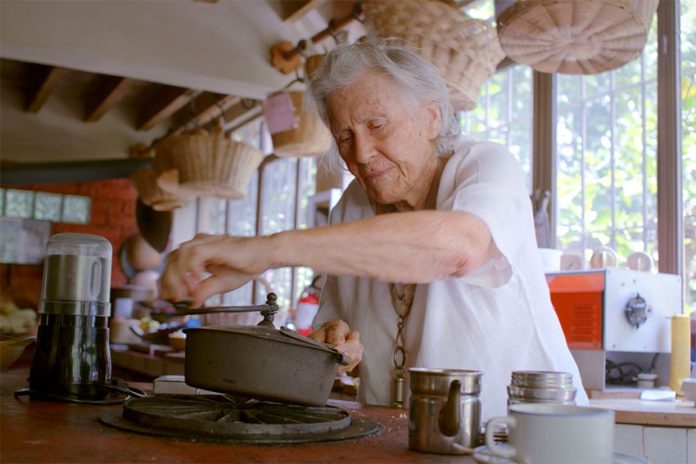
No foreigner has done as much to promote Mexican cuisine as Diana Kennedy, a 97-year-old British-born food writer, home chef and cookbook author who has called Mexico home for around half a century.
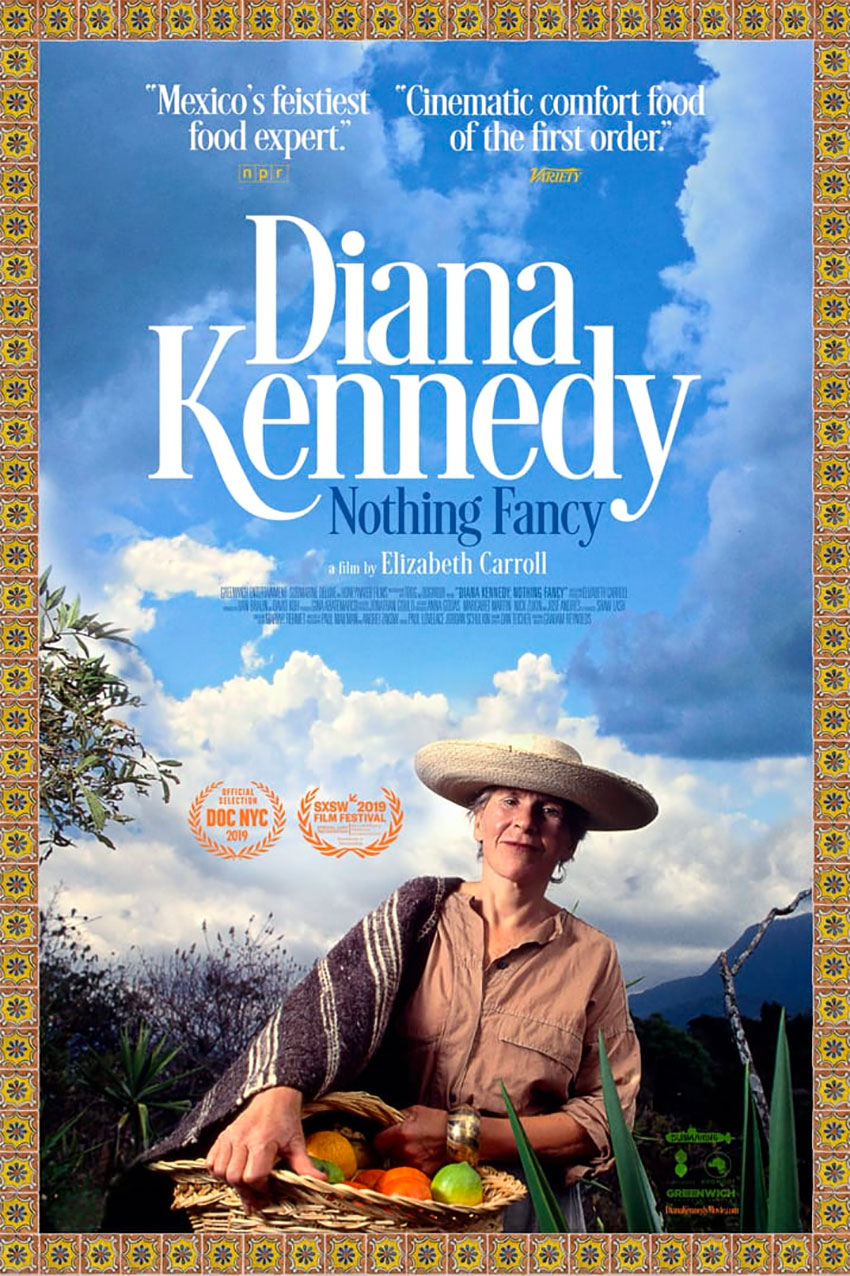
Now, a documentary explores the life and passions of the woman who has been described as “the rock star of Mexican cooking” and an authority on the cuisine of her adopted country.
Described as a “short, sharp, marvelously watchable docu-portrait” by The Guardian newspaper’s film critic, Diana Kennedy: Nothing Fancy is the directorial debut of filmmaker Elizabeth Carroll.
Just minutes into the film, Kennedy’s editor at the publishing house Harper & Row, Frances McCullough, poses the question: “How can it be that a white British woman knows more about Mexican food than anybody else?”
Carroll’s 80-minute film searches for an answer, says food writer Mayukh Sen in a review for The Washington Post.
The documentary succinctly covers key events in Kennedy’s life, including her birth in England in 1923 and her first trip to Mexico in 1957 with Paul Kennedy, a New York Times correspondent who would become her husband.
While living with him in Mexico City, Diana Kennedy – the author of nine Mexican cookbooks – developed a great love for Mexican food that would endure throughout her whole life.
She moved to New York for a period in the 1960s but after her husband’s death from cancer, Kennedy settled for good in Mexico in the 1970s and dedicated the ensuing years to continuing her intensive on-the-ground research about Mexican cooking and culinary traditions.
She continues to live on an off-the-grid property near Zitácuaro, Michoacán.
Diana Kennedy: Nothing Fancy, writes The Guardian film critic Peter Bradshaw, “shows us her life in Michoacán, … vigorously engaged with her community, lecturing and giving media interviews and masterclasses in Mexican cooking, taking long walks, driving herself around the place, visiting markets and not hesitating to tell stallholders if their produce isn’t up to scratch.”
The documentary “functions as a tender character study of Kennedy in the twilight of her life,” writes Sen.
It features interviews with several foreign chefs and admirers of the nonagenarian as well as insights from three Mexican chefs: Abigail Mendoza of the Tlamanalli restaurant in Oaxaca, Pati Jinich, host of the television series Pati’s Mexican Table and Gabriela Cámara of Mexico City’s Contramar, who describes Kennedy as a “legend.”
The film, which has received near-unanimous praise since premiering at Texas’ South By Southwest festival in 2019, presents an overwhelmingly positive view of Kennedy’s contribution to the promotion of Mexican cuisine.
However, as Sen notes in her Washington Post review, some reviewers have criticized the documentary for “presenting an antiseptic portrait of Kennedy” and “smoothing over the complications of her legacy.”
Carroll, the filmmaker, said that Kennedy told her in no uncertain terms that there were some people she didn’t want involved in the film.
“I was given the opportunity to make the film about her, and this is a perspective that I’m offering on Diana,” she said. “It’s not everybody’s perspective, and it doesn’t have to be.”
One person who has been critical of Kennedy is Gustavo Arellano, a Mexican-American writer.
Diana Kennedy: Nothing Fancy | Official Trailer
“Her place in the history of Mexican food is secure: she made regional Mexican cuisine palatable to Americans. I will never begrudge that, because it was an important step in the course of Mexican food in the U.S. that a Mexican chef or writer could’ve never accomplished,” he told the Post.
“My issue with Kennedy has always been that she wants to fix Mexican food in amber, and belittles any interpretation or deviance from her romanticized notions of what Mexican food should be.”
Indeed, Kennedy’s disdain for tampering with traditional recipes is on display in the film.
“No you don’t put garlic in!” she snaps as she hovers over a stone mortar while making guacamole.
While the documentary – and Kennedy – have their critics, the film provides an easily-digestible and fascinating insight into the life of one of the giants of Mexican cooking and will be of interest to anyone interested in Mexico, and especially Mexican food.
The only aspect of my life that is likely to garner a mention in Ripley’s Believe it or Not is my relationship with earthquakes.
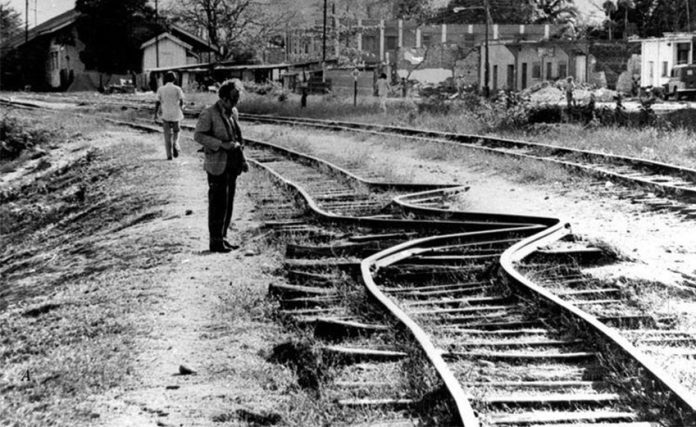
I am, statistically speaking, possibly the only person around who can claim to have been in not just one but two Big Ones — Guatemala in ’76 and Mexico in’85. The former took 25,000 souls, and the latter about 8,000.
Fortunately Monday’s earthquake was a lot less lethal but I, survivor of at least a personal Earthquakedemia, may be a carrier of “Earthquakeovid” and able to offer some perspective as a recovered patient. A survivor.
Having lived not only in Guatemala and Mexico, but also seismic-prone Peru and Ecuador, my status as a quakecarrier is only logical, especially when I frost my earthquake cake astrologically with birth in San Francisco, site of the Really Big One.
Twice I’ve been unmasked as a carrier: the first time saw my radio interview in San Diego on the topic abruptly shortened by one. The second saw me hustled out of Japan, by my host, where earthquakes are serious business. Monday’s Oaxaca quake, a rocker in Mexico, was just a “thudder” in Guatemala, where I am currently marooned.
Scientists have their Richter and Mercalli classification scales. My own classification system encompasses rollers, rattlers, and as mentioned, thudders.
A roller seems to come as a wave from a distance, passing by like a surfer’s missed wave. I remember one roller appearing to bend my kitchen wall inwards, only to straighten back upright as the wave passed. A rattler makes window glass rattle, often opening drawers and doors like a poltergeist.
A thudder, by far the most common, sounds and feels like someone has dropped a bag of cement on the floor nearby.
Peru, or at least Lima, has its unique “rock n roller,” being built on a bed of water-rounded alluvial rocks. A quake coming from the Pacific through Lima announces itself by an ever louder clicking of stones, and says adiós by a receding clicking into the Andes, much like the whistle on a distant train.
The same scientists who dote on Richter scales have their HQ bunker in Golden, Colorado. The National Earthquake Center hosts a fascinating website if you’re the kind who likes to handle spiders. They are an amiable bunch, many with seismographs at home, and welcome input. Their responses from someone in the field are often noticeably tinged with envy. Gee! and Wow! are big vocabulary words.
As in marathons, endurance matters. My Big One in ’76 was just 35 seconds. The Big One in ’85 three times that — a seeming eternity.
Monday’s Oaxaca quake had two silver linings. Mexico’s unique early warning system functioned well, if not 100%.
And you can now, if this was your first one, set yourself down on a cracker barrel by the stove in the winter and swap long and short Mexico tales, no longer just about traffic cops and exotic ailments, but now about quakes. “Well, when I was in Mexico …”
Carlisle Johnson is a journalist living in Guatemala and a frequent contributor to Mexico News Daily.
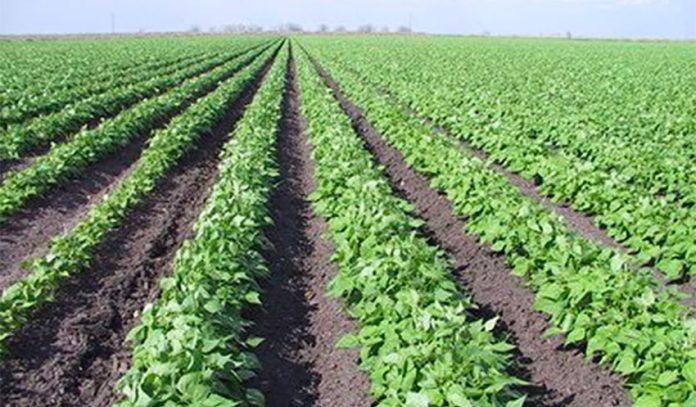
Although President Lopez Obrador has urged Mexicans to eschew expensive and processed foods and eat more beans, the country is facing a bean shortage due to drought and is being forced to import some 100,000 tonnes in order to meet the short-term demand.
The problem has been ongoing, the Ministry of the Economy reports.
In 2019 bean production decreased by 31% and as a result, prices have increased by nearly 30% in the last year, according to the National Consumer Price Index.
Bean imports, which will start this year on July 1 and end October 15, were also necessary in 2016 and 2017. In 2018 the crops had recovered enough that beans were only imported for a six-week period.
The Ministry of Agriculture and Rural Development warned in December that the 2019 drought was the worst since 2011 and that the production of basic grains, sugar, corn, coffee and livestock would be affected. Key bean-growing states Chihuahua, Durango, Guanajuato and Zacatecas saw their driest month on record in July of last year.
Imports of rice, which are already at 85% of the nation’s supply, may also be increased as a result.
Last year the government spent 8.1 billion pesos (US $356 million) on subsidies for small farms, including financial assistance for 300,000 bean producers, and this year that budget has increased to 10 billion pesos (US $439 million).
The coronavirus-induced economic crisis will hit Mexico harder than any other country in Latin America, predicts the International Monetary Fund (IMF).
In its June World Economic Outlook Update, the IMF forecast that Mexico’s GDP will shrink 10.5% this year, 3.9% below its April prediction of a 6.6% contraction.
The forecast is considerably worse than those of the World Bank, the Organization for Economic Cooperation and Development and the United Nations Economic Commission for Latin America and the Caribbean, which are currently predicting that Mexico will suffer an economic contraction in 2020 of 7.5%, 8.6% and 6.5%, respectively.
If the IMF prediction proves to be accurate, Mexico will suffer its worst recession since 1932 when the economy contracted 14.8% amid the Great Depression.
The IMF’s 2020 growth forecasts for other major Latin American economies are: Brazil, 9.1% contraction; Argentina, 9.9%; Colombia, 2.4%; Chile, 4.5%.
The organization predicts that the GDP of the Latin America and the Caribbean region as a whole will shrink by 9.4% this year, while global economic output is forecast to contract 4.9%, a 1.9% decline compared to its April prediction.
“The Covid-19 pandemic has had a more negative impact on activity in the first half of 2020 than anticipated, and the recovery is projected to be more gradual than previously forecast,” the IMF said.
The growth forecast for Mexico is also below that of its North American trade partners, the United States and Canada, which the IMF predicts will suffer contractions of 8% and 8.4%, respectively, in 2020.
However, the outlook for Mexico in 2020 is better than the forecasts for the economies of France, Italy and Spain, all of which are predicted to contract by more than 12%.
The IMF predicts that the Mexican economy will grow 3.3% in 2021, an increase of 0.3% compared to its April forecast. However, the 2021 prediction for Mexico is below the 3.7% growth forecast for Latin America and the Caribbean and the 5.4% global forecast.
Mexico’s central bank is currently offering the most optimistic growth forecast for 2021, the newspaper El Universal reported, predicting that GDP will increase 4.1%.
Access has been restricted at the Salamanca refinery.
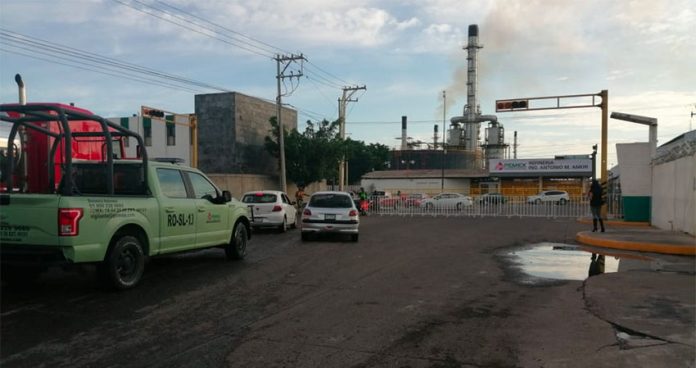
Authorities foiled an attempted attack on a Pemex refinery in Guanajuato Wednesday night after an abandoned vehicle containing 12 explosive devices was discovered near the site, the minister of national defense (Sedena) reported.
President López Obrador said today that security at government facilities has been strengthened as a result.
The attempted bombing may be related to the law enforcement crackdown on the Santa Rosa de Lima Cartel, known for extortion and fuel theft, in which dozens of suspected cartel members were arrested Saturday.
Among them were the mother, sister and cousin of cartel leader José Antonio Yépez Ortiz, alias El Marro.
In response, Yépez ordered vehicles to be set on fire on several roads in and around Celaya in order to create fiery blockades to hinder efforts to arrest him. Blockades were established at 47 different points in 13 municipalities, Milenio reported.
The United States Embassy subsequently issued a security alert warning its citizens to avoid highways in 10 Guanajuato municipalities.
Yépez thanked his supporters and those who burned cars, and threatened the government in two emotional videos posted to social media the evening after the arrests.
“These thieves humiliated and did what they wanted with my family and I will be a stone in their shoe, I’m going to blow up, you will see,” he vowed, promising to keep battling authorities “even if I’m left alone like a fucking dog.”
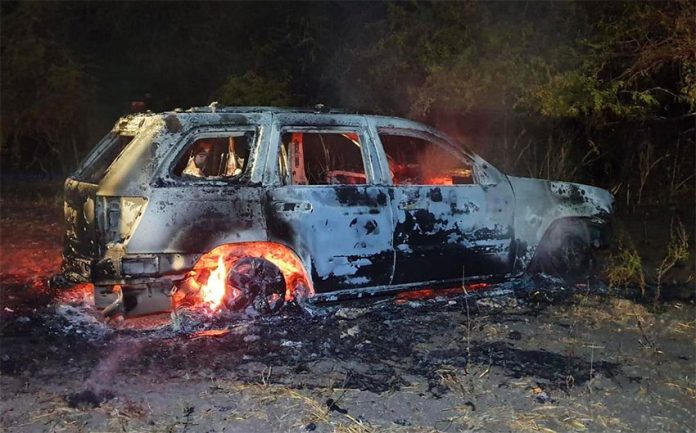
A car burns north of Culiacán where cartel hitmen have been fighting among themselves.
Cartel gunmen clashed Wednesday morning in Tepuche, Sinaloa, a group of small rural communities near Culiacán, leaving 15 people dead. They are presumed to have been feuding members of the Sinaloa Cartel.
In one attack, seven men clad in body armor and tactical gear and brandishing assault rifles were killed.
And in a separate incident, eight armed men were killed in the town of Bagrecitos after they opened fire on homes and vehicles.
Two bodies were found near the cemetery, one in the brush, and others inside homes.
Sinaloa Public Security Minister Cristóbal Castañeda Camrillo initially dismissed reports of the shootings as rumors until they were confirmed late yesterday afternoon.
The region has seen a wave of violence in recent months, including last week when a group of armed men in a convoy of pickup trucks ambushed and attacked navy marines while they were patrolling a dirt road. One marine was injured.
Much of the violence is blamed on rival factions of the Sinaloa Cartel battling for turf and power.
The Sinaloa Cartel has been under the control of Ismael “El Mayo” Zambada since Joaquín “El Chapo” Guzmán’s incarceration.
However, some cartel members, headed by El Chapo’s children and known as “Los Chapitos,” refuse to recognize his authority after Zambada’s brother and son testified against El Chapo in 2018 exchange for a plea deal.
Tensions within the cartel have been brewing for some time.
Last October, when the cartel descended on the city of Culiacán in order to force the government to release El Chapo’s son, Ovidio Guzmán, Zambada was reportedly opposed to Ovidio’s release and did not participate. Los Chapitos are said to have viewed this as a slight.
The divide intensified when Zambada’s right-hand man, known as “El Ruso,” was alleged to have been behind the November 2019 kidnapping and torture of 11 police officers who were on the payroll of Los Chapitos. When Los Chapitos demanded that Zambada hand over El Ruso, he refused.
Since then, eruptions of violence in the area have become commonplace.
Security Minister Castañeda has asked that the National Guard intervene to help de-escalate the violence in and around Tepuche.
“A request was made by the state government to the National Guard to increase the number of troops in that area. We have five bases operating and 10 more bases were requested to operate in that area,” he explained.