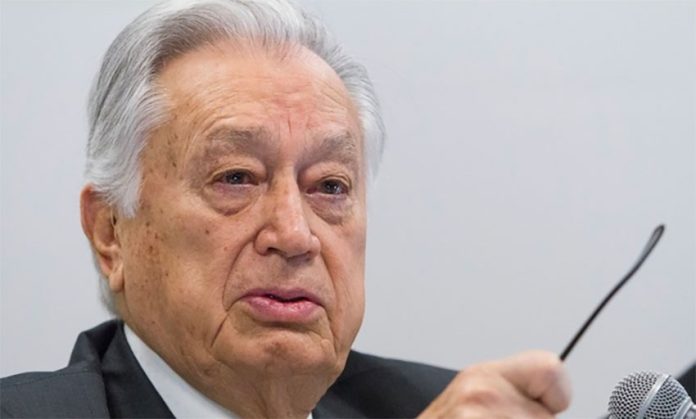
A federal investigation into assets allegedly owned by the head of the Federal Electricity Commission (CFE) did not find any evidence that he failed to declare any.
Public Administration (SFP) Secretary Irma Eréndira Sandoval told a press conference Thursday that even though Bartlett’s romantic partner, Julia Elena Abdalá, and his children own numerous properties, he was under no obligation to declare them because none of the owners are considered his dependents.
“The evidence collected in the comprehensive investigation does not show that there was a legal obligation to declare the properties because none of their owners maintain a marital, common-law or economically dependent relationship [with Bartlett],” said Sandoval.
She said the relationship between Bartlett and Abdalá is not considered conjugal or common-law because the two are not married and have not lived together for at least two consecutive years, nor do they have children together.
Public Administration Secretary Eréndira announced Thursday that Bartlett was in the clear.
SFP undersecretary Tania de la Paz said the investigation looked into the CFE director’s alleged use of a front man to cover illicit or questionable real estate transactions, but no evidence supporting the claim was found.
Sandoval added that although Adbalá does own a company on the CFE’s list of possible suppliers, there is currently no contract between the companies nor is there evidence that Bartlett had intervened to the benefit of her company, thus discrediting a conflict of interest charge.
She highlighted that the regulations used in the investigations were those currently in force, but new declaration forms approved by the National Ant-Corruption System enter into force in 2020.
Those forms will require all public servants to declare properties registered in the names of their romantic partners, even when there is no legal relationship between them.
The probe into Bartlett’s assets was triggered by a report in the newspaper El Universal that he and his family owned “a real estate empire” of 23 luxury homes.
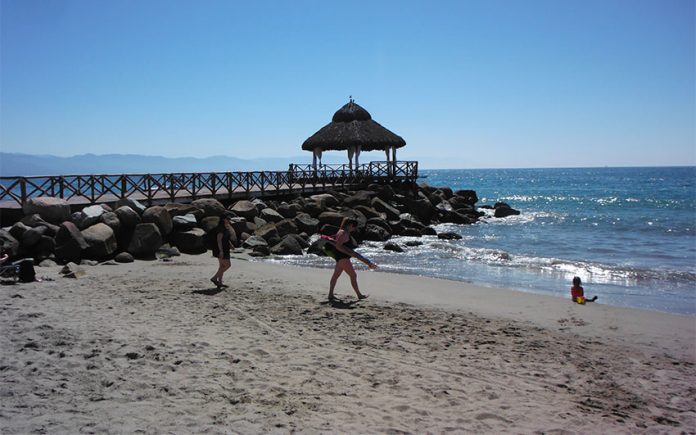
Playa de Oro in Puerto Vallarta is one of the 270 clean beaches.
Water quality testing of 273 beaches found three that failed to meet standards for recreational use.
All three are located in Acapulco, said the Federal Commission for Protection Against Sanitary Risks (Cofepris).
The Suave, Icacos and Manzanillo beaches were found to contain levels of enterococcus bacteria over the limit of 200 parts per 100 milliliters of water, as established by the World Health Organization (WHO).
The bacteria are usually found in fecal matter and can cause urinary tract infections, diverticulitis and meningitis, among other health complications.
The Cofepris study analyzed over 1,800 samples from 273 beaches in 70 coastal tourist destinations across Mexico, of which 98.9% complied with WHO criteria and were deemed safe for swimming.
This was not the first time that Acapulco’s Suave and Manzanillo beaches have appeared on the commission’s do-not-swim list. Cofepris announced that the beaches had yielded unfavorable lab results just days before summer vacations began this year.
Acapulco is expected to see 90% hotel occupancy rates during the winter holiday season.
The Concepción Bamba beach in Oaxaca’s Isthmus of Tehuantepec yielded negative results but technical complications prevented the proper analysis of the sample.
Despite a few unsafe beaches, Mexico continues to have the most Blue Flag certifications in the Americas, a recognition granted by the Foundation for Environmental Education (FEE), based in Denmark.
The foundation recognizes beaches that comply with strict criteria including management, environmental education, security and services, as well as water quality.
Mexico boasts 54 beaches and three marinas with Blue Flag certification, with Quintana Roo and Baja California Sur leading the way with 20 certified beaches each. The complete list of Blue Flag beaches and marinas can be consulted (in Spanish) at the Blue Flag Mexico website.
Cofepris has conducted water quality tests of Mexico’s tourist beaches since 2003 in order to maintain public health standards among the country’s primary environmental tourist attractions.
To achieve this goal, the commission also urges visitors to the beaches to help keep them clean during the holiday season.
Any water quality anomalies can be reported (in Spanish) directly to the commission via telephone at 01 800 033 5050, available 24 hours a day, or by email.
Aspiring astronaut Adhara may soon be off to university.
Now that 8-year-old Adhara Pérez Sánchez of Mexico City has graduated from secondary school she has been invited to study astrophysics at the University of Arizona.
Boasting an IQ of 162 — two points higher than Albert Einstein and Stephen Hawking — Adhara is now studying mathematics and systems engineering at online universities.
But in order to accomplish her dream of being an astronaut, she hopes to study in the astronomy department at the University of Arizona (UA), which has received recognition from NASA for its space exploration program.
The letter of invitation from UA president Robert C. Robbins gets her one step closer to that goal.
“I was thrilled to read about your incredible story online and to find out that your dream school is the University of Arizona,” said Robbins in his letter to Adhara.
“We have many outstanding space sciences programs, you would have many opportunities to work side by side with the world’s leading experts. If you would like, I am happy to connect you with our faculty in astronomy or the lunar and planetary sciences laboratory . . .”
Adhara’s mother said she hopes her daughter will be able to attend this year.
“They sent us the letter because they want her to attend (UA), but first she has to take an intensive English course,” said Nayeli Sánchez. “We still haven’t decided when . . . I hope by the summer . . .”
She and her husband have contacted the university and are looking for ways to fund her tuition.
“They’re just now giving me information, they have to tell me the costs and everything . . . We can’t say much about it because we are looking for the support of a foundation,” she said.
Adhara was diagnosed with Asperger syndrome at the age of 3, before her parents and teachers became aware of her talent. She was the victim of bullying in school where her teachers said she didn’t have much of a future.
“At a parent-teacher conference I saw that Adhara was playing in a little house and the others trapped her in there. They began calling her ‘Weirdo!’ and were hitting the house . . . she told me she didn’t want to go to school and went into a deep depression,” said Sánchez.
Adhara’s teachers said the girl fell asleep in class and didn’t work hard, but her mother observed that she was studying algebra and the periodic table. She took her daughter to therapy and a psychiatrist recommended she go to the Talent Assistance Center (CEDAT), a school for gifted children.
Despite difficulties paying the CEDAT tuition, Adhara finished her basic schooling and became interested in UA after a teacher took her to an event in which the university had participated.
Adhara was listed among the 100 Powerful Women in Mexico by Forbes magazine in 2019. She has also written a book, No te rindas (Don’t Give Up), in which she hopes her experiences will help other children with autism and encourage the sciences to include more girls.
The Bank of México lowered its benchmark interest rate 25 basis points to 7.25% on Thursday, citing slow economic growth and low inflation.
It was the fourth consecutive time that the central bank cut its benchmark rate by a quarter-point this year.
Predicted by all but one of 23 economists surveyed by Bloomberg, the move brings rates down to a level not seen since February 2018.
The Bank of México has not cut rates at four consecutive board meetings since 2009, when rates were lowered on seven consecutive occasions. One member of the bank board voted on Thursday to reduce the rate by 0.5%.
The central bank said in a statement that there has been some recent positive activity in the economy, noting that the peso has strengthened, partially as a result of the signing of a revised version of the new North American free trade agreement.
But it said that there is still uncertainty about debt ratings both for Mexico and the state oil company Pemex.
The bank highlighted the importance of complying with both “the 2019 fiscal goals and the objectives of the 2020 economic package,” adding that it is also “essential to strengthen the rule of law, bring down corruption and combat insecurity.”
The latest rate cut comes after the central bank downgraded its growth forecasts to between -0.2% and 0.2% this year and 0.8% to 1.8% in 2020.
Inflation has slowed to the target of 3% but the central bank said that the 20% increase to the minimum wage announced this week could drive up prices in 2020.
Bloomberg noted that even with yesterday’s cut, Mexico still has the highest real interest rate (borrowing costs minus inflation) among G20 countries.
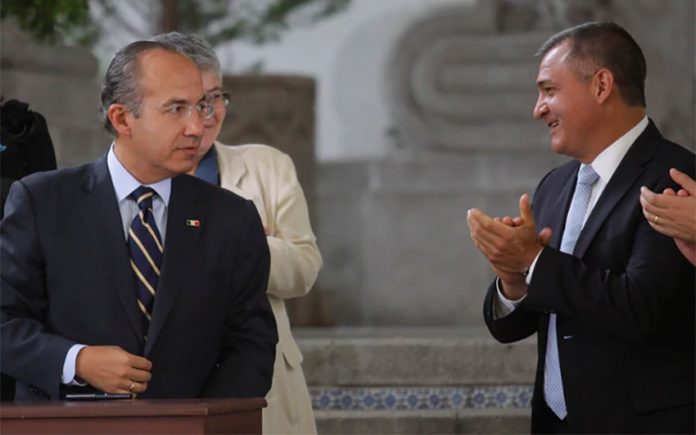
Calderón, left, and García in a photo taken during the former's presidency.
Former president Felipe Calderón has demanded the federal government provide evidence to support its accusation that public funds were diverted during his administration to companies owned by his security secretary.
Financial Intelligence Unit (UIF) chief Santiago Nieto said on Wednesday there is an investigation under way into the alleged diversion between 2009 and 2012 of 2 billion pesos (US $105.8 million at today’s exchange rate) from the Interior Secretariat to bank accounts of Genaro García Luna and members of his family.
García Luna, a key architect of the so-called war on drugs launched by Calderón, was arrested in the United States last week on charges that he allowed the Sinaloa Cartel to operate in exchange for multimillion-dollar bribes.
Nieto said that 11 bank accounts linked to the former security secretary had been blocked and that a criminal complaint would be filed with the federal Attorney General’s Office (FGR).
He said on Thursday that the UIF is also investigating transfers of public resources to García Luna during the presidency of Enrique Peña Nieto.
In a brief interview after a cabinet meeting at the National Palace in Mexico City, Nieto said that “irregular financial operations and transactions related to Mr. García Luna” had been detected during the governments of both Calderón, who was in office between 2006 and 2012, and Peña Nieto, who was president from 2012 to 2018.
The UIF chief said public resources were diverted from the Interior Secretariat as well as other federal departments but declined to offer further details.
In a Twitter post on Thursday night, Calderón wrote that two of the three interior secretaries who served during the latter half of his administration, Fernando Gómez Mont and Alejandro Poiré, as well as Juan Marcos Gutiérrez, undersecretary of the deceased ex-interior secretary Francisco Blake, have all denied that resources were diverted from the Interior Secretariat to companies owned by García Luna.
“It’s up to the government to specify the information. Accusations can’t be made in general and without proof,” he said.
Calderón also shared on Twitter a statement from Gutiérrez that said that the Federal Auditor’s Office (ASF) had not detected any irregularities in Interior Secretariat finances during the period in which Blake headed up the department.
Poiré, interior secretary between November 2011 and December 2012, also said that the ASF hadn’t found any irregularities in the department’s finances during his tenure.
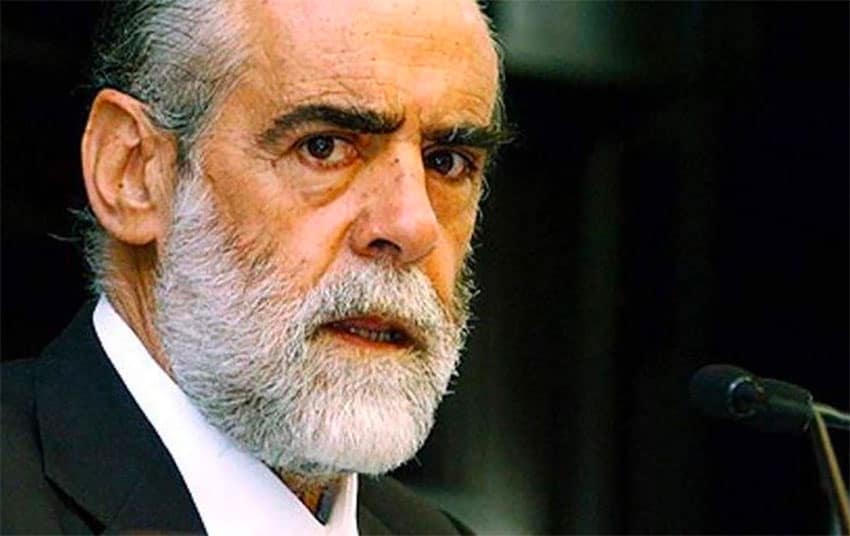
Fernández: government using García case to smear Calderón.
“I’ve always been in favor of the truth being known and justice being served. We’re ready to respond to any clarification that is necessary . . .” he told the news website Enfoque Noticias.
For his part, President López Obrador said it’s only a matter of time before García Luna provides details to United States authorities about who was involved in the alleged embezzlement scheme.
“. . . It’s certain that García Luna will give evidence; he’ll talk because if he doesn’t say anything, if he hides things, his prison sentence will be longer if he’s [found] guilty. . .” he said.
López Obrador said on Wednesday that his government wouldn’t investigate Calderón in relation to the charges against his security secretary, explaining “there won’t be an investigation because it would create the perception that we’re doing it for political purposes.”
However, he said the FGR would cooperate with U.S. authorities in the investigation into García Luna.
“If they [the U.S. government] decide to open a case, it’s a decision of that independent authority,” López Obrador said, apparently referring to Calderón.
Despite the president’s assertions that the former National Action Party (PAN) won’t be investigated, members of his government have leveled accusations at Calderón.
Two days later, an elder statesman of the PAN claimed in an interview that the government is attempting to use the García Luna case to damage the reputation of Calderón.
Diego Fernández de Cevallos, a former PAN lawmaker and the party’s candidate in the 1994 presidential election, described the attempt to link Calderón to crimes allegedly committed by his security secretary as “a dirty political blow.”
Calderón last week denied any knowledge of García Luna’s alleged collusion with the Sinaloa Cartel but he has not responded to the accusations made by Delgado.
Fernández said there was no question that “millions passed through [García Luna’s] hands” but expressed doubt that it was cartel money.
“The money could have come from public resources, not drug trafficking . . . There will be a lot of news, a lot of surprises. We mustn’t get ahead of the trial. I think that if there was illicit enrichment, it will be [shown to have been] a diversion of public resources.”
Pemex won't be offering clean diesel outside major cities for another five years.
The Energy Regulatory Commission (CRE) has voted in favor of postponing for five more years the implementation of a rule requiring Pemex to produce, distribute and sell ultra-low-sulfur diesel (ULSD) across the country.
Members of the CRE governing body voted unanimously on Wednesday to defer the rule in a brief meeting. No reason was given for the decision and no public discussion was allowed.
The postponement comes after a deferral of the rule in late 2018 amid a continuing legal battle launched by Pemex over the matter.
According to the CRE resolution, the state oil company can only continue marketing ULSD in the country’s three largest cities – Mexico City, Guadalajara and Monterrey – and along the northern border.
In a document sent to the CRE last week by energy undersecretary Miguel Maciel, the federal government said the technical and operational conditions for distributing ULSD across the country won’t exist until late 2024, the year the current administration will leave office.
The news agency Reuters reported that Pemex doesn’t currently produce enough clean diesel to satisfy the demand that would be created by the rule, which was approved during the administration of the previous government. Its aim is to reduce carbon emissions and replicate regulations already in place in neighboring countries.
Refineries in the United States began preparing last year to produce USLD to export to Mexico but as the diesel rule didn’t take effect, higher demand for the clean fuel never came.
Pemex planned a project to produce USLD at its refinery in Cadereyta, Nuevo León, but it was suspended as were similar projects at other refineries due to a lack of funding.
The clean diesel rule passed during the administration of former president Enrique Peña Nieto but was based on a clean fuel strategy designed in 2005.
Nationwide distribution of USLD was originally supposed to begin in September 2009.
The federal governments led by ex-presidents Vicente Fox, Felipe Calderón and Peña Nieto all failed to meet their clean fuel commitments, the newspaper El Universal reported.
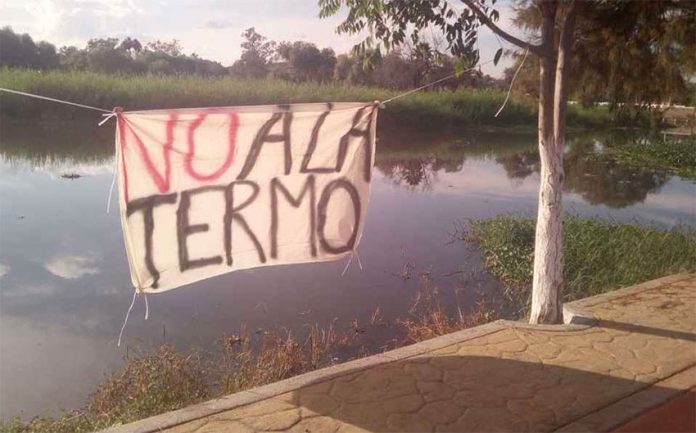
One answer to Jalisco plan: 'No to the thermal plant.'
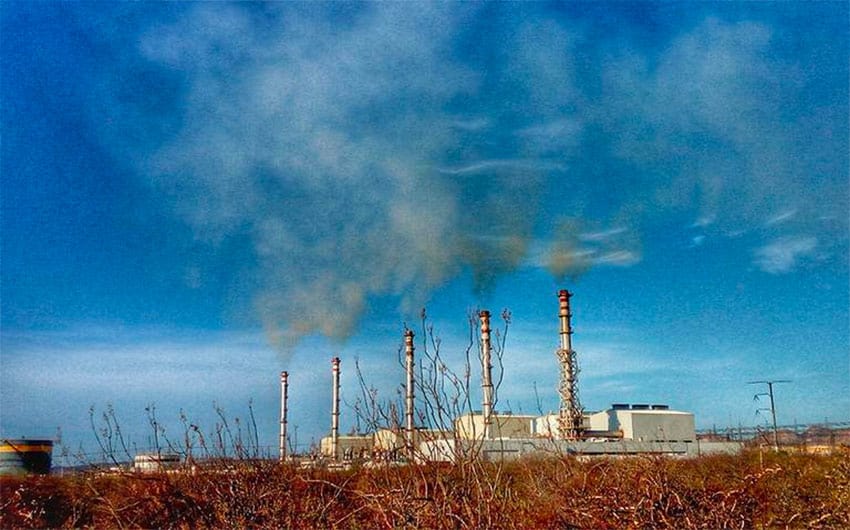
Political leaders in Jalisco and Baja California Sur have rejected private and federal government plans to build power plants that would run on non-renewable energy sources.
Jalisco Governor Enrique Alfaro said construction of a US $759-million thermal power station by the Spanish firm Fisterra in the municipality of Juanacatlán is not viable as it would violate his government’s commitment to tackle climate change.
“. . . We want to make it perfectly clear . . . that the governments of Jalisco and Juanacatlán will not allow the thermoelectric project in this municipality,” he said.
He said the state government’s message to private investors is that Jalisco intends to resolve its energy shortage problems by “betting on clean energy.”
“We’re not going to continue jeopardizing the future of new generations,” Alfaro said.
The governor said that permits already granted to Fisterra will be revoked through a legal process.
State Environment Secretary Sergio Graf said that if the plant were to go ahead, overall carbon emissions in Jalisco would increase by 24%.
“To give us an idea, the Juanacatlán plant would emit 21% of the emissions generated by the entire transportation sector including private vehicles, 63% of those generated by the entire livestock sector or 62% of those generated by the management [burning] of all solid waste in urban areas,” he said.
For her part, Juanacatlán Mayor Adriana Cortés González said the municipality needs investment and progress but stressed that it shouldn’t come at the cost of residents’ health.
“Installation [of the plant] is not viable . . .” she declared.
In La Paz, Baja California Sur, Mayor Rubén Gregorio Muñoz Álvarez has similarly rejected a plan to build a power plant that would run on non-renewable energy sources.
La Paz mayor says no to more fossil fuel power plants.
At a council meeting earlier this month, he proposed refusing to grant land use permits to the Federal Electricity Commission (CFE) to build a fossil fuel power station.
Muñoz said the municipal council must use its authority to stop a plant that would produce “toxic energy” and proposed meeting with CFE officials to discuss alternative generation methods.
Five councilors supported his proposal but five voted against it and four abstained, meaning that the mayor failed to get the support he required to ensure that land use permits won’t be granted to the utility.
José María Avilés Castro, one of the councilors who didn’t support Muñoz’s proposal, said he isn’t against banning contaminating energy sources but added that it was too soon to make a definitive decision.
“. . . It all depends on where it will be located . . . There are circumstances that have to be assessed to see if we will approve the land use [permit] or not,” he said.
“We can’t approve [or disapprove] a possible land use application that hasn’t been made . . .” Avilés added.
Muñoz said the councilors who didn’t support his proposal will have to face up to society for their actions.
The mayor did receive strong support from the Mexico Climate and Energy Platform (PMCE), an umbrella group of organizations that advocate for a reduction of greenhouse gases and propose public policies to decarbonize the Mexican economy.
The PMCE said the power plants in both La Paz and Juanacatlán were “unacceptable when there are renewable energy alternatives that don’t produce greenhouse gas emissions and . . . contaminants that are harmful to health.”
The group also said that renewable energy is cheaper to generate and that the Jalisco plant would use a lot of water that is needed for human consumption and agriculture.
CRE decision could limit competition, businesses charge.
A powerful business group has expressed concern about the decision by the Energy Regulatory Commission (CRE) to revoke a regulation that restricted Pemex from selling wholesale fuel below cost or well above market prices.
The decision “seriously affects free competition in the oil market in Mexico, generates uncertainty and violates the trust of investors and final consumers,” the Business Coordinating Council (CCE) said in a statement.
“. . . Pemex can now exercise its dominant position in the sale of hydrocarbons without any restriction. Although the federal government had committed not to introduce changes in energy regulation, this measure is a new change to the rules of engagement . . .” the CCE said.
The business group charged that the state oil company will now be able to sell fuel at “discriminatory prices” without any intervention from authorities.
In other words, it could sell gasoline and diesel to Pemex-branded gas stations at cheaper prices that those at which it sells to private companies, creating an uneven playing field.
The CCE said the CRE decision “creates a climate of uncertainty in the existing regulatory framework, destroys legal certainty, affects the investment climate and inhibits the participation of more service providers [gas stations]” in the retail fuel market. The business group urged energy authorities to reconsider the decision.
At his regular news conference on Thursday, President López Obrador defended the CRE’s decision and denied that it was a threat to private businesses, which were able to enter the fuel market as a result of the previous government’s energy reform.
The decision was taken so that Pemex “can compete on equal terms,” he said, asserting that the state oil company lost that capacity during the previous federal administration.
“The objective was to disappear Pemex and the CFE [Federal Electricity Commission]. What the regulatory authority is doing is acting with justice, what it’s doing is not illegal . . . ” López Obrador said.
The president also expressed support for a federal court ruling that said Pemex is not obliged to allow private companies to use its pipelines and storage facilities.
“They [the previous government] wanted . . . the private sector to use Pemex pipelines . . . that’s not equality. A lot of excesses were committed because the aim was to put an end to the two public companies in order to leave the market to private companies but we have to find a balance – to guarantee prices above all,” López Obrador said.
“You can’t only continue betting on the market and seek to dilute [the role of] the state. To that freedom, [I say] no because it’s like the freedom of the fox in the henhouse, there has to be order and consumers have to be defended, that’s the role of the state.”
It’s whale-watching season in Mexico as the pacific gray, humpback and blue whales migrate to Mexican territorial waters to breed.
Officially designated observation areas are located in Baja California, Baja California Sur, Nayarit, Jalisco, Sinaloa, Sonora, Oaxaca and Guerrero, where the whale-watching season runs from mid-December to the end of March, depending on the location. In some areas the season doesn’t end till May.
The most common whale to winter in Mexico is the Pacific gray whale, which is seen over much of the Pacific coast, and the humpback whale, which is mostly found in the Gulf of California. A third species, the blue whale, can be seen in Bahia de Loreto, Baja California Sur. The whales migrate each winter to the warm waters here to breed, coming from feeding grounds near Canada and Alaska.
The whales can get as close as 200-500 meters from the beach, making it possible to see them from the shore. But whale-watching season usually means getting on a boat for an even closer look. During the season, many fishermen take a break from fishing and become tour operators. Since the 1980s, this has become an important economic activity for a number of coastal communities, especially those whose fish stocks have been depleted.
The Mexican government considers whale-watching tours to be an economically sustainable activity, but regulates it nonetheless. In certain sensitive areas, all human recreational activities, especially water sports, are prohibited.
Tour operators must be licensed and are restricted to the types of boats they may use, how they may approach the whales and how close they can get. However, enforcement of the rules is typically not quite as it should be, although following them reduces the stress on the animals and protects their life cycle.
While there are rules about how close humans may approach the animals, there are no rules governing how close animals may approach humans. Although never guaranteed, it is possible for these giants to get right up to the boat.
The whales of one lagoon, San Ignacio in Baja Californa Sur, are particularly noted for their interaction with humans. This phenonmenon has been documented at least since the late 1970s. Sometime before that, the story goes, one curious whale in this lagoon approached a fishing boat close enough to be touched, and one fisherman did.
It was the start of a kind of truce and agreement between the whales and the local population. Today, the whales in this lagoon are so comfortable with human contact that if you do not rub their head, scratch their tongues or splash water on them, they will quickly lose interest in you. Mothers even push their calves over to waiting and very willing humans.
This situation is not the norm for whale-watching in Mexico or anywhere else and is limited only to this lagoon. These same whales will not approach boats after they leave to head back north.
The success of whale-watching is significant after considering that whales, especially gray whales, were nearly hunted to extinction in the 19th century. At that time, locals called the whales “devil fish” because the mothers would attack small whaling boats after their offspring were harpooned. Those approaching boats today are the descendants of those few who survived that period.
Gray whales have since bounced back to an estimated 20,000 in the wild, but they are still classified as being of special concern by the Canadian government. Experts advise caution when interacting for the safety of both whales and humans.
This has been one of the best years for the tequila industry with producers breaking production and export records.
“In 2019 we achieved the highest production of tequila in history, reaching 330 million liters in November,” said the president of the Tequila Regulatory Council (CRT), Miguel Ángel Domínguez Morales.
“We still need to add the numbers from December and we’ll surely be talking about ending the unprecedented year with over 350 million liters.”
A year ago the industry expected 2019 production to be about 310 million liters.
Domínguez said exports also broke a record with 230 million liters shipped as of November, “breaking our own export record for the 10th year.”
CRT director Ramón González Figueroa described the year as “spectacular” for the industry.
“We’ll close 2019 with a record for production, almost one million liters per day; a record in exports, 472 liters per minute; a record in agave consumption, over 1.2 million tonnes; and a record in the number of countries that protect the denomination of origin and recognize the issue of intellectual property; [that’s] 30 countries in just a year,” he said.
And tequila’s popularity on the world market is expected to continue growing, especially in China. González expects the country to be among the world’s top 10 importers of tequila within the next two years since it finally eliminated tariff barriers.
Even after China began to recognize tequila’s denomination of origin, which protects it as an authentically Mexican product, the country’s protectionist policy still restricted the amount Mexico could export.
But González said notification had just been received to advise that the barriers had been lifted.
According to the tequila council, 1.02 million liters of tequila were exported to China between January and November. To become one of the top 10 importers it will have to import two million liters, which González believes will happen in the next two years due to the size of the Chinese market.