Home Blog Page 1690

Two towns in Mexico where Christmas is a year-round event

0
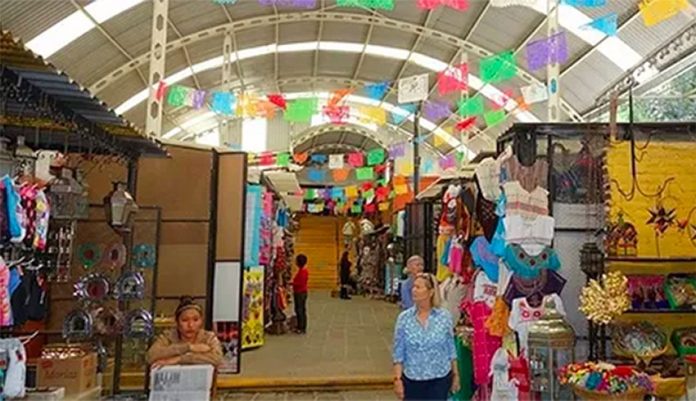
Tlalpujahua, where Christmas is eternal.

There are two places in Mexico that are year-round Christmas towns and for good reason: their economies are based on the production of Christmas ornaments.

One is Tlalpujahua, Michoacán, a town that faced severe economic depression after the last mines closed in the area in the 1930s.

Some 20 years later, Joaquín Muñoz decided to leave Tlapujahua and migrate to the United States. He wound up in Chicago, working at a factory making artificial Christmas trees. He also learned about blown glass tree ornaments, neither of which was known in Mexico at the time.

In the 1960s, he returned to Mexico but there was still no work in Tlalpujahua so he went to Mexico City where he set up a workshop making artificial trees. The business went well enough but it began to take off when Muñoz added glass ornaments, which proved more popular than the trees themselves.

Muñoz returned to his hometown and moved his operations there, establishing Adornos Navideños, the largest business in town.
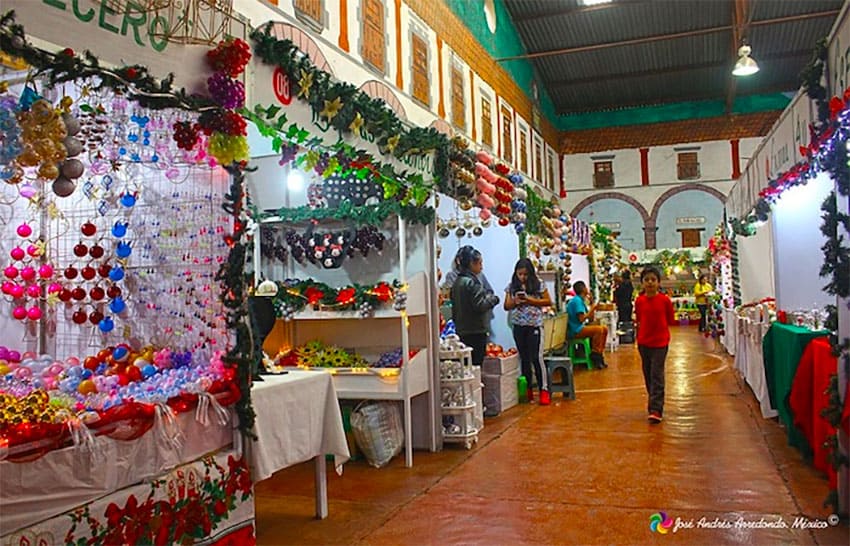
Christmas ornaments on display in Tlalpujahua.

The glassblowing and painting techniques quickly spread among local families and today most of the population is involved in the making and selling of Christmas ornaments in some way. It is the main economic lifeline of the municipality, which exports ornaments and other decorations to the United States and other parts of the world.

It has also taken advantage of its location only three hours west of Mexico City to make itself a weekend tourist destination, billing itself as the “eternal Christmas town.” The year-round Christmas feel comes not only from ornaments for sale throughout the year, but also because of the area’s pine-covered mountains. 

Even the town’s wooden houses with their tin roofs lend the right feel. The success of this promotion is due in no small part because it takes advantage of the monarch butterfly’s winter hibernation in the same region.

Each year Tlalpujahua hosts the Feria de la Esfera, or Ornaments Fair, which this year runs until December 15.  The event brings thousands of visitors during the months before Christmas and the town can be packed on weekends. Booths are set up all over town, but the center of it all is the auditorium, where the widest variety of products can be found.

Most of the ornaments made here are still blown and painted by hand, and the fair offers demonstrations of the process. Some even allow visitors to participate in the making of their own ornaments.

But there is more to see than just ornaments in this Pueblo Mágico (Magical Town) of cobblestone streets, such as old mines offering tours and a colonial church.

Chignahuapan, Puebla, holds a Christmas tree and ornament fair every year.

One caveat, however. Along with the northern-like scenery, there are also northern-like winter conditions. Daytime temperatures can be comfortable (or not) but nights here can be cold.

Mexico’s other Christmas town is on the opposite side of Mexico City, three hours northeast in Pueblas Sierra Norte. Ornament making started in Chignahuapan about 30 years ago by a man named Rafael Méndez Núñez.

It is double the size of Tlalpujahua, but like its Michoacán neighbors, its economy is dominated by the making of blown glass ornaments for export. There are over 200 producers here, with the largest being El Castillo de la Esfera. Founded in 1993, it claims to be the largest producer in Mexico.

Chignahuapan earned its Pueblo Mágico status in 2012 but has a very different feel. The town plaza is dominated by a highly unusual and colorful kiosk of Moorish design. Just off the plaza is a church with the largest image of the Virgin Mary in the world at 12 meters high.

The climate is very rainy and somewhat chilly, but it does not get anywhere near as cold as the Michoacán mountains. The town is surrounded by fruit and coffee trees, along with waterfalls and hot springs for relaxation.

Chignahuapan also holds an annual fair to celebrate Christmas trees and ornaments but it ends in early November. But this does not mean that the town is out of ornaments afterwards. Visitors and vendors continue to crowd its streets through the month of December.

Painting ornaments in Chignahuapan.

The bread and butter of both towns is the making of ornaments for export, and for that reason most of those sold here will be very nostalgic to people from north of the border. However, in its short history there has already been experimentation not only to create products different from those in the U.S. or those made in China.

There is also a subtle but noticeable difference between the ornaments and other decorations made in the two towns. Most of this focuses on the making and painting of blown glass. All kinds of motifs can be found on the spheres, even those related to Day of the Dead in Chignahuapan.

Both are working to make other blown shapes, such as stylized poinsettias and some not related to Christmas at all, such as artificial fruits (to make fruit bowls and other arrangements) and hot air balloon decorations. Both have also worked to create new ways to display ornaments, from mini-trees made of wire or wood to showcase one or a group of ornaments, to very interesting versions of Christmas wreaths made from willow branches, bamboo strips, wire, colored corn husks and more, decorated with ribbons and, of course, glass ornaments.

Mexico News Daily

Cuernavaca police chief murdered as violence continues in Morelos

0
Police Chief Juárez was killed on Thursday.

The police chief of Cuernavaca, Morelos, was murdered by gunmen on Thursday night.

Juan David Juárez López, 49, was eating at a taco restaurant in the state’s capital when he was shot six times. Paramedics who arrived on the scene were unable to revive him.

The neighborhood in which the murder occurred was later patrolled by National Guard and army troops to calm frightened residents. The situation became more tense when the security forces blocked reporters from filming near the scene of the crime.

Juárez was appointed police chief by Cuernavaca Mayor Francisco Antonio Villalobos Adán on October 19, at a challenging — and dangerous — time for security forces in the state.

This year is turning out to be the most violent in its history. At least 14 state and municipal police officers have been murdered so far this year.

According to the National Public Security System, there were 873 intentional homicides in Morelos in the first nine months, up from 729 in the same period last year.

March was the most violent month in the period, with 114 homicides, followed by February with 109 and June and September with 100 each.

Source: El Financiero (sp)

Toyota initiates new Guanajuato plant amid falling automotive production

0
toyota

Toyota will begin production at a new plant in Guanajuato in the coming days as industry-wide automotive production continues to fall.

The Mexican subsidiary of the Japanese automaker plans to manufacture 100,000 Tacoma pickup trucks annually at its US $700-million plant in Apaseo el Grande, a municipality that borders Querétaro. Most of the vehicles will be exported to the United States.

Toyota Motor Sales Mexico president Tom Sullivan told reporters Thursday that 2020 is expected to be another difficult year for the domestic automotive industry. Car sales in Mexico have been on the wane for the past two and a half years.

Toyota is the fourth most successful automaker in the domestic new car sales market with a share of 7.9%. However, its sales in Mexico between January and November fell to 94,342 vehicles, a 2% decline compared to the same period last year.

The combined production of all automakers in Mexico also fell in November a month after the industry recorded its biggest ever annual production decline.

The national statistics agency, Inegi, reported on Friday that 300,292 vehicles were made in Mexico last month, a 13% decline compared to November 2018. The production downturn is the largest for the month of November in 16 years.

The production of eight of 12 automakers that operate in Mexico fell last month.

The biggest decline was at Ford, whose output shrank by 68.2% compared to November 2018. Audi recorded a 27.6% production decline, Volkswagen’s output fell 23% and KIA manufactured 19.5% fewer vehicles.

The only manufacturers that made more vehicles last month compared to November 2018 were Mazda, General Motors and JAC, whose production increased by 10.5%, 9.1% and 7.7% respectively. BMW was the fourth carmaker that didn’t record an annual production decline. However, the German company wasn’t operating in Mexico in November 2018.

Lower automotive production last month had a knock-on effect on exports, which declined 7.5% compared to November 2018 to 268,296 vehicles.

Just under 85% of that number – 227,684 vehicles – went to the United States. The number of cars sent to Mexico’s northern neighbor was 0.4% lower than in November 2018.

During the first 11 months of the year, just over 3.54 million vehicles were made in Mexico, a 3.5% decline compared to the same period last year, while exports fell 2.2% to just over 3.1 million.

Source: Milenio (sp), El Financiero (sp) 

Most murderous day of the year wasn’t so murderous after all

0
Homicide reports are not entirely accurate.

Major Mexican newspapers published an alarming story on Monday: they reported that December 1, the first anniversary of President López Obrador’s presidency, was the most violent day to date of his six-year term with 127 homicides.

But it was in fact a bit of “fake news” of the government’s own making.

Security analyst Alejandro Hope noted in his column in the newspaper El Universal that the source for the story was the government’s own figures. He also noted that the figures were “obviously wrong.”

Hope wrote that the government data included 21 victims of intentional homicide in Coahuila, where police and suspected members of the Northeast Cartel clashed after gangsters attacked the small town of Villa Unión.

However, he pointed out that media reports indicated that 14 of the victims were killed on Saturday and therefore their deaths should have been included in homicide statistics for November 30 rather than December 1.

But they weren’t, Hope said: only three murders in Coahuila were included in Saturday’s statistics.

The analyst said the director of the National Information Center, David Pérez Esparza, explained to him that daily homicide statistics are indicative of the day on which a murder investigation is opened rather than the day on which the crime occurred.

A murder investigation might be opened one day or even several days after a homicide occurs, Hope wrote.

On the plus side, the government’s methodology ensures that only official information contributes to the statistics and not rumors, he said.

“However, it also generates serious difficulties. In the first place, by following the [daily government homicide] reports, it’s never possible to know with precision how many people were murdered on a specific day,” Hope wrote. “A day that appears calm might have been unusually bloody. Or vice versa.”

The analyst said that f0r President López Obrador and his security team, the discrepancy is not a trivial one.

The daily murder count, Hope wrote, is supposed to be used as a tool to determine where the nation’s security forces are most needed.

“How can strategies be adapted if the information available is obviously untrue?” he asked, noting also that the government’s daily homicide statistics have underestimated the actual number of murders by about 20%.

Hope said the discrepancies generate “monumental confusion” in both the media and the general population.

He said that if the 14 deaths on Saturday are subtracted from Sunday’s figures, “we’re left with a total of 113” murders, “an undoubtedly high figure but not the highest” since López Obrador took office (there have been several days with between 114 and 117 homicide victims).

However, Hope noted that it wasn’t known how many of those 113 homicides actually occurred on Sunday because, as Pérez explained, the figure refers to the opening of murder investigations.

In light of the confusion, the analyst made a two-point proposal: “1) Suspend the daily count: it doesn’t help to improve decision making and confuses public opinion. 2) If the aforementioned isn’t possible because the president wants to have that data, cancel the publication of the daily report and replace it with a weekly statistical report compiled with consolidated figures. If it is explained well, no one will complain about a decision of that nature.”

Source: El Universal (sp) 

What began as a children’s choir in Coahuila is now three full orchestras

0
From choirs to orchestras in Coahuila.

In the northern industrial town of Torreón, Coahuila, one organization is working to make a difference in the lives of marginalized children and adults, contributing to their personal development — and keeping them off the streets — with music.

And what began as a simple choir has grown into orchestras.

Founded in 2011 by artistic director Miguel Ángel García, DIME (comprehensive youth development) helps children and teens from poor communities develop physically, socially and psychologically through music.

The original idea was to create a children’s choir in Ejido Allende, one of thousands of farm communities with few economic opportunities. 

While working with the choir, the idea emerged to add instruments. They began with seven violins, found the money to buy seven more and later bought cellos. This became much more popular than the choir idea, which eventually gave way to orchestras.

A young violinist performs during a DIME concert.

As the program grew, one challenge became finding more music teachers willing to work with students from poor and troubled homes. This not only required technical skills but also a special kind of personality. At first there was high turnover, but today the situation has stabilized to 15 teachers working with 670 children between the ages of 6 and 15.

They belong to three fully-formed orchestras, as well as a fourth in development, operating in six ejidos, along with a children’s home, the municipality of Chavez and the Carolinas neighborhood in Torreón.

Eight of the 15 teachers are former child participants who can demonstrate the importance the program has had on their lives. About 30 students so far have earned music scholarships from the Universidad Iberoamericana in Torreón, as well as from the Rotary Club.

DIME’s success has prompted it to work with another vulnerable population – prison inmates. It has partnered with the state’s Center for Social Rehabilitation, an adult facility with a number of highly dangerous individuals, but one with programs and services not available in other parts of the country.

While still in the development stage, it is DIME’s most ambitious project by far, soliciting interest from over half the prison’s inmates. About 100-115 will be selected to participate, based on interest, talent and behavior. The main goal of the program is to foster self-esteem and a sense of community among inmates and is believed to be the first attempt at something like it in Mexico.

The program is soliciting donations of musical instruments such as those that are sitting unused in people’s homes.

More information about DIME can be found on its Facebook page.

Source: El Siglo de Torreón (sp), Noticias de El Sol de la Laguna (sp), Milenio (sp)

San Miguel mayor refutes story about infiltration by drug-dealing cartels

0
There were reports earlier this year of extortion in the artisans' market.

The mayor of San Miguel de Allende has rejected a story by the news agency Bloomberg that said drug cartels have infiltrated the Guanajuato city.

Published on Tuesday, the story said cartels had moved in to San Miguel to deal drugs and extort businesses.

The murders started soon after, Bloomberg said, citing the death of a restaurateur who was shot in front of his horrified customers and the homicide of the son of the owner of a construction materials business.

The story also said that the owners of several businesses, including cantinas, a restaurant and a convenience store, closed their doors after “shake-down visits” in the city in which an estimated 10,000 expatriates – mainly Americans and Canadians – live at least part of the year.

“San Miguel has joined the chilling list of tourist destinations – Cancún, Los Cabos, even Mexico City itself – that are losing their perceived immunity from the drug wars that have ravaged much of Mexico for years, captured in headlines about beheadings, mass graves and broad-daylight shootouts,” Bloomberg said.

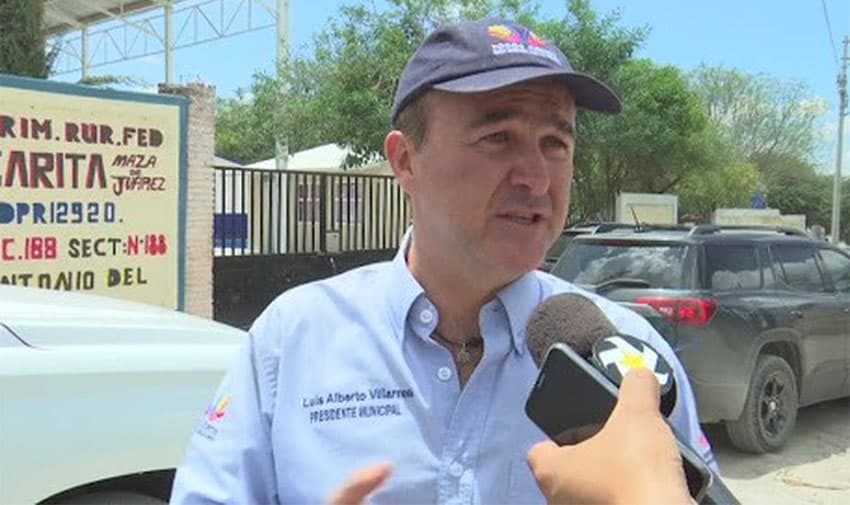
In response, Mayor Luis Alberto Villareal – who didn’t respond to a request for comment before the story was published – said in a letter that San Miguel is not losing its immunity from cartel violence. Any such perception is “fed by the gossip and opinion of very few residents,” he said.

The murders cited by Bloomberg, Villareal said, “unfortunately took place in San Miguel but don’t represent the everyday life and good social environment in this town.”

In a statement posted online, the municipal government said that it “categorically denies the publication made by the Bloomberg Group, which, without any basis, stated in an article that this municipality is gripped by organized crime.”

The government said that statistics from the National Public Security System are sufficient to refute the claim.

“. . . The statistics tracked by that office only record a single case of extortion in the municipality through October 2019. In this municipality, there are no protection payments being demanded,” the statement said.

“In the same way, there are no records of kidnappings and the official figures for drug trafficking vary, but the month that records the most arrests is August, with 14.”

Mayor Villareal: 'good social environment'
Mayor Villareal: ‘good social environment’

The government said that much of the Bloomberg story describes “unfortunate events” in other parts of Guanajuato and Mexico and “the few cases” cited that did occur in San Miguel are not representative of the city.

“There is clearly no support to the arguments put forward with respect to San Miguel de Allende because it only bases itself on the statements and opinions of very few citizens, most of them speaking anonymously,” the statement said.

“In San Miguel de Allende, there are hotel managers, restaurateurs and public figures who are willing to speak freely without fear and with first-hand information.”

The government also said that “this type of publication only damages the economies of thousands of San Miguel families . . . that have dedicated themselves for decades to the hospitality services industry.”

Bloomberg noted that the local chapter of the Business Coordinating Council (CCE) also wrote to challenge some parts of its story. None of its members, the CCE said, has complained about an increase in crime or shakedowns by cartels.

However, in the same letter, local CCE president José Torres said “it’s correct to say there’s been an increase in the use and influx of drugs in our town” and that the homicides there were likely “directly or indirectly related to drug trafficking.”

Other media outlets have also reported about increasing crime in San Miguel de Allende. A report by the newspaper El Universal in July said that crime including extortion had increased in the city following the federal government’s crackdown on fuel theft.

Members of the Santa Rosa de Lima Cartel began to diversify their criminal activities and found a fertile hunting ground in the colonial city, El Universal said. The newspaper also said that the Jalisco New Generation Cartel (CJNG), which is engaged in a bitter turf war with the Santa Rosa gang, also operates in San Miguel.

Ten suspected members of the Santa Rosa cartel were arrested in the colonial city in October, seven of whom were high-priority targets, according to state Attorney General Carlos Zamarripa Aguirre.

Source: Bloomberg (en) 

In 8 months, nearly 12,000 domestic workers signed up with IMSS

0
More than two million domestic workers are eligible.

Almost 12,000 domestic workers have been enrolled in the IMSS social security scheme since a pilot program began eight months ago, director Zoé Robledo said on Thursday.

Speaking at the president’s news conference on the first anniversary of the Supreme Court’s ruling that domestic employees must have access to social security like any other worker, Robledo said that 76% of the 11,947 people enrolled are women and 26% are concentrated in Mexico City and México state.

The Mexican Social Security Institute chief called for more employers to register their domestic workers for social security using the IMSS website trabajadorasdelhogar.gob.mx.

Cleaners, cooks, live-in maids, babysitters and gardeners are among more than two million people who are eligible for enrollment. Workers enrolled in the scheme have access to medical care, medicines, disability and retirement benefits and social services such as daycare.

Also at today’s press conference, a new advertisement was presented which encourages employers to enroll their domestic workers. Film director Alfonso Cuarón, whose 2018 movie Roma tells the story of a domestic worker in Mexico City, collaborated on the production of the ad along with the Support and Training Center for Domestic Employees (CACEH) and others.

CACEH founder Marcelina Bautista called on domestic workers to speak with their employers about enrollment in the IMSS scheme and praised the government for its commitment to ensuring the rights of domestic workers. However, she added that it still needs to sign the International Labor Organization’s Domestic Workers Convention.

In response, Interior Secretary Olga Sánchez said the convention would be signed today and sent to the Senate for ratification.

Source: El Financiero (sp) 

Mayan language instruction will be obligatory in Yucatán schools

0
Bilingualism a goal in Yucatán schools.
Bilingualism a goal in Yucatán.

The Yucatán state Congress has approved a law that will make Mayan language instruction a requirement in primary and secondary schools.

The law was passed unanimously with the intention of rescuing and preserving the region’s native tongue.

State Deputy Paulina Viana Gómez cited numbers from the National Institute of Statistics and Geography (Inegi) that reveal that Yucatán has the most indigenous language speakers of any state in Mexico — more than 570,000, most of whom speak Mayan.

“Nevertheless, it is important to point out that the percentage of people that speak Mayan in the state has been decreasing constantly and drastically in recent years,” Inegi warned.

The institute explained that it was due to a lack of interest in creating public policies to rescue and strengthen the mother tongue.

The law will enter into force as soon as it is published in the state’s official record, but will not be implemented immediately. It will be applied gradually by the Yucatán Education Secretariat.

One reason for going slowly might be a shortage of teachers. Education authorities said in September there was a shortage of bilingual — Spanish and Mayan — teachers.

The state said it would attempt to remedy the situation by introducing a “seed group” of 20 primary-level bilingual teachers who would pass their skills on to at least another 40 teachers in a process that would fan out and prepare more teachers to help meet Mayan instruction goals.

Source: Milenio (sp)

Just 1 in 10 homicides were solved in 2018

0
Another murder that will probably go unsolved
Another murder that will probably go unsolved.

Last year was another easy one in which to get away with murder: only one in 10 homicide cases were solved, a new study reveals.

Completed by the non-governmental organization Impunidad Cero (Zero Impunity), the study Impunity in Intentional Homicide in Mexico said that 89% of murders last year went unpunished.

The impunity rate began rising in 2008 after hitting a low of 54.7% in 2007, the study said. After remaining stable between 2010 and 2014, impunity started to increase again in 2015, a year in which there was a significant increase in homicides.

The impunity rate was 81.3% in 2015, 86.6% in 2016 and 89.5% in 2017 before declining 0.5% last year.

The high levels of impunity highlight “the limited capacity” of the criminal justice system to deter violent crime, Impunidad Cero said, adding that harsher penalties for homicide are pointless if arrest rates don’t increase.

At 99.6%, impunity for homicide was higher in Morelos than any other state. Chiapas was next with a rate of 99% followed by Oaxaca, Nayarit and Quintana Roo, where 97.8%, 97.7% and 96.6% of murders, respectively, went unpunished.

Eleven states had impunity rates higher than 91% last year while seven exceeded 95%. Four years ago, only three states were in the former category.

The lowest impunity rate was in Yucatán, where 27.1% of cases went unsolved. Aguascalientes had the next lowest rate at 45.5% followed by Nuevo León, Durango and Hidalgo, with rates of 61%, 64.8% and 71.7% respectively.

Impunity for homicides committed in Mexico City and Quintana Roo has increased more than 20 points since 2015 to 86.7% and 96.6% respectively, while the rate declined 13.8% in Nuevo León and 11% in Michoacán to 78.1%.

Impunidad Cero called on the federal government to prioritize improving the investigative capacity of the nation’s prosecutor’s offices. The offices are working with limited budgets and personnel, the NGO said.

The impunity that plagues Mexico extends to virtually all criminal activity. In a study published in September, Impunidad Cero said the probability of a crime being reported, investigated and solved is just 1.3%. 

Source: El Economista (sp) 

Chihuahua bus crash kills 13, injures 50

0
The bus that left the road in Chihuahua Thursday morning.

A bus went off the highway near Delicias, Chihuahua, early Thursday morning leaving 13 people dead and 50 injured.

Initial reports said the driver lost control of the bus, operated by the company Tour Nómada, which went off the road between Delicias and Jiménez and rolled over.

State health authorities said the injured were taken to hospitals in the city of Delicias.

Units from the Red Cross and urban rescue departments of Meoqui, Saucillo and Delicias were mobilized to attend to the victims and transport them to hospitals.

Only five of the dead had been identified by Thursday afternoon. Authorities asked the public for help identifying the remaining eight deceased passengers.

Seventy passengers were aboard the vehicle.

Sources: El Financiero (sp), El Heraldo de Chihuahua (sp)