The police academy in San Pedro Garza García, Nuevo León, celebrated its largest graduating class ever, with 100 cadets becoming officers on Wednesday.
In addition to its record size, the graduating class stands out for the education levels among the officers, 74 of whom have bachelor’s or postgraduate degrees in fields such as criminology, psychology, law or engineering.
As cadets, they completed 1,080 hours of training and study, a higher standard than the one mandated by the National Security System (Sesnsp).
San Pedro Police Chief Gerardo Escamilla Vargas said the cadets had to pass 48 subjects in six months of study and training in order to graduate. Subjects included the legitimate use of force, crime prevention and victim services.
Almost a third of the graduates were women.
The graduates will be the best paid in the force’s history, earning 20,000 pesos (US $1,028) a month, the newspaper Milenio reported.
During the graduation ceremony, the graduates demonstrated riot squad tactics, blindfolded arming and disarming of weapons and victim services techniques.
At 2%, the Finance Secretariat's forecast is higher than those of financial institutions surveyed.
Seven banks and brokerages are predicting economic growth of less than 1% in 2020, a new survey shows.
Conducted by economic analysis and forecasting firm FocusEconomics, the survey indicates that Germany’s Commerzbank and Swiss investment bank UBS anticipate 0.9% GDP growth next year.
British bank Standard Chartered, Mexican foreign exchange company Monex and Mexican financial services firm Invex all predict 0.8% growth, while U.S. firm DuckerFrontier is forecasting an economic expansion of just 0.4%.
The most pessimistic outlook comes from the French investment bank Société Générale, which sees zero growth in 2020.
Thirty-five other entities surveyed by FocusEconomics predict growth of 1% or higher next year. The most optimistic outlook came from Germany’s DekaBank, which forecasts 1.8% growth next year.
The American Chamber of Commerce in Mexico predicts a GDP expansion of 1.7%, while the Mexican firms Actinver and GBM Securities both anticipate 1.6% growth. The average forecast of the 42 entities consulted was 1.2%.
Joel Virgen, BNP Paribas’ chief economist for Mexico, told the newspaper El Economista that the French bank is forecasting 0.6% growth in 2020.
He said the bank is still waiting for further details about the National Infrastructure Plan before predicting what impact it will have on the economy.
Virgen said that the economy will face a range of internal risks related to government policy in 2020 as well as external ones such as uncertainty about the new North American free trade agreement.
The economy contracted in both the first and second quarters and grew by just 0.01% in the third, Inegi said.
Meanwhile, the Finance Secretariat’s 2020 economic package anticipates 2% growth next year while the Bank of México’s forecast is a growth rate between 1.5% and 2.5%.
Despite the weak economy, business magnate Carlos Slim last week endorsed the economic performance of President López Obrador and his government, claiming that the foundations have been laid for greater investment and growth in coming years.
A Christmas village in Puebla may be the closest thing to a northern Christmas that exists in Mexico.
From late November to early January, the city of Atlixco boasts the largest arrangement of colored lights in Mexico at an event called the Villa Iluminada (Lighted Village).
The historic center of the city, from the main square to Parque Revolución, boasts millions of Christmas lights strung up on over two kilometers of old buildings public and private, plazas and streets. Many of the lights are set up on over 2,000 figures related to the Christmas season.
In addition, the event includes attractions not necessarily related to Christmas as those from the north know it. One is the Árbol de los Deseos (Wish Tree) where you can leave messages about what you would like for Christmas, a lava tunnel and a train. It even includes a Corner for Lovers, a backdrop for professing your undying affection to that special someone.
One of the highlights of this period is the Desfile de Nikolaus (Nicholas Parade), based on a variant of the Saint Nicholas story. In this version, a young girl was playing with a box when Nicholas, a neighbor, saw her through the window and was curious. He asked her what she was doing with the box and she said, “Playing with my doll.” But the box was empty.
A train is part of the parade at Atlixco’s Christmas event.
The girl also told him that the Three Wise Men could not bring gifts to all children and she was one who did not receive a gift. So she gave herself an imaginary doll.
The next day, the girl opened her box to find a real doll, a gift from Saint Nick. The parade to honor this legend features floats and people in costume and marching bands.
Another major attraction is the Magic Circus, which is new this year.
There is an entrance fee for the parade of between 165 and 270 pesos, but it includes access to a pavilion featuring local and gourmet food. However, the walk around the lighted area is free.
After only seven years, the event is the most important tourist attraction for the municipality, and is expected to bring in over 50 million pesos (US $2.57 million).
This year’s event runs from November 22 to January 6.
Fruit, piloncillo and cinnamon are among the ingredients in this mug of ponche.
Mexico’s quintessential Christmas beverage will be celebrated at the first annual Feria del Ponche Tradicional (Traditional Ponche Fair) in Tepoztlán, Morelos, on December 14.
Traditional Mexican ponche is made with fruits such as apples, guavas and tejocote (Mexican hawthorn), and cinnamon, sugar cane and piloncillo (made from sugar cane juice). It is usually served hot in a clay mug.
However, each family has their own recipe for the beverage, making it unique at each Christmas party and family get-together.
Ponche has its roots in India. Its name in Sanskrit — pañc — translates to “five,” in reference to the five traditional ingredients: alcohol, sugar, water, lime and tea or other spices. From India the beverage made its way to England, spread through Europe and was brought to Mexico by the Spaniards during the conquest.
Here, it took on uniquely Mexican ingredients, lost the alcohol (though some recipes still call for it) and became the drink people across the country use to warm their bones in winter. It is also renowned for its supposed healing properties, as it is packed full of vitamins.
The fair will serve over 10 traditional ponche recipes that have survived for generations, such as versions with milk or alcohol (con piquete). There will also be lots of food, as well as dance presentations, traditional costumes, live music and a piñata competition.
Visitors should take their own mug to the fair. In an effort to generate less waste, organizers have asked attendees to bring their own mugs, which can afterwards be donated to the recycling and waste reduction campaign Recapacicla.
The fair will be held at the municipal building at San Andrés de la Cal. It runs from 4:00pm-9:00pm and admission is free.
Families of suspects in LeBarón case say they're innocent.
Three men arrested in connection with the massacre of nine members of the extended LeBarón family are scapegoats, claim relatives of two of the suspects.
The armed forces, Federal Police, National Guard and intelligence agents detained Héctor Mario Hernández, his brother Luis Manuel Hernández and another man identified only as Cipriano N. on Sunday morning in Janos, a Chihuahua municipality that borders the United States.
Héctor Mario was identified by the federal Attorney General’s Office (FGR) as “El Mayo,” suspected plaza chief in Janos of La Línea, a criminal gang with links to the Juárez Cartel.
Authorities said shortly after the attack that the criminal group may have mistaken the vehicles in which the victims were traveling as those of a Sinaloa Cartel splinter cell called Los Salazar.
Héctor Mario’s niece rejected the accusation that her uncle and father were responsible for the November 4 ambush in Bavispe, Sonora, that left three women and six children dead.
“They’re both scapegoats,” Estefanía Hernández, daughter of Luis Manuel, told the newspaper Reforma.
She said that her aunt spoke with her brothers at FGR facilities in Nuevo Casas Grandes, Chihuahua, and that Héctor Mario told her that he was being pressured to confess that he was a criminal leader in exchange for the release of Luis Manuel.
The fact that the people of Janos are supporting her father and uncle is evidence of their innocence, Hernández told Reforma. She asserted that the security forces who arrested the two men acted in a violent manner and planted drugs on them.
In a social media post, Hernández described the massacre of the women and children, members of a fundamentalist Mormon community that has lived in northern Mexico for decades, as “a real shame” and “a great tragedy” and said that she and the rest of her family want justice.
“. . . We all hope that what is necessary to arrest the culprits is done. But I don’t think it’s fair that people who had nothing to do with the crime are being directly blamed just because the relevant [security] forces have to provide results of their ‘hard’ work,” she wrote.
A brother-in-law of Héctor Mario and Luis Manuel also claimed that they, and the third man who was detained, were wrongfully arrested.
Families close road in protest against arrests.
“We don’t have problems with the LeBarón family, we want justice to be done but not with scapegoats,” he said in a radio interview on Tuesday.
The unidentified relative said that Luis Manuel is the caregiver for his ill 73-year-old father and that Héctor Mario is a rancher.
“Luis hasn’t left the house for almost two years . . . Héctor works with his cattle,” he said. “Neither has a criminal record, they’ve never been in prison.”
The brother-in-law said that when Luis Manuel and Héctor Mario were arrested, security forces broke a window of their father’s home and threw a package at the former that allegedly contained drugs.
“They told him, ‘this is yours.’ The package supposedly had crystal [methamphetamine],” he said.
The third man arrested is a hunter, the brother-in-law said, adding that he legally possessed the weapons that were taken from him.
“In the case of Cipriano, we know that they took weapons from him but that man is a hunter and the weapons they took from him were in order . . .” he said.
The relative said that family members will continue to protest to demand the return of the three men from Mexico City, where they were transferred after their arrest.
“We’re going to carry out blockades and we’ll close highways. We don’t have the resources to go to Mexico City, we want them to be returned to so that we can defend them,” he said.
In a subsequent radio interview, Janos Mayor Sebastian Efraín Pineda confirmed the claims made by the brother-in-law, adding that he personally knows the three men who were arrested.
“I corroborate what their brother-in-law said. Cipriano belongs to a hunting group . . . Luis looks after his father and Mayo works with his cows,” he said. “As far as I know . . .they’re not criminal leaders,” the mayor added.
“I believe that what we have to do is support the families [of the arrested men], see how we can help them. Of course, I don’t agree with any crime. If they turn out to be guilty, they’ll receive their punishment but if they’re innocent, the least they can do is release them because they have no criminal record,” Pineda said.
The mayor also said that federal authorities didn’t contact him either before or after the operation to detain the three suspects.
Their arrests followed the detention of another suspect in Mexico City last month. Military authorities said the man detained in November provided information about the alleged perpetrators of the crime that led to the latest arrests.
The president said on Wednesday that the meeting was respectful and that the government is committed to “clarifying the facts” about last month’s ambush and ensuring that justice is served.
One of the first five auctions that have sold off assets of organized crime.
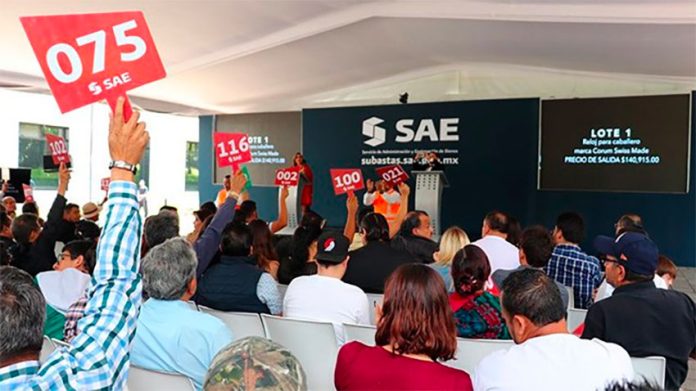
Over 600 lots of jewelry, luxury cars and real estate will be on the block at the next government narco-auction of assets seized from organized crime.
The director of the Institute to Return Stolen Goods to the People called the event a “mega-auction,” since it will sell over twice as many lots as previous auctions.
“We’re going to toss everything in the house out the window,” said Ricardo Rodríguez. “We’re going to do a mega-auction of jewels, luxury cars, homes and other goods . . . We’re going to get rid of everything we’ve got in order to take advantage of . . . the gift-giving season.”
The auction, the institute’s sixth, will be held at the Los Pinos Cultural Center, in Chapultepec Park, on December 14 and 15.
Rodríguez said that in past auctions, 300 was a “robust” number of salable items, making this auction a stand-out event both in the number and quality of items up for bidding.
The institute currently has 2,200 pieces of jewelry, but that number is expected to grow to around 4,578.
The objects have been turned over to the institute by the federal Attorney General’s office (FGR), Rodríguez said, after confiscating them during criminal prosecutions.
Specifics on the vehicles will be released at a later date, but Rodríguez said that among them are an Aston Martin, a Lamborghini and a Ferrari. There will also be a number of real estate properties up for bidding, as well.
The resources obtained by the auction will be applied to infrastructure projects, specifically two highway projects in Nayarit and Guanajuato.
NASA will launch the first all-Mexican nanosatellite into space on Wednesday from Cape Canaveral, Florida.
Designed and built by students at the Popular Autonomous University of Puebla (UPAEP), the AztechSat-1 will carry out a mission operated by Elon Musk’s company SpaceX.
Héctor Simón Vargas Martínez, a UPAEP academic who oversaw the satellite project, said the aim of the AztechSat-1 mission is to establish communication with the entire Globalstar satellite constellation system with a view to improving the transmission of data to earth.
Andrés Martínez, an advanced exploration systems executive at the United States space agency, told a press conference in November 2018 that the quality of the design of the AztechSat-1 satellite, which measures just 10 cubic centimeters, was on a par with those of NASA engineers.
A total of 74 undergraduate and post-graduate students at UPAEP as well as 12 academics worked on the project.
Vargas recalled that there was also a Mexican project in the 1990s that aimed to send an experimental satellite into space but it didn’t get past the design stage.
“AztechSat-1 is the first national project . . . to go into space,” he said. “It has already obtained permission from the International Telecommunication Union.”
Carlos Duarte, coordinator of human capital training at the Mexican Space Agency (AEM), said the launch of the nanosatellite will set an important precedent and help lay the groundwork for Mexico to become a future leader in space research.
All of the information obtained by AztechSat-1 will be freely available so that students at other educational institutions can learn from its mission, he said.
Duarte said the total cost of developing and building the satellite and launching it into space is more than US $400,000.
About half of that amount came from the UPAEP and was used to purchase components for AztechSat-1 as well as pay for other development-related expenses while the AEM contributed US $100,000. NASA is covering the US $100,000 cost of launching the nanosatellite into space.
Vargas said another Mexican project to send a second satellite is already underway. The aim of a space mission by the AztechSat-2 satellite will be to monitor marine mammals and the oceans in which they live, he said.
One of the Sukhoi Superjet aircraft operated by Interjet.
Interjet’s share of the domestic air travel market declined in the first nine months of 2109 due to financial and operational problems, including trouble with its Russian-built planes.
The airline transported 7.86 million passengers between January and September to claim a 19.8% stake in the Mexican market, according to data from the Federal Civil Aviation Agency. In the same period last year, Interjet had a 20.6% share of the market.
Independent aviation consultant Juan Antonio José told the newspaper Reforma that the decline can be partially attributed to the grounding of many of the airline’s Sukhoi Superjet 100s. Interjet has been forced to take most its fleet of 22 Sukhois out of service due to a lack of spare parts.
The airline received about US $40 million in compensation from Sukhoi last year due to the company’s inability to supply parts to planes with mechanical problems in a timely manner.
José said that demand for flights on the planes was also low due to safety concerns, meaning that even if Interjet was able to keep them in the air, they would operate at a loss.
“The reality is that air transport demand reacts particularly aggressively in the face of any perception of a lack of safety . . . If I’m going to take a trip, I want it to be on an airline that guarantees [the safety of] the journey,” he said.
In that context, Interjet is planning to withdraw its remaining operational Sukhoi Superjets from service by the end of the year, and operate exclusively with planes made by European multinational Airbus.
The airline has 64 A320 Airbus planes and, according to a report by the news agency Reuters in October, is close to a deal to purchase 12 A220 passenger jets to replace its grounded Sukhoi fleet.
The inactive Russian planes, purchased by Interjet about six years ago, are located at several airports around the country, the aviation news website Transponder 1200 reported. Interjet reportedly wants to sell the planes although some of them no longer have airworthiness certificates.
The airline ordered 30 Sukhoi jets in 2013 and was still to take delivery of eight. However, in light of the decision to cease operations with the Russian-built planes it appears unlikely that it will be willing to receive them.
While Interjet has lost market share this year, two of its main competitors have increased their share. Volaris captured 31.4% of the domestic air travel market in the first nine months of 2019, up from 27.9% in the same period last year, while VivaAerobus grew its share by one point to 19.8%.
In contrast, Aeroméxico’s market share declined to 24.3% from 28.1% as the result of the grounding of its Boeing 737 MAX planes due to safety concerns.
Winter is just around the corner, temperatures are dropping and people are getting out warmer clothes — for themselves and even street dogs.
But in Yucatán it had to be traditional clothing for a dog named Polita, who was given a huipil by local artisans in Ticul.
A photo of the dog wearing the traditional, embroidered tunic went viral on Monday.
“So that she doesn’t suffer from the cold, the little dog with her huipil. It’s worth sharing and making her go viral,” wrote the resident who posted the photo.
Temperatures in Ticul were dropping to 18 C thanks to Cold Front No. 19, definitely huipil-wearing weather for a street dog.
As of Tuesday, the photo had earned over 3,000 reactions and 700 comments on Facebook, and had been shared 19,000 times.
The army, which is currently building a new international airport at the site of the Santa Lucía Air Force Base, may be called upon to build bank branches next.
President López Obrador suggested Tuesday that the army could build 13,000 branches of the new Banco del Bienestar (Bank of Well-Being) in less than a year.
“We’re looking at the possibility of military engineers building them . . .” he told reporters at his morning conference. “What’s important to us is to have them, we need the infrastructure.”
To that end, the federal government’s super-delegates in each of the states and Mexico City are seeking land on which to build the branches.
“. . . We don’t want them to be in marginal spaces, we want them to be a respectable office, a real bank. It’s going to be the bank with the best infrastructure in the whole country,” the president said.
López Obrador emphasized the importance of the bank as a more secure means to deliver government assistance provided through the new Secretariat of Welfare.
“We’ve had some 10 robberies [of resources] and people have lost their lives receiving welfare payments. So we don’t want to use cash, we want to use the [benefits] card in these 13,000 banks.”
Welfare undersecretary Ariadna Montiel reported that around 20 million pesos (US $1.02 million) of government assistance intended for senior citizens was stolen between January and September.
The robberies occurred in Chiapas, Hidalgo, Michoacán, Guerrero and Oaxaca.
The new bank replaces the federally-owned Bansefi.