Home Blog Page 1708

Bank cuts benchmark interest rate; weaker peso predicted to follow further cuts

0
mexican currency
Economists predict peso will gradually weaken.

The central bank cut its benchmark interest rate on Thursday in a move that was predicted by economists, who expect the bank to continue monetary policy easing in 2020.

Leading economists forecast a weaker Mexican peso as a result.

The Bank of México cut the interest rate by 25 basis points to 7.5%.

Seventeen of 26 economists surveyed by Bloomberg predicted that the bank would cut its benchmark rate by 0.25% to 7.5% at today’s meeting. The other nine anticipated a 0.5% cut to 7.25%.

The bank made quarter-point cuts at its last two meetings after inflation dropped and the economy continued to slow.

Further rate cuts could diminish the appeal of the peso because they put a dent in its carry trade appeal. Carry trade is a strategy in which investors borrow currency in markets where interest rates are low and buy in markets where they are higher.

The strong performance of the peso since President López Obrador took office is mainly due to demand for the currency generated by its carry trade appeal, Bloomberg said.

Among the world’s major economies, only Argentina, where the economy is in crisis, and Turkey currently have a higher real interest rate (the difference between the interest rate and the inflation rate) than Mexico. A decrease in inflation to the central bank’s target of 3% has left Mexico’s real rate at 4.73%.

If the Bank of México benchmark interest rate continues to fall as predicted, Mexico’s real interest rate will also fall and purchasing pesos will become less attractive to investors, causing the currency to weaken.

“We believe the peso will depreciate gradually for the rest of the year and into 2020 as the carry advantage of the peso erodes,” said Banorte economist Juan Carlos Alderete.

He predicted a 6% interest rate at the end of next year and an exchange rate of 21.3 pesos to the US dollar.

The most recent survey by Citibanamex showed economists predicting on average a 6.5% rate at the end of 2020 and an exchange rate of 20.07 to the dollar. Early on Thursday, the peso weakened 0.55% to 19.46.

Bloomberg said the “debate among economists and strategists isn’t whether the peso will depreciate, but how weak it will become.”

While López Obrador has lauded the strength of the peso since he took office, a weakening of the currency due to monetary policy easing could actually help his government grow the economy because it would make Mexican exports more competitive.

Any economic expansion would be welcome news for the government after growth of just 0.1% in the third quarter, 0.0% in the second and a contraction of 0.3% in the first.

The ailing economy coupled with concern about the government’s policy agenda is affecting investor confidence in Mexico.

The Bank of America Merrill Lynch November survey showed that 77% of investment fund managers in Latin America believe that Mexico will lose its investment grade credit rating.

The figure is the highest since January when the survey first asked fund managers to offer an opinion about the outlook for Mexico’s sovereign rating.

Almost six in 10 fund managers said that government decisions represented a risk to the economy, while 23% expressed concern about the impact on Mexico of a slowdown in the United States.

The possibility of new U.S. tariffs on exports, another cut to Pemex’s credit rating and non-ratification of the new North American trade deal were also cited as risks albeit by just 8%, 4% and 4% of those polled, respectively.

Carlos Capistrán, the Bank of America’s chief economist in Mexico, told the newspaper El Financiero that data shows that investment has dropped significantly in real terms in 2019. Policy “uncertainty is one of the main factors” that has caused investment to fall, he said.

Capistrán said that monetary policy easing could stimulate the economy but predicted that it wouldn’t lift GDP growth above 1% next year.

The Bank of America is forecasting 0.0% growth this year and 0.9% in 2020.

Source: Bloomberg (en), El Financiero (sp) 
Cold front brings chest-deep sea foam to Tabasco town

0
Sea foam invades Villas Sánchez Magallanes in Tabasco.

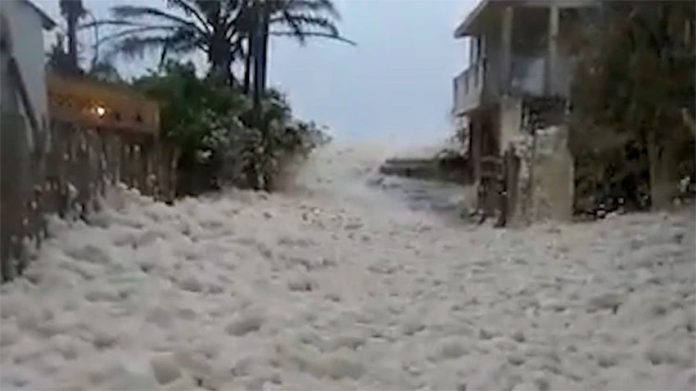
A town on the coast of Tabasco was inundated with sea foam during an unusual weather event on Wednesday.

Residents of Sánchez Magallanes were forced to vacate their homes when the chest-high foam invaded the streets near the port town’s beaches.

In a video of the event, caused by the high winds and waves of Cold Front No. 12, a man is seen carrying a woman through the foam after it surrounded her home.

“They’re taking out a woman who was trapped in the foam . . . she was evacuated from her home . . .” said the woman who shot the video.

The video also showed the intense winds caused by the front, which produced gusts of up to 60 kilometers per hour and three-meter waves in Tabasco.

Chest-deep sea foam in Tabasco on Wednesday.

Sea foam is generated by the waves’ agitation of water containing high concentrations of dissolved organic matter. As the water is churned by the waves, resilient bubbles formed. In this case they were blown onto land by strong winds.

The phenomenon occurred on Wednesday morning but by 12:30pm, Tabasco Civil Protection officials reported that the foam had subsided.

The agency also announced that samples of the foam had been collected to be examined by experts.

The National Water Commission (Conagua) reported that the cold front hit northern Mexico on Wednesday, and would make its way down to the center, east and southeast of the country.

It will bring low temperatures and heavy rains to states from Chihuahua and Nuevo León down to Puebla, Tabasco, Oaxaca and Chiapas. Meteorologists have also predicted hailstorms in some areas.

With as much as 150 millimeters of rainfall expected in many areas, authorities have warned residents to keep abreast of weather conditions and take precautions, as the precipitation is likely to cause flooding and rivers to overflow.

Mexico City residents have been warned for two days in a row now to be prepared for cold weather in the early morning. A yellow alert was issued in the boroughs of Álvaro Obregón, Cuajimalpa, Magdalena Contreras, Milpa Alta, Tlalpan and Xochimilco to warn that temperatures would drop to 4 to 6 C between 5:00am and 8:00am for a second day.

Source: Infobae (sp)

200 donkeys retired from garbage collection in Coacalco

0
horse-drawn cart
It's out with the old ways in Coacalco . . .

The use of donkey and horse-drawn carts to collect trash officially came to an end in Coacalco, México state, on Tuesday after the municipal government put 40 new garbage trucks into operation.

More than 200 cart drivers who have long collected garbage in the municipality north of Mexico City will no longer be allowed to operate, said Mayor Darwin Eslava.

He said citizens demanded the removal of animal-drawn carts from the streets of Coacalco after expressing concerns about the treatment of the animals for many years.

“In the coming days, there will be a council meeting at which we’re going to ban” animal-drawn vehicles, Eslava said.

In the first instance, burreros (donkey drivers) will be a given a warning to leave Coacalco if they are seen operating on the streets, the mayor said. If they reoffend their animals will be taken away from them.

garbage truck
. . . and in with the new.

“We have an agreement with the people at the Otumba donkey sanctuary,” Eslava said.

He added that the cart drivers will be offered alternative employment by the municipality.

The local government signed an agreement to lease the garbage trucks for the next two years at a cost of 40 million pesos (US $2 million) annually. They will provide service to the entire municipality, where about 500 tonnes of trash are generated every day.

The government previously had the capacity to collect garbage in only 70% of Coacalco while the cart drivers provided service in the remaining areas.

Eslava said garbage collection will be free for Coacalco residents and that new drivers will also be prohibited from receiving tips.

Local authorities are also planning to put a waste sorting system in place to encourage residents to recycle.

Source: El Universal (sp), La Prensa (sp) 

In water disputes, what to do if authorities can’t be counted on to fix it?

0
water

A few days ago it was discovered that the LeBarón family of Chihuahua was at the center of a longstanding dispute over water.

The claim by a nearby farmers’ group was that the family had been drilling illegal water wells on their property for years, the result being much less water to go around for the surrounding properties and communities. 

It is still unknown if this has anything at all to do with the ghastly and horrendous murders of many of the family’s children and several of its women.

I personally suspect that criminal gangs set on generally sowing terror and cementing their power among even the most influential families are responsible for the massacre.

That said, when “the family denied any wrongdoing” regarding the alleged hundreds (and perhaps thousands) of water wells they drilled on their ranches, it makes me wonder how many friends they had among the surrounding communities, and whether having those friends would have made a difference regarding their fate.

After all, there are plenty of examples of organized crime acting as a shadow state, “exacting justice” on behalf of communities in their own gruesome ways. This is always the danger in our current state of affairs: where real, legitimate authority is absent, opportunities for stepping into the vacuum are plentiful.

In a country in which it’s clear that the rule of law is not something anyone can count on, the authorities can’t be relied on to prevent or solve either kind of crime; not those of rich families exploiting natural resources simply because they can and it’s beneficial to them, and not the murders of said rich families either.

(I hope it goes without saying that I do not approve of the murders as retribution for any crime. I do think, however, that the desperation over water and the lengths people are willing to go to in order to control it are very much worth discussing.)

So let’s talk about water. In my rainy city in the cloud forest (Xalapa, Veracruz), I don’t have running water in my modern, centrally-located home at least a couple of times a month. I’m forever fighting with the water company, which sends bills month after month that make it look like I’m filling an Olympic swimming pool every day — as if I even had that kind of water pressure!

Comparably, I have it easy. There is almost always water available, and I don’t have to call an expensive water truck to bring water to fill up my tank.

In places like this that receive plenty of rainwater each year, there should be less pressure to pump water throughout the city. The technology to harvest rainwater exists, and valiant efforts have been made to ensure that homes most in need — especially in Mexico City — have that technology installed first.

Other places, like the vast deserts of the north that cannot count on a steady supply of rainwater, have a harder time. Out of necessity their water comes from wells that are dug down to natural aquifers. Rain harvesting might put a dent in things for the little rain they get, but is not the kind of radical solution that it is in other places.

In these areas, water is scarce, and to whom that water arrives first and in what quantities can be a difficult issue.

“The family denied any wrongdoing” [in relation to water wells]. Okay, but what does that mean exactly? People know they can’t count on fairness. There’s always a conflict between someone’s “right” to have an equal share of a basic right like water and someone else’s “right” to “make a living.”

So when some kind of unfairness is threatening ones livelihood, whats to be done if the authorities cant be counted on to fix it? How, as a society, do we deal with injustice when no institution can actually solve it or enforce the rules that are already there?

There are plenty of places in Mexico where large companies and factories, expensive resorts, and yes, the land and businesses of wealthy families, have all the water they need, even when scarcity in the area is a problem.

Those who live in surrounding areas often go without, or have to figure out other solutions to the unequal distribution.

Like many of Mexico’s problems, our water crisis can only really be addressed by fixing the issues that make the distribution so problematic in the first place. If water really is a human right, then it’s time to step up.

Sarah DeVries writes from her home in Xalapa, Veracruz.

Highway paved with recycled plastic is world’s first

0
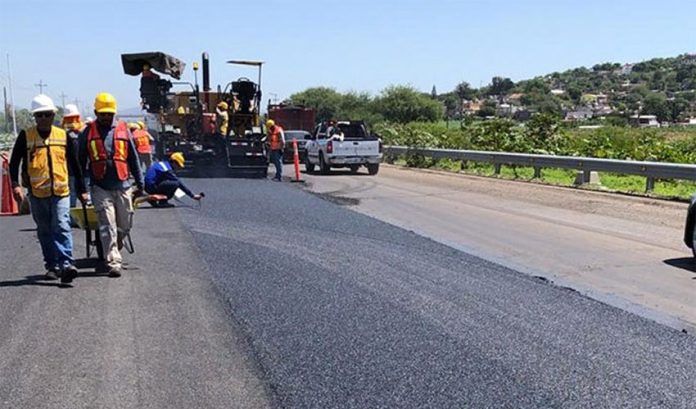
This pavement is made with thousands of used water bottles.

The world’s first highway paved partially with recycled plastics has been inaugurated in Guanajuato.

The four-kilometer stretch of pavement is located on the highway that connects the municipalities of Irapuato and Cuerámaro. The project utilized as much as 1.7 tonnes of reclaimed plastics, or the equivalent of 425,000 plastic packaging units, according to Dow Plastics Technology Mexico.

The asphalt was created by a consortium of companies including Dow, Vise, Surfax, Lasfalto and Omnigreen, and its application in the highway system was supported by the federal Communications and Transportation Secretariat (SCT).

“This new technology not only offers a possible solution to the management of plastic waste, it also theoretically prolongs the life span of highways by 50% compared to conventional asphalt,” said Dow in a press release.

“The advantage of using recycled plastic products is that they can be used on all types of highways, not only in high-performance products, which can extend the life span of any paved road,” the company added.

Dow Mexico’s commercial director of packaging and specialty plastics, Paula Sans, emphasized the use of plastics in a circular economic model, in which they can be used more than once.

“Showing that we can build highways out of modified high-performance asphalts that utilize recycled plastic is a step forward toward developing applications based on a business model of circular economy . . .” she said.

Dow said it plans to carry out more pilot projects with the modified asphalt in order to be able to use the technology on a large scale.

Sources: Forbes México (sp), El Financiero (sp)

Doctors target of extortionists in Salamanca, Guanajuato

0
Security Commissioner Huett: it's worse in Celaya.

Extortionists operating in Salamanca, Guanajuato, have diversified: they are now targeting doctors in addition to business owners.

Several doctor’s offices have recently closed in the city due to extortion demands made by suspected members of criminal groups, according to a report published Wednesday by the newspaper Milenio. Some clinics are not operating at night as a result of the same threat.

“They’re not opening anymore,” an unidentified doctor told Milenio. “My patients tell me, ‘when we went to clinics at night, they used to treat us, now the clinics are closed . . .’”

The doctor said there have also been cases in which patients’ vehicles have been stolen while they are receiving treatment, adding that some people are too afraid to seek medical attention at night and attempt to treat their problems themselves.

The doctor also said that he was once contacted by suspected members of a criminal group who asked him to treat a person who had been shot.

“I told them that I wasn’t a surgeon and that in these cases [the person] should be taken to a clinic,” he said.

Salamanca Mayor Beatriz Hernández said the city is affected by a range of crimes, including extortion, and that business owners bear the brunt of the scourge.

“. . . Those who have had the greatest number of problems with crime are shopkeepers . . . We’re reviewing the security strategy that will be applied by this new generation of police,” she said, referring to 30 recently graduated municipal police officers.

“. . . We have a high rate of vehicle theft . . . and of course, [we also have] homicides, shootings . . .”

According to the crime monitoring website elcri.men, Salamanca was the 16th most violent municipality in Mexico between April and September with a per-capita homicide rate of 84.1.

But according to Guanajuato Security Commissioner Sophia Huett López, the extortion problem in Salamanca is not as bad as in Celaya, where many businesses including tortilla shops and a Ford dealership have closed.

Source: Milenio (sp) 

Controversy dogs human rights chief even after winning Senate vote

0
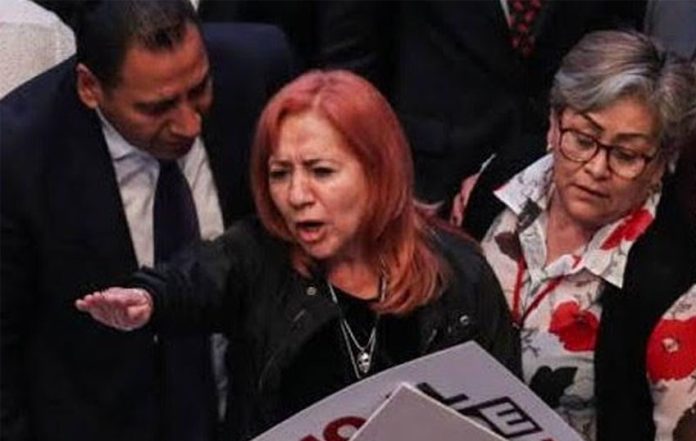
The new head of the Human Rights Commission is sworn in in the Senate.

After accusations of a rigged vote and claims that the new head of the National Human Rights Commission (CNDH) would be a puppet of the government, yet more controversy surfaced Tuesday when Rosario Piedra Ibarra indicated she was unaware that any journalists had been murdered this year.

After she was sworn in as CNDH president, Piedra was asked by a reporter about violence against journalists in Mexico.

“This year has been the worst for journalists,” the reporter said to the new rights chief.

“Have journalists been killed?” Piedra asked.

“Haven’t you heard about the murder of journalists?” the reporter responded.

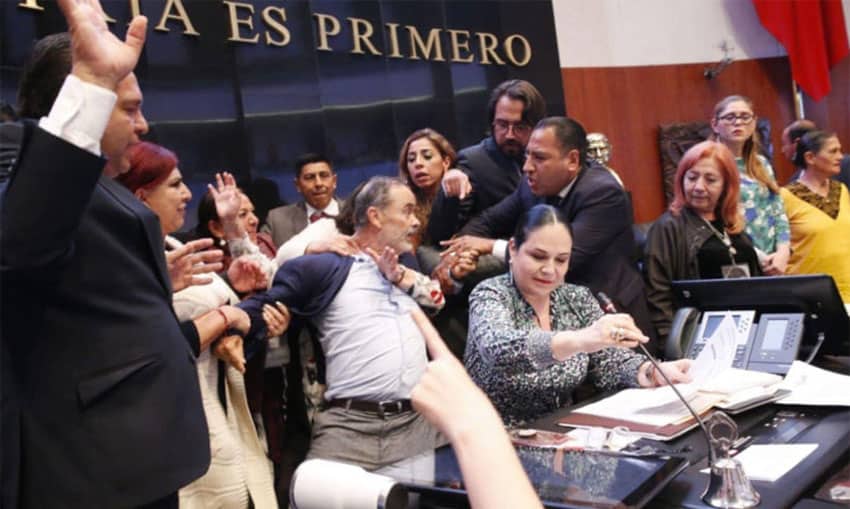
A commotion in the Senate during the swearing in of human rights chief.
Commotion in the Senate during the swearing in of human rights chief.

“. . . No, look, I’ve seen what happened in past presidential terms and it’s something terrible,” Piedra said.

According to Periodistas Desplazados México (Displaced Journalists Mexico), 13 journalists have been killed since President López Obrador took office in December.

The NGO announced on Twitter on Wednesday that it had filed a complaint with the commission over which Piedra now presides “for her regrettable responses” about the “grave problem” of murders of journalists in Mexico.

Her remarks are a violation of the human rights of the families of journalists who have been murdered, Periodistas Desplazados said in its complaint.

“[Piedra’s] response provokes a feeling of vulnerability,” the group said, adding that her “ignorance of such a difficult reality . . . generates uncertainty and fear in those who have been victims of attacks . . .”

The organization also said that data shows that Mexico is the most dangerous country in the world for journalists.

Since 2000, 131 have been killed and more than 99% of the murders have gone unpunished, according to the human rights group Article 19.

Periodistas Desplazados said on Twitter that its complaint extended to the Senate for appointing a candidate to the role of CNDH chief who is “clearly not informed about extremely important issues.”

The NGO stopped short of calling for Piedra’s resignation but urged her to offer a public apology and commit to undertaking training about freedom of expression and violence against the press.

Jan-Albert Hootsen, Mexico representative for the Committee to Protect Journalists, said on Twitter that Piedra’s comments were “deeply troubling,” adding that Mexico needs a human rights agency that fully defends the right of journalists to do their job without fear of reprisals.

“I hope that the new chief, Rosario Piedra Ibarra, recognizes the depth of the crisis,” he wrote.

Piedra faced staunch opposition to her election as CNDH president from opposition lawmakers.

National Action Party (PAN) senators charged that the commission’s autonomy would be lost under its new chief, claiming she would be acting under the orders of President López Obrador.

PAN Senator Gustavo Madero attempted to physically stop Piedra from being sworn in on Tuesday while other lawmakers shouted their disapproval and held up signs that read: “No to fraud in the CNDH.”

There were also accusations that the voting was rigged in Piedra’s favor.

Source: El Sol de México (sp), El Financiero (sp), Animal Político (sp), Proceso (sp)  

Woman’s death triggered formation of volunteer fire department

0
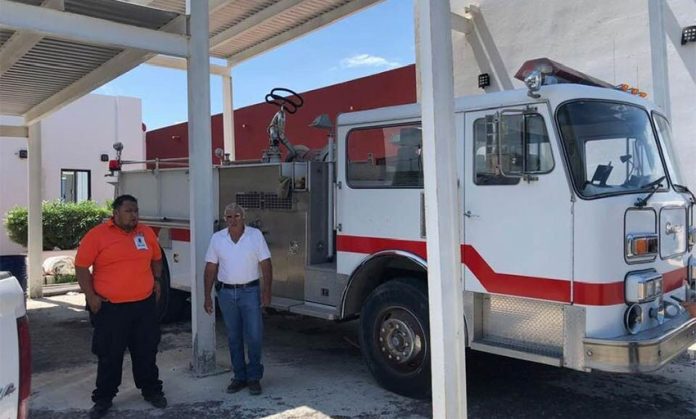
La Ribera now has a fire truck thanks to the creation of a new fire department.

The tragic death of a woman trapped in a housefire in La Ribera, Baja California Sur, has spurred a former United States fire captain to found a volunteer fire department in the town.

The closest first responders to the August 7 fire that killed María Teresa Lomelí  were located in San José del Cabo, over 70 kilometers to the south and almost an hour’s drive away.

This prompted part-time La Ribera resident and former fire captain Steve Alcorn to create a campaign to create a volunteer fire department. Alcorn, from Incline Village, Nevada, fell in love with La Ribera when he first visited in 2000.

He saw that most fires were dealt with by citizens without serious incidents, but Lomeli’s death showed him that response times for structure fires and other incidents were far too long to make a difference in an emergency situation.

The campaign began with the goal of getting La Ribera a fire truck and basic life-saving equipment, but it quickly grew into an international movement to establish a fully functioning volunteer fire department.

The La Ribera Volunteer Fire Department will also provide fire and emergency response service to neighboring communities that lack them.

Alcorn has received support from people on both sides of the U.S.-Mexico border in the form of donations and locals willing to participate in the project.

La Ribera Mayor Juan Carlos Montano has accepted the post of chief of administrator for the department. He says the project has advanced rapidly thanks to cooperation from local government, business and citizens, and the monetary support of donors.

“We have advanced a lot in in just a few short months. We have acquired some life-saving equipment and are already training volunteers,” he told Mexico News Daily.

He said the department will change the lives of the residents of La Ribera and neighboring communities by drastically reducing response times.

“We’ll be able to respond much more quickly to fires and accidents,” he said. “Minutes are lives in these situations.”

The department is still in need of support to acquire personal protection equipment, fire rescue training, equipment maintenance and administrative and logistical support.

Those interested in helping out can donate to the department’s GoFundMe page.

Mexico News Daily

Protesting Federal Police clash with Mexico City cops at airport

0
Cops vs. cops at Mexico City airport.
Cops against cops at Mexico City airport.

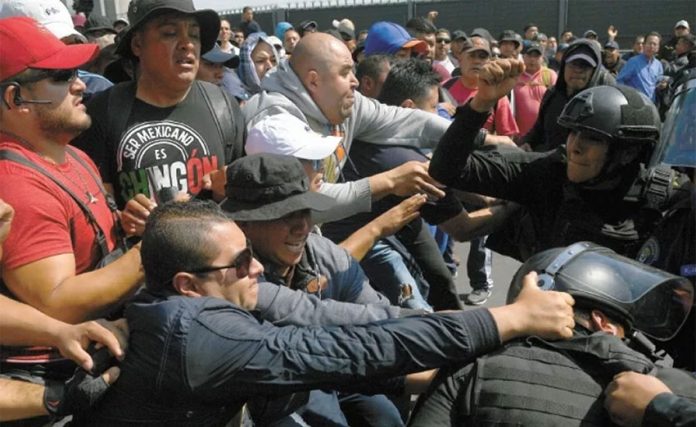
Federal Police officers who continue to protest against having to join the new National Guard clashed on Tuesday with Mexico City police outside the Mexico City airport.

About 60 police, including 32 on the city force, were injured in a violent confrontation on the Circuito Interior freeway outside Terminal 1.

Mexico City Police Chief Omar García Harfuch said that seven officers were taken to hospital but none was in serious condition. He accused federal officers of throwing 12 tear gas grenades at Mexico City police and said that another 22 gas grenades were seized.

About 1,200 Federal Police officers began blocking Circuito Interior shortly after 10:00am to demand compensation from the government because they don’t want to join the National Guard when the force is disbanded.

About 400 city police tried to dismantle the blockade, triggering a violent response. Officers from both forces were briefly detained by their opposite numbers.

Federal Police said that some of the officers they detained were armed, a claim that was denied by Mexico City authorities.

After the initial clash, an additional 300 Mexico City police arrived at the scene along with Harfuch, who initiated talks with protest leaders. But the talks quickly broke down and the Federal Police refused to lift their blockade.

The violence restarted within minutes, the newspaper El Universal reported. Mexico City police responded to the throwing of tear gas grenades by launching the same at their federal counterparts. Reporters and civilians were also affected by the gas.

Police maintained their blockade for more than six hours, causing traffic chaos outside the airport. Some people missed their flights, El Financiero reported, while others were escorted to the airport by police so they could arrive on time.

The federal Security Secretariat of Security (SSPC), which has responsibility for the Federal Police, condemned the blockade and violence.

Mayor Claudia Sheinbaum said the operation to break up the blockade was a success although she conceded that police protocols for responding to protests could be improved.

President López Obrador weighed in on the clash this morning, suggesting that it was no coincidence that police staged their protest outside the airport on the day that former Bolivian president Evo Morales arrived to take up an offer of political asylum.

“There continues to be a lot of provocation. It’s not possible, it’s not a coincidence that Evo arrives and at the same time they’ve organized a protest. It’s not spontaneous, there is someone that is rocking the cradle,” he said.

“. . . I’ve given instructions for there to be dialogue, for [officers] that don’t want to go into the National Guard to be paid off. We’re not dismissing anyone but we can’t have officers [in the National Guard] without a good track record. We have to have honest, professional people who are not linked to illegal acts,” López Obrador added.

Federal Police have staged several protests against their transfer including one in September that blocked the Circuito Interior outside the airport for almost nine hours.

Source: El Financiero (sp), El Universal (sp), Milenio (sp) 

Hackers demand US $5 million after cyberattack shuts down Pemex computers

0
pemex

Hackers have demanded a payment of almost US $5 million in bitcoin from Pemex after a cyberattack on the state oil company’s systems on Sunday.

According to the news agency Reuters, a ransom note that appeared on Pemex computers pointed to a dark net website affiliated with DoppelPaymer, a type of ransomware.

It demanded Pemex pay 565 bitcoins, or just over US $4.9 million, within 48 hours in order to have the ransomware removed.

The ransom note said: “Your network has been penetrated. This link and your decryption key will expire in 14 days after your systems were infected . . . We have gathered all your private sensitive data. So if you decide not to pay, we would share it. It may harm your business reputation.”

It also listed an email address to contact.

Reuters wrote to the address and received a response from the suspected hackers stating that Pemex had missed the deadline for a “special price,” apparently referring to a discount.

The state oil company said the cyberattack affected fewer than 5% of its computers and that its storage and distribution facilities were operating normally.

However, several workers told Expansión that Pemex didn’t reveal the true extent of the attack.

The hack, which Pemex said it detected on Sunday, forced the company to shut down computers across Mexico and froze systems such as payments, sources told Reuters.

Employees told Expansión that as many as five in seven computers are affected in some locations. The computer network at Pemex Tower in Mexico City was also breached.

One employee said that Pemex was forced to communicate with workers using the WhatsApp messaging service because they couldn’t open their emails.

The ransom note sent to Pemex.

“In finances, all the computers are off, there could eventually be problems with payments,” the anonymous source said.

Other sources told the news agency Bloomberg that the cyberattack was disrupting Pemex’s billing systems. They said the oil company is relying on manual billing that could affect payment of staff and suppliers and disrupt supply chain operations.

Invoices for fuel delivered to gas stations on Tuesday from Pemex storage facilities were done manually.

Some employees at Pemex’s refining division couldn’t access the internet on Tuesday and their computers were operating slowly, Bloomberg said.

A source in Villahermosa, Tabasco, said that well-drilling services employees were told on Tuesday that they could start their computers but not log on to the network. Telephone lines weren’t working and workers were unable to access email and Skype.

Employees at the Pemex refinery in Salamanca, Guanajuato, told Expansión that administrative activities had come to a halt since Sunday because they had been unable to use their computer system.

“Here in Salamanca, not even the telephones are being used because they were also connected to the network. They’re transmitting data via radio and working with paper backups,” one employee said.

Cyberattacks on the computer systems of large companies are becoming increasingly common but the ransomware allegedly used in the Pemex hack is relatively new.

However, it is not the first time that it has been used to target a large computer network. According to cybersecurity firm CrowdStrike, DoppelPaymer was behind recent attacks on computer systems at Chile’s Ministry of Agriculture and the town of Edcouch, Texas.

CrowdStrike vice president of intelligence Adam Meyers said that DoppelPaymer attacks are typically made against “high value targets” and executed at a time when they need their systems to be “up and running.”

Therefore, those targeted may feel compelled to pay a large ransom, he said.

A source told Reuters that Pemex was reconnecting unaffected computers to its network on Tuesday and wiping infected computers clean.

The company has not commented on the ransom demand but cybersecurity firm MalwareHunter Team, which has investigated the cyberattack, confirmed that Pemex did not comply with the 48-hour deadline.

President López Obrador said Wednesday morning the attack was not serious and blamed it on interests that were resisting changes brought in by his administration. He said he would not discount the possibility that “conservatives” were behind it.

“. . . they are capable of anything.”

Whether Pemex pays the ransom or not, the hack could take a heavy toll on the state oil company’s finances.

After it was hit by a ransomware attack in March, Norwegian aluminum producer Norsk Hydro refused to pay the hackers but had to spend US $71 million to repair its systems. The company has so far only recovered $3.6 million from insurance.

Computer forensics expert Andrés Velázquez told Expansión that even if Pemex paid the ransom “there is a possibility that the malware won’t be eliminated and weeks later, an attack could occur again.

“Once a system is infected, there is not a lot that can be done but where there is a lot of work to do is in prevention. Unfortunately, what we’ve seen from this government is that cybersecurity. . . is not a priority,” he added.

Velázquez, CEO of the digital investigation firm Mattica, said that the attack should serve as a “wake-up call” not just for Pemex but for all public and private companies, especially those that manage critical infrastructure.

According to the Organization of American States, Mexico is among the least prepared of its members to confront a cyberattack that affects critical infrastructure.

The hack of Pemex’s systems comes seven months after a cyberattack on five Mexican financial institutions during which 300 million pesos was stolen via fraudulent transfers.

Source: Reuters (en), Expansión (sp), Bloomberg (sp)