Home Blog Page 1736

Chihuahua farmers replace marijuana with avocados

0
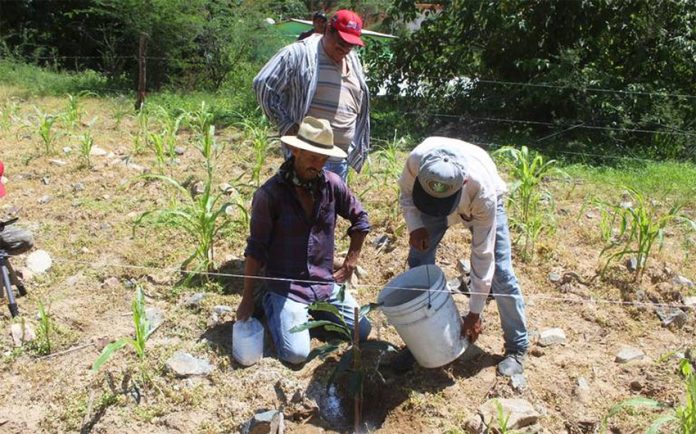
Planting avocado trees in Chihuahua.

Some farmers in Chihuahua are giving up growing marijuana and planting avocados instead, according to the mayor of Guadalupe y Calvo.

Farmers in the municipality, considered part of the notorious Golden Triangle of drug production, harvested 10 tonnes of Hass avocados this year. Now they aim to plant up to 50,000 avocado trees by the end of the year, announced Mayor Noel Chávez, who hopes to create a new economic model in the region.

“People didn’t believe in this, but we said we’d give it a try, and the first results are being seen. This program started three years ago with coordination from all three levels of government, and in another three years we’ll be seeing our production multiply,” said Chávez.

The municipal government believes avocado production can generate up to 90 million pesos (US $4.6 million) annually.

Chávez says he sees motivation among the farmers who themselves see great potential in avocados due to their popularity in markets like China, Japan, the United States and Europe.

He suggests that poverty is to blame for area farmers growing marijuana and other illegal crops, but hopes that education and awareness will show them another way to make a living.

“No one gave them the technical knowledge [before] to switch over to avocados,” he said.

Chávez has envisioned a plan to disassociate communities from illegal crops and increase local consumption of the fruit, with the expectation to become an exporting community within the next three years.

This year’s 10 tonnes is a good start, but Chávez believes his municipality of 70,000 residents can do much better. And he expects Chihuahua to be able to compete with avocado-producing states in southern Mexico.

He recognizes that the project has received its fair share of criticism and that many people were reluctant at first because they thought the avocados wouldn’t take off. Now, however, many are looking to get certified to export.

“Today, Guadalupe y Calvo is . . . about to become the mega-region for avocados . . . said Chávez.

“I’ve been working as a professional forest environmentalist for 25 years, having seen all kinds of ways to take advantage of our ecosystem. It’s now time for us to take advantage of this use of our natural resources,” he added.

Source: El Sol de México (sp)
Athletes, trainers protest salary arrears by sports agency

0
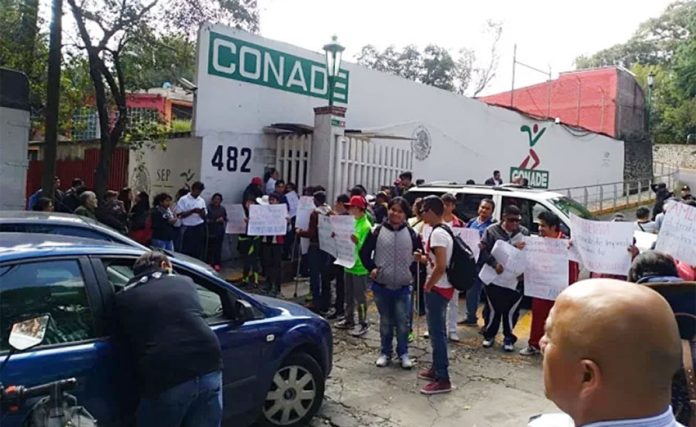
Athletes and trainers protest at Conade on Monday.

About 120 athletes, trainers and sports officials gathered outside the headquarters of the federal sports agency Conade on Monday to protest against delays in salary payments.

Efraín Mora, vice president of the Mexican Paralympic Committee, told the newspaper El Universal that coaches and administrators have not been paid for months.

“There were about 120 of us at the protest,” he said. “It’s been 10 months that trainers and administrators haven’t been paid, and that’s why the presidents of the federations, athletes and family members got together to demand our salaries.”

Mora said the total debt is around 6 or 7 million pesos (US $306,000 to $357,000).

The protest started around 10:00am on Monday, and ran until 1:30pm, when Conade official Israel Benítez agreed to meet with the protesters.

Mora said that Benítez promised the salaries will be paid by October 18.

“If they don’t follow through, we’ll be back at the Conade,” he said. “We’re also thinking of going directly to President López Obrador at the National Palace to explain our case to him.”

Source: El Universal (sp)

Taxis withdraw blockades; legality of ride-hailing services to be examined

0
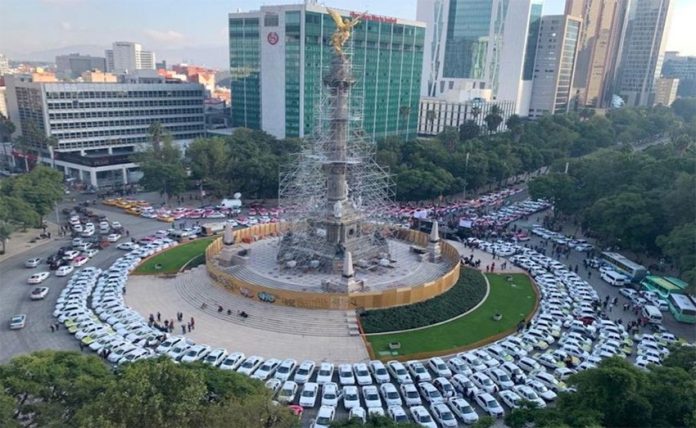
Protesting taxis surround the Ángel de Independencia in Mexico City.
Protesting taxis surround the Ángel de la Independencia in Mexico City.

Taxi drivers withdrew their blockades in Mexico City on Monday afternoon after reaching an agreement with the federal government that will see the legality of app-based ride-hailing services examined.

Interior Secretariat undersecretary Ricardo Peralta told a press conference that the government and the National Movement of Taxi Drivers (MNT) agreed to the formation of a group of legal experts who will analyze whether services such as Uber, Didi and Cabify are operating legally in Mexico.

He said that experts from the secretariats of Communications and Transportation and the Interior as well as the Mexico City and México state governments will participate. Meanwhile, talks between authorities and taxi drivers will continue.

While the legal analysis is taking place, the MNT – which protested across Mexico yesterday to demand stricter regulation of the ride-hailing apps –  pledged to refrain from setting up more blockades, Peralta said.

“There is an agreement that under no circumstances will there be any blockade in any of the cities where there were blockades today,” he said. Blockades were in place for about 12 hours, and their removal began after the agreement was reached at about 5:00pm yesterday.

The undersecretary said that if the legal experts determine that Uber, Didi and the like are operating legally, the MNT will be able to develop its own app to allow its drivers to find fares.

The Mexico City government released an app called “Mi Taxi” in September whose main aim is to improve security for taxi passengers but it said that by November, it will be possible to use it to request to be picked up at a designated location.

The México state government said on Monday that it is analyzing the possibility of developing an app to be used by licensed taxi drivers.

Peralta told reporters that the government is committed to establishing a level-playing field for drivers of both taxis and the ride-hailing services.

The MNT argues that it is unfair that taxi drivers have to pay a range of fees and fulfill requirements that don’t apply to drivers who work for the app-based services.

Appearing alongside Peralta, MNT treasurer Ángel Morales confirmed the pledge not to protest while the legality of the ride-hailing apps is being assessed and said that taxi drivers are committed to improving the service they offer.

Protesting taxi drivers in Mexico City.

Ride-hailing services have become increasingly popular in many Mexican cities not only as a result of their convenience but also because they are widely considered to be safer and more comfortable than taxis.

Morales offered an apology for the traffic chaos caused by the taxi blockades in Mexico City but said they were necessary because three months of negotiations with the government failed to yield any progress.

Taxi drivers affiliated with the MNT blocked several major roads in and around the capital starting early Monday morning, including those used to access both terminals of the Mexico City airport.

They also staged protests and set up blockades in cities in the majority of Mexico’s 31 states.

The arrival of Uber and similar services in cities across the country has triggered countless protests by taxi drivers who argue that the newcomers have been allowed to grow indiscriminately without regulation and that their operation poses a threat to taxi drivers’ livelihoods.

Source: Milenio (sp) 

Decree to protect Chiapas’ Sumidero Canyon park

0
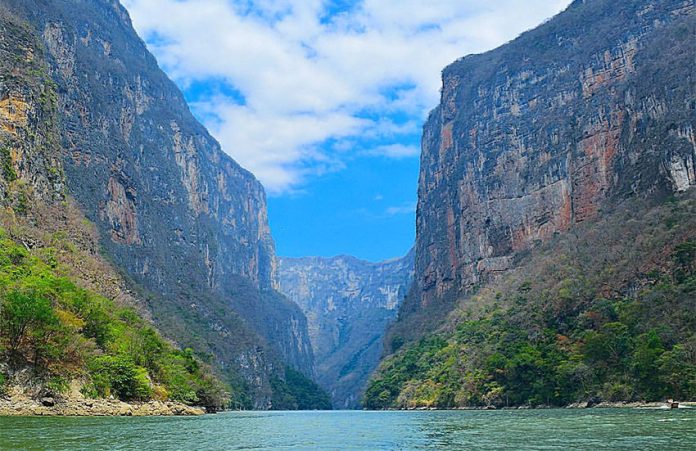
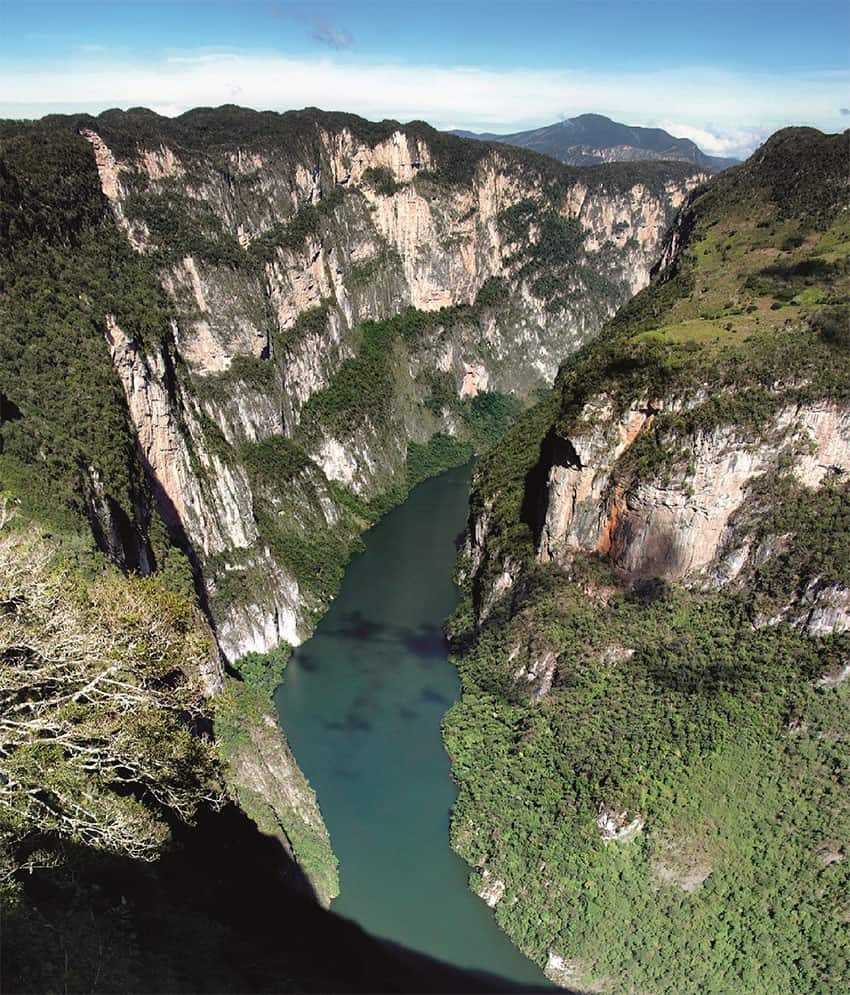
The Sumidero Canyon in Chiapas.

President López Obrador will issue a decree to protect the Sumidero Canyon National Park in Chiapas and increase its territory by more than 3,000 hectares.

The newspaper Milenio reported that the national park will increase in size from 21,789 to 25,100 hectares, a 15% enlargement.

The presidential decree – exactly when it will be issued is unclear – will aim to stop the encroachment of urbanization on the Sumidero Canyon, put an end to the extraction of rock from the national park and prevent the accumulation of trash.

It will also seek to protect the park’s forest, the sheer 1,000-meter-high cliffs that border both sides of the Grijalva river and the habitat of endangered species that call the area home.

Among the species that live in and around the canyon are mushroom-tongued salamanders, cinnamon hummingbirds, crocodiles, spider monkeys and a kind of bream that is endemic to the area.

The Sumidero Canyon, formed by 1,000-meter-high cliffs on either side of the Grijalva river.

One section of cliff in the park is at risk of collapsing due to the nearby operation of an illegal quarry, at which dynamite is used to extract limestone.

Bordering the state capital Tuxtla Gutiérrez, the Sumidero Canyon was first declared a national park in 1980 but for the next 20 years it wasn’t protected as it should have been, Adrian Méndez Barrera, a regional director of the Natural Protected Areas Commission (Conanp), told Milenio.

He said that more than 9,000 hectares of land that were decreed part of the park have been overtaken by urbanization.

Land on which 91 neighborhoods have been built will be excluded from the park’s territory but another section of unprotected land will be added and increase its overall size, Méndez explained.

“. . . We’re going to add a new area to ensure forest cover throughout [the municipalities of] Chiapa de Corzo, Tuxtla Gutiérrez and San Fernando . . .” he said.

Land within the park’s borders has been targeted by illegal loggers in the past.

The Sumidero Canyon is one of Chiapas’ premier tourist destinations. Tens of thousands of visitors admire the canyon and its wildlife from boats that travel up and down a 30-kilometer stretch of the Grijalva river, which runs between the imposing cliffs.

Source: Milenio (sp) 

Citizens, businesses must change behavior, pay more taxes: Herrera

0
Finance Secretary Herrera.

A behavioral shift is required from individual taxpayers and businesses in order to increase tax revenue, Finance Secretary Arturo Herrera said on Monday.

“We have to recognize that [tax collection] is a problem, that there are quite high levels of evasion and avoidance. We at the Secretariat of Finance [SHCP] have to do what we can to collect the taxes but citizens and businesses will also have to change their behavior,” he said.

Speaking to reporters after addressing a business forum in Mexico City, Herrera said the SHCP has to ensure that it collects all taxes in accordance with current tax laws.

Once the secretariat, of which the Federal Tax Administration is part, has improved its revenue collection practices, there will be a debate about possible changes to Mexico’s tax system, he said.

The aim of any change, Herrera said, is not only to make more resources available to the federal government but also to state and municipal authorities.

“It’s not just the federal government that lacks resources,” he said, adding that all of Mexico’s workforce must pay tax to ensure that there are sufficient funds in public coffers.

During his address to the Forbes Business Forum, Herrera said that Mexico’s tax revenue represents 13% of GDP, whereas the average for Latin America is 17%.

“If we collected about 16% of GDP, which is the level of Central America [but below] Chile, Uruguay, Brazil and Colombia . . . we would have about 750 billion pesos [US $38.3 billion] extra per year . . .” he said, adding that the money could be used to invest in infrastructure projects or to pay off public debt.

Source: El Financiero (sp) 

New whale watching zone declared in Oaxaca

0
whales
Tourism is expected to benefit from the declaration.

The federal Secretariat of the Environment (Semarnat) has created a new whale watching zone off the coast of Oaxaca.

The 280-square-kilometer area stretches between the municipalities of Santa María Colotepec and San Pedro Mixtepec, just off the shores of Puerto Escondido.

“[We are] very excited,” said Gonzalo Ramírez Patiño, president of the local whale watching cooperative Rosa de los Vientos (Compass Rose), who worked with the University of the Sea (UMAR) to attain the observation zone designation.

“It’s a dream for all of us. I believe it’s a benefit for Puerto Escondido. We know that this will bring about a boom. With good publicity, it will bring lots of tourism,” he said.

The Oaxaca coast is a transit zone for many different whale species as they travel to and from their habitat in the Gulf of California and seas further south.

“The whales begin to arrive in December and they return to their feeding grounds, in the north of the country, in February, March, and by April there aren’t any whales,” said Francisco Villegas Zurita, a researcher at UMAR. “So the data tells us that the best months to see whales in the zone near Puerto Escondido, Mazunte and San Agustinillo are January and February.”

The creation of the zone includes a series of regulations for enjoying this spectacle of nature, among them the prohibition of boats to get within 60 meters of the whales. Tourism boat captains will also be required to take training to learn to observe them.

“The whales have done their part by migrating. It falls on us to have certification, and we will soon have it. I believe that the tourists that come for this will look for certified individuals, people with the knowledge and experience we’ve acquired through our research,” said Villegas.

Puerto Escondido is the second observation zone to be designated in Oaxaca. The first was created off the coast of Mazunte in 2015.

Source: Ciudadanía Express (sp)

Mexico City wants quick results from its new police chief

0
Mayor Sheinbaum and the new chief of police, Omar García.

The new Mexico City police chief has a simple strategy to bring down crime rates: arrest more criminals.

Omar García Harfuch, who was sworn in as security secretary on Friday, told reporters on Sunday that Mayor Claudia Sheinbaum is seeking a rapid reduction in crime rates in the capital.

But that won’t happen unless lawbreakers are taken off the streets, he said.

“The main instruction we have from the mayor is to produce quick results. We know that there are very delicate issues that won’t be resolved if there are no arrests. There have to be arrests so that crime rates go down . . .” García said.

The police chief said the secretariat he heads will work closely with the Mexico City Attorney General’s Office in order to strengthen criminal investigations and thus make more arrests.

“The reality is that there is a large number of crimes, a large number of crimes that are affecting society and which have to be dealt with. They range from carjacking . . . to the robbery of passengers on public transit . . .” García said.

Statistics show that a range of crimes increased in Mexico City during the first eight months of 2019 compared to the same period last year.

Kidnappings surged 430%, extortion rose 69%, homicides increased by 12.5%, drug dealing offenses went up 30.7% and robberies grew by just under 1%.

García, a former Federal Police officer who most recently was in charge of the capital’s investigative police, said that a thorough review of the Mexico City police will be undertaken in the coming days in order to ascertain what is working and what is not in the government’s fight against crime.

The 37-year-old’s appointment as police chief came a day after the resignation of Jesús Orta Martínez, whose 10-month tenure was marked by several high-profile cases, including the murders of Norberto Ronquillo and Leonardo Avendaño.

Orta also came under fire for the Mexico City government’s response to a case in which four police officers were accused of raping a 17-year-old girl.

Two women’s protests in August that demanded the authorities take action against the alleged perpetrators of the crime, and declare a gender alert in the capital, turned violent as did the recent anniversary marches for the 43 students who disappeared in Guerrero in 2014 and the victims of the 1968 Tlatelolco massacre.

García acknowledged that preventing violence at protests is an issue that authorities must confront. Sheinbaum said last week that the “Peace Belt” of civilian government employees that was deployed during the Tlatelolco protest march served its purpose and may be deployed again in future marches.

García said yesterday that “people who infiltrate the marches” are responsible for the violence and acts of vandalism committed recently on the streets of the capital.

“It doesn’t matter what the objective of the march is, it doesn’t matter what it’s about, [infiltrators] turn up to wreak havoc,” he said.

Source: Milenio (sp) 

Hybrid, electric vehicles gain market share; July sales up 86%

0
Mexico City leads the states in electric vehicle sales.

As sales of fossil fuel-burning vehicles have been declining, those of electric and hybrid vehicles have been rising sharply in the past few years, according to data from the Mexican Automotive Industry Association (AMIA).

An AMIA report published by the national statistics agency Inegi said that 2,068 electric and hybrid vehicles were sold in Mexico in July 2019, an increase of 86% compared with the same month in 2018, when only 1,113 such vehicles were sold.

Mexico City saw the most sales, followed by México state and Jalisco. Those three states accounted for 65% of the total sales in July.

The increase in sales has continued for a little more than three years. In the first seven months of 2016, electric and hybrid vehicle sales numbered 3,439 units. Over the next three years, that number grew to 5,030, 8,163 and 11,503 respectively.

But the numbers are minuscule compared to all light vehicle sales, which in July totaled 105,699.

Meanwhile, sales of conventional vehicles have been declining for the past two years.

Source: El Economista (sp)

Guanajuato city wants marines back after 11 killed

0
Mayor Ortiz want the marines back.

After 11 people were killed last week in the Guanajuato municipality of Apaseo el Alto, Mayor María del Carmen Ortiz wants the navy to send marines back to improve the security situation.

“I would say to the citizens that I am working with delegates to tell them what is happening, and that they aren’t alone, and that I’m doing everything I can to stop this,” she said in an interview with the newspaper Milenio. “The navy should come back, that’s what worked.”

Marines were withdrawn September 1, after which the mayor said she was unaware of the reason.

She stressed that last Thursday’s violence was not new, which she said shows that the security strategy being pursued by the state and federal governments is not working.

“I think that, seeing how the violence has increased, the strategies haven’t worked,” she said. “I think it has to do with communication.”

Security in Apaseo el Alto is carried out under a single-command model, where police are controlled by the state rather than municipal government, but the municipality will be given control of the police at the end of the year.

The killing began early Friday morning when a group of armed civilians attacked three homes in the community of San Juan del Llanito, killing six people. Five of the attackers were killed later in a confrontation with the National Guard.

After the murder two weeks ago of a municipal councilor, the Morena party mayor said she felt abandoned by the state, observing that violence was worsening after improvements had been seen in recent months. The state is governed by the National Action Party.

The mayor’s husband was murdered last year while running for mayor himself. His wife ran in his stead after his murder and won the election.

Source: Milenio (sp)

17 communities still cut off in Oaxaca as storm clean-up continues

0
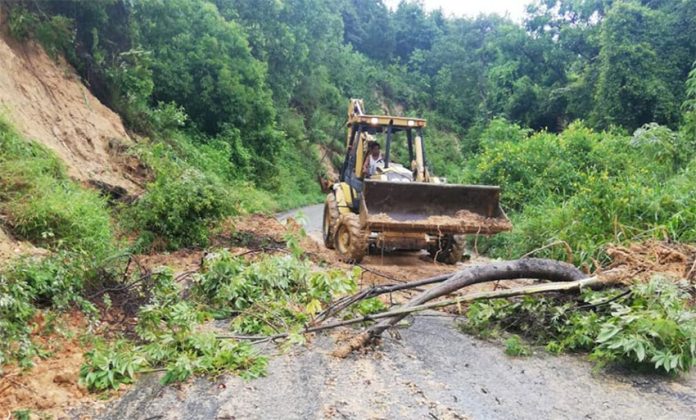
Clean-up continues in Oaxaca after Tropical Storm Narda.
Clean-up continues after Tropical Storm Narda.

At least 17 communities in Oaxaca are still isolated because of damage to roads by Tropical Storm Narda, according to Oaxaca Highways and Airports Director David Mayren.

He said that of the 96 roads that were damaged by Narda, only 38 have been completely reopened, while the other 58 have only been partially opened because it has continued to rain.

He noted that the federal government is refusing to pay for fuel for machines and salaries for workers, and that the work is being organized through “internal economies.”

Most of the aid is being delivered to 60 municipalities in the Costa, Isthmus of Tehuantepec, Mixteca and Sierra Sur regions.

Oaxaca Civil Protection coordinator Heliodoro Díaz Escarraga said that not all of the aid promised by the federal government has arrived and that emergency declarations have only been authorized for 22 municipalities out of the 122 that require declarations because the government is continuing to evaluate the damage.

Meanwhile, Oaxaca Agriculture Secretary Sofía Castro said that heavy rains from the storm have damaged 70,000 hectares of farmland, while a nine-month drought before the storm had already damaged 57,000 hectares.

The storm made landfall in Oaxaca a week ago before sweeping north through Mexico, causing extensive damage.

Source: Milenio (sp)