President López Obrador has had enough of construction businesses “that have behaved badly,” taking advantage of the government contracts they are awarded.
“The companies had more lawyers than engineers; they specialized in arguing. The government was their piggy bank and that is now over,” he said at his morning press conference on Tuesday.
“We have a problem in how badly national and foreign companies have behaved,” he said. “They don’t follow through and they keep the advances.”
Nevertheless, he cited two experiences that he considered worthy of praise.
“One good example is the military engineers in the construction of the Santa Lucía airport, who are doing a quality job on time,” he said.
“The other experience is [with] a Dutch company that is [working on] the new Dos Bocas refinery [in Tabasco]. I can’t say the same for other cases.”
AMLO, as he is commonly known, said that now that the government is calling for tenders for the restoration of the railway on the Isthmus of Tehuantepec, he’ll make sure the bidders know that this aspect of business culture in Mexico has changed.
“Companies that come through will have the full recognition of the government, but those that run afoul will be derided, I can assure you … We cannot go on with more of the same,” he said.
The ex-senior officer of former Attorney General Jesús Murillo Karam has been charged with improper exercise of power for the purchase of a nearly US $20-million private plane for Murillo’s own use.
The current Attorney General’s Office (FGR) claims that Judith Aracely Gómez Molano ordered the purchase of a Bombardier Challenger CL-600 in 2013 with a leasing agreement through the state development bank Banobras.
Also implicated is Víctor Rodrigo Curioca Ramírez, former deputy director of material resources for Banobras and current undersecretary of administration in México state.
During a 10-hour hearing on Monday, prosecutor Carlos Palafox said that the plane had been valued at $16.4 million, but Murillo’s office paid the company Aviation Enterprise $19.6 million. He added that an expert with the FGR valued the plane at $14 million.
Palafox claimed that the purchase of the aircraft was unjustified, as the attorney general, who served in the administration of former President Enrique Peña Nieto, did not need a plane capable of transatlantic flights to carry out his duties of prosecuting federal crimes within Mexico’s borders.
“You don’t need an airplane with that type of luxury and comfort in order to prosecute crime. It was only used to fly the former head of the Attorney General’s Office, as well as his close collaborators,” said Palafox in court.
Both former officials could face up to 12 years in prison for the offense.
Federal Judge Beatriz Moguel Ancheyta rejected the FGR’s petition to put Gómez and Curioca in preventative custody, releasing the two on 100,000-peso (US-$5,350) bail bonds and restricting them from traveling outside the country.
Moguel said in her judgment that the decision to buy the plane failed to consider the cost-benefit impact of such a purchase, and that the lease agreement compromised the office’s funds for five years.
“They said the plane has 11 seats. I wonder if buying 11 tickets on commercial flights wouldn’t have been cheaper than paying over 344 million pesos,” she said.
The defense for Gómez and Curioca said that the two merely signed the contracts, but the purchase was endorsed by other departments, such as Finance. But Moguel didn’t seem to buy it.
“It would be illogical to think that a person in the post of senior officer could blindly sign the contracts and compel an undersecretary [of Banobras] to sign a contract without looking through it,” said Moguel.
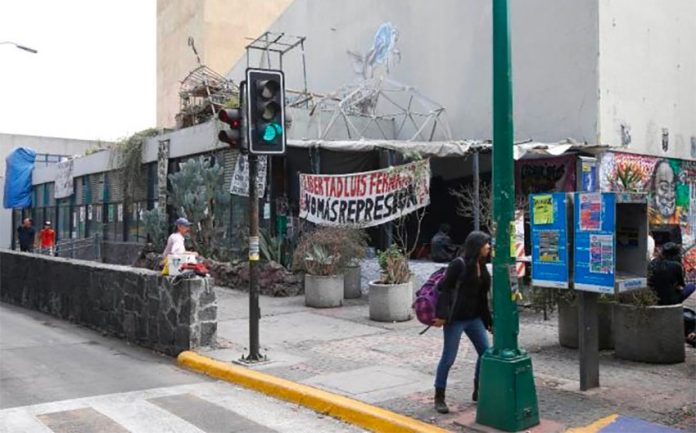
The UNAM auditorium has been 'occupied' for 20 years.
An auditorium at the National Autonomous University (UNAM) that once hosted luminaries such as French statesman Charles de Gaulle and Italian philosopher and novelist Umberto Eco has fallen into disrepair after being in the hands of self-styled “anarchists and punks” for almost 20 years.
According to a report by the newspaper El Universal, the Justo Sierra auditorium at Mexico City’s University City was first occupied by rebel students in September 2000 just months after the end of the longest strike in the university’s history.
Today it serves as the home and workplace of members of four collectives that are continuing its near 20-year history as a bastion of anti-authoritarianism. A vegetarian fonda, or small restaurant, a tattoo parlor and a screen printing workshop all operate in the auditorium but access to bona fide members of the university community is limited at best.
Students can’t freely use the auditorium – now dubbed the Che Guevara in homage to the Argentine-Cuban revolutionary – are prohibited from taking photos or videos of its interior and are met with stern responses if they ask too many questions of its occupants.
It’s not surprising that not all students are happy about the situation.
“I believe that the [university] community should take [back] … the space. … I agree with there being self-managed spaces but why in a university … ? At the start, the takeover was important but those there today don’t have very democratic attitudes. They’re closed off and don’t lend themselves to dialogue,” said literature student Andrey Palma Márquez.
El Universal reported that the auditorium, named after UNAM founder Justo Sierra, had its glory days, hosting events featuring not only de Gaulle and Eco but also other influential figures of the 20th century including Argentine novelist Julio Cortazar, Uruguayan writer Mario Benedetti, Chilean poet and diplomat Pablo Neruda and Mexico’s own literary superstar Octavio Paz. It was also once a rehearsal and performance space for the university’s philharmonic orchestra.
The seats have not been removed from the auditorium but the ceilings are cracked as a result of the twin earthquakes of September 2017. The bathrooms are in a state of disrepair, stink of urine and feces, and both vulgar and revolutionary graffiti is scrawled on the walls, El Universal said.
Other walls in the auditorium are plastered with anarchism-related images and messages in support of a range of social movements and leaders. Punk or ska music blares incessantly from two speakers, making it difficult for students anywhere in the vicinity to study.
One unidentified student told El Universal that the auditorium is now home to a “kind of very strange polygamous, communist commune,” adding “even children have been born here.”
El Universal noted that the occupants are aware that they could be evicted at any time and have stockpiled fire extinguishers, cudgels and shields similar to those used by riot police to stave off any attempt to kick them out.
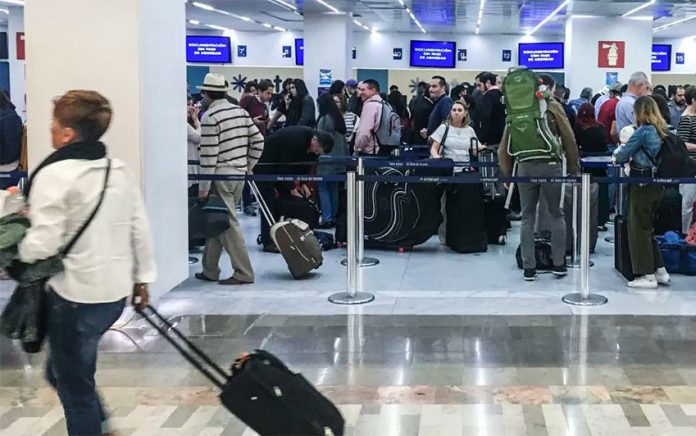
No new flights will be authorized for the Mexico City International Airport (AICM) nor will airlines be allowed to increase the frequency of existing routes due to saturation of the facility, says the general director of the Federal Civil Aviation Agency (AFAC).
“If international operators come that want to fly in [already] saturated schedules, they won’t be able to. If they want to increase the frequency of a domestic flight, they won’t be able to,” said Rodrigo Vásquez Colmenares.
“The AICM is finished for all of us,” he added.
A record 50.3 million international and domestic passengers used the Mexico City airport last year, a figure that Vásquez said is evidence that the facility has well and truly reached its limit. The airport was designed to handle just 34 million passengers annually.
However, the AFAC chief explained that the main reason why no new flights will be added is that there is insufficient airspace to accommodate them in an already crowded flight schedule.
To reduce the pressure that the airport currently faces, there will be a “rationalization” of take-off and landing spots, Vásquez said.
“The implication that has will be different for each airline. Each will have to take their own decisions,” he said.
Airlines will have to decide where they want to concentrate their growth efforts, Vásquez said, citing the Toluca and Guadalajara airports, both of which are slated for upgrades, as possibilities.
He explained that airlines are forced to use up to 16% more fuel because they frequently face delays when taking off from the Mexico City airport. Transferring some flights to alternative airports would allow airlines to avoid such additional costs and improve their bottom line, Vásquez said.
The AFAC chief said that the federal government has the authority to reduce the number of slots an airline has at any given airport and as a result can effectively force carriers to shift part of their operations.
“The temptation to impose a decision is big,” Vásquez said before predicting that “it won’t happen.”
For his part, federal Communications and Transportation Secretary Javier Jiménez Espriú has said that the aim is to reduce the number of passengers using the AICM on an annual basis to 45 million even though a third terminal is in the works.
The Santa Lucía airport, currently under construction at a México state air force base north of the capital, will relieve pressure on the AICM but is not expected to be completed until 2022.
The operator of the Guadalajara airport hopes to double capacity there to almost 30 million with the construction of a new runway and terminal building but the new infrastructure is part of a five-year plan and it is unclear exactly when it will be finished.
Raúl Revuelta, CEO of the Pacific Airport Group, told the newspaper El Financiero that the aim is to “absorb” passengers who are currently using the Mexico City airport but didn’t specify when the Guadalajara facility would be in a position to allow that to happen.
Remains of the exhibit at the OMR Gallery in Mexico City.
An avant-garde work exhibited at one of the Mexico City’s most important annual art shows may or may not have been intentionally destroyed by a disapproving critic last weekend, though a number of observers believe it was her intention to do so.
Gabriel Rico’s sculpture entitled Nimble and Sinister Tricks (To be Preserved with Out Scandal and Corruption) broke into innumerable pieces at the Zona Maco Fair in Mexico City on Saturday. Controversial art critic Avelina Lésper was very close to the piece when it shattered, and she is not a fan of the sculpture.
The newspaper Milenio reported Lésper denied breaking the sculpture and trying to run off afterward. She claimed a glass sheet that was part of the piece shattered when she placed an empty Coke can atop one of the stone elements that stands upon the glass.
“I had an empty can of soda. I tried to put it on one of the stones but the work exploded. It was as if the work heard my comment and felt what I thought of it.”
Artist Pavel Égüez, who was with Lésper at the time, stated “… the glass the objects supported exploded. Avelina did not touch it. The glass was too thin.”
The art exhibit before Saturday’s incident and Lésper. Did she or didn’t she?
On Sunday, La Jornada reported that Lésper admitted to breaking the artwork by accident and putting a Coke can on one of the stones to show her rejection of the piece’s premise.
According to artnet.com one day later, the glass shattered when the critic put a can of Coke on it.
The OMR Gallery, where the piece was exhibited, issued a statement expressing its dismay, stating “We don’t understand how an alleged professional art critic could destroy a work.”
“Despite the fact that it appears to have been accidental … Lésper’s getting too close to the work to put a can on top of it and take a photo … which undoubtedly caused the damage, [demonstrates] an enormous lack of professionalism and respect.”
Lésper has been denounced by museum directors, galleries and others over the incident. Alfonso Miranda Márquez, director of the Soumaya Museum, accused her of trying to escape the scene, calling the incident a “tragedy” and calling Lésper a “pseudo and self-proclaimed art critic.”
The sculpture has been valued at US $20,000. It consists of a sheet of glass supporting a soccer ball, a tennis ball, stones and other objects. Its creator, Gabriel Rico, is an avant-garde artist whose work appeared in the 2019 Venice Biennale. The sculpture was the centerpiece of the OMR Gallery’s exhibit at the fair.
Lésper suggested that the work should be exhibited and sold as it was left, making reference to Marcel Duchamp’s The Bride Stripped Bare by Her Bachelors, Even (The Large Glass), which the artist declared complete after it had broken in transit.
Lésper said she did not have the resources to pay the asking price, but she offered to “repair it,” buying the exact same materials and rearranging them as Rico had done.
Lésper is a controversial art critic who is noted for her aversion to contemporary art. The incident quickly trended on social media with some defending the critic and sparked memes based on her fierce reputation.
It remains unclear if Rico will recreate the work or who will pay for it.
Young harp player Erédira Yaretzi Morales Flores of the state of México will have a solo at Carnegie Hall in New York, thanks to her win at the 2020 Golden Classical Music Awards.
Morales won first place in the intermediate category (13 to 15-year-olds) in the competition held last month.
The Golden Classical is a musical competition open to people of all nationalities and ages, with competitions in strings, piano, wind and vocal. The objective is to discover new talent and offer opportunities to launch international careers.
Morales earned the chance to compete by submitting a video of herself playing. An international jury selected her from among contestants from 12 other countries for the intermediate strings category.
She began studying music when she was 6 years old. Today, she is a student at the Escuela de Iniciación de la Música y Danza, part of the Ollin Yoliztli Cultural Center, which is the concert hall in the south of the city for the Philharmonic Orchestra of Mexico City.
Here, she has studied various types of harp music, along with traditional instruments and dance of Mexico. One of her teachers is Baltazar Juárez, the principal harpist of the National Symphony Orchestra of Mexico.
Morales stated that she decided to study the harp because she likes its sound, its wide range and the ease in which she can touch people’s emotions. She stated that she is not sure if she plans to make music a career, but believes that it is important that every child in Mexico has musical training because “… it is sad to see that people are so busy with careers they do not like and become depressed.”
Morales’ win earns her the right to a solo performance at part of the award ceremony concert. This will be held March 9 and 10 at the Weil Recital Hall, part of Carnegie Hall. For this event, she is currently working with French harpist and composer Marcel Tournier.
Nuestra Señora del Juncal sank in the Bay of Campeche in 1631.
Spain and Mexico are set to search for the wreckage of a Spanish ship that sank in the Gulf of Mexico in 1631.
Nuestra Señora del Juncal was part of a 13-vessel fleet that left Cádiz, Spain, in 1630. After leaving on its return voyage from the port of San Juan de Elúa, Veracruz, in 1631, it and the Santa María sank in a storm.
Planned for May or June of 1631, its return voyage had been delayed due to the threat of pirates lying in wait near the west coast of Cuba. The Spanish crown’s need for the precious metals and other American goods on board forced it to launch in October despite the risk of crossing the gulf during cold front season.
Severe weather from a strong northerly storm dispersed the fleet a few days after leaving port. Thirteen days into the voyage, the crew had tossed its cargo and canons overboard, and even cut down the main mast, but the ship continued to take on water.
Those on board began to make preparations for death, the crew forming crosses with sticks and shouting their last confessions, while the noblemen locked themselves in their cabins to say their final prayers.
After weeks of fighting the storm, Nuestra Señora del Juncal succumbed to the wind and waves on November 1 and sank to the bottom of the Bay of Campeche.
The story of the ship’s final days was recorded for posterity by the 39 survivors who were rescued the following day in a lifeboat.
The search for its remains will be carried out over 10 days in the spring and will be financed by both Mexico and Spain. A team of experts from the National Museum of Subaquatic Archaeology in Cartagena, Spain, will aid in the search efforts.
The decision to search for the ship comes as a result of a memorandum of understanding signed by both countries in June 2014, which promotes joint subaquatic archaeological projects between Mexico and Spain.
Part of the project includes an exhibition of Nuestra Señora del Juncal, which will visit both countries, its first stop being in Sevilla, Spain.
The countries also agreed to carry out investigations of the commercial route called the Manila Galleons, which connected Mexico to the Philippines from 1565 to 1815.
Specialists from Mexico, Spain and the Philippines will meet in Acapulco, the route’s Mexican terminus, in the fall to begin discussing the project.
Just 1.4% of municipal, state and Federal Police officers who failed control and confidence tests last year were dismissed despite a law stipulating that police who don’t pass such tests must be relieved of their duties.
Only 392 of 26,700 officers who flunked the tests lost their jobs, according to a report from the National Public Security System (SNSP). The failure to dismiss the vast majority of officers whose trustworthiness and competence were not verified is a violation of the General SNSP Law.
The report revealed that Jalisco has the lowest percentage of police officers with certification intended to show that they are trustworthy, competent, physically able to carry out their job, meet performance standards, have undertaken initial training, don’t take drugs, don’t have a criminal record and have no links to organized crime.
Just 2.7% of officers in the western state have such certification, while only 13.2%, 13.9% and 14.3% of police in Tlaxcala, Baja California Sur and Mexico City, respectively, meet all the requirements they should.
In contrast, 96.4% of officers in Querétaro are fully certified, making that state’s police forces the most trustworthy and competent and least corrupt in the country, at least on paper.
Colima ranks second, with 86.9% of officers fully certified followed by Guanajuato, with 81.7%; Baja California, with 81.2%; and Durango, with 76.5%.
At a meeting with state and municipal authorities in January, the executive secretary of the SNSP said that low levels of certification among Mexico’s police officers were unacceptable.
“It’s not possible that there are municipalities and states that have only 20% certification,” Leonel Cota Montaño said. “The national average is only 43%,” he added.
The security official said that he expects to see improvements in 2020, adding that the federal government is providing funding for the application of new evaluation tests.
“We have to make significant progress this year in control and confidence tests; the resources we’re giving to the municipalities are for that purpose,” Cota said.
He also said that the SNSP is aiming to improve the operation of the 911 emergency service and establish a new registry of telephone numbers used by criminals for the purpose of extortion.
Hundreds of people attend a march to protest against the number of people who have been murdered or disappeared in Guerrero. Lexie Harrison-Cripps
Members of the LeBarón family from northern Mexico joined forces with local activists, a senator and around 300 members of the community in Chilapa de Álvarez on Saturday to remember those who had been murdered or abducted in the Guerrero community in recent years.
Leading the walk for “Peace, Justice and Truth” were José Díaz Navarro of the association Siempre Vivos, together with Senator Emilio Álvarez Icaza and the president of the organization Causa en Común, María Elena Morera.
Although not directly connected to Chilapa, members of the LeBarón family attended the march as a show of support and mutual understanding after violence touched their family in November last year. Nine members of the family — three women and six children — were killed while traveling in Sonora; other children were also injured but survived.
Adrián LeBarón and his wife Shalom LeBarón attended the march in memory of their daughter, Rhonita Miller, and their four grandchildren who were killed in the attack. Rhonita’s cousins, Julián and Bryan, were also present.
The march began with the laying of flowers on a memorial to the disappeared at a spot where five citizens, including two of Díaz Navarro’s brothers, were found decapitated. Throughout the march, attended mostly by women and children, a local band played as people waved flowers and white balloons in a sign of peace.
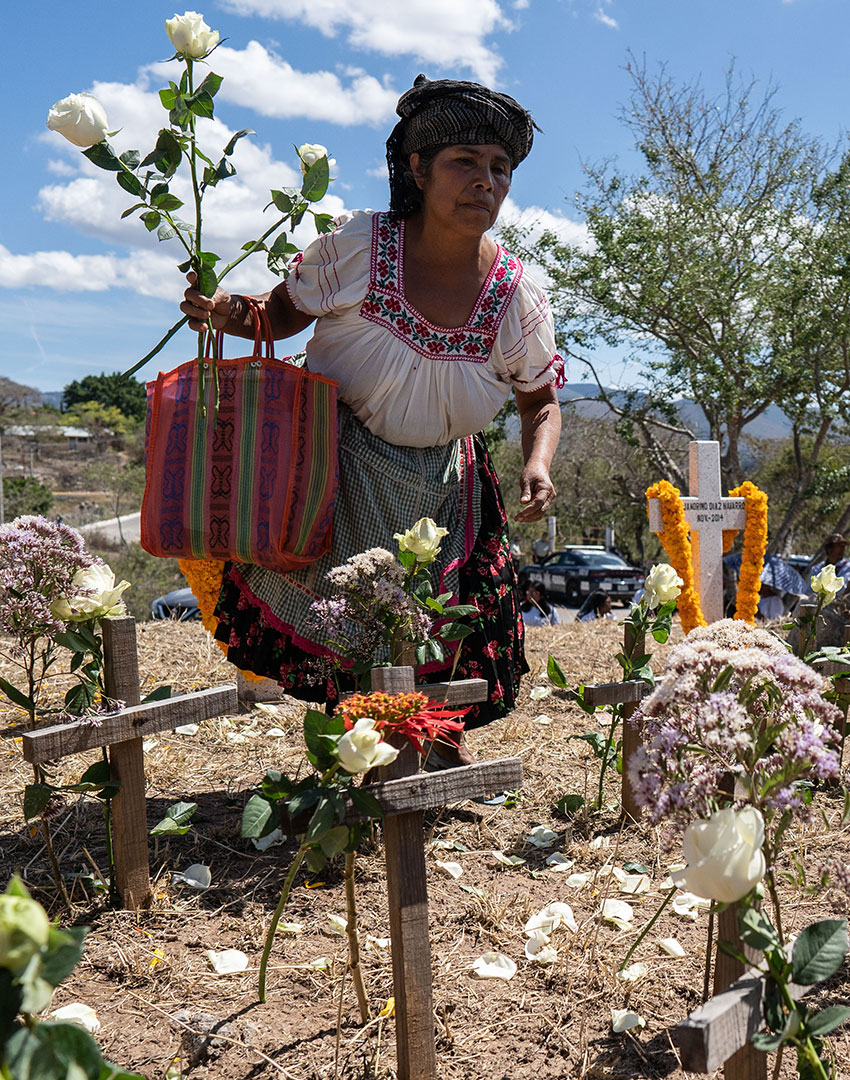
Before Sunday’s march in Chilapa, a woman places flowers on the crosses that represent those who have disappeared. Lexie Harrison-Cripps
Many people marched with images of their missing family members. One woman, Beatriz, cried as she recounted the night that men entered her home and took her husband, who has now been missing for more than four years.
In the past seven years more than 243 people have gone missing in Chilapa and more than 452 people have been assassinated, confirmed Morera in her speech in the central square at the end of the march. Álvarez Icaza went on to say, “It is important to raise our voice. We do not want Chilapa to go on being the center of pain for our country.”
Although the LeBarón family had received messages of support suggesting that over a thousand people would attend the march, local cartels broadcast threats beforehand that anyone attending the march would be killed and put up a roadblock on the day of the event, confirmed Bryan LeBarón.
Chilapa is currently regarded as a particularly dangerous area of Guerrero as two cartels, Los Rojos and Los Ardillos, fight for territory. Despite this danger the march ended peacefully, likely due to the dozens of police who also accompanied the procession.
Following the march, the LeBarón family and Navarro visited houses that had been abandoned after family members had been targeted and ultimately abducted. “Seeing the abandoned houses made a huge impact on me,” said Bryan LeBarón after the visit.
When asked about the purpose of the march, he said, “I don’t see [Guerrero] as how everyone describes it, as an unconquerable situation that is losing control with no hope. I think that even with limited resources and attention from the government, it could make a huge impact. It could save lives.”
The Sea Shepherd vessel Sharpie. sea shepherd conservation society
Conservationists and authorities on board a Sea Shepherd Conservation Society vessel came under gunfire in the upper Gulf of California on Saturday while on a voyage to protect the critically endangered vaquita marina porpoise.
Four fishing skiffs known as pangas approached the M/V Sharpie and began to chase it at full speed just after 10:00 a.m., Sea Shepherd said in a statement.
At least two shots fired from the pangas landed in the water near the Sea Shepherd vessel but it was not hit. There were no injuries among the conservationists on board nor the officials from the navy, Federal Police and Environmental Protection Agency (Profepa) who accompanied them.
The incident occurred in an area of the upper Gulf of California known as a “critical zone” because several vaquitas have been sighted there.
In response to the attack, the captain of the Sharpie carried out anti-piracy procedures, which included the use of water cannons.
The Sharpie activates water cannons as one of the attacking boats lies nearby. sea shepherd conservation society
“This just shows how aggressive the poachers are here,” said Captain Jacqueline Le Duc.
“It proves to us that they are armed and that we need to take every panga that we come across seriously, because we have no idea what they are capable of,” she said.
Profepa condemned the attack in a statement and said that it would cooperate with investigations to bring the perpetrators to justice. It also said that it would continue to collaborate with Sea Shepherd and security forces in the effort to protect the environment.
The vaquita marina population has been decimated by the illegal use of gillnets to catch totoaba, whose swim bladders are considered a delicacy in China and sell for thousands of dollars. The mammals often become entangled in the nets and drown.
Experts estimate that there are only between six and 19 vaquitas left in the Gulf of California, the only place in the world they live.
The attack on Saturday occurred in the same area where Sea Shepherd found a dead vaquita trapped in a net last March. Profepa said that the vaquita was in a state of advanced decomposition but had stab wounds consistent with the cutting of the net in which the animal was entangled.
Sea Shepherd has been collaborating with Mexican authorities for six years to remove gillnets from the Gulf of California.
Desperate to protect the fat profits they make from selling totoaba on the black market, poachers have resorted to violence in the past.
The Sea Shepherd vessel M/V Farley Mowat was attacked last January by crew members on more than 50 skiffs, who threw rocks and molotov cocktails at the ship, breaking its windows and causing its hull to catch fire.
The same vessel was ambushed and boarded by poachers earlier the same month, the United States-based marine conservation organization said.
Scientists said in October that they saw over 70 fishing boats in the 150-square-kilometer zero-tolerance zone on a single day that month. They also photographed a vaquita swimming alongside one of the vessels working in the area where the use of gillnets is prohibited.