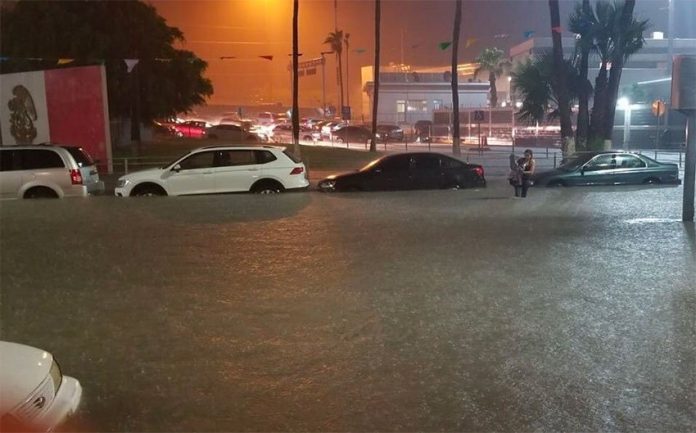
Heavy rains in Reynosa, Tamaulipas, provoked flooding and power outages last night, and shut down two international border crossings.
The downpour began at 6:30pm and lasted until 11:30, with lingering showers following until early this morning. Over the course of the evening, floodwaters stranded vehicles and inundated the city’s IMSS hospital.
Additionally, Mexican and United States authorities decided to close the Anzaldúas and Hidalgo international bridges — both busy international points of entry between the two countries — due to flooding.
The rising water also forced some residents to flee their homes. In response, Tamaulipas Governor Francisco Garcia Cabeza de Vaca announced over Facebook and Twitter that Civil Protection officials and authorities from the state water commission had been ordered to Reynosa to assist those left temporarily homeless.
Meanwhile, municipal authorities and firefighters remained on high alert and recommended that citizens remain indoors.
A flooded hospital and a half-submerged car last night in Reynosa.
On social media, residents posted pictures and video from affected areas, requesting government help with evacuations, while others offered their homes and warehouses located on higher ground as temporary shelters for families in need.
Flooding was also severe on the other side of the border, where officials in McAllen, Pharr and Edinburg, Texas, reported power outages and emergency evacuations of residents to temporary shelters opened in local schools.
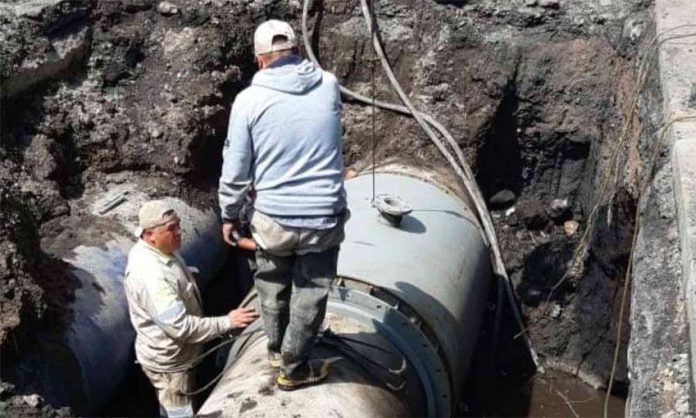
The water has been turned off for three days for over half a million people in Mexico City to allow the city’s water utility to repair 70-year-old water lines.
Pipes went dry at midnight last night in 52 neighborhoods of the central and eastern boroughs of Coyoacán, Iztapalapa and Tláhuac, as the Mexico City water department, Sacmex, started the repairs at the Tulyehualco aqueduct.
The work is scheduled to be completed on Thursday.
The city has announced that a fleet of 780 tanker trucks will distribute water to the affected households, and that funds have been allocated to allow local borough administrations to cover the cost.
Sacmex director Rafael Bernardo Carmona Paredes explained that the repairs at Tulyehualco are the beginning of maintenance work to repair aging water lines that have deteriorated and started to leak.
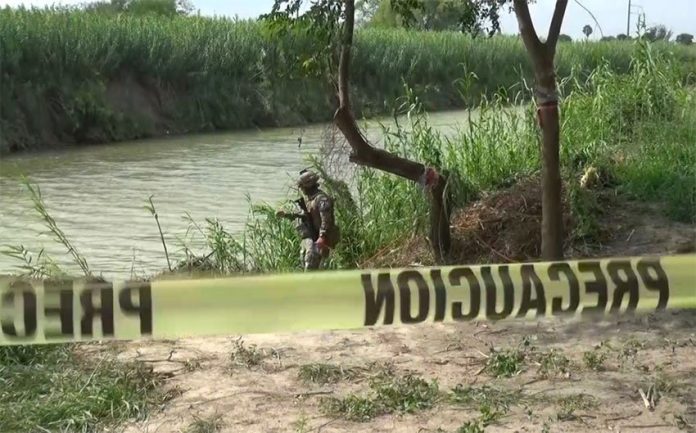
The Rio Grande, where the bodies of father and daughter were found.
A young father and his infant daughter drowned on Saturday in the waters of the Rio Grande while attempting to cross into the United States.
Óscar Alberto Martínez, 25, and Tania Vanesa Ávalos, 21, from El Salvador, had been waiting in Matamoros, Tamaulipas, to be granted asylum by the United States.
But after months of waiting, they decided to risk crossing the border and, with their 23-month-old daughter Valeri, waded into the waters of the river that separates the U.S. from Mexico.
But once in the water, Tania Ávalos lost her grip on the child due to the strong current, and her husband swam after her. The mother’s cries for help were heard by bystanders who took her her back to shore but her husband and daughter were not so lucky, and both drowned.
Their bodies were recovered yesterday by Civil Protection officials.
As Mexican authorities crack down on undocumented migrants entering the country from Central America, the government’s immigration agency is going through internal turmoil because of mass firings and restructuring.
The National Immigration Institute (INM) has fired around 500 agents for corruption since the beginning of the year, when Interior Secretary Olga Sánchez Cordero announced the agency would be “purged” because of reports of extortion of migrants.
INM Head Francisco Garduño, who took office on June 14, says he will not tolerate corruption in the ranks of the INM.
“We’re going to clean up, from top to bottom and side to side,” he told the newspaper Reforma.
Agents have been fired for offences including accepting money in exchange for immigration documents, using the threat of deportation to extort migrants and being involved in human smuggling networks.
Garduño said the INM is preparing an official report about the firings, which he promised will contain “surprises.”
Since April, the INM has been working to hire new agents. But the new hires — 239, according to Garduño — have been insufficient to cover the gap left by the purge and the increased demand for agents because of the migrant crisis. Garduño said the INM’s goal is to have 3,000 agents, more than twice the 1,400 it currently has.
To help cover that gap, the agency made an agreement with the Federal Police to temporarily commission 600 Federal Police officers to work in immigration enforcement.
The Federal Police will disappear at the end of the month and the majority of its members will be incorporated into the National Guard. But around 600 officers who did not meet the physical requirements for the National Guard have been commissioned to work for the INM.
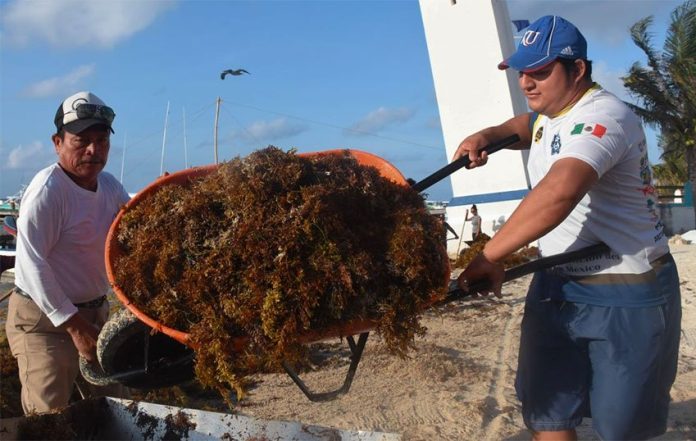
A wheelbarrow full of sargassum is removed from a Quintana Roo beach.
The Quintana Roo government and the state’s tourism industry have rejected President López Obrador’s assessment that the arrival of sargassum on Caribbean coast beaches is not a serious issue, declaring that the problem is in fact “extremely serious.”
In addition to dismissing the president’s evaluation, Tourism Secretary Marisol Vanegas Pérez said that it would be “very worrying” if the federal government doesn’t release more resources to combat the arrival of the seaweed on the Quintana Roo coastline.
Navy Secretary Rafael Ojeda announced yesterday a 52-million-peso (US $2.7-million) anti-sargassum plan, which includes the installation of new barriers to keep the weed from reaching beaches as well as the construction of vessels to collect it at sea.
But both Vanegas and Governor Carlos Joaquín González believe that the funding is insufficient – it represents just 5.2% of the 1 billion pesos (US $52 million) the state government has said is needed to implement a comprehensive strategy against the invasion of the smelly and unsightly seaweed.
Asked yesterday whether his administration anticipated more federal money to be forthcoming, Joaquín responded: “yes, of course, we expect more resources.”
It’s not serious, says AMLO, but state disagrees.
But it appears unlikely that the federal government will commit to providing anywhere near the level of funding sought by its state counterpart, which earlier this month declared a state of emergency due to the large amounts of sargassum washing up on beaches.
At his daily press conference yesterday, López Obrador recalled that shortly after he took office last December he was presented with a proposal for an exorbitantly priced anti-sargassum plan.
“What they were seeking was to be able to award contracts without calling for bids, to do business with the problem. That’s finished now . . .” he said.
Despite the unwillingness to allocate larger sums of money to the issue, Navy Secretary Ojeda asserted that the sargassum issue is being treated as a “state problem” for the first time, with a coordinated response from the three levels of government.
However, hotel owners remain less than satisfied with the authorities’ efforts.
Hoteliers who spoke to the newspaper El Financiero also rejected López Obrador’s minimization of the gravity of the situation, stating that the problem “isn’t serious, it’s extremely serious.”
They said hotel occupancy levels in destinations such as Cancún and the Riviera Maya have fallen between 3% and 7% and that some businesses, such as restaurants and providers of beach activities, have lost up to half their normal revenue as a result of the tourism downturn caused by the sargassum invasion.
Roberto Cintrón Gómez, president of the Hotels Association of Cancún and Puerto Morelos, said that most tourists who vacation in Quintana Roo expect sunny weather and clean beaches, explaining that seeing the coastline covered with sargassum “causes disappointment” among visitors.
Nevertheless, visitor numbers during the summer vacation period are expected to be strong, according to the state tourism secretary.
Based on airline bookings and hotel reservations that have already been made, Vanegas predicted just over 3.3. million visitors during the summer months, a figure that would be similar to that recorded in the same period last year.
Four students from the engineering school at the National Autonomous University (UNAM) have won the Blue Sky Competition Contest held by the American Society of Civil Engineers (ASCE).
The team of four UNAM engineering students won the contest with a proposal for a sustainable floating city built in the middle of the ocean.
The team advanced to the finals after coming in first place in the Texas-Mexico section. In the finals, they faced eight rivals, including teams from Bradley University in Illinois, the University of Michigan and the University of Puerto Rico.
One of the students said he had high hopes when he traveled to Melbourne, Florida, for the contest. But winning first place was still hard to imagine.
“It’s amazing that we are the first Mexican university to win the competition,” Juan Carlos García told the university’s newspaper, Gaceta UNAM. “We’re proud to represent the engineering school and UNAM.”
The team designed an octagonal floating city that could be built in the middle of the ocean and have sustainable energy, food production, water purification and recycling systems. Then they built a 1:2500 scale model for the city, which they tested in a UNAM hydraulics lab.
“With that model, we got a clear idea of how it behaves, and we could respond to the judges’ questions,” said Jesús Márquez, one of the team members.
The proposals are judged for written work, oral presentation and marketing.
“One of the judges gave us his card, and said that if we want to do a doctorate in the United States he would support us,” said team member Carlos Alberto Ibarra Cantú. “It feels good when Mexican engineering is valued outside the country. Now we’ll need to take advantage of these opportunities and keep working.”
The prize for the contest, which brought civil engineering students from all over the world, consists of a trophy and a cash award, which the students said they will use for a project to design concrete canoes.
The national concrete canoe competition is another event held by the Society of Civil Engineers. It takes place in June next year.
Frida celebrates her retirement from rescue work today.
Frida, the famous rescue dog that won millions of hearts and minds in Mexico and abroad for her efforts searching for earthquake victims, officially retired today after nine years of service.
The navy held a ceremony to honor the work of the 10-year-old yellow Labrador, best known for her participation in search efforts following the powerful September 19, 2017 earthquake that devastated Mexico City and other parts of central Mexico.
Frida was also involved in the search for earthquake victims in Haiti in 2010, in Ecuador in 2016 and in Juchitán, Oaxaca, in September 2017.
In addition, she searched for landslide victims in Guatemala in 2012 and people buried under rubble after an explosion at the Pemex tower in Mexico City in early 2013.
All told, Frida is credited with finding 12 people alive – all of whom were victims of the Haiti quake – and 41 bodies.
Frida on the job.
While her active service ends today, it’s not a final farewell for Frida from the navy’s canine unit.
The rescue dog’s trainer said that his star pupil will now become a teacher for the next generation of Fridas and Fidos.
Israel Arauz Salinas described working with the famous canine for five years as a “very special” and “rewarding” experience.
“I’m happy because Frida is retiring completely healthy. She’s earned her rest as a result of the work she’s done,” Arauz said.
The trainer said there have been plenty of offers to adopt Frida but for the time being she will continue to live at navy facilities in the southern Mexico City borough of Coyoacán.
“She will have the care and love of the handlers who work in the canine unit,” Arauz said.
Both he and Frida were honored with statues in their likeness that were unveiled in Puebla last year, while a mural in Roma, a Mexico City neighborhood that was hit hard by the 2017 earthquake, depicts the beloved Labrador as a saint-like figure.
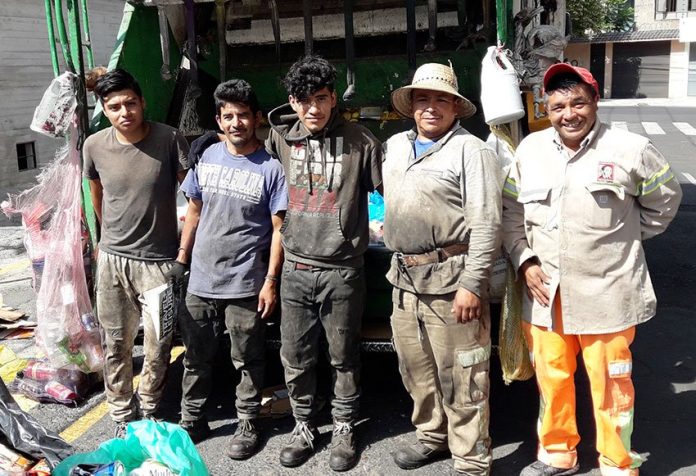
Mexico City’s sanitation workers are not government employees, but volunteers, subsisting on tips and what little money they get from recycling plants after separating recyclable materials by hand.
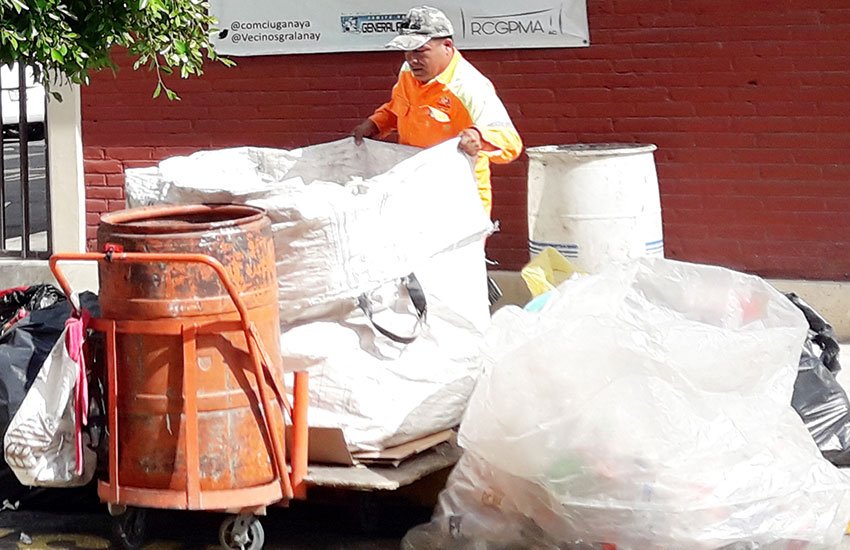
Mexico News Daily spoke to Israel Martínez, 40, on a Saturday morning in General Anaya, Benito Juárez, as he was separating garbage. Martínez has been doing this work for 25 years.
He wears an orange reflective uniform that he bought himself: “This way, people on the street can identify you, and they trust you more,” he said.
There are many dangers in his line of work. “You can cut yourself on glass or sharp metal, or a nail might stab you in the hand. You might get hit by a car, now that everyone’s on their cell phone while they’re driving.”
He does not wear gloves or any protective equipment. “I’ve been doing this for so long that I’m used to it.”
Mexico City sanitation worker Martínez.
He points out that when people separate their recyclables, his job is much easier, even if they still have a bit of liquid inside.
“I can pour out the liquid, no problem. When there are other things inside, like syringes, that makes it more difficult.” He works Monday to Saturday, starting at 7:00am, usually finishing around 4:00pm or 5:00pm. “There are no fixed hours, so it’s all about how much work you put in.”
There are many types of materials that can be recycled. “Plastic, like PET [polyethylene terephthalate], and metal goes to a processing plant in Ecatepec, in México state. Glass is sorted by color and recycled in a plant in Iztapalapa. The organic trash goes all the way to Chalco [México state]. There are four trucks a day that take it from here in Benito Juárez out to the plants.”
He explains the different materials and their separation. “Let’s say you have one of those plastic domes that a cake or pie comes in. The black base is one type of plastic, the transparent dome is PET. So those need to get separated so that the plant will accept them. A plastic Coca-Cola bottle is also PET, but the red top is a different plastic.”
On the Saturday that we spoke to him he was working alone with a wheeled cart that he uses to push around the enormous bags of garbage. During the week, he also volunteers on the garbage trucks. None of the workers on those trucks has a government salary, or a retirement package, health care or any other benefits. The government leases the truck to one person, and the rest of the workers come along to help sort the garbage in exchange for a share of the tips and payment from the plants.
Apart from paying for the gasoline, the government offers no other assistance to these essential workers.
The worst garbage, said, Martínez, are adult diapers and kitty litter. “They throw them in with everything else, and they smell awful. Also, they can make you sick.” He wishes more people would separate their recycling from their organic trash, and especially separate the dangerous and hazardous materials.
We asked Martínez if he would like to become an employee of the government. He told us that he prefers to stay independent. He also told us that he has two children, aged 11 and 14, and he would not like them to continue in their father’s footsteps. “It’s dangerous out here. I want them to finish school and look for more opportunities.” He finished secundaria (middle school) when he was 18.
On a single day. Martínez collects three giant white bags of garbage. “I’ve never weighed it, but I’d say it’s about 150 kilograms per day.” He earns between 120 and 150 pesos a day (US $6.25 to $7.80) for his efforts. When he finds anything in good condition that he can sell, he takes it to his puesto (a street market stall) in his local tianguis (a traditional Mexican flea market) in El Peñón, México state, a two and a half-hour drive from where we spoke to him.
He used to sell these items in a tianguis in Benito Juárez on Avenida Popocatépetl in Ermita, but it was recently removed by the government.
For these workers, the days are long and the work is hard. Only with the support of their community can they begin to get ahead.
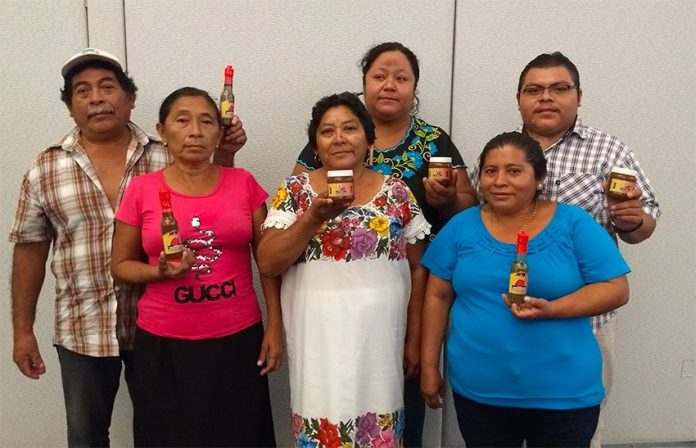
Salsa and jam makers from Tekax at the Mérida Facebook course.
A Mérida art gallery that does 40% of its sales on Facebook was one of the success stories presented at a free training course for about 2,000 entrepreneurs and small business owners.
The social media network offered the course to entrepreneurs wishing to learn how to use the network for their businesses.
Mérida is the third city visited so far this year by the Boost your Business with Facebook program. Last year the program visited 33 cities across Mexico and offered training to over 10,000 small business owners. This year, training will be held in 35 cities.
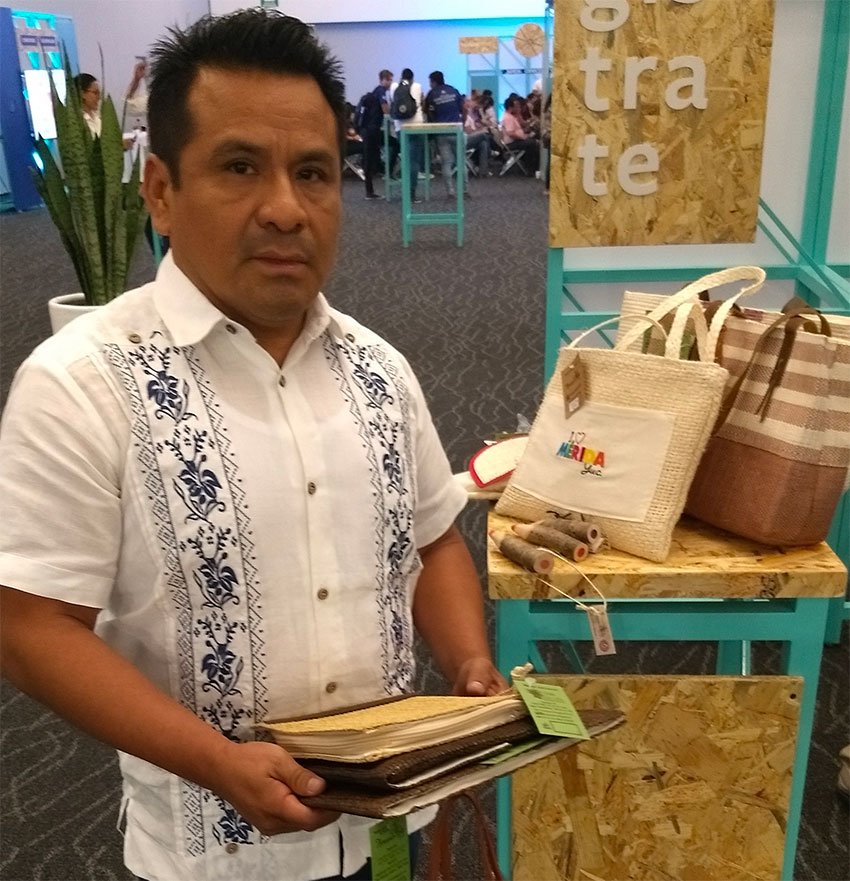
The success story presented at the event was that of Pedro Cab Kuk, an artisan who owns the Henequén art gallery. He has been able to take advantage of Facebook to promote and sell his products.
“The business of social networks is promotion, people knowing you, you being credible, them believing that what you make is good and that it works, because the things we make are to be used, not just for decoration,” he told El Financiero.
Cab Kuk of the Henequén Arte Galería.
The Henequén art gallery has more than 700 clients, including hotels, stores and individuals. Sales on Facebook represent 40% of the company’s income, making the social network “the spinal column of the business.”
“I used to spend a lot of money going to expos, traveling and everything, but now I’m spending less on that,” he said.
Another entrepreneur who attended the training was Mayela Contreras, who took a three-hour bus ride with her partners from Tekax, a municipality in southern Yucatán.
Originally from Oaxaca, Contreras founded the “La Sultana” brand in Tekax, which produces salsas and pineapple preserves with habanero chiles.
“These are traditional products of Tekax,” she told El Financiero. “All of our products are made in the traditional way; the washing, the peeling, the roasting.”
Contreras and her 15 partners sell the products from door to door, but they hope to be able to use the skills they learned at the Boost your Business training to make sales on Facebook.
A photo can bring a fine for illegal use of public spaces.
The chances of being punished for drinking or urinating in public in Mexico City are higher than ever before.
Under the new Civic Culture Law, photographs and videos taken by citizens on mobile phones can be considered sufficient evidence to sanction people for committing a range of administrative offenses on the capital’s streets.
Until two weeks ago, unless a person was caught red-handed by police, there was no possibility of a fine or other punishment being imposed.
Now, 24 civic judges have the authority to impose fines, order arrests and hand down community service sentences to people who have been caught on camera in the act of committing a range of offenses.
They include drinking alcoholic beverages on the street, urinating or defecating in public, not picking up a pet’s feces, verbally or physically attacking a person and using offensive language.
Héctor Villegas, a Mexico City legal official, explained that the new law was introduced to increase the probability of people facing legal consequences for their wrongdoings.
In recent years, there have been numerous cases in which social media users have uploaded footage filmed on mobile phones in order to publicly shame people who have acted in illegal, questionable or controversial ways.
Now, Mexico City residents can refer such footage to police with the knowledge that the evidence they supply could lead to a conviction.
Since the new Mexico City government took office in December, police have detected 94,463 administrative offenses, of which 90% were committed by men.
Using public spaces or streets for private events without obtaining consent, drinking in public, causing damage to public or private property and peeing in the street were among the most commonly committed infractions.
Almost 40% of the offenses were committed in the central borough of Cuauhtémoc, while people in Miguel Hidalgo and Coyoacán were responsible for 13% and 7.5% of the infringements respectively.