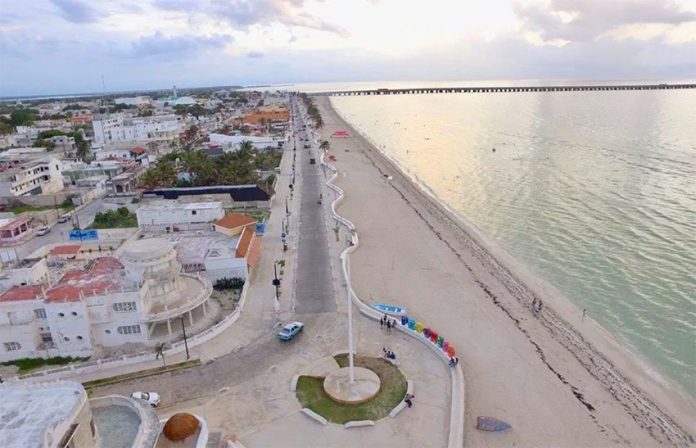
The Yucatán government will spend 60 million pesos (US $3.1 million) on improvements in the port city of Progreso this year.
The infrastructure projects will include installing underground wiring, road repairs and improvements and the remodeling of Progreso’s House of Culture.
But that’s only the beginning.
At the inauguration of a sports event, Governor Mauricio Vila Dosal said President López Obrador had agreed to contribute between 300 million and 500 million pesos to infrastructure projects in Progreso next year.
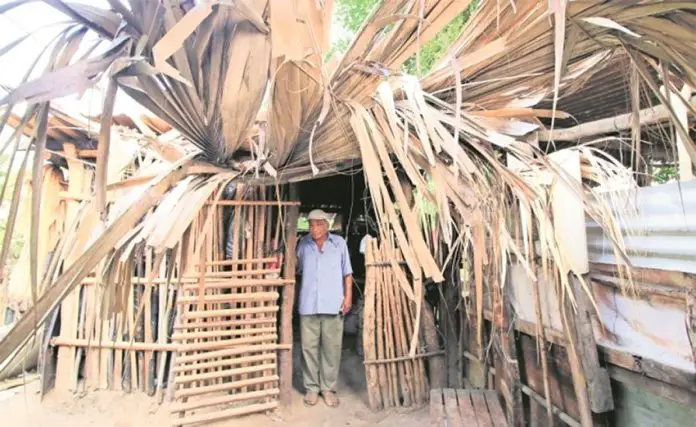
“The most important thing is that it’s not just tourism infrastructure: it’s to improve roads, schools, potable water, distribution of electricity, and to be able to relocate many of those that live in makeshift housing near the swamp to more permanent housing made of concrete with stable roofs.”
The governor highlighted that these projects and more are also essential to increase tourism in the city, which currently receives 128 cruise ships and 440,000 tourists every year.
To that end, the state government will also direct some of the funds toward the construction of a tree-lined plaza with areas for recreation, the finishing of the city’s boardwalk and the construction of a pedestrian-only street to connect the boardwalk to Progreso’s commercial center.
The city will also use the money to install underground utility cables, improve water and drainage systems and plant trees to line roadways.
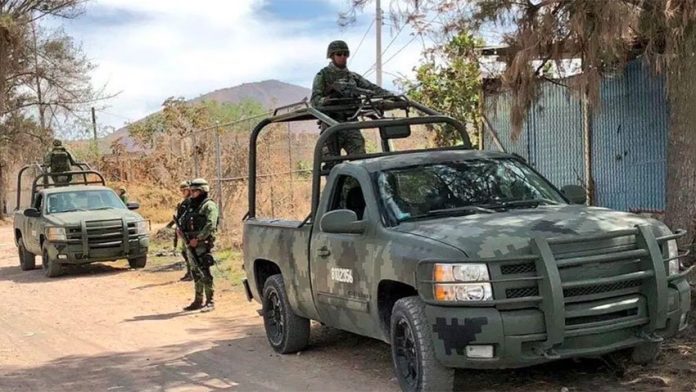
Military personnel have secured a safe house in Tlajomulco de Zúñiga, Jalisco, where they found the remains of about 20 people.
The soldiers also rescued three people who were being held captive.
The incident began when an army patrol spotted a man wearing handcuffs on the side of the road in San Sebastián el Grande. He told the soldiers he had escaped from a nearby property where he was being held captive.
When the patrol approached the property, armed civilians began firing at them. After a firefight, the soldiers took control of the property.
Three individuals fled the scene in a pickup truck toward Santa Anita, also in the municipality of Tlajomulco de Zúñiga, and three others were arrested. There were no casualties in the operation.
[wpgmza id=”189″]
Soldiers found 18 plastic bags containing human remains on the farm where the safe house was located, as well as 200-liter drums containing mutilated limbs, from which they concluded that about 20 people could have been killed there.
But state Attorney General Gerardo Octavio Solís emphasized that the number of victims still cannot be conclusively stated.
“We can’t say with complete certainty the number of bodies that were found at this property,“ he said. “But we’re working with forensic scientists to figure out how many deceased people could be here.”
If Sheinbaum doesn't discuss on aluminum, steel and vehicles
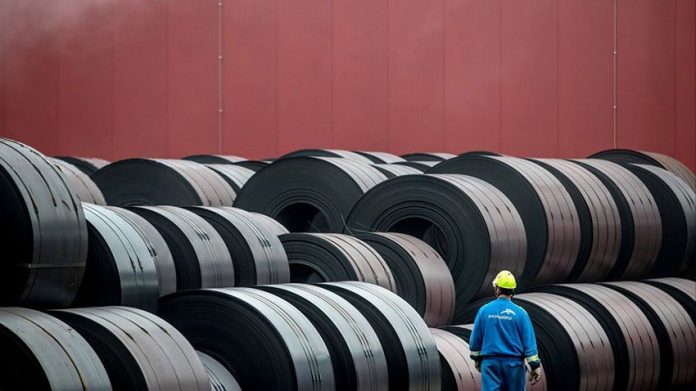
The United States government agreed yesterday to lift its tariffs on Mexican and Canadian steel and aluminum, removing a major obstacle for the ratification of the new North American trade deal.
In exchange, Mexico and Canada pledged to remove their retaliatory tariffs on a range of U.S. products.
“We’ve just reached an agreement with Canada and Mexico and we’ll be selling our product into those countries without the imposition of tariffs or major tariffs,” United States President Donald Trump said.
His administration imposed tariffs of 25% and 10% on Mexican and Canadian steel and aluminum last June on national security grounds, angering its North American trade partners and complicating the trilateral negotiations to reach a trade pact to replace the quarter-century-old NAFTA.
As part of the tariff removal agreement, Mexico and Canada must adopt strict monitoring and enforcement measures to prevent subsidized Chinese steel entering the United States via their territory. In exchange, the United States said it would lift its tariffs in 48 hours.
No quotas will apply to Mexican and Canadian metal imports to the United States but if volumes significantly exceed historical levels, the U.S. reserves the right to impose new tariffs following consultation with the exporting country.
Trump said that the removal of tariffs paved the way for the U.S. Congress to ratify the United States-Mexico-Canada Agreement (USMCA), which despite a range of difficulties leaders of the three countries signed last November.
“That deal is going to be a fantastic deal for our country. Hopefully Congress will pass the USMCA quickly,” he said.
The Mexican government described the agreement reached with the United States as “beneficial for both parties” and said that its retaliatory tariffs on U.S. products, including pork, apples, cheese and bourbon, will be lifted once the metal duties are formally eliminated.
Economy Secretary Graciela Márquez said in an interview that the deal will allow Mexico’s steel and aluminum industries to be competitive again, while foreign affairs undersecretary Jesús Seade wrote on Twitter that Congress could now proceed towards ratifying the trilateral trade deal.
“With great enthusiasm, we welcome the decision of the United States president and the U.S. trade representative [Robert Lighthizer] to eliminate the steel and aluminum tariffs imposed on Mexico and Canada. This action opens the way to advance towards the ratification of the USMCA,” Seade said.
He also said difficulties in the relationship between the U.S. and China have helped Washington recognize the importance of a united North American trade bloc.
President López Obrador today credited his negotiators. “. . . it was a triumph for diplomacy and the negotiators of the government of Mexico and furthermore we even gave a little help to the government of Canada.”
Mexico’s steel exports to the U.S. did not suffer as a result of the tariffs. The U.S. Census Bureau said they were up 10% last year.
As part of the deal struck with their largest trading partner, Mexico and Canada both agreed to withdraw all complaints filed against the United States at the World Trade Organization.
This meme appeared a few years ago when the fans idea was revisited. But this is not exactly what the original proponent had in mind.
Could giant-sized fans blow away Mexico City’s contaminated air? Not likely, says the mayor.
Claudia Sheinbaum ruled out a proposal to install fans to disperse pollution in the city on Friday, saying the possibility had been seriously considered.
“It’s an option that has been studied a lot, and it’s not a viable option,” she said. “In reality, to reduce pollution, we need to address the sources of pollution, which in the case of the metropolitan area has to do with vehicles, industry, and recently, high temperatures and wildfires.”
The idea originated in the 1990s when it was proposed by Heberto Castillo, an accomplished engineer and left-wing activist.
Castillo, who was running for the Senate at the time, described his proposal in an article for El Universal on February 24, 1992. Admitting that it sounded absurd, Castillo described a system of three tunnels that would run under the mountains, connecting the Valley of México with the valleys of Toluca, Cuernavaca and Cuautla.
Castillo said that running fans in the tunnels for 60 hours straight and then for one hour a day would keep air pollution levels at under 100 Imeca points. The Environmental Commission of the Megalopolis declares an Environmental Contingency when pollution levels reach 150. In the early ‘90s, it was common for air pollution to rise above 300 points.
Castillo conceded that such a system would not address the root cause of air pollution, but defended it by saying that it also would not preclude other efforts to fight it.
“For example, when a kitchen fills up with smoke, using an exhaust fan doesn’t resolve the problem of the creation of smoke, but it does allow the housewife to breathe clean air,” he wrote.
He estimated that such a project would cost around US $100 million, only about 2.2% of the city government’s budget for the remainder of the term.
Heberto Castillo died five years later, in 1997. He is better remembered for being a founding member of the Democratic Revolution Party (PRD).
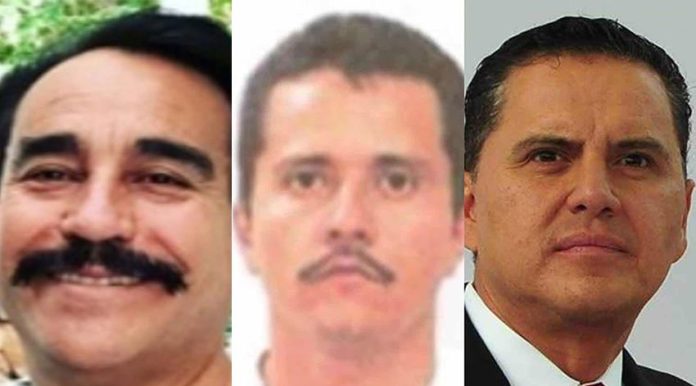
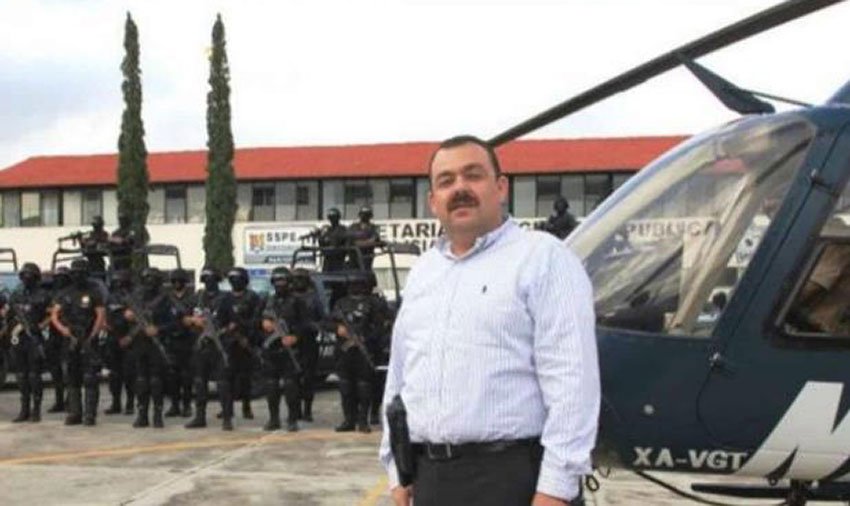
From left, the judge, CJNG leader Nemesio Oseguera Cervantes and the ex-governor.
A judge accused of collusion with drug cartels has been suspended after he was placed on the United States Kingpin List, while a former governor also designated as corrupt by U.S. authorities has defended his record in office.
Both men have received bribes from drug trafficking organizations including the powerful Jalisco New Generation Cartel (CJNG), the Treasury Department said.
After yesterday’s designation by the United States, Mexico’s Federal Judiciary Council (CJF) announced in a statement that Avelar had been suspended without salary for six months.
The CJF explained that the decision was made because of indications that “he could be obtaining part of his wealth through operations with resources of illegal origin.”
Avelar’s frozen accounts held 50 million pesos (US $2.6 million) and according to federal lawmakers, he spent 18.7 million pesos on property between 2010 and 2016.
The CJF said it would carry out its own “exhaustive investigation” into Avelar’s conduct as a judge and stressed that it would do so “with strict adherence to due process, the presumption of innocence and in accordance with the constitution.”
Meanwhile, Sandoval – whose alleged corruption also included the misappropriation of state assets – has denied that he and his administration committed any wrongdoing while in office between 2011 and 2017.
“Every authority that has requested information from us about different matters has found truthful data that demonstrate with transparency . . . that I, as a civil servant, managed a government in adherence with the law,” he said on Twitter.
The former Institutional Revolutionary Party (PRI) governor is currently under investigation for corruption by authorities in Nayarit, where properties he owns have been seized, and the federal Financial Intelligence Unit (UIF).
Sandoval asserted that the issues raised both by the United States Office of Foreign Assets Control (OFAC) and the UIF “will be explained as we have always done with the peace of mind of having worked correctly.”
The ex-governor – whose wife and adult children were also designated by the U.S. for being complicit with Sandoval by holding his “ill-gotten assets” in their names – said he deeply regretted the “unfortunate moment we’re going through as a family.”
“But my faith in God and my determined patience to overcome obstacles reaffirm my conviction of who I am, what I did, and what I didn’t do.”
Environmental commission chief Páramo announces lifting of the contingency.
The Environmental Commission of the Megalopolis (Came) lifted the Extraordinary Environmental Contingency on Friday because of falling levels of ozone and PM2.5 pollution.
At 9:00am Saturday, Imeca air quality index levels were at a maximum of 90 points in Mexico City, which is considered regular.
The commission had been operating without a director until this week, when the city appointed Víctor Hugo Páramo to the position.
At an event to mark the start of his new job, Páramo noted that weather conditions will be favorable for the dispersal of pollution over the weekend.
He said the high-pressure system that has been preventing the dispersal of pollution in central Mexico for several days has lost intensity and moved towards the south coast.
“We predict that on Saturday and Sunday, instead of having winds coming from the Guerrero coast, we’ll have winds from the north, which means the wind won’t be pushing smoke from the Guerrero coast,” he said. “It’s very likely that conditions will be more favorable and that we will be finished with this heavy pollution episode.”
“Hoy no Circula” will be applied normally starting Saturday, although 16 municipalities in the Valley of Toluca are still under an Environmental Contingency.
Mexico City has been suffering under high levels of PM2.5 pollution since last Saturday because of a series of forest fires and the high-pressure system. Came declared the Extraordinary Environmental Contingency on Tuesday.
During the four days of the contingency, 800,000 vehicles were taken off the road, representing 23% of the four million vehicles that circulate in the Valley of Mexico.
The Mexican Automotive Industry Association (AMIA) said in a press release that reducing the average age of vehicles used in Mexico City would help improve the air quality situation, because older vehicles contribute significantly to air pollution. The average age of vehicles used in the Mexico City area is 17 years.
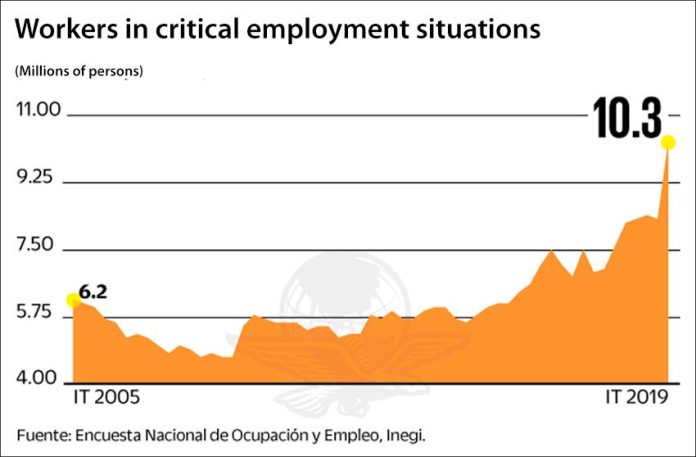
Unemployment rose to its highest level in two years in the first quarter of 2019, while more than 10 million Mexicans with jobs are in a precarious employment situation, according to the National Statistics Institute (Inegi).
Just under 1.9 million people were unemployed at the end of March, an increase of more than 170,000 compared to the same month a year earlier. The unemployment rate increased to 3.5%, Inegi said.
Héctor Magaña, a professor and researcher at the Tec. de Monterrey university in México state, said that government layoffs and adjustments in certain areas of the private sector contributed to the higher unemployment rate.
Tabasco had the highest jobless rate, with 7.6% of the population of working age people unemployed, followed by Mexico City, with a rate of 4.7%; Durango, 4.6%: México state, 4.3%; and Coahuila and Sonora, both 4.2%.
Guerrero, Morelos and Oaxaca had the lowest unemployment rates, with just 1.8% of people in each state unemployed. Yucatán, San Luis Potosí and Michoacán followed with rates of 1.9%, 2.1% and 2.3% respectively.
In addition to the unemployed, Inegi said that there are a record 10.3 million people – 19% of the total working population – who are either underemployed or work regular or long hours but earn very low to low salaries, making their employment situation critical.
The cohort includes people who work less than 35 hours a week even though they want to work more, full-time workers earning less than the minimum wage (around US $160 per month) and employees whose salaries are below the equivalent of two minimum wages despite working more than 48 hours a week.
The states with the highest percentage of workers enduring critical employment conditions are: Chiapas, 42%; Oaxaca, 28%; Tlaxcala, 27%; Veracruz, 26%; Guerrero, 26%; and Baja California, Tamaulipas and Campeche, 25%.
An additional 27.8 million employees, or just over half of all Mexican workers, earn between one and two monthly salaries. As they work regular hours, their employment situation is not considered precarious by Inegi.
The percentage of people earning between three and five minimum salaries – the latter is 15,400 pesos or about US $800 a month – declined by 30% in the first quarter of 2019, statistics show, meaning that 6.3 million employees, or 11.6% of the working population fall into that bracket.
José Luis de la Cruz, director of the Institute for Industrial Development and Economic Growth (IDIC), said that a slowing of the economy is limiting the possibility of people finding well-paid jobs and working as many hours as they would like.
He said that employment in the service sector rose in the first quarter but those jobs typically don’t pay well.
“Some workers live on tips because their salaries are [so] low . . .” de la Cruz said.
Others are forced to move into in Mexico’s gargantuan informal economy.
Statistics show that the informal sector grew by 2.7% in the first quarter and now employs 30.8 million people, or 56.9% of all Mexican workers.
At his morning press conference today, President López Obrador rejected the Inegi employment figures, asserting that they are incorrect because they don’t take into account jobs created by the government’s apprenticeship and agricultural schemes.
“I have information that there are currently more job opportunities . . . For example, there are 500,000 young people that are in the Youths Building the Future program and 200,000 planters,” he said.
Conditions can be rough in Tabasco, where resistance to paying for electricity continues.
More than half a million residents of Tabasco were told this week that 11 billion pesos (US $573.5 million) they owe to the Federal Electricity Commission (CFE) will be forgiven and that effective June 1 they will be charged the lowest rate in the country.
But the civil resistance movement that led to the accord is not over.
Announced Tuesday by Governor Adán Augusto López Hernández, forgiveness of the debt through an agreement between the state government and the CFE was supposed to represent a new beginning for Tabasco, where 520,000 people joined a resistance movement against the public utility that began in 1995.
But some Tabasco residents maintain that their resistance has not ended and say they will not pay future electricity bills. Others say they won’t pay them unless debt cancelation is extended to small businesses or until members of the government personally explain to them how the new electricity rate will work.
In Buena Vista, an indigenous Chontal town considered the birthplace of the resistance movement – where residents first clashed with the CFE over excessive price rises in 1990 and have even detained utility employees – residents offered reasons why they won’t pay to the newspaper El Universal.
“Take this information to [President] Andrés Manuel. He started the resistance here and we’re holding out . . . Tell him that Buena Vista and [the nearby community of] Tamulté de las Sabanas will continue to resist,” said Primitivo Hernández Hernández.
“There’s no work, where are we going to get money for food, for school for the children, where are we going to get money to pay for electricity, the people here won’t enter [into the new agreement],” he added.
Another resident, José Cruz Hernández, said: “[They have to] explain how this preferential rate deal is going to work. Until a government committee comes and explains . . . everything . . . we won’t enter into it.”
In Tamulté de las Sabanas, a small town around 40 kilometers from the state capital Villahermosa, Ramiro Hernández Valencia said it was unfair that small businesses were excluded from the deal struck between the governor and the CFE.
“. . . I’m not happy, I’m not convinced, resistance will continue here if they don’t give a clean slate and a [cheaper] electricity rate to everyone,” he said.
Local official Saturnino Hernández Hernández said that people are waiting anxiously for the new electricity rate to take effect, adding that López Obrador should visit Tabasco to meet with residents and explain to them exactly how it will work.
People currently receive bimonthly electricity bills of as much as 2,000 pesos (US $104) but many residents, most of whom earn their living from farming or fishing, can’t afford to pay them, he said.
López Obrador arrived in Tabasco today, where he called on residents to be “good citizens” and pay their
CFE bills. The utility, he said, belongs to the people and needs resources to continue providing service.
“. . . it’s not like before when the governors robbed all the money, now there is no corruption . . . [whereas] before those at the top helped themselves with the big spoon, dedicating themselves only to obtaining privileges of all kinds, they didn’t even pay taxes.”
Electricity charges should be seen as “contributions” to the development of the country, he said, rather than “taxes.”
The United States government imposed sanctions today on 11 Mexicans, including a sitting federal judge and a former governor, for their alleged involvement in corruption and links to drug trafficking.
The Department of Treasury said in a statement that Judge Isidro Avelar Gutiérrez was designated under the Foreign Narcotics Kingpin Act because he received bribes from the Jalisco New Generation Cartel (CJNG) and Los Cuinis drug trafficking gang in exchange for providing favorable judicial rulings to their senior members.
It is the first time that a member of Mexico’s federal judiciary has been placed on the kingpin list. Avelar’s access to any financial assets he holds in the United States will be blocked.
Mexico’s Financial Intelligence Unit (UIF) announced earlier this week that they had frozen the Jalisco-based judge’s bank accounts and filed a criminal complaint against him with the federal Attorney General’s Office (FGR).
Treasury said that former Nayarit governor Roberto Sandoval Castañeda was also designated for having engaged in an array of corruption activities such as the misappropriation of state assets and the receipt of bribes from Mexican drug traffickers, including the CJNG.
Sigal Mandelker, undersecretary for terrorism and financial intelligence at the Department of Treasury, said that United States authorities coordinated with their Mexican counterparts to make the new designations.
“Officials such as Isidro Avelar Gutiérrez and Roberto Sandoval Castañeda callously enrich themselves at the expense of their fellow citizens,” she said.
“Whether they are receiving bribes from narcotics trafficking organizations or engaging in a variety of other illicit activities, these and other corrupt officials will face serious consequences including being cut off from the U.S. financial system.”
Treasury said that six other Mexican individuals and six Mexican entities linked to the CJNG or Los Cuinis were designated under the Kingpin Act, while three of Sandoval’s family members and four entities with links to the ex-governor were also named.
Among those designated was Gonzalo Mendoza Gaytan, a senior CJNG member and boss of the Puerto Vallarta plaza who is known as “El Sapo” (The Toad). Treasury said he and his subordinates are responsible for kidnappings and numerous killings.
Mendoza’s wife, Liliana Rosas Camba, was also designated because she “manages business activities and launders drug proceeds on behalf of her husband and CJNG.”
Édgar Veytia was attorney general under Sandoval. He is now in a US prison on drug trafficking charges.
The six designated entities with cartel links are all located in the Guadalajara area. They include three architecture and real estate firms, an organic products company, a women’s clothing store and a restaurant management company.
The wife, adult son and adult daughter of Sandoval, Institutional Revolutionary Party (PRI) governor of Nayarit between 2011 and 2017, were also designated, Treasury said.
“Sandoval Castañeda and his family members continue to enjoy the illicit benefits from his corruption schemes,” the statement said.
The four entities that were designated because they are owned or controlled by Sandoval or a family member were a butcher business, a clothing store, a real estate company and a land-holding foundation.
Treasury said that the access of all designated individuals and entities to any financial assets and property they own in the United States will be blocked.
The designations are not criminal charges but rather administrative actions and don’t guarantee that authorities will seek to prosecute those named.
Sandoval denied today that he had any connection with the Jalisco cartel and said he was innocent of the accusations.
Mexican soccer star Rafael Márquez and singer Julión Álvarez were placed on the United States kingpin list in 2017 but neither faced charges in Mexico.
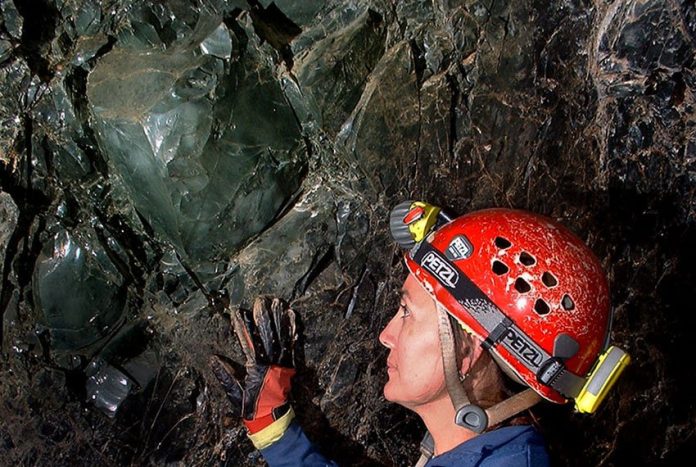
A chunk of green obsidian protrudes from the wall at the end of the mine in San Isidro, Jalisco.
The state of Jalisco hosts the fourth-largest obsidian deposits in the world. In pre-Hispanic times, obsidian was perhaps as valuable as oil is today because from it could be made knives, scrapers and arrowheads, as well as jewelry and mirrors.
Because obsidian was so abundant in western Mexico, a typical mine was nothing more than a hole or trench no deeper than a meter or two and open to the sky.
Today their remains typically resemble shallow depressions, surrounded by the broken bits of tools that didn’t pass muster.
But one day archaeologist Rodrigo Esparza told me about an exception.
“Not far from San Isidro, we found an obsidian mine that’s completely underground and dark as a cave. It’s just the sort of place you would love . . .”
Portrait of Desmodus vampire bat, found in many Mexican caves and mines.
San Isidro Mazatepec is located 13 kilometers west of Guadalajara. Here, members of our Zotz Caving Club found Rodrigo Esparza and Phil Weigand, the legendary discoverer of the Guachimontones, waiting for us next to a beat-up truck.
“This is the first underground obsidian mine we’ve found in Jalisco,” said Weigand, “so it needs to be surveyed and mapped. However, to get inside of it, you have to crawl on your hands and knees through low, narrow passages . . . and we suspect there are plenty of vampire bats inside . . .”
“So you thought of us,” I replied, “but to tell you the truth, it does sound like a place we would love!”
We climbed into the truck bed and the old archaeologist drove us out of town along a dirt road full of ruts. Eventually we passed through a fence on to private land.
“We’ve been riding on an expressway until now,” said Weigand, “but here comes the rough stuff.”
And rough it was. We had to make sure some of us were sitting on two concrete slabs (kept in the truck bed for ballast) so they wouldn’t fly around and land on top of us.
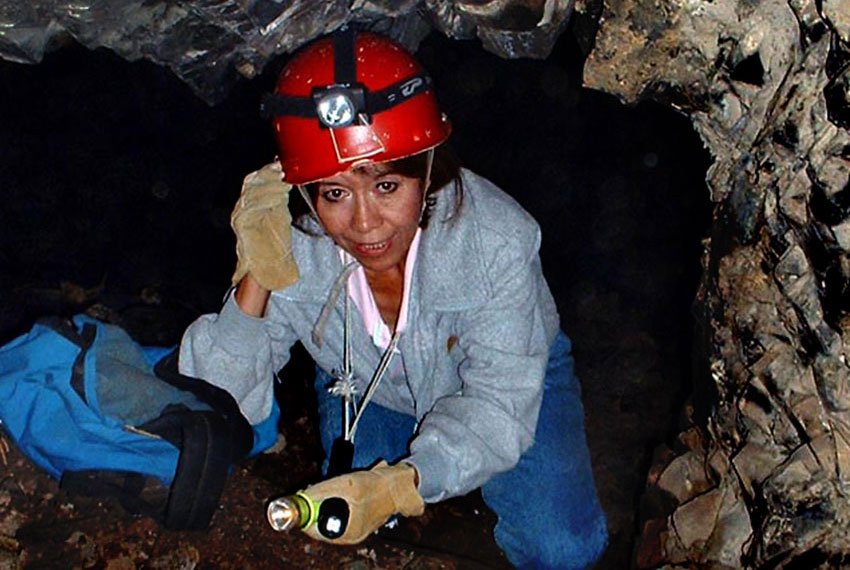
In parts of the mine, the ceiling is less than a meter high.
After half an hour of bouncing and bumping, we pulled to a stop among tall oak trees at the base of a small hill. Pieces of obsidian covered every inch of the ground around us like autumn leaves in New England.
Rubbing our sore bottoms after the hammering they had received on the awful, rocky road, we picked up unfinished arrow and spear heads, knives, flakes, scrapers and other fragments that had obviously been worked on and discarded.
We were standing in the middle of a typical obsidian workshop and it brought home the importance — perhaps unimaginable to us moderns — that obsidian played in the lives of the people living here for most of the last 2,000 years.
Those ancients had no metal tools or weapons but they knew what few people today would believe, that nothing on earth is as sharp as an obsidian blade.
“All other liquids crystallize when they turn solid,” explained Phil Weigand, “except obsidian, which has no crystal structure whatsoever.”
Metal can’t be sharpened less than the size of its smallest crystals, but obsidian has no such limit. In the old days, indigenous Mexicans used to line the edges of their flat wooden sword — called the macahuitl — with obsidian flakes, and it is said it could slice off a man’s leg with one blow.
Several pieces we picked up did indeed have a smoky-green luster and a very shiny surface. “Do you think they made mirrors out of this?” I asked.
“Oh no,” replied Phil. “They only used the blackest obsidian for that because they believed mirrors depict how you will look in the afterlife and black was the color of death.”
Inside the Boudoir of the Vampires.
As we discussed death and obsidian, we walked up the hill to the mine. Emanating from the small, triangular entrance hole, barely large enough for a human being to squeeze through, was a light current of air carrying the unmistakable smell of a dead animal inside.
Immediately, it was decided that I would go first into the Smelly Unknown. I wriggled through the small hole and was received by a welcoming committee of little black flies which angrily flew around my head.
As they didn’t bite, I started crawling along until I found myself in a room where the roof was just one meter above the floor. The evil stench was coming from somewhere in here but I couldn’t find the source.
Above me there was a small skylight. A few meters on, in another room where there was almost no daylight, I nearly put my hand into a gooey black puddle that I immediately recognized from so many visits to western Mexico’s caves.
“Yup, we’ve got vampire bats, alright,” I shouted to the others, who were listening at the entrance hole, hoping this would encourage them to rush right in. Of course, the fresh vampire guano added yet another tantalizing odor to the already notable aroma of the mine.
Ten meters from the entrance, I came to a steep down slope. I glanced up at the ceiling and gulped. My headlamp revealed sharply pointed “spears” of obsidian pointing down at me and it looked like any one of them could easily be pulled out — or even fall out by itself — perhaps resulting in the collapse of the entire roof! This was a unique substitute for the stalactites found in limestone caves.
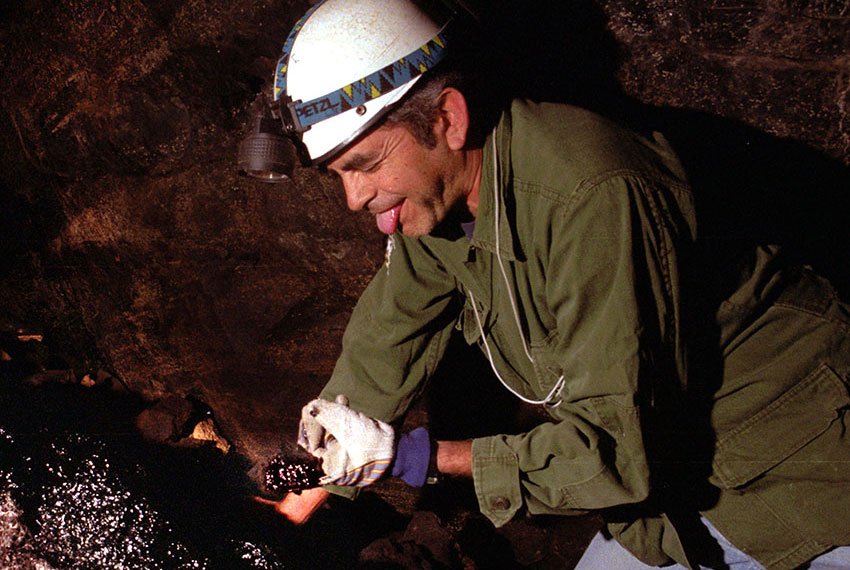
Examination of vampire-bat guano produces a nasty smell.
“Amigos, you have to come in here. This is something you’re never going to see in a cave.”
To my surprise, my compañeros (but not the archaeologists, by the way) did come in, braving the bugs, the decomposing corpse and the slimy vampire guano. By then, I was moving down the slope to total darkness and another, much bigger pool of tar-like vampire goo.
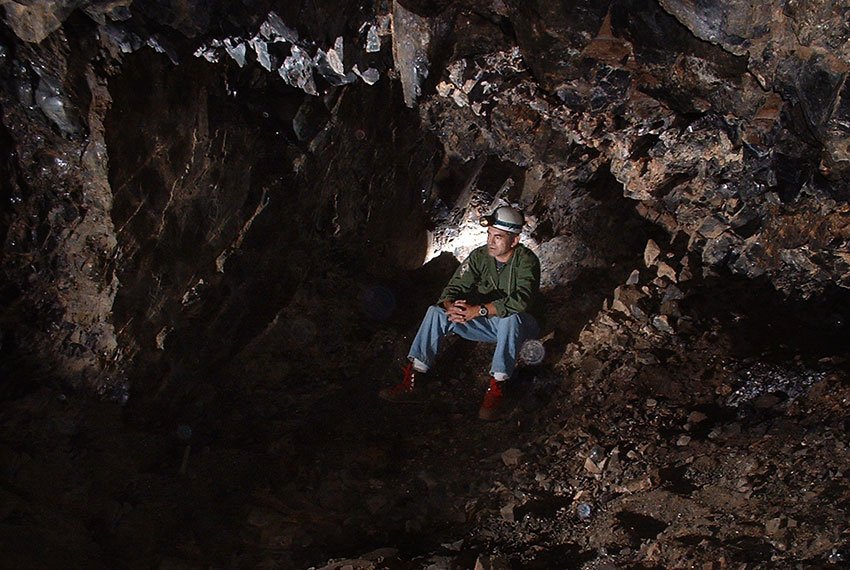
Now, they had told us that this mine was as dark as a cave, but I would say “darker than the darkest cave” because the black obsidian ceiling, walls and floor — with a little help from the vampire guano on the floor — absorbed light even more than the black basalt walls of a lava tube, making it exceedingly difficult indeed to see anything using flashlights and headlamps.
The creatures living in that black room, however, had no problem “seeing” us thanks to their marvelous echolocation skills. All around us we could hear them darting.
Suddenly one would land on the wall near us. In the dim light of our headlamps, we could see it shifting left and right, showing us its fangs, shaking its head menacingly and then flying right at us.
Ah, but we knew about this little trick. It’s all a show and they never actually hit you (much less bite you, which they only do to sleeping or immobile prey).
[soliloquy id="78863"]
One nice thing about this room. which we soon christened “The Boudoir of the Vampires,” was that at last we could stand up and move around easily, truly a blessing as we had been crawling along on the natural equivalent of broken beer bottles: shards of volcanic glass that tinkled every time we moved.
In Stygian blackness we walked down the slope to what turned out to be the end of the mine. And suddenly we were standing at the very last spot where the ancient miners had been at work. This was a perfectly vertical wall.
It was flat, except for a beautiful nodule of creamy-green obsidian — big as a basketball — embedded in the wall and protruding from it.
[wpgmza id=”188″]
What had stopped the ancient miners from prying out this prize? Was it a shout from a fellow worker: “Hey, Mixtli, forget that rock! Some bizarre creatures are coming down the hill, half men and half animals. We have to get out of here — run for it!”
For whatever reason, they left, their job incomplete. We, instead, were able to complete our survey and then we too, left, allowing the old mine to return to its habitual darkness and silence, broken only by the occasional flapping of vampire wings.
The writer has lived near Guadalajara, Jalisco, for more than 30 years and is the author of A Guide to West Mexico’s Guachimontones and Surrounding Area and co-author of Outdoors in Western Mexico. More of his writing can be found on his website.