Home Blog Page 1940

President not getting factual advice on science issues: scientist

0
José Franco defends scientific agency that faces government's axe.

President López Obrador is not getting factual advice on science issues, according to the former chief of an autonomous government scientific agency that is about to be disbanded.

Describing it as “another sticky mess” in the president’s office, López Obrador confirmed yesterday that the Scientific and Technological Advisory Forum (FCCyT) will disappear.

The president said the forum was a waste of money and unnecessary because he receives his advice on science issues from the National Council of Science and Technology (Conacyt).

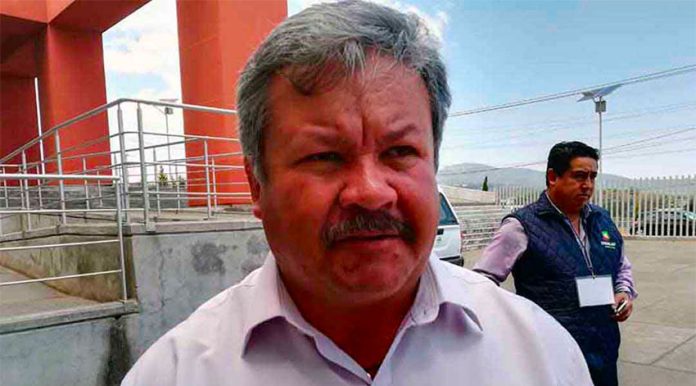
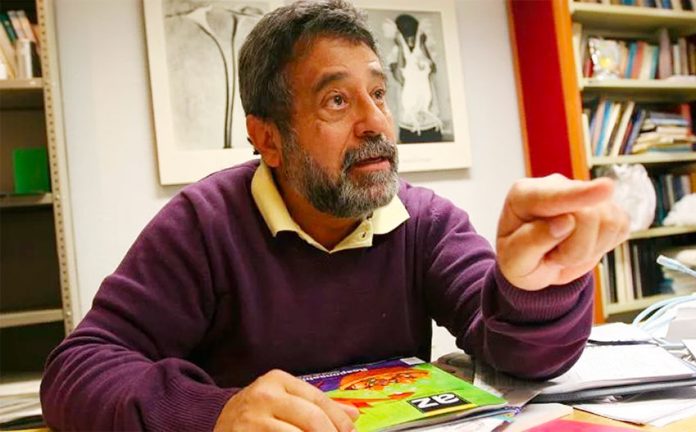
In response to the announcement, José Franco, general coordinator of FCCyT between 2014 and 2018 and current head researcher at the National Autonomous University’s Institute of Astronomy, charged that the president is receiving scientific advice based on lies.

In an interview with the newspaper El Economista, the scientist said that López Obrador doesn’t have a clear idea of what the FCCyT is and the work it does.
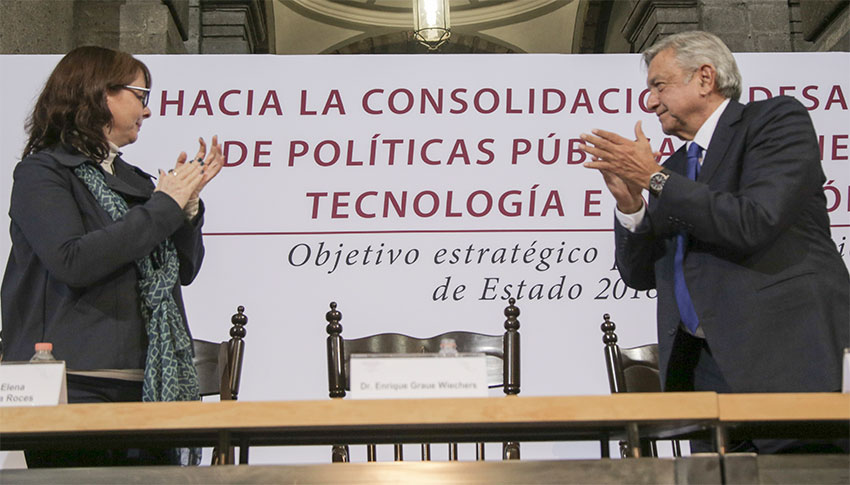
Álvarez-Buylla of Conacyt and López Obrador.

“By saying that the forum is an irrelevant actor, he’s saying that a large number of institutions are unimportant. The forum isn’t a person but rather 17 institutions that work to build the country; that’s not a minor thing,” Franco said.

He claimed that Conacyt is behind the decision to dissolve the FCCyT, which was established during the Vicente Fox presidency in 2002.

Franco said the forum opposed a proposal presented by Morena party Senator Ana Lilia Rivera for a new federal science and technology law, explaining that its opposition riled Conacyt.

“As they have already cooked up their science and technology law, which is surely going to be an authoritarian thing like the previous one, that annoyed them immensely . . .” he said.

Nevertheless, Franco said the reasons why the president and Conacyt want to get rid of the FCCyT were not entirely clear.

He explained that when he was forum chief, current Conacyt director Elena Álvarez-Buylla visited FCCyT offices and was shown the projects the organization was working on.

“. . . She thought they were marvelous; I told her that they were very much in line with the mission of the new government,” Franco said, explaining that they included social innovation programs for disadvantaged communities.

“After that the curtain came down without us knowing why . . . The forum is accused of wasting money when there is complete evidence of the projects it carries out,” he said.

Citing budget cuts to federally-funded laboratories and scientific institutes, Franco said the move to dissolve the FCCyT fits within the context of a wider effort by the government to dismantle the public scientific sector.

“. . . They’re trying to strangle all the organizations that are representative of the community and the forum is part of all that,” he said.

“Thousands of people are protesting but unfortunately the government isn’t listening . . . and wants to destroy science. The construction of the science system, [which is] still very modest, has taken us more than 50 years and in [just] a few months they want to dismantle it, causing frustration everywhere.”

Source: El Economista (sp) 

Fracking prohibition would cost $45 billion over 20 years: energy consultant

0
An NGO sees fracking as essential for the viability of Pemex.

A ban on hydraulic fracturing would cost the Mexican economy US $45 billion over the next two decades, according to oil and gas consultancy Welligence Energy Analytics.

Senators with the ruling Morena party last month presented a bill to prohibit the controversial gas and oil extraction technique commonly known as fracking.

President López Obrador is also opposed to the practice due to environmental and water supply concerns and in June vetoed fracking operations that Pemex planned to carry out in the Huampa oil field in Tamaulipas.

If the bill becomes law – which would appear likely considering a Morena-led coalition has majorities in both houses of Congress – the fracking prohibition “would cancel investments of US $1.3 billion in 2020 and $45 billion to 2040,” Welligence said in a report.

The company said that potential fracking investments in states such as Veracruz, Tabasco, Tamaulipas, San Luis Potosí, Puebla, Coahuila and Nuevo León would be lost.

Welligence estimated that a fracking ban would result in a loss of 140,000 barrels per day of oil and 1.2 billion cubic feet of natural gas.

It would cost the government US $7 billion in tax revenue next year and 20,000 direct jobs would be lost.

Outlawing fracking would also be a big blow to the embattled state oil company.

Welligence said Pemex would be unable to exploit 30% of its 3P (proven, probable and possible) reserves and some 8,000 wells would be shut down.

According to the National Hydrocarbon Commission, about one in four natural gas and oil wells drilled in Mexico since 1996 has used fracking to extract the fuels.

In light of Welligence’s forecasts, the Mexican Institute for Competitiveness (IMCO) said that it was concerned about the economic impact of a fracking ban.

“Fracking is essential for the viability of Pemex,” the public policy research organization said in a statement.

IMCO also said that fracking is “essential to democratize the petroleum industry,” explaining that a lot of shale gas reserves are not economically viable for large companies such as Pemex but can be profitable for smaller ones that are more flexible.

The organization said that fracking has contributed to economic development in marginalized areas of the United States, citing North Dakota as an example, adding that the U.S. “put an end to its energy dependence on the Middle East thanks to these technologies.”

“. . . Mexico has to find its way in the use of fracking technology, adequately managing the associated risks. All technologies imply some kind of risk. The role of public policy is to evaluate what risks are manageable and able to be mitigated. Other countries have done it successfully. Why not Mexico?”

Source: Forbes México (sp) 

Suspected car thief becomes cop’s piñata in Jalisco city

0
Officer strikes suspected thief with a stick while a crowd below chants the piñata song.

Authorities in Tonalá, Jalisco, have begun internal proceedings against a police officer who used a suspected thief as a piñata.

Police had responded to reports of a vehicle that had been stolen while a 5-year-old girl slept in the back seat. They located the vehicle but the thief abandoned it and fled on foot.

Officers chased the suspect to the roof of a nearby church, where he threatened to jump to his death. For the next two hours, police officers and firefighters attempted to dissuade the man, slowly drawing closer to him, while a crowd of onlookers gathered below.

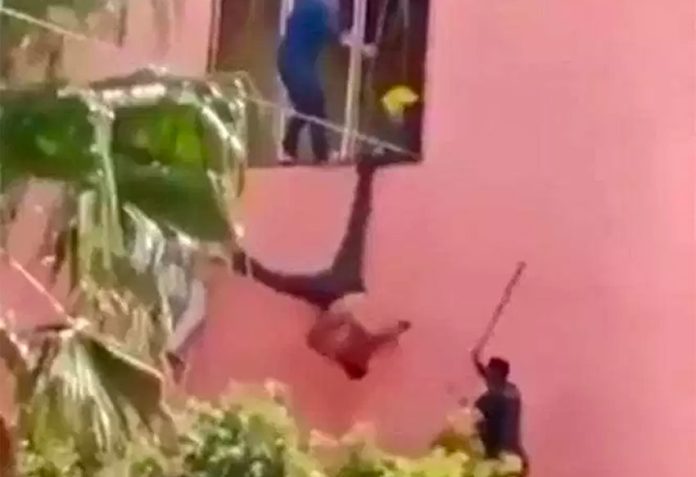
Finally, police were able to lasso the man by his ankle, and when he leapt from the roof he was left hanging upside down from a rope tied between the church and another building.

That was when a police officer climbed far enough to hit the man with a stick, which he began to do as if the suspect were a piñata. Shouts of encouragement came from the large group of spectators below.

Eventually, police arrested the man and handed him over to the public prosecutor’s office after he was given medical attention.

In the meantime, municipal authorities issued a statement saying that internal affairs had opened an investigation into the incident, which was captured on video and has been widely shared on social media.

Source: El Universal (sp)

Medical interns call national strike over scholarships, insecurity

0
Interns march in Mexico City today.

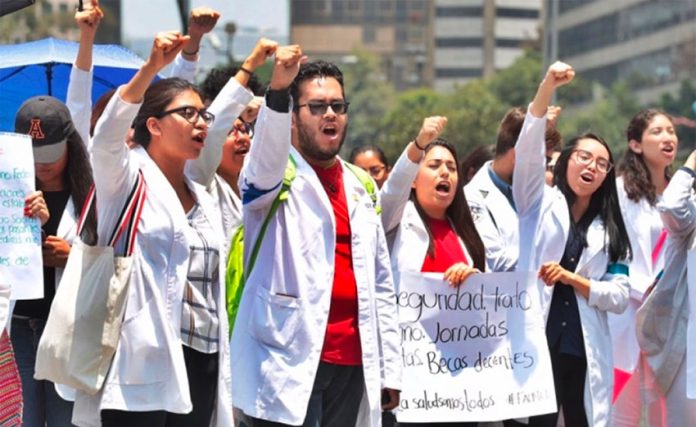
Medical interns are striking across the nation today to protest against any reduction of scholarship payments and to express their concern over working conditions and insecurity even as the government says there will be no cuts to training stipends.

In Mexico City, interns marched from the central square to the Health Secretariat while chanting “there is no austerity in health,” the newspaper Reforma reported.

Graduate doctors, nurses and other medical professionals claim that the government is planning to reduce the number of scholarships for interns and cut the amount they are paid even though the health department said in a statement yesterday that is not the case.

“No student that is fulfilling their social service will be left unprotected as there will be no reduction or suspension of the resource allocated to that end,” the statement said.

“The Secretariat of Health has a sufficient budget to pay 52,250 scholarships in 2019, an amount that is the same as . . . in 2018 and 2017.”

However, a member of the Mexican Assembly of Social Service Medical Interns told the newspaper El Universal that the payment of scholarships is not the only cause of concern.

“Today 54,000 medicine graduates should be starting their social service but that won’t be the case because positions were not assigned well in all states,” Roberto Gallardo said.

“The [protest] movement goes beyond scholarships, it’s not just about money but also so they [the government] see and know the conditions in which we work. There are very serious security issues,” Gallardo added.

Protesters in Mexico City demanded that the government provide security guarantees for interns posted to positions in isolated and marginalized communities and establish a national plan to improve conditions in rural healthcare centers.

Gallardo said that interns need certainty that they won’t be assaulted while working in a marginalized area but added that if it does happen, they need to have support.

He also said that interns are often “responsible for healthcare centers that don’t have equipment and supplies.”

Gallardo told El Universal that no member of the government has spoken with the disgruntled interns, adding that while President López Obrador says that sufficient resources have been allocated to pay scholarships and cover healthcare expenses in general, state health services say otherwise.

Nursing intern Luisa Fernanda Segura told Reforma that the government’s austerity measures have left hospitals and clinics without the materials they need to operate effectively.

“There is a shortage of medications and materials that we need in day-to-day life in the hospital.”

Source: El Universal (sp), Reforma (sp) 

Record remittances in first 6 months, though numbers declined in June

0
dollars to pesos
Remittances declined in June. concanaco servytur

Mexicans living outside the country sent a record amount of money home in the first six months of this year, compared with the same period in other years.

According to Mexico’s central bank, remittances reached US $16.882 billion between January and June.

Within that period, however, remittance numbers have been evening out. In June, Mexicans abroad sent back $3.118 billion, 1.4% less than in May, and less than in June 2018, when the number was US $3.14 billion.

The number of transactions grew by 1.6% compared with June 2018, but the average amount per transaction fell by 2%.

Goldman Sachs economist Alberto Ramos told the newspaper El Economista that the slowdown should be carefully monitored.

“Remittances are important on the macroeconomic level, for financing, and for private consumption, especially for low-income families, which also tend to be the principal receivers,” he said.

Ramos added that in June, the average remittance received per household hit its 2019 high, as 1.8 million Mexican households received an average of US $336 from family members working in other countries. Based on that metric, June was the best month for remittances since November 2018, when the figure was US $342.

Remittances represent Mexico’s second most important source of foreign currency. Automotive exports are No. 1.

Most of the money is sent from Mexicans working in the United States.

Source: El Economista (sp)

Thinking he was a bad guy, police open fire on mayor’s truck

0
The mayor was unhurt after police opened fire on him.

Police in Hidalgo are in hot water after they fired their weapons at a vehicle that turned out to be that of the mayor.

Acatlán Mayor Benito Olvera Muñoz said that shortly after noon on Wednesday he was driving in his truck when armed men got out of a parked vehicle and order him to stop.

Not knowing who they were and fearing a kidnapping attempt, Olvera sped up. The men shot at his vehicle several times, attempting to puncture his tires. Olvera was not injured, but the vehicle was damaged by the gunfire.

Olvera reported the incident to the municipality’s police chief, who discovered that the shooters were ministerial police employed by the Hidalgo Attorney General’s Office.

“ I found out they were police officers who were looking for someone for whom they had an arrest warrant, and they had been circulating pictures of a pickup truck similar to the one I was driving,” said Olvera.

Olvera added that he has already reported the incident to Governor Omar Fayad and Government Secretary Simón Vargas, who confirmed that the shooters were police officers and said they will face consequences because they did not follow protocol.

Source: El Universal (sp), El Independiente de Hidalgo (sp)

National Guard on patrol join the party, have a few too many

0
A guardsman struggles to remain standing while on patrol in Veracruz.

Everyone had a good time at the annual patron saint festival in Xico, Veracruz, even National Guardsmen who were on hand to provide security.

One member of the National Guard was caught on video stumbling around drunk and authorities revealed later that at least two more guardsmen had abandoned their posts to participate in the festivities.

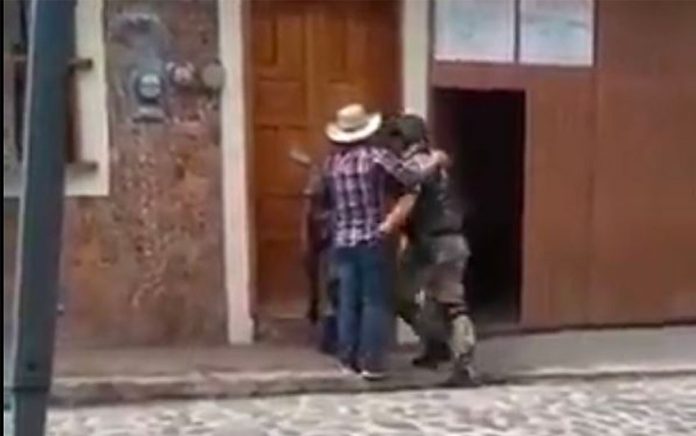
In the video, the guardsman is seen being propped up by a colleague and a civilian as he struggles hard not to fall. The two talk with the inebriated soldier for a minute before ushering him away from the small crowd of onlookers.

In a statement yesterday afternoon, police said that members of the Guard and regional security forces were deployed in Xico on July 22 to deter crime and keep the peace during the town’s patron saint celebrations.

But the absence of three guardsmen was noted during a roll call. A search was ordered and the three were later found in an apparent state of intoxication.

Source: El Universal (sp)

Elemento de la Guardia Nacional fue captado en estado de ebriedad

Amazon inaugurates new distribution center in México state

0
Amazon's new distribution center in México state.
The distribution center is the size of 18 soccer fields.

Amazon has inaugurated its third distribution center in Mexico, the company’s biggest in Latin America.

Amazon México operations director Luis Correa said the new facility covers more than 100,000 square meters in Tepotzotlán, México state.

“These installations are . . . equivalent to 18 soccer fields,” he said. “This is the fourth building we have in México state, where we’ve made a total investment of over US $125 million.”

Amazon’s two other distribution centers are also in the state of México, both in the city of Cuautitlán Izcalli.

Correa added that the Tepoztotlán facility employs more than 1,500 people, and that it started operations in May 2018.

“When you have a building this big, you don’t start all at once,” he said. “We’re going to see how it goes, and make changes, according to the needs of the customers.”

México state Economic Development Secretary Enrique Jacob Rocha thanked Amazon for investing in the state.

“Amazon trusted us since they got here in 2015, with their two centers in Cuautitlán Izcalli, and now in Tepotzotlán,” he said. This is an important investment for México state, which has been growing as a center for logistics.”

Governor Alfredo del Mazo spoke about the importance of investing in projects that make use of technology like the Amazon distribution centers, and said his government will continue to support similar projects in the future.

At the end of 2018, Amazon held the top spot in Mexican e-commerce for the second year in a row, with 36.54% of market share, compared with 35.26% for Mercado Libre and 15.38% for Walmart, according to the consultancy Euromonitor.

Source: El Financiero (sp)

Stadium beer sales suspended after vendors found recycling beer

0
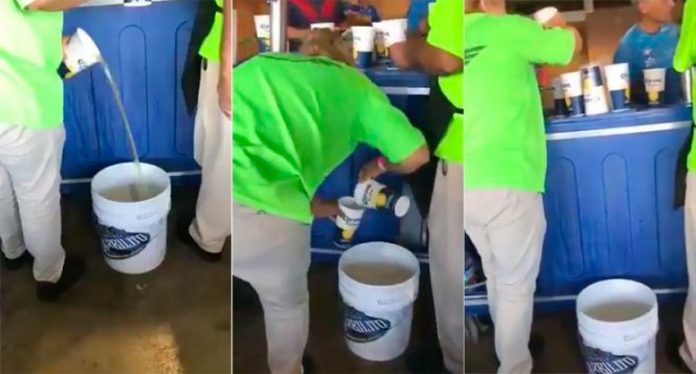
The hidden beer bucket at a stadium in Coahuila.

Health authorities have shut down food and beverage sales at the Territorio Santos Modelo stadium in Torreón, Coahuila — home of the Santos Laguna Soccer Club — after a video appeared showing vendors recycling leftover beer, sparking public outrage and health concerns.

The video shows a bartender dumping leftover beer from a cup into a bucket on the floor behind the bar before filling several other cups from the same bucket and placing them on the counter for sale.

The Santos Laguna Soccer Club told fans in a statement that the Coahuila Secretariat of Health had subsequently inspected the stadium’s food and beverage stands, operated by Eurest Proper Meals, and placed notices of closure outside the facilities.

“We thank the Coahuila Secretariat of Health for their inspection of our facilities and evaluation of our distributor Eurest Proper Meals . . .”

Alejandro Irarragorri, president of the club’s parent company Grupo Orlegi, promised it would take action against the offenders.

“We are totally committed to our fans and we will get to the bottom of this embarrassing incident.”

Source: El Universal (sp), ABC Noticias (sp)

Homicides related to organized crime up 30% in first seven months

0
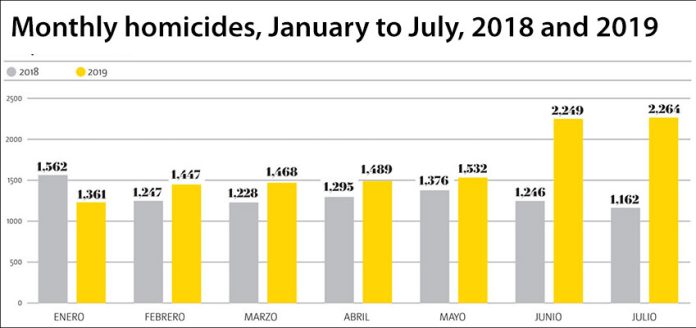
Homicides spiked in June and July.
Organized crime-related homicides spiked in June and July. milenio

The month of July broke a record for the number of deaths by homicide linked to organized crime, according to records kept by the newspaper Milenio.

A total of 2,264 people were murdered during the month, only 0.6% more than in June, but almost twice as many as in July 2018.

It topped off a four-month record-breaking streak: since April, every month has been the most violent since Milenio began counting murders. June was the first month in which more than 2,000 people were murdered.

In the first seven months of 2019, there have been 11,810 homicides, almost 30% more than there were in the same period last year, when there were 9,116.

México state, the most populous state in the country, had the highest number of homicides in July, with 230, an average of almost eight a day. Guanajuato, which previously topped the list of most violent states, followed with 205. Baja California was next with 194, followed by Jalisco with 185, Guerrero 150, Veracruz 130 and Puebla with 100.

The states with the fewest murders were Yucatán with one and Campeche with two.

Source: Milenio (sp)