Gunmen shot and killed two municipal police officers yesterday in San Miguel de Allende, Guanajuato, bringing to 24 the number of police killed in the state this year.
The attack occurred at about 1:40pm on Independencia avenue in the San Rafael neighborhood, located just over a kilometer northwest of the historic center.
The police were responding to a report of gunfire when they were shot at by armed men who got out of a black Honda SUV.
After the attack, municipal police from San Miguel and Dolores Hidalgo, soldiers and state and Federal Police participated in an operation to capture the perpetrators assisted by city security cameras, which tracked the men’s vehicle.
The Guanajuato Attorney General’s Office reported that two of three men believed responsible for the crime were arrested in the neighborhood of Montes de Loreto. Police also seized weapons and the car in which the men were traveling.
The double homicide takes the number of police officers killed in the line of duty in Guanajuato this year to 24, a figure higher than in any other state.
State security commissioner Sophia Huett described the loss of officers’ lives as “regrettable” but added that police slayings are down 42% this year compared to 2018.
“It’s not enough because we want to get to zero homicides, in other words a reduction of 100%. It doesn’t console us to have fewer homicides but we’re working and there are results,” she said.
San Miguel de Allende Mayor Luis Alberto Villareal condemned yesterday’s attack.
“I am terribly sorry about the events and secondly we condemn them. Thirdly, we’re working in coordination with the state, the federal government and the army . . . so that these cowardly acts don’t go unpunished. Fourthly, I feel very proud of the San Miguel de Allende police who did an extraordinary job to be able to follow the alleged perpetrators . . . and achieve their arrest,” he said.
The Baja California Congress yesterday ratified a reform that extends the term of the next state governor, Jaime Bonilla, from two years to five.
Lawmakers first passed legislation to extend the Morena party governor-elect’s term two weeks ago, a move that was condemned by the leadership of the opposition National Action Party (PAN), several federal deputies and senators and a National Electoral Institute councilor, among others.
Bonilla was elected on June 2 and will take office on November 1. Instead of concluding his term in 2021, it now appears likely that he will remain in office until 2024.
Supporters of the extended term have argued that limiting it to two years would be too costly, but opponents say voters went to the polls on the understanding that they were electing a governor for two years.
The purpose of the shortened term was to align the state’s election for governor with the federal mid-term elections.
Ratification of the extended term took place in a hastily-organized special session of Congress held behind closed doors at the Playas de Rosarito municipal palace, located about 200 kilometers from the Congress building in Mexicali.
Congress president Benjamín Gómez convened a meeting at 3:00pm to discuss a petition sent by the federal Congress that asked state lawmakers to reconsider the legislation that extends the next governor’s term.
After the petition was discussed and declared to be in violation of the sovereignty of Baja California, it was announced that a second extraordinary session would immediately take place to ratify the extended term.
Members of the Morena, Labor and Transformemos parties supported ratification as did former deputies of the National Action and Democratic Revolutionary parties who now sit as independents as a result of their backing of the legislation.
The Congress will ask current Governor Francisco Vega de Lamadrid to promulgate the reform by publishing it in the official gazette.
If the PAN governor refuses to do so, as he has indicated he will, Congress will seek to publish the reform directly as permitted by the constitution.
Only a Supreme Court ruling could overrule the reform.
The National Human Rights Commission said last week that it would analyze the viability of filing a claim against the constitutionality of the law, while PAN national president Marko Cortés said on Twitter yesterday that his party will initiate action in the Supreme Court as a result of the decision taken “in the dark” and “outside” Baja California’s official “legislative precinct.”
In addition to criticizing the reform, some state lawmakers expressed their disapproval of the way in which yesterday’s meetings were convened.
“. . . I don’t feel comfortable with a notice [for a session of Congress] that didn’t reach me . . . I found out that the legislature would meet through third parties and the press,” said PAN Deputy Miguel Antonio Osuna Millán.
Another PAN deputy, Eva María Vázquez, said in an interview that the session was “convened illegally.”
She also described the reform as “illegal” and the whole situation as “regrettable.”
President López Obrador last week ruled out any possibility that he would intervene in the matter despite complaints that the extension of the governor’s term is undemocratic and/or illegal.
“It’s my opinion that the relevant authority should settle [the issue] . . . the president’s office won’t interfere in these matters,” he said.
The man at the center of the controversy said in a statement that he would respect any decision handed down by the Supreme Court with respect to the length of his term.
“Now it’s five years but it could change. Independently of that, we’re going to work the same way every day . . . We’re going to move ahead with our projects,” governor-elect Bonilla said.
Critics of the decision to extend his term should wait to see the outcome of any legal challenges, he said.
“Let the Supreme Court decide, but why so much scandal?”
AMLO the corruption fighter represents hope for all Mexicans.
Andrés Manuel Lopez Obrador, better known as AMLO, is a savvy politician who slept on the floor of mud huts in impoverished rural Mexico before rising to the challenge of the Mexican presidency to combat corruption in multidimensional ways starting with big oil companies.
He has gone to war against the immense network of criminal gangs, politicians and businesses that have been sacking Mexico for the last 80 years.
AMLO today represents hope not only for Mexicans but for Latin Americans as well to be part of something better, for both rich and poor. The game is on and the stakes are high!
In July 2018, as president-elect, AMLO acknowledged that he was about to receive a country with an unsustainable economic model, and probably on the verge of collapse. A magical country with a perverse disparity; while one part was bright with a trillion-dollar economy, the other was in darkness with more than 50% of its population living in extreme poverty.
Mexico was at the bottom of most metrics of the Organization for Economic Co-operation and Development (OECD): corruption, bullying, femicide, sexual violence, assassinations, inequality and even tax revenue. To put it mildly, all government institutions were rotten to the core and corruption was rampant.
The Washington Post has said on several occasions that AMLO is the Mexican Trump and at the same time compares the AMLO administration to Venezuela and Cuba. No surprise, given that highly respected media organizations have skewed to the extreme left and are not fans of a populist.
According to the Post’s own words, populist-fueled fragmentation is bad news for democracy. Clearly its corporate ideology blurs cognitive thought for the comprehension of a complex reality.
To understand AMLO’s populist approach, we must understand where we come from. Neoliberalism in the 20th century was a progression of the 19th-century ideas of laissez-fair economic liberalism. In the 1980s Margaret Thatcher and Ronald Reagan led the economic liberalization policies such as privatization, austerity, deregulation and free trade, which were effectively implemented in the developed world.
In Mexico the whole model was tropicalized with a twist; democracy was an illusion; institutions were fragile and the despoiling of government by the governing classes created a profound disrespect for the law from all sides.
Mismanagement and corruption became tangible. Corruption progressed to a point where it was no longer just an aspect of Mexican political life — corruption became its purpose. Many newly privatized conglomerates were given to friends and family. The result was slower growth, decreasing equality, increasing criminal violence and the development of an underclass with no future and no hope.
Before AMLO won the elections, he was questioned by the media pundits of Mexico’s governing class who warned voters that AMLO was a dangerous radical who would drive Mexico into a Venezuela-like economic catastrophe.
‘Te AMLO,’ a play on the phrase ‘te amo,’ or ‘I love you.’
Of course, these are the same guys who had hailed each of the last five neoliberal presidents — Carlos Salinas, Ernesto Zedillo, Vicente Fox, Felipe Calderón and Enrique Peña Nieto — as “honest reformers.”
AMLO’s economic vision includes economic improvement for the poor — in a country where more than 50% are poor — development of new infrastructure, rebuilding of the police, the judicial system and much of the civil service from the ground up.
He holds town meetings and conducts polls to get citizen feedback, and it is the first time in the history of Mexico that people outside the governing class have ever been asked.
Mexico’s labor force was about 52.8 million as of 2015. The OECD and the World Trade Organization both rank Mexican workers as the hardest-working people in the world, a positive title hard to win.
One of the most visible wars AMLO has taken on has been the frontal intervention in Pemex against the vast network of criminal gangs, politicians and businesses that had been looting the national oil company at the rate of more than 60,000 barrels of gasoline a day.
He shut down illegally tapped pipelines, sent in the army to stop tanker trucks from delivering to the black market, sent auditors to seize the fraudulent books and began bringing criminal charges against corrupt managers.
No doubt it was a risky move. Gas supplies suddenly dropped across the country, frustrated motorists could not fill their tanks, freight shipments were delayed and tourism plunged. The Mexican and international media — again — screamed that AMLO was destroying the economy. Within two weeks, supplies were restored.
At a time when persistent inequality is no longer sustainable and much of the neoliberal wisdom has been sent to the trash, most of Latin America — indeed, much of the world — is moving to the right, the 65-year-old López Obrador is an unabashed man of the left, but wise enough to understand that his economic and political rhetoric has to be refurbished for the future, and has to move to the right, in the right direction.
Today AMLO has alliances with the most respectful entrepreneurial associations, has strong bonds with Latin America, Europe and the United States government. He has been recognized by international organizations like the United Nations and the World Bank. Most Mexican entrepreneurs are positively convinced.
The line is clear — economic development and no corruption. But here is a doubt. Will AMLO have the political will to enforce the law against an extremely small yet highly toxic Mexican elite, some of whom have already been red flagged by Interpol?
If so, this might create havoc since their economic and political power is immense in the swamp of the bureaucracy. On the other hand, he could defer to a cordial yet not welcome pardon — the least preferred option among all Mexicans.
In ways such as this AMLO’s presidency could be a game-changer, not only for Mexico, but for Latin America and for the U.S. where economic development, hence immigration, is high on the multilateral agenda.
The risks of having so much depend on one man are real. An assassin’s bullet or a heart attack (he’s already had one) could suddenly throw Mexico and its 130 million inhabitants into chaos and, as several think tanks plainly put it, a civil war.
There is no wall high enough to keep that from spilling over. If AMLO goes down, we all go down.
The writer heads Swiss-based asset manager point5 FAMILY OFFICE and ESG-LAB, which promotes the use of environmental, social and governance metrics to determine risks and opportunities in the performance of investments and companies. He was named one of the Top 100 People in Finance last year by The Top 100 magazine. He holds Mexican and U.S. citizenship.
The Giants of the Mountain won Las Vegas championship for the second year in a row.
A team of indigenous Triqui youths from Oaxaca has once again claimed victory in an international basketball competition.
The “Giants of the Mountain,” as the team is also known, beat another from San Francisco 52-43 to win first place in the “Jam on It” tournament in Las Vegas on Sunday.
The “Niños Triqui” team is coached by Sergio Zúñiga, a former professional basketball player who moved to Oaxaca in 2009 to found the Indigenous Basketball Academy of Mexico, a program to promote sports among indigenous youth.
The Triqui team received media attention in 2013 when it won an international competition in Argentina playing barefoot, which Zúñiga said was a reflection of their impoverished backgrounds. After that, the government provided the team with uniforms and shoes.
The players have continued to dominate in international tournaments, including the Barcelona Cup in 2016 and the Jam On It tournaments.
Barefoot Niños Triquis in 2014.
On his Facebook page, coach Zúñiga said the team is currently in Los Angeles to train, visit universities and play scrimmage games.
“To win, you need talent, to do it again, you need character,” he wrote. “Next year, we’re going for our third championship.”
Thirty-five municipal governments have run up debts with the Federal Electricity Commission (CFE) totaling just under 301.5 million pesos (US $15.7 million).
The city of Tepic, Nayarit, is the state-owned utility’s biggest municipal debtor, according to information on the federal government’s transparency website, followed by Cuernavaca, Morelos.
The Tepic government owed the CFE 158.16 million pesos (US $8.24 million) at the end of May, while authorities in Cuernavaca were in arrears 110.5 million pesos (US $5.76 million).
The combined debt of the two municipalities accounts for almost 90% of the total amount owed by the 35 local governments.
México state capital Toluca owes the third highest amount, followed by Chilpancingo, Guerrero; Culiacán, Sinaloa; Mexico City borough Iztapalapa; Chihuahua, Chihuahua; and Tuxtla Gutiérrez, Chiapas.
Those cities owe CFE between 8.5 and 1.6 million pesos.
The borough of Miguel Hidalgo in Mexico City and the municipality of Querétaro are included among the 35 CFE debtors but only owe nominal amounts of three and 57 pesos respectively.
High-ranking CFE officials, who spoke to the newspaper El Universal on the condition of anonymity, said that a large part of the debt problem is due to the increase in electricity rates and the arrival of new governments that refuse to recognize power bills left by their predecessors, especially if they were of a different political party.
The officials said that electricity rates increased by 7.4% last year and that tariffs have continued to go up this year.
One CFE bureaucrat lamented that the practice of not paying power bills has become commonplace among domestic customers, businesses and both municipal and state governments, costing the utility billions of pesos in revenue.
The official said that the utility is also losing 60 billion pesos (US $3.1 billion) a year due to electricity theft, deficiencies in the national electricity grid, meter anomalies and billing errors.
However, the CFE sources told El Universal that the company is making progress towards more efficient operations.
To reduce electricity and financial losses, new electrical transmission infrastructure is being built, equipment is being modernized and better operational practices are being implemented, they said.
Despite sustaining heavy losses, the CFE agreed in May to cancel 11 billion pesos in debt owed by more than 520,000 customers in Tabasco who joined a “civil resistance” movement against the public utility that began more than two decades ago.
Thieves broke into the Quintana Roo home of prominent journalist and human rights activist Lydia Cacho on Sunday, stealing electronic equipment and “highly sensitive” journalistic work.
The press freedom advocacy organization Article 19 said in a statement that the thieves also killed one of Cacho’s dogs and poisoned the other.
It called the attack on the journalist’s Puerto Morelos home “an act of retaliation” against Cacho’s work in defense of human rights and freedom of expression.
Article 19 regional director Ana Cristina Ruelas told the newspaper El Universal that those responsible were trying to instill fear in Cacho and other journalists and human rights defenders within a context in which the federal government hasn’t attempted to implement public policy that guarantees their protection.
According to the organization’s statement, two unidentified persons entered Cacho’s home at approximately 6:30pm Sunday after cutting the cables of security cameras and deactivating an alarm system.
The thieves stole a voice recorder, three cameras, several memory cards, a laptop and 10 hard drives containing information related to pedophilia cases.
“Fortunately, the journalist has security backups abroad” of all the information that was stolen, Article 19 said.
Cacho is perhaps best known for her 2005 book The Demons of Eden, which exposed a pedophilia ring in Cancún run by businessman Jean Succar Kuri, who has been tried and convicted.
The same year, she was arbitrarily detained, tortured and threatened with rape by Puebla police who were allegedly acting on the orders of then Governor Mario Marín and Kamel Nacif, a businessman known as el rey de la mezclilla (the denim king) who was implicated in the pedophilia ring.
Warrants for the arrests of those two men and two others were issued in April. However, Marín and Nacif remain at large, and both are believed to be living abroad.
In addition to the information theft, the thieves also entered Cacho’s bedroom, went through her personal belongings and destroyed objects including family photographs and her underwear, Article 19 said.
“Security experts consulted by the journalist after the forceful entry assured her that ‘they were going for her’ but fortunately, she wasn’t at home,” the group said.
Ruelas told El Universal that there was a “clear intention to repeat the aggression” to which Cacho has been subjected for her work as a journalist.
“It’s a form of revictimization,” she said, adding that the crime has been reported to the federal Attorney General’s Office and that Cacho is seeking “exhaustive, objective and impartial justice.”
Cacho wrote on Twitter yesterday that as much as people try to intimidate her, she will not stop her work as an investigative journalist.
“. . . Fear will not colonize my spirit. I’m a journalist, I’m a feminist and a defender of human rights . . . To those who threaten me, I say: #HereNobodyGivesUp #Justice #ChildhoodFirst.”
A young Mexican mathematician won first place at the ALOHA Mental Arithmetic International Competition in Guangzhou, China, beating out 900 other children from around the world with his mental math prowess.
Sergio Antonio Luna Álvarez, an 8-year-old student from Querétaro, had previously won ALOHA state and national mental math championships, earning him a chance to compete in Guangzhou on July 20.
Sergio’s mother, Cynthia Álvarez Frías, told the newspaper El Universal that Sergio answered all of his questions in three and a half minutes, winning him the Champions’ Cup, a recognition that is higher than first place and is awarded to competitors who answer the problems in record times with no errors.
“Sergio had been nervous for a month before the competition, but on the day he was very relaxed, he wasn’t nervous, he was very calm and sure of himself,” said Álvarez. “When Sergio finished his evaluation, he came out and told us, ‘I think I’m going to win the Champions’ Cup.’ We always believed in him, even though we were nervous.”
Before the competition, Sergio’s mom helped him practice his skills so he would have the best chance of succeeding.
“Honestly, we did expect Sergio to win, because he prepared a lot. In fact, the last few weeks that he was practicing, he was bored,” said Álvarez. “I got nervous, I didn’t know what was happening, but I realized that he was bored because he already understood everything so well.”
Looking forward, Sergio plans to keep studying mental math with the ALOHA system.
“Now, he knows sums and differences, and after this comes multiplication, division, units, tens, thousands, until finally getting to powers, which takes about four years,” Álvarez said. “He wants to get to the end of the program.”
He was among 79 Mexican students who participated. Forty-nine won some sort of recognition, while 13 were named World Champions after they successfully completed 70 error-free calculations in under five minutes.
The competition focuses on the Aloha mental arithmetic program, which is designed to enhance children’s learning abilities by enabling them to do calculations mentally without the aid of any external tools.
Migrant detention center in Tapachula, Chiapas. government of mexico
Repatriating some of the undocumented migrants detained in Mexico won’t come cheap.
National Immigration Institute (INM) chief Francisco Garduño said immigration authorities are holding 715 immigrants from outside the Americas, and that deporting them will cost the Mexican government 56 million pesos (US $2.9 million).
“Right now, we have 715 migrants we have to send to Asia, Europe and Africa,” he said.
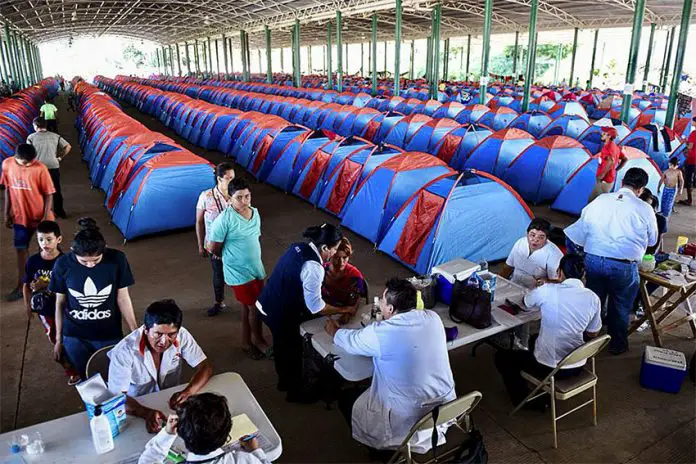
Speaking to reporters at the National Palace on Monday, Garduño said there are 5,000 migrants being held in 66 facilities around the country, and that feeding each one costs about 120 pesos a day.
What do they eat? The food to which they are accustomed, Garduño said.
“. . . based on a human rights recommendation, you can’t give the same food to Chinese nationals as to people from India. You have to give different food to different nationalities based on what they are used to,” he said. “We’re making an effort with the food.”
Garduño admitted that conditions in some migrant detention centers are “deplorable” because of overcrowding and deterioration, and need to be improved. He noted that improvement projects have already started at two of the centers with the worst conditions: Siglo XXI in Tapachula, Chiapas, and the center in Acayucan, Veracruz.
Attention is also being provided to children. “We want minors to be able to have a formal education . . .” he said.
Foreign Secretary Marcelo Ebrard announced that 60 million pesos from the Infrastructure Fund for the Countries of Mesoamerica and the Caribbean, also known as the Yucatán Fund, will be used to improve conditions in detention centers in Mexico.
The fund is a financial cooperation instrument set up by the Mexican government in 2012 to promote infrastructure development projects in Central America, the Caribbean and Mexico.
Garduño also admitted that there continues to be corruption in the INM, despite efforts by the federal government to control it. Since President López Obrador took office, the governmenthas sanctioned 21 INM officials for acts of corruption against migrants, and three officials face criminal charges for extortion of migrants.
Between the white sand and turquoise waters a band of stinky seaweed.
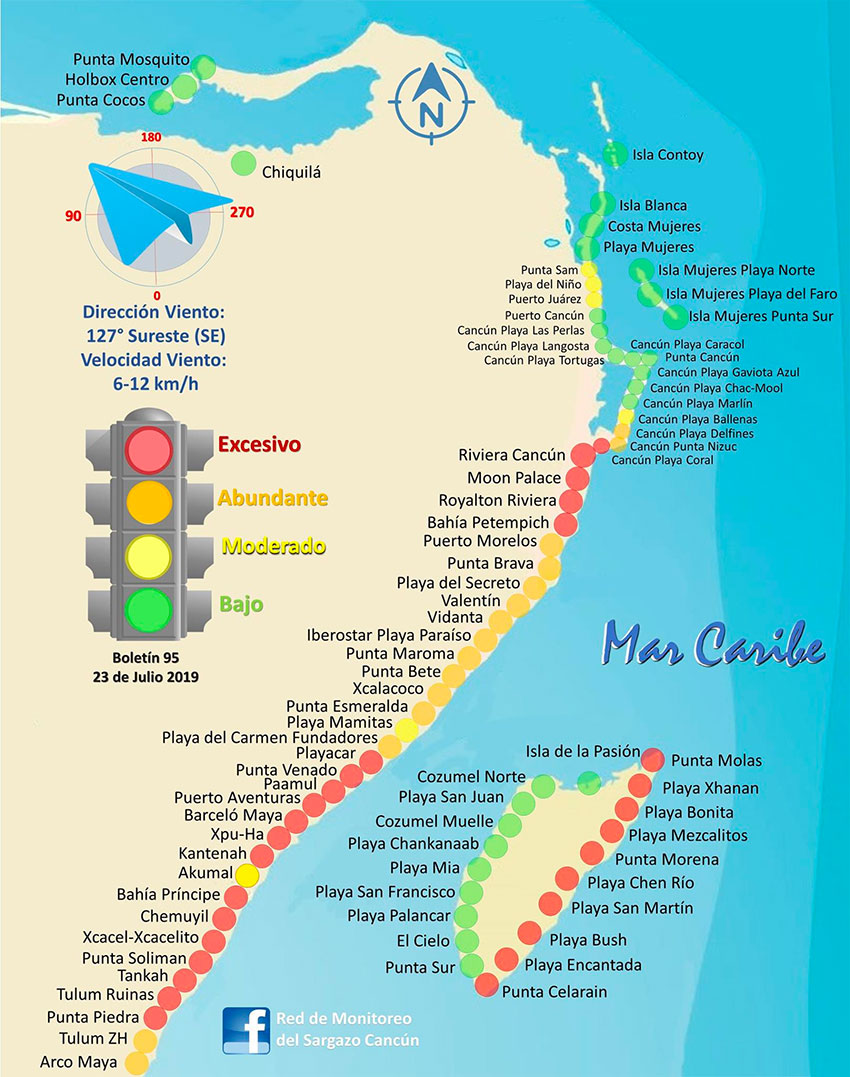
There were excessive amounts of sargassum at 33 coastal locations in Quintana Roo yesterday, according to the Cancún sargassum monitoring network, but the number declined slightly today to 29.
The non-governmental organization’s report showed that Riviera Cancún, Moon Palace, Playacar, Xpu-Ha, Bahía Príncipe, Tulum Ruinas and the entire east coast of Cozumel are among the destinations affected by large amounts of the seaweed.
The monitoring network uses a four-tier “traffic light” system to show the extent to which Quintana Roo beaches are affected by the smelly weed. The number of locations with a red light increased to 33 from 19 in just 24 hours.
Most beaches between Puerto Morelos and Playa del Carmen are currently affected by “abundant” amounts of sargassum, the second highest tier on the network’s system.
The sargassum monitoring network’s map as of Tuesday morning.
Although the sargassum situation quickly worsened this week, network chief Esteban Amaro said that more beaches were affected by excessive quantities of weed in April and May.
Still, he charged that the navy’s strategy to combat the arrival of the macroalgae is not working.
“The navy’s efforts are practically being exceeded. I believe that the navy has [just] one [sargassum-gathering] vessel and obviously for 700 kilometers of coast in Quintana Roo, it’s not enough . . .” Amaro said.
The Secretariat of the Navy (Semar), which was given the responsibility for leading the efforts to combat the arrival of sargassum in early May, reported that between the start of that month and July 15, it collected almost 39,000 tonnes of sargassum.
Of that amount, just 219 tonnes were removed from the sea, indicating that the anti-sargassum strategy has been largely ineffective in preventing the seaweed from reaching Quintana Roo beaches.
Semar announced that it will build four new catamaran-style boats designed to collect sargassum from the sea but it is unclear whether any of them will be ready to assist in the fight against seaweed this season, even though navy chief José Rafael Ojeda said the first would be finished by July 24.
The navy also said earlier this year that it was looking at purchasing additional sargassum barriers but it has made no further announcement about the plan.
The mayor of Benito Juárez (Cancún) said that Semar asked her government to contribute 23.8 million pesos (US $1.2 million) to the efforts to combat the arrival of sargassum but added that no money would be transferred until there was more clarity about when the new sargassum-gathering vessels will be ready.
“Their plan is to collect sargassum in the sea. We’re waiting for them to tell us when the sargassum vessels will arrive . . .” Mara Lezama said.
UPDATE (5:45pm CDT, July 24): Rain, wind and ocean currents have reduced sargassum quantities significantly since Tuesday. The sargassum monitoring network map, published Wednesday afternoon, shows just five locations where the seaweed is excessive. All are on the east coast of Cozumel.
Actress Yalitza Aparicio, center, with Guelaguetza dancers in Oaxaca.
The 87th edition of the Guelaguetza kicked off yesterday in Oaxaca city, where the annual celebration of the indigenous traditions of Oaxaca’s eight regions drew a record-breaking 15,000 visitors.
Yalitza Aparicio, the star of Alfonso Cuarón’s Roma and the face of this year’s Guelaguetza, was in attendance, accompanied by Oaxaca Governor Alejandro Murat and federal Tourism Secretary Miguel Torruco Marqués.
The delegation of Chinas Oaxaqueñas from the state’s Central Valleys region launched the festivities with a lively jarabe, balancing baskets of flowers on their heads as they whirled around the auditorium with giant paper-mâché figures, huge paper lanterns and decorative symbols.
They were followed by representatives from Chicapa de Castro in the Isthmus of Tehuantepec, who delighted the audience with The Kidnapping and the Carrying of the Trunk, a representation of a traditional wedding in the region.
Delegations from Chalcatongo de Hidalgo, Sola de Vega, Huautla de Jiménez and Tlaxiaco also presented traditional dances from each of their regions, culminating in an emotional performance of Canción mixteca, a famous song by Oaxacan composer José López Alavez that evokes the loneliness and longing he felt while living far from his home state.
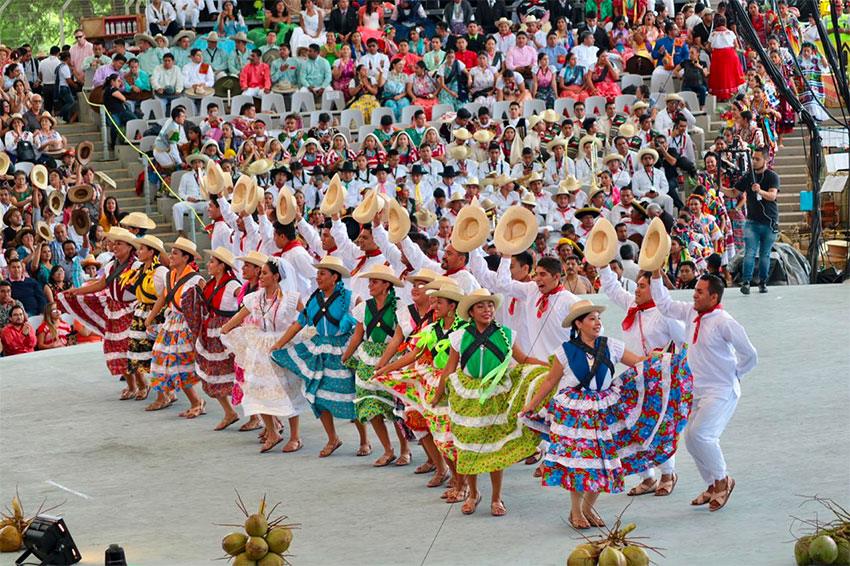
Dancers on stage yesterday at Latin America’s biggest ethnic festival.
The audience gave loud approval for the myriad colors and intricate choreography displayed in other spectacles, from the dancers of Santa María Tlahuitoltepec with their sones mixes, to a feather dance by representatives from Zaachila, and even The Taking of the Turkey by the delegation from Ocotlán de Morelos, among many others.
The celebration reached a climax when, during the presentation of the delegation from Putla Villa de Guerrero, the dancers invited the representatives from the other 22 delegations to join in the fun. Even Governor Murat could not contain himself from moving to the happy rhythms of the Mixtecan sones and chilenas.
The event closed with a fireworks display, kindling the celebration’s festive spirit in one of the largest crowds of spectators the Guelaguetza has ever seen.
A variety of other festivities will follow throughout the week until next Monday when the dancers will once again meet at the auditorium to continue with the second show, another vibrant spectacle of colors, dance and age-old traditions.