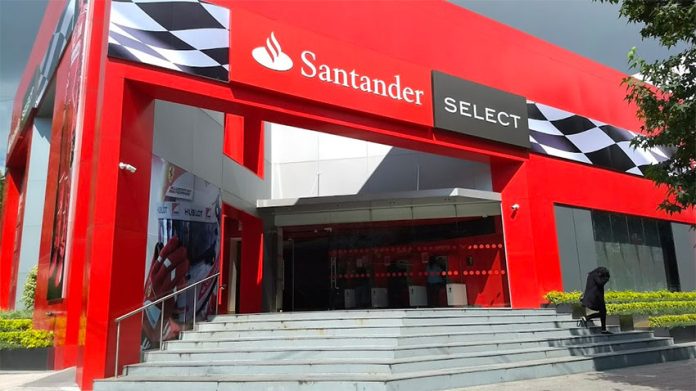
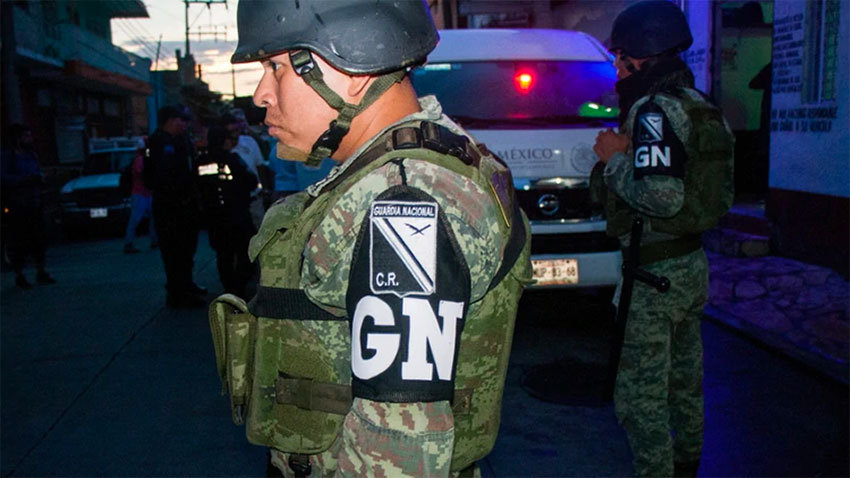
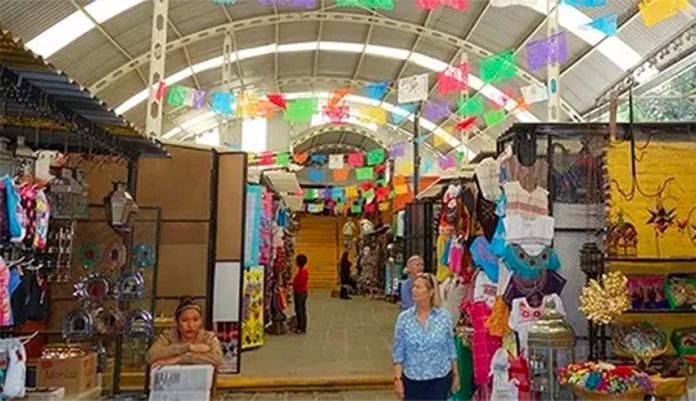
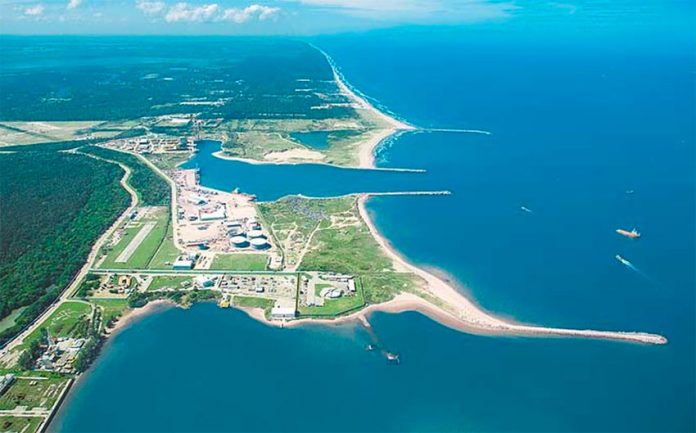
Polanco is one of the neighborhoods where thieves target banking customers.
Robberies targeting people leaving banks in Mexico City have more than doubled in the first six months of 2019, according to an analysis by the newspaper Milenio.
There were 313 robberies committed against people who had just withdrawn cash from banks, 111% more than in the same period in 2018.
Most of the incidents occurred in affluent areas with high concentrations of offices and middle and upper class residences.
The three areas with the highest rates of robbery were the Polanco neighborhood and the adjacent neighborhoods of Granada and Anáhuac, followed by Del Valle and Roma Norte.
The robberies usually occur within three and five blocks of banks. In Polanco, most of the crimes targeted customers of the Multiva and Santander banks on Presidente Masaryk avenue, while in Roma Norte most of the robberies took place near the Glorieta de los Insurgentes.
The unidentified officer, right, turns in the cash left at an ATM.
Mexican police have a poor reputation for honesty but not all can be painted with the same brush.
In two separate incidents, two Mexico City police officers turned in cash to authorities after failing to locate the owners who had left it behind.
On Friday morning, a member of the auxiliary police force found US $1,100 in $100 bills at the Mexico City airport. Although the sum is roughly equal to two months’ salary, the officer immediately reported the discovery and turned in the money at the airport’s security center. No one has yet claimed it.
In another incident, a member of the banking and industrial police found 4,200 pesos (US $220) left in an ATM at the World Trade Center in the Nápoles neighborhood of Mexico City yesterday afternoon. Following police protocol, the officer first attempted to locate the owner.
After being unable to do so, the officer turned the money over to his superior, who informed him that the cash would be held for one day at a security desk before being turned over to the bank where it was found.
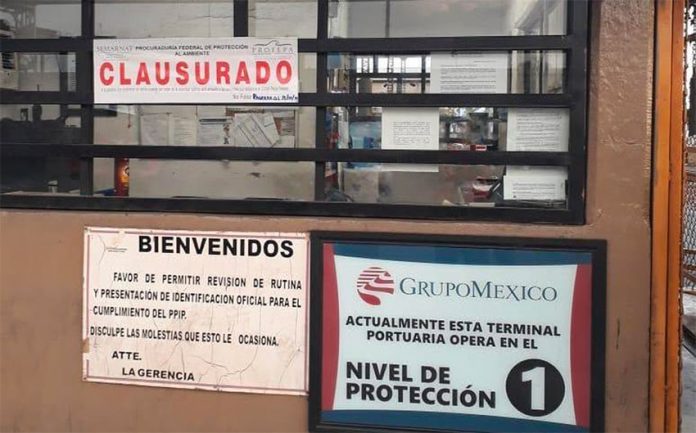
Grupo México's Guaymas terminal after it was closed by Profepa.
A Port of Guaymas terminal where a sulfuric acid spill took place on July 9 will be temporarily shuttered, the environmental protection agency Profepa announced Saturday.
According to a Profepa press release, the terminal owned by Grupo México will be closed because the mining company did not have environmental authorization from the Secretariat of the Environment and Natural Resources (Semarnat).
Profepa carried out two inspections of the terminal after the spill, the first on July 10 and the second on July 16. Although it found that the company was lacking the required documentation, the agency has not determined the scale of the environmental impact of the accident.
The closure applies to all Grupo México facilities in the Port of Guaymas used for the storage and loading of sulfuric acid. Other company facilities will remain open.
According to Grupo México, a report by the navy found that the spill did not cause serious environmental damage because the 3,000 liters of acid were rapidly diluted and neutralized when it spilled into the sea.
“The spill was inoffensive, and it was determined that there was no effect on the flora or fauna in the port area, according to the navy report,” a company statement read.
The report referred has not been made public and the navy did not respond to a request for comment.
On Tuesday, Semarnat announced that it will investigate Grupo México’s history of environmental accidents, although Secretary Víctor Manuel Toledo said it was likely the July 9 spill has not had a serious environmental impact.
The weekend totoaba release in Baja California Sur.
An aquaculture company released 40,000 young totoaba into the ocean in Baja California Sur on the weekend, declaring the fish would never become extinct.
Earth Ocean Farms released the young fish into Bahía Concepción in Mulegé, where director Pablo Konietzko told the newspaper Milenio that with the release of the juvenile fish, which were grown in a laboratory in La Paz, the survival of the species is “guaranteed.”
“I can guarantee that the totoaba will never go extinct, because we can grow them in captivity, unlike the vaquita marina,” he said. “That makes us very happy, it’s a contribution to aquaculture and the preservation of species.”
The company began growing totoaba in captivity in 2012, using fish held by the Autonomous University of Baja California. In 2014, it received permission from the Secretariat of the Environment (Semarnat) to capture 60 totoaba for breeding. The following year, the first 15,000 juvenile totoaba were released. Counting the 40,000 released last weekend, 110,000 totoaba have been released to date.
The totoaba has been endangered for several decades because of overfishing. The fish is prized for its swim bladder, which is considered a delicacy in certain parts of Asia and can fetch prices of around US $500 per kilo in Mexico and $10,000 per kilo on the international market.
Young totoaba are raised in La Paz.
Illegal totoaba fishing has also led to the near extinction of the vaquita marina, a marine mammal endemic to the Gulf of California. Vaquitas often die when they are trapped in nets used by totoaba fishermen. Earlier this year, a conservation group estimated that only 10 vaquitas remain in the wild.
Earth Ocean Farms also produces farmed totoaba for the domestic market, selling the fish to restaurants in Mexico. A kilo of totoaba meat costs about 280 pesos (US $15), and the company produces 250 tonnes a year.
Konietzko noted that his company only farms totoaba and does not fish for them.
“We have nothing to do with illegal or extractive fishing,” he said. “We don’t get any totoaba from the sea, our whole cycle is closed. The fishing of that species, and the problems it creates for the vaquita marina, has nothing to do with us.”
A federal judge sentenced the former leader of the infamous Los Zetas cartel to 18 years in prison for operations involving illegally-sourced funds and for possession of illegal firearms.
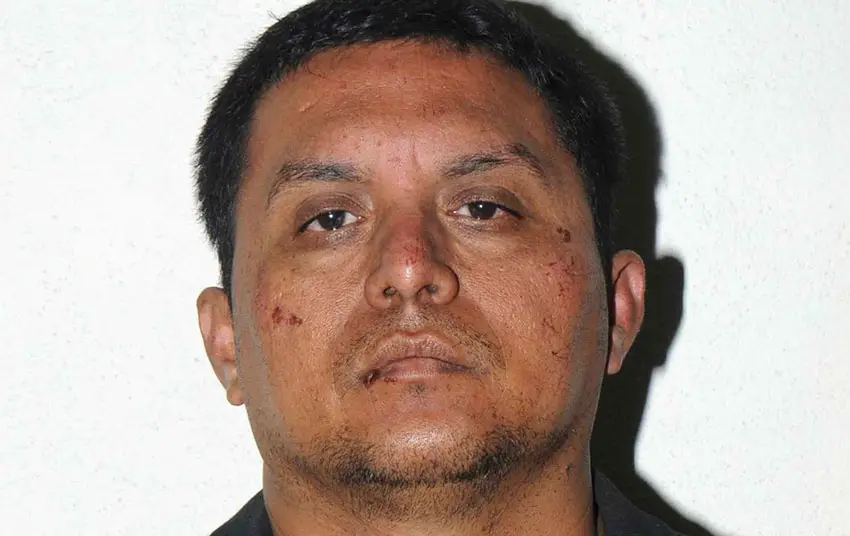
Óscar Omar Treviño Morales, known as “El Z42,” once bragged he had killed 1,000 people. He has several other criminal charges pending.
Treviño, 45, took over leadership of the Zetas after his brother Miguel Treviño Morales was arrested in July 2013. He ranked near the top of the previous federal government’s most-wanted list and was considered to be one of Mexico’s most violent cartel leaders, leading Mexican authorities to offer 30 million pesos (close to US $2 million at the time) for information leading to his capture. North of the border, United States authorities offered $5 million.
Omar Treviño was captured by federal forces in 2015 at one of his homes in San Pedro Garza García, Nuevo León, one of the wealthiest municipalities in Mexico.
The judge also handed down sentences to several other former members of the Zetas.
Miguel Treviño, Omar’s older brother, was arrested in 2013.
The gang was formed in the 1990s by former military personnel as the enforcement arm of the Gulf Cartel. The gang later broke off and engaged in a bloody and enduring feud with its parent organization, battling the Gulf Cartel and others for control of drug routes and territory in Tamaulipas, Coahuila and Nuevo León. The conflicts led to a record increase in homicide, drug trafficking, extortion and kidnapping in those states.
Los Zetas had a reputation for being one of Mexico’s most vicious cartels, often torturing and beheading their victims before hanging them from bridges and other public spaces. The organization began to fragment after Miguel Treviño’s arrest.
Omar Treviño was thought to be less intelligent than his brother but he did have a reputation for ruthlessness. The former is believed to have been responsible for the 2010 massacre of 72 undocumented migrants in San Fernando, Tamaulipas, and the 2011 fire at the Casino Royale in Monterrey, Nuevo León, that killed 52 people.
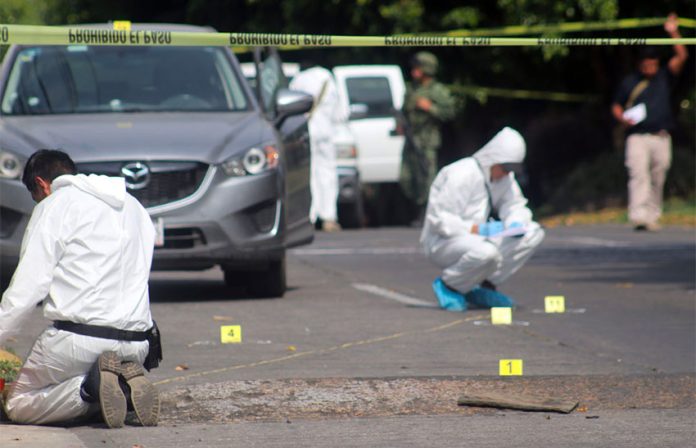
Paul Nielsen of Utah was murdered in Petatlán, Guerrero.
Community police in Guerrero allegedly shot and killed a couple from the United States and wounded their son.
Paul Nielsen of Utah and his wife Janeth Vázquez, originally from the state of Puebla, and their 12-year-old son were traveling from Acapulco to Zihuatanejo when they were shot in the municipality of Petatlán.
According to a report published on by the news website SDP Noticias, the attack occurred at about 3:30am last Thursday after the family’s vehicle failed to stop at a roadblock set up by community police between the towns of Santa Rosa and Juluchuca.
The car was intercepted by armed men who ordered the three occupants to get out and shot Nielsen, 48, and Vázquez, 43, in the head. Their bodies were later found by state police.
Kevin Joel Rojas Vázquez sustained non-life-threatening injuries and was taken to a community hospital in Petatlán. The boy, who reportedly suffered a nervous breakdown, was later discharged and transported to Zihuatanejo, where he provided a statement to authorities.
[wpgmza id=”220″]
Nielsen’s sister, Vilate Ssempala, told the Salt Lake Tribune that she wasn’t aware of any investigation to capture those responsible for the crime.
However, Guerrero Governor Héctor Astudillo said Friday that investigating the case was a priority.
Ssempala also said that her family has been working with the United States Embassy in Mexico to have Nielsen’s body returned. A GoFundMe page has been set up to raise funds to help with the expense of transporting the body.
Ssempala said that while growing up her brother was known as “Perfect Paul” because he was a stickler for following rules.
“He was very deliberate in everything that he did and very organized,” she said.
The United States Department of State said in a statement Saturday that it was aware of reports of Nielsen’s death but added that “out of respect for the family during this difficult time, we do not have additional information to provide.”
There were 85 new murder cases per day last month.
The latest homicide figures indicate not only that June was the most violent month so far this year, but the first six months of the year were the worst on record, according to official data.
There were 2,560 intentional homicide cases last month and 14,603 cases between January and June, the National Public Security System (SNSP) reported on Saturday.
The latter figure is a record for the first half of a year — 4.4% higher than the previous record of 13,985 homicide cases, which was registered in the first six months of last year. The figure is 22% higher than the same period of 2017.
The total number of homicide victims between January and June was 17,138, an increase of 7.2% compared to the same period last year. The figure is higher than the number of cases because there are two or more victims in some investigations.
Homicide cases increased 3.5% last month compared to May and 8% compared to June of last year. Authorities opened an average of 85 new murder cases every day last month.
Baja California was the most violent state in June, followed by Chihuahua, Guanajuato, México state and Jalisco.
In per-capita terms, Colima led in the first half of the year. The small Pacific coast state recorded 40.7 homicides per 100,000 inhabitants between January and June, 3.5 times higher than the national rate of 11.6.
Baja California was next, with a murder rate of 34.1 per 100,000 followed by Chihuahua, 27.6; Guanajuato, 23.1; and Morelos, 22.7.
However, in terms of sheer numbers, Guanajuato was the most violent state during the first six months with a total of 1,383 homicide cases.
México state was the second deadliest with 1,315 cases, followed by Baja California, Jalisco and Chihuahua, all of which recorded more than 1,000 homicide investigations.
In contrast, there were just 16 intentional homicide cases in Yucatán, the lowest of any state.
There are high expectations for the the new National Guard.
The next lowest number of cases was recorded in Campeche, with 28, followed by Baja California Sur, Aguascalientes and Durango, with 42, 47 and 70 cases respectively.
In Mexico City, there were 786 murder investigations during the first half of the year, making the capital the seventh most violent entity in the country.
In the first six months of the year, femicides, kidnappings and extortion also increased compared to the same period last year.
The new security force, the centerpiece of the government’s security strategy, wasn’t deployed nationally until the start of this month, meaning that its effectiveness cannot be realistically measured until homicide statistics for July are released next month.
President López Obrador last month admitted that his administration has not yet made progress in combating the high levels of insecurity but blamed previous governments for the problem.
In addition to expressing confidence that the National Guard will be successful in reducing violence, the president has said that his government’s social programs and crusade against corruption will help pacify the country.
Francisco Rivas, director of the National Citizens’ Observatory, a crime watch group, said that “social policies are very important” and “we agree they’ll have positive effects.”
However, he added that the positive effects will not be seen in the short term.
Vendors at the artisans' market are among those forced to pay extortion.
The crackdown on fuel theft has had an unwanted effect in San Miguel de Allende — an increase in crime, according to businesspeople.
There have been around 65 homicides in the municipality so far this year — there were three during the same period last year — and extortion cases are also on the rise.
Local business owners told the newspaper El Universal that crime spiked in the municipality after the federal government’s crackdown on fuel theft.
Members of the Santa Rosa de Lima Cartel began to diversify their criminal activities and found a fertile hunting ground in the colonial city.
The Jalisco New Generation Cartel (CJNG), which is engaged in a bitter turf war with the Santa Rosa gang, also operates in San Miguel.
The charging of extortion fees known as derecho de piso has become widespread, the business owners said, explaining that everyone is forced to pay.
That includes stallholders in the artisans’ market and proprietors of the city’s most popular nightclubs, they said.
One business owner identified only as Alice said she had heard that artisans are charged monthly extortion fees of between 5,000 and 10,000 pesos (US $260 to $520), which she described as “unacceptable.”
She said both violence and extortion were affecting businesses “in a brutal way,” adding “we don’t want to even imagine what will happen the day that something happens to a visitor.”
Another business owner, who asked to be identified only as Oropeza, said he never imagined that he’d see people gunned down in commercial areas of San Miguel as occurred earlier this month on Conspiración boulevard near the La Placita Market.
Three people were killed in the attack including a 14-year-old girl, after which municipal councilor Humberto Campos asked residents not to share news stories about violence in San Miguel in order to promote a “good image” for the municipality.
Oropeza, whose son was murdered in February, said both municipal and state governments are deliberately trying to keep news about violence quiet because “they know we live from tourism.”
The federal Attorney General’s Office (FGR) has identified suspected CJNG member Ramiro “N” as the principal instigator of violence in San Miguel.
An FGR report says that the alleged criminal also known as “El Perro” (The Dog) was arrested in November on drug trafficking and organized crime charges but was released in February.
The CJNG operative allegedly recruits young people in San Miguel de Allende to sell drugs such as marijuana, cocaine and methamphetamine.
Although the story today in El Universal reported that San Miguel was the third most violent municipality in the state, homicide figures show otherwise. Mexico News Daily records indicate there have been 65 homicides this year, well behind other violent municipalities such as Salvatierra, Salamanca and Abasolo.
However, homicide statistics from December through May put San Miguel in 39th place on a list of Mexico’s most violent municipalities, with a murder rate of 51.9 per 100,000 people.
Guanajuato has recorded more homicides than any other state since the new federal government took office in December.
Information in the environmental impact statement (EIS) for the new refinery in Tabasco is incomplete and the project shouldn’t be approved, environmental groups warn.
Greenpeace México, the Mexican Center for Environmental Law and two other organizations claim that the EIS presented by Pemex doesn’t provide “complete, exhaustive and adequate information that takes into account the principles of prevention and precaution in order to guarantee the right to a healthy environment.”
The lack of fundamental information makes it impossible for the US $8-billion project to be evaluated in a comprehensive and objective way and therefore cannot be approved, the groups said.
Pemex said that the impacts on the environment “will be controlled, mitigated or compensated” and the operation of the refinery “will totally comply” with existing environmental laws.
However, in a letter to the ASEA, the environmental organizations charge that the EIS doesn’t reveal the full extent of the impact that the project will have on the environment.
They said it doesn’t provide information about smaller projects associated with the refinery, which could damage habitats, modify the site’s natural drainage features and involve the clearing of yet more mangroves.
The groups also said that the impact statement fails to include information about preparatory work required at the site and the roads and railways that will link to it, and charged that Pemex has presented the project as if it will comply with all environmental regulations when there is evidence that it will not.
The organizations said the EIS fails to mention that 212 hectares of vegetation have already been illegally cleared, doesn’t set out a rescue and relocation plan for native animals and omits details about the project’s impact on hydrological flows at the site.
They pointed out that even the state-owned Mexican Institute of Petroleum, which worked on the EIS, has previously said that the site is not appropriate for a refinery.
A 2008 report by the institute said that among the factors that made the site unsuitable was that it’s home to a range of protected and endangered species including the howler monkey, the northern tamandua anteater and the Mexican crocodile.
Energy Secretary Nahle: the refinery will be built.
The report also said that extensive preparation would be needed due to the presence of lagoons and swamps, that it is prone to flooding and that it has significant potential to be used for ecotourism.
“It’s clear that the site . . . is a priority ecosystem for conservation,” the letter said, concluding that “in consideration of everything expressed here . . . the ASEA must issue a negative environmental impact ruling.”
Investors and ratings agencies have also criticized the refinery project, arguing that it will divert funds from Pemex’s more profitable exploration business.
But Energy Secretary Rocío Nahle said this week that the government would not be deterred by the opposition.
“This government will build it,” she said in a radio interview on Thursday.
“Why would we backtrack on that? It is a viable project, it’s a necessary project, it’s a Pemex project.”
President López Obrador announced in May that the oil company and the Secretariat of Energy would build the refinery because the bids made by private companies were too high and the project would take too long.
He has pledged that the refinery will be ready in May 2022 and that it will help reduce Mexico’s reliance on imported petroleum.
Once open, it is expected to process 340,000 barrels per day of Mexico’s flagship grade, Maya heavy crude.
A new dining experience in Yucatán offers a different — and lofty — perspective of turquoise sea and white sand.
Dinner in the Sky seats up to 22 people who are suspended from a crane 45 meters above the ground.
Each seat is equipped with a safety harness, but diners can recline in their chairs to feel the wind in their hair and get a better view of the ground far below.
The service is being offered until August 11 at the Grand Marina Kinuh Hotel in Telchac Puerto, about an hour from Mérida.
Dinner in the Sky offers breakfast, lunch and dinner and each dish incorporates regional Yucatán flavors. Meals can be purchased in packages for between 2,500 and 2,800 pesos (US $130 and $147) per person.
Lunch and dinner “flights” are limited to adults over 18, although children are welcome for breakfast.
Dinner in the Sky first began in Belgium in 2006 but has since expanded to 54 countries around the world. In Mexico, the experience will be offered this fall in Morelia, Michoacán, at the pyramids at Teotihuacán and in Mexico City.