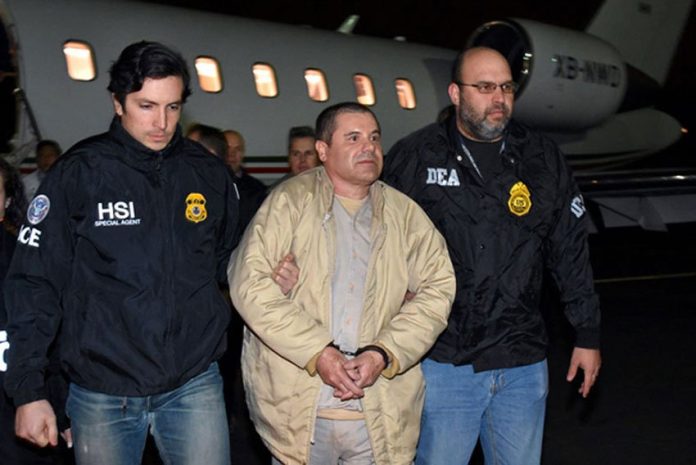
The DEA uses their own aircraft for some extraditions, which can be time-sensitive.
United States authorities are seeking a court order for the forfeiture of nearly US $12.7 billion by convicted Mexican drug lord Joaquín “El Chapo” Guzmán.
The amount sought by prosecutors represents the total amount of illegal drugs a jury determined that Guzmán had trafficked to the United States multiplied by the average price of those narcotics, according to a motion filed in a New York court.
The former head of the Sinaloa Cartel was found to have obtained just over $11.8 billion in illicit resources as a result of the trafficking of cocaine, $846 million from marijuana sales and $11 million from heroin.
The cocaine revenue came from the shipment of more than 528 tonnes of the drug to the United States.
United States authorities are “entitled to forfeiture of all property that constitutes or is derived from the defendant’s narcotics-related crimes, as well as any property that facilitated the commission of those crimes” said a motion filed by attorney Richard Donoghue.
However, the news agency Reuters reported that it wasn’t immediately clear what assets United States authorities could seize to satisfy the amount sought.
Jeffrey Lichtman, a lawyer for the notorious drug lord, said “this is largely an academic exercise as the government has never located or identified a penny of this $12.7 billion in proceeds supposedly generated by Mr. Guzmán.”
Guzmán was found guilty on 10 charges of drug trafficking on February 12 after a three-month trial during which jurors heard testimony about the inner workings of the Sinaloa Cartel and intimate details about the lavish life of its onetime leader.
He will be sentenced on July 17 and is expected to be given life imprisonment.
On Wednesday, Judge Brian Cogan denied a request for Guzmán’s guilty verdict to be set aside and for another trial to be held.
Lawyers for the 62-year-old trafficker argued for a trial after Vice News published an interview with an unnamed member of the jury that convicted Guzmán.
The juror said that at least five other jurors violated the judge’s orders by following the case in the media during the trial.
Government prosecutors opposed a retrial on the grounds that the veracity of the interview that Vice News published could not be verified.
Mexico extradited Guzmán to the United States in January 2017, a year after he was captured in Los Mochis, Sinaloa.
Six months before that, the drug lord escaped from a maximum security penitentiary in México state via a tunnel, his second prison break after exiting a Jalisco jail in a laundry cart in 2001.
As he awaits his July 17 sentencing appearance, Guzmán is being held in a federal jail in Manhattan. His 91-year-old mother was granted a humanitarian visa last month so that she can visit her son in prison.
“I hope they will allow me to give him a hug . . . and I wish they would free him,” María Consuelo Loera Pérez said.
Mexican fencer Pleigo is now a citizen of Uzbekistan.
Mexican fencer Paola Pliego announced this week that she had become a citizen of Uzbekistan and would no longer represent her country of birth in upcoming competitions.
But she is by no means the first high-level athlete to have turned her back on Mexico – at least five others have recently done the same.
Pliego cited corruption at the National Sports Commission (Conade) for her decision to switch allegiances to the central Asian nation of Uzbekistan.
The fencer missed out on the opportunity to compete in the 2016 Olympic Games in Rio de Janeiro, Brazil, because she tested positive to the banned substance modafinil in the lead-up to the event.
But it was later revealed that the test carried out by a Conade laboratory had mistakenly shown that Pliego had taken the banned drug when in fact she had not.
Linda Ochoa said she will compete for the United States.
In a statement, the fencer slammed Conade chief Ana Gabriela Guevara and the president of the Mexican Olympic Committee, Carlos Padilla, for not having supported her through the ordeal she faced.
“Why did they do that to me? How did I go from being someone who filled them with pride to someone who inconvenienced them so much?” she asked.
Pliego will represent Uzbekistan at the World Fencing Championships in Budapest, Hungary, later this month and if all goes to plan she will compete under the country’s flag at the 2020 Olympics in Tokyo, Japan.
Other athletes have abandoned Mexico in recent times for a variety of different reasons.
Taekwondo practitioner Damián Villa, a native of Zamora, Michoacán, announced last year that he would compete for the United States, a country of which he is also a citizen.
He said that he made the move north because only two athletes per country can compete in grand prix events and “there are already two excellent athletes with very established positions” in Mexico’s taekwondo team.
In 2017, archer Gabriela Bayardo moved to the Netherlands and now competes under the Dutch flag, while diver Jonathan Ruvalcaba decided to try his luck in Colombia after missing out on the selection for the 2016 Olympics.
He later switched allegiance to the Dominican Republic and will represent the Caribbean nation at the World Aquatics Championships in Gwangju, South Korea, this month.
Another diver, Kevin Chávez, took up an invitation to join the Australian diving team after a long injury layoff.
Yet another athlete who has given up the red, green and white of Mexico is archer Linda Ochoa, who has announced that she will compete for the United States.
The 32-year-old Guadalajara native had problems with sporting authorities and fellow competitors for some time before she decided to pull the pin on competing for Mexico.
In January, Ochoa said she was taking an indefinite break from competing in archery events, citing a lack of funding as the main reason for her decision.
However, she also said that she was sick of the “deception and blackmail” of other archers.
The giant likeness of Frida Kahlo, part of the weekend exhibition in Mexico City.
The Mexico City zócalo will come alive this weekend with the vibrant colors of Mexico’s most famous artist in a floral and photographic open-air exhibition to celebrate the 112th anniversary of Frida Kahlo’s birth.
The display, called “The Colors of Frida,” will include works and installations by 32 artists from the United States, Australia, France, the United Kingdom, Spain, China, Brazil, Germany, Finland, Greece, Italy, Portugal, Japan, Switzerland, Turkey and Mexico.
Some of the works include walls painted with subjects that reference Frida’s colors and most popular themes, such as pro-indigenous sentiment, Mexican nationalism and highly personal expression, as well as giant painted sugar skulls, arches and pathways lined with flowers and lush vegetation and — to crown the exhibition — a giant Frida lying in a bed adorned with vivid Mexican colors and themes.
There will be lots of color in the zócalo this weekend.
The exposition is an initiative by the nonprofit organization Alliance Graphique Internationale, which has previously exhibited the display at the Mexican consulate in Dallas, Texas, the University of North Texas, in Rio de Janeiro, the University of Monterrey, the El Rule Gallery in Mexico City and most recently at the Mexican Cultural Institute of New York.
The exposition will be on display in the zócalo Friday through Sunday. Admission is free.
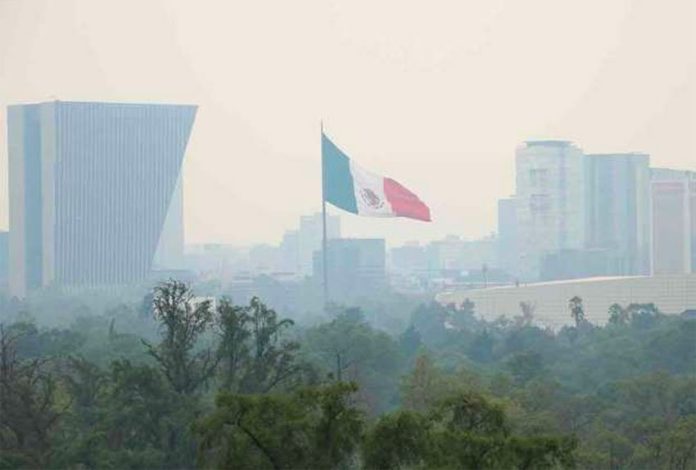
The environmental contingency program that stipulates when air pollution alerts are issued in Mexico City has been temporarily suspended due to legal action taken by Greenpeace.
Under the regulations set by the Environmental Commission of the Megalopolis (CAMe) in May, an environmental contingency is declared when the city’s Imeca index, which measures the quantity of fine particulate contaminants in the air, reaches 150.
But as a result of an injunction granted to Greenpeace, the government’s contingency program has been put on hold and contingency measures must be activated when the Imeca index hits 101.
CAMe chief Víctor Hugo Páramo explained that the environmental organization is seeking to align the activation of contingency measures to Mexico’s health protection regulations, which are stricter than those established by the government’s contingency program.
Once a judge makes a definitive decision about the Greenpeace legal challenge, CAMe will adjust its current protocols if need be.
“. . . When we have certainty about the judge’s ruling we will have to create a special protocol . . .” said Environment Secretary Marina Robles.
Despite that commitment, the head of Mexico City’s air quality measuring system said that Greenpeace’s proposal goes too far.
“The official Mexican [health] regulations are one thing and an environmental contingency is another issue. It wouldn’t make sense,” Sergio Zirath said, adding that authorities would have to order cars off the road every day of the week.
CAMe established a new environmental contingent program in May shortly after Mexico City suffered several days of severe air pollution caused by fires in and around the capital.
In early June, the environmental commission presented 14 proposals aimed at reducing contamination including the introduction of stricter emissions limits for new cars and an expansion of the public transit system.
A blindfolded visitor gives Be My Eyes a practical test. The app was developed to help the blind get around.
Technovation is the world’s largest program aimed at introducing girls aged 10 to 18 to technology entrepreneurship.
It is promoted by the global non-profit organization Iridescent and it is entirely free. It is supported by well-known companies like Google, Oracle, Adobe, Uber and Samsung and is endorsed by the likes of UNESCO and even the U.S. Peace Corps.
But I bet you have never heard of it, and you might wonder why, last year, 20,000 girls from 115 countries took part in it. What could possibly entice kids to spend hours of their free time, on weekdays and weekends, over a period of three to five months, learning computer programming and business skills?
I am in Guadalajara, Mexico, and I aim to find out. Mexico has been participating in Technovation for six years and every year more girls from more Mexican states have opted to participate. Now, June 29, 2019, the first national Technovation competition is being held at a large hall at Monterrey Tec University.
The room is bustling with activity. Along one wall 12 small stands are lined up and at all of them, small teams of girls are demonstrating their creations to anyone interested. By now I know that each of these teams has created an app, a little program that works on a smartphone.
An app called Opus helps the handicapped find jobs with open-minded employers.
Although I am one of the world’s most reluctant users of smartphones, I am open to learn something new, so I pick a stand at random and walk right up to the five girls standing there.
“Buenos días, I understand you girls have invented an app . . . can you tell me about it?”
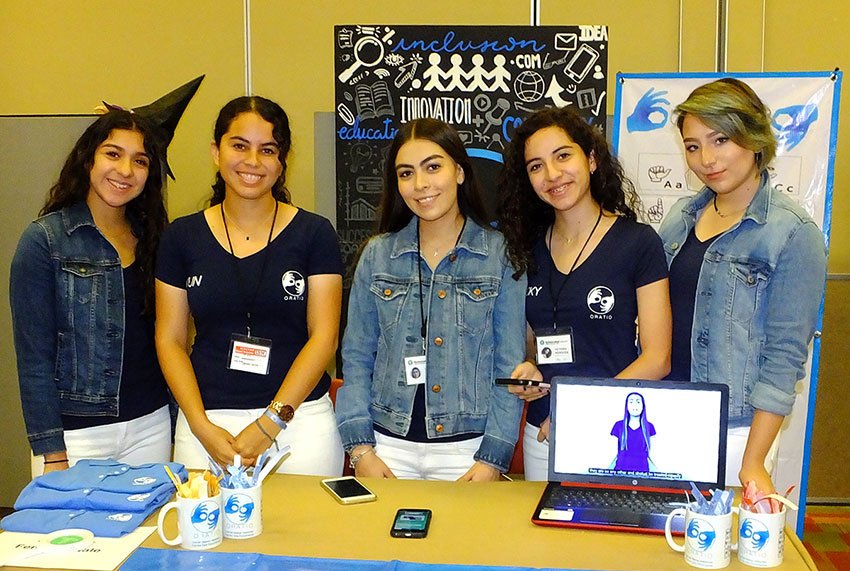
“Of course,” says Oriana Hernández. “We’re all from the state of Guanajuato and we’ve developed an app called Oratio, which means ‘speech’ in Latin. This app makes it possible for you to communicate with someone who is deaf, but knows Mexican sign language. So, you could use it to say hello to a deaf person or ask a question. And our app also has a very nice teaching component so you can actually use it to learn how to sign.
“However, I should mention that there are lots of varieties of sign language around the world and we hope to expand our app so it could be used in other countries.” Another of the girls, Alma Yunuen, adds: “We developed this particular app because we felt people with hearing disability are marginalized in our society. Only 12% of the deaf ever have a chance of going to school in Mexico.”
The team I am talking to is called Femme Fatale. They tell me they’ve been working on their project for five months. “We knew absolutely nada about programming when we started and now we have our own app! And we learned all kinds of other things along the way, for example how to organize ourselves and how to work as a team.”
All of the teams present here today have been assisted right from the get-go by several volunteers who act as mentors. As I stepped away from the Oratio booth, I literally bumped into one of them. Her name was Martha Elena Rodríguez, from San Luís Potosí.
The winners: Femme Fatale with their app for translating sign language.
“I really like being a mentor,” she told me. “It’s the second time I’ve done it. This time I’ve been working with girls who developed an app which acts as a job center for the disabled. For me, it was a wonderful experience simply to be with these girls and to watch them grow. We mentors teach them something, but they also learn a lot entirely on their own. You can’t imagine how beautiful it is to see them here today, all self-confident, explaining everything they’ve learned to other people. I should also mention that I am one of four mentors for this group and I’ve personally learned a great deal from the other three!”
By chance, the next team I walk up to is from San Luis Potosí. They call themselves TechnoWitches and there are only two members on the team. One of them, Sarahí Alonso, who couldn’t be much more than 10 years old, tells me that their app is called Be My Eyes and it helps the blind get around and solve various problems.
“What?” I blurt out. “How can they use a mobile if they can’t see?” Well, I quickly get put in my place. I learn that their app employs something called Google Talkback which, indeed, is designed to make it easy for the blind to use a smartphone. Through voice commands, Be My Eyes helps the blind use their phone’s GPS to get where they want to go — and not only that. The program cleverly makes use of the camera. Let’s say the blind person wants to know what’s across the street: is the bank that they’re trying to get to over there? Well, explained Sarahí, all they have to do is take a picture and listen to an oral description of what’s in the photo.
“Why did you choose an app to help the blind?” I asked Sarahí.
“When I was little, my mom took me to Diálogo en la Oscuridad (Dialogue in the Dark) where we experienced what it is like to be blind. We had to do a lot of things in total darkness, like go buy something in a pharmacy and by the time it was all over, we realized just how difficult it is simply to walk down the street when you are blind. Now I have a chance to help those people.”
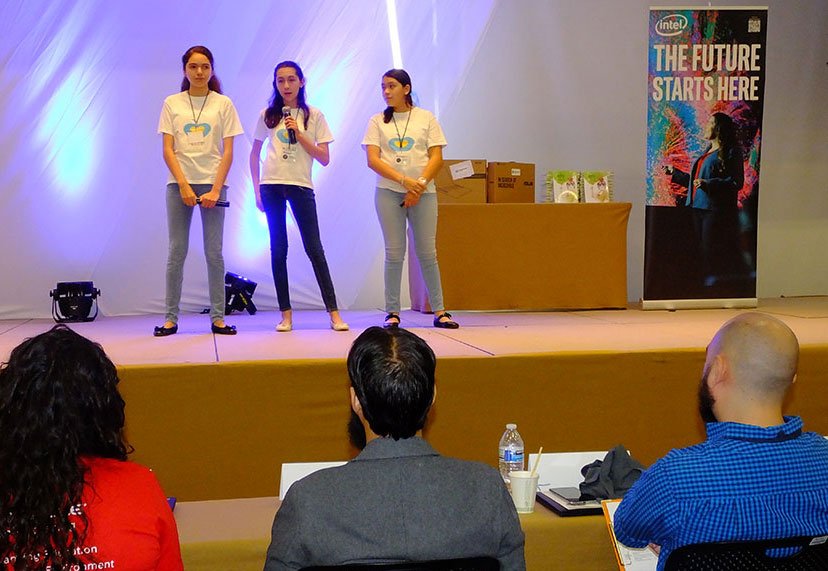
After an hour, it was time for “the pitch event” in which the 12 teams would compete for the national prize. With the help of visuals on giant screens, each team of girls had only a few minutes to get up on the stage to tell the audience all about their app and to answer questions — some of them tough — by a panel of judges from tech companies like Oracle and HP.
Judges watch a pitch for Maveat, an app teaching healthy eating habits.
In the end, the winning team turned out to be Femme Fatal from Guanajuato, the first group I had interviewed.
“Their prize,” coordinator María Makarova told me later, “is a trip to San Francisco where the Technovation world pitch event will take place. They will visit the Silicon Valley companies, meet girls from all over the world and spend a whole week in the Bay Area.”
“After the event,” Makarova continued, “we all went out to dinner together and what were most of the girls doing throughout the meal? They were using the two apps from this competition that teach you how to use sign language and they were actually communicating with girls on the other side of the room. It was beautiful!”
Schools all over the world try to get girls interested in science, often without much luck. How, I asked myself, does Technovation succeed in this so brilliantly? To find out, I first looked into the origin of the Technovation Challenge. I learned it was founded in 2009 by Anuranjita Tewary, a data scientist who was so impressed by her experience at a startup weekend that she developed a method to recreate that same experience for young girls.
I had no idea what a startup weekend was, but quickly learned that it’s a three-day event for business people who form teams, work with mentors, develop a business plan, engineer a demo product and pitch their idea to others. At the end there is a competition and prizes for the best project. Said Dr.Tewary: “I want every girl and every woman to have that confidence that they can lead, that they can create something out of nothing.”
Perhaps the key word here is “create.” Force kids to study what’s in a textbook and you get boredom. Challenge them to create something out of nothing and you get learning.
[soliloquy id="83312"]
The writer has lived near Guadalajara, Jalisco, for more than 30 years and is the author of A Guide to West Mexico’s Guachimontones and Surrounding Area and co-author of Outdoors in Western Mexico. More of his writing can be found on his website.
'We will never abandon you again,' AMLO says to the nation's young people.
A new federal addictions plan will focus on “instilling values” in young people and protecting the “wellbeing of the soul.”
President López Obrador announced today the launch of “Together for Peace” (“Juntos por la Paz”) that will offer opportunities to young people to not only keep them away from drug abuse but to pacify the country.
“I am sure that we will have the support of all the people, I have a lot of faith in the young people of Mexico,” he said. “We will never abandon you again, we will embrace you and protect you so that you don’t feel alone, so you don’t feel empty, so you don’t get drawn into crime and bet on cheap luxuries. We can only be happy if we are good.”
Presidential spokesman Jesús Ramírez Cuevas said that the campaign will focus on four areas: health, education, wellbeing and culture, and will be supported by various federal agencies.
“We are going to inform young people about cultural and athletic opportunities, educational opportunities in different regions, through workshops, social circuses, concerts, theater workshops, even chess workshops, to take back our public spaces,” he said.
The Mexican Youth Institute will train 5,000 young people to participate in “peace brigades” to work on addiction prevention projects, while the Health Secretariat will train 8,000 of its employees to work in addictions treatment and will open 10 rehabilitation centers across the country.
For its part, the National Sports Commission will promote athletic activities in 500 public spaces while the Culture Secretariat will hold events as part of community culture programs in all 32 states.
The Public Education Secretariat will help make information about addictions more readily accessible to teachers, parents and young people.
Ramírez also said that the strategy will include the development of a mobile application offering information and support for people whose loved ones may be struggling with addiction.
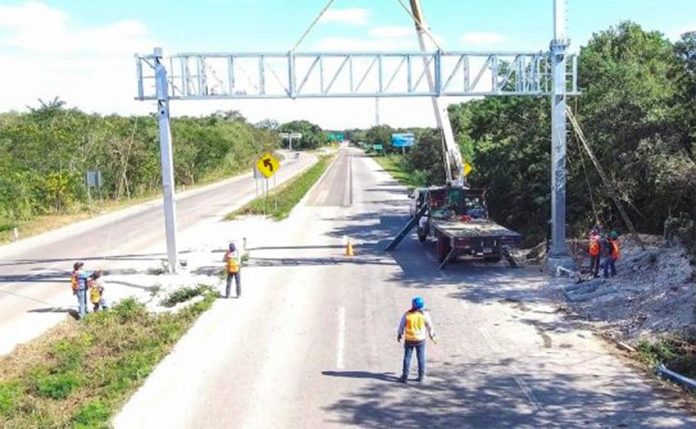
One of Yucatán's existing highway security gantries. Another 119 are planned.
Mexico’s safest state is going all out on its security strategy.
Yucatán Governor Mauricio Vila Dosal presented a new public security plan for the state, which will include 3,527 new security cameras, 119 highway security gantries, intelligent traffic lights, six drones, a specialized airplane and four dedicated boats for protecting the coastline.
The governor said that using the latest and best technology will significantly improve the reaction time of security forces and result in better preventative policing throughout the state.
The specialized aircraft is a stealth plane outfitted with a solar panel that enables it to stay in the air for eight consecutive hours on just 120 liters of fuel. It has infrared security cameras that are capable of spotting people and objects in high definition from 900 meters up in low visibility areas.
The government plans to use the drones to patrol high traffic areas such as city centers, shopping malls, large events and popular tourist areas.
In addition, the government believes the drones could present a unique opportunity to discreetly identify high-risk areas and neighborhoods. To protect the drones while not in use, the Secretariat of Public Security will oversee the installation of specialized hangars capable of withstanding heavy rains, hail and intense sun.
“This program, as well as maintaining a climate of security and peace in Yucatán, will also allow us to stay one step ahead of crime with a police force equipped with the latest technology for air, land and sea.”
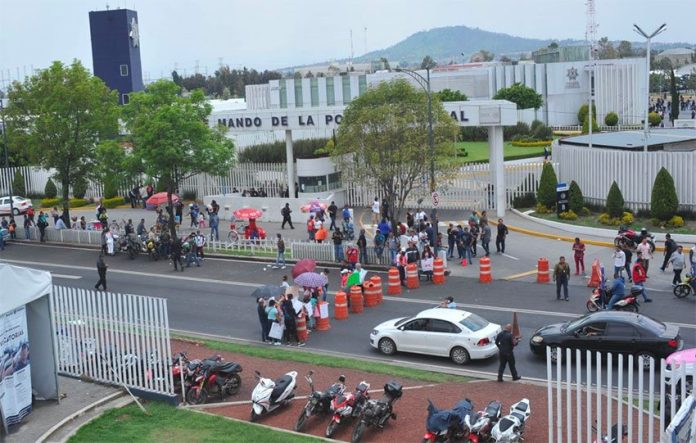
The blockade erected by protesting officers outside police headquarters.
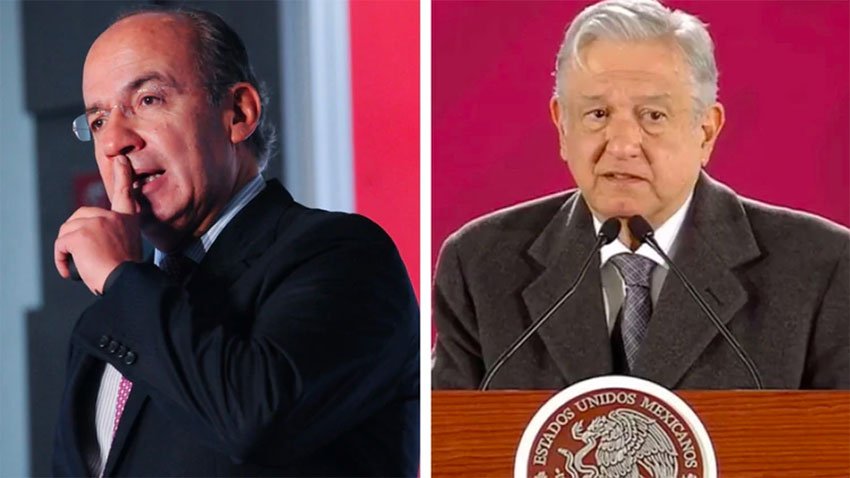
Former president Felipe Calderón hit back yesterday at the government’s insinuation that he is involved in the protests by Federal Police against their incorporation into the National Guard, while officers continue to demonstrate in Mexico City today.
President López Obrador claimed on Wednesday that there is a “dark hand” behind the protests and Security Secretary Alfonso Durazo told a press conference yesterday that “it’s not a coincidence that one of the representatives of the Federal Police asked ex-president Felipe Calderón to be their union representative.”
He charged that “critics of the government” are taking advantage of the officers’ protests to try to damage the López Obrador administration, and accused a human rights activist who was previously imprisoned on kidnapping charges as being one of the chief instigators of the demonstrations.
Later yesterday, Calderón posted a video message to social media to reject what he called a “cowardly insinuation.”
The former National Action Party president demanded Durazo present proof to back up his claims or else “immediately withdraw his slander.”
Calderón declined the invitation to represent the police, stating that he would be more hindrance than help because “in the government and particularly in the secretariat [of security], prejudices, insecurities and fears reign.”
He called on the government to listen to the officers’ grievances and urged the police to protest peacefully and in a way that “doesn’t harm the public.”
Calderón also urged the president to refrain from discrediting those who don’t think as he does. “We are all Mexicans and I ask you respectfully to stop dividing Mexico.”
Durazo later denied that he had explicitly linked Calderón to the protests, and said that in any case the government wouldn’t have any problem if he were representing or advising the Federal Police.
“The name of the ex-president was put forward by one of the self-proclaimed representatives of the discontent [officers] who said that it would be an honor if the former president Felipe Calderón assumed the leadership of the organization that the disgruntled police are establishing,” the security secretary told broadcaster Grupo Fórmula.
“We have only referred to the ex-president in relation to the statement of that supposed representative . . . whatever his position is, it’s respectable. We don’t have any problem with him having a critical position with respect to the government’s initiatives . . .” Durazo added.
Calderón, left, to AMLO: ‘stop dividing the country.’
The government has maintained that Federal Police officers are not being forced to join the National Guard and that their salaries and benefits won’t be cut.
But the officers remain unconvinced and gathered again this morning outside police headquarters in the eastern borough of Iztapalapa.
Police have also continued to block some roads in the capital but the toll booth entrance to the Mexico City-Pachuca highway was cleared this morning.
Smaller protests have been reported in some other states including Veracruz, Querétaro, Oaxaca and Chiapas.
In addition to demanding that their pay and benefits be maintained at current levels or increased, officers have called for the resignation of corrupt police commanders and officials, and expressed opposition to being subjected to military evaluations and having to live under poor conditions while on deployments away from home, among other complaints.
They also claim that they will be dismissed if they refuse to join the National Guard, even though López Obrador and Durazo have denied that is the case.
The latter said yesterday that after the Federal Police is disbanded – which is expected to occur within the next 18 months – officers will enter the National Guard or, if they prefer, a range of other organizations such as the National Immigration Institute, Civil Protection services, customs or the National Anti-Kidnapping Commission.
This morning, police demanded Durazo’s presence at a meeting scheduled for 1:00pm, asserting that they are open to dialogue.
Officers also guaranteed the safety of the security secretary after he accused them of having stolen ammunition and police vehicles.
“We simply want him to come, tell us his position and to be a coherent person so that he understands what we want. We won’t be aggressive towards him in any way,” the police said in a message to the media.
“It’s been said that we hijacked vehicles and ammunition and that’s not true. We don’t have any kinds of weapons in our hands . . .”
One officer told the newspaper El Financiero that he hoped to get a “positive response” from government officials at today’s meeting in order to resolve the issues “once and for all.”
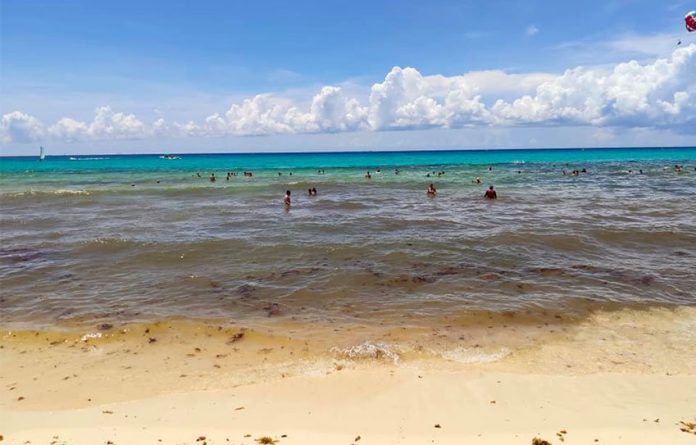
Swimmers find sargassum-free water about 30 meters out on a Playa del Carmen beach.
Tourism Secretary Miguel Torruco Marqués said President López Obrador has ordered that addressing sargassum invasions be considered a national priority.
“The president . . . has made the sargassum problem a national priority,” he said. “Every Thursday at 6:00am, we meet to discuss the issue. [The president] designated Navy Secretary José Rafael Ojeda Durán to coordinate our actions.”
Torruco criticized the previous government’s handling of the issue, noting that it spent 800 million pesos (US $42 million) on efforts to control the macroalgae between 2014 and 2018, but did not have a comprehensive strategy.
“The sargassum phenomenon started in Brazil, in the Amazon River,” he said. “It started because of mining and fertilizer. Now, it’s become a Godzilla.”
Torruco added that the current government has plans to address the problem in the short, medium and long terms.
Navy Secretary Ojeda has announced that the navy will spend 52 million pesos on a strategy to control sargassum, but that amount represents only 5.2% of the 1 billion pesos the government of Quintana Roo estimates will be necessary.
The navy strategy includes the construction of four sargassum-collecting boats, the first of which will be ready in a few weeks.
Torruco said the government is also building floating barriers to prevent sargassum from washing up on beaches.
López Obrador previously downplayed the sargassum issue, saying it was “not very serious,” and charging that an emergency declaration by the state of Quintana Roo was disproportionate to the gravity of the problem.
On Thursday, the Confederation of Chambers of Commerce, Services and Tourism (Concanaco-Servytur) announced that in light of falling hotel occupancy rates due to sargassum, hotels in the Mexican Caribbean will be offering discounts of between 15% and 25% this summer in an attempt to maintain an average of 80% hotel occupancy, which was the average for last summer.
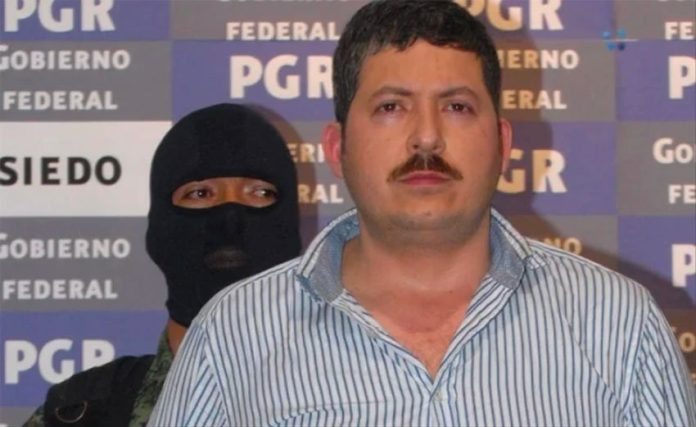
A Nuevo León plaza chief of the Beltrán Leyva cartel has been identified as the victim in a murder yesterday in Zapopan, Jalisco.
The wife of Héctor Huerta Ríos identified the body of her husband after he was killed in what was believed to be a dispute with another cartel boss over territory in San Pedro Garza García, part of the metropolitan area of Monterrey.
He was murdered while traveling in a vehicle with his wife and two young daughters.
Huerta was arrested in 2009 by the army at his luxury car lot in San Pedro Garza García along with four bodyguards. Federal forces confiscated high-caliber weapons, grenades, over US $13,000 in US and Mexican currency and 18 luxury vehicles.
He was charged with organized crime and the 2006 murder of the director of the Nuevo León Investigations Agency. He has also been linked to the 2009 assassination of a lawyer.
Huerta was released from prison a year ago.
The murder is the latest downward turn in the Beltrán Leyva cartel’s fortunes after most of the organization’s leaders were either captured or killed in recent years, including its best-known leader, Héctor Beltrán Leyva, who was arrested in 2014 and died of a heart attack in jail in November of last year.
Two other Beltrán Leyva brothers, out of four founders of the criminal organization, are currently in jail, and another was killed in 2009.