An 11-year-old mathematics whiz from Mexico City wants to represent his country at an international competition next month in China, but he’s US $5,800 short.
Carlos Alejo Ontiveros’ prowess in arithmetic was first noticed by his parents when he was 3, when they nurtured and encouraged it. He went on to learn the abacus system of mental calculation in which an abacus is mentally visualized to perform calculations, which can be carried out quickly.
“I study 15 minutes every day. I get practice sheets and study with a chronometer in order to measure how long it takes me. You have to answer 70 problems in less than five minutes,” Alejo said.
The boy has won two regional math awards, two at the national level and an international award last year in Russia, earning him an invitation to this year’s match in Guangzhou, China.
Last year, the Science, Technology and Innovation Secretariat of Mexico City sponsored his trip to Moscow, but financing has become an issue this time around.
The only bump in Alejo’s road to success is a financial one: the boy and his mother need about 110,000 pesos to cover the travel expenses for the China trip.
“It’s not easy at all for us to get that amount,” said Alejo’s mother, María Angélica Alejo. “He wants to go to China and proudly represent Mexico. He is an intelligent boy who wants to get ahead.”
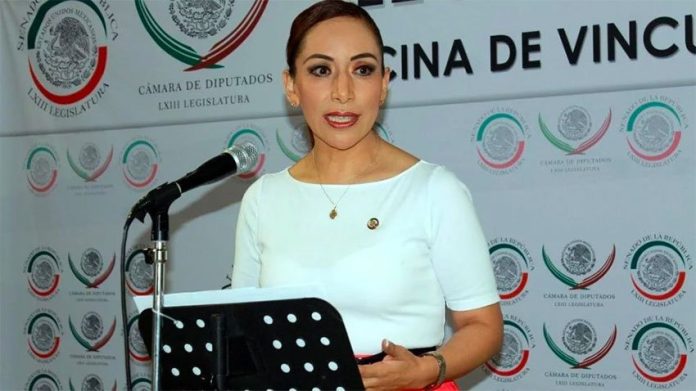
Adriana Dávila accuses Orozco of reaping personal benefits from her foundation.
The name Rosi Orozco resurfaced yesterday as the owner of one of the confiscated properties that the government will sell at an auction next month.
For more than a decade, Orozco has been a prominent activist against human trafficking. But accusations of corruption and misuse of government resources have been following her for much of that time.
In an interview with Reforma yesterday, Deputy Adriana Dávila said that Orozco has been using the issue of human trafficking for her own benefit, receiving privileges from the government without delivering any results.
In 2005, Orozco and her husband, Alejandro Orozco, founded the Camino a Casa Foundation, a nonprofit dedicated to fighting human trafficking. Her work with the foundation helped her win a seat in the Chamber of Deputies, which she held from 2009 to 2012.
During the presidency of Felipe Calderón (2006-2012), the federal government assigned four properties to the Orozco couple; one to Alejandro Orozco and three to the foundation.
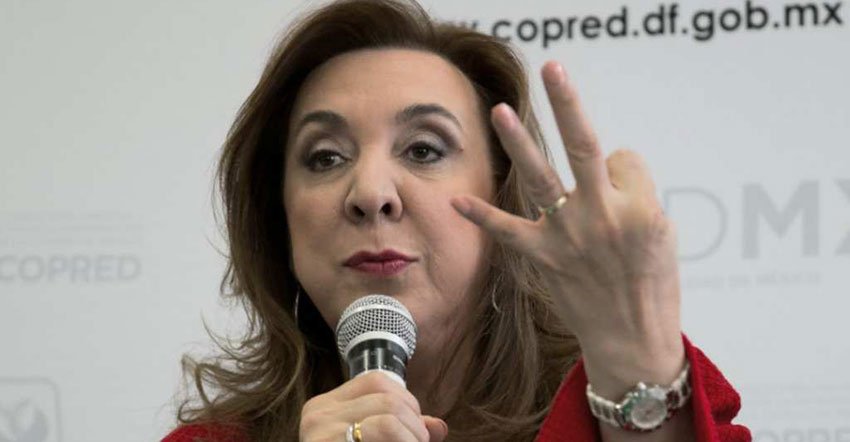
Activist Rosi Orozco.
Dávila, who has served as president of the Senate human trafficking commission, also said the federal government has given Orozco’s foundation over 13 million pesos (US $685,000) in directly awarded contracts where no bidding process took place.
Orozco’s foundation also presented prizes to several state governors in recognition of their efforts against human trafficking, which Dávila says the governors paid back to the foundation with more directly awarded contracts.
“It was a process of complicity,” said Dávila. “She signed agreements with PRI candidates during election campaigns, which implied million-peso contracts.”
According to the news magazine Proceso, one of the properties given to the foundation had previously been confiscated by the federal government from Vicente Zambada Niebla, a high-ranking Sinaloa Cartel member currently in prison in the United States. The property is not one of the two that will be auctioned next month.
Dávila hopes that Orozco will face criminal consequences that go beyond the confiscation of her properties.
“The law applies to everyone, and anyone who commits a crime needs to be punished,” she said. “This is a deeper issue than just confiscating properties.”
Yesterday, information about those properties was listed on a government website. However, today the website indicates the auction has been suspended and the information has been removed.
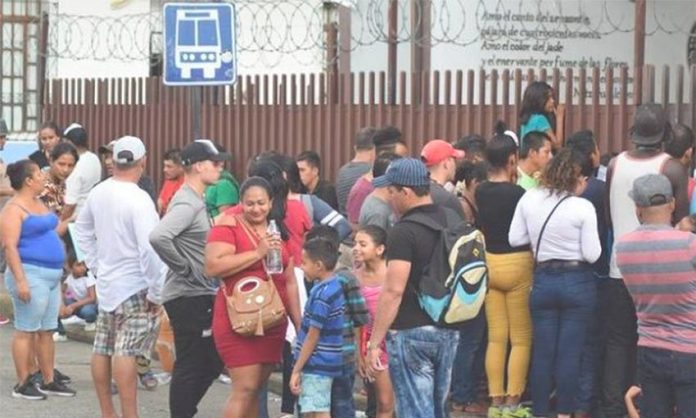
Amid a surge in demand from asylum seekers in Mexico, the country’s tiny refugee agency has turned to the United Nations for assistance to open three new offices.
The Mexican Commission for Refugee Assistance (Comar) received 18,365 requests for asylum in the first four months of this year as Central Americans fleeing poverty and violence and migrants from further afield continued to stream into the country.
Comar chief Andrés Ramírez told the news agency Reuters that Mexico is on track for 60,000 asylum applications this year – double the number received in 2018.
Ramírez said the organization is so overwhelmed that he asked his former employer, the UN Refugee Agency (UNHCR), for help.
“We at Comar are simply trying to survive,” he said, adding that “our central issue is a concern with resources – we are fighting for them, we are struggling for them but we can’t self-finance, we don’t have the capacity in our hands alone to revolve this.”
The commission is facing its lowest funding in seven years as a result of the federal government’s austerity plan, Reuters said. Its 2019 budget is just US $1.2 million, or $20 for each asylum application it expects to receive.
However, the UNHCR is offering financial assistance and staff that will allow Comar to open three new offices to deal with the influx of asylum seekers, Ramírez said.
The first new office will open next month in Tijuana, Baja California, where thousands of migrants have been stranded for months as they await the opportunity to seek asylum in the United States.
Offices in Monterrey, Nuevo León, and Palenque, Chiapas, will follow.
The three new offices will double the number currently operated by Comar, and the UNHCR will send 30 staff members to Mexico to supplement the commission’s 48-person workforce, Ramírez said.
But while Comar personnel wait for the UN funding and staff to ease their workloads, they continue to attempt to meet the soaring demand for refugee services.
In Tapachula, Chiapas – a first port of call for migrants who enter Mexico at the border crossing located to the city’s south – sidewalk spots outside the Comar office are sold for 200 pesos (US $11) a pop to give would-be asylum seekers a head start in long lines, Reuters said.
Farther north in Oaxaca, Honduran Omar Quintero and 12 of his family members, including his wife and young child, are among the thousands of Central Americans who have filed applications for asylum in Mexico in recent months.
But like many others, they have been forced to endure long waits to see if they will be allowed to stay in Mexico as refugees.
“Thirteen of us came. We escaped from the gangs and handed ourselves into immigration a month and a half ago. We left our country because they killed my brother and my father, that’s why we want Mexico to give us refuge,” Quintero told the newspaper El Universal.
The massive surge in the arrival of migrants to Mexico – around 300,000 of them traveled through the country in the first three months of the year, according to the interior secretary – has also placed a heavy strain on the limited space and resources of migrant shelters.
In Ciudad Ixtepec, Oaxaca, as many as 300 people a day have arrived at the Hermanos en el Camino (Brothers on the Road) shelter since the first of several large migrant caravans started entering Mexico last October, said employee Daniel Cordero.
“We’ve had to increase our response capacity in terms of food, water and medicine,” other staff members said.
President López Obrador refused to engage his United States counterpart today on the issue of migration, saying that he prefers to have conversations in an “environment of friendship.”
When asked by UnoTV reporter Melina Ochoa about a tweet sent yesterday by U.S. President Donald Trump criticizing Mexico’s supposedly lax immigration policy, López Obrador emphasized the positive aspects of the relationship between the two countries.
“While tariffs are going up and a trade war is starting between the United States and China, we have been able to get the United States to drop tariffs on steel, which is very good,” he said.
He went on to say that he does pay attention to Trump’s statements about Mexico, but prefers to “act with prudence” and avoid publicly responding to them.
López Obrador confirmed that he had seen the Trump tweet, but carefully avoided mentioning any specifics about it.
…Mexico’s attitude is that people from other countries, including Mexico, should have the right to flow into the U.S. & that U.S. taxpayers should be responsible for the tremendous costs associated w/this illegal migration. Mexico is wrong and I will soon be giving a response!
“Yes, I am aware of the message sent yesterday about his point of view on an issue I’m not even going to mention,” he said. “But — love and peace.”
The tweet in question, sent by the U.S. president Tuesday morning, criticized Mexico for what he sees as a failure to prevent migration towards the United States and included a vague threat of a U.S. “response.”
“I am very disappointed that Mexico is doing virtually nothing to stop illegal immigrants from coming to our Southern Border . . .” the tweet reads. “Mexico’s attitude is that people from other countries, including Mexico, should have the right to flow into the U.S. & that U.S. taxpayers should be responsible for the tremendous costs associated w/ this illegal migration. Mexico is wrong and I will soon be giving a response!”
The police chief during his arrest, one of the victims and confiscated weapons and phones.
The police chief of Manuel Doblado was arrested in León on Monday night when he was caught in the act of kidnapping two young women.
A vehicle driven by Alejandro Alaniz Muñoz was pulled over by Federal Police during an anti-fuel theft operation. Inside, police discovered two women, aged 18 and 23, bound hand and foot with their mouths gagged with masking tape.
Authorities also found firearms, ammunition and cell phones.
Manuel Doblado Mayor Gustavo Adolfo Alfaro Reyes said the incident was something no one expected and has generated dismay among members of the municipal police.
He said the chief clearly committed a crime and will face the appropriate legal consequences.
Alaniz, 37, was named police chief in October of 2018 at the beginning of the term of the current administration. Previously, he was a member of a special state police force created to combat organized crime.
According to statistics provided by the National Geography and Statistics Institute (INEGI), 6 out of 10 interactions between citizens and police in Mexico are marked by some form of corruption, but only 4.6% victims of corrupt police actions by report the acts.
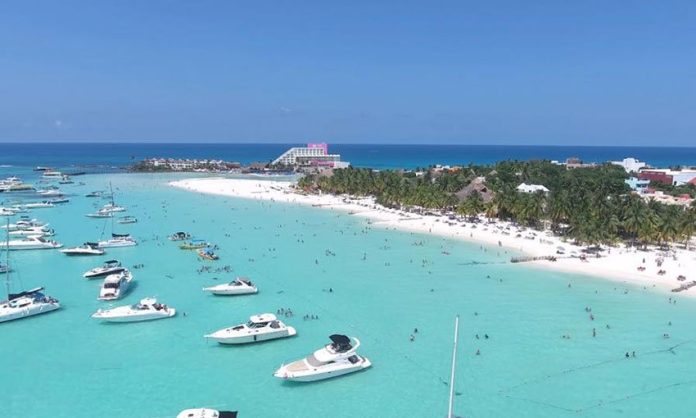
At the north end of Isla Mujeres sits Playa Norte, a protected Caribbean beach with white sand and clear turquoise water. (File photo)
The island of Isla Mujeres in Quintana Roo is hoping to have a second Blue Flag beach, a certification awarded to beaches that meet stringent quality standards.
Playa Centro was the island’s first beach to be certified. Local authorities hope that Playa Norte will become its second this summer.
After a recent inspection by an auditor, the local administrator of the federal zone announced that advances have been made in achieving that goal.
Kerem Pinto Aguilar said efforts have been under way for months to meet the 33 quality requirements of Blue Flag certification.
She said confirmation will come in June or July, when the Blue Flag organization will announce whether Playa Centro’s certification will be renewed and if Playa Norte will receive it for the first time.
“The auditor . . . remarked on the progress obtained so far at this beach as he did not expect Playa Norte to meet the 33 criteria needed,” said Pinto, adding that work will continue to get the Blue Flag approval.
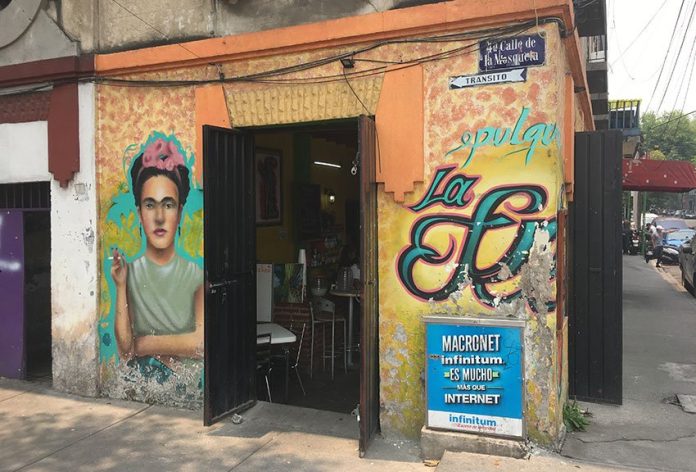
You'll find pulque by the liter at La Frida, one of the attractions at the Martínez de la Torre market.
There’s a comforting middle-class, almost suburban feel at Mexico City’s Mercado Martínez de la Torre in Colonia Guerrero.
On any given afternoon, the market’s surrounding holes-in-the-wall cantinas are populated mostly by men in the laid-back stepdad look of plaid shirts tucked into comfortable jeans with cell phone holsters and tennis shoe/hiking boot hybrids.
Traffic blasts by on Eje 1 Norte, and a few blocks off the market can get a little sketchy, but it’s all full bellies and family smiles between Zarco and Calle Soto.
With around 600 stalls, Martínez de La Torre Market is the cultural and economic center of Colonia Guerrero and one of the best food markets in the city, often overlooked by non-locals.
The symphony of scissors snipping chickens into vendible pieces and the smell of piles of ripe guava make their way into the market’s exceptionally wide walkways – a gawking tourist’s dream. The quality of meats and sausages is way above par, and there are mountains of excellent moles to choose from.
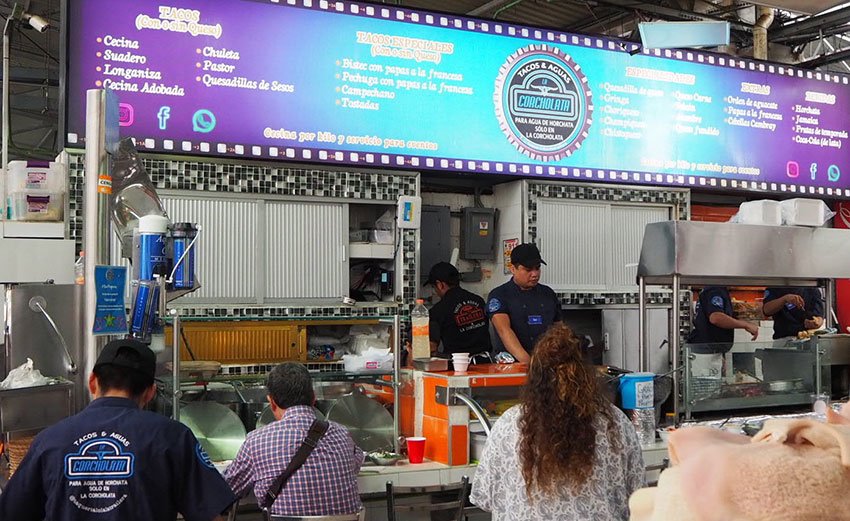
The bustling counter at famed Tacos y Aguas La Corcholata.
You can safely get lost wandering the abundance of delicious flavors, but we’ve picked out some particular culinary gems at Mercado Martínez de la Torre.
Taquería Lola La Trailera & La Corcholata
Why settle for just one name, when you can have two? Named for actress friends of the taquería’s owner, “Lola the Truck Driver,” played by Rosa Gloria Chagoyán, and “The Bottle Cap,” played by Carmen Salinas, La Corcholata is the most publicized eatery in the market and run as such – super attentive staff with pressed uniforms and name tags.
The buttoned-up look is a little out of place in Guerrero, but it runs like a well-greased plancha. Their cecina tacos are not to be missed. But the local favorites are the beef or chicken tacos with French fries, to fully absorb the salsa verde, and a perfectly sweet and frothy horchata to balance the salt and heat.
Taquería “El Mejor” Barbacoa de Horno
You don’t have to wait until the weekend for barbacoa at Mercado Martínez de la Torre, and their name is accurate – El Mejor is truly the best barbacoa in the market.
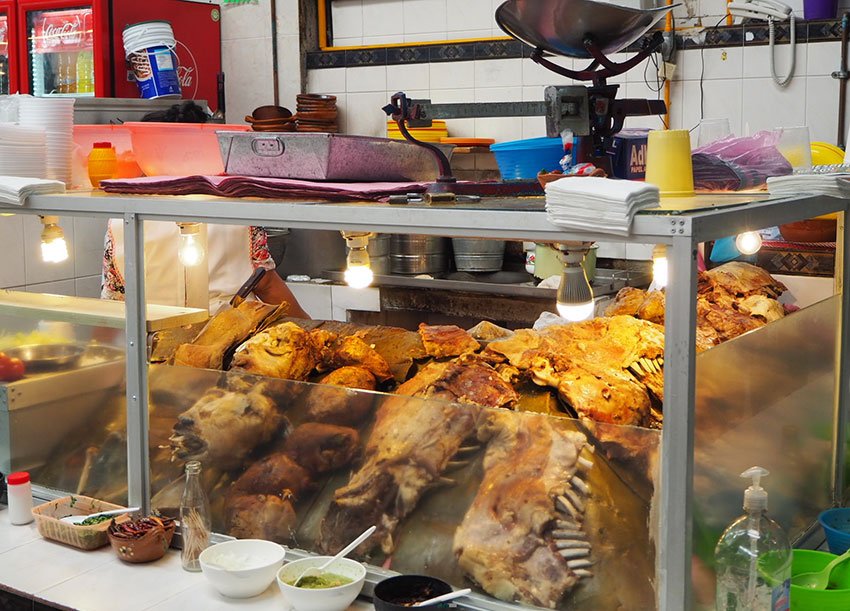
The mutton case at Taqueria “El Mejor” Barbacoa de Horno.
The slow oven-roasted mutton is brought in daily from Mexico City’s agrarian outpost, Milpa Alta – the city’s southernmost borough known for its sheep, both in the oven and on the pasture.
Ignacio Ramírez has manned the butcher block at El Mejor since 2000, and his barbacoa comes off the knife appropriately tender and stringy with the deep buttery, only slightly pungent, flavor of a properly roasted mutton.
A Coke, barbacoa taquito and a bowl of consommé for only 50 pesos is a wonderful pick-me-up any day of the week.
Carnitas La Güera
Over 60 years in, and La Güera’s crispy carnitas pork bits are still one of the best reasons to come to the market.
Take home a giant, half-a-pig-sized chicharrón or just sidle up to the counter for a quick taco. La Güera won’t let you down on the pork front.
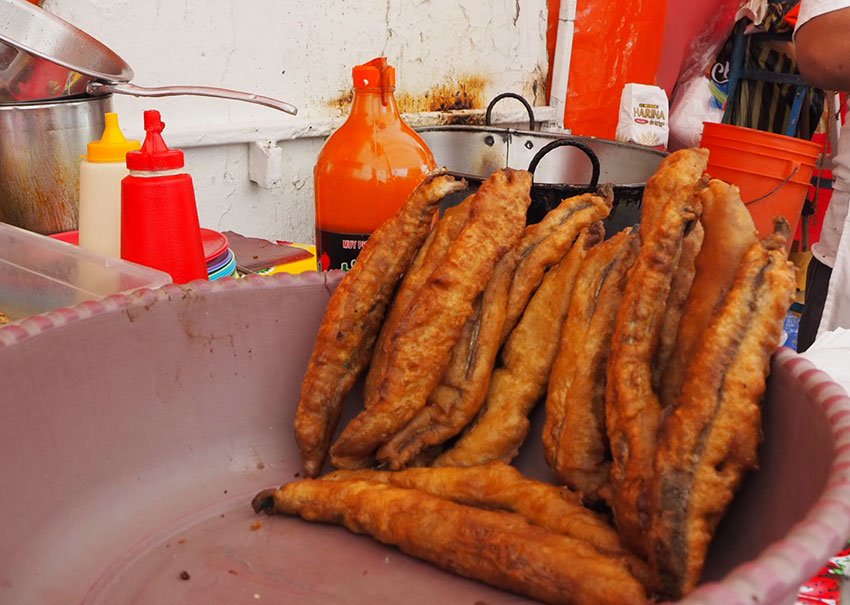
Delicious, greasy, whole fried sierra at Ocotlán.
Ocotlán
Just outside the market entrance on Zarco is the tiny fried fish stand, Ocotlán. The fish – Mexican sierra – are in the mackerel family, and come breaded, whole. They’re about the size of a toothpaste tube, like a giant greasy sardine, and wrapped in paper to go. Or enjoy them hot, on the spot with a bit of mayo and hot sauce.
Eskimoz y Raspados Sonia
The blenders buzz non-stop at Sonia, the ideal last stop for the sweet tooth on the Martínez de la Torre tour. Their nostalgic milkshakes and shaved ices will warm your heart and cool your core on a hot day. Or go nuts with a fruit frappe rainbow of your design.
Pulquería la Frida
If you’re looking for a drink of the alcoholic variety, head across Mosqueta/Eje 1 to La Frida for a pulque – the drinking person’s milkshake. The viscous, fermented agave sap beverage provides a distinctive tingly buzz. Pulquería la Frida is a tiny, single room in bright pink, yellow, and green, providing a no-nonsense pulque experience – loud music, pulque, and beer – because who wants nonsense?
While the banner promotes over a dozen sweet and savory flavors, they’re likely to have only a couple in stock. Try celery or oatmeal flavored for something delicious and mellow. Or go native with the natural flavor, and ask for some baking soda to shake into it (for the extra bubbles) if you’re really looking to impress.
Watch traffic whizz by out of the open doors and enjoy your pulque in a cracked glass, for that truly authentic feel.
• Mercado Martínez de la Torre is on Eje 1/Mosqueta, between Calle Soto and Zarco. Some stalls open as early as 7:00am, with most open until 6:00pm.
This is the 11th in a series on the bazaars, flea markets and markets of Mexico City:
Funding cuts are affecting health care in 24 states.
Shortages of doctors, nurses and medicine are among the problems faced by hospitals in 24 states as a result of federal budget cuts to the health sector.
A report published today in the newspaper Milenio said the reduction in health funding — part of the government’s wider austerity plan — is affecting hospitals in the north of the country, the Bajío region, central and southern Mexico and the Yucatán peninsula.
In Durango, the State Workers’ Social Security Institute (ISSSTE), a federal organization responsible for part of Mexico’s public health care system, is at a critical juncture, according to an institute official.
Patricia Herrera, ISSSTE delegate in the northern state, said the institute doesn’t have enough medical and administrative staff following the layoff of around 100 employees.
Supplies of medicine have fallen from 97% to 80%, she added, warning that if the problems are not promptly solved, the situation will become “grave.”
Baja California Sur Health Secretary Víctor Flores said that funding in that state has been cut by 30 million pesos (US $1.6 million) and that the operation of basic medical services in rural communities has been affected.
In San Luis Potosí, the availability of medicine is also on the wane and a reduction in federal funding has forced state authorities to slash by half the stipends paid to medical interns working at both hospitals and health clinics.
In Yucatán, the government’s budget cuts have placed patients and personnel at the ISSSTE regional hospital in Mérida in an especially sticky situation – while the city swelters through soaring temperatures, the air conditioning system has been switched off in several parts of the facility as a cost-cutting measure.
Farther east in Quintana Roo, 45% of employees at 59 urban and rural health centers will lose their jobs when their current contracts expire, Milenio said, while 45 workers have already been laid off.
Public hospitals, clinics and pharmacies in Veracruz are experiencing shortages of antiretroviral and cancer drugs and staff cuts are also in the works.
In Tabasco, 500 health care employees who worked for the Seguro Popular program were laid off in January and other medical personnel in the state say that they are owed wages.
Authorities in Nayarit, Guerrero, Oaxaca and Sonora say that their health systems are also under pressure due to the federal budget cuts.
Since taking office in December, the government led by President López Obrador has implemented a range of austerity measures including reducing funding to 15 secretariats and other federal departments, and slashing wages.
In a resignation letter, he charged that the Secretariat of Finance’s interference in IMSS is “pernicious” and that “excessive savings and controls in health spending are inhumane.”
Mexican dancer Elisa Carrillo joined the most exclusive club of dancers in the world yesterday when she received the Benois de la Danse prize, considered the Nobel Prize of dance.
The jury awarded the prize to Carrillo for her performance last year as Juliet in Prokofiev’s Romeo and Juliet, with choreography by John Cranko.
On a stage at the Bolshoi Theater in Moscow, Carrillo dedicated the prize to Mexico and thanked her family.
“I dedicate this prize to the Mexican people,” she said. “We’ll never stop fighting and working to achieve our dreams.”
Born in Texcoco in 1981, Carrillo showed talent in dance from a young age and was accepted into the English National Ballet School at 14. Since 2011, she has been the lead female dancer at the Berlin State Ballet.
Carrillo is prima ballerina at the Berlin State Ballet.
Carrillo is the second Mexican dancer to be awarded the Benois, after Guadalajara-born Isaac Hernández won it last year. She is also the first Latin American woman to win.
She had previously been awarded the Soul of Dance prize and a top prize at the International Dance Festival in St. Petersburg.
According to El Financiero, Carrillo’s performances demonstrate solid classical technique as well as skill for theatrical interpretation.
“I love the roles where you have to act, not just show off the technical difficulty of the steps, but actually tell a story with the steps,” she told the newspaper in 2014.
Recently, Carrillo has been using her prominence to promote classical dance education in Mexico. Last year, she partnered with the government of her native state of México to create the Elisa Carrillo scholarship, a program to support promising young dancers from the state.
“There’s a lot of talent in Mexico, but unfortunately sometimes parents can’t support their children economically, or they can’t get information,” she said.
This year, she is organizing the second annual Danzatlán festival, which will bring top dance talents from across the world to Mexico City in July.
In an interview with the magazine Quién after winning the Benois prize, she said she is optimistic about the future of dance in Mexico.
“There are more and more people going to shows, more and more children taking classes,” she said. “I think that everything we’ve done in the past few years has helped people take another point of view and see dance as a way of living and enjoying life.”
There will be a new option for lovers of hamburgers and creamy milkshakes this summer in Mexico City when the country’s first Shake Shack location opens.
The New York chain of casual restaurants will be on Paseo de la Reforma in front of one of Mexico City’s most iconic landmarks — the Ángel de la Independencia.
Shake Shack vice-president Michael Kark said the restaurant’s fans in Latin America had asked for a Shake Shack for many years.
Mexican restaurant operator Grupo Toks will operate the new outlet, whose exterior will be adorned with a mural by celebrated Mexican artist Claudio Limón.
Toks general manager Juan Carlos Valverde Losada said last fall that the company plans to open 30 Shake Shack locations in Mexico. Santa Fe, Bosques de las Lomas and Polanco in Mexico City and the airports at Cancún and Los Cabos are among them.
Known for its fresh and mostly local ingredients, Shake Shack was born as a hot dog cart in 2004 in Manhattan, New York, and has expanded to 26 American states with 220 locations, and to more than 70 international location such as Hong Kong, Istanbul, Dubai, Moscow and now Mexico.
In addition to the chain’s classic burgers, fries, milkshakes and custards, Shake Shack’s Mexican location will also offer organic wines from La Lomita winery in Baja California, as well as a special menu for dogs.