Home Blog Page 2017

Despite deficiencies in consultation process the airport vote will continue

0
López Obrador says the consultation went well.

President-elect López Obrador and members of his team have defended the vote on the future of the new Mexico City International Airport (NAICM) and pledged that it will continue despite deficiencies reported yesterday.

Late starts at some polling stations and proof that it was possible to cast more than one ballot were among the problems that plagued the first day of the public consultation asking the public to decide the future of the airport project.

The ballot asks whether construction should continue in Texcoco or be abandoned in favor of reconditioning the existing airport and that in Toluca and building two new runways at the Santa Lucía Air Force Base.

After casting a symbolic invalid vote, López Obrador said the result of the consultation will not pose a risk to the economy, as Mexico’s two largest banks and other analysts have contended.

He also said he would meet with government contractors “to calm them” about the possible outcomes of the vote.

As for yesterday’s problems he said “it’s only the corrupt and the cunning” that want the vote canceled. “The corrupt don’t want the consultation so they are conducting a counter-campaign,” López Obrador charged.

“Do you know why I voted? For democracy!” the president-elect declared. He later said that the first day of the consultation had gone “very well.”

However, that assessment was not supported by evidence on the ground.

A digital application used to register voters’ details crashed yesterday, enabling citizens to vote more than once.

Election ink applied to voters’ thumbs didn’t provide a barrier to casting more than one ballot either because it could easily be removed with water, antibacterial gel, saliva or alcohol, the newspaper Milenio said.

But López Obrador’s spokesman, Jesús Ramírez, said the number of voters who had cast two or more ballots wasn’t “significant” and therefore “there is no reason to cancel the process.”

Ramírez added that “we’re shielding [the process] so that [duplicate voting] doesn’t continue occurring . . . It’s a mistake but it doesn’t invalidate the consultation . . . it’s continuing until Sunday.”

Future interior secretary Olga Sánchez Cordero responded to criticism that the vote is pointless because it is not legally binding.

“Haven’t you understood that it’s not a legal matter?” she said.

“. . . It’s a political matter in order to take a political decision, it’s a tool.”

That view, however, is somewhat at odds with López Obrador’s pledge that the view of the people will be respected.

“What the people decide will be supported by the government,” he told reporters after casting his ballot.

Just over 184,000 citizens had their say on the future of the airport yesterday and some polling stations revealed the results of the ballots cast.

In Tecámac, the México state municipality where the Santa Lucía Air Force base is located, 245 voters supported the air force proposal whereas just 146 voted in favor of the existing project continuing.

A further 12 people cast invalid ballots on which they expressed their opinion about the public consultation.

“This vote is stupid. We’re not experts,” one person wrote.

“It’s not a [valid] consultation because it doesn’t comply with the law,” another suggested.

Source: Milenio (sp), Animal Politico (sp) 
At least two people killed in explosion at Veracruz pipeline tap

0
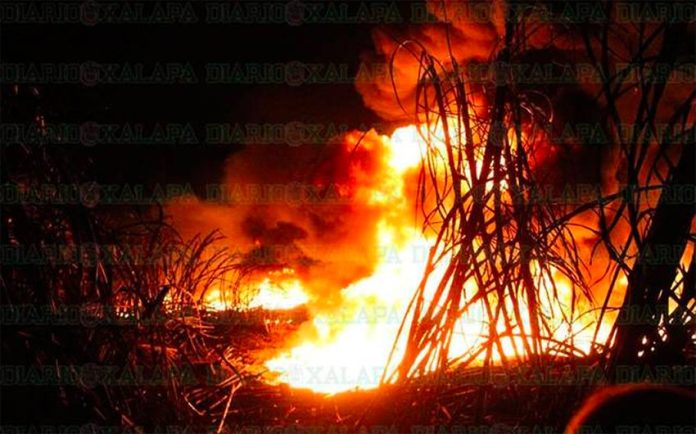
Explosion at the site of a pipeline tap.

Two people died, five were injured and 10 reported missing in Veracruz when an illegal pipeline tap caused a fuel spill that caught fire.

The incident occurred at El Once in the town of El Otate, Amatlán, where huachicoleros, or fuel thieves, tapped a Pemex pipeline that runs between Minatitlán, Veracruz, and Mexico City, near the highway between Córdoba and Cuichapa.

But fuel began to spill, attracting about 20 residents with buckets and other containers who arrived to help themselves to free fuel.

That was when a fire started, causing a minor explosion.

Among the victims was a 10-year-old boy who suffered second and third-degree burns to 70% of his body.

The spill reached a nearby creek, leaving a fuel stain about 1.5 kilometers long.

Source: Diario de Xalapa (sp)

6 headless bodies in Chihuahua: cartel battles continue

0
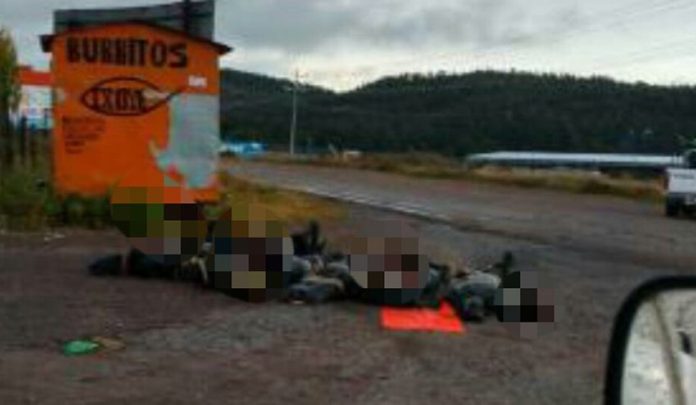
Bodies left on the roadside in the Tarahumara region.

Six decapitated bodies were found on the side of a highway in Chihuahua Wednesday, state authorities said.

According to police reports, the bodies were wrapped in a black material and left next to the Creel-San Juanito highway near a gas station in the northern state’s Sierra Tarahumara region.

The deaths are believed to be linked to a feud between La Línea criminal gang and the Sinaloa Cartel, both of whom are involved in organized crime in the state, including illegal logging.

A cardboard sign signed by the suspected leader of La Línea, the armed wing of the Juárez Cartel, was found with the victims’ bodies.

The Chihuahua Attorney General’s office (FGE) attributed the deaths to the gang’s leader, César Daniel Manjarrez Alonso, who is also known as El H2.

Police took the corpses to a state morgue for identification and to establish the causes of death.

State authorities deployed a search operation to locate those responsible for the crime but no arrests were made.

La Línea is also believed to be behind a separate incident in Ciudad Juárez this week, in which a group of armed men shot at two police officers eating breakfast at a street stand.

One officer and the woman operating the stand were wounded, state authorities said.

A police operation deployed in response resulted in the arrest of eight people traveling in a vehicle in which assault weapons were found that are believed to have been used in the attack.

The attack was the 11th time this month that police in Chihuahua have been targeted by suspected members of criminal organizations.

An hour before the incident, state police and the Ciudad Juárez municipal force announced a joint operation aimed at combating aggression towards police.

Source: El Universal (sp) 

Demonstrations follow journalist’s assassination in Acapulco

0
Guerrero journalist Gabriel Soriano.

Demonstrations yesterday in the Guerrero cities of Acapulco, Zihuatanejo and Atoyac de Álvarez followed the assassination on Wednesday of journalist Gabriel Soriano Kuri.

Soriano had been covering Governor Héctor Astudillo Flores’ third annual report for the Radio y Televisión de Guerrero (RTG) broadcaster Wednesday evening.

After the event, held in Acapulco, he was driving a company vehicle when he was attacked and killed by armed civilians.

Following the murder, Astudillo offered his condolences to Soriano’s family via Twitter. But it didn’t go down very well.

Soriano’s daughter replied with a blunt message: “My dad was assassinated doing his job. Covering your report to the state! Do your job and fix the situation the state is in. It’s not right,” she wrote.

Her discontent was echoed in at least three demonstrations where journalists demanded that authorities solve the assassination of their colleague.

The protesting journalists also demanded guarantees to be able to perform their jobs safely.

A state journalists’ association reported that three members of the profession have been slain during Astudillo’s three years in office.

Francisco Pacheco was killed in Taxco in 2016, while Cecilio Pineda was murdered last year in Ciudad Altamirano.

The organization also stated that journalists in the state have been victims of multiple aggressions perpetrated by state officials and police.

Soriano’s assassination was also condemned by the Mexico office of the United Nations High Commissioner for Human Rights.

“The assassination of Gabriel is yet another terrible reminder that violence against journalists in the country is unstoppable, reinforcing what we already know: Mexico is one of the most dangerous countries in the world for those who do the work of providing information,” said UN representative Jan Jarab.

One of the chief measures to prevent violence against journalists, he added, is to stop impunity.

The latest murder brings to 10 the total number of journalists slain this year in Mexico. There may have been one more: Agustín Silva has been missing since January.

The UN office said there were at least 12 journalists assassinated last year in Mexico.

Source: Reforma (sp)

Electrical tariffs strike a blow at Cancún restaurants

0
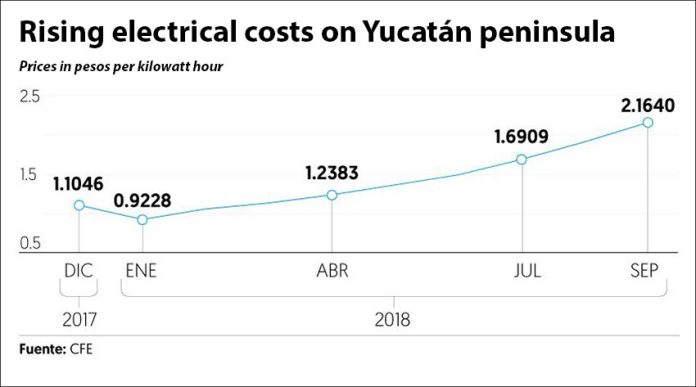
Electricity costs have risen 96% this year on the peninsula.
Electricity costs have risen 96% this year on the peninsula. cfe

Rising electricity and gasoline prices coupled with insecurity are hitting Cancún restaurants hard.

Juan Pablo Aguirre, head of the restaurant industry association Canirac, believes that between 30 and 50 restaurants in the Caribbean coast resort city could close by the end of the year due to the economic pressure faced not only by businesses but also by local residents.

“September was a very complicated month for the whole sector, we’re waiting to see how the year ends. We hope that there will be a slight rebound during the December holiday season but it definitely won’t make up for how difficult the whole year has been for us,” he said.

“What is hitting us are issues at the national level, like the increase in gasoline prices, the increase in electricity tariffs, the depreciation of the peso compared to the [US] dollar although at a local level the increase in insecurity [is also a factor]. All this together is stopping people from going out and eating in restaurants and all kind of establishments in general.”

Aguirre said that a lot of businesses have had to take on debt in order to pay their electricity bills.

Prices have increased significantly recently, prompting Canirac to seek exemptions from the municipal government that would help restaurants to reduce their electricity bills.

Inna Germán Gómez, president of the Caribbean branch of the Business Coordinating Council (CCE), described the increase to electricity prices as “scandalous.”

She explained that a National Energy Control Center (Cenace) levy had added 3% to 4% to monthly electricity bills and that customers are also being charged more for distribution and transmission.

“. . . In some cases, they’re raising monthly electricity bills by up to 50%,” she said.

Germán said the CCE will file at least 1,000 complaints with the Federal Consumer Protection Agency (Profeco) in relation to the price hike.

She added that the Federal Electricity Commission (CFE) has repeatedly blamed the increases on the Energy Regulatory Commission.

Source: El Economista (sp) 

The airport vote: delays, few voters and a dead website kick things off

0
A polling station in Puebla for the airport vote.

A late start, few voters, a dead website and proof that it is possible to cast more than one ballot all contributed to defining the first hours of the public vote on the future of Mexico City’s new airport (NAICM).

In the México state municipality of Chimalhuacán, the polling station opened half an hour later than scheduled this morning because the ballots and other electoral materials were late to arrive.

Voting got under way at around 8:30am.

Pedro Valencia was the first person to cast a ballot in response to the question asking whether construction of the new airport in Texcoco should continue or whether the existing airport and that in Toluca should be reconditioned and two new runways built at the Santa Lucía Air Force Base.

Valencia told the newspaper El Financiero that he hoped that the project would continue at Texcoco because it would generate employment for the area. However, he conceded that the project also presented risks.

In the south of Mexico City, the consultation got off to a slow start with only a few citizens arriving early this morning to cast votes at a polling station located on a busy avenue in the borough of Coyoacán.

However, one person who did vote, a biology student at the National Autonomous University (UNAM), stressed the importance of participating in the democratic exercise.

“Asking whether you want an important infrastructure project [to go ahead] or not is something that is unprecedented in the country. It’s necessary to know all of the implications that building the airport in Texcoco or moving it to Santa Lucía will have for the city,” Diego Ortiz said.

In Tlalpan, a Mexico City borough even further to the south, there was again only a trickle of voters shortly after polls opened this morning.

Elvira Hernández told the newspaper El Financiero that she had voted but that she was initially unaware that a vote on the future of the airport project was taking place.

“I thought that [the polling station] was to register for a senior citizen’s card but the young lady explained to me that it was about the airport so I took the opportunity to vote,” she said.

Perhaps one reason why voter turnout was low this morning is that the website set up to provide information about the public consultation —  including the location of the polling stations across the country  was down intermittently.

The newspaper El Economista reported that a “this site can’t be reached” message was displayed on the site when it made several attempts to access it. Mexico News Daily received the same message after several attempts to visit the site this morning and late this afternoon.

Another reason for the low number of voters could be that many Mexicans have indicated that they don’t have enough knowledge about the airport project to offer an informed opinion about it.

“A lot of people are not informed to make a decision about which place is better,” María Victoria González told the newspaper Milenio.

“. . . We don’t have the training, we don’t know what is advisable . . . I declare myself incompetent to offer a response because I don’t know on what citizens should base their vote.”

Businessman Fernando Gómez offered an even blunter assessment on the public consultation.

“It’s a perverse farce,” he said, adding that the decision to build the airport at Texcoco was the result of a years-long study and that it would benefit the whole country.

Layla Arcos, a pilot for low-cost airline Volaris, said that only 15% of Mexicans travel by plane and that what really matters is the opinion of those “inside the planes.”

“Yes to Texcoco, a new airport is needed. The delays [at the existing airport] are excessive,” she said.

The first part of the old adage “vote early and vote often” may not have been followed by many but some people heeded the latter advice.

Despite president-elect López Obrador declaring that it would not possible to vote more than once, two reporters — one from Milenio, another from broadcaster Multimedios — found otherwise.     

Gabriel Ortega first voted this morning in a neighborhood in the Mexico City borough of Miguel Hidalgo before voting again at another polling station located two kilometers away in the same borough.

Not to be outdone, Ramón Ramírez of Multimedios was able to obtain ballots at three different polling stations but only voted once so as to not willingly distort the result.

“These inconsistencies could throw up alarming figures at the end [of the vote],” he said.

Some social media users also claimed that they, or people they know, had voted more than once.

Voting in the public consultation called México Decide (Mexico Decides) is taking place in 538 municipalities across Mexico and will conclude Sunday.

President-elect López Obrador has said that the result will be binding, although legally speaking the incoming government will not be bound by it.

There are signs of growing concern over the negative economic impact a decision to cancel the project might have, with Mexico’s two biggest banks and others saying that it would hurt private investment.

Source: El Financiero (sp), Milenio (sp), El Economista (sp) 

Patent protection sought for traditional indigenous dishes

0
The Mixtec dish called chileajo.

Traditional Mixtec dishes from Oaxaca might soon be protected by a patent that has been requested by the Indigenous Peoples Development Commission (CDI).

A CDI representative in the Mixtec municipality of Silacayoápam, Oaxaca, told the newspaper Noticias that the first stage of the cultural conservation project is to promote staple dishes of regional cuisine to a larger public.

It has been through “gastronomic festivals that we have been developing this . . . we’ve had good progress, some recipes have already been written down, like those for the atoles [traditional hot corn and masa-based beverages] from Tepejillo, the chileajo [a thick pork-based sauce] from Tonalá and the guaximole [a river tamarind-based mole] from Cuautepec . . .” said Anastasio Villarreal Díaz.

Once the cuisine of the Mixtec region and all of its autochthonous dishes are fully recognizable by foodies, the CDI will move forward to formally register them.

Another part of the registration process is taking place at the Teposcolula Institute of Technology, where gastronomy students are conducting investigations intended to formalize each of the Mixtec dishes’ recipes.

The CDI, concluded Villarreal, is also offering counsel and training to traditional Mixtec cooks, improving the presentation of their pre-Hispanic dishes while keeping them authentic.

Source: Noticias de Oaxaca (sp)

Tunnel, chamber discovered beneath Pyramid of the Moon

0
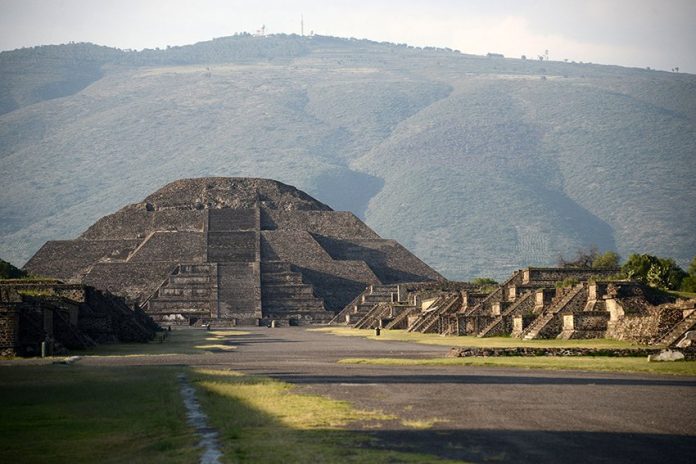
Pyramid of the Moon at Teotihuacán.

Experts have discovered a tunnel leading to a chamber that was possibly used for funeral rituals beneath the Pyramid of the Moon at the Teotihuacán archeological site.

A team of researchers from the National Institute of Anthropology and History (INAH) working in collaboration with the Institute of Geophysics at the National Autonomous University (UNAM) made the finds during an electrical resistivity study of the pyramid.

Verónica Ortega, director of the Plaza de la Luna Conservation Project, said it is possible that human remains and artifacts could be found in the 15-meter-diameter chamber.

She explained that archaeologists discovered skeletons with deformed skulls as well as a range of objects made out of green stone within the same pyramid in the 1980s.

“. . . Because of that it’s not hard to think that something similar could be found . . .” Ortega said.

She added that the investigation would help researchers to understand more about ancient rituals at Teotihuacán and the civilization’s relationship with other pre-Hispanic cultures.

“What’s found inside could help to unravel the relationships that this ancient metropolis had with other regions of Mesoamerica,” Ortega said.

At the start of this month, the INAH team carried out a new study that detected the location of the tunnel leading to the chamber.

“The tunnel is towards the south of the Plaza de la Luna [Plaza of the Moon] but it’s probable that there is another entrance [to the chamber] towards the eastern side. Consequently, getting a complete radiography is fundamental to finding out where it can be accessed from,” Ortega said.

The Pyramid of the Moon is the only structure at Teotihuacán that directly faces the Calzada de los Muertos, or Avenue of the Dead. It is believed to have been enlarged seven times since it was first built.

Last month, the same team of INAH archaeologists announced that they had uncovered evidence that Mayan elites lived in Teotihuacán, located northeast of Mexico City more than 1,000 kilometers from the center of their civilization.

INAH said in a statement that the remains of a Mayan-style mural and offering as well as fragments of Mayan ceramics and bones of thousands of sacrificed people were found in the Plaza of the Columns, which is positioned between the Pyramids of the Sun and Moon.

During its prime, between 100 BC and 750 AD, Teotihuacán is believed to have been the home of more than 100,000 people and possibly the most powerful city in North America. Today, it is a popular tourist destination because of its huge pyramids.

Mexico News Daily 

Hurricane Willa affected 33,000 in two states

0
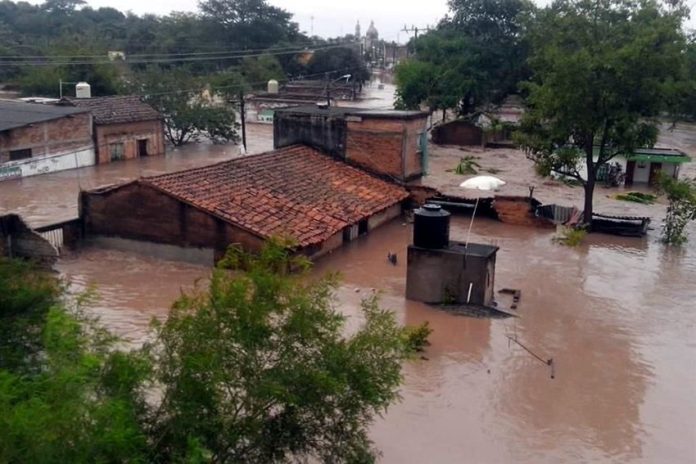
A flooded home in Nayarit.

Around 33,000 Sinaloa and Nayarit residents were affected by Hurricane Willa, a category 3 hurricane that struck the Pacific coast Tuesday night.

Authorities in both states reported flooded homes, overflowing rivers, damaged highways, power cuts, damage to crops and the death of livestock. However, there were no human casualties.

Escuinapa, the southern Sinaloa municipality where the powerful storm made landfall, and Rosario, to its immediate north, bore the brunt of the powerful storm.

The Baluarte River burst its banks, flooding homes in both municipalities where an estimated 20,000 people were affected.

Power went out in several areas of Sinaloa but the Federal Electricity Commission (CFE) had restored service to 53% of affected areas by late yesterday.

Sinaloa Governor Quirino Ordaz visited affected areas of the state yesterday to assess damage.

He said that 4,000 people had evacuated to shelters set up by state and municipal authorities, many of whom arrived after their homes sustained damage in the hurricane.

In Nayarit, more than 13,000 people were affected by Willa, which brought winds of 195 kilometers per hour with gusts as strong as 240 kilometers per hour.

The strong wind damaged homes, toppled trees and utility poles and cut power in several municipalities.

Rivers in the state overflowed, livestock drowned and several vehicles were swept away by floodwaters.

Around 15,000 members of the military have been deployed to the Sinaloa-Nayarit border area to assist residents of affected communities.

The navy said in a statement yesterday that more than 3,800 marines, 163 vehicles, eight planes, six boats and three mobile kitchens were deployed as part of its response to Hurricane Willa.

Marines helped 178 people to evacuate yesterday from two Escuinapa communities that had been cut off due to heavy rain.

Willa, which strengthened to a category 5 hurricane earlier this week, weakened rapidly after landfall and was downgraded yesterday morning to a tropical depression.

The National Meteorological Service (SMN) is forecasting that its remnants will continue to bring rain to several states today including Sinaloa, Durango, Nayarit, Nuevo León and Coahuila.

Source: Milenio (sp), El Universal (sp) 

8 dead after bus collides with vehicles in the wrong lane

0
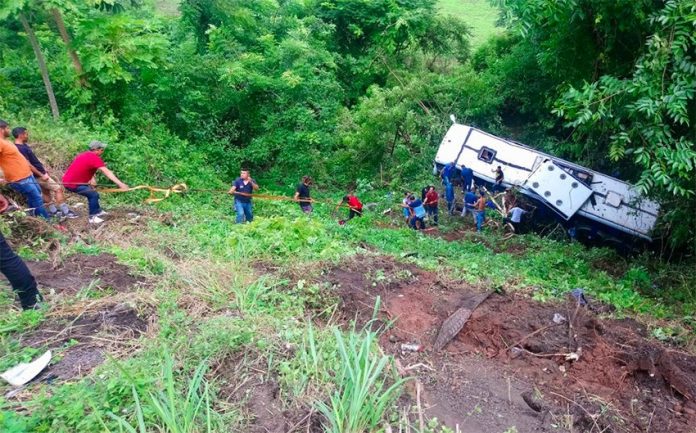
The bus that went off the road yesterday in Nayarit.

Eight people died and 40 were injured yesterday in Nayarit when a bus carrying tourists collided with three vehicles in the wrong lane on the Guadalajara-Puerto Vallarta highway.

The bus was rounding a curve in the highway when it encountered three vehicles in its lane as they attempted to pass a semi-trailer. The bus went off the road and plunged into a ravine.

The accident occurred a few minutes after noon near Lo de Marcos.

Passersby in other vehicles stopped to help survivors out of the overturned bus before emergency services personnel arrived.

Six passengers were killed instantly while a seventh died while receiving emergency medical attention at the scene of the accident.

The injured were rushed to nearby hospitals due to the severity of their injuries. One died later in the day.

The bus was carrying visitors from Arandas, Jalisco, who had been vacationing on the beach in Puerto Vallarta.

Source: El Sol de México (sp), Milenio (sp)