Home Blog Page 2016

Honduran migrant gives birth in Chihuahua after highway collision

0
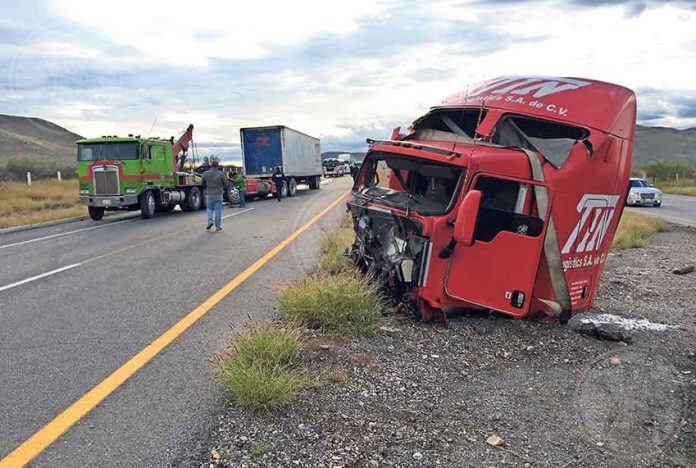
Wreckage of the semi after accident in Chihuahua.

A migrant traveling through Mexico from Honduras gave birth in Chihuahua Thursday after she was the victim of a traffic accident.

The 27-year-old woman was traveling with 19 other migrants when the truck in which they were riding collided with another vehicle before overturning on the Chihuahua-Delicias highway.

Eight of the passengers emerged unscathed but their 12 companions had to be transported to local hospitals, “where they are reported stable and receiving free medical attention . . .” said a state official.

The pregnant woman was among those injured, and a c-section was ordered after she reported pain in her upper abdomen.

Mother and child were later reported stable and in good condition but will remain under observation, hospital officials said.

The injured migrants have received medical examinations, counseling, food, clothing and lodging free of charge at several state-run health centers and non-government shelters.

Their eight companions are now in the custody of the National Immigration Institute (INM), where their migratory status will be defined.

Source: Milenio (sp)

Tigers, other animals seized in Sonora home after child attacked

0
One of the Bengal tigers seized in Sonora.

The federal environmental agency Profepa has seized three Bengal tigers, a lion, 23 turtles, a lemur and a crocodile from a home in Hermosillo, Sonora, after a seven-year-old girl was attacked by one of the tigers.

The girl was in intensive care but in stable condition after an injury to the back of her head.

Set up as a “private zoo,” the house in the Las Minitas neighborhood lacked the required security measures to keep the animals and the owner was unable to present documentation showing their origin, authorities said.

Nor did he have documentation issued by the federal Secretariat of the Environment and Natural Resources for a handling, care and feeding program designed for wild animal species.

Profepa inspectors found that two of the tigers had been tagged with the required microchips, but the remaining animals lacked this identification system.

The owner of the animals, and father of the young girl, lamented that his animals had been seized.

He said his plan was to create an ecological reserve where animals would be kept for  conservation rather than entertainment although in future he wished to open a zoo to allow people to see them.

Source: El Imparcial (sp), Milenio (sp)

Airport vote ‘opaque and illegal,’ ‘useless consultation,’ business leaders charge

0
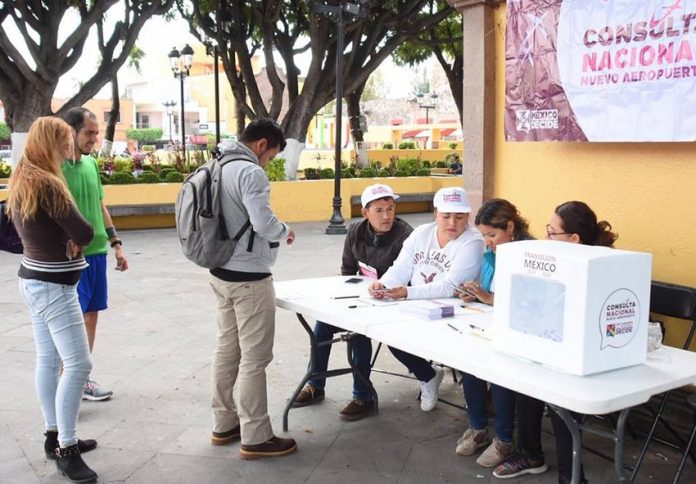
Voters at a polling station in Querétaro.

The leaders of two of Mexico’s most influential business groups have spoken out against the incoming government’s public vote on the future of the new Mexico City International Airport (NAICM).

The public consultation, which asks citizens whether the current project at Texcoco, México state, should continue or whether two new runways should be built at the same state’s Santa Lucía Air Force Base, began Thursday and will conclude tomorrow.

Juan Pablo Castañon, president of the Business Coordinating Council (CCE), described the consultation process as “opaque and illegal,” charging that there is no guarantee that its result will be implemented by the new López Obrador-led government.

The process, he added, is not conducive to generating economic confidence.

“For all governments, it’s very important that their decisions, their acts of governance, generate confidence,” Castañón told attendees at a business event yesterday.

He also pointed to the deficiencies detected in the process, such as proof that some people have voted more than once, as further evidence of the consultation’s flaws.

In addition, the business leader rejected López Obrador’s claim that only the “corrupt and the cunning” want the vote to be cancelled.

“We have always thought that the participation of Mexicans to strengthen democracy is fundamental,” Castañón said, but criticized the procedure.

“We’re against how this consultation has been organized . . . After listening to the experts, seeing the different studies, [it’s clear] they are technical decisions so complex that it is difficult for any citizen . . .who isn’t an expert . . . to have the knowledge [required] to vote about the different alternatives.”

Castañón added that López Obrador and his team have made it clear that they are in favor of the Santa Lucía option.

“. . . That’s why we believe that this way of making decisions is not the correct one for this project in particular,” he said.

Castañón also claimed that the Santa Lucía base would be overwhelmed by passenger numbers in six or seven years whereas the NAICM would meet Mexico’s air travel needs for at least the next 45 years.

For his part, Gustavo de Hoyos, president of the Mexican Employers’ Federation (Coparmex), said in a Twitter post that he wouldn’t participate in the public vote.

“. . . It’s a useless consultation. I believe that it’s technical design is imperfect and the result will not be representative. I don’t have confidence in the impartiality of the exercise.”

De Hoyos told a press conference this week that if the new airport ends up being canceled, the ramifications will extend well beyond the contractors with interests in the project and the wider business sector.

“Who would lose if this project isn’t completed isn’t just one or two business people. In the long term, it’s Mexico who loses starting with the [new] government because . . . it will pay the compensation [to contractors] . . . We all lose but first the government.”

Mexico’s two largest banks, BBVA Bancomer and Citibanamex, have also warned that if the new government decides to scrap the US $15-billion airport, it will hurt private investment.

Source: El Universal (sp), El Economista (sp) 

Sinkhole swallows gas truck in Zapopan

0
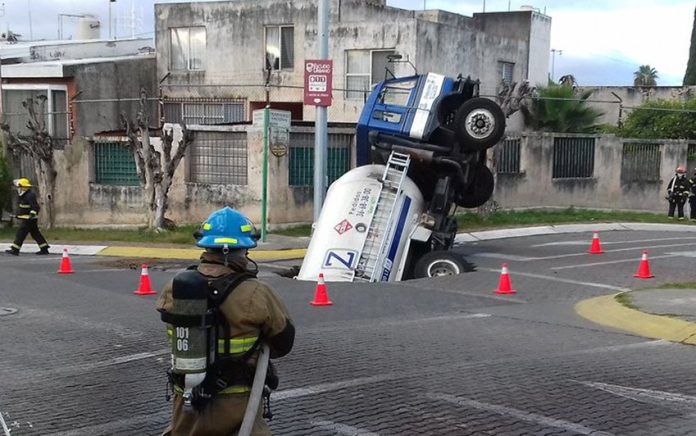
Gas truck in Zapopan yesterday.

A propane truck was swallowed up by a sinkhole yesterday in Zapopan, Jalisco.

The truck was left in a near-vertical position after the 1.5-meter-deep hole opened up in the Conjunto Patria neighborhood.

A delicate maneuver to extract the vehicle followed, which required removing half its gas content.

Civil Protection officials explained that the sinkhole was caused by a leak in a water pipe below the street.

Fifty residents of homes within a 250-meter radius were evacuated.

Source: Milenio (sp)

Honda says there is no plan to move production out of Mexico

0
Honda Fit, made in Mexico for US market.

The Honda Motor Company has denied a report that appeared yesterday saying it was considering moving production of its United States-bound Fit subcompact cars from Mexico to Japan in a few years, partly due to the new North American trade deal.

The Fit is made in the automaker’s plant in Celaya, Guanajuato, which also makes SUVs for the U.S. market.

The news agency Reuters said two sources familiar with the Japanese company’s plans had confirmed that production was set to shift but a Honda spokesman said no decision had yet been made about where the Fit will be made.

The new trade deal between Mexico, the United States and Canada raises the minimum North American content for cars to qualify for tariff-free status from 62.5% to 75%.

The pact will also push up auto-sector wages in Mexico because it requires a higher proportion of auto content to be made in high-wage areas where workers are paid at least US $16 per hour.

The sources told Reuters that the terms of the new deal make Mexico less attractive to Honda for production of its Fit model.

They said that if the plan to shift production goes ahead, it would happen when Honda launches a new model in the next few years.

The sources added that U.S. consumers are increasingly purchasing SUVS and therefore making those rather than subcompacts made more sense for Honda’s Mexico plant.

The company issued a statement after the report appeared to say there was “no plan confirmed to move production from Mexico to Japan.”

Source: Reuters (sp) 

Hidden dangers for Mexico expats: there are financial and psychological costs to consider

0
Choosing the right accommodation can save a lot of money.

Prior to choosing Mexico as a relocation destination, all future expats ponder the big question: “What will be our cost of living?”

The implications contained in the term cost of living cover a broad spectrum of our personal reality, where the financial aspect is the most conspicuous component. So what does it really cost to live in Mexico? Just what are the monetary advantages, and are they all true advantages? Are there hidden costs?  If so, why and where are they hiding?

Some wonder, will my meager retirement income be adequate to live with some level of comfort?  Oh dear, oh dear, oh dear! What shall I do?

How about the personal costs? What is the impact of this culture on your psyche? Will it rankle the deep-rooted and closely held sensibilities implanted by your native culture? How do people deal with the merciless culture shock which lurks around every corner? Is there some type of therapy available to defray the nagging angst of making a huge mistake? Oh dear, oh dear, oh dear! What shall I do?

Or, could it be possible that life in Mexico is the most brilliantly awesome thing since sliced bread? How easy could it be to meld into a culture where the concept of tomorrow falls somewhere between nebulous and nonexistent?

I will start with the fiscal aspect of what it costs to live full time in Mexico. Over the years I have heard the all too common expat refrain: things would cost twice as much back in Duluth, or Edmonton, or whatever frozen wasteland they have left behind. But is that actually a well thought out assessment, or an apples and avocados type comparison?

For example, financially speaking, living on a tropical beach in Somalia would be a real bargain, but what about that quality of life thing?

So let’s first take a look at the peso side of life in this strange and colorful land. The obvious lifestyle bargains in Mexico are, quite conveniently, also life’s basic needs: food, housing, medical, dental, property taxes and tequila. However, there are less obvious expenditures which can be the real budget busters.

These cleverly camouflaged costs for a life in Mexico are numerous and can be outright deceptive. For example, people who live in condos, throughout Mexico, are charged monthly maintenance fees which seem reasonable at the time of purchase. However, many condo developers view the monthly charge as a long-range cash cow and these fees can rise over time well beyond reasonable “cost of living” adjustments.

And, if you live in a condo where not all the residents pay their share of the maintenance costs, upkeep could get expensive. I know of one place where friends footed the bill to have the outside of their four-story building painted because the other owners refused to pay the maintenance fees.

For those who rent, unexpected costs could plague your idyllic life in paradise. Numerous Mexican landlords consider expat tenants as the perfect way to improve their property. It is quite common for the general maintenance of the property to be the tenant’s responsibility i.e. water heater, stove, fridge, plaster repair, roof repair, paint, door hardware, plumbing fixtures, electrical breakers, air conditioners, propane tanks and whatever else may break or fail.

And to top off this arrangement, it is not uncommon for landlords to actually raise the rent after the tenant has spent substantial money to improve the property. After all it’s a better property now so it’s worth more, right?

Even the simple act of shopping for food and other necessities can be a maze of conflicting prices and disappointing choices. Knowing where to shop is a journey of discovery for the adventurous but savvy expat. And, unlike north of the border, prices of consumer goods in Mexico can fluctuate greatly, especially for people who are obviously recently arrived foreigners.

Despite the fact that Mexican consumer law forbids the sale of goods without clearly marked prices, there is a lot of cheating. The lack of a price label is the perfect way for shopkeepers to bump the price for well-dressed Mexicans or to impose a “gringo tax” on the unsuspecting expat.

Construction or renovation costs, auto maintenance and repairs of miscellaneous household items can either be a bargain or a serious rip-off, totally dependent upon how you make your choices. And the best way to determine whose service is fairly priced, or where to shop, is through recommendations from the expats who have boots on the ground in your chosen area of residence.

Mexican friends can also be very helpful when trying to locate fairly priced goods and services. However, a word of caution: all Mexicans have either a relative or neighbor who they will assure you is a very capable and reliable plumber, electrician, handyman, gardener, brain surgeon, notario, etc. But what about the genuine newbies, without friends or acquaintances to guide them through the sticky wicket of potentialities?

In our digital world of the 21st century, there is invariably an internet forum or a Facebook page that will cover the area of your interest. There you will find expats who have endured the gauntlet of bad plumbers and lousy dentists, and are more than willing to share their experiences. Even in such venues, a word of advice: don’t ask for referrals; again, get details of direct experiences.

Your life in Mexico is completely dependent upon how you create it and how you wish to live it out. For those people who have tight budgetary constraints, life in Mexico is the perfect opportunity to perfect a totally Zen state of being.

A two-room hovel in a small village at the end of a dirt road could easily be rented for a few hundred pesos per month. The purification diet (required to attain nirvana) of your new Zen lifestyle can be carefully gleaned from the sparse shelves of any rudimentary mercado or local tienda. Again, your meager sustenance would cost very little on a monthly basis.

Since the Zen discipline frowns on personal luxuries, material possessions, alcohol and other ego-driven accessories, this further reduces your monthly outlay. If this type of lifestyle appeals to you, life in Mexico could be had for about US $100 US per month.

Conversely, I know people who boastfully declare their grand life in Mexico costs them no more than $100 per day. Actually, this is not far off the mark for a comfortable life in many areas of Mexico — and it requires no meditation. Your true financial outlay for life as an expat is normally less than your pervious home country, but it can be much more than you anticipated prior to making the expat leap. So just suck it up Bucko, that’s the financial reality of living full time in Mexico.

But wait, there’s more! Now we get to examine the psychological cost of living in Mexico when compared to life in your native country. I know in my native country I was making a living, but my attempt at making a life was impaired by the fast-paced insanity of adequate survival. As I ran the perpetual wheel of the first-world ratrace I began to feel a numbing futility with each tedious stride.

I realized I was spending my present moments as a down payment in the hope of higher quality moments somewhere in my anxiously anticipated, but murky future. My fiscal cost of living was just fine, but my state of mind was dark; hovering somewhere just above Neanderthal. Being swept up in the tumultuous flow of modern life had blinded me to my self-induced plight. Fifteen years ago I couldn’t even spell Mazatlán, let alone envision the potential for a lifestyle so sublime.

My transcendental moment came one snowy evening as I was trudging through an ally, in a small town at the north end of Idaho. I caught a reminiscent fragrance wafting through the downy texture of the falling snow. As I peered through the drifting flakes I spotted an exhaust fan that was disseminating the haunting aroma of serious tacos; the lingering redolence of smoldering mesquite in a symbiotic dance with carne asada; I abruptly snapped. What happened next is a bit sketchy, because I found myself in the throes of a vividly realistic flashback.

When I finally regained what was left of my senses, I was ensconced in a nicely padded room with no windows. Later I read a report of my actions in the local paper. It alleged that once inside the restaurant, I stripped down to boxer shorts and began screaming Spanish expletives at the falling snow, while smearing my almost naked body with salsa picante.

Directly after this episode, I realized my psychological cost of living north of the border was massively insurmountable. I then knew that trying to buy a better life as I had been doing was futile. It was time to create a lifestyle that would become entirely holistic as well as culturally integrated.

Of course, my therapist recommended this new lifestyle was to be totally devoid of any form of cold weather, especially snow.

The writer describes himself as a very middle-aged man who lives full-time in Mazatlán with a captured tourist woman and the ghost of a half wild dog. He can be reached at buscardero@yahoo.com.

The Tobacco Cartel attempts to control cigarette market with raids, threats

0
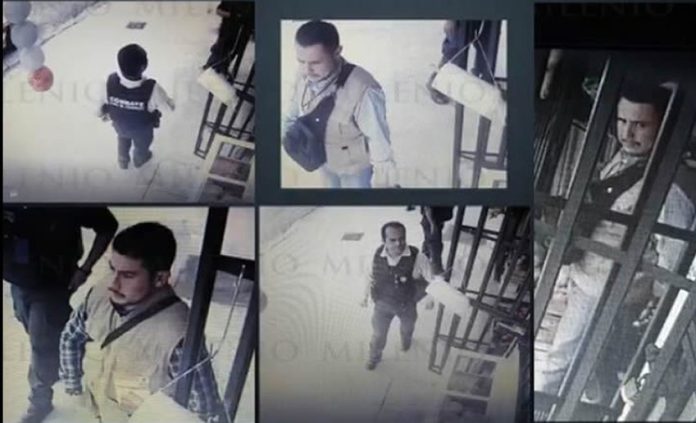
Security camera footage of a Tobacco Cartel operation.

A criminal organization known as the Tobacco Cartel is attempting to control Mexico’s cigarette market by eliminating brands it doesn’t sell from store shelves in several states.

A special report published by the newspaper Milenio this week said that between January and September, police — or people posing as police — have carried out 364 operations at stores in eight states to seize and destroy cigarettes not distributed by the company Tobacco International Holdings (TIH).

The states where the raids have occurred are Nayarit, Veracruz, Sonora, Michoacán, Jalisco, Coahuila, Tabasco and Sinaloa.

Milenio said business owners and distributors of other cigarette brands were given fake letters from government departments such as the Federal Tax Administration (SAT) or the Federal Commission for Protection Against Sanitary Risk (Cofepris).

The letters state that cigarette brands other than those distributed by TIH are illegal and cannot be sold in Mexico.

The “seize and destroy operations” have been carried out by municipal, state and federal police, according to people targeted by them.

“They introduce themselves and show their badges and their guns but they never say their name. Then they say that they’ve come to seize a product, that only one brand of cigarettes can be sold, that it is the only one authorized for sale in Mexico,” one shop owner said.

In some states, such as Michoacán, the so-called Tobacco Cartel has distributed flyers to small grocery stores stating that by order of the Jalisco New Generation Cartel (CJNG), only TIH cigarette brands could be sold.

People selling or distributing non-TIH brands have even been kidnapped and the Tobacco Cartel has published videos warning those who defy its orders that they are also at risk of abduction or worse.

Federal authorities have denounced the operations as false. In other words, those selling and distributing the allegedly “illegal” cigarette brands are not breaking any law.

According to the Tobacco International Holdings website, TIH is a “Swiss-founded company for the exclusive purpose of having the rights of the brands registered in Mexico.”

Those brands, Laredo, Botas and Económicos among others, are all much cheaper than better-known cigarette brands, costing no more than 25 pesos (around US $1.30) a pack.

TIH cigarettes are made by Braxico Manufacturing and distributed by the company Bradis. Both are subsidiaries of TIH.

One of the partners of the company — and the head of the Tobacco Cartel — is believed to be Carlos Cedano Fillipini, a former police officer who has worked with several federal agencies including the Attorney General’s office (PGR).

He worked for the Federal Ministerial Police in several states, including four where the fake operations have taken place.

Cedano’s sister and nephew both work for the TIH subsidiaries while two of his brothers are in active service with the PGR, Milenio said. One of them, Genaro Cedano Fillipini, is suspected of links to organized crime.

A sign hung in Guadalajara earlier this year accused him of covering up for those responsible for the torture and murder of three film students in March. Members of the CJNG are believed to be responsible for the crime.

Carlos Cedano has previously been imprisoned both in Mexico and in the United States on charges of organized crime and illicit enrichment.

A Michoacán self-defense leader told authorities during a recent declaration that the former federal agent, also known as El Rambo, has links to the leader of the CJNG, Nemesio Oseguera or El Mencho — Mexico’s most wanted drug lord.

Source: Milenio (sp) 

Daylight Savings ends Sunday but the practice could be put to AMLO’s next vote

0
Clocks change Sunday morning. But will AMLO call for a vote on it?

Clocks fall back one hour on Sunday in most of Mexico but is there a chance the practice might change under the new federal government?

When president-elect Andrés Manuel López Obrador served as mayor of Mexico City between 2000 and 2005 he often clashed with then-president Vicente Fox on a range of issues and public policy, one of which was Daylight Savings Time.

The former mayor decided to consult the people — as he is doing now with Mexico City’s airport — if they wished to continue changing their clocks twice a year, which he had previously declared unconstitutional and illegal.

The February 2001 survey polled 321,933 chilangos and found that only 25% supported the measure, while 75% did not.

The following day, López Obrador issued a decree that would regulate time in the city, in opposition to another decree by Fox regarding the implementation of Daylight Savings Time.

The disagreement went to the Supreme Court where a ruling went against both decrees and left the final decision on the matter in the hands of the federal Congress which in the end voted for its adoption.

López Obrador brought the issue up again in 2006 during his presidential campaign. He made it clear that continuing with Daylight Savings Time would be decided through public consultation if he were elected.

Early Sunday morning the clocks will fall back one hour everywhere in Mexico except in municipalities located along the northern border where the time change takes place on November 4. Matters are simpler in the states of Sonora and Quintana Roo which do not observe Daylight Savings.

With a new president eager to transform his country and one who is keen on public consultation, the rest of the country might soon join them.

Source: El Universal (sp)

Nayarit town well out of Willa’s way takes a hit from the hurricane

0
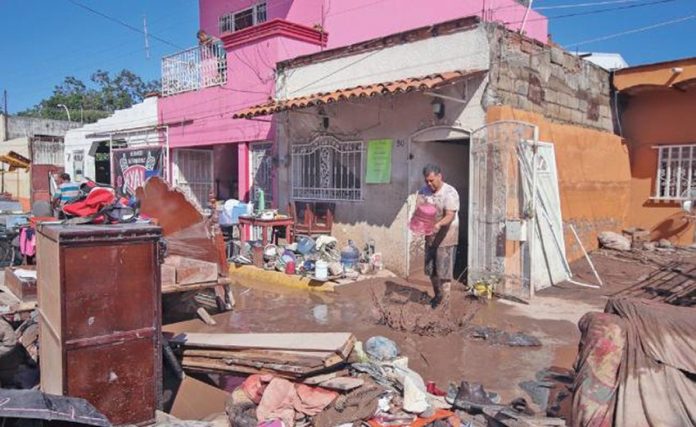
Flood damage in Tuxpan, Nayarit.

Tuxpan, Nayarit, wasn’t in the direct path of Hurricane Willa, a category 3 storm that slammed into the coast of southern Sinaloa Tuesday night, but it wasn’t spared from its destruction.

In fact, in contrast to expectations, it suffered the worst damage of any municipality in the small Pacific coast state.

Thousands of residents of Tuxpan — located more than 80 kilometers from the course Willa took — lost most or all their belongings as a result of flooding. The only fatality that has been reported as a result of Willa also occurred there.

Tuxpan police yesterday received a report that 77-year-old Moisés Landa Riva had drowned in floodwaters after torrential rain caused the San Pedro River to burst its banks.

Ramón López Calvillo, one of many Tuxpan residents facing a massive clean-up task following the storm, told the newspaper El Universal that locals were taken by surprise by the extent of the flooding.

“They told us three days ago that there was a risk; we’ve suffered from floods here before but never one like this. Everything was flooded in half an hour,” he said.

López explained while he worked that he was attempting to salvage family photos from his flooded home, declaring that “material things don’t matter but we’re not going to lose our memories.”

He and his family, like almost everyone in Tuxpan, took refuge during the hurricane on the second story of their home and remained there for 18 hours until the floodwaters receded.

A few blocks away, one home collapsed completely.

Arnulfo Jiménez, who lives on the street where the house fell, said that not only was his home damaged but he also lost his crops of beans, jicama and stevia.

Nearby, two police officers stood guard outside an Oxxo convenience store with windows broken by looters, their eyes red from not having slept for more than 24 hours.

“The worst thing is that people go in to steal cell phones, cables and cigarettes, not even food or water, which there is a shortage of everywhere,” one officer said.

Despite the widespread damage in the municipality, aid has been slow to arrive because response efforts in Nayarit have concentrated on Acaponeta and Tecuala, both of which border Sinaloa.

Nayarit Governor Antonio Echevarría said yesterday that more than 150,000 people in the state are estimated to have been affected by Willa, a figure much higher than initially reported.

He said that Nayarit authorities didn’t have the capacity to respond to the situation on their own and requested assistance from other states.

Some Tuxpan residents are skeptical that they will receive any aid that will help them to repair their homes and rebuild their lives.

“Tell them [the state authorities] to not even ask for resources from Fonden [the federal Natural Disaster Fund],” said one man who was attempting to dry his furniture under the sun.

“All that happens is a few people get rich and we won’t recover with the food aid and mattress they’ll give us.”

Source: El Universal (sp) 

Beauty and peace at the spectacular monoliths of El Diente, a forest of rocks

0
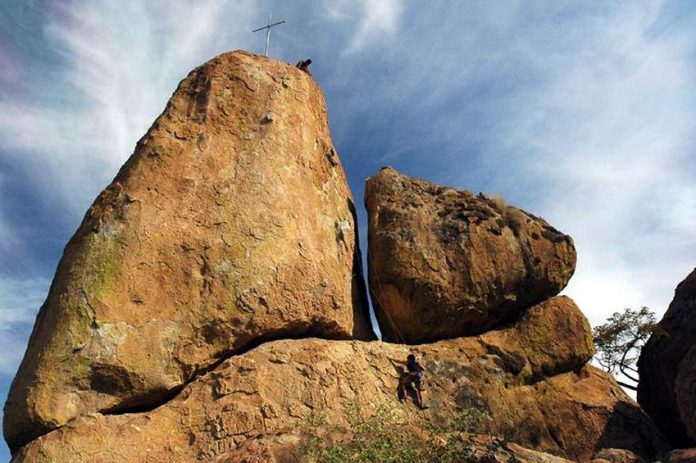
El Diente, the tooth, one of the boulders near Río Blanco, Jalisco.

The hills above the little town of Río Blanco, Jalisco, are covered with a curious forest consisting not of trees but of hundreds of huge, smooth, rocky spires.

One of these monoliths happens to have the shape of a giant tooth and has given a name — El Diente — to this extraordinary place of solitude and natural wonders, located only minutes from Mexico’s second largest city.

“When I first saw El Diente, I was quite surprised,” Canadian geologist Chris Lloyd told me. “The geological maps of this area show nothing unusual, but when I got here I found they were wrong. These monoliths are amazing.

“They are composed of a rather pure feldspar porphyry which formed deep under the earth perhaps up to 30 million years ago. That’s how long it’s taken the surrounding rock to erode away, leaving these extremely old monoliths standing tall. Geologically speaking, this is a very special place.”

The rock climbers of Guadalajara discovered the monoliths of El Diente many years ago and for a long time they considered them their big secret. “The rock is very hard,” says Luis Medina of Jalisco Vertical, “and the monoliths come in so many different shapes that climbers can practice every technique and maneuver imaginable, sometimes only two meters above the ground.”

Another thing that attracted the climbers is the silence. Wandering among these curiously shaped rocks, all you can hear is the chirping of birds, the chattering of squirrels and perhaps an occasional expletive from a climber who has missed his or her handhold and is — hopefully — about to be caught by the belay rope.

But the silence of El Diente is all the more extraordinary because this geological wonder is located only six kilometers from Guadalajara’s noisy, ever-busy Periférico or Ring Road.

The Diente monoliths are part of El Bosque de Nixticuil, which was once an impressive forest but over the years was eroded away by land development schemes of all sorts. Since 2008, what’s left of this woods has been officially “protected” but seemingly still under threat, as was evidenced in 2012 when rumors circulated that El Diente had been bought up by developers who were going to fence it off, shutting out the boulder climbers from their favorite weekend hangout.

“We were going to organize a festival called Salva El Diente, Save the Tooth,” says Luis Medina, “but when the developers heard about it they assured us they would never cut us off from our beloved rocks and we all joined together in a Vive El Diente International Festival of solidarity.”

Well over a thousand rock climbers from all over the world participated, including California’s Lisa Rands, said to be the best boulder climber anywhere, and Mexico’s national bouldering champion, Fernanda Rodríguez of Guadalajara, who called the event “padrísimo” [totally cool], perhaps the best qualification possible from a modern young Mexican.

“The festival was a great success,” commented Luis Medina, “because it brought the existence of El Diente to the attention of the authorities, of politicians and of many organizations. In addition, it turned out to be one of the biggest outdoor events in Mexico’s history.”

Several years after the festival, archaeologist Francisco Sánchez visited El Diente as part of a survey conducted by CIDYT, the Center for Dialog and Multidisciplinary Research, to catalogue the resources of the Nixticuil woods.

“I know it sounds strange,” Sánchez told me, “but in the nearby pueblito of Río Blanco I met a woman who told me she had had a dream that long ago people had lived on top of a certain hill just 400 meters southeast of El Diente rock. So I went to see the hill she indicated and even before I reached its base I began to find artifacts: the foundations of stone walls. The further I went up, the more it was clear that this hill had been terraced, but not for farming, and then, at the top I found the base of a pyramid.”

“The ground here,” Sánchez told me, “is covered with tepalcates [shards] and fragments of worked obsidian. The ceramic pieces pinpoint the builders of these structures exactly. This civilization flourished during the Epiclassic period, from 650 to 900 A.D. They are the same people who built the Ixtépete pyramid just outside Guadalajara and are referred to by archaeologists as the El Grillo Tradition.”

Quite near this hill where the ancient pyramid is located, you’ll find the trailhead for an eight-kilometer loop hike that circumnavigates the monoliths of El Diente. This is one of the most spectacular senderos I’ve seen in western Mexico. “The further we went,” I wrote about this trail after first walking on it, “the bigger and more beautiful the rocks got, with plenty of opportunities for us to scramble atop some of them. After hiking three hours at an easy pace, with three rest stops, we reached altitude 1,633 meters, just a hair over one mile high, where we had a magnificent view of the village of San Esteban far below us and, far, far away in the background, the smog-shrouded tall buildings of Guadalajara.

“We stopped for lunch near a truly colossal pinnacle which rock climbers call El Fistol (The Pin) and then we looped around the northwestern edge of the Bosque and returned to the El Diente parking area. This route is scenic every step of the way any time of the year, but it is especially beautiful if you follow it during the rainy season.”

If you are not interested in hiking or in watching boulder climbers do their thing, you can still have a great time at El Diente simply wandering and letting your imagination run wild. I went there with friends one day with no particular plan in mind. “Let’s just look at the rocks,” I suggested and, with every step, one of us would cry out: “This place is incredible; it’s astounding!”

And over and over we would point: “Look at those rocks: two giant turtles; over there, you can see a brontosaurus and here’s a giant finger pointing at the sun.”

Spend a few hours at EL Diente and I swear you will begin to see everything from giant bowling balls to natural bathtubs, and when you’ve seen enough you can sit down in the shade of a towering pinnacle to have a picnic. Just remember to clean up behind you and leave the place as you found it. And whatever you do, be sure not to bring your boombox!

El Diente is only a 16-minute drive from Guadalajara’s northern Ring Road. You can get there easily by asking Google Maps to take you to “El Diente, Zapopan Jalisco.” In case you would like to do the hike I described, check out my map on Wikiloc.

[soliloquy id="64067"]


The writer has lived near Guadalajara, Jalisco, for more than 30 years and is the author of A Guide to West Mexico’s Guachimontones and Surrounding Area and co-author of Outdoors in Western Mexico. More of his writing can be found on his website.