Home Blog Page 2038

Citizens’ group detains federal election officials in Oaxaca

0
Federal election officials in San Dionisio: not a warm welcome.

A citizens’ organization in a coastal community in Oaxaca detained four officials from the National Electoral Institute (INE) for nine hours yesterday in the most recent episode of a long protest over local elections.

The officials were visiting San Dionisio del Mar to appoint several local electoral officials and train them in their tasks, which didn’t sit well with members of the Peoples’ Assembly of San Dionisio del Mar.

Elections in the indigenous Ikojts municipality were scheduled for December 9 after that organization prevented the completion of the electoral process on July 1, part of an ongoing social and political dispute it has with municipal authorities.

[wpgmza id=”108″]

On a list of demands presented to the state government is a request for compensation for damages and for justice in an incident last March in which five of its members were allegedly victims of an armed attack.

The assembly claims that Mayor Teresita de Jesús Luis Ojeda was responsible.

It has warned that as long as there is no justice it will not allow elections to take place.

The Peoples’ Assembly of San Dionisio del Mar was created in 2012 by a group of residents dedicated to protect the Ikojts land and opposed to the installation of a wind farm in their municipality.

Source: La Jornada (sp)

National guard, fighting corruption among key elements of new security plan

0
A soldier stands guard after a confrontation in a Mexican street.

A 50,000-strong national guard is one of the central elements of a new national security plan presented yesterday by president-elect López Obrador, who pledged that his government’s priority will be to guarantee peace and improve the lives of Mexicans.

The new guard, which will be under the control of the army, will be made up initially of members of the army, navy and military police, and is expected to be operational within three years.

Alfonso Durazo, the new secretary of public security, pledged a radically different approach to the “repressive strategy” that has been in force since 2006 when former president Felipe Calderón deployed the military to wage a war on drugs.

The strategy, continued by the current administration, has been a “manifest failure,” Durazo said.

“Despite the hundreds of thousands of lives lost, the billions of dollars invested, the military resources used and the intelligence and surveillance used in the war on drugs, the Mexican government has not been able to defeat the cartels and there’s no prospect of it doing so any time soon,” he charged.

However, Durazo also said that it would be disastrous to withdraw the military from its public security role.

Shortly after López Obrador’s landslide victory in the July 1 election, the future security secretary said the incoming government would gradually withdraw the military from the nation’s streets.

But both he and López Obrador have since backtracked on the idea.

Yesterday he noted that there has been a “decomposition” of police forces at all levels.

While the use of the military will continue to be a major part of the new government’s security plan, López Obrador said that 80% of his government’s overall security strategy would try to address the root causes of crime.

The task is enormous. Last year was Mexico’s most violent year on record, with 31,174 homicides, according to the National Statistics Institute. There is a good chance that this year will finish with an even higher murder rate.

The new security strategy is built on eight key components:

1. The eradication of corruption and a renewed pursuit of justice.

Political impunity for lawmakers, known as the fuero, will be eliminated and government purchases will be monitored in real time. All government officials will be required to declare their assets and make their tax records available.

The new government will seek to classify corruption as a serious crime. It will also go after the finances of organized crime and aim to reduce money laundering.

2. Guaranteed employment, education and health care.

Through development and well-being programs, the new government will aim to reduce poverty and marginalization.

3. Guaranteed respect for and promotion of human rights.

The incoming government will not permit repression or torture and pledges to investigate all reports of human rights violations.

The release of political prisoners who didn’t commit any act of violence will also be pursued.

4. The regeneration of societal ethics.

Through the creation of a moral constitution, the new government will seek to improve relationships at the individual and collective level.

It also pledges to be austere, honest, inclusive and respectful of individual freedoms.

5. Reformulation of the war against drugs.

Government funding dedicated to fighting cartels and other criminal gangs will be redirected to drug rehabilitation services and programs.

“You can’t confront violence with violence. You can’t fight fire with fire and evil with evil,” López Obrador said.

6. Peacebuilding

The López Obrador-led government will seek to build peace by guaranteeing victims’ rights based on four components of transitional justice: truth, justice, reparations for damages and a guarantee that crimes won’t be repeated.

It will also introduce legislation that could reduce prison terms for criminals or grant amnesty.

7. Recovery of the control of prisons and improvement of their conditions.

Criminals who have been convicted and sentenced to prison terms will be held separately from inmates who have been ordered to remain in preventative custody.

Improving conditions in women’s prisons will also be a priority.

8.  The new security plan

Working with public institutions and Mexican citizens, the incoming government aims to develop a culture of peace. The new national guard will both prevent and fight crime as well as preserve security.

The new plan was not warmly received by longtime security analyst Alejandro Hope, who wrote yesterday that it gave him little peace of mind and few reasons for optimism.

Hope wrote in an opinion piece in the newspaper El Universal that “there is a lot of willfulness and magical thought behind the plan,” pointing out there is not much empirical evidence that shows that combating corruption will lead to a reduction in crime.

He also said it appears the new government intends to offer legal benefits to serious criminals, a proposal that goes well beyond the amnesty for small-time criminals previously put forward

In addition, Hope noted that little was proposed in the way of police reform.

However, Durazo yesterday gave the strongest of endorsements to the government’s approach, declaring “this plan will bring peace to every corner of the country . . . Children will be able to play in the streets again.”

The plan takes effect on December 1 when López Obrador is sworn in.

Source: El Financiero (sp), El Universal (sp), Financial Times (en)  

El Chapo was key cartel leader, says witness as trial gets under way

0
Jesús Zambada, brother of the leader of the Sinaloa Cartel, took the stand at El Chapo's trial yesterday.

Joaquín “El Chapo” Guzmán was a top leader of the Sinaloa Cartel and “one of the most powerful drug traffickers in Mexico,” a former cartel operations chief said in court testimony yesterday.

Taking the witness stand on the second day of the New York trial of the infamous drug lord, Jesús Zambada – younger brother of cartel leader Ismael “El Mayo” Zambada – spilled secrets on the inner workings of the lucrative trafficking operation that allegedly shipped billions of dollars’ worth of drugs to the United States under Guzmán’s leadership.

Zambada said he worked for the cartel for two decades until his arrest 10 years ago.

He is the first cartel witness to testify for government prosecutors against Guzmán, who faces 17 criminal charges and a possible life sentence if convicted.

United States prosecutors allege that between 1989 and 2014, the Sinaloa Cartel smuggled almost 155,000 kilograms of cocaine into the U.S. as well as heroin, methamphetamine and marijuana.

From Guzmán, who is also accused of conspiracy, firearms offenses and money laundering, they are seeking a US $14-billion forfeiture.

Jesús “El Rey” Zambada, a 57-year-old accountant who was arrested in 2008 and remains in United States custody, told jurors that he first met Guzmán in 2001 after the capo had escaped from a Jalisco prison in a laundry cart.

After the bold escape, Zambada said, he was given the task of finding a spot where the cartel could land a helicopter to pick up its boss.

“We were rescuing him . . . because the military was about to recapture him,” he said.

During most of the 2000s, Zambada said that his brother Mayo, who a lawyer for Guzmán portrayed as the “real” Sinaloa Cartel leader on the opening day of the trial,” and Chapo co-headed the criminal organization.

The testimony dismisses the defense’s characterization of the accused as a “scapegoat.”

The cartel imported large shipments of Colombian cocaine by land, sea and air before transporting it to border cities and then into the United States, Zambada said.

The drug, referred to by cartel members variously as Sapphire, Pacman and Coca-Cola, the witness said, would often be shipped by fast boats to Cancún, Quintana Roo, from where it was usually transported to warehouses in Mexico City and later onward to cities including Ciudad Juárez, Chihuahua and Agua Prieta, Sonora.

A common smuggling method used by the cartel involved placing the cocaine in containers that were concealed inside gas tankers filled with fuel, Zambada explained.

He said that he was responsible for cartel operations in the Mexican capital including a warehouse that processed 80 to 100 tonnes of cocaine a year, bringing in “billions” of dollars in revenue.

Through bribes, the ex-cartel member claimed, “I controlled the airport in Mexico City . . . controlled the authority.”

Zambada said that cartel profits soared after cocaine was moved into the United States, explaining that the extent of the illicit gains depended on its final destination.

One kilo of cocaine purchased in Colombia for US $3,000 would yield $20,000 in Los Angeles, $25,000 in Chicago and $35,000 in New York City, he said.

Zambada told jurors he established a system to track payments from clients in the United States, explaining that Guzmán and his brother Ismael Zambada invested together to buy large quantities of cocaine and shared the profits together.

One shipment that was deliberately sunk at sea in the 1990s by cartel members when they feared they were being followed by authorities was later recovered by deep-sea divers, he said.

At one point in his detailed three-hour testimony, Zambada, dressed in a blue prison jumpsuit and wearing tinted glasses, jumped to his feet to point at Guzmán and label him “one of the most powerful drug traffickers in Mexico.”

El Chapo, dressed in a dark suit and tie, calmly met the gaze of his accuser.

At times during the lengthy declaration, Guzmán, 61, wrote notes that he passed on to his defense team. At others, he gazed in the direction of his 29-year-old wife Emma Coronel, who watched proceedings from the public gallery.

The notorious drug lord, kept in solitary confinement in a Manhattan prison cell since his extradition to the United States in January 2017, has been banned by the Brooklyn federal court from having any communication or physical contact with Coronel, whose father was a Sinaloa Cartel leader.

Before Zambada’s testimony, federal prosecutors showed jurors a video of a tunnel between Agua Prieta and Douglas, Arizona, that Guzmán allegedly used to transport drugs into the United States.

Carlos Salazar, a retired U.S. customs agent and the trial’s first witness, told jurors that agents were surprised at how sophisticated the tunnel was.

It was half the length of a football field and fitted with lights, an industrial-sized weigh scale and a hydraulic system to lift away flooring that was covered by a pool table, he said.

Its exit in a Douglas warehouse was just two blocks from a U.S. Customs office.

In a continuation of his statement from the first day of the trial, Jeffrey Lichtman, a lawyer for Guzmán, again went on the attack against convicted criminals who have reportedly agreed to testify against his client.

Ismael Zambada’s son, Vicente, is also expected to take the witness stand after reaching a plea agreement on drug trafficking charges with U.S. authorities last week.

“They’re here because they want to get out of jail by any means necessary,” Lichtman said.

He had previously referred to the government’s witnesses as “gutter human beings” and asked the jury to “keep an open mind” and consider that law enforcement authorities in both Mexico and the United States could be corrupt.

Yesterday, he dubbed the witnesses “liars,” “degenerates” and “scum.”

Lichtman singled out Miguel Ángel Martínez, believed to be Guzmán’s former right-hand man, for his “unbelievable” cocaine habit.

“His nose basically fell off for sniffing cocaine,” he told the jury.

On Tuesday, Lichtman claimed that El Mayo had paid millions of dollars in bribes to current President Peña Nieto and his predecessor Felipe Calderón to buy immunity

Judge Brian M. Cogan subsequently cautioned Lichtman against making statements that might not be supported by evidence.

Peña Nieto, through a presidential spokesman, and Calderón dismissed the bribery allegations as completely false.

The trial, which is expected to last between two and four months, continues today.

Source: AFP (sp), Associated Press (en) 

Aviation complex will design and build planes, train pilots

0
The Halcón would be built at the new complex.
The Halcón would be built at the new facility.

A Mexican conglomerate is holding talks with the Guanajuato government with a view to building an aviation complex in the state that will design and assemble planes as well as train pilots.

IK Aerospace Group, made up of light aircraft manufacturer Horizontec, aircraft interior manufacturer Siasa Air and aerospace software company Optimen, told the newspaper Milenio that the new complex could be built in one of three Guanajuato municipalities — León, San Miguel de Allende or Purísima del Rincón.

Construction of the facility, which will be the first of its kind in Mexico, requires approximately 100 hectares of land.

Giovanni Angelucci Carrasco, founder of Horizontec, said that the group’s discussions with the Guanajuato government are already well advanced.

“There is good progress in Guanajuato, where we already also spoke to the next governor. There is a lot of interest on the part of the state government for us to set up there. We have three possible options to lay the first stone,” he said.

Angelucci explained that the idea for the project is to have a private runway, a manufacturing plant, an aircraft maintenance center and a flying school for pilots, which could include future customers who purchase light planes manufactured at the new complex.

Horizontec, currently based at the aerospace complex at the Querétaro International Airport, is developing a new two-seater plane after building and testing a prototype made out of compressed wood and fiberglass last year.

The three companies belonging to the IK Aerospace Group consortium would combine forces to build the new 100% Mexican aircraft known as the Halcón 2 at the complex slated to be built in Guanajuato.

Measuring seven meters in length and with a wingspan of 9.4 meters, the two-seater, 100-horsepower-engine aircraft belongs to the light sport category.

It will have a flight range of eight hours, an average top speed of 250-300 kilometers per hour and can reach an altitude of 15,000 feet.

“Aeronautics in Mexico has an excellent future,” Angelucci said.

“Growth projections for the [aerospace] industry in the country place [Mexico] among the first seven or eight [manufacturers] worldwide . . .”

Source: Milenio (sp) 

Mexico City stadium not up to snuff; NFL cancels Monday’s game

0
The stadium where Monday's game was to be held.

The National Football League (NFL) has announced that a match between the Los Angeles Rams and the Kansas City Chiefs will not be played in Mexico City Monday due to the poor condition of the playing surface at Estadio Azteca.

“The decision is based on the determination . . . that the playing field at Estadio Azteca does not meet NFL standards for playability and consistency and will not meet those standards by next Monday,” the league said in a statement yesterday.

The highly-anticipated match has been transferred to the Rams’ temporary home stadium, the Los Angeles Coliseum.

The decision to move the match from Mexico City came after NFL and Rams officials as well as independent experts inspected the stadium’s playing surface and determined that it posed a risk to players’ safety.

New hybrid grass was laid at the stadium in the middle of July but since then 23 soccer matches have been played on it and the stadium has also hosted three concerts and president-elect López Obrador’s final campaign rally.

Estadio Azteca authorities said in a news release that “the long and unusual rainy season, as well as the calendar of events with third parties . . . might be a factor in the grass being in far from optimal conditions.”

Mark Waller, an NFL executive vice-president, said in a statement that “we have worked extensively with our partners at Estadio Azteca for months in preparation for this game,” adding that “until very recently, we had no major concerns.”

He also cited “a difficult rainy season and a heavy multi-event calendar of events at the stadium” as reasons for “significant damage to the field that presents unnecessary risks to player safety and makes it unsuitable to host an NFL game.”

The NFL and Estadio Azteca said that they will offer details in the coming days about refunds for people with tickets.

Losing the hosting rights to next Monday’s showdown will mean missing out an economic spillover worth approximately US $52 million.

Analyses conducted by the accounting firm Ernst & Young based on NFL matches played in Mexico City in 2016 and 2017 showed a combined spillover of US $104 million.

Thousands of football fans from the United States and different parts of Mexico traveled to Mexico City to watch the previous matches, both of which were played at the cavernous facility, located in the south of the capital.

Many remained several days or longer in Mexico, spending money on things such as accommodation, restaurants and entertainment.

Tourism marketing expert Rodrigo Cobo said the losses associated with the game’s cancellation in Mexico will extend beyond the tourism sector.

“There’s going to be a range of contractual consequences; we’ll soon see the extent of the impact. The NFL contract with Mexico also includes a lot of advertising and publicity agreements and there will be a lot of cancellations,” he said.

“It’s terrible that as a country we were not able to solve a problem of this magnitude, it has an impact on the country, on the entry of foreign currency and the international reputation of Mexico . . .”

One contract affected is that reached between the federally-funded Mexican Tourism Board and the NFL.

The former agreed to pay the latter US $72.5 million to host five matches between 2016 and 2020.

The payments are made via annual installments to the NFL of US $14.5 million.

The tourism board had already transferred US $10.8 million for this year’s match but according to the contract between the two entities, the money, less costs incurred, must be reimbursed if the NFL cancels the game.

However, for American football fans in Mexico there is likely no adequate compensation for missing out on the experience of watching an NFL match at home.

Source: El Universal (sp), El Economista (sp), Milenio (sp) 

Public opinion to be sought on Maya train project: López Obrador

0
Route of the planned Maya train.

President-elect López Obrador announced Monday that he will hold a public consultation later this month on his proposal to build a railway on the Yucatán peninsula, although work on the project has been scheduled to start in December.

During a trip to Mérida, López Obrador said that three planned infrastructure projects – the Maya train, a new oil refinery in Tabasco and development of the Isthmus of Tehuantepec –  as well as 10 proposed social programs will be put to a public vote on November 24 and 25.

The incoming government held a public consultation late last month on the future of the new Mexico City International Airport in which 70% of participants voted to build two new runways at a México state air force base and upgrade the existing airport and that in Toluca rather than continuing the current project.

López Obrador subsequently announced that the will of the people would be respected and cancelled the new airport, which is around one-third complete.

Thousands of people marched in Mexico City Sunday to protest the decision.

After meeting Monday with the governors of the states through which the Maya train will run – Chiapas, Tabasco, Campeche, Yucatán and Quintana Roo ­– the president-elect announced the new consultation.

“So that all our opponents, whom we respect very much, don’t have any excuse or concern, I inform you that on the 24th and 25th of this month we’re going to carry out a comprehensive citizens’ consultation to ask Mexicans, not just residents of the southeast but all Mexicans, their opinion about the Maya train project,” López Obrador said.

However, he also said he had agreed with the five governors to hold an inauguration ceremony for the project on December 16, adding that work would start the next day.

“With complete transparency and authenticity, I can tell you that I’m going to defend these projects,” López Obrador told reporters.

“In other words, it’s not going to be like the airport consultation in which I acted with impartiality. In the case of these projects . . . I’m going to defend them, regardless of what the people decide. Obviously, it’s just my opinion, that’s how I’m going to vote, but the citizens will decide,” he continued.

“I want to tell you that I’m in favor of the 10 programs because they are commitments I made in the campaign but . . . as our adversaries are very harsh [and] so that there is no doubt, we’re having a consultation.”

López Obrador explained that the consultation process would be exactly the same as that for the airport vote with polling stations to be set up in the same municipalities.

The leftist soon-to-be president also said that he had complete confidence in those organizing the vote.

Asked whether that confidence was a result of the vote being organized and funded by lawmakers of Morena – the party he leads – López Obrador responded “no,” explaining that his trust stemmed from them being “honest people.”

He also expressed confidence that the people of Mexico would back his train proposal to link cities including Cancún, Palenque, Mérida, Valladolid and Campeche.

“The truth is that I have polls and I’m very confident that the people are going to vote to build the Maya train, because it won’t hurt anyone. On the contrary, it will benefit a lot of people,” López Obrador said.

The president-elect added that there would be no negative environmental impact on the region, which is full of jungle, wetlands, wildlife reserves and archaeological sites, explaining that a simultaneous project to plant trees across 100,000 hectares in southern Mexico would be undertaken.

The Maya Train project is expected to cost between 120 billion and 150 billion pesos (US $5.8 -$7.3 billion).

Among the proposed social programs on which citizens will be asked to express an opinion in the new public vote are increased pensions for seniors and scholarships for students.

López Obrador will be sworn in as president just six days after the consultation concludes.

Source: Milenio (sp) 

3 dead, 1,500 displaced in Chiapas conflict

0
Displaced Tzotzil indigenous people in Chiapas.

A dispute in the Tzotzil town of Chavajebal, Chiapas, has left three people dead and displaced at least 1,500 people although it remains unclear what the conflict is about.

It began last month when local authorities jailed a man for reasons that are also unclear. Two hours later, 30 people armed with sticks and stones and led by a local teacher set him free.

Shortly after, three representatives from the town traveled to the capital, Tuxtla Gutiérrez, where they filed a formal request before the federal Secretariat of Public Education to remove the teacher from his job.

But they were ambushed on their way back to Chavajebal, and two of the men were killed.

The alleged perpetrators of the ambush were later identified, and three were apprehended and incarcerated on Wednesday by residents.

Later that day, however, an armed gang blocked the road to prevent moving the prisoners out of town. Hours later, the same group broke into the prison and released them and then attacked the town, triggering the exodus of more than 1,500 people.

At least one person was killed during the attack.

News of the incident were only made public after a delegation of Catholic church representatives visited Chavajebal on the weekend.

Church authorities say some 1,500 Tzotzil people from Chavajebal have left their homes and are unaccounted for. A human rights group puts the figure at more than 1,700.

Source: El Universal (sp), QS Noticias (sp)

80 police investigated for excessive use of force in Tlalnepantla

0
A burned-out car after Sunday's demonstration.
A burned-out car after Monday's blockade.

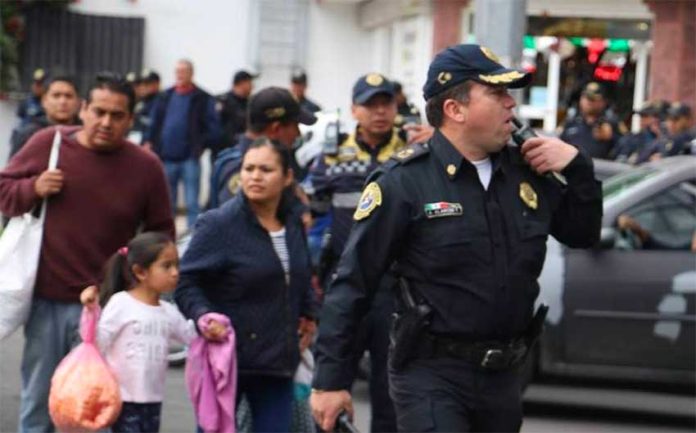
Eighty Mexico City police officers are under investigation for excessive use of force in a México state neighborhood early Monday morning.

Videos circulating on social media show police punching and kicking people on the street in San Juan Ixhuatepec, a neighborhood in the municipality of Tlalnepantla, which borders the capital.

They also allegedly broke windows of houses and businesses in the neighborhood and damaged cars as well.

The police had arrived in San Juan Ixhuatepec in pursuit of four men who allegedly committed a robbery at a gas station in the Mexico City borough of Gustavo A. Madero.

After arresting one suspected criminal, “taxi drivers from the state of México and civilians” attacked police in an attempt to free him, Mexico City police chief Raymundo Collins said.

San Juan Ixhuatepec residents blocked the Mexico City-Pachuca highway for 20 hours Monday to protest against what they claimed was excessive use of force by officers.

Mexico City Mayor José Ramón Amieva yesterday acknowledged that police had committed abuses but ruled out dismissing Collins, as residents are demanding.

“Here the issue is to impart justice and the dismissal [of Collins] would be an injustice. What we’re doing is investigating in order to impose sanctions,” he said.

Amieva pledged that victims of a “crime [or] abuse” committed by police will be directly compensated by the Mexico City government.

For his part, Collins made it clear that he wouldn’t step down voluntarily.

He said that among his roles as police chief are to guarantee citizens’ safety and support officers when they come under attack, as allegedly happened in Tlalnepantla.

The Mexico City Secretariat of Public Security (SSP), whose internal affairs department is conducting the investigation into the 80 police officers, said yesterday that 90% of those involved in the San Juan Ixhuatepec operation had been interviewed.

However, no officers have been arrested.

The México state Attorney General’s office (FGJEM) has received 63 criminal complaints from residents who alleged that they had been injured by Mexico City police or that their property had been damaged.

The FGJEM has asked the SSP to supply it with a list of the names of the officers involved in the alleged incidents with a view to conducting its own interviews with them.

The Attorney General’s office also said it will seek to interview the commander of the operation and that its investigation will require security camera footage from state and municipal authorities as well as private citizens and businesses.

Officials from the Mexico City and Tlalnepantla governments visited San Juan Ixhuatepec to assess damage caused to cars and homes.

Their records will be submitted to investigators.

Source: El Universal (sp) 

Guerrero violence kills 7, closes schools in five municipalities

0
Armed gangsters invade Filo de Caballos on Sunday.

Public transportation services and schools have shut down in the mountains of Guerrero after a gang of armed civilians launched an attack in Leonardo Bravo in which seven people were killed.

Buses operating between the capital of Chilpancingo and several towns and municipalities in the mountains have suspended service and a number of schools have been closed since Monday.

[wpgmza id=”107″];

A state education representative said bus service that usually transports 270 teachers to their schools was suspended indefinitely.

“Unfortunately we had to suspend the school year once more in schools located in the sierra because violent conditions do not allow us to send our teachers. We will resume activities as soon as conditions allow it,” he said.

Sunday’s clash took place in Filo de Caballos, where 400 suspected gangsters invaded the towon to attack the rival Cártel del Sur in an attempt to take over territory in the opium poppy-growing region.

Seventeen people were injured and several houses were damaged by gunfire.

Source: El Financiero (sp), Apro (sp)

Cold front leaves winter wonderland in several states

0
Winter has arrived in higher regions of Chihuahua.

A few months ago thermometers around the country were edging close to the scorching 50 C mark. Conditions are much different today.

Meteorological authorities say cold front no. 10 is in full force, covering parts of several states in a white, snowy blanket.

Parts of Nuevo León located in the Sierra Madre woke up yesterday to temperatures as low as -7 C and a wintry landscape after snow and sleet fell.

The spectacle extended to the mountains around the city of Monterrey, including the nearby Chipinque ecological park and Mitras hill.

The National Water Commission (Conagua) forecast that temperatures will remain below freezing in several parts of the state.

In Chihuahua, the town of Majalca saw snowfall and reported a low temperature of -9 C.

Farther south, temperatures dropped to -3 C in Pinal de Amoles, Querétaro, early this morning and a snowfall affected power lines, leaving several towns without electricity.

In México state, sleet was reported on the Nevado de Toluca volcano, while authorities in Hidalgo suspended all school activities due to the severe cold weather.

Highways linking Mexico City to Toluca, Ajusco, Oaxtepec and Cuernavaca were affected by a thick cover of fog that impeded visibility.

It did not snow on the Gulf coast, but the cold front has caused heavy rainfall in Campeche and Tabasco.

In the former, trees fell during the storm, causing blackouts. The rain was so severe that schools were closed at all levels.

In Tabasco, close to 700 residents of El Alacrán, Cárdenas, were cut off from the rest of the state when a nearby lagoon overflowed. Residents had to use boats to leave town.

The National Meteorological Service (SMN) says the cold front and its intense mass of continental polar air will cause thermometers to continue dropping as the weather phenomenon moves south.

In a statement issued this morning, the SMN forecast temperatures of between 0 and -5 C in the mountainous regions of the states of Chihuahua, Coahuila, Nuevo León, Durango, Zacatecas, Tamaulipas, San Luis Potosí, Guanajuato, Querétaro, Hidalgo, México, Tlaxcala, Puebla and Veracruz.

In the mountains of Baja California, Aguascalientes, Jalisco, Mexico City, Morelos and Oaxaca, temperatures are expected to range between 0 and 5 C.

Snow and sleet will continue to fall in mountainous regions in Tamaulipas and San Luis Potosí, and in regions located 1,200 meters above sea level in the states of Querétaro, Hidalgo, Veracruz, Puebla, Tlaxcala, México and Mexico City.

Rain and intense storms are forecast for southern Veracruz, eastern Oaxaca, northern Chiapas, southern Tabasco, central, southern and western Campeche and southern Quintana Roo.

Very strong storms are expected today in Yucatán, while Tamaulipas, Puebla, Michoacán and Guerrero also see stormy weather.

Source: El Universal (sp),  Milenio (sp)