Home Blog Page 2063

Some 300 turtles die trapped in fishing nets off Oaxaca coast

0
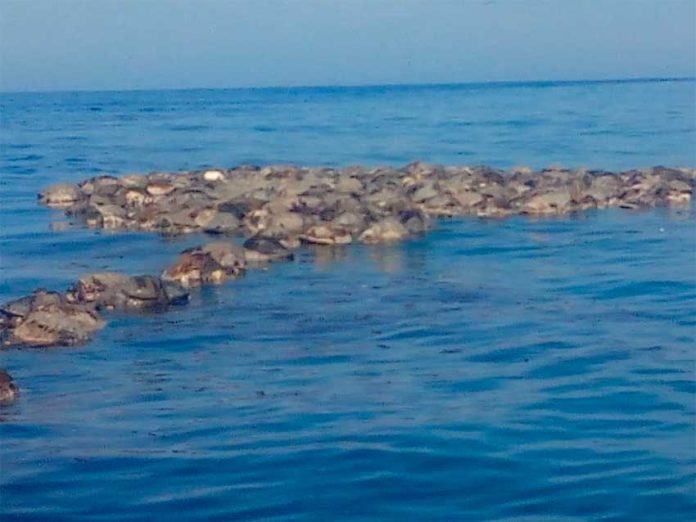
Dead turtles off the coast of Oaxaca today.

Around 300 turtles were found dead off the coast of Oaxaca today after they became trapped in fishing nets, state authorities reported.

Oaxaca Civil Protection services said that the olive ridley sea turtles were located in the Pacific Ocean three miles from Barra de Colotepec, a beach community near Puerto Escondido.

After receiving an anonymous tip, authorities and volunteers launched an operation to free the entangled reptiles from what are believed to be nets belonging to a tuna vessel, but all of the turtles had died by the time they arrived.

Judging by their state of decomposition, it is probable that the turtles had been dead for at least eight days.

Fisherman Antonio Mendoza ruled out any possibility that the net that trapped the turtles belonged to a local, and at least one media report said it might have belonged to a foreign fishing vessel.

The Federal Environmental Protection Agency (Profepa) said via Twitter that it had received a report of the turtles’ deaths and was initiating an investigation to identify those responsible.

The olive ridley turtle, known in Mexico as tortuga golfina, arrive in their thousands on Mexican Pacific coast beaches every year to lay eggs.

Last week, federal authorities arrested five men after a routine inspection on the Huatulco-Salina Cruz highway revealed they were carrying 30,000 olive ridley sea turtle eggs.

Source: NVI Noticias (sp), Excelsiór (sp), El Universal (sp)

Canada and the NAFTA negotiations: two’s company, three’s a crowd?

0
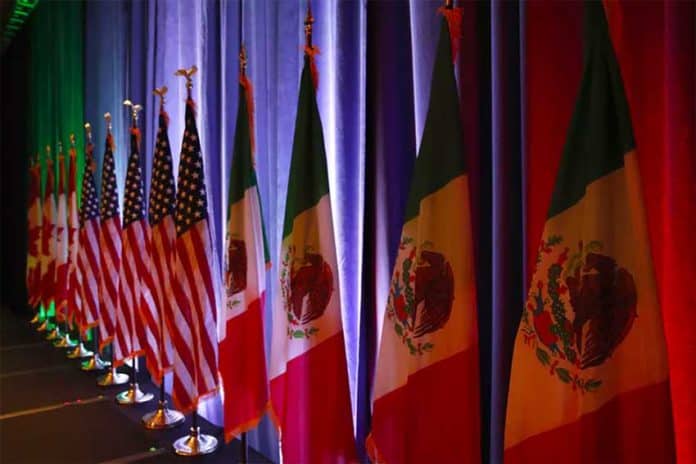
The national flags of Canada, the U.S. and Mexico are lit by stage lights before a news conference at the start of NAFTA renegotiations in Washington
The national flags of Canada, the U.S. and Mexico are lit by stage lights before a news conference at the start of NAFTA renegotiations in Washington. But Canada’s status is now unsure. AP Photo/Jacquelyn Martin

Two’s company, three’s a crowd. The third wheel. There’s no good term for someone who jams a couple, seemingly invited in out of pity.

Is that the position Canada finds itself in with the United States and Mexico, brought back in to the negotiations to conclude a new continental trade pact at the 11th hour after Washington and Mexico City have made a deal of their own?

And, if so, how did it get to the point that the United States’ most important trading partner appears to be essentially an afterthought in talks fundamental to Canadian national interests?

The Trudeau government said for weeks that Ottawa wasn’t frozen out of the negotiations. It was normal for two parties in a three-way negotiation to huddle and work on issues fundamental to them alone, Ottawa said.

But the U.S.-Mexico agreement initialed this week didn’t deal solely with bilateral issues, but with issues fundamental to Canada too, such as the dispute-resolution mechanism that was Canada’s most important trade objective when Ottawa first signed a free-trade pact with the United States in 1987.

If anyone traditionally worried about being the third wheel in the North American relationship, it was Mexico.

Mexico was only invited to negotiate its way into the free-trade zone after Canada and the United States had done their deal and put it into effect. Once those trilateral negotiations began in 1991, the three parties were scrupulous in ensuring they remained three-way talks.

Certainly, there were issues that concerned Canada only, such as cultural protections. And there were issues that concerned Mexico only, such as protections for its energy industry. But Canada and Mexico maintained a common interest in engaging the United States. And Washington didn’t try a divide-and-conquer strategy, recognizing that NAFTA involved continent-building as much as trade facilitation.

Not so now. Canada now finds itself behind the eight ball in these negotiations, possibly faced with a choice between a bad deal and no deal at all, precisely what the Trudeau government was determined to avoid.

In particular, the price of signature may include a humiliating climb-down on protections for the supply-managed dairy and poultry sectors.

Much of this is the fault of the Trump administration. The White House has been singular in its contempt for its trading partners and in its dismissal of any concept of a North American community.

Canada and the United States have fought over trade since before Canada was a country (the first dispute over softwood lumber trade dates to shortly after the American Revolution), but Ottawa and Washington always sought to make those disputes about those disputes alone.

U.S. President Donald Trump, in contrast, talks as if Canada’s dairy tariffs are symptomatic of Canada’s trading practices rather than the exception.

But Ottawa deserves plenty of blame too. The Trudeau administration went into the NAFTA talks with unrealistic expectations.

It’s demand for a progressive pact, worthy as that goal might have been, simply turned off the White House, just as it did the Chinese government in putative trade talks last year.

More costly still was Ottawa’s determination to show no flexibility on supply management. More than one prime minister over the past three decades has wished quietly for an opportunity to reform this protectionist throw-back, even as they mouthed fealties to it.

This negotiation was the opportunity to act but, instead of doing it proactively and strategically, the Trudeau government may be forced into it as the price of saving Canada’s most important trade pact.

It’s now widely accepted that Canada is too dependent on the U.S. market given the wave of protectionism washing over U.S. politics. But, if anything, it may be more accurate to say that Canada didn’t do enough to protect its North American advantage by building a community of interest and institutional ties in the United States.

Instead, Canada took the U.S. market — as big as the entire European Union and right on our doorstep — for granted.

The White House, having finally grabbed Ottawa’s attention, may now agree to a deal that Ottawa can live with. Or it may work to drive a very hard bargain with the clock ticking. If so, another European comparison comes to mind: Canada just might have been sleepwalking to its own Brexit.The Conversation

Drew Fagan is professor of public policy at the Munk School of Global Affairs and Public Policy, University of Toronto. This article was originally published on The Conversation.

Once accused of embezzling $55 million, union boss returns from exile

0
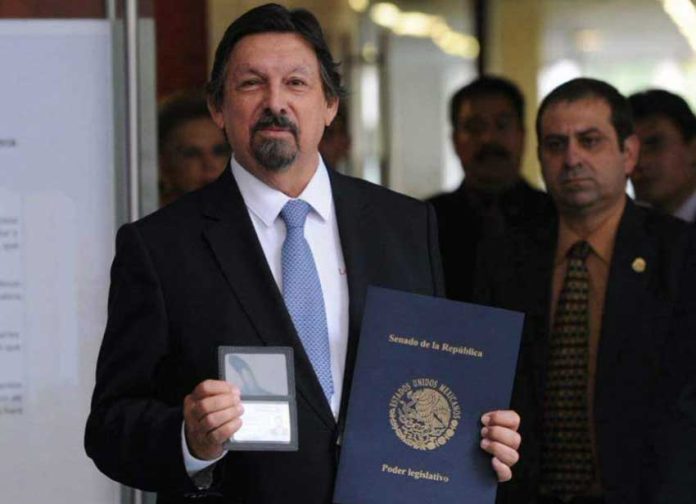
Gómez arrives at Mexico City airport, credentials in hand.

A union leader formerly accused of embezzling US $55 million has returned to Mexico to take up a position as a federal senator after spending 12 years in exile in Canada.

Napoleón Gómez Urrutia, president of the National Union of Mine and Metal Workers, fled Mexico in 2006 while facing accusations of fraud against 20,000 miners.

He was accused of stealing money owed to them in relation to the purchase of a state-owned mine by mining conglomerate Grupo México.

He continued to serve as the union’s boss while living in Vancouver and this year was elected to another six-year term.

The current federal government attempted to extradite Gómez to Mexico, and for a while he was included on Interpol’s red list.

However, a federal court ruled in 2014 that the warrant for his arrest was unconstitutional, while many labor organizations around the world claimed that Gómez was unfairly persecuted for political reasons.

Now, the union boss is on the verge of being sworn in as a plurinominal, or proportional representation, senator for Morena, the party that president-elect Andrés Manuel López Obrador led to a landslide victory in the July 1 elections.

After receiving his Senate credentials yesterday in preparation for taking the oath of office tomorrow — after which he will have immunity from prosecution known as the fuero — Gómez made some brief remarks to the media regarding his role as a senator but didn’t respond to questions, explaining that he will hold a press conference Thursday.

His goals as a lawmaker, Gómez said, were to “help to reconstruct the country, help to change economic policy so that we can really put an end to inequality and poverty and help to eliminate corruption.”

The United States’ largest industrial labor union, the United Steelworkers, said in a statement that it welcomed Gómez’s return and included an extract of a congratulatory letter written by its international president Leo. W. Gerard.

“With your swearing-in to the Senate, a new world of possibilities begins for Los Mineros and the working class of Mexico,” the letter said.

“For the first time in decades, there is a real opportunity to transform the structures of worker representation . . . This transformation would benefit not only workers in Mexico, but also their sisters and brothers in Canada and the United States who have suffered the unfair competition resulting from wage suppression in Mexico.”

Olga Sánchez Cordero, prospective interior secretary in the incoming federal government, today defended Gómez’s appointment as a senator, saying that no charges against him had been proven and that he had been absolved of all of them.

Source: Milenio (sp), El Economista (sp)

Real de Catorce: a lively ghost town in the mountains of San Luis Potosí

0
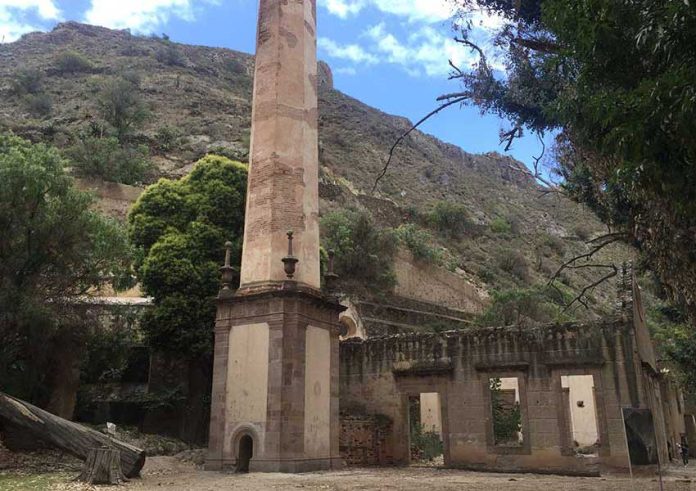
Old mine at Real de Catorce
Old mine at Real de Catorce. susannah rigg

Leaving my hotel on a bright summer morning in June, I had no idea that later that day I would be traversing cliff edges while hanging on to the back of a Jeep to see an old abandoned mine.

Perhaps I should have known, since I was heading to the desert to explore the ghost town of Real de Catorce, some 160 miles north of the colonial city of San Luis Potosi. Once a vibrant mining town, Real de Catorce saw its peak in the 19th century with a population of 15,000 dedicated to mining silver.

A combination of the Mexican Revolution and a steep decline in the price of the metal saw the town almost entirely abandoned by the early 1900s, becoming a ghost town in the middle of the Sierra de Catorce Mountains.

[wpgmza id=”64″]

Years later, in 2001, when Real de Catorce would become the second town to be named a Pueblo Mágico or Magical Town, it was brought back to life with visitors from Mexico and beyond.

For the many years in between, however, only pilgrims went to the town. Catholics went to visit Panchito, as the venerated figure of St Francis of Assisi is affectionately known. The Wixáritari or Huichol people came on a yearly pilgrimage to Wirikuta in the valley below Real de Catorce, the birthplace of the world in their belief system and a land abundant with the sacred plant and spiritual guide peyote.

Our much more touristic pilgrimage, accompanied by a soundtrack of early 90s American rock, took three hours. Turning off from the main freeway onto an unassuming dirt-track road, our four-wheel-drive bumped along slowly, the wheels vibrating hard, making conversation difficult.

Miguel, our guide, gave up on his explanations about the surrounding area and the spiritual properties of peyote, his voice drowned out by the shuddering of wheels on rock.

The dirt track through the desert was lined on either side with thousands of yuccas and set against the impressive backdrop of the Sierra Madre Mountains. Somehow, not being able to reach Real de Catorce via a smooth, paved road made the adventure all the more appealing.

Eventually we arrived at the entrance to the Ogarrio Tunnel, a four-mile passageway that burrows through the Barriaga de Plata Hill and opens out into the town of Real de Catorce.

With space for only one lane of traffic, we waited in a small line of cars to get the go-ahead to enter. Locals milled around offering snacks of quiote, an intensely sweet disc cut from the stalk of the agave flower.

Soon enough it was our turn to make our way into the tunnel. With one passenger a confirmed claustrophobic and another — me — suffering a little post-earthquake fear of enclosed spaces, we entered with some trepidation. However, the tunnel was wide and tall enough that our concerns were soon dispelled. Miguel also helped to keep us occupied, enticing us with tidbits about the town.

Once through the tunnel, we arrived on the cobbled-stone streets of this old mining town eager to explore. The bright desert sky stretched out above, the light diffuse, highlighting the decaying stone walls and old worn-out shop signs.

Men in cowboy hats on horseback rode past tourists from Quéretaro and Zacatecas and elsewhere, while Wixáritari men and women in brightly-colored traditional dress sat on the raised sidewalks selling beaded figures of jaguar heads or traditional medicines made with peyote.

Escaping the bustle, we took one of the smaller side streets and climbed up the slight incline. The sight of donkeys tied in the shade of old stone ruins was like something out of a western.

We happily wandered up the picturesque street, passing by the old palenque, or cock-fighting arena, and upwards until we were rewarded by a view deep into the valley where the sacred land of Wirikuta lies.

Clouds began to cover the sky, bringing us some relief from the stark white sun and we continued our walk to find the old bullfighting ring and the Chapel of Guadalupe, built in the 18th century. In a true testament to the syncretism of indigenous faith and Catholicism, which can be seen across Mexico, the gates to the church are decorated with brass molds in what appears to be the shape of the peyote plant.

I thought we had seen all there was to see of this picturesque and fascinating town but after a hearty lunch of Potosí-style enchiladas, we were suddenly heading towards a group of old Jeeps, called Willys.

“You have a choice,” Miguel told us. “You can go inside the Jeep, ride standing up on the back or climb up on the roof.”

Observing the off-road vehicle in front of me, I decided to stand on the back. I had no idea of the road to come and having taken many a hairy journey in my time but still enjoying adventure, I opted for the middle ground.

What would follow was a white-knuckle ride down narrow and steep mountain paths that got the adrenaline pumping through my veins. Every rock that seemed to tip the jeep to one side had me imagining my demise, toppling over the cliff edge. While I was hanging on for dear life, I kept looking up at the family on the roof of the Jeep, two at the front and two at the back who were sitting on old tires to get a better view.

They were having the time of their lives, taking photos and enjoying the view, and they didn’t seem worried at all. The hair-raising trip was only about 15 minutes long in the end and delivered us to El Socavón de la Purísima Concepción.

Here, among fallen trees and rundown buildings, the chimney of the mine still stands. There is a small chapel and a number of the buildings still have doors intact. It is a fascinating insight into how the mine worked and how the miners lived.

In addition, it looks just like a film set and, in fact, Real de Catorce has been used for just that. Julia Roberts and Brad Pitt filmed The Mexican in the town and Penelope Cruz and Salma Hayek starred in Las Bandidas, which had a Catorce backdrop.

On the steep ride back up, it took all my strength to hold on to the back of the Jeep, my knuckles literally turning white. Miguel happily chatted, pointing out the flora and taking photos of me in which, in contrast to reality, I appear rather relaxed.

I looked behind me down the steep track observing the small ruins of other mines or residences dotted around the mountains. I tried to imagine what it would have been like back in its heyday — a heyday for some and hard labor for others, I mused.

My imaginings were cut short, however, when we swung around a steep bend of the ghostly cliff and all my attention had to be redirected to hanging on for dear life.

Take a guided tour to Real de Catorce with Auténtico San Luis

Susannah Rigg is a freelance writer and Mexico specialist based in Mexico City. Her work has been published by BBC Travel, Condé Nast Traveler, CNN Travel and The Independent UK among others. Find out more about Susannah on her website.

[soliloquy id="59826"]

Comandante 30 sought fame as a drug lord but found death instead

0
Marines in Amozoc on Sunday.

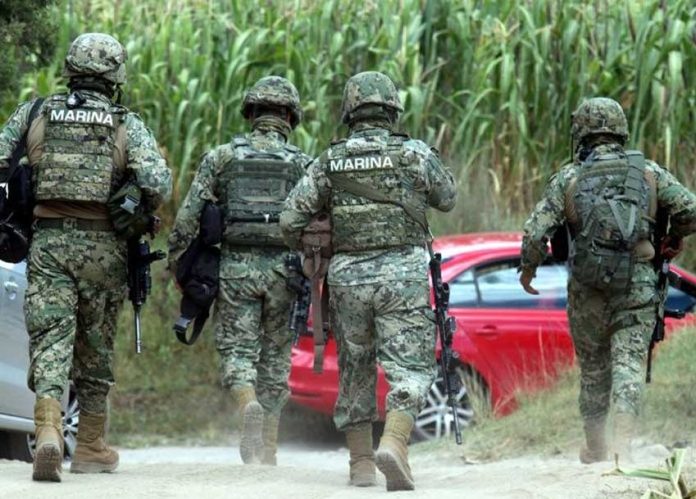
A regional Puebla gang boss with a penchant for posting his ambitions on social media was shot and killed early Sunday in Amozoc by Navy marines.

The man, known as El Comandante 30 and Teódulo “N,” was caught red-handed by federal forces as he and seven accomplices were stealing fuel from a Pemex pipeline. A gunfight followed in which all eight were killed.

El Comandante 30 had been identified as the leader of the Los Cuijes, believed to be one of the main instigators of violence in the state.

He had declared himself a member of the the Jalisco New Generation Cartel (CJNG), but that organization denied the connection.

He earned notoriety after posting intimidating videos online, threatening rival gangs and state authorities. On July 4 he used a video to announce his intention to create a statewide criminal organization to be known as the Safe Puebla Cartel (CPS).

Comandante 30 intended to gather all the state’s criminal gangs under the CPS banner and control all fuel theft, drug sales and highway robbery in Puebla.

In the videos he was surrounded by heavily armed sicarios, or hit men, wearing balaclavas.

He and Los Cuijes are suspected in the homicide of nine people in Huehuetlán el Grande on July 2 and the discovery of two dismembered corpses.

They have also been linked to the killing of six municipal police officers in Amozoc on June 15.

Source: El Universal (sp)

Widespread support for trade pact but everyone wants Canada to be a part

0
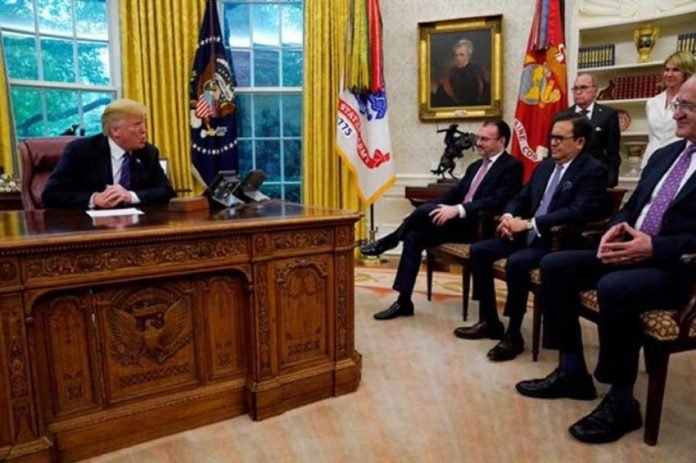
Trump with Mexican negotiating team members Luis Videgaray, Ildefonso Guajardo and Jesús Seade yesterday in the White House.

President-elect Andrés Manuel López Obrador was among a range of stakeholders in Mexico who welcomed yesterday’s announcement of a bilateral trade deal with the United States, although he and others stressed that Canada should also be included in the updated agreement.

López Obrador was particularly pleased that the deal preserved Mexico’s sovereignty in the energy sector.

“We put the emphasis on defending national sovereignty on the energy issue and it was achieved,” he told reporters in Chiapas.

“We are satisfied because our sovereignty was saved. Mexico reserves the right to reform its constitution, its energy laws, and it was established that Mexico’s oil and natural resources belong to our nation.”

News agency Blomberg reported last week that Jesús Seade, López Obrador’s nominee to be his chief trade representative, had asked the Trump administration to address concerns that language proposed for a new deal would place too many restrictions on how Mexico can treat foreign companies seeking to explore and drill for oil in national waters.

López Obrador said Trump “understood our position” but charged that “it’s important that Canada also be included” in the deal, describing the agreement with the United States as a first step.

“We’re very interested in it remaining a three-country deal,” he said. “The free-trade agreement should remain as it was originally conceived.”

United States President Donald Trump said yesterday that Canada could be excluded from the deal if it didn’t “negotiate fairly.”

López Obrador, who will be sworn in as president December 1, added: “We also take a favorable view of the fact that salaries have been increased in the auto industry.”

Reactions of financial analysts and members of the private sector to the announcement of the Mexico-U.S. agreement were also largely positive.

Carlos Serrano, chief economist for Mexico’s largest bank, BBVA Bancomer, said the agreement is “positive for both countries,” describing it as “fundamental for Mexico” and noting that the United States is the country’s biggest source of direct foreign investment and largest export market.

He also said that it reduced uncertainty and risk for Mexico’s manufacturing sector but added that Canada’s inclusion was desirable because “it would enhance the scope and depth of the treaty.”

Approval of the agreement by the congresses of both Mexico and the United States would provide more certainty in the medium to long term, Serrano said.

Economic analysts at Banorte also described the agreement as “positive” although the bank said that the “high wage area” provision, which stipulates that 40% to 45% of cars must be made by workers earning at least US $16 per hour, could reduce Mexico’s competitiveness.

Juan Pablo Castañón, president of the influential Business Coordinating Council (CCE), said that overall it was a good deal for Mexico because it will help to generate high-tech jobs and attract new investment from around the world.

However, he added that maintaining a trilateral agreement was important to boost synergy between automotive, aerospace and energy companies operating in the North American market.

“Canada will enter the negotiations today and if everything goes well, an agreement in principle between the three countries could be announced Friday, signed in November and then subjected to the legislature of each nation for approval and put into operation in April or May,” Castañón said.

CCE international trade official Moises Kalach also said the agreement should be trilateral, but both businessmen stressed that the negotiation process was not yet over.

Another powerful business sector voice that praised the agreement was that of the president of the Confederation of Industrial Chambers (Concamin).

“Great day for Mexico today, due to the completion of a long NAFTA renegotiation. The industrial sector expresses its satisfaction for the agreement reached with the United States. The agreement contains the provisions for fair trade and means a guarantee of greater investment for our country,” Francisco Cervantes Díaz said in a statement.

However, he also said the goal now was to bring Canada into the deal in order for the 24-year-old trilateral pact to continue.

Negotiations aimed at reaching agreement with Canada are taking place in Washington D.C. today and are to continue this week with the hope of meeting a Friday deadline.

Canadian Prime Minister Justin Trudeau said today “there has been some very positive progress, especially on autos” but also stressed that he would continue to defend the supply management system that protects Canadian farmers.

Canada looked forward to signing a deal as long as it was good for Canadians, he added.

Source: El Financiero (sp), El Economista (sp), Milenio (sp), Sin Embargo (sp)

Mayor faces charges that he stole more than ‘just a little’

0
Former San Blas mayor Ramírez.

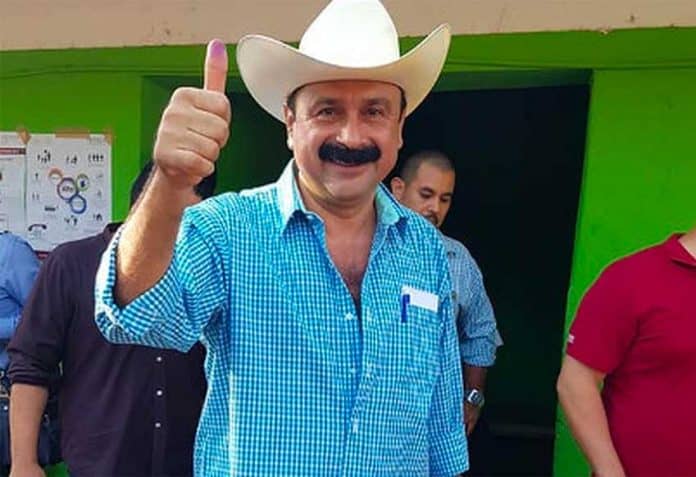
The former mayor of San Blas, Nayarit, who earned notoriety after he declared that he had only “stolen a little” while in office, is now facing charges of improper performance of duty, embezzlement and fraud.

The state Attorney General’s office said Hilario “Layín” Ramírez Villanueva was charged along with two collaborators in his municipal administration.

The Nayarit state auditor presented a formal complaint against Ramírez in March for the embezzlement of 12 million pesos (about US $640,000 at the time).

The amount was allegedly stolen through the sale of a municipal landing strip in 2016 that was never registered in the treasury.

Ramírez attended a hearing in the case last week, after which he declared that “it had gone well” and that he had “never stolen from anyone.”

He later told the broadcaster Grupo Fórmula that his 2014 statement —”I only stole a little” — was “just a joke.”

Ramírez made the statement during his campaign for a second term as mayor in reference to his first term. He went on to win a second time despite his admission.

A political opponent later said Ramírez hadn’t just stolen a little but “stole it all.”

Source: Milenio (sp)

Drug lord’s son arrested in Morelos

0
Drug lord's son, right, and an accomplice after their arrest in Morelos.
Gang leader's son, right, and an accomplice after their arrest in Morelos.

Morelos state police have arrested the son of the leader of Los Rojos, a crime gang that has long been active in Guerrero and more recently Morelos.

Alexis Oswaldo Mazari, 21, was riding on a motorcycle with an accomplice in Jojutla when one of them fired a gun. That drew the attention of police and a short chase ensued in the streets of Los Pilares.

But Mazari and his companion were soon subdued and arrested despite the former’s attempt to threaten officers with his gun.

The two were carrying two handguns, 20 small packages containing marijuana and a larger packet containing methamphetamine.

In his deposition, Mazari stated that he hadn’t been in physical contact with his father, Santiago “El Carrete” Mazari Miranda, for two years and that due to financial problems he had resorted to selling drugs and guns.

Authorities are unaware whether Mazari belongs to his father’s criminal organization, dedicated to smuggling and selling illicit drugs, kidnapping and extortion.

State Security Commissioner Alberto Capella Ibarra told a press conference that the information provided by Mazari confirms intelligence reports gathered by federal and state security forces that indicate Mazari Sr. has fled Morelos due to pressure by security forces.

He is believed to be in the mountains of Oaxaca.

Capella said Mazari’s criminal activities have been “virtually eliminated” in Morelos but other criminal organizations have moved in to fill the vacuum, triggering a spike in violence in some regions of the state.

A 3-million-peso (US $157,000) reward was posted for Mazari in 2016.

His gang has generated much of the violence in Guerrero through its longstanding turf war with Los Ardillos. Mazari is also suspected of links to the disappearance of 43 college students in Iguala, Guerrero, in 2014.

Source: Milenio (sp)

‘US-Mexico Trade Agreement’ awaits conclusion of talks involving Canada

0
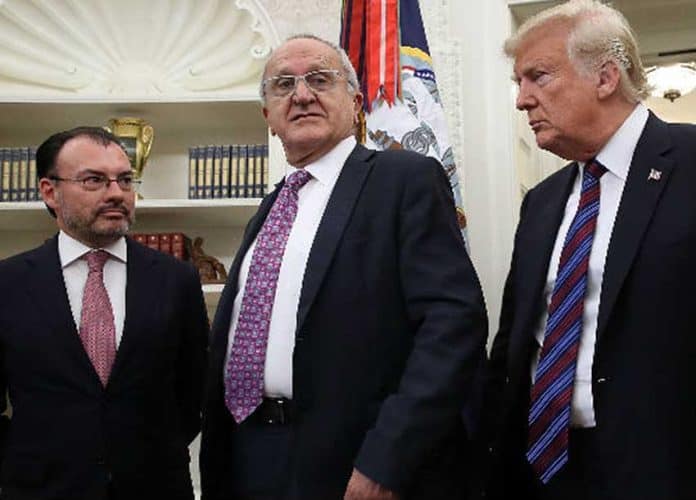
Videgaray, Jesús Seade and Trump yesterday in the White House.
Videgaray, negotiating team participant Jesús Seade and Trump yesterday in the White House.

After more than a year of talks aimed at reaching a new trilateral NAFTA, United States President Donald Trump announced yesterday that the U.S. and Mexico had reached a deal that Canada might — or might not — join.

“We’re going to call it the United States-Mexico Trade Agreement,” Trump said, although the Office of the United States Trade Representative described the deal as a “preliminary agreement in principle . . . to update the 24-year-old NAFTA with modern provisions representing a 21st century.”

Trump, on the other hand, appeared to consign the North American Free Trade Agreement to the dustbin of history, saying “we’ll get rid of the name” because it has a “bad connotation” for the United States.

But, in fact, the U.S. president doesn’t have the unilateral power to do so.

Scrapping the 24-year-old accord would require not only congressional approval in the United States — entailing a process that could extend past November’s midterm elections, meaning there is no guarantee that Trump’s Republicans will continue to control Congress — but also the consent of Mexico and Canada, making the proposition even trickier and more unlikely.

Mexican President Enrique Peña Nieto yesterday stressed his wish for the deal to remain trilateral, telling Trump that he hoped that “Canada will also be able to be incorporated,” although Foreign Affairs Secretary Luis Videgaray later said that Mexico might be prepared to go ahead with the agreement without Canada.

“There are things that we don’t control, particularly the political relationship between Canada and the U.S., and we definitely don’t want to expose Mexico to the uncertainty of not having a deal,” Videgaray said in an interview.

“Not having a trade agreement with the U.S., that’s a substantial risk to the Mexican economy. Literally millions of jobs in Mexico depend on access to the U.S. market.”

However, in another interview today, Videgaray modified his language, saying “we are now going to devote long hours to the negotiation with Canada” in pursuit of a three-way deal.

United States Treasury Secretary Steve Mnuchin said the same in a television interview today. “I think our objective is to try to get Canada aboard quickly,” he said, adding that he thought an agreement could be reached this week.

In any case, Canada’s preparedness to be left out of a new deal would appear unlikely.

A spokesman for Canada’s chief trade negotiator, Foreign Minister Chrystia Freeland, said in a statement that “Canada’s signature is required” for any renegotiation and like Mexico, it has consistently maintained that a new three-way deal must be struck.

Some analysts suggested that Trump’s “we’ll see” attitude on whether Canada will join the agreement is a strategy designed to pressure its northern neighbor in negotiations taking place in Washington D.C. today and set to continue throughout this week.

Trump threatened yesterday that the United States could impose tariffs on Canadian-made vehicles if Canada doesn’t “negotiate fairly” by reducing or eliminating tariffs on U.S. dairy products. The Canadian negotiating team led by Freeland, who cut short a European trip to attend today’s talks, is now under pressure to accept the terms that Mexico and the U.S. have already agreed to.

Those on auto trade and dispute settlement rules are looming as particularly contentious.

Under the bilateral agreement announced yesterday, 75% of a vehicle’s content would have to be made in the United States or Mexico to qualify for tariff-free status, while 40% to 45% of content would have to be made by workers earning at least US $16 per hour. Under the existing deal, rules of origin set a 62.5% minimum regional content.

Canada has said that it also wants to have its say on rules of origin, while Freeland’s spokesman said, “we will only sign a new deal that is good for Canada and good for the middle class.”

Economy Secretary Ildefonso Guajardo said yesterday that almost 70% of Mexico’s auto exports already comply with the new content rules.

On auto sector wages, Mexico essentially gave in to U.S. and Canadian demands but Guajardo said he believed that in time Mexico would also be able to meet the high-wage area requirement, going some way to dispelling fears that Mexico could lose manufacturing jobs to its NAFTA partners.

Mexico also agreed to eliminate a settlement system for anti-dumping disputes, as established by chapter 19 of the current NAFTA, but getting Canada to agree is likely to be more difficult.

Canadian Prime Minister Justin Trudeau had insisted on maintaining the system as a means to fight U.S. duties on Canadian wood, paper and other products that it sees as unfair.

On the so-called sunset clause that would have seen the trade agreement automatically expire if it wasn’t renegotiated every five years, it was the United States that softened its stance, agreeing instead to “review” the deal every six years.

Trade Representative Lighthizer said the agreement with Mexico would last 16 years but could be extended with a new 16-year deadline every six years.

The new deal keeps tariffs on agricultural products between Mexico and the United States at zero, while Guajardo said the U.S. had also dropped its demand for trade barriers to be erected during its harvest seasons.

The two countries also agreed to create separate chapters for labor and the environment, with Mexico committing to “specific legislative actions” to recognize workers’ rights to collective bargaining.

Mexico also agreed to continue to recognize bourbon and Tennessee whiskey as distinctive U.S. products while the United States said it would do the same for tequila and mezcal.

With formal notice required to be given to the United States Congress by Friday in order for Peña Nieto to have enough time to sign the agreement before he leaves office at the end of November, the pressure is on Canada to sign on to the deal or risk being left to negotiate its own separate deal at a later date.

If a deal is not reached with Canada this week, Mnuchin said, the U.S. would proceed with the separate agreement with Mexico, adding that he believed Congress would pass such a deal.

However, some Republican lawmakers have said that they would not support a deal that doesn’t include Canada.

Lighthizer also said yesterday that Trump plans to notify Congress of the deal with Mexico if talks with Canada don’t conclude by the end of this week.

Source: El Financiero (sp), El Economista (sp), Reuters (en), Quartz (en)

Mexico needs more responsible, sustainable tourism

0
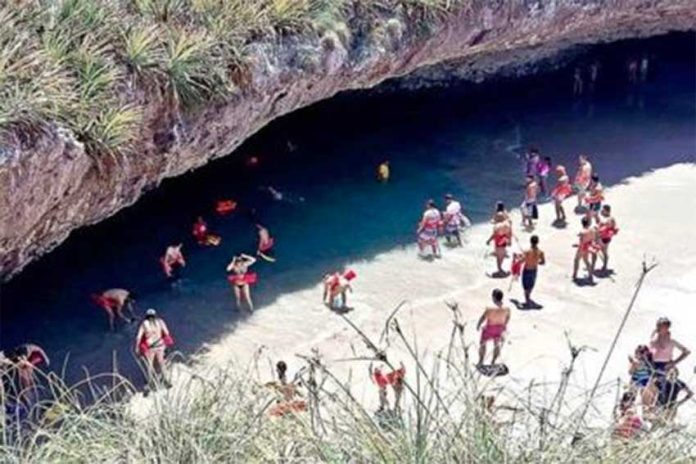
Marieta Islands: there were too many visitors.

A high-level federal environment official and an academic have called on government and other stakeholders to make Mexico’s tourism industry more responsible and sustainable.

Lucía Ruiz, a strategy director at the Natural Protected Areas Commission (Conanp), told the newspaper Milenio that rules need to be put in place to avoid “overcrowding” and the consequent environmental damage of popular tourist destinations.

The Marieta Islands National Park, off the coast of Nayarit, is one example of a destination where an overload of visitors triggered concerns over environmental damage.

Conanp closed the park for three months in 2016 and later limited access to 116 people per day and increased entrance costs, which Ruiz said had “the aim of avoiding the collapse of the area’s attractions.”

She added that communities that depend on tourism along with the government and visitors need to work together towards achieving “responsible tourism that allows attractions to be protected and, at the same time, for locals’ lives to improve.”

The need to better protect Mexico’s natural treasures is emphasized by a 2017 report issued by the World Bank, which ranked Mexico second for quantifiable natural resources but 116th of 136 countries for environmental sustainability.

The increasing number of international tourists coming to Mexico — making the country the sixth most visited in the world — is also placing extra strain on the environment.

Francisco Madrid Flores, director of the School of Tourism at the Anáhuac University, said the challenge Mexico faces is to make that growth sustainable.

“. . . Mexico has the possibility to do more for sustainability . . . There are real instruments in the General Tourism Law of 2009, with two explicit chapters about sustainable tourism. One has to do with tourism legislation . . . and the other is related to sustainable tourism development zones,” he said.

Madrid, who is also a former federal tourism (Sectur) official, added that federal, state and municipal authorities need to work together to establish criteria for sustainable tourism development using a model similar to that in place for archaeological zones and natural protected areas.

Doing that, he said, would be “conducive to more orderly growth” and limit the power of municipalities to grant land use authorizations that are harmful to the environment.

Madrid also said that he believed that Sectur should declare a “moratorium on the construction of [new] accommodations until housing and public services needs have been met.”

Federal Tourism Secretary Enrique de la Madrid has cited both Los Cabos in Baja California Sur and Tulum in Quintana Roo as destinations where tourism development has advanced quickly but infrastructure for local residents hasn’t kept pace.

He blamed municipal authorities for lacking long-term vision and said that federal intervention is needed.

De la Madrid also said that sustainable tourism should be based on three principles: respect for the environment, profitability and improving the lives of local residents of tourism-oriented communities.

Sectur is currently working in conjunction with the federal secretariats of Environment, Interior and Finance as well as Conanp and state and municipal governments to establish sustainable policies for all of the country’s tourism destinations.

Teresa Solís Trejo, a Sectur undersecretary, said – the aim is to establish a “legal framework” that protects the environment and promotes “programs, strategies and actions against climate change.”

She also said that strict regulation of tourism projects which guarantees sustainable development is also a priority for the federal government.

Source: Milenio (sp)