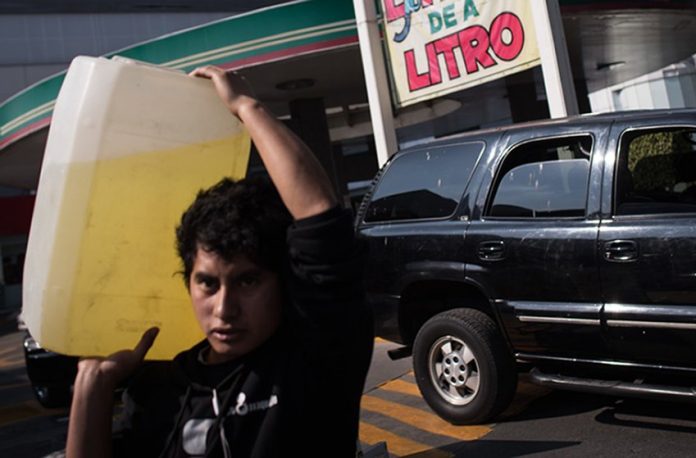
Pemex tanker trucks will be joined by those of private companies to transport fuel.
Private trucking companies will provide 3,500 tanker trucks to transport gasoline to states affected by the current shortage, the National Chamber of Trucking (Canacar) has announced.
Pemex yesterday approved a strategy developed by Canacar to speed up the supply of gasoline.
In a statement, Canacar said that “in the next 48 hours, a strategic plan that strengthens the distribution of fuel by highway will be implemented.”
Tanker trucks will begin operating “24 hours a day, seven days a week, with the protection of the Federal Police,” it explained.
The government has committed to providing 8,300 police officers and 1,400 vehicles to guarantee security, Canacar said. The 3,500 private tanker trucks will be supplied by 150 companies.
“The 150 companies . . . are ready to provide professional and efficient service to immediately restore . . . fuel distribution in affected areas,” Canacar said.
Pemex has committed to making its fuel terminals more efficient and to speed up the loading and unloading of trucks.
The state oil company is making greater use of tanker trucks to distribute fuel because the federal government has closed several major pipelines as part of a strategy to combat fuel theft.
But the changed distribution method has caused fuel shortages at gas stations in more than 10 states because Pemex has been unable to transport product quickly enough in its own tankers.
The National Trucking Chamber said that a working committee made up of representatives of different divisions of Pemex, the Federal Police, the railway industry and Canacar will be formed to monitor the new distribution strategy, “recognizing that some pipelines will be opened gradually, either intermittently or permanently.”
The Tijuana hospital that is subject of a health alert.
Health authorities in the United States have warned against having surgery at a Tijuana hospital after some U.S. residents were diagnosed with infections caused by an antibiotic-resistant form of bacteria.
The Centers for Disease Control and Prevention (CDC) issued a Level 2 alert Wednesday stating that it had received reports of serious drug-resistant Pseudomonas aeruginosa infections in U.S. residents who had operations in the northern border city.
“All of the travelers with this particular infection had an invasive medical procedure performed in Tijuana. Most (but not all) of them had weight-loss surgery. About half of those infected had their surgery done at the Grand View Hospital,” the CDC said.
“CDC recommends that travelers to Tijuana, Mexico, not have surgery at the Grand View Hospital until the Mexican government can confirm that the drug-resistant form of Pseudomonas aeruginosa bacteria is no longer there,” it added.
CDC medical officer Dr. David Ham said that there are 11 confirmed cases of Pseudomonas infections, nine of which occurred between August and November 2018.
“Based on information provided by the CDC, the Mexican government has closed the Grand View Hospital until further notice,” the CDC said.
However, on Thursday night, that assertion appeared to be incorrect, The San Diego Union-Tribune reported.
It said that people could be seen coming and going from the facility, located on an upscale residential street near the border, and there was no obvious sign that the hospital had been closed by the government.
According to the CDC, “infections caused by . . . Pseudomonas are rare and difficult to treat in the United States.”
Dr. Benjamin Talei, a Beverly Hills plastic surgeon, told NBC Los Angeles that a lack of hygiene is usually the cause of such infections.
“[Surgical teams] do not clean the body perfectly or the instruments, and with liposculptures they are passing a piece of metal inside the body,” he said.
“With this bacteria you can lose a hand, you can have a lung infection, it can be very serious,” Talei added.
The CDC said that “Pseudomonas infections of the blood, lungs (pneumonia), and after surgery can lead to severe illness and death.”
Héctor Rivera Valenzuela, a Baja California health official, confirmed that there had been a contamination of operating rooms at the Grand View Hospital but said that surgeons were not to blame.
“The problem wasn’t the surgical technique or the capacity of the doctors . . .” he said.
Thousands of United States residents travel to Mexican border cities each year to undergo medical and dental procedures that cost much less than in the U.S.
However, the CDC and other U.S. medical professionals warn that there are significant risks in traveling abroad for medical treatment.
Looking to shed weight gained over the Christmas holidays? There’s an event designed with that in mind next week in Tultepec, México state.
And participants will receive two free tamales — presumably low-fat.
The municipality better known for its fireworks industry (and related explosions) is organizing the first ever Tamal Race to promote physical activity and family harmony.
Scheduled for January 20 at 8:00am, the 10-kilometer race will be open to 200 participants.
There will be no prize for finishing first. Instead, all runners will receive two “recovery tamales.”
The municipal physical culture and sports secretary, Gerardo Ramírez Hernández, told the newspaper El Universal that giving tamales to those looking to lose weight was not a contradiction.
The main goal of the Tamal Race is to promote healthy habits among the families and groups of friends of Tultepec, “and to start the year with the best attitude.”
Ramírez said the only requirements are to be in good spirits and have a good attitude.
Did reducing gasoline imports contribute to the current shortage?
Mexico has significantly reduced gasoline imports from the United States since Andrés Manuel López Obrador was sworn in as president on December 1, according to a United States research firm.
The period in which they were cut back partially coincides with the current widespread fuel shortage that the government has explained is the result of López Obrador’s decision to close several major petroleum pipelines as part of the strategy to combat fuel theft.
A report published yesterday by The Wall Street Journal (WSJ) cited data from Houston and New York-based ClipperData which shows that under the new government, seaborne gasoline imports from the United States’ Gulf Coast have averaged around 350,000 barrels a day.
The number represents a 28% decline on the quantity of U.S. gasoline imported in December 2017 and January 2018 when former president Enrique Peña Nieto was in office, according to ClipperData.
During the first 10 days of January, a period in which the fuel shortage progressively spread and worsened, gasoline imports from the U.S. Gulf Coast dropped further, averaging about 254,000 barrels a day, a 33% decline on last month and a 45% decline on January 2018 imports.
The WSJ said that, according to industry analysts and government officials, the decline is the result of fewer orders for American gasoline as well as congestion at Mexico’s Gulf Coast ports.
Forty foreign oil tankers were stranded at the Veracruz and Tuxpan fuel terminals yesterday, where they were waiting to unload several million barrels of gasoline.
According to shipping experts, the tankers are unable to offload their cargo because port storage facilities are full due to the closure of petroleum pipelines.
A Pemex spokeswoman said the slowdown in U.S. gasoline imports in January was due to seasonal factors, noting that December is usually the month when gasoline is most in demand in Mexico.
But the decline in imports between December and January is over four times greater than that recorded over the past four years when, according to the U.S. Energy Information Agency, the month-on-month slowdown averaged 8%.
There are other factors that appear to be contributing to the prolonged fuel shortage.
The WSJ said the shortages have “laid bare the inefficiencies of Mexico’s refineries.” According to Pemex figures, the nation’s six refineries operated at a daily capacity of 46.1% last year through November.
The situation has also “raised questions about the new administration’s reversal of steps taken by the previous government to begin importing light crude, necessary for mixing with Mexico’s heavy Maya crude at refineries to produce gasoline.”
A person familiar with oil imports to Mexico told the WSJ that all Mexican tenders for U.S. light crude have halted.
Monserrat Ramiro, a commissioner on Mexico’s Energy Regulatory Commission, said the current crisis is the result of years of insufficient investment in logistics infrastructure such as storage tanks, pipelines and fuel terminals.
López Obrador, who has pledged to “rescue” Mexico’s oil sector by upgrading existing refineries and building a new one on the Gulf Coast in Tabasco, has said repeatedly that the current gasoline shortage is due to logistics rather than a lack of supply.
Responding to a question today about the WSJ story, he said, “It’s not true,” and suggested the newspaper was not reliable.
Published yesterday afternoon, the story triggered intense debate on social media about the root cause or causes of the gasoline shortage.
Many social media users posted the story as evidence that López Obrador, commonly known as AMLO, had created the shortage crisis on purpose by cutting imports. But one of two WSJ journalists who wrote the article said that the story doesn’t support that claim.
“A lot of Mexican Twitter is retweeting this story as proof that AMLO caused the gasoline crisis on purpose by cutting imports of U.S. fuel and light crude, and is using the huachicol crackdown as a pretext . . .that’s NOT what the story says,” Robbie Whelan wrote.
In an earlier tweet, he wrote: “Mexico’s gasoline supply is paralyzed by closed fuel pipelines, but there are other factors: Pemex refining and downstream infrastructure are a mess, AMLO has stopped importing U.S. light crude, and January daily import volumes are down 45% from 2018.”
John M. Ackerman, a law professor at the National Autonomous University (UNAM) and husband of federal Secretary of Public Administration Irma Eréndira Sandoval, wrote to Whelan on Twitter, stating that “official data on Mexican imports are not out yet,” charging that the WSJ “article is based on speculations and data provided by a little known shipment company.”
Whelan responded that “we wouldn’t have cited ClipperData if we weren’t confident in their data and if we hadn’t checked their claims against observations (not speculation) of industry sources.”
Carlos Bravo Regidor, a political analyst and associate professor at CIDE, a research university in Mexico City, supported Whelan’s position.
“Is it a story about huachicol crackdown as a smoke screen? No. Is it a story about the deliberate creation of a crisis? No. To me, it is a story about unforeseen logistical complications (incompetence, in brief),” he wrote on Twitter.
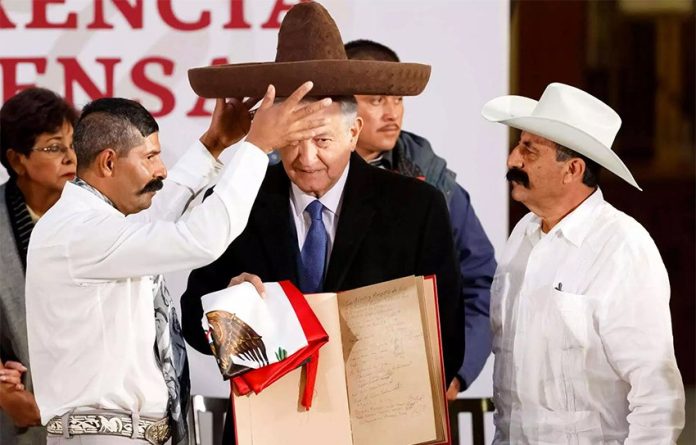
Descendants of Zapata present the president with a sombrero.
President López Obrador declared today that 2019 will be the year of Emiliano Zapata, a mustachioed, charro hat-wearing hero of the Mexican revolution.
The president told reporters at his morning press conference that he had decided to dedicate this year to Zapata to commemorate the centenary of his death and to recognize his role in the armed struggle that lasted from 1910 to 1920.
All of the federal government’s stationery will feature Zapata’s name, López Obrador said, adding that the best homage that will be paid to him “is that the government, which arose from the people and through democratic elections, will respond to the demands of Mexicans, especially . . . the humblest people.”
Descendants of the revolutionary, who was killed near Ciudad Ayala, Morelos, in 1919, were on hand to hear the president’s declaration.
Jorge Zapata González, a grandson of the revolutionary, said that he was confident that López Obrador would be a president who embodies his grandfather’s ideals.
“Finally, the people of Mexico and their critical awareness have awoken and together we’re going to rebuild Mexico, which was handed to us bleeding and in tatters, with thousands of missing persons and looted by corruption at all levels,” he said.
“The people of Mexico and the Zapatistas are with you, you’re not alone . . . Viva México, cabrones!”
Emiliano Zapata, nicknamed the Caudillo del Sur, was the leader of the Liberation Army of the South that fought to overthrow former president Porfirio Díaz and for land reform.
The Mexican revolution ended Díaz’s 30-year rule as president in 1911 but fighting continued for nine more years as competing factions sought to take power and exert control.
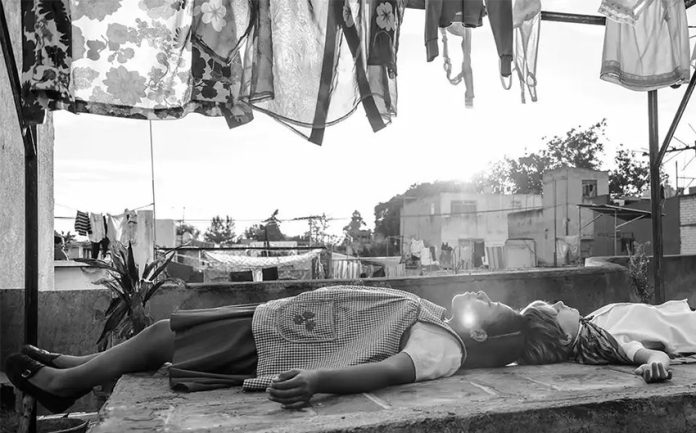
Recently, Alfonso Cuarón was awarded best foreign language film and best director at the Golden Globes for Roma. He is fittingly being praised for both technical features and the powerful stories Roma tells about daily life in Mexico in the 1970s.
The film, however, contains other subtle but important elements that have been largely ignored by critics so far.
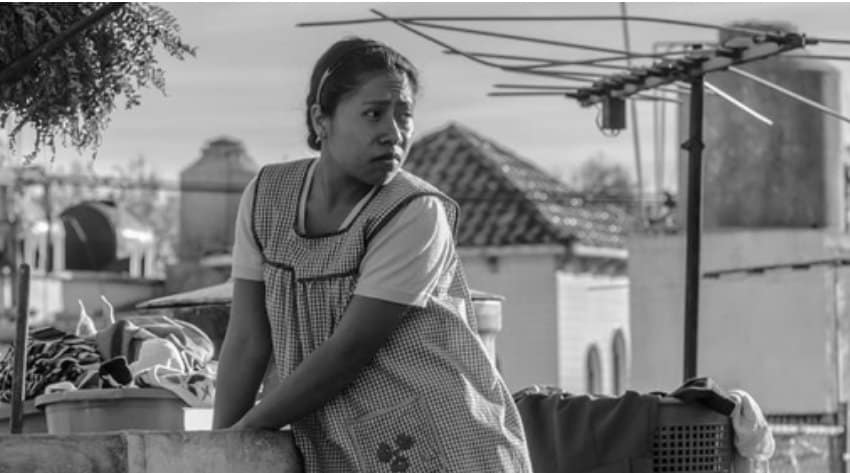
Two of these elements are Mexico’s political context in the early 1970s and the ongoing conditions that have characterized domestic workers’ lives since. The main character of Roma is Cleo (played by Yalitza Aparicio), a domestic worker based on a woman named Liboria Rodríguez (known as Libo) who worked for Cuarón’s family when he was a child.
Cuarón situates Roma’s characters amid significant historical events: the fight of some Mexicans for social progress and their opposition to a political, authoritarian regime that worked to maintain its privileges through various means.
One of these means is exemplified in the film by the character Fermín — Cleo’s boyfriend (played by Jorge Antonio Guerrero) who belongs to the paramilitary group Los Halcones (The Hawks).
We know now by various direct sources and United States government declassified documents that high-ranking Mexican government officials secretly organized, financed, trained and armed various groups, including Los Halcones, to help quash social movements in the late 1960s and early 1970s.
Cleo, domestic worker in the film Roma.
Los Halcones were composed of around 2,000 young men, aged 18 to 29, distributed in squads of 200 members each.
The squads’ leaders were middle-class university students who, for their participation, received free education, weekly stipends and the promise of a bright future in the ruling Institutional Revolutionary Party (PRI).
The assailants and hitmen were gang members and working class and unemployed young men. They were paid half of what the leaders received.
Los Halcones were also trained by Mexican military and police personnel who, subsidized by USAID, had previously received training at the International Police Academy in Washington.
On June 10, 1971, around 10,000 demonstrators, mainly students, marched to demand improvements to Mexico’s democratic, economic and social conditions.
In Roma, Cleo and others pass these demonstrators on their way to a furniture store. They also pass, in a depiction of real life, a long row of riot police trucks and idle police officers, while Halcones patiently wait at the corner.
Armed with canes and M1 and M2 rifles, Halcones attacked demonstrators, producing the second bloodiest event in modern Mexican history (El Halconazo), only after the Tlatelolco massacre of October 1968.
It is estimated that around 120 people were killed and hundreds more injured, including children, women and seniors. Although the military and uniformed police knew beforehand about the attack, they stood by and did nothing.
Fermín belongs to the second-tier group of Los Halcones. In the hotel, he confesses to Cleo: “I owe my life to martial arts [to Halcones]. I grew up with nothing, you know?”
Portraying the real Halcones youth, Fermín’s participation offered him certain social mobility but only in exchange for committing atrocities.
Some young men’s allegiance to Los Halcones and their corrupt decisions were thus mediated by class aspirations, ideology and violence.
Los Halcones’ violence also manifested in gender violence. This is depicted in Roma when Fermín dismisses his paternity and threatens to beat Cleo and their unborn daughter if she insists on looking for him.
Moreover, despite his low-class background, Fermín ends the scene yelling “gata” at Cleo, an upper class-based insult aimed only at domestic servants, reflecting the latter’s low ascribed social status.
A second element that has not been widely discussed, which Roma touches on, is the historical conditions of domestic workers.
As of June 2018, there were 2.2 million domestic workers in Mexico. Around 95% are women, mostly young and middle-aged (some are even children).
In 2010, 58% of indigenous women in the Monterrey, Nuevo León, metropolitan area were domestic workers. Many migrated from the countryside to the city. This means that, as indigenous migration researcher Séverine Durin asserts, domestic work is strongly shaped by ethnicity.
It is not a coincidence then, that Cuarón’s former nanny Libo or the characters Cleo and Adela in Roma are (young) indigenous women.
Mexican laws do not offer domestic workers the same rights and benefits that other workers enjoy, such as paid sick days and holidays. They can also be dismissed without warning at any time.
Only as recently as December 2018, the Mexican Supreme Court determined that it is unconstitutional for employers to deny domestic workers access to social security, meaning mainly access to public health services.
It is commonplace for domestic workers to face low wages, long working hours and no holidays. Some also experience humiliation, mistreatment and discrimination for speaking their indigenous language, wearing traditional clothes, practising cultural customs and for their physical traits.
Others experience forced confinement or sexual abuse by the men of the family or teenage sons. Yet, domestic workers are expected to thank their employers for the “opportunity” to have a job.
Only one in 10 women file a complaint when they encounter a problem with their employers.
Domestic workers with children also need to make extraordinary arrangements for their own children to be taken care of, meaning prolonged separation many times while they take care of other families’ children. Their caring and affection not only become commodified, but also dislocated.
Some employers consider domestic workers as “part of the family.” However, uneven power relations, class differentials, discrimination and racism make them not really part of the family.
Cuarón mentioned that he was forced to recognize several decades later, and only after he started working on Roma, that Libo was, first, a woman, and second, an indigenous woman. He then realized that Libo belongs to a “world of affective needs, a world of sexual desires,” and also to “a more dispossessed group, a world of injustice.”
In Roma, the family members are unaware of the domestic workers’ social and personal lives.
When Cleo is taken to the delivery room, the grandmother, Teresa, is asked by a nurse about Cleo’s second last name, her date of birth and if she has insurance. But Teresa cannot answer those questions.
Cleo picks up after the family dog, feeds the family, prepares the kids for school, puts them to bed, washes and irons the family’s clothes and cleans the house. Still, the grandmother ignores everything about Cleo despite living in the “same” house (usually, domestic workers sleep and even eat apart from the family).
Cleo is “part of the family” but she is not really part of the family.
Overall, Roma contains various stories that subtly unveil different forms of violence: poverty, social exclusion and gender-based violence promoted by sexist and misogynistic forms of masculinity.
Moreover, domestic workers’ quiet but endless work, which in Roma takes over half of the film, hinders uneven power relations mediated by class, gender, age, affection, ethnicity, race and the urban/rural divide.
These factors intersect to maintain domestic workers, mainly (indigenous) women, in subordinate positions. They are conveniently imagined as “part of the family,” but they are never really part of the family, neither in Mexico, nor in Canada, nor anywhere else in the world.
CORRECTION: The earlier version of this article stated that in 2010, 58% of indigenous women were domestic workers. It should have indicated that the statistic referred to indigenous women in the Monterrey, Nuevo León, metropolitan area.
Clouthier, center, during discussion on the national guard.
A deputy leader of Mexico’s ruling party warned yesterday that the creation of a national guard under the command of the army could lead to the military deciding who the next president and government would be.
And it appears people in the right places were listening. Federal Security Secretary Alfonso Durazo announced today that President López Obrador had decided that the National Guard should have a civilian command.
“I’m clearly in favor of a civilian command, not a military command . . .” Tatiana Clouthier said during a public debate in the Chamber of Deputies.
However, the deputy leader of the Morena party in the lower house of Congress added that if it’s the military that is ultimately chosen to head the new security force, it should only be given a three-year mandate, not five years as proposed.
“. . . Having five years of military command would be [as good as] saying that it’s the military command that’s going to end up deciding who will govern us for the next six years [from 2024] in this country. I refuse to support that prelude,” Clouthier said.
Two weeks before he was sworn in as president on December 1, Andrés Manuel López Obrador announced a new national security plan whose central element was the creation of national guard under the control of the army.
Jan Jarab, the Mexico representative of the United Nations High Commissioner for Human Rights, warned that the national guard proposal doesn’t provide any guarantees that human rights violations committed by the armed forces in the past won’t occur again.
Speaking in the Congress yesterday, he also said that a proposal to give the national guard the authority to investigate crimes was concerning.
Jarab added: “Since the deployment of the armed forces to carry out security tasks, violence in the country has skyrocketed . . .This doesn’t seem the optimal way to achieve security.”
He urged lawmakers to be “thoughtful” in their consideration of the national guard proposal and to act in strict accordance with Mexico’s international human rights commitments.
The head of the National Human Rights Commission (CNDH) proposed the creation of a new civil force to combat the high levels of violent crime plaguing Mexico.
“We can’t place the direct protection of rights, within our constitutional system, in [the hands of] military bodies or structures,” Luis Raúl González Pérez said.
Secretary Durazo said today that López Obrador had taken on board the different opinions about the leadership of the national guard.
“The president has listened with great interest to the different arguments presented by the people of Mexico and now in these forums organized by the Chamber of Deputies . . .” he said.
Durazo asked lawmakers to modify the original initiative in order to create a national guard with a civilian command but with the same levels of discipline and training as the armed forces.
The secretary said the new force would be the responsibility of the Secretariat of Public Security, not the Secretariat of National Defense as previously proposed.
Clouthier celebrated the move on Twitter. “Great,” she wrote, attaching a video of Durazo’s announcement to her post.
The Austrian-born anthropologist and historian Eric Wolf once complained that for a long time, archaeologists in Mexico and Central America had become “shardists” and “pyramidiots,” whose archaeological horizons were limited to dating and classifying pieces of pottery or restoring pyramids for tourism.
A leader in opposing this trend was American archaeologist Phil Weigand, who spent most of his life studying the people who created western Mexico’s curious Guachimontones or “circular pyramids.”
Weigand brought a more holistic focus to his work, stating that his professional goal was “to be an anthropologist — not an archaeologist, not an ethnologist and not an ethnohistorian, but all three of these at the same time.”
Weigand laid down his trowel in 2011, but his spirit lives on in the work of his friend and colleague Dr. Eduardo Williams, researcher and professor at El Colegio de Michoacán. Williams has been putting the concept of ethnoarchaeology into practice for decades, using ingenious strategies.
For me, the term ethnoarchaeology is anything but self-explanatory and I hesitate to use it here for fear of turning people off — which would truly be a shame, because the word simply refers to a common-sense way of looking at ancient artifacts and buildings.
Every visitor to an archaeological site inevitably asks the guide, “What did the people who lived here do with these things? What were these people like?” Likewise, every historical novel or period drama about ancient peoples attempts to portray their human side: their strategies for survival, conquest or simple well-being, their struggles, successes and failures.
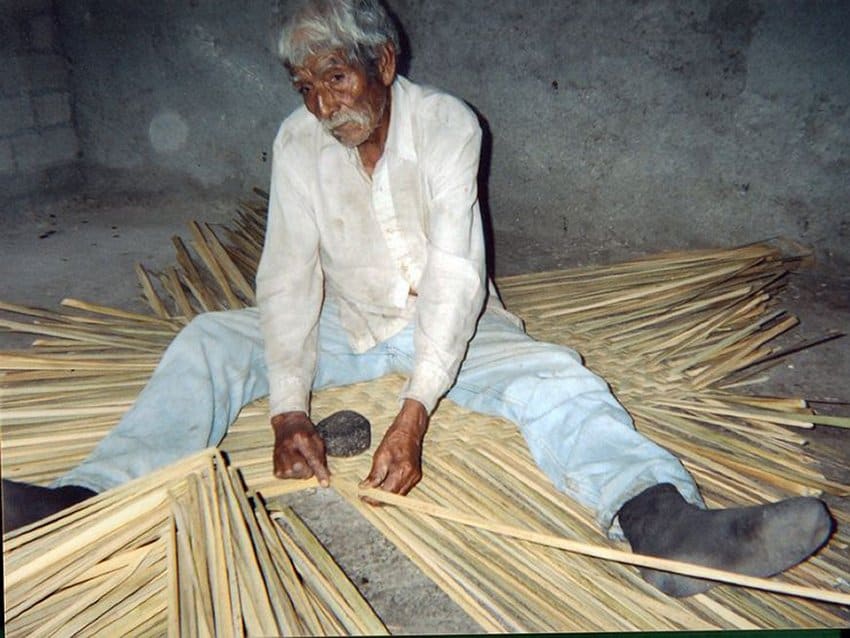
An artisan weaves a reed mat using only a stone and a metal knife.
Ethnoarchaeology simply restores the humanity and culture of the maker to the stone axe or shaft tomb.
After earning a PhD in archaeology from the University College of London, Eduardo Williams settled in at the Colegio de Michoacán and put his mind to finding research projects within the financial limits available to him as a member of the Colegio.
“I told myself I needed projects that were easy to do in terms of resources and expertise, that didn’t cost money, and that I could do on my own without help from anyone.” A solution to his problem came from a book called In Pursuit of the Past by Lewis Binford, a pioneer in anthropological archaeology who studied modern-day Nunamiut (Eskimo) hunter-gatherers in Alaska, in order to better understand the behavior of their Paleolithic counterparts, through ethnographic analogy.
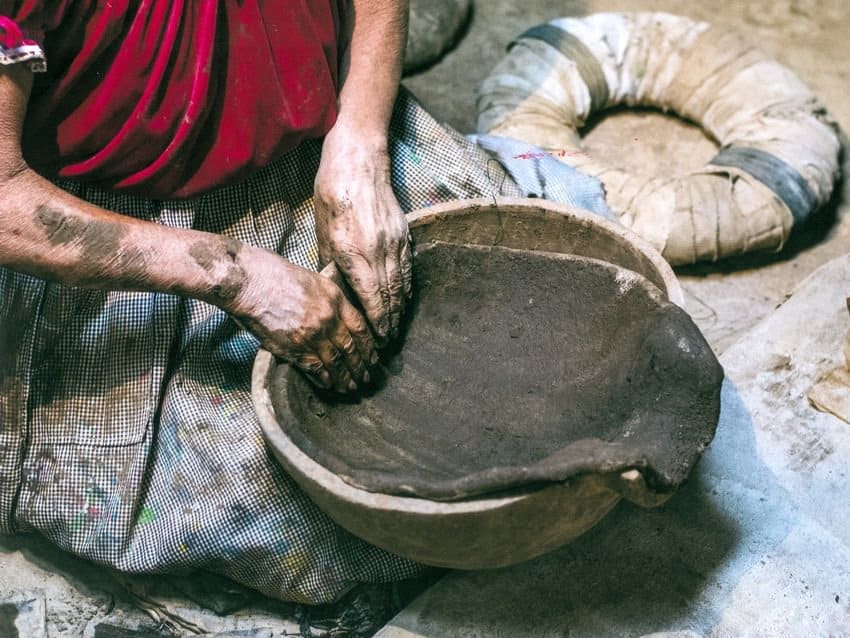
“I saw I could do something original, never before done in the history of west Mexican archaeology, and I could start doing it among friends of mine making pottery in a Tarascan village just half an hour from my home. While my colleagues had to find lots of money for their excavations, all I had to pay was the cost of a tank of gasoline.”
A few years before Williams’ arrival at the Colegio, Dr. Phil Weigand had joined the faculty.
Tarascan potter. Cloth pot stand (upper right) is doomed to eventually disappear.
“Phil Weigand was a true Renaissance Man. He crossed the boundaries of the historical and anthropological understanding of western Mexico, and I felt an instant rapport with him. When I told him about my project with the Tarascan potters, he had an immediate reaction, because he had been working with potters in San Marcos, Jalisco.
“So, I didn’t have to explain anything. He read my thoughts and told me what to do. So, we had a very good start as colleagues, right from the beginning and soon became fast friends.”
Eduardo Williams’ investigations of modern-day Tarascan potters led him to study the lives of salt-makers and fishers, as he calls them to avoid gender prejudice, many of whom, it turns out, still follow a lifestyle and traditions passed along from generation to generation, in many ways unchanged from pre-Hispanic times.
“At Lake Cuitzeo,” he says in his book, La Gente del Agua (Water Folk), “I found people using a stone hammer and anvil for basket-making. Now this technology goes back 10,000 years. These are the oldest kinds of human-made instruments known in archaeology.
“Once the basket makers cut the reed, they have to split it lengthwise. Then they use the hammer to mash it, so it becomes flat — and then it can be used to weave a basket. Just imagine the experience for an archaeologist to see artifacts that you know are thousands of years old being used today, right before your eyes!”
[soliloquy id="69212"]
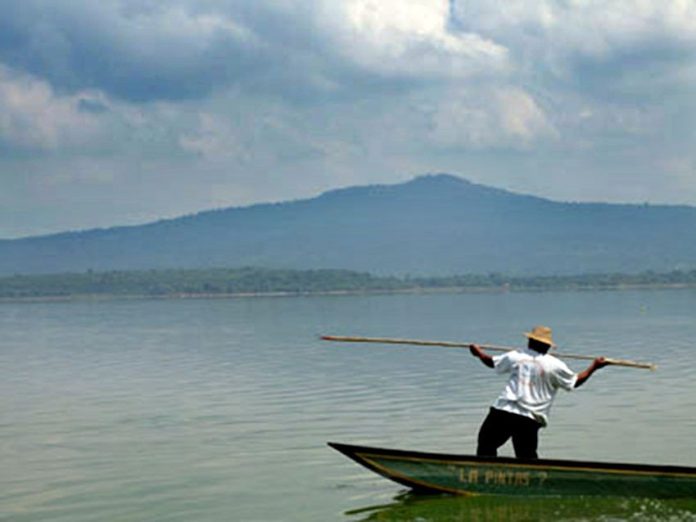
On the shores of Lake Pátzcuaro, Williams actually found people who knew how to use the atlatl, the celebrated device for propelling a spear much faster than it could be thrown by hand alone and one of humankind’s first mechanical inventions (at least 10,000 years old, according to archaeological data).
“In the late 1940s, ducks by the millions used to arrive at Lake Pátzcuaro in early October,” fisherman Manuel Morales told Williams, “and on October 31 we used to go out in canoes to hunt them, with nothing but fisgas (reed harpoons) and el tirador (the atlatl).”
A second informant, Rogelio Lucas, offered to show Williams the techniques for manufacturing an atlatl, even though he had not made one since 1978. He also showed him how to prepare the metal point of the fisga and a special insert at the other end which fits into the atlatl.
Altogether, the craftsman used 13 different tools to make the two pieces, including a hacksaw and a vise-grip. Ancient atlatl makers would have had their own specialized set of tools (called an “assemblage” by Williams) to produce the same result.
Archaeologist Jeffrey Parsons says in his book The Last Saltmakers of Nexquipayac, “There are many traditional activities hovering on the edge of extinction that deserve . . . recording in Mexico and throughout the world. Few scholars appear to be much interested in studying the material and organizational aspects of these vanishing lifeways, and archaeologists may be virtually alone in making such efforts as do exist. In one sense this . . . is a plea to others to undertake comparable studies elsewhere while there is still a little time left to do so . . . .”
Eduardo Williams is one of those few scholars studying these vanishing lifeways. To learn more about his work, you can view a 165-page, well-illustrated, abridged version of Water Folk in excellent English at ResearchGate.
The writer has lived near Guadalajara, Jalisco, for more than 30 years and is the author of A Guide to West Mexico’s Guachimontones and Surrounding Area and co-author of Outdoors in Western Mexico. More of his writing can be found on his website.
Zipolite beach in Oaxaca is always popular among people who like to spend time on the beach unclothed, but never more so than during its International Nudist Festival.
More than 4,000 participants are expected to celebrate the festival’s fourth edition from February 1 to 3, when activities will include nude yoga, beach volleyball au naturel, unclad obstacle courses and body painting.
Sami Pineda, mayor of the municipality of San Pedro Pochutla, said local authorities are in favor of promoting the event because of the boost to the local economy.
The mayor said that since it began the festival has been considered one of the best by the international nudist community and attracts visitors from all over the globe. This year, she has asked the federal government for organizational help and assistance with security.
Juan Marcos Castañeda Jair, president of the Zipolite Nudist Federation, clarified that nudism is not sex or swapping partners but freedom, contact with nature, acceptance without giving undue importance to one’s physical characteristics and having fun with friends and family.
Since 1950, Zipolite has been known worldwide for promoting nudism, its tolerance for marijuana consumption, and more recently, as a sought-after destination for gay weddings.
A former technology guru for the Sinaloa Cartel told jurors this week at the New York trial of Joaquín “El Chapo” Guzmán that he spent three days with the former drug lord in the Sinaloa mountains while on the run from the Mexican army.
Cristian Rodríguez, a Colombian info-tech expert who set up an encrypted communications system for Guzmán, told the court that in 2009, the military raided the kingpin’s secret hideout in the northern state.
Rodríguez said that he, Guzmán, other cartel leaders and a band of heavily armed bodyguards fled into the mountainous terrain to evade capture.
The witness said the gunmen carried both large weapons and one enormous weapon “capable of shooting down a helicopter.”
After their first day on the lam, the men slept in a small house, Rodríguez said. The second night was spent exposed to the elements.
“Chapo was very calm,” the I.T. specialist told jurors. “He was always very sure, calm, tranquil.”
Asked by a prosecutor how he felt during the ordeal, Rodríguez responded: “Very afraid.”
On their third day on the run, the 32-year-old witness said, they reached another house where they were given a meal, after which they got a lift to Culiacán, the Sinaloa state capital.
After that experience, Rodríguez said, he worked for the cartel remotely from Colombia.
However, according to court testimony Tuesday by Federal Bureau of Investigation special agent Stephen Marston, Rodríguez started cooperating with the FBI in 2011 by helping it to infiltrate the encrypted communications system he developed.
He sent recordings of Guzmán’s calls to the FBI and also installed an automatic recording system that allowed United States authorities to listen in to the kingpin’s conversations almost in real time.
Marston said Tuesday that undercover FBI agents had posed as Russian mobsters at a meeting with Rodríguez in a New York hotel in 2010, where one agent told him that he was interested in acquiring an encrypted communications system so that he could speak to criminal associates without law enforcement listening in.
Rodríguez said yesterday that he agreed to work for the FBI after two federal agents approached him in Bogotá, Colombia, the following year, saying that they knew he worked for Guzmán and that he was “in serious trouble.”
Rodríguez also installed a GPS system on the cell phone of Jorge Cifuentes, a criminal associate of Guzmán’s who had recommended him for the IT job. Cifuentes was arrested shortly after. He has also testified against Guzmán.
The tech guru told jurors that after the Sinaloa Cartel became aware that he was cooperating with the FBI, he panicked and fled to the United States, where he had a “nervous breakdown.”
Rodríguez has not faced any criminal charges and, according to a report by the Associated Press, has received US $480,000 from the United States government in exchange for his cooperation.
Guzmán, who was extradited to the United States in January 2017, is facing multiple charges of drug trafficking, conspiracy, money laundering and weapons offenses.
Since his trial started in mid-November, several cartel witnesses have testified against him, giving testimony about bribes the kingpin paid to corrupt officials, the life of luxury he led, his first prison break inside a laundry cart, multi-tonne drug shipments and bitter cartel wars, among other tales.
If convicted, Guzmán faces probable life imprisonment. The trial resumes Monday.