Home Blog Page 2121

MX considers tariffs on US corn, soy should trade war escalate

0
Mexico imported 14 million tonnes of corn last year from the US.

Mexico is studying tariffs on United States corn and soybean imports worth US $4 billion annually in case the U.S. should escalate trade tensions by imposing additional tariffs of its own, officials told the news agency Reuters.

The federal government is currently studying how to reduce the pain of such a move, the officials said, although it is considered a last resort given that Mexico is the number-one export market for United States corn.

Tariffs on grains would come at a considerable cost for both U.S. exporters and buyers in the domestic market.

Mexico struck back swiftly after the United States announced May 31 that it would impose 25% and 10% tariffs on Mexican steel and aluminum imports by imposing its own “equivalent measures” on U.S. products including steel, pork, apples, bourbon and cheese.

But it didn’t include corn and soybeans, both of which are used in Mexico to feed cattle, hogs and poultry.

However, Mexico has already begun increasing its grain imports from producers such as Brazil and Argentina, meaning that the impact of any move to enforce tariffs on U.S. grains could be reduced.

National Agricultural Council (CNA) president Bosco de la Vega told Reuters that he attended a June 4 meeting at the Economy Secretariat where grain tariffs were discussed, but he explained that such a move was intentionally “left for a major crisis phase.”

Economy Secretary Ildefonso Guajardo — who is also Mexico’s chief negotiator in ongoing NAFTA talks — was present at the meeting, he said.

De la Vega explained that tariffs on grains would be targeted at the United States corn belt and specifically mentioned the states of Missouri, Kansas, Iowa and Nebraska, all of which were won by U.S. President Donald Trump in the 2016 election.

Many of the tariffs Mexico has already imposed were also aimed at products exported from states that are politically important to Trump, especially considering that midterm elections will be held in the United States in November.

Raúl Urteaga, director of international trade for the Secretariat of Agriculture (Sagarpa), said that “right now” Mexico is not targeting U.S. grains but he didn’t rule out the possibility it would at some time in the future.

One eventuality that would likely pressure Mexico to act is the introduction of tariffs that affect its US $67-billion auto industry.

The government is particularly concerned about the United States’ decision last month to launch an investigation into vehicle imports given that it could lead to that outcome. De la Vega said, “That’s why we’re preparing.”

An anonymous trade source told Reuters that the decision not to include grains in Mexico’s first round of retaliatory measures was made in order to retain options as trade negotiations continue and to avoid subjecting Mexican consumers to higher prices.

But although Mexico may feel that the option to impose grain tariffs is a trump card, playing it might not be the wisest move given that cheap U.S. grain imports have helped Mexico’s growing beef industry to become a major global exporter over the past 20 years.

If tariffs were imposed on corn and soy, finding enough alternative suppliers without incurring significantly higher costs would be difficult and some analysts don’t believe it could be done without seriously damaging Mexico’s meat producers.

Former Sagarpa undersecretary Mariano Ruiz Funes said “there’s no real possibility of substituting these two products in the short term” because “the impact on the pork and beef industries in Mexico in terms of costs would be brutal.”

However, de la Vega said the Economy Secretariat is considering introducing a broad duty-free quota that would attract larger grain imports from other suppliers and therefore offset the higher costs of U.S. grains.

The same measure was introduced for pork last week, while Guajardo said that Mexico would “surely” look to import more pork from Europe.

A tariff-free quota on grain would likely benefit Brazil and Argentina in the short term given that Mexico has already increased its imports from both countries as part of its strategy to reduce dependence on its northern neighbor.

During the first quarter of 2017, imports of Brazilian yellow corn and soybeans were non-existent but in the first quarter of this year Mexico bought 107,000 tonnes of the former and 74,000 tonnes of the latter at a combined cost of US $48.5 million, according to government data.

De la Vega said he expects Brazilian feed corn imports to reach one million tonnes by the end of the year while Argentine shipments of the same grain will likely reach 500,000 tonnes.

However, the volumes are still relatively low compared to the approximately 14 million tonnes of corn and almost four million tonnes of soy that Mexico imported from the United States last year.

“Any disruption to this critical trade through tariff or non-tariff barriers would be detrimental to U.S. farmers, Mexican livestock producers and ultimately consumers,” said Ryan LeGrand, head of the Mexico office of the U.S. Grains Council.

Source: Reuters (sp)

Rarámuri runner dreams of gym, training ground for youth

0
Juana, Lorena and Mario Hernández meet with Governor Corral.

A Rarámuri runner who has just returned from competing in an ultramarathon in Spain has a dream that one day there will be a gym and training ground in his community to help nurture the next generation of indigenous athletes.

Chihuahua native José Mario Ramírez, who along with his sisters Lorena and Juana ran in the Tenerife Bluetrail race last Saturday, told the newspaper El Universal that he and his family want to cultivate the passion for running among the youth who live in the state’s Tarahumara Sierra region.

“We want to help the Rarámuri people, to have a professional team in order to be able to prepare ourselves better and teach youngsters so that they keep running. We would be very happy to receive support to achieve it,” he said.

After he and his sisters met yesterday with Chihuahua Governor Javier Corral, Ramírez’s dream may be one step closer to reality.

“We’re going to support them so that they achieve this objective because they are an example for all of Chihuahua . . . there should be a gymnasium inspired by the Ramírez family, it has to be a gymnasium inspired by what they represent,” Corral said.

The governor congratulated the siblings for their achievements in Spain and said the government will get to work to ensure that the gymnasium project comes to fruition.

At a press conference before the meeting with Corral, Ramírez said that running can help young people “get away from bad habits,” adding that he’d like to see everyone fighting to achieve their dream, which could be competing in an ultramarathon or even representing Mexico at the Olympic Games.

The 27-year-old’s personal goals include running “as long as God lets him” and competing in the Canyons Ultramarathon in his hometown of Guachochi next month.

Five members of the Ramírez family, including the three siblings’ proud father Santiago, will take part in either the 63-kilometer or 100-kilometer events.

Lorena Ramírez won third place in her category in the 102-kilometer Tenerife Bluetrail, held on the largest of the seven main Canary Islands, while José Mario and Juana both finished in the top 10 in their divisions.

Female Rarámuri runners are especially famous for eschewing normal running shoes and attire, preferring to compete in traditional dress and sandals.

Source: El Universal (sp), Milenio (sp)

Dunkin’ Donuts plans to open 100 outlets by 2024

0
Customers at the opening last year of Dunkin' Donuts in Polanco, Mexico City.

The doughnut and coffeehouse giant Dunkin’ Donuts is betting on the millennial market as it plans to open 100 outlets in Mexico by 2024.

The Massachusetts-based chain already operates five of its iconic coffehouses in Mexico City through a franchise system, and by the end of the year it plans to add five more.

The next opening is scheduled for next month, when a 1-million-peso (US $48-million) outlet will open its doors near the Condesa district of the country’s capital.

The remaining four establishments will open in Morelos, Hidalgo, Querétaro and Jalisco.

“We’re betting strongly on 100% Mexican coffee, from the Chiapas region,” said Guadalupe Sánchez, the company’s operations manager in Mexico.

She explained that 85% of a cafe’s clientele visits during breakfast hours, a fact the company is relying on for its Mexican expansion. “We’re targeting all types of markets, but we believe that millennials [the generation that was born between the 1980s and the early 2000s] are our potential clients.”

Dunkin’ Donuts’ six-year expansion plan follows the market’s trend: there are currently 2,658 cafeterias and cafes in Mexico, 11.5% more than five years ago. By 2021, the consultancy Euromonitor International estimates, the figure will be nearly 3,000.

With a market share of 45.4%, the domestic landscape is dominated by Starbucks, operated as a franchise in Mexico by Alsea.

Source: Forbes (sp)

Gunmen assassinate candidate for mayor in Michoacán

0
Assassination victim Chávez and his wife.

A candidate for mayor of Taretan, Michoacán, was attacked and killed by gunmen today in the community of La Florida.

Alejandro Chávez Zavala was killed while campaigning for the July 1 election. His wife was wounded in the attack.

[wpgmza id=”29″]

The occupants of a black Ford Lobo fired several times at the couple before driving off. Chávez was hit at least three times.

He and his wife were rushed to hospital in Uruapan where he died soon after. His wife was reported to be in stable condition.

The National Action Party (PAN) politician was running for reelection as mayor under a PAN-Democratic Revolution Party-Citizens’ Movement coalition.

Source: Reforma (sp)

Soccer fans arrive in Russia after 16,000-kilometer bus ride

0
Soccer fans' bus La Bendición.

A group of adventurous soccer fans followed a long route to Russia for the World Cup tournament: they traveled 16,000 kilometers by bus from Durango.

The six friends set off in April from the northern state in their colorfully-painted, converted school bus dubbed La Bendición (The Blessing), bound for the Tamaulipas port city of Altamira.

From there the bus and its occupants — including a Canadian and a Chilean who tagged along for the ride — crossed the Atlantic Ocean before arriving in the German city of Bremerhaven on May 26 to start an 18-day road trip to Moscow.

Along the way, the red, green and white bus adorned with paintings of mariachi musicians, the female skeletons known as catrinas and a taco stand passed through more than 10 European cities, making longer stops in Amsterdam, Berlin and Krakow.

soccer fans bus roof
Message on the roof: ‘Sing and don’t cry.’

Written across the roof of the vehicle is the most famous line from the popular Mexican song Cielito Lindo: Canta y No Llores (Sing and Don’t Cry), perhaps suggesting that even if the Mexican team doesn’t perform well on the pitch, the party will go on.

In a video uploaded to social media yesterday, La Bendición is seen passing slowly through a street in the Russian capital, sounding its horn as Mexican fans cheer and sing to celebrate its arrival.

One of the bus travelers told the newspaper El Universal that Europeans’ reaction upon seeing the vehicle has been nothing short of extraordinary.

“People laugh, take photos, say hello to us and generally treat us very well and ask us what the bus is about,” Daniel Garza said.

While in Russia, the die-hard fans will travel to the port city of Rostov-on-Don for Mexico’s second match against South Korea and the team’s third group match against Sweden in Yekateringburg, ensuring that several thousand more kilometers will be added to the bus’s odometer.

Two of the enthusiastic fans first got the idea of setting off on the adventure to Russia by bus after attending the World Cup in Brazil four years ago.

One of the men told broadcaster UnoTV that the bus is furnished with beds, a kitchenette, a fridge and a couch, while it also has regular seats in the front so the fans can travel in safety.

“If you organize things well with your group of friends, it works out much cheaper than buying flights and paying for accommodation and other expenses,” Fernando Osorio said.

Héctor Galindo, who also traveled to Moscow on board La Bendición, said the aim of the trip is to enjoy the experience with friends and to “take Mexican culture to all the counties we travel through.”

The four Mexican supporters on the bus will be among 45,000 Mexicans that FIFA has estimated will travel to Russia for the month-long tournament.

The Mexican team, nicknamed El Tri because of its tricolored uniform, will play its opening match against defending champions Germany in Moscow at 10:00am Sunday.

Source: UnoTV (sp), El Universal (sp)

Newly discovered dinosaur species lived 85 million years ago

0
A replica of the new dinosaur species.

Some dinosaur fossils unearthed eight years ago in Coahuila have led to the discovery of a new species that lived in Mexico 85 million years ago.

Acantholipan gonzalezi, which belongs to the nodosaurus family, is the oldest dinosaur to have been found in the region.

Paleontologists based their discovery after eight years of research on bones and bone fragments excavated in Ocampo in the northwest of the state, and believe that the young animal had died and its body was swept away by a river, later depositing it on what at the time was the coast.

A team of paleontologists from Coahuila’s Desert Museum, Chiapas and Germany judged that the remains were sufficiently distinct to be described as a new species, despite having only a partial skeleton to go on.

The animal would have weighed a little over half a tonne and measured 3.5 meters long. An adult would have been five to six meters long.

[wpgmza id=”28″]

Specialists say the finding confirms that many species of dinosaur inhabited Mexico tens of millions of years ago.

“Here in Mexico, we have a significant paleontological wealth, specifically in the state of Coahuila. We have this paleontological richness, and it is worthwhile for the population . . . to get involved in getting to know this heritage that belongs to all Mexicans,” said José Rubén Guzmán Gutiérrez, a Desert Museum collaborator.

The name Acantholipan gonzalezi combines the Greek akanthos, which means spine, with lipan, in honor of a tribe of Apaches who lived in the area of the discovery, and Mexican paleontologist Arturo González González, the director of the Desert Museum.

The museum, located in Saltillo, plans to display a replica of the dinosaur.

Meanwhile, the project that spawned the new find, Dinosaurs of the Desert Region of Coahuila, will continue, Guzmán said, with further work in the Ocampo area.

Source: El Universal (sp)

Men recognized for rescuing nearly 100 people in Guadalajara flooding

0
The four heroes of the train rescue.
The four heroes of the train rescue and one of the inflatable toys.

Four young men who helped rescue nearly 100 people trapped in flooded rails cars Sunday in Guadalajara have been recognized for their efforts by the governor of Jalisco.

Aristóteles Sandoval Díaz commended the men and described them as “anonymous heroes” when he met them at the bar where they had been working when they went to the aid of stranded transit passengers.

The train was stationary at the Dermátologico station when heavy rains caused a massive flash flood, with water levels rising as high as four meters.

It was an employee at the nearby Salam Beach Bar who observed that passengers aboard the train needed help getting out.

“They’re drowning!” yelled Alicia Sandoval, grabbing the attention of the four young men, who ran from the bar, cleared the fence enclosing the station and headed for the floodwaters. There, they called out to observers for rope to rescue passengers, many of whom were in the deep water around the train.

But Sandoval had another idea. She grabbed surfboards and inflatable beach toys that formed the bar’s decor and they were passed along to the rescue team.

Interviewed shortly after, the four friends — who were joined by three other young men who came to help — described a chaotic and claustrophobic scene inside the rail cars. With the surfboards and flotation devices they helped the nervous passengers, crying children and seniors among them, to higher ground.

In one instance, a five-month-old baby was retrieved from the train by placing the chid on a floating backpack, making sure the child didn’t move during the process, Mauricio Covarrubias recounted, his clothes soaking wet.

He said the most desperate moment came when they felt an electrical shock upon touching the side of the train. “I said, ‘My god, perhaps this is where it ends, but just give me strength.'”

Half an hour later everyone had been removed from the cars and observers began to applaud the rescue.

The owner of the bar wasn’t too pleased upon seeing images on social media that showed people removing the decor from the walls of his establishment, apparently intending to play with them. He soon learned the truth and said later of the rescuers, “. . . they’re good guys.”

Three days later, the four were still receiving messages of gratitude on social media.

Source: Informador (sp), Milenio (sp)

Train robbers steal 50 tonnes of wheat in Puebla

0
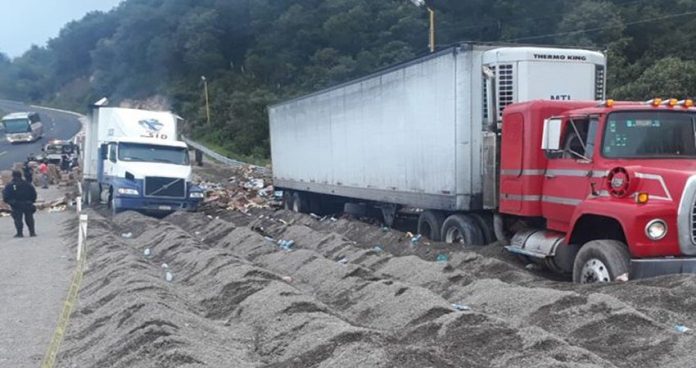
Wheat lines the tracks after yesterday's train robbery.

Thieves struck another blow against rail transportation yesterday, stealing 50 tonnes of wheat in Puebla as auxiliary police stood by and watched.

Officials at the Ferromex railway consortium said thieves physically assaulted rail personnel when they attempted to call for help.

The theft occurred at about 1:00pm in the San Pablo Xochimehuacan district in the municipality of Puebla.

The estimated 50 people who participated in the robbery are believed by authorities to be members of Puebla-based gangs known as the Panteoneros and the Barranqueros.

Located to the northwest of downtown Puebla city, Xochimehuacan has become a hot spot for train robberies. Despite the large number of thefts over the last few months there hasn’t been a single arrest since February, when police thwarted a robbery in progress.

According to statistics, there were 1,986 train robberies in Mexico in the first five months of the year, with the central-eastern Mexico states of Puebla, Hidalgo, Tlaxcala and Veracruz seeing the largest number.

Source: El Universal (sp)

For the second time, candidates quit in Guerrero municipality

0
Cutzamala de Pinzón, where few want to stand for election.

A group of candidates running for office for the same party in a municipality in the notoriously-violent Tierra Caliente region of Guerrero have quit just two weeks after they replaced another contingent of candidates who also resigned en masse.

Off the record, party officials are saying the resignations are probably due to threats by organized crime.

The 11 Democratic Revolution Party (PRD) candidates (or their substitutes) had been nominated to stand for mayor, trustee and councilor positions in Cutzamala de Pinzón, one of nine municipalities that make up the Guerrero portion of the tri-state Tierra Caliente.

Their candidacies were registered with electoral authorities on May 31.

Arturo Pacheco Bedolla, a PRD representative at the Guerrero Electoral Institute (IEPCG), said he didn’t know why the candidates had quit, adding that the party’s previous group of aspirants didn’t reveal their reasons for withdrawing either.

But the fear of becoming a victim of political violence — at least 113 politicians and candidates have been killed during the current election period starting last September — and/or coercion from criminal groups are likely factors, according to a PRD official who spoke on condition of anonymity.

Last month, Guerrero Governor Héctor Astudillo warned that that organized crime is seeking to influence the electoral process in the state in order to gain control of the next generation of mayors and members of state Congress and the regions they will represent.

In a radio interview, Astudillo explained that “criminal groups don’t only try to extort money [from politicians] but also to control territory through the authorities,” citing the Tierra Caliente region as a prime example.

Pacheco Bedolla explained that in accordance with the state’s electoral laws, candidates who quit voluntarily cannot be replaced after a May 31 cut-off. Only those forced to withdraw due to death or mental illness can be substituted.

But the PRD official charged that the legislation is unconstitutional and said the party would challenge it before both state and federal electoral authorities with the intention of nominating a third list of candidates.

[wpgmza id=”27″]

On May 31, the IEPCG approved the replacement of 477 municipal and state candidates who had voluntarily decided to pull out of the July 1 elections.

The full lists of candidates for the PRD and the Morena party in the municipality of Pedro Ascencio Alquisiras — located in the north of Guerrero — were among those who quit the race.

According to risk analysis firm Etellekt, 23 politicians or candidates have been assassinated in Guerrero since September, the highest toll of any state in the country. An election official was also murdered in Guerrero last month.

More than 8,000 candidates will appear on ballots in the southern state to contest elected positions in 81 municipalities as well as seats in the Guerrero and federal congresses.

Source: Reforma (sp), El Financiero (sp)

Heavy rain turns Guanajuato streets into raging rivers

0
A flooded street yesterday in Guanajuato.

Heavy rain turned streets in Guanajuato into raging rivers yesterday after a dam in the city burst its banks.

The floodwaters brought traffic to a standstill in the state capital and inundated businesses in the historic center and the Sangre de Cristo district as well as at the IMSS medical clinic in El Cantador.

A torrential downpour began at 5:30pm and didn’t start to ease off until 7:00pm, causing the Presa de la Olla dam to overflow and fill the surrounding streets with water.

The dam is located about four kilometers southeast of downtown Guadalajara and 500 meters from the state government building.

Among the thoroughfares affected were Subterránea Street, which runs beneath the city’s downtown, and Benito Juárez Avenue. Both roads — and others — were shut off completely to traffic and pedestrians for more than two hours.

In several videos that circulated on social media, partially submerged vehicles can be seen on city streets. The road leading to the swollen dam, Paseo de la Presa, was also flooded.

Guanajuato Mayor Édgar Castro Cerillo convened a meeting last night with Civil Protection authorities to assess the impact of the flooding and ordered the dam’s floodgates to be left open to allow the large quantities of excess water to flow to the Guanajuato river.

“A large amount of water fell in a very short time . . . the rain was so quick that it caused flooding and the overflowing of the dam,” the mayor commented.

However, Castro explained that “Guanajuato is not in a state of maximum alert, we’re not in an emergency” although he added that all of the city’s relevant authorities and security forces were on the ground and ready to respond to any situation.

There were no reports of injuries or loss of life.

The mayor also said that city personnel were working to unblock rubbish-clogged drains that were exacerbating the flooding.

By 8:30pm the floodwaters had begun to recede and Castro said that no one remained in danger.

In a preliminary report, Civil Protection authorities said that torrents of water “ran with a lot of fury” through the streets, while the city’s water utility said that all of the city’s reservoirs were at elevated capacity levels.

Source: Reforma (sp), El Universal (sp)

[soliloquy id="54365"]