Home Blog Page 2120

At 101, Marcial Martínez has learned how to read

0
Marcial Martínez: back to school at 101.

He’s 101 years old but Marcial Martínez Martínez has decided it’s time to go back to school.

The Mexico City man has just finished a course in which he learned how to read and is now planning to pursue further studies.

Even as an illiterate young man and father Martínez knew how important it was to be able to read and write.

“I put my children in school, I tried to get them all in, I decided that my children had to learn, it didn’t matter that I didn’t. Thank God my children know how to read. I didn’t want them to be like me . . .” he told the newspaper Milenio.

Martínez is one of 133,126 people enrolled at the National Institute for the Education of Adults (INEA) in a program that targets people 15 or older with gaps in their education.

While people of all ages are welcome in the program, INEA pays special attention to younger students, providing them with counseling and family planning courses.

INEA offers courses up to the preparatory school level, but Martínez has his sights set a bit lower than that, at least for now. His next step is to finish primary school.

He will not be alone in the classroom: there are currently over 53,000 parents enrolled in INEA’s courses.

Source: Milenio (sp)

Senior police officials arrested in connection with murder of 6 officers

0
The six officers who were slain yesterday in Puebla.

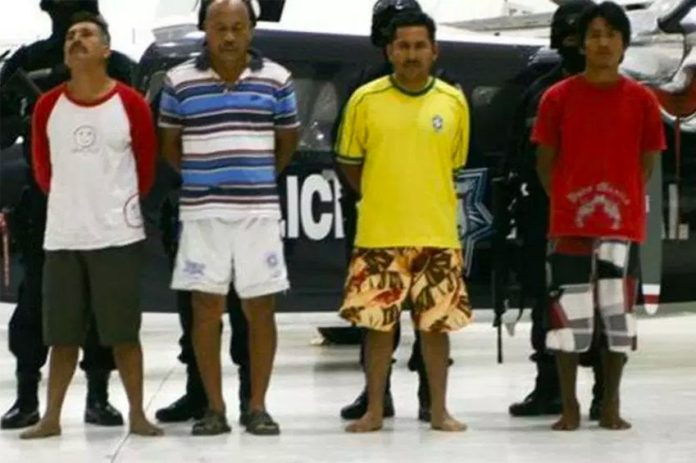
Two senior police officers in Amozoc, Puebla, have been arrested in connection with the murder yesterday of six municipal police officers who had filed a formal complaint about issues in the municipal government.

The state Attorney General’s office said the six victims had been tortured and executed after being lured to an ambush with a false alarm about a disturbance.

Initial reports said fuel thieves killed the officers. Two heavily armed civilians were arrested shortly after the execution, and a pipeline tap and tanker truck were found one kilometer away from the location where the bodies were found, state authorities said last night.

But today, the Attorney General’s office announced that the state investigation agency had arrested two Amozoc police officials for their presumed participation in the murders.

The six police who were killed had made an official complaint on Thursday before the municipal controller, the office said, but did not reveal any details regarding the nature of the complaint.

Source: Periódico Central (sp) 

Jalisco bus accident kills seven, injures 30

0
The bus that went off the road last night Jalisco.
The bus that went off the road last night in Jalisco.

Some survivors of a bus accident that killed seven people last night in Jalisco are blaming excessive speed.

Thirty people were injured when the bus went off the road at about 11:00pm after the driver lost control. The vehicle overturned and plunged into a drainage canal on the San Martín de las Flores-El Verde highway in Tlaquepaque.

State Civil Protection officials said two children aged two and 11 were among the dead. There were about 40 passengers aboard.

Ambulances were called in from Guadalajara, Zapopan and Tlajomulco to transfer the injured to hospital.

Emergency personnel said there was a meter of water inside the bus, which caused panic among survivors who feared more water was going to enter.

Some said the driver was going too fast when he lost control.

Source: El Occidental (sp), Milenio (sp)

3 weather systems are bringing rain, stormy weather

0
mexico weather forecast
The numbers indicate heavy rain (1), very heavy rain (2) and intense rain (3). The yellow symbol indicates electrical storms.

Three weather systems will bring rain to much of the country today, according to the National Meteorological Service (SMN).

Hurricane Bud was downgraded to a tropical storm Wednesday but the SMN said it could still bring strong to severe storms to the north of the country with wind gusts of 45 to 55 kilometers per hour and one to three-meter swells on the coasts of Baja California, Baja California Sur, Sonora and Sinaloa.

In central and southern Mexico, Tropical Storm Carlotta is also producing strong winds and heavy rain.

The stormed formed in the Pacific Ocean near Acapulco, Guerrero, yesterday and is forecast to move inland late today or early tomorrow. A tropical storm warning is in effect between Acapulco and Lagunas de Chacahua, Oaxaca.

Wind gusts of 45 to 55 kilometers per hour are expected along with swells of one to three meters on the coasts of Guerrero and Oaxaca, the SMN said.

The United States National Hurricane Center said Carlotta would produce 75 to 150 millimeters of rainfall along the Guerrero and southwestern Oaxaca coasts, including the city of Acapulco, with isolated higher amounts of 250 millimeters possible.

It also said the rains are likely to produce life-threatening flash floods and mud slides, especially in areas of higher terrain.

Stormy weather is also forecast for Michoacán, Chiapas, Puebla and Veracruz.

The SMN said that a third tropical storm system will affect the Yucatán Peninsula and also bring heavy rains.

The system is currently located off the northern coast of Quintana Roo and there is a 10% chance that it could develop into a hurricane.

It will cause severe storms with torrential rains in the states of Quintana Roo and Yucatán and strong storms with heavy rain in Campeche and Tabasco, the SMN said.

The rainfall expected today will add to what has already been a wet week in much of Mexico.

A strong storm struck Guadalajara, Jalisco, Sunday producing flash flooding that affected several parts of the city, including the light rail system from which scores of people had to be rescued, while heavy rains in Guanajuato Wednesday turned streets in the capital into raging rivers after a dam burst its banks.

In Sinaloa, Hurricane Bud caused flooding, toppled trees, closed the ports of Topolobampo and Mazatlán, tore a roof off a building and forced at least 14 people to evacuate their homes.

In neighboring Sonora, the ports of Yavaros, Guaymas, Bahía de Kino, Puerto Libertad and Puerto Peñasco were also closed.

Steady rain has also fallen over the past three days in Mexico City, causing flooding in several parts of the city and shutting down five subway stations in the east of the city Thursday.

Source: El Universal (sp)

Presidential candidates largely sympathetic to migrants’ plight

0
Migrants aboard the freight train nicknamed 'The Beast.'
Migrants aboard the freight train nicknamed 'The Beast.' AP/Eduardo Verdugo

Mexico is often considered a transit country for migrants. It’s the territory Central Americans must cross to get to the United States.

But many generations of migrants have made Mexico their home. From 1930s-era Spanish Civil War exiles and Jewish World War II refugees to South Americans escaping military dictatorships throughout the 20th century, Mexico has welcomed successive waves of immigrants.

In 1948, during the drafting of the Universal Declaration of Human Rights – the founding document of the international human rights system – Mexican delegate Pablo Campos Ortíz advocated for a “very broad conception” of asylum.

Seconding a Lebanese proposal, Campos Ortíz said the world should recognize “not only the right of seeking asylum but also the right to be granted asylum.”

Mexico and Lebanon lost that debate.

The 1951 Convention for Refugees and subsequent agreements require that signatory countries offer asylum to migrants who can prove they have a “credible fear” of certain kinds of persecution. As demonstrated by U.S. Attorney General Jeff Sessions’ recent exclusion of domestic abuse as grounds for asylum, they are not obliged to accept all applications.

Mexico provides an exception to that rule – in law, if not in practice. It took almost 60 years, but in August 2016 a Campos Ortíz-inspired amendment to the Mexican Constitution recognized migrants’ right to seek and be granted asylum. The amendment proposal called Mexico a “country of refuge.”

The next year, Mexico City approved a local constitution declaring itself a sanctuary city where authorities will “prevent, investigate, sanction and offer reparations for human rights violations.”

As a human rights scholar and immigrant, I have watched Mexico’s 2018 presidential election season closely. Would any candidates take a page out of Donald Trump’s playbook and demonize Central American migrants for political gain?

Despite an official commitment to the rights of migrants, Mexico has recently followed the U.S.’s punitive lead on immigration.

Between 2007 and March 2017, the U.S. government invested US $1.5 billion in the Mérida Initiative, a U.S.-Mexico partnership officially intended “to fight organized crime and associated violence while furthering respect for human rights and the rule of law.”

In recent years, however, Mérida Initiative funds have gone toward enhancing Mexican immigration enforcement. At the urging of the Obama administration, in 2014 President Enrique Peña Nieto launched an aggressive arrest and deportation program along its southern border.

The U.S. has funded Mexico to increase enforcement along its southern border with Guatemala
The U.S. has funded Mexico to increase enforcement along its southern border with Guatemala. AP Photo/Rebecca Blackwell

The Programa Frontera Sur targets Central American migrants attempting to cross Mexico. U.S.-trained Mexican immigration officials use American-funded surveillance towers and biometric data equipment to control the southern Mexican states of Chiapas, Oaxaca and Tabasco.

Nearly 40% of Central American migrants entering Mexico are fleeing violent attacks or threats back home, according to Doctors Without Borders.

But Mexican authorities still routinely force people to return to dangerous conditions, Amnesty International reports. This practice, known as refoulement, is illegal under domestic and international law.

Despite Trump’s Twitter claims that Mexico has done “nothing at stopping people” from coming to the U.S., the Frontera Sur program has proven effective. Between 2014 and 2015, Mexican deportations of Central American migrants – primarily Guatemalans, Hondurans and Salvadorans – more than doubled, from 78,733 in 2013 to 176,726 in 2015.

During the same period, detentions of Central Americans along the U.S. border fell by half.

From restrictions on asylum claims to mass deportations, the Trump administration’s draconian immigration policies may actually push Mexico closer to becoming the “refuge country” it claims to be.

According to a 2017 study by the country’s National Human Rights Commission, around 20% of 1,000 Central American migrants surveyed while passing through Mexican territory have now decided to stay in the country. The U.S. Border Patrol detained some 351,000 people attempting to cross illegally into the U.S. in 2017, down from 600,000 in 2016.

That has made migrants a hot topic in the lead-up to Mexico’s July 1 general election – but not in the way that might be expected. Presidential candidates have largely been largely sympathetic to their plight.

During the second presidential debate, which aired on May 21, an audience member from the border city of Tijuana asked the four candidates how they would improve Mexico’s “outrageous” treatment of undocumented Central Americans.

Frontrunner Andres Manuel López Obrador, from the Morena party, answered that he would stop doing the U.S.’s “dirty work” on immigration if elected.

López Obrador proposed instead an “alliance for progress” between the U.S., Mexico, Canada and Central America to foster regional job creation, economic development and security, thus reducing the need to migrate. He did not explain how he would persuade Trump to join.

Candidate Ricardo Anaya, who heads an unusual left-right alliance between the progressive Democratic Revolution Party and the conservative National Action Party, said Mexico must be the “moral authority” on immigration. It should treat Central American migrants the way Mexicans would like to be treated in the U.S.: justly and humanely.

Even José Antonio Meade, from President Peña Nieto’s Institutional Revolutionary Party, acknowledged that criminals, economic migrants and victims of violence are different groups of people and should treated as such.

In a rebuke to a Trump administration policy of separating migrant children from their parents, Meade added that unaccompanied minor migrants should be offered special health services and legal protection.

Not even independent Jaime Rodríguez, a political renegade who once suggested that Mexico could fight crime by chopping off drug traffickers’ hands, has taken a hard line on immigration. He proposed making the southern state of Chiapas a “Mexican California” – evidently meaning a place where low-paid migrant workers would help drive the local economy.

None of the candidates attacked migrants in a populist bid to win votes.

But none addressed the gap between Mexico’s treatment of Central American migrants and its “refuge country” status, either.

The ConversationFor the next president, complying with Mexico’s new humanitarian law will mean passing policies that truly take migrants’ rights seriously.

Luis Gómez Romero is a senior lecturer in human rights, constitutional law and legal theory at the University of Wollongong. This article was originally published on The Conversation.

Census finds Mexico’s jaguar population up 20% to 4,800

0
Jaguar cubs at a zoo in México state. The numbers of their wild counterparts are up.

Mexico’s wild jaguar population has increased by 20% over the past eight years, according to a new study released yesterday.

The Second National Jaguar Census 2016-2018 found that there are now 4,800 wild jaguars in the country, compared to 4,000 reported in 2010.

News of the growing population is especially significant considering that jaguar numbers have been on the decline in recent years.

The study was carried out by researchers from 16 institutions and 25 academic groups using 396 remotely activated cameras which are triggered by sensors that detect the animals’ movements.

The president of the National Alliance for Jaguar Conservation, Gerardo Ceballos, presented the results of the census at the International Symposium on Ecology and Conservation of the Jaguar in Cancún, Quintana Roo.

Ceballos said the aim of conservation efforts “is to have 7,000 or 8,000 jaguars throughout the country” in the near future.

“. . . If we continue with the conservation actions of recent years, I estimate that we will achieve it in the next three or four years. By doing that, we’ll remove the jaguar from the list of animals in danger of extinction . . .” he said.

He explained that the increase in the jaguar population was due to conservation work completed by the Jaguar Alliance, the World Wildlife Fund (WWF) and the Telmex Telcel Foundation, whose technology has played a crucial role in monitoring the jaguar.

Sergio Patgher, a Telcel brand manager, said the foundation has provided funds to purchase camera traps and has assisted researchers with the technology to remotely monitor the jaguars and their movements.

WWF Project Coordinator María José Villanueva said the main threats to jaguars in Mexico are habitat destruction, illegal hunting, wildlife trade and conflict with livestock farmers.

She and Ceballos agreed that jaguar conservation should be included in the government’s overall environmental strategy, ensuring that their protection is guaranteed beyond each six-year presidential term.

Both conservationists also said the private sector and citizens’ groups should be included in the efforts to protect the species.

Alejandro del Mazo, who heads up the government’s Natural Protected Areas Commission (Conanp), said in March that Mexico will seek to create a trinational natural protected area for the jaguar in the southern jungle region that extends into Guatemala and Belize.

The project would add to a system of interconnected wildlife corridors known as the “Paseo del Jaguar” (Path of the Jaguar), which is already in place and extends through several countries in the Americas.

In Mexico, jaguars live in the states of Yucatán, Quintana Roo, Campeche, Chiapas, Oaxaca, Guerrero, Colima, Sinaloa, Sonora y San Luis Potosí.

There are around 64,000 jaguars left in the wild, according to the International Union for Conservation of Nature, which has declared the mammal a “near-threatened” species.

The yellow, black-spotted cats are found in 18 countries across the Americas but an estimated 90% live in the Amazon rainforest.

Source: Excelsiór (sp), Phys.Org (en)

Court rules tariff on solar panels must be eliminated

0
These ought to be cheaper now.

A federal court ruled yesterday that the 15% tariff that had been imposed on solar panel imports into Mexico since 2015 must be removed.

The court’s decision came in response to an application for annulment of the duty filed by the Mexican Association of Solar Energy (Asolmex), which argued that the tariff created legal uncertainty for solar power investors.

In a statement, Asolmex said it was “happy with the decision as it returns conditions of legal certainty to the sector and guarantees the competitiveness of solar energy in Mexico.”

The 15% tariff was imposed on solar panels after the Federal Tax Administration (SAT) ruled in October 2015 that they must be reclassified as electric generators.

With yesterday’s ruling, Asolmex expects that the installation of solar panels across the country will increase.

Before the decision was handed down, the association estimated that distributed solar generation — which includes the sale of surplus solar power to the Federal Electricity Commission (CFE) — has the potential to generate 6,000 megawatts of energy by 2024 and could attract investment of 150 billion pesos (US $7.25 billion).

With those goals in mind, Asolmex presented a Distributed Solar Generation Initiative to the federal government last week.

The full implementation of the initiative would also enable Mexico to reduce CO2 emissions by 27 million tonnes, save 27,000 liters of water and generate 77,000 new jobs, Asolmex said.

Over the past two years, 37 large-scale solar projects have been developed and more than 160,000 homes are now powered by the sun.

However, if the objective of adding 6,000 additional megawatts to the national grid is achieved, the electricity demands of a further 1.2 million homes could be met.

That would bring a variety of economic, environmental and social benefits, the newspaper El Economista said.

It also said that “distributed solar generation has the potential to democratize access to electricity by taking advantage of the roofs of homes, businesses and industry in the whole country.”

Among the large-scale solar projects that have recently started operations in Mexico are a 40-hectare solar farm in Coahuila and a US $14-million facility near Guadalajara, Jalisco.

Source: Milenio (sp), El Economista (sp)

Low-cost airline Volaris announces 14 new domestic routes

0
Low-cost carrier announces new domestic routes.

Low-cost airline Volaris announced it will introduce 14 new domestic routes before the end of the year.

From Mexico City, the airline will open new routes to Cozumel, Puerto Escondido, Colima, Guanajuato, Aguascalientes and Tepic.

Five routes will link the Bajío airport of Guanajuato to the cities of Mexicali, Mérida, Puerto Vallarta, Huatulco and Los Cabos.

Two routes will connect the city of Tijuana with the southern Mexico destinations of Zihuatanejo and Tuxtla Gutiérrez, while a new Guadalajara-Puerto Escondido route will round out the list.

The new routes will begin operating during the second half of the year.

Volaris CEO Enrique Beltranena said that the new routes “will contribute to a more united Mexico, one that can enjoy the best benefits: connectivity with no layovers, excellent customer service, punctuality and, above all, the best prices.”

The airline’s pricing manager, Omar Carrera, said the new routes “strengthen the point-to-point business model, allowing more Mexicans to connect in a direct manner, at the lowest prices, with the destinations they are most interested in.”

Source: A21 (sp), La Voz de Michoacán (sp)

Mexico City-Toluca train delayed until middle of next year

0
It hasn't left the station yet.

The start date for the Mexico City-Toluca passenger train has been postponed yet again, although the head of the federal Secretariat of Communications and Transportation (SCT) said he was satisfied with the progress.

Gerardo Ruiz Esparza said the service could begin operating early next summer, in what he said experts had described as “record time.”

In February, Ruiz’s department insisted that the project would be finished by the end of this year, with trains operating on the 57-kilometer line at the beginning of 2019.

The project was initiated in June 2015 and scheduled to be finished by December 2017.

Ruiz said it is now 80% complete, and that construction time has been good.

When first proposed in 2014, the train was projected to cost 35 billion pesos but that figure has been adjusted several times and has now risen to 52 billion (US $2.5 billion), although that is rather less than the 59-billion-peso estimate reported at the beginning of the year.

Ruiz cited inflation, variations in the peso-US dollar exchange rate and changes to the route as reasons for the overruns.

“These are adaptations that are made in these kinds of projects . . . the cost so far is reasonable and according to what was planned,” he said.

Ruiz said operation testing will begin in September.

The train will have the capacity to carry 230,000 passengers a day, reducing travel time between Mexico City and Toluca to 39 minutes, and operate at 160 kilometers per hour.

Source: El Economista (sp)

An alternative to plastic straws: this product is made from avocado pits

0
From avocado seeds come straws.

As plastic straws fall out of favor for their potential to inflict environmental damage, a company with an alternative that uses avocado pits is getting more attention.

Morelia, Michoacán-based Biofase is manufacturing biodegradable straws made out avocado seeds using a process whose beginnings date back to 2012.

Scott Mungía was a chemical engineering student at the time and, being motivated to solve pollution problems, was looking for a reliable source for biodegradable plastic.

After a trial-and-error process that tested the properties of raw materials such as mango and mamey sapote seeds, Munguía hit upon avocados.

It took him a year and a half of research to find an effective method to extract a molecular compound from the avocado pit and obtain a biopolymer, which could then be molded into any desirable shape. Munguía’s avocado-based bioplastic was born.

The bioplastic products manufactured using his process biodegrade after 240 days of being exposed to the elements or buried in the ground, while their fossil fuel-based counterparts can take more than 100 years.

By 2013, Munguía had the process patented and founded Biofase. Two years later he installed his first plant in Morelia to manufacture ecofriendly plastics and sell them as raw material.

In 2016, Mungía decided to start manufacturing his own bioplastic-based products in a second plant. He began with plastic cutlery, and in February this year moved into straws.

Four months on, the young entrepreneur has found that changing people’s habits is no easy feat: “people are still reluctant to pay more for [a product] that protects the environment.”

But production continues in the Morelia plant, whose monthly yield of biodegradable plastic products is 130 tonnes, 40% of which are straws. Eighty per cent of the plant’s production is exported to the United States, Canada, Costa Rica, Colombia and Perú.

Its daily consumption amounts to 15 tonnes of avocado seeds, which it gets from the United States-based food company Simplot. It also operates a plant in Mochoacán.

Mexico is the second biggest market for Munguía’s company, but its principal customers are chain restaurants such as Fiesta Americana, P. F. Chang’s China Bistro and Chili’s Grill & Bar rather than consumers.

Source: El Financiero (sp)