The new federal government will face snowballing pension costs throughout its six-year term, economic forecasts show.
According to projections by the Secretariat of Finance and Public Credit (SHCP), the payment of pensions will cost the government 3.4% of gross domestic product (GDP) in 2018.
But in 2019, that figure will grow to 3.5% of GDP and in subsequent years it will continue to go up, forecasts contained in an SHCP document show.
In 2024, President López Obrador’s last year in office, the government will be forking out 4.3% of GDP in pensions, a 0.9% increase on the forecast for this year.
The projections are based on actuarial studies and trends observed in recent years.
In the SHCP document, the government acknowledges that longer life expectancies coupled with a lower fertility rate provide it with an economic challenge.
“For some decades, the adult population in Mexico of pensionable age has been growing at a faster rate than the younger population. This demographic transition presents a challenge for the sustainability of public finances because spending on pensions and health will increase with the growth of the older population,” the document says.
“It’s estimated that in 2019 the population in Mexico of pensionable age will be 9.5 million, while in 2040 it’s predicted that it will double to reach 19.5 million.”
Next year, the government is expected to pay out more than 877.4 billion pesos (US $44.6 billion) in pensions, 6.4% more than this year. The projected expenditure is almost three times higher than the total budget allocated to public education in 2019.
Three of every four pesos the government spends in the area will go to retirees who are covered by the IMSS and ISSTE social security schemes.
Government spending on the universal old-age pension system, which is funded separately, will increase by a much greater amount – 148% – to 101.5 billion pesos (US $5.1 billion) next year, data in the 2019 budget shows.
Just under 41 billion pesos (US $2.1 billion) was allocated to the program in 2018 but the López Obrador administration intends to more than double pension payments.
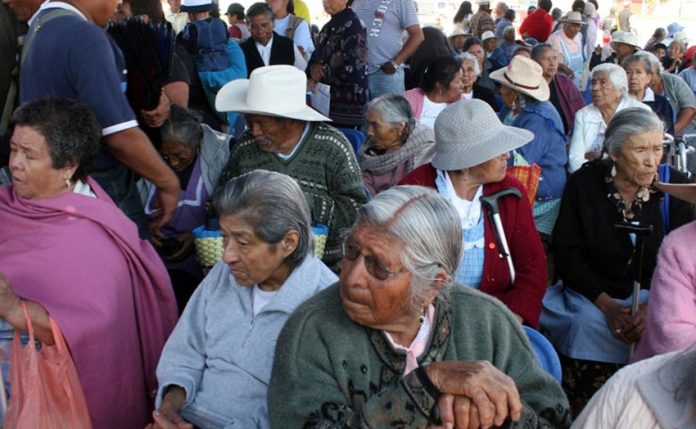
Adults aged 68 or over, regardless of wealth, will be entitled to receive a monthly pension of 1,274 pesos (US $65). Indigenous people will qualify from age 65.
“This amount represents a significant increase (more than 100%) with respect to what the previous 65 and over [universal] system offered . . .” the Secretariat of Welfare said.
Gerardo López, a pensions expert at the Panamerican University, told the newspaper El Economista that while the intention of the universal pension program is good, there is a lack of clarity about how it will function.
“One of the most important issues is the operating rules . . . who is going to have the right [to claim a pension] and how is it going to be verified. The operating rules haven’t been announced . . .” he said.
López was also critical of the plan to include people who already receive a pension from another source such as IMSS or ISSTE in the universal pension scheme.
“. . . It’s unfair to give an additional prize to someone who already has a pension. In that area, I think the rules should be more precise,” he said.
The Chinese government has moved to stop the smuggling of illegal totoaba swim bladders from Mexico.
Chinese Customs announced on Christmas Day that an operation to bring down smuggling rings had led to the arrest of 16 individuals representing one of the main swim bladder trafficking gangs. Chinese authorities confiscated 444.3 kilograms of bladders worth an estimated US $26 million.
Though the investigation is still ongoing, preliminary results show the syndicate would purchase the bladders in Mexico and transport them to China in suitcases.
“For many years China was not aware of the illegal trade in totoaba bladders,” said Peter Knights, CEO of the non-governmental organization WildAid. “But when alerted, they stopped open trade and now they are taking down smuggling rings. Let’s hope their decisive action can help the remaining vaquita porpoises that are literally on the brink of extinction.”
The totoaba is a fish endemic to the upper Gulf of California and has been considered critically endangered since 1996. The totoaba shares the same habitat with the vaquita. Decades of destructive fishing practices and the rampant use of illegal gillnets to poach the totoaba have decimated the vaquita population, with now fewer than 20 individuals estimated to remain.
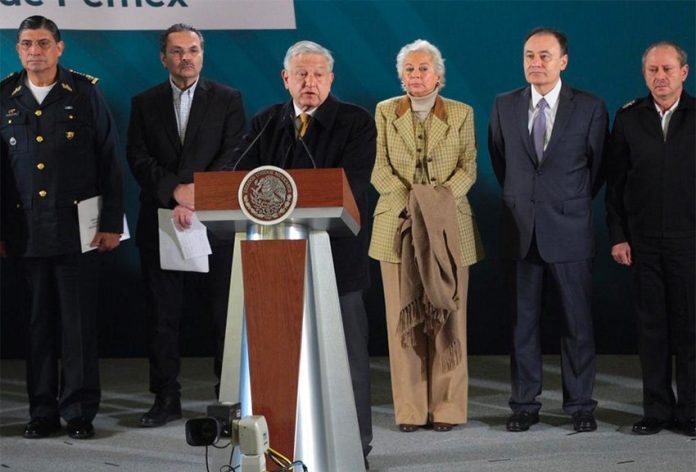
Cabinet secretaries listen as the president announces his petroleum security strategy.
The federal government will deploy 4,000 soldiers and marines to guard the nation’s oil refineries and petroleum storage facilities to combat fuel theft, President López Obrador announced today.
All told, 57 facilities will be protected by the military: six refineries, 39 storage terminals and 12 pumping stations.
The use of the army and navy is part of the government’s wider plan to combat petroleum theft.
López Obrador said that state oil company Pemex lost 60 billion pesos (US $3 billion) due to fuel theft last year, a figure double the amount cited by the company’s former CEO, and charged that the theft couldn’t have occurred without the complicity of members of the previous government.
“The aim of the plan is to avoid [fuel] theft . . . [The amount] stolen each year equates to 60% of what’s going to be allocated to old-age pensions. It’s 60 times more than the amount we’re going to use next year to create 100 public universities. We can’t allow this, we have to put an end to this corruption . . .” López Obrador said.
At the same press conference, acting Attorney General Alejandro Gertz Manero said that three officials at Pemex who were allegedly complicit in the theft of petroleum have been dismissed and will face criminal charges.
Just hours after López Obrador’s announcement, soldiers assumed responsibility for the security of the Pemex refinery in Salamanca, Guanajuato.
“We arrived in the state of Guanajuato last night and today they sent us here,” an army sergeant told the newspaper Milenio.
Personnel at the refinery have previously come under investigation for involvement in fuel theft.
López Obrador told reporters that 15 government departments are involved in the implementation of the new anti-fuel theft strategy.
He called on Pemex employees to help stamp out corruption, on gas station owners to not sell stolen fuel and on citizens to not buy it.
The president said there was no evidence that former Pemex directors had participated in the theft of petroleum but charged that they were aware that it was occurring within the company.
Combatting fuel theft is one of the biggest security challenges faced by the new federal government.
The incidence of illegal taps on state-owned petroleum pipelines increased sharply throughout the six-year term of the last government and there is evidence that Mexico’s notorious drug cartels have moved in on the lucrative racket.
López Obrador said that fuel was also stolen from 600 tankers per day last year and the same number this year.
Gangs of fuel thieves known as huachicoleros are believed to behind the alarmingly high levels of violence in some states including Guanajuato, which has been transformed from a relatively peaceful state to one of the most violent in the country this year.
Auto theft will reach a record-breaking 94,000 cases in Mexico this year but after two years of what has been perceived as lax enforcement, new efforts are being undertaken in Morelos to curb the crime.
A new operation by the Federal Police and the army has installed a mobile detection unit on the Mexico City-Cuernavaca highway. The vehicle is equipped with a license plate scanner to identify stolen vehicles, allowing security forces to respond immediately.
The detector’s mobility will prevent lawbreakers from evading the scanner because they won’t know where it will be located.
The unit will be moved to different locations around the state of Morelos.
According to the Association of Mexican Insurance Companies (AMIS), auto theft this year will be up 4.4% over last year’s 90,187 cases. The value of the stolen vehicles at the end of November was 14 billion pesos, or US $713 million.
The figure will likely be rather more because December is historically one of the worst months for auto theft.
AMIS general manager Recaredo Arias Jiménez told the newspaper Publímetro that he believes the spike in theft was the result of a relaxation in efforts to combat insecurity during the last two years of President Enrique Peña Nieto’s administration.
Three Pemex officials who were allegedly complicit in the theft of petroleum have been dismissed and will face criminal charges, the acting attorney general said today.
“The federal Attorney General’s office (PGR) has initiated criminal proceedings against three individuals whose names we cannot release so as not to create a problem with due process,” Alejandro Gertz Manero said.
Speaking at President López Obrador’s morning press conference, Gertz explained that new Pemex management were aware that some company employees were complicit with criminals in pipeline petroleum theft and moved promptly to combat the problem.
“They immediately got to work in Pemex Logistics . . . and established that . . . those who managed the control of the pipelines were allowing the theft to take place,” he said.
New Pemex CEO Octavio Romero said the officials had been removed from their positions on December 20 and offered a graph that showed the quantity of stolen fuel had subsequently decreased from 43,000 barrels on December 21 to 19,000 barrels on Christmas Day.
López Obrador offered further details about the means with which authorities detected the complicity of the officials.
“There is a system . . . [that provides information about] the pressure of the pipelines and during the whole day they didn’t shut off the valves, which is what they should have done . . . There was a great loss of fuel in one section of pipeline,” he said.
“In another incident, a carrier who went in and out of a refinery was arrested. There is other evidence we can’t announce because the investigations are under way,” López Obrador added.
The president called on Pemex employees to help stamp out corruption, charging that there is a “large-scale fuel theft and distribution scheme” operating within the state oil company.
“It’s fuel theft but from above . . . There is a theory that of all theft, only 20% is through the tapping of pipelines – which is a kind of front [for what’s really happening] – that most [fuel theft] is related to a plan that operates with the complicity of authorities and with a distribution network. So, there are huachicoleros [fuel thieves] at the bottom and huachicoleros at the top,” López Obrador said.
Former Pemex CEO Carlos Treviño said in October that the crime was expected to cost the state oil company 35 billion pesos (US $1.75 billion) this year.
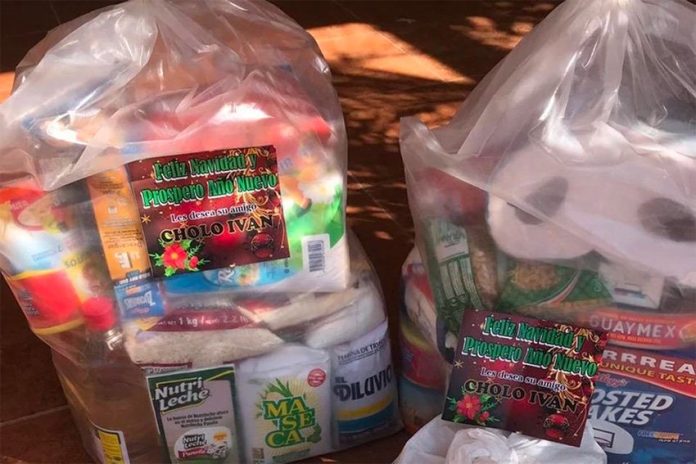
Christmas gifts with card signed by a jailed cartel boss.
Some residents of Sinaloa had a happy Christmas thanks — evidently — to the Sinaloa Cartel.
Dozens of trucks turned up last week in several rural towns in the municipalities of Salvador Alvarado and Mocorito and delivered holiday gift baskets.
Wrapped in clear plastic, the baskets came with a card bearing a short message: “Merry Christmas and a Prosperous New Year from your friend Cholo Iván.”
A similar distribution of gifts took place three months ago in the town of Ranchito, Angostura.
Victims of the Tropical Storm 19E received food supplies, mattresses, stoves and other appliances bearing a logo consisting of a black baseball cap with the initials JGL written in gold.
The donation of the disaster relief supplies has been attributed to the former chief of the Sinaloa Cartel, Joaquín Guzmán Loera, also known as “El Chapo.”
“El Cholo Iván” is Orso Iván Gastélum Cruz, identified as the Sinaloa Cartel’s former chief lieutenant and security boss. He was arrested with Guzmán in January 2016 and has been behind bars since.
But it appears his influence still reaches far on his former turf in Sinaloa.
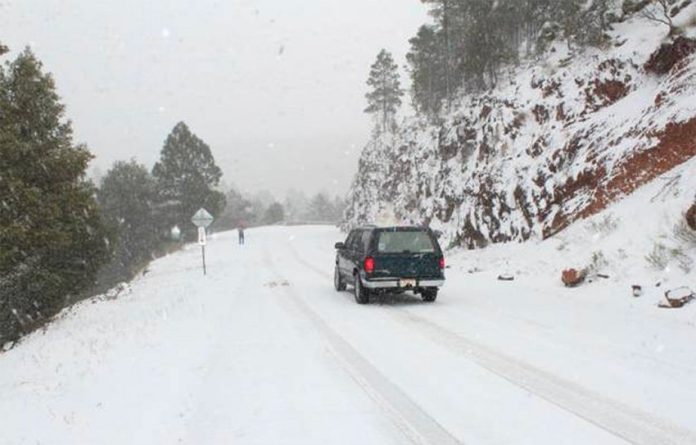
Heavy snowfall closed the highway between Janos, Chihuahua, and Agua Prieta, Sonora, for more than three hours yesterday.
Sonora Civil Protection services (UEPC) said that Federal Police and Agua Prieta municipal police closed federal Highway 2 at Puerto San Luis at 5:30pm.
The highway reopened to traffic at 8:40pm, the UEPC said in a Twitter post, and urged motorists to drive with caution due to the slippery conditions and limited visibility.
The fourth winter storm of the season delivered snow and sleet to several parts of Sonora and Chihuahua yesterday, including the cities of Cananea and Nuevo Casas Grandes.
The National Water Commission (Conagua) said there is a possibility of more snow today in mountainous areas of the two states.
Temperatures below -5 C are forecast for mountainous areas of both as well as Baja California and Durango.
Below freezing temperatures are also forecast today for several other states in northern, western and central Mexico.
With a new cold front arriving on Friday, Civil Protection services have issued warnings for 46 Sonora municipalities due to the likelihood of already low temperatures dropping further.
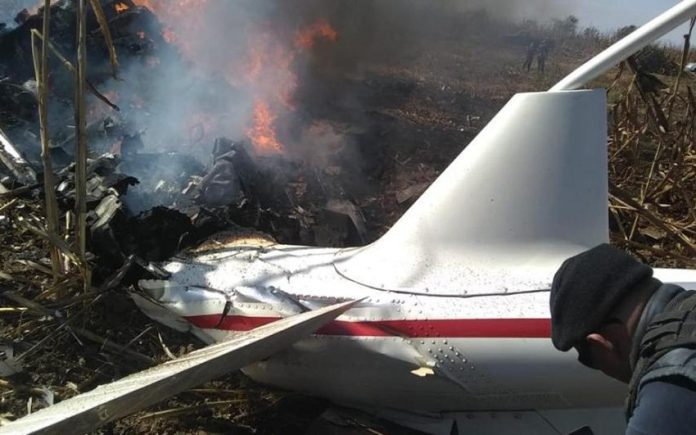
Wreckage of the helicopter in which the governor of Puebla and four others died on Christmas Eve.
People who have blamed the federal government for the helicopter accident that claimed the lives of the governor of Puebla and her senator husband are a “mean” and “neo-fascist” minority, President López Obrador said yesterday.
At his morning press conference, López Obrador rejected accusations that his government was responsible for the Christmas Eve crash in which Governor Martha Érika Alonso, ex-governor Rafael Moreno Valle, a political assistant and two pilots were killed.
“As a matter of principle, we would never act against anybody,” he said.
The president said that his government is fully committed to finding out what caused the crash.
“There is a commitment and willingness of the federal government to know the whole truth. We are not going to hide anything, we have to know what caused this accident and this tragedy,” he said.
“So that there is no suspicion, the government . . . will appeal to an independent body from abroad, recognized and prestigious, to present a conclusion that we are going to make public to the people of Mexico.”
The Security Secretariat (SSPC) said in a statement issued later yesterday that the Transportation Safety Board of Canada, a government agency, would send two aeronautical experts to Mexico to participate in the investigation into the accident.
Jimmy Cancino, a civil aviation expert with more than 25 years’ experience, and Nora Vallée, a helicopter pilot with more than 30 years’ experience, will arrive at the Puebla airport today and start work tomorrow morning, the SSPC said.
Other aviation experts, including representatives of the Italian company that manufactured the Agusta A109 helicopter and engine-makers Pratt & Whitney, have already examined the crash site, located in the Puebla municipality of Coronango.
The government said on Tuesday that the investigation had not found any sign of explosive material on the aircraft, which hit the ground nose first. A witness said it was on fire before it crashed.
López Obrador also responded to questions about his absence at the funeral for Alonso and Moreno. He told reporters it was an act of prudence within the context of an atmosphere of hostility towards his government that has been created by its critics.
“I don’t like to beat around the bush . . . Yesterday [Tuesday] there was an [adverse] environment that the usual conservatives created, not all of them, but a minority who acted in a very mean way . . . They’re neo-fascist groups who are very angry about the triumph of our movement . . . They act anonymously, especially on social media,” he said.
“The right, the conservatives, in addition to hypocrisy and being very corrupt, are also mean. On social networks, they started to talk about the liability of the government I represent . . .” López Obrador added.
He called for people to calm down and to avoid speculating about the cause of the crash as the investigation takes place.
The president said that he had spoken to Moreno’s father to offer his condolences but that he hadn’t been in contact with Alonso’s family.
Federal Interior Secretary Olga Sánchez and Security Secretary Alfonso Durazo represented the government at the political power couple’s funeral, which took place in Puebla city on Christmas Day.
Alonso, 45, was sworn in as National Action Party (PAN) governor just 10 days before her death.
Her July 1 election victory was contested by her Morena party opponent, Miguel Barbosa Huerta, and other party officials, who alleged that the vote was plagued by irregularities. However, the Federal Electoral Tribunal ratified Alonso’s victory in a decision on December 9.
Moreno, who governed Puebla from 2011 to 2017, was accused of manipulating the poll in order to secure the governorship for his wife.
Artisans at work decorating ornaments in Tlalpujahua.
The small ex-mining town of Tlalpujahua (pronounced Tlal-pooh-how-a) is found just across the border from México state in Michoacán.
The town’s gold mine, Dos Estrellas, was the leading global producer of gold between 1908 and 1913 but closed in 1937 when a mining accident caused mudslides that buried one-third of the town.
The mine now stands as a museum, but Tlalpujahua has a new form of gold. It comes in the shape of locally-made glass Christmas tree ornaments.
Nowadays, visitors flock to the town to buy these artisan creations for their Christmas tree. For anyone who wishes it could be Christmas every day, Tlalpujahua is the place for you since these ornaments are found in stores throughout the year.
Go in June and there are stores complete with a welcoming Santa and an elf or two to guide you inside.
So how did this town that used to mine gold suddenly become the Mexican home of the Christmas ornament? The story goes back to the 1950s when Joaquin Muñoz Orta and his wife, María Elena Ruíz Villagrán, left Tlalpujahua for Chicago.
Ornaments on display during the annual fair.
During their time in the United States they learned the technique of glass blowing Christmas ornaments. After returning to Mexico in the 1960s, Joaquin Muñoz had the idea to start an ornament making company and so Adornos Navideños SA was born. What started as a small business went on to be a company with multiple factories and thousands of workers.
Almost 50 years on, in 2008, it was estimated that Adornos Navideños SA produced 38 million ornaments each year, of which some two-thirds were exported. There are now other factories in the town and around 400 smaller production houses with new ones popping up all the time. Despite the huge production, most of the ornaments are still artisanal rather than mass produced. The artisans blow the glass and decorate them by hand.
You can find glass ornaments in all shapes and sizes, colors and decorations in Tlalpujahua. There are green spheres with red glitter, silver droplets with gold dots, red and white swirled baubles and a seemingly infinite selection of color combinations. There is something for every taste, blown and decorated by hand. The prices are incredibly reasonable, even more so given the talent and time that it takes to make and decorate each ornament.
From September through December, the streets fill with people looking for the perfect adornments for their trees. That is when La Feria de la Esfera takes place and most of the ornament makers can be found in the Municipal Auditorium selling their wares. Visitors can also go to the workshops and watch the artisans making the glass ornaments from scratch, a process which is completed in four parts.
First, the glass is blown into the required shape by the glassblower, and then the base color is added. Once dry, they are delivered to the decorating stations, where glitter and other embellishments are added before the hanger is added to the top.
Once finished, they are packed into boxes to be sent around the world or sold locally. Unsurprisingly, the production of Christmas ornaments is the largest industry in Tlalpujahua, earning it the title as the Town of Eternal Christmas.
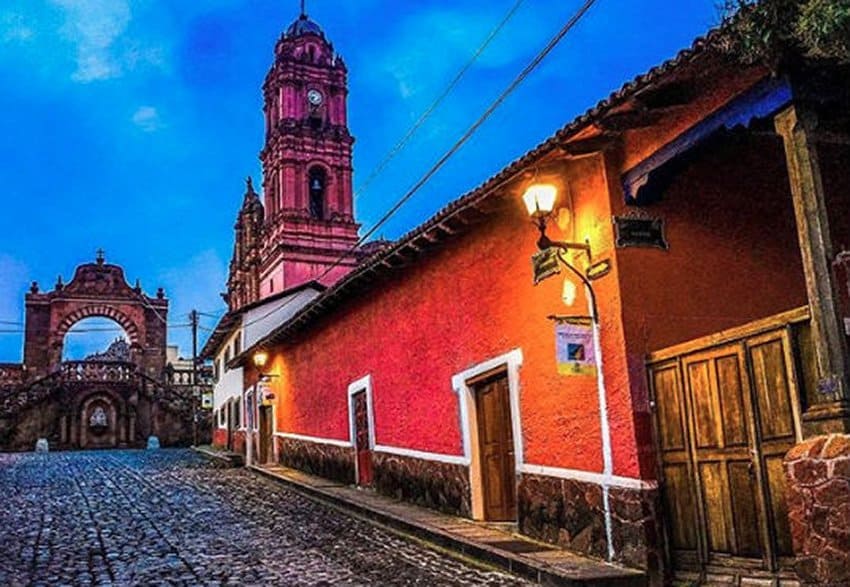
Tlalpujahua, Pueblo Mágico, or magical town.
It is worth a visit whether or not you want to buy the Christmas ornaments, however. It was declared a Pueblo Mágico, or magical town, in 2005 and when you arrive it is easy to see why.
Like many towns in Mexico, it sits around a picturesque main square. The narrow cobblestone streets, lined with adobe and pink stone houses with red tile or tin roofs, lead off from there in multiple directions, with some very steep ones leading up to the church that overlooks the town.
The Santuario del Carmen, which was built during the mining boom, has a beautiful baroque façade with intricately ornate carving. Inside, the sight is even more impressive, with the church decorated in pastel colors adorned with sculpted flowers. There is no wall without detail. It is hard to know where to look first.
Local children tell the history of the church to passing tourists in exchange for a small tip. At night, the church is lit up and can be seen from around the town.
Back in the town square, there is a small stall selling delicious gorditas made with maiz quebrado (literally broken corn, a name that refers to a technique of lightly crushing the corn to give a chunkier texture to the dough), and La Michoacana, the ice cream chain which began over 60 years ago in Tocumbo, Michoacán, has a small shop nearby too. Eating a Michoacana ice cream while visiting the town is a must.
Visitors who want to learn about the mining history should head to the Dos Estrellas mine and the Museum of Mining Technology. Here, visitors can discover everything about this mine, run mainly with French and English technology, with the majority of its excavations sent to England.
[wpgmza id=”123″]
While many mines closed during the Mexican Revolution, Dos Estrellas continued until the accident in 1937 that destroyed a large part of the town and killed hundreds of people. The museum is complete with artifacts from the time. Don a hard hat and you get to see inside.
To explore the world of mining in Mexico further it is worth taking a quick trip over state borders into the neighboring magical town of El Oro, which sits just inside México state. When gold was found in Tlalpujahua, mining companies were attracted to the area and also set up mines in the town now known as El Oro, or The Gold.
Heading to El Oro is like stepping back in time and you can easily imagine that you are no longer in Mexico but in the old mining towns of the U.S. The town has a western feel, with houses with tin roofs and outside awnings. There is also a mining museum to explore in El Oro as well as the old railway station that was used to move the precious metals out to the docks to be shipped out of the country.
Whether you are a lover of Christmas, a mining enthusiast or you just love exploring the beautiful towns of Mexico, a trip to Tlalpujahua and nearby El Oro should be on your list.
• Tlalpujahua is located 180 kilometers outside Mexico City and can be reached in about two hours and 45 minutes from the capital. Local taxis make the journey back and forth between Tlalpujahua and El Oro, an eight-kilometer trip that takes about 15 minutes.
Susannah Rigg is a freelance writer and Mexico specialist based in Mexico City. Her work has been published by BBC Travel, Condé Nast Traveler, CNN Travel and The Independent UK among others. Find out more about Susannah on her website.
Barbosa took office after former governor Martha Érika Alonso and her husband, ex-governor of Puebla Rafael Moreno Valle Rosas, died in a helicopter crash. (File photo)
The new governor of Puebla and her husband were killed this afternoon when the helicopter in which they were traveling crashed just outside the city of Puebla in the municipality of Coronango.
Martha Érika Alonso, who was elected National Action Party governor on July 1, was traveling with her ex-governor husband and Senator Rafael Moreno Valle.
Two other passengers are believed to have died as well.
Alonso’s election win was contested by her Morena party opponent, but the Federal Electoral Tribunal ratified her victory in a decision on December 9.