Home Blog Page 2168

Pumps at BP, Pemex stations in Puebla closed for irregularities

0
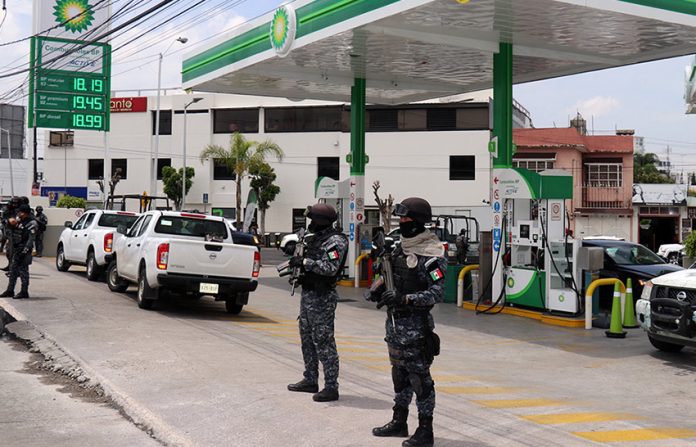
Police stand guard at a BP gas station in Puebla.

In an unprecedented move the federal consumer protection agency (Profeco) requested support from the Federal Police to carry out an operation in Puebla this week that resulted in the closure of pumps at two gas stations.

Profeco said in a statement issued yesterday that it resorted to asking the security force’s National Gendarmerie for backup due to repeated refusals from two gas station owners to allow their pumps to undergo calibration checks, which are required twice annually.

At about 11:00am Tuesday, Profeco officials arrived at a British Petroleum (BP) station located in the Santa Cruz Los Ángeles neighborhood of the state capital where they closed five of 18 pumps.

Four of the pumps were closed due to fuel leaks while the fifth was shut down because of “clear defects,” the agency said.

Hours later, Profeco shut down all 20 pumps at a Pemex station in the La Libertad neighborhood of the city.

At that station, the agency said, none of the pumps was displaying valid calibration certification.

The statement also said that staff refused to grant access to Profeco officials to conduct inspections in other areas of the gas station despite the presence of the gendarmerie forces.

BP responded to the closure of its pumps by saying that it was working as quickly as possible to resolve the issues detected by authorities.

The company also said in a statement that its Santa Cruz Los Ángeles station would continue to operate as normal and reiterated its commitment “to providing quality service to Mexican consumers and complying with the obligation of selling fuel in the correct way.”

Profeco said in its statement that in accordance with reforms to federal consumer law promulgated by the current government, it has the power to apply measures in order to “coercively enforce its requirements or decisions,” which includes requesting the assistance of security forces.

Until this week the agency had never called for backup from police.

A report released in April said that 21 Pemex gas stations were closed in Puebla last year because they were selling stolen fuel, known colloquially as huachicol.

The central Mexican state, and in particular the region known as the Red Triangle, is a hotbed of petroleum theft from state-owned pipelines, a crime which the Pemex CEO said in April costs the company 30 billion pesos a year (US $1.5 billion).

Source: El Popular (sp), e-consulta (sp), Milenio (sp)

Parents’ group criticizes sex education content in textbooks

0
'How to make love:' some parents aren't happy with new textbook material.

A parents’ group has accused the federal government of attempting to indoctrinate children through sexual education content in new textbooks for first-year middle school students.

The National Parents Union (UNPF) also charged that the government wants to “control” children’s consciences and said that any sexual education provided to students should have a “transcendental” or spiritual component.

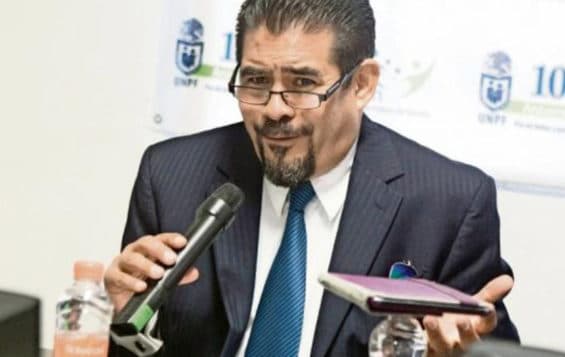
At a press conference yesterday, UNPF president Leonard García Camarena called into question the members of an expert group who were responsible for reviewing the content of new biology textbooks that will be distributed to students free of charge at the start of the 2018-19 school year.

“We’re complaining about things that don’t have any scientific proof, about the ideological baggage [of people] who, hiding in the offices of the state, want to indoctrinate our children . . .” he said, warning that the group was organizing across the country to stop that happening “without our consent.”

Criticizing the government of the day is not new for the conservative parents’ group.

In March 1975, the New York Times reported that the UNPF had charged that children were being indoctrinated in Marxist-Leninist ideology and “abnormal” sexual views through content in social and natural sciences textbooks.

Yesterday García said giving information to teenagers about contraceptives and other sexual education was like providing them with alcohol and paying for a motel room.

“If a family wants to give the pill and condoms [to their children], if it asks the government to be progressive and not just give them those things but also a six-pack [of beer] and a night in a motel, it’s that family’s problem but respect the judgement of the rest of us . . .” he said.

The newspaper El Universal reported last week that among the things that first-year middle-school students will learn about via new biology textbooks are that there are people with different sexual identities, and gay, bisexual and transsexual communities.

It also said the books contain information about sexual and reproductive rights as well as content relating to self-exploration of one’s own body.

In response to the UNPF’s criticism, the federal Public Education Secretariat (SEP) said in a statement that all the sexual education content in the textbooks was provided from an educational perspective within “the framework of sexual and reproductive health and human rights.”

García speaks at yesterday's press conference.
García speaks at yesterday’s press conference.

SEP added that the aim of the content is to avoid sexually-related “fears, blame, false beliefs, coercion, discrimination and violence” among young people.

The books also take into consideration the constitutional rights of children to education, the department said.

The SEP also pointed out that sexual education is particularly important given that Mexico has the highest teen pregnancy rate among the member countries of the Organization for Economic Co-operation and Development (OECD) and because of the risks associated with contracting sexually transmitted infections.

In addition, it said the Federal Education Authority has the sole power to prepare, update and edit the government-sanctioned textbooks and added that it was ultimately up to teachers to decide what books they will use with their students.

Source: El Universal (sp), Excelsiór (sp)

Illegal fireworks makers outnumber the legal ones in Tultepec

0
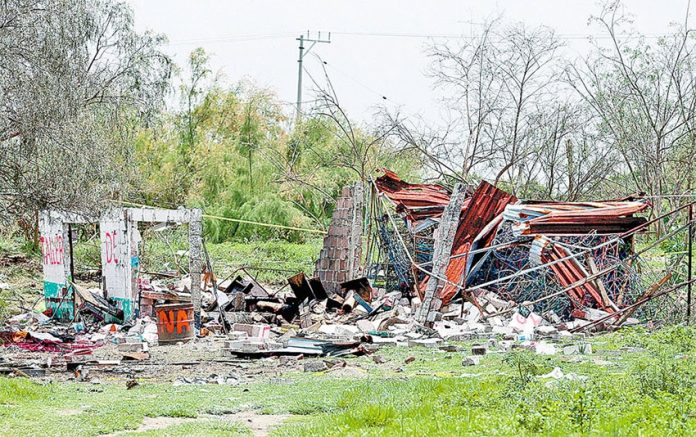
Scene of a fireworks explosion this week that left one person dead.

In Mexico’s self-declared fireworks capital, illegal manufacturers and vendors of the explosives dominate the local industry, increasing the risk of tragic accidents, according to a municipal government official.

Juventino Luna, director of artisanal development and pyrotechnics in Tultepec, México state, told the newspaper Milenio that local authorities know of around 700 fireworks-related businesses that are operating unlawfully in the municipality.

In contrast, those with official permission to make and distribute the explosives — which is granted by the federal Secretariat of Defense (Sedena) — number just 585.

Since an explosion in Tultepec’s San Pablito market in December 2016 that left 42 people dead, Luna said that there have been a further nine fireworks accidents, mainly at workshops without Sedena authorization.

For that reason, the municipality is lobbying higher authorities for the power to regulate the industry at a local level.

Luna said right now all the municipality can do is “raise awareness” about the dangers of making fireworks and “carry out campaigns” aimed at dissuading people from making and storing the explosives at their homes or transporting them without the relevant licenses.

The dangers of fireworks were again brought into sharp focus when more than 500 people were injured during Tultepec’s annual fireworks fair in March while an explosion at a fireworks workshop in the city earlier this month killed seven.

On Monday of this week, another workshop blast left one person dead and a further eight with injuries.

Although that workshop had permission from Sedena to operate, Luna said the incident shows that “human error” can still lead to accidents, although he added that “the risk is less.”

The official pointed out that the manufacture and distribution of fireworks is the most important economic activity in the municipality and estimated that 30% of local families depend on it for their livelihood, further underscoring the need for regulations at a local level.

Meanwhile, the leader of a fireworks merchants’ union at the San Pablito market said that a new market will open in August, one that was specifically designed to prevent a another disaster similar to the 2016 tragedy.

Germán Galicia said that shops within the new market are made out of reinforced concrete while it also has built-in security features such as firewalls and lightning rods.

“The stores are a little bit smaller to avoid excess storage [of fireworks and] between every establishment there are air pockets measuring 60 centimeters so that in the case of a fire it doesn’t spread from store to store,” he added.

The state government contributed 35 million pesos (US $1.7 million) for the construction of 150 stores within the market while the Tultepec municipal government chipped in seven million pesos (US $346,000) towards building its 150 other stores.

Source: Milenio (sp)

Researcher develops process that converts waste into livestock feed

0
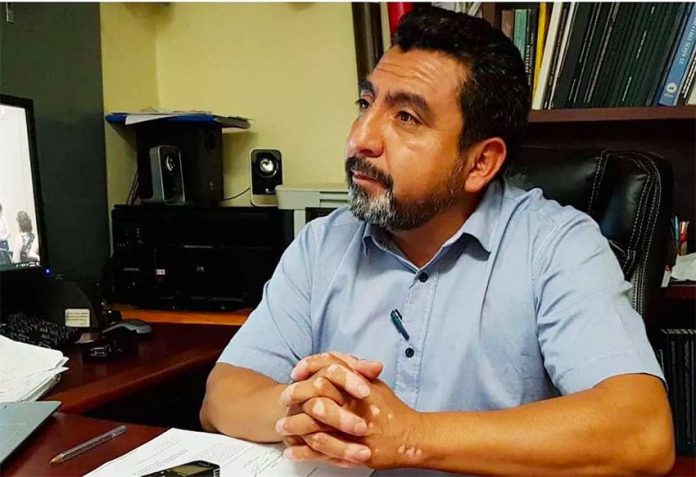
Hernández: from fruit waste to livestock feed.

In Oaxaca, they’re obtaining livestock feed from organic waste.

The project that converts fruit waste into feed is the result of three years of research and development led by Jorge Hernández Bautista at the Benito Juárez Autonomous University of Oaxaca (UABJO).

Hernández’s raw material are the peelings and other fruit waste discarded by juguerías, or juice stands, located in the wholesale Central de Abastos market in Oaxaca city.

Every morning he visits three of the establishments to gather the fresh waste before it starts fermenting. Back in his lab, he dries it and gives it a protein treatment.

Hernández can obtain 300 grams of feed for sheep out of every kilogram of organic waste. So far, he has taken 15 tonnes of what would otherwise become smelly garbage and obtained a nourishing source of food for animals instead.

“Everybody wins with this process: juguería owners save what they spend to get the garbage truck to collect their waste, others can even start dehydrating it themselves and selling the waste at up to two pesos per kilogram,” said the researcher.

There’s also the benefit of keeping this waste from ending up in open-air landfills, where it becomes yet another source of pollution.

Hernández’s sheep feed is also advantageous for livestock breeders: regular feed costs five pesos per kilo, but his product is 50 centavos cheaper.

Along with being more affordable and nourishing, it can also produce a carcinogenic-free meat, he claimed.

Hernández explained that the high antioxidant content of jugería waste can counter the high levels of free radicals found in meat.

His project was presented last month at a meeting of the Latin American Association of Animal Production (ALPA) in Ecuador, where it obtained international recognition.

Source: Milenio (sp)

One of FBI’s most wanted captured in Michoacán

0
El Tablas, one of 10 most wanted in US.

One of the 10 most wanted men in the United States was arrested yesterday in Uruapan, Michoacán.

Eduardo Ravelo Rodríguez, known also as Richolm and El Tablas among other aliases, was apprehended by federal officials along with three of his collaborators. The men were carrying several firearms and an undetermined amount of methamphetamine at the time of their arrest.

The government of the United States has a standing extradition order against him for racketeering, money laundering and conspiracy to possess heroin, cocaine and marijuana for the purpose of trafficking.

He is also wanted for numerous murders in Ciudad Juárez, Chihuahua. His criminal activities are alleged to have begun in 2003. In 2008 and 2011, Ravelo was indicted in the United States District Court, Western District of Texas.

Ravelo has been singled out as one of the founding leaders of the Barrio Azteca transnational gang, with an area of influence extending to the cities of El Paso, Texas, and Ciudad Juárez. More recently, the criminal organization is said to have extended its activities into Michoacán.

Barrio Azteca is believed to maintain close ties with Línea gang, considered to be the armed branch of the Juárez Cartel. That organization is embroiled in a years-long violent turf war with the Sinaloa Cartel.

The FBI posted a reward of up to US $100,000 last year for any information leading directly to the arrest of Ravelo. At the time, it warned that Ravelo was considered armed and extremely dangerous.

Source: Milenio (sp)

Mexico loses to Sweden 3-0 but advances after Germany’s defeat

0
Goalkeeper Ochoa during this morning's game.

Mexico has qualified for the second round of the soccer World Cup in Russia despite losing 3-0 to Sweden in its final group match today.

The national team known as El Tri finished second in group F behind Sweden due to an inferior goal difference although both sides finished on six points with two wins and one loss apiece.

Mexican fans, both at the stadium in Ekaterinburg and back home, endured a highly anxious last few minutes of the match as attention turned to the result of the group’s other final match, which was played simultaneously between defending champions Germany and South Korea.

A draw in that match would have been enough for Mexico to advance but with the score locked at 0-0 until injury time started, there were fears that the Germans could score a late goal and edge Mexico out of the tournament due to a superior goal difference.

But in the end it was Korea that surprised with a goal in the 92nd minute of the match before following up with a second in the 96th minute to well and truly secure Mexico’s path through to the round of 16 and send the Germans packing.

Social media quickly filled up with memes and posts praising South Korea for its victory and thanking the team for helping secure Mexico’s passage through to the next round of the World Cup.

Scores of social media users declared their love for the East Asian nation and many Mexico City residents suggested going to the Zona Rosa district of the capital — where the city’s Korean community is centered — to show their affection and gratitude to the citizens of many Mexicans’ new favorite country, at least for today.

El Tri will now play the winner of group E which, depending on results in the two matches to be played later today, could be Brazil, Switzerland or Serbia.

The 3-0 loss to Sweden will no doubt serve as a wake-up call for El Tri’s Colombian coach Juan Carlos Osorio and his players after they enjoyed a dream start to the tournament with victories over Germany and South Korea in their first two matches.

After a scoreless first half today, Mexico conceded its first goal in the 50th minute of play before goalkeeper Guillermo Ochoa’s defenses were broken twice more in the 62nd and 74th minutes.

The second goal came via a penalty after the referee ruled that a Swedish player had been fouled in the penalty area. Sweden’s captain Andreas Granqvist made no mistake from the spot, drilling the ball into the back of the net.

The third and final goal was an own goal after the ball deflected off the leg of Mexican defender Edson Álvarez and past Ochoa into the goal. Mexico had 20 shots of its own during the match but only three were on target.

Following the conclusion of the match, Mexico’s players and support staff gathered in the middle of the pitch and after the conclusion of the Germany-South Korea match a couple of minutes later, it was confirmed that El Tri would live to play another day at Russia 2018.

While celebrations were muted among the players, there can be no doubt that the relief for them — and the team’s millions of supporters — was enormous.

Mexico’s fans in Russia can go ahead and book their accommodation in the southwestern Russian city of Samara, where Mexico will take on its round of 16 opponent on July 2, while those back home will no doubt be once again glued to their screens.

Mexico News Daily

Ballots stolen in Tabasco, Oaxaca; some polling stations at risk

0
Election materials ready for shipping to polling stations.

Thousands of ballots for Sunday’s elections have been stolen over the past two days in separate incidents in two southern states.

In Tabasco, a total of 11,025 ballots were stolen Monday in the municipality of Macuspana, state and federal electoral authorities said.

A truck parked across a highway near the community of San Antonio forced a vehicle carrying personnel from the National Electoral Institute (INE) to stop.

At the same time, armed civilians arrived in a pick-up truck and proceeded to steal the packets containing the ballots.

State INE official María Elena Cornejo Esparza said one of the INE personnel was treated later at a hospital for fright.

Of the stolen ballots, 6,615 were for state elections including 2,205 for the gubernatorial contest, while the other 4,410 were for federal elections, including 1,470 for the presidential race.

Cornejo said the robbery was an isolated incident and one that doesn’t place elections in Tabasco at risk, but explained that security for INE officials transporting ballots would be beefed up to avoid a repeat of similar incidents.

In Oaxaca yesterday, more than 8,000 ballots were stolen and burned in the Coast region on a road leading to the municipality of San Juan Quiahije.

State electoral authorities said officials were delivering ballot packets to Mixtepec when their vehicle was intercepted by a group of unidentified individuals. The officials were unharmed but 8,204 ballots were destroyed. All corresponded to local elections and were destined for polling stations in three municipalities.

In a statement, the Oaxaca Electoral Institute said it would carry out “the steps and actions necessary so that the burned ballots are reprinted” in a timely manner in order to guarantee citizens’ right to vote.

In addition to ballot theft, electoral authorities are also facing problems installing voting booths in some other parts of the country.

An electoral councilor and the president of the INE’s organization and training committee said Monday there is a risk that around 100 polling stations may not go ahead due to social conflict.

“The number [of voting booths with problems related to their installation] has increased but it’s not something that places any of the elections at risk. It’s a recurring problem in every electoral process. We’re talking about around 100 [booths] out of 157,000,” Marco Antonio Baños said.

However, he stressed that it was not organized crime or violence that were causing the problems.

Instead, regular crime and dangers such as being bitten by a dog were hindering the process of setting up the voting booths, he said.

“Fortunately, violence hasn’t created a situation that has impeded the formation of voting booth committees . . .” Baños said.

Millions of voters will go to the polls Sunday in Mexico’s largest ever elections with thousands of municipal, state and federal-level positions up for grabs.

Source: Milenio (sp), El Universal (sp)

Oaxaca student awarded doctorate in chemistry by MIT

0
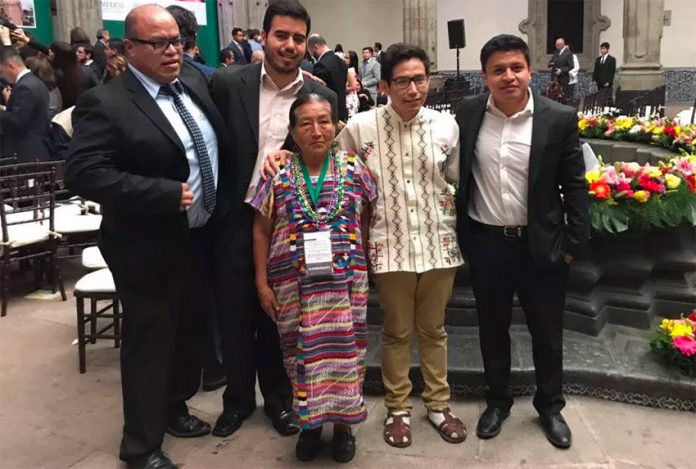
Pablo, with his trademark sandals, and his mother at his graduation.

An indigenous student from a poor region of Oaxaca has been awarded a doctorate in theoretical chemistry by the Massachusetts Institute of Technology.

Ricardo Pablo Pedro, 27, was born to an indigenous Chinantec family in the small town of La Mina, Tuxtepec, where his early years were marked by poverty and discrimination. But those obstacles were never enough to stop from achieving his goal: obtaining a doctorate from a foreign school.

After obtaining a full scholarship and studying for six years at MIT, that dream has come true.

“My mother always told me that education was the only thing that would get me going forward, and I understood there was a reward if you made the effort,” Pablo told the news agency Conacyt Prensa last year.

His mother traveled to the United States for her son’s graduation ceremony in May, where Concepción Pedro proudly wore the traditional huipil, a common garment among the women of the Cuenca region of Oaxaca.

And her son wore his sandals, which had in the past earned him the discriminatory label, “indio huarachudo,” or sandal-wearing Indian.

Pablo plans to dedicate the summer months to finish several research projects, after which he wants to enroll in a post-doctorate course and later, perhaps, teach at MIT.

In 2017 he was awarded the National Youth Prize by the Mexican government.

Source: El Universal (sp)

Geothermal a superpower in Mexico’s energy potential

0
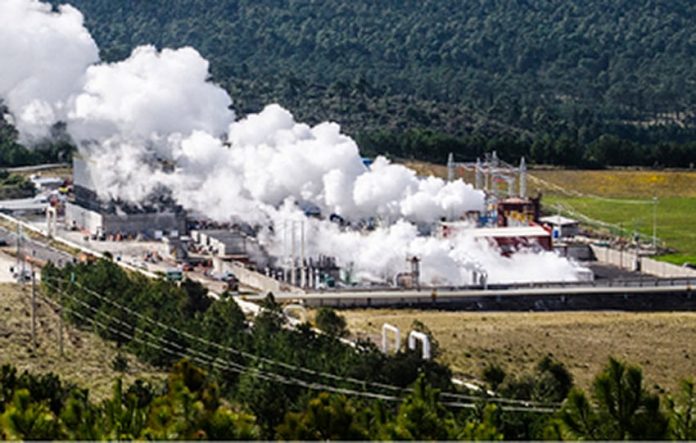
A geothermal power plant.

The capacity to generate geothermal energy is a veritable superpower within Mexico’s enormous energy potential but a significant barrier stands in the way of reaping its rewards: exploiting it is very expensive.

However, a New Zealand company that specializes in developing technologies to overcome earth, environmental and energy challenges is helping Mexico achieve that potential.

Since its creation in 2004, Seequent has developed a close relationship with Mexico and in April this year the company hosted the country’s ambassador to New Zealand at its Christchurch headquarters.

“Mexico is embracing the importance of developing geothermal, not just as an energy replacement source, but to future-proof base load energy needs for the future,” company CEO Shaun Maloney said in a statement issued after José Gerardo Traslosheros’ visit.

“Mexico is one of our fastest growing markets and represents a great opportunity as the world’s 13th largest economy. We’re continuing to invest in people and skills in the region,” the statement said.

Maloney subsequently told the newspaper El Financiero that Mexico has a source of energy under the ground that is “constantly flowing.”

However, he added that “to drill a hole for thermal energy, it costs around US $10 million and if you dig in the wrong place, you lose it all.”

Those high costs have held Mexico back from further exploiting its thermal capacity despite the introduction of the 2014 energy reform which enabled foreign and private companies to enter the Mexican market.

In fact, Mexico slipped from being the world’s fourth largest geothermic energy producer in 2014 — behind only the United States, the Phillipines and Indonesia — to sixth place last year with Turkey and New Zealand moving into fourth and fifth places respectively.

Beyond meeting the high costs, Seequent’s geothermal energy business manager said during the meeting with Ambassador Traslosheros that the biggest challenge for Mexico is to encourage investment by better explaining what geothermal energy involves.

“The resources exist but people need more information in order to support the development of these kinds of projects,” Jeremy O’Brien said.

However, he added that “we’re already working with some of the largest geothermal companies and look forward to supporting the development of new geothermal assets to add capacity in Mexico.”

To identify those assets before the expensive drilling process takes place, Seequent has developed a solution for understanding, visualizing and communicating ground conditions in the form of a 3D subsurface modeling software program called Leapfrog Works.

The software eliminates the risk of undertaking expensive exploratory drilling without reward.

The company’s innovativeness in the geothermal energy sector has translated into collaborations on projects around the world that account for 40% of the planet’s entire capacity to generate the renewable power.

However, in Mexico mining remains the company’s biggest business.

“We have a long link with Mexico. Mining operations in Mexico are great adopters of innovation and were among the first supporters of our software globally,” said Nick Fogarty, Seequent’s general manager for mining and minerals.

The company is already working with a range of private energy and mining companies in Mexico as well as the state-owned Federal Electricity Commission (CFE).

At the April meeting with Sequent, Traslosheros said that “Mexico is responding to global energy challenges by developing new renewable energy sources,” adding that “in terms of geothermal energy, we already have a number of geothermal power stations, and new developments are under way.”

Source: El Financiero (sp)

Borough offices still abandoned 15 years, 99 million pesos later

0
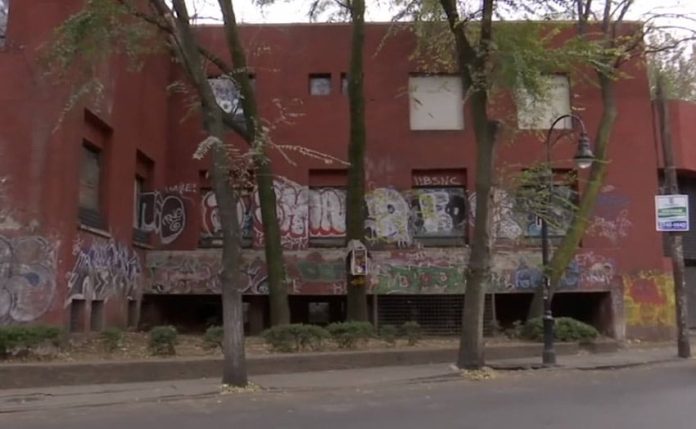
The abandoned building that was to have housed borough offices.
The abandoned building that was to have housed borough headquarters.

A property earmarked to become the main office for the government of the Mexico City borough of Coyoacán continues to lie abandoned 15 years after it was purchased for more than 99 million pesos.

Neither permission to change the permitted land use nor urban development approval to convert the property for its originally intended residential purpose have ever been granted, according to a report published today by the newspaper Milenio.

In addition, residents of the San Lucas neighborhood of Coyoacán — where the property is located — have opposed the project.

The building and land, with an area of more than 10,000 square meters, were bought during the administration of former Coyoacán borough chief María Rojo e Incháustegui for just under 99.4 million pesos (just under US $5 million at today’s exchange rate) in 2003, which Milenio said was more than double the property’s real market value.

Rojo — who is aiming to once again head up the Coyoacán government by contesting Sunday’s election as a Morena party candidate — reportedly sought the assistance of then-Mexico City government secretary, Alejandro Encinas, to speed up the bureaucratic process required to complete the purchase.

According to Milenio, Encinas and former finance undersecretary Gustavo Ponce — who was later jailed for 10 years for embezzlement of government funds — signed off on the allocation of resources and the property was paid for via a cash deposit to a bank.

Shortly after the transaction was completed, the former borough chief, who is also well-known for her career as an actress, took leave from her position to contest the 2003 elections for Mexico City’s legislative assembly.

Both she and Ponce have been accused of pocketing the difference between the property’s purchase price and its actual value, and that Rojo had run for deputy in order to obtain the fuero, or immunity from prosecution.

Raúl Flores, who succeeded Rojo as borough chief, told Milenio that when he took office he had no choice but to scrap the plan to move the government’s offices.

“I had to cancel the project because it didn’t have the neighbors’ approval. In addition, the cost of fitting out the offices and moving everything cost more than what the borough could pay at the time,” he said.

“Money was needed that year to deal with flooding and they took money from us, on the part of Andrés Manuel López Obrador — the then-mayor — for the [elevated road project known as] the second story,” Flores added.

He also said there was a proposal to donate the property to the Hospital of the Blind but the idea was ultimately rejected by the administration of Mexico City mayor Marcelo Ebrard.

Milenio said San Lucas residents also lobbied Rojo before she left office to have the property donated in order to be converted into a cultural center but she declined the proposal.

Milenio sought comment from Rojo about the property and the transaction to acquire it but her campaign team responded that she had a full schedule and would be unable to speak on the matter.

A poll published by the newspaper El Financiero earlier this month showed that the Morena party candidate is on track to win the mayoral election in Coyoacán with 48% voter support.

A community representative from the San Lucas neighborhood said the property is “completely abandoned” and a source of insecurity for both residents and visitors to the borough.

“. . . But to the then-authorities it represented a 52-million-peso profit,” Elvira Rodríguez charged.

A visit to the site by a Milenio reporter confirmed that the property is in a state of complete abandonment with its facade covered with graffiti, 40 broken windows and a leaky roof among other problems.

Source: Milenio (sp), El Financiero (sp)