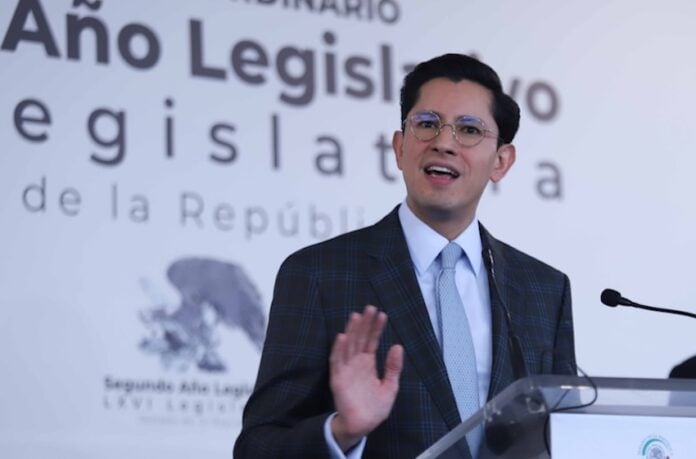
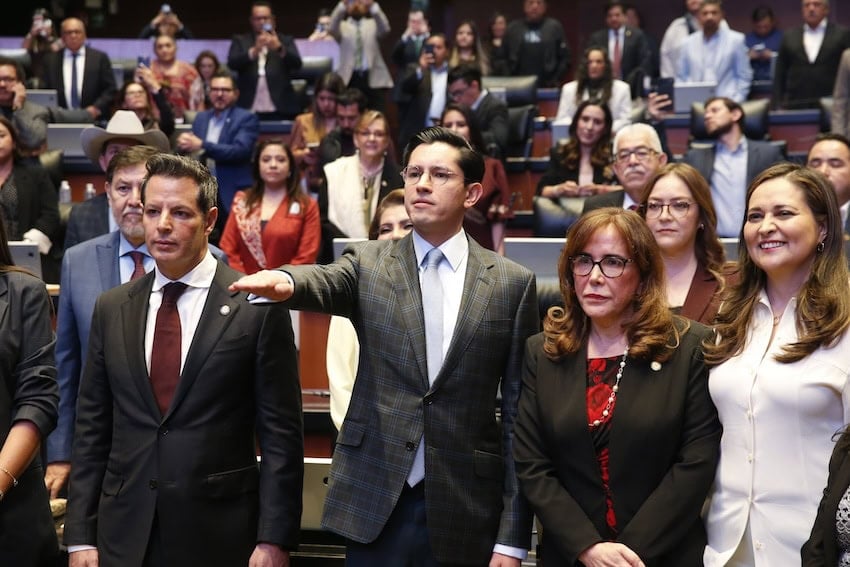
Roberto Velasco Álvarez is now Mexico's top diplomat, taking over from Ramón de la Fuente as foreign relations minister during an especially key period in U.S.-Mexico relations. (Graciela López/Cuartoscuro.com)
Just a day after the Senate confirmed his nomination as Mexico’s top diplomat, new Foreign Relations Minister Roberto Velasco Álvarez tackled his most important task — managing U.S.-Mexico affairs.
After his first working telephone call on Thursday with his counterpart, U.S. Secretary of State Marco Rubio, Velasco said the chat — which he termed “productive and cordial” — focused on the key bilateral issues of security and migration.
Roberto Velasco was officially sworn in Wednesday as Mexico’s top diplomat. Within 24 hours, he was on the phone with U.S. Secretary of State Marco Rubio. (Cuaroscuro.com)
Velasco told reporters that he and Rubio would work “to respect the principles agreed upon by both countries.”
Velasco acknowledged Rubio’s concerns, emphasizing “the importance of addressing the challenges of human mobility, while respecting the human rights of individuals.”
He takes over at a pivotal moment for regional trade as the three North American nations have begun a joint review of the U.S.-Mexico-Canada trade pact.
Velasco will also have to tiptoe around the constant threats made by U.S. President Donald Trump regarding military incursions into Mexico against drug cartels.
The treatment of Mexican migrants by U.S. authorities will also be a chief concern. On March 25, Velasco said Mexico will seek justice for the 13 Mexican nationals who have died while in the custody of U.S. immigration officials during the past 14 months.
The 38-year-old Mexico City native earned a master’s degree in Public Policy from the University of Chicago in 2017. While in Chicago, he was editor-in-chief of the Chicago Policy Review, a magazine published by students at the university’s Harris School of Public Policy, while also collaborating in the office of Chicago Mayor Rahm Emanuel.
Velasco returned to Mexico in 2018, joining Marcelo Ebrard’s staff when the current economy minister served as President Andrés Manuel López Obrador’s Foreign Relations minister from 2018 to 2023.
Before rising to the top spot, the new foreign minister managed diplomatic relations with the United States and Canada, serving first as the head of the North American unit (2020-2025) before becoming undersecretary for North America last year.
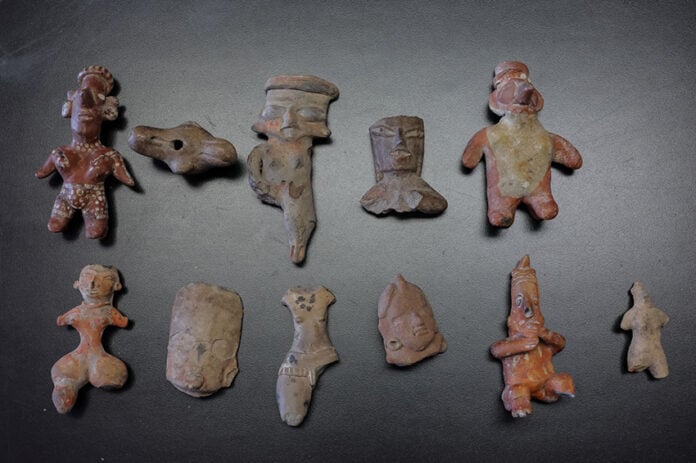
A selection of pre-Columbian artifacts recently repatriated to Mexico from the U.S., Canada, Argentina and France, part of Mexico's campaign to recover its cultural relics. (Gerardo Peña / INAH)
The Mexican government this week called for the suspension of the sale of four pre-Colombian figures from Mexico scheduled for auction on April 16 in Monte Carlo, Monaco. Mexico is now pushing for the artifacts’ repatriation to Mexico, part of a campaign to protect and recover archaeological pieces previously removed from the country.
In a statement addressed to the auction house Academia Fine Art, Culture Minister Claudia Curiel de Icaza said that after a thorough review of the auction catalog, the National Institute of Anthropology and History (INAH) identified that four of the the announced objects “are archaeological and historical assets that are part of the cultural heritage of the Mexican nation,” and are therefore protected under Mexican law.
Se han identificado cuatro piezas de origen mesoamericano en una subasta organizada por la casa Accademia Fine Art y que se llevará a cabo el 16 de abril de 2026 en Monte-Carlo, Mónaco.
— Claudia Curiel de Icaza (@ccurieldeicaza) April 8, 2026
“The Ministry of Culture appeals to ethics and respect for cultural heritage and calls for a halt to the offering and sale of these pieces, taking into consideration that they represent an invaluable legacy of ancestral cultures and national history,” Curiel said in the statement.
The auction house has not responded to Curiel’s call yet.
In the statement, Curiel added that Mexican authorities have started legal proceedings through official diplomatic channels in an effort to repatriate the pieces to Mexico, and called on the auction house to “join in the efforts of safeguarding cultural heritage.”
Mexico’s efforts to repatriate archeological pieces are part of a wider campaign known as Mi Patrimonio No Se Vende (My Heritage Is Not For Sale), a strategy that gained momentum during the administration of former President Andrés Manuel López Obrador. According to the Culture Ministry’s latest report, Mexico has recovered 3,716 pre-Hispanic pieces since 2024.
However, Mexico’s efforts don’t always bear fruit. In February, Casa Millon, an auction house in France, held a sale of 40 archaeological pieces of Mexican origin despite the fact that days earlier the Culture Ministry had initiated a process for repatriation.
The collection featured sculptures, ceramics, jewelry, goldwork and textiles of Mexican and Peruvian origin, among other cultures.
Meanwhile, Spanish newspaper El País reported the appearance of nearly 40 more pre-Columbian artifacts of Mexican origin in an auction catalog in Germany.
The Zemanek-Münster auction house in Germany will hold an auction of Mexican archeological artifacts, including pieces of Maya origin, with a starting price of 826,300 euros (US $965,123). Mexican authorities had yet to comment on that auction as of mid-day Friday.
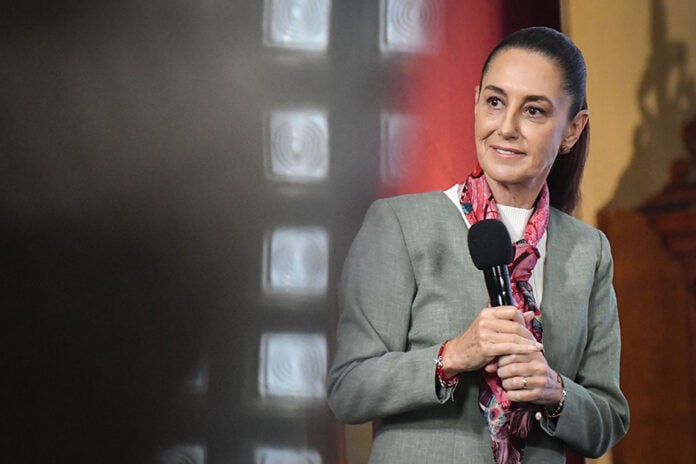
President Sheinbaum celebrated the approval of her "Plan B" electoral reform at her Friday presser, where she also shared positive tidings for Mexico's economy. (Mario Jasso / Cuartoscuro.com)
Sheinbaum’s mañanera in 60 seconds
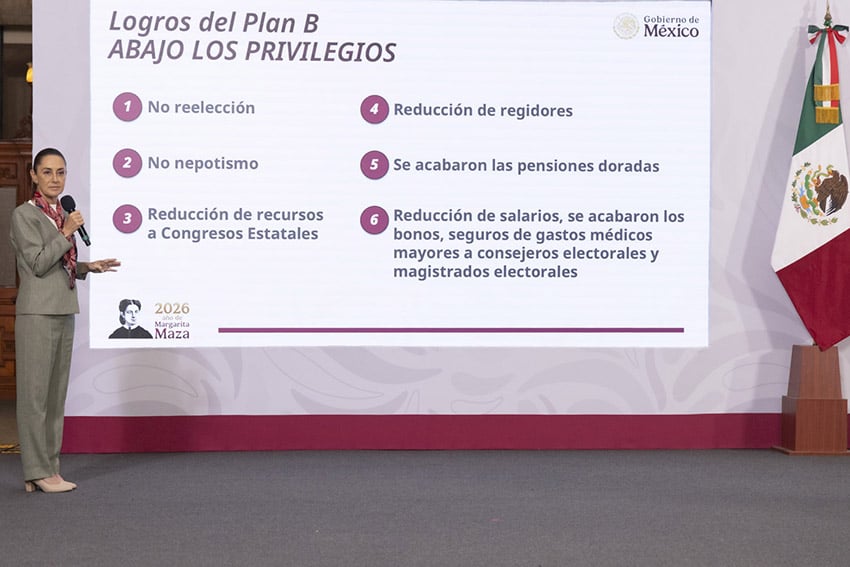
🗳️ Electoral reform now ‘constitutional’: Sheinbaum’s “Plan B” electoral overhaul has been ratified by a majority of Mexico’s 32 state legislatures, making it constitutional. The president highlighted six achievements to limit special privileges for politicians, including provisions related to nepotism and reelection, slashed legislative budgets, and the elimination of outsized pensions for former officials.
✈️ Barcelona bound: Sheinbaum revealed she’ll travel to Barcelona for an April 18 gathering of left-wing leaders. Expected attendees include the presidents of Colombia, Brazil and Uruguay, as well as Spain’s prime minister.
📈 The economy, a glass half full: Despite March inflation ticking up to 4.59%, Sheinbaum touted several bright spots — the peso at 17.26 to the dollar, a 9.3% annual rise in international tourist arrivals, a 2.4% uptick in light vehicle sales, and Mexico climbing six places to 19th on the 2026 Kearney FDI Confidence Index.
Why today’s mañanera matters
With five morning press conferences every week, President Claudia Sheinbaum and other federal officials have ample opportunity to tout government policies, programs and achievements.
On Friday morning, Sheinbaum highlighted that her “plan B” electoral reform is close to becoming law and outlined how it will reduce privileges for Mexican politicians and help to create a fairer electoral system. She also talked up the Mexican economy, although inflation is on the rise and growth has been anemic.
Friday’s mañanera was also noteworthy as Sheinbaum revealed that she will make her sixth international trip as president next week. The president is headed for Spain on a trip that will be her first beyond the Americas since she was sworn in on Oct. 1, 2024.
Sheinbaum: Plan B electoral reform is ‘constitutional’
“That means it is now constitutional,” she said, adding that the reform will now be certified by the Senate prior to promulgation via publication in the federal government’s official gazette.
Sheinbaum outlined what she called “six major achievements” of the “plan B” reform she submitted to Congress after her original proposal was rejected. However, some of the achievements she highlighted are in fact the product of separate reforms approved by Congress earlier in the year. Sheinbaum said that all the achievements fall under the “down with privileges” banner, specifically highlighting:
A “no re-election” provision that prevents politicians from serving consecutive terms.
A “no nepotism” provision that prevents relatives of politicians from seeking to succeed their family member.
A reduction of the budgets allocated to state legislatures and the federal Senate.
A reduction in the number of councilors in “a large number of municipalities.”
The elimination of “golden” — i.e. excessively generous — pensions for former officials.
The reduction of salaries and benefits for electoral councilors and electoral magistrates.
After her original electoral reform was rejected, the President proposed her “Plan B” reform, which includes several provisions related to reducing the privileges granted to politicians. (Carlos Ramos Mamahua / Presidencia)
Sheinbaum to travel to Spain next week
“I’m going to give you a story,” Sheinbaum told members of the press corps.
“I’m going to Barcelona,” she said, adding that she will travel to the Spanish city to take part in an event on Saturday April 18.
Sheinbaum said that she will attend a meeting with other “progressive” leaders who are part of a group that was formed by former Chilean president Gabriel Boric.
She said that “as far as we know,” President Gustavo Petro of Colombia, President Luiz Inácio Lula da Silva of Brazil, Prime Minister Pedro Sánchez of Spain and President Yamandú Orsi of Uruguay will attend the meeting in the Catalonia capital.
Sheinbaum said that her trip to Spain will be very short. “We’ll go one day and come back the next,” she said.
Sheinbaum didn’t specify what issues she and her fellow leaders planned to discuss in Barcelona.
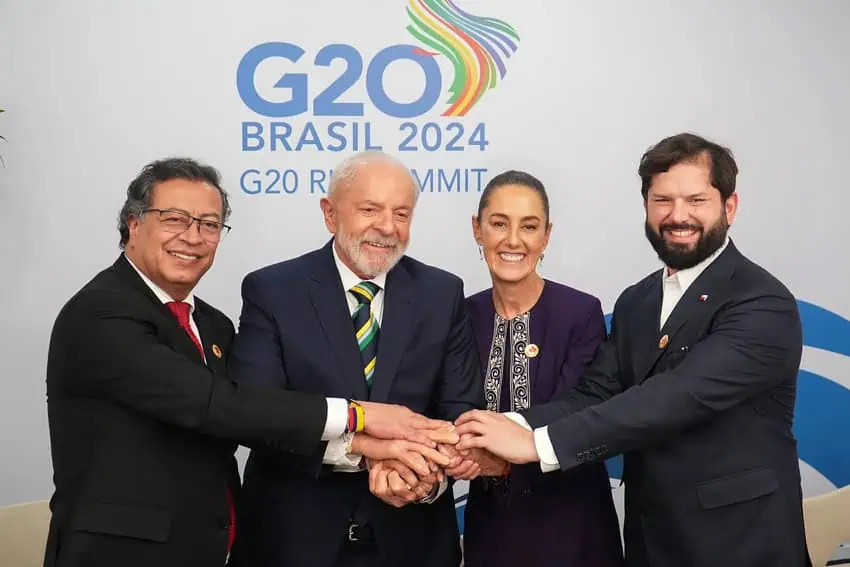
Chilean President Gabriel Boric, at right in this photo from the 2024 G20 Summit in Brazil, invited President Sheinbaum to join a meeting of progressive leaders in Barcelona next week. (Presidencia)
Four American and six Mexican border states form an economy worth roughly US $7 trillion: the third-largest on the planet. (Courtesy of the author)
I’m writing this text on a plane back from Ciudad Juárez (Chihuahua)-El Paso (Texas), to Mexico City. The U.S.-Mexico border phenomenon is something hard to cover in a few paragraphs, but I’ll give it a try.
The border is almost a country in and of itself. It has history, shared territory, culture, traditions and communities that long predate the line drawn on the map. Less than two centuries ago, all the lands that are now the U.S.-Mexico border states belonged to the same nation.
Together, those ten states (four American, six Mexican) form an economy worth roughly US $7 trillion: the third-largest on the planet, just behind China and nearly as big as the UK and France combined. In terms of population, the border region is home to more than 100 million people, more than Vietnam, France, Germany, the UK or Turkey; more than twice the population of Canada, Spain or South Korea.
For too long, the U.S.-Mexico border has been framed in mainstream media almost exclusively as a problem. The language is “crisis”: migration surges, drug trafficking, violence and political standoffs. Yet that narrative misses the deeper truth. This same border is the backbone of one of the world’s most integrated production systems. It is also the living proof of cultural fusion — where being American or Mexican blurs into something new: fronterizo. Not one or the other, but both.
Every day, more than two billion dollars in goods cross that line.
Cars assembled in North America crisscross it multiple times before rolling off the line. Agricultural supply chains stretch from Canadian prairies to Mexican fields to American supermarkets. What started as trade has quietly become continental co-production and social blending. I see more in common between a regio from Nuevo León and a Texan than between a regio and a yucateco — or between a Texan and a Californian, for that matter.
And yet the infrastructure and institutions governing the border still behave as if none of this integration exists.
I flew from Mexico City to Ciudad Juárez. A driver picked me up and took me to El Paso. Fortunately, she had the Secure Electronic Network for Travelers Rapid Inspection (SENTRI), a trusted traveler certificate that allowed us to go through the express line. It took us about half an hour from the start of the “express” line to the bridge, where I had to step out and walk across the bridge. In the end, it took me about 50 minutes to get to the U.S. once the line started. Unfortunately for my colleagues, they had no SENTRI, and they waited 2.5 hours in line to cross one of the three bridges connecting Juarez to El Paso.
The border runs on outdated procedures, fragmented data systems and physical inspections straight out of the last century. The result is a frustrating paradox: the production networks and societies that rely on it grow ever more intertwined, while the border itself stays slow, opaque and ripe for criminal exploitation.
We desperately need a smarter border.
Imagine one that works less like a wall and more like an intelligent filter — speeding up everything legitimate while surgically catching the bad stuff. The technology already exists: data analytics, real-time tracking, supply-chain transparency, smart infrastructure. Customs could run joint inspections and ditch the duplicative nonsense that inflates costs and kills just-in-time manufacturing. Trusted-trader programs (U.S. CTPAT, Mexico’s OEA; basically the SENTRI or Global Entry of trade) could become fully interoperable, letting certified shipments glide through dedicated lanes. A trilateral “single window” digital platform could replace mountains of paper with secure, risk-based clearance.
But real security can’t stop at the bridge. That’s where Mexico’s Safe Logistics Corridors idea shines. Certify not just the company and the cargo at the factory gate, but the entire route: from Pacific ports like Lázaro Cárdenas or Manzanillo, along guarded highways, through secure rest areas, all the way to the border. Digital tracking, coordinated patrols and real-time monitoring. At the crossing, that trusted status unlocks the fast lane. The whole journey becomes a secure, continental conveyor belt.
The payoff is huge. Legitimate trade flows faster and cheaper. Criminal networks lose their favorite blind spots — meaning better chances of stopping fentanyl heading north and firearms heading south. One smart system quietly chips away at three of the most toxic bilateral headaches at once: drugs, guns and irregular migration.
On my return trip from El Paso to Juárez, the bridge was almost empty. There was no passport check-in or visa check-out at the border; the crossing took minutes. The contrast was almost comical.
In the end, a smarter border isn’t about erasing lines or surrendering sovereignty. It’s about managing flows — of goods, people and ideas—with far more intelligence, coordination and earned trust. Prosperity, efficiency and security aren’t trade-offs here; they can reinforce one another if we let them.
North America already has the economic foundations of a true continental powerhouse, rivaling Europe’s integrated market or East Asia’s production networks. Yet our border infrastructure still feels stuck in the 1970s. If we project today’s problems eighty years forward without bold upgrades, they won’t magically disappear — they’ll multiply.
It’s been more than fifty years since the American Chamber of Commerce of Mexico (AMCHAM) last opened a chapter on Mexican soil.
Sitting in Juárez-El Paso, the case for doubling down on this region feels obvious, and I’m glad AMCHAM is spearheading its new Northwest Chapter. During my time at the border, I kept hearing businesspeople calling it “the world’s best-kept secret.”
It is time to break the news.
Pedro Casas Alatriste is the Executive Vice President and CEO of the American Chamber of Commerce of Mexico (AmCham). Previously, he has been the Director of Research and Public Policy at the US-Mexico Foundation in Washington, D.C. and the Coordinator of International Affairs at the Business Coordinating Council (CCE). He has also served as a consultant to the Inter-American Development Bank. Follow his Substack here.
Rafael Prieto-Curiel is changing how people view cartel violence in Mexico, and he's doing it through math. (YouTube)
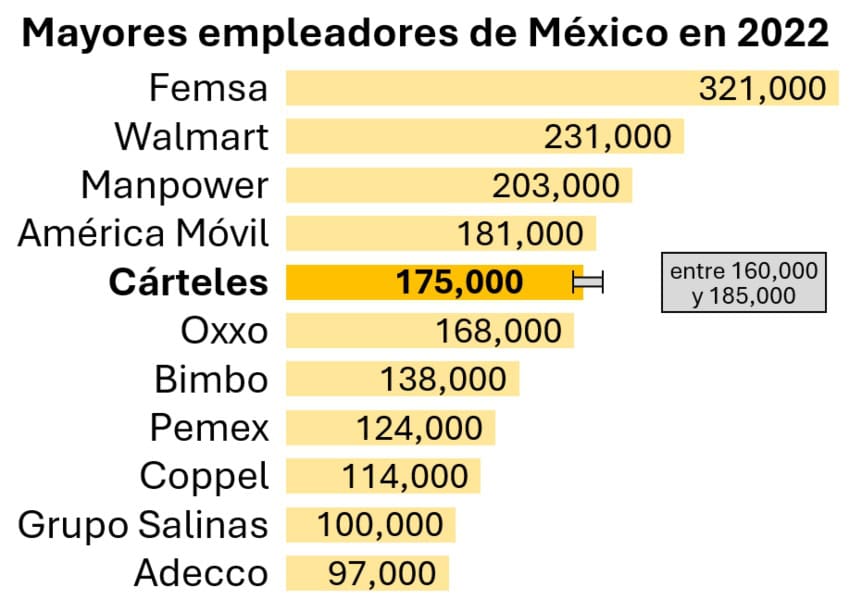
In 2023, three mathematicians conducted a modeling study on organized crime in Mexico. Cartels were treated as large-scale employers within an illegal labor market, recruits as employees. Their findings were concerning — according to their research, between 160,000 and 185,000 Mexicans worked for criminal organizations, making cartels the country’s fifth-largest employer.
The three authors concluded that in order to keep that workforce from collapsing, cartels need to hire roughly 350 to 370 new members every week, which they accomplished throughTikTok campaigns, video games and sheer force. Andrés Manuel López Obrador (AMLO), the country’s president at the time, publicly refuted the report, calling the findings “false” without providing any contradictory evidence.
Who were the biggest employers in Mexico in 2022? According to Rafael Prieto-Curiel, cartels likely had more employees than Oxxo, based on the statistical range his model claimed. (X, formerly Twitter)
A year later, one of those mathematicians, Rafael Prieto-Curiel, won Complexity Science Hub’s Science Breakthrough of the Year award. Using quantitative research, Prieto analyzed homicides, arrests and cartel behavior to determine that arrests alone will not lead to the demise of cartel networks. Putting a stop to recruiting, however, will. He and his collaborators built a mathematical model of around 150 criminal organizations, assigning each a set of members, alliances and rivalries. They then “played out” different scenarios such as killing or arresting leaders, fragmenting groups or cutting off new recruits.
Across thousands of simulations, the only strategy that consistently shrank manpower and reduced homicides was lowering recruitment. Even imprisoning or assassinating cartel kingpins mostly led to splinter groups and new waves of violence. But who is the man behind the model — and what made a Mexican mathematician decide to take on the cartels?
From finance to fighting cartels with math
Prieto-Curiel was born in 1987 in Mexico City. After attending ITAM (Instituto Tecnológico Autónomo de México) and an unfulfilling stint in finance, he landed a job with Mexico City’s police department. At the C5 emergency command and control center, he worked his way up to Director of Strategic Analysis.
At the time, Mexico City had 8,000 security cameras to cover about 80,000 city blocks — a low number, considering it’s now the most surveilled city in the Americas with more than 80,000 cameras. But it was never the number of cameras that mattered as much as who was watching them: in 2009, just a few dozen officers were tasked with monitoring 12 different screens at the same time, missing crimes as they happened.
To solve the monitoring gap, Prieto-Curiel compiled three years of crime records and built a model to predict where crime would likely take place and when. Operators could instead concentrate on high-risk areas, anticipating criminal activity and responding efficiently. According to his former boss, Alejandro Herrera Bonilla, “at the beginning of the program, we caught one criminal every day,” but after a year of running Prieto-Curiel’s model, they were stopping about 120 suspects each day, and decreasing response time from 17–20 minutes to just four.
Despite his success, something nagged at him. The surge in arrests did not make people feel safer. To understand why, Prieto-Curiel left Mexico to pursue a PhD in Applied Mathematics at University College London, digging deeper into statistics around crime, fear of crime and urban security.
According to mathematician Rafael Prieto-Curiel, stopping cartel recruitment is a crucially important factor in reducing violent crime in Mexico. (X, formerly Twitter)
Why feeling unsafe has nothing to do with crime rates
At UCL, Prieto-Curiel and Steven Bishop, a professor of nonlinear dynamics at University College London and co‑author on the fear‑of‑crime models, built a simulated city: thousands of virtual inhabitants living across neighborhoods of varying safety, each carrying a personal fear level that rose when they were victimized, rose again when they heard a neighbor’s story and faded slowly in the absence of new incidents. He then let those agents talk to each other — at home, at work and on the street — so that fear could spread socially instead of through direct experience.
The result was counterintuitive. When the simulation’s crime rate doubled, fear levels didn’t change. Nor did it change when crime levels were reduced. He determined that less crime didn’t automatically make people feel safe — supporting exactly what he saw in Mexico, where perceived insecurity has remained stubbornly high despite fluctuations in official crime data.
Prieto-Curiel went on to complete postdoctorate work at Oxford, analyzing crime and conflict in Africa, before joining the Complexity Science Hub in Vienna in 2022, where he now leads research on human migration and organized crime, consulting the OECD and the World Bank on urban and demographic analysis. It was exactly the kind of systemic thinking he would need when he turned his attention back to Mexico and its cartels.
Why more arrests mean more violence, not less
The model’s core finding tells us that doubling arrests doesn’t reduce violence. In fact, apprehensions largely increase it, because cartels simply recruit faster to replace their losses. In Prieto-Curiel’s projections, even prosecuting twice as many cartel members would still leave Mexico with more deaths in 2027 than today. In the most optimistic scenario, eliminating recruitment entirely, it would still take roughly three years just to return to 2012’s levels of violence, which were already high. (According to theMexico Peace Index, Mexico’s homicide and violent crime rates in 2011–2012 surged to their highest levels in at least a decade.)
In short, criminal organizations are massive and deeply integrated into Mexican society. By halving recruitment, Mexico would see a significant reduction in casualties and criminal activity. Which brings us back to AMLO’s fiery response (and subsequent failure to back up his claim with facts) — for a country that poured nearly all its security budget into military and police operations, Mexico is an awfully violent place. That same index calculates that the rate of overall peace has dropped 14% since 2015, with organized‑crime killings nearly tripling in a decade.
While the López Obrador and Sheinbaum administrations repeatedly tout falling homicide numbers, independent analysts and human rights groups see it differently. Mexico has racked up more than30,000 killings a year since 2018; AMLO’s term is frequently considered the most violent on record in absolute terms. The math, as they say, is not mathing.
What happens when the cartels find out a mathematician is watching?
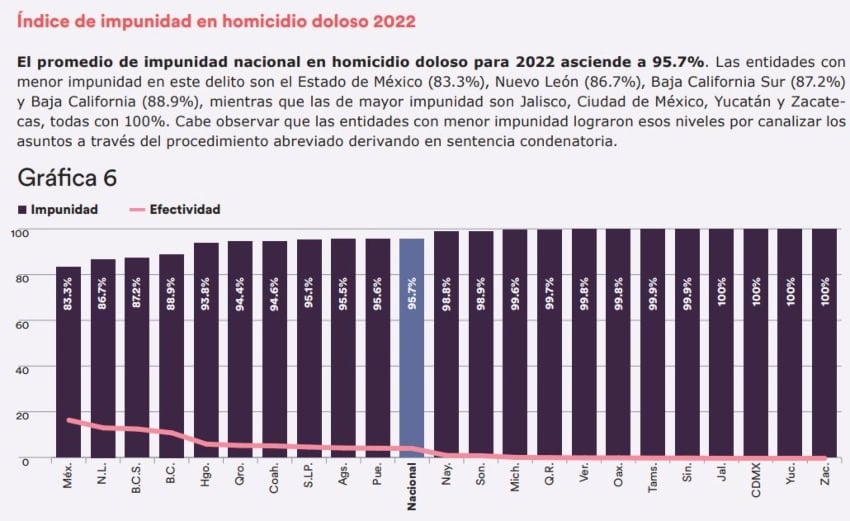
Few people are punished for violent crime in Mexico, as Prieto-Curiel shows with the red line in this “impunity index.” In 2022, for example, not one person was convicted of a homicide in Mexico City. (X)
His mother wasn’t happy when he joined the Mexico City police, let alone when he went on to research organized crime. He kept going anyway, driven, he has said, by “the love of science and for the love of his country.” The possibility of threats from the cartels themselves looms at the back of his mind — a fear few mathematicians ever have to reckon with — but Prieto-Curiel remains determined to use his skill set to benefit society.
Here is a Mexican mathematician with an equation that could reduce violence, save lives and, in an ideal world, exterminate organized crime. What happens if Mexico finally follows the math?
Bethany Platanella is a travel planner and lifestyle writer based in Mexico City. She lives for the dopamine hit that comes directly after booking a plane ticket, exploring local markets, practicing yoga and munching on fresh tortillas. Sign up to receive her Sunday Love Letters to your inbox, peruse her blog or follow her on Instagram.
Regenerative tourism in Mexico might appear, at first glance, like the ideal solution to environmental and social challenges — but is it really, though? (Elizabeth Ruíz/Cuartoscuro)
Last year was historic for tourism in Mexico. According to theMinistry of Tourism’s latest figures, 2025 closed with record numbers, thanks to the arrival of more than47.8 million international tourists. This translates, according to the Ministry, to a 6.1% increase compared to last year — the highest this century.
The figures were so impressive that the Secretary of Tourism, Josefina Rodríguez Zamora,stated in a press release that “Mexico is entering 2026 with a strengthened and competitive tourism sector, firmly positioned to capitalize on major international events.” And this could be a perfect opportunity for the federal government, on the eve of the2026 FIFA World Cup.
Regenerative tourism implies making a lasting contribution to the workforce, economy and communities of the destinations we choose to visit. (Salomon V/Pexels)
However enthusiastic we might feel about these figures, these activities have had an undeniable social, economic and environmental impact. Enter regenerative tourism, the even more enthusiastic approach to dealing with the challenges that this growth entails in Mexico.
What is regenerative tourism, exactly?
First of all, regenerative tourism is more than simply refraining from littering the streets of the cities we visit. The Global Sustainable Tourism Council (GSTC) considers this a broader and more holistic travel practice.
Following the GSTC’sdefinition, regenerative tourism “seeks to leave destinations in a better state than they were found.” This new perspective draws inspiration from regenerative agriculture, a contemporary practice focused on restoring native ecosystems.
Beyond merely minimizing harm, such as polluting the Bacalar Lagoon with sunscreen, this practice aims to increase “positive impacts alongside reducing negative ones,” as outlined in the GSTC Criteria. This translates to contributing to the workforce, economy and communities of the destinations we choose to visit — and not just avoid harming their natural environmentsor disregarding their customs to favor our own.
So no, regenerative tourism does not aim to generously tip your local waiters or restaurant owners. It’s way more than that. Lethabo-Thabo Royds, content program coordinator at the World Travel & Tourism Council,thinks of this newtravel approach as “the next step in our sustainable travel journey,” given that “as travelers, we have a huge impact on the world around us.”
Regenerative tourism vs. sustainable tourism: key differences
Regenerative tourism has received a heavy wave of criticism due to its lack of applicable and concrete guidelines, as the GSTCacknowledges. Not only that. It seems that this new approach to travel has had no substantive change or positive impact on local communities and businesses. That’s why, too, the term is often misused or confused with the so-called “sustainable tourism.”
Regenerative tourism “seeks to leave destinations in a better state than they were found,” says the GSTC. (SICULA Đỗ/Pexels)
Sustainable tourism encompasses practices that promote sustainability across the industry. It is defined as “tourism that fully considers its current and future economic, social and environmental impacts, while addressing the needs of visitors, the industry, the environment and host communities.”
Regenerative tourism, however, focuses mainly on restoration. It not only aims to avoid harm, but to “create the conditions for life to thrive,” as explained by theBBC’s Tourism Sustainability Network.
To ensure long-term viability, the GSTC proposed the three Ps: People, Planet and Profit, referring to the positive impact tourists could have on communities, the environment and local businesses alike. There are now global certifications that massive hotel chains can apply to — if they comply with certain guidelines.
Beyond pretty certificates … can tourism really restore living conditions in host countries, like Mexico?
A postcolonial point of view in the Mexican context
Last year, a reader wrote a fantastic comment inone of my travel articles, pointing out that it promoted “gentrification and the continued displacement of Mexican people.” Honestly, I can’t blame them.
We’ve already established regenerative tourism’s intent “to leave things better than they were.” Now, were things “bad” or “wrong” as they were? Andrey Núñez Kozlova, human rights specialist at UNAM, thinks otherwise.
Can tourism really restore — or even better — life conditions in the host countries? (Mark Neal/Pexels)
Despite Royds’s enthusiasm, there is arather sinister side to these allegedly “restorative” practices. Núñez has dedicated his doctoral studies to the postcolonial theory, which, in a nutshell, denounces the abuses of the West — understood as the hegemonic power — over everything it considers exotic and foreign.
How does this apply to regenerative tourism? Núñez thinks this fits “with the colonial mindset,” given that “massive hotel companies are mowing down the jungles of Southeastern Mexico.” These activities have way more impact than those that could possibly be done by individuals. “This is nothing compared to what the government and its institutions can do,” the human rights specialist told Mexico News Daily in an interview.
The road paved by good intentions
Moreover, there’s a problematic innuendo to these practices. “It is as if tourists from the global north came to teachus (locals) how to behave and take better care of our own resources, when the Indigenous populations have been the ones to safeguard them.” Delving deeper into this, Núñez thinks that this way of thinking suggests that the individuals are to blame, while “disregarding the root problem.” Namely, a healthier public policy that addresses the human and environmental rights of communities that receive tourism in Mexico. “Problems regarding deforestation and corruption should be matters that are resolved locally, by strengthening democracy.”
Don’t get me wrong. Tourism is a fundamental pillar of the Mexican economy, directlyemploying nearly 5 million people and contributing approximately 8.7% to the national GDP. Not only that, but this industry is the leading employer of young people and women in the country, making its economic and social importance undeniable. But not everything is flowers and rainbows when it comes to tourism in Mexico.
However, seen in this light, regenerative tourism might seem like an easy, almost palliative, way out for complex power structures at play. “The road to Hell is paved with good intentions,” concludes Núñez Kozlova.
PUERTO ESCONDIDO, OAXACA — Civil Protection authorities successfully captured and relocated a 300-kilogram, 3-metre crocodile from Bacocho Beach Monday after the animal alarmed tourists by being present in a coastal lagoon system it has occupied, along with its ancestors, for approximately 74 million years.
The crocodile, described by authorities as posing “a real threat to humans,” was found stationary on the beach after being displaced by a swell event. It had not approached anyone. It had not displayed aggression. It was, by all available evidence, simply there, which is something it and its predecessors have been doing in this specific coastal area since before the Gulf of Mexico had its current shape, before the Sierra Madre existed in its present form, and before the resort infrastructure of Puerto Escondido was developed in the 1970s, which is when the humans arrived.
Bit unfair to do this when he was here first. (Facebook)
Civil Protection personnel captured the animal, confirmed it had no injuries, loaded it onto an ATV, and transported it to Lagunita de Punta Colorada, a lagoon authorities described as “suitable within the crocodile’s habitat,” which is a description that also applied to Bacocho Beach, where it was before the tourists were there, and to every other body of water along this stretch of Oaxacan coast, where it was also before the tourists were there.
The tourists returned to the water following the crocodile’s removal.
Authorities confirmed surveillance operations are ongoing to ensure beachgoers’ safety. They did not comment on the crocodile’s perspective on the matter, as it had submerged.
Civil Protection urged the public not to approach crocodiles, not to attempt to handle them, and to report any sightings immediately. The crocodile, whose species has survived five mass extinctions, two supercontinent separations, and the complete reorganisation of life on earth, was not available for comment. It is, however, still out there.
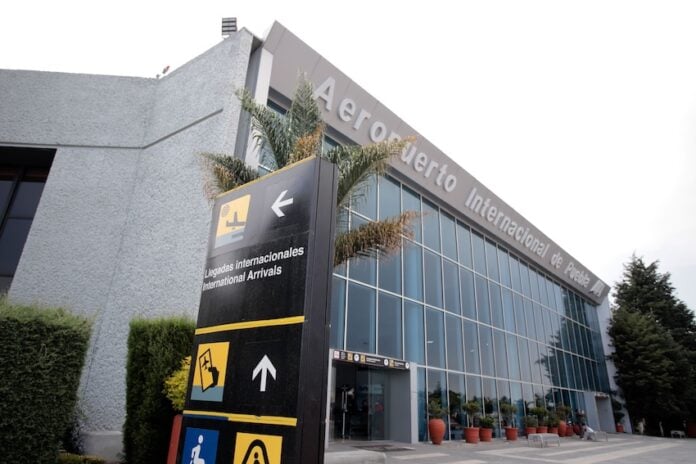
The Puebla International Airport, also known as Aeropuerto Internacional Hermanos Serdán, is located in the city of Huejotzingo, 30 minutes outside of the state capital. (Cuartoscuro.com)
The Puebla International Airport is preparing for a 420 million-peso face-lift ahead of increased flight schedules expected to include at least 12 new domestic and international routes.
In a related development, local businesses have announced plans to develop a hotel, a shopping center and a bus terminal at the airport and three investment groups have already submitted letters of intent to the state Economic Development Ministry (Sedetra).
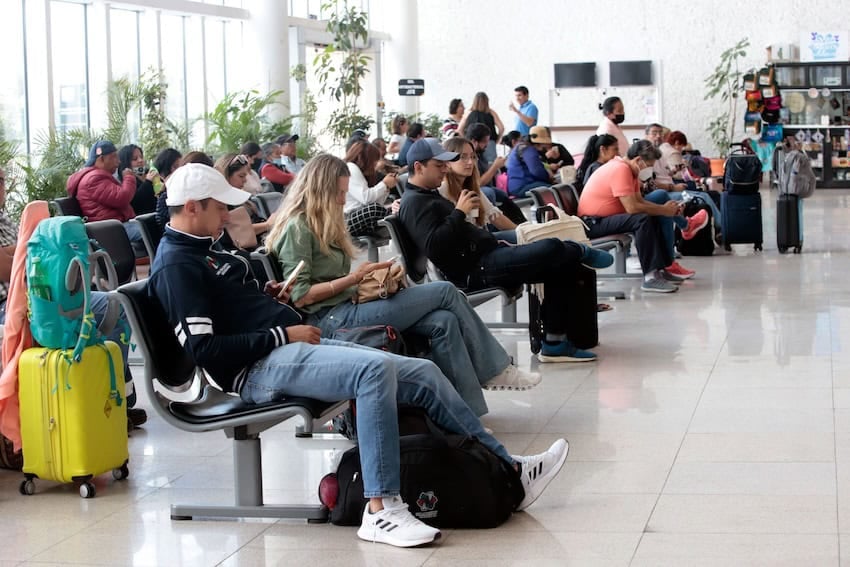
Puebla’s airport is operating at very low capacity, so the 420 million-peso renovation and expansion can be seen as a step toward a turnaround. (Cuartroscuro)
Sedetra Minister Víctor Gabriel Chedraui said the state government will allocate 300 million pesos (US $17.3 million) for the airport expansion. The remaining 120 million pesos (US $6.9 million) will be contributed by the National Guard, through Grupo Mundo Maya, a government-owned tourism network operated by the Defense Ministry.
The funds will reinforce airport infrastructure — including runway expansion — providing “a dignified entrance to the region for visitors.” The renovations are also designed to strengthen connectivity, attract more tourism and boost economic development in the state.
The airport — which Chedraui said is operating at only 10% of capacity — is located in Huejotzingo, about 30 minutes northwest of downtown Puebla city, the state capital.
Some construction is expected to begin this month, with Chedraui saying initial results “should be evident before the end of the first half of 2026.”
Additionally, state officials are negotiating with several airlines to open new routes, with the hope that some could be operational in June.
Among the international routes being sought are flights to and from Houston, Los Angeles and New Jersey. El Economista newspaper reported that new domestic routes will connect Puebla to Aguascalientes, Guanajuato, San Luis Potosí, Tuxtla Gutiérrez (Chiapas), Villahermosa (Tabasco), Huatulco (Oaxaca), San José del Cabo (Baja California Sur), Puerto Vallarta (Jalisco) and Zihuatanejo (Guerrero).
As part of the development plan, the state government invited the private sector to invest in the area, even suggesting it might offer to provide matching funds. “We will provide [investors] with every possible support for development projects at the airport,” Governor Alejandro Armenta said.
“We will provide [investors] with every possible support for development projects at the airport,” Governor Alejandro Armenta said.
Armenta laid the groundwork for the airport renovation project last year when he met with the director of Grupo Mundo Maya, General Adolfo Héctor Tonatiuh Velasco, convincing him to participate in the funding efforts.
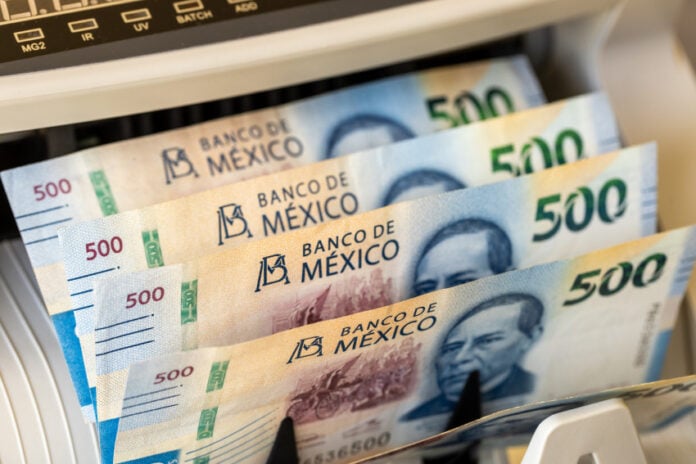
The peso has had a strong run so far this month, appreciating from over 18 pesos to the dollar to just 17.36 to the dollar on Thursday. (Shutterstock)
The Mexican peso rose in value against the US dollar every trading day between March 30 and April 9, appreciating more than 4% in the period.
The peso closed at 17.36 to the greenback on Thursday after appreciating 0.4% during the trading day.
The gain on Thursday came after the peso appreciated 1.6% against the dollar on Wednesday, buoyed by the two-week ceasefire agreement that the United States and Iran reached on Tuesday night Mexico time.
Over the past seven trading days, the peso has appreciated from 18.13 to the dollar to 17.36, a gain of 4.4%.
The 2% appreciation on Wednesday and Thursday coincided with a general weakening of the dollar. The U.S.-Iran ceasefire deal has increased appetite for currencies considered higher risk, such as the Mexican peso.
In a social media post, the director of economic analysis at Banco Base, Gabriela Siller, wrote that the appreciation of the peso on Wednesday morning was the greatest since April 9, 2025, “when Donald Trump announced a pause on the highest reciprocal tariffs that had been announced on ‘Liberation Day‘ [April 2, 2025].”
Inflation rises in March
National statistics agency INEGI reported on Thursday that Mexico’s annual headline rate was 4.59% in March, up from 4.02% in February. The headline rate was thus above the Bank of Mexico’s 2-4% target range for a second consecutive month.
Month-over-month inflation was 0.86% in March, while the annual core rate was 4.45%, down from 4.50% in February.
David Olvera swam the 85 kilometers (53 miles) from the island of Cozumel to Cancún in
16 hours, 48 minutes.
(David Olvera/Facebook)
Ten months after setting a Guinness World Record with his open-water swim around Manhattan, David Olvera has rewritten the record books again — this time by swimming from Cozumel to Cancún.
Olvera, 31, from Ciudad Valles, San Luis Potosí, swam the 85 kilometers (about 53 miles) on Tuesday, completing the crossing in 16 hours, 48 minutes of nonstop swimming.
The feat set a new record for the longest solo, unassisted, open-water swim in Mexico, surpassing the previous widely recognized 55-kilometer record held by Graco Morlán.
Olvera set out in the early hours of the morning off Cozumel and faced strong currents, humid Caribbean conditions and the physical toll of nearly 17 hours in the water.
The marathon crossing was officially documented — including video of his arrival in Cancún — with observers on hand to comply with validation protocols for the national record, according to media reports.
One Facebook account posted, “¡Orgullo potosino!” — which means “Potosí Pride!”
On Instagram, a small hotel in Cozumel posted, “Not every achievement is measured in numbers, some are felt in discipline, focus, and the strength to keep going when it matters most. Congratulations to David Olvera … a truly historic accomplishment [and an] inspiring reminder of what happens when preparation meets determination.”
The swim capped a years-long pursuit for Olvera, who has over 15 years of experience as a high-performance swimmer.
Published reports said this crossing was his third attempt at the 85-kilometer Cozumel–Cancún challenge. (The world record for the longest unassisted ocean swim is 142.3 kilometers, set in 2024 by Neil Agius of Malta over 60 hours and 35 minutes.)
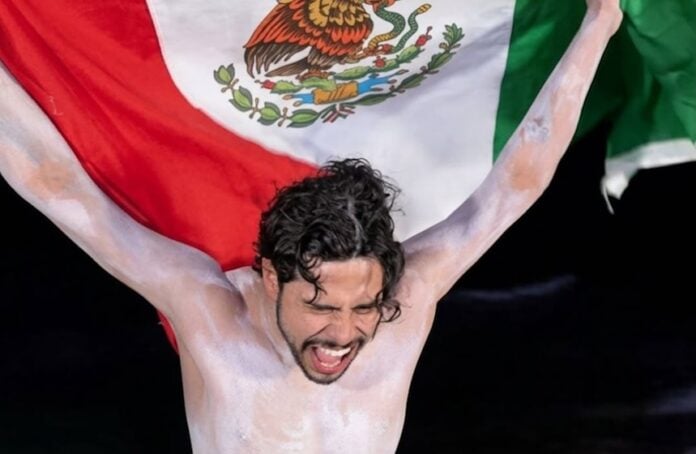
Upon his arrival in Cancún Tuesday, Olvera was welcomed by Cancún Mayor Ana Paty Peralta, who presented him with an award and said his achievement was a point of pride for the country. Shortly after he stepped onshore, exhausted, someone draped the Mexican flag across his shoulders.
Olvera has said the Cozumel–Cancún crossing is another step in a still-evolving career. He is eyeing future ultra-distance challenges abroad, including attempts to cross the Strait of Gibraltar, the English Channel and the Catalina Channel in Southern California.
After his feat this week, the popular Facebook page “Mexican Problems” — which posts Mexico-related viral content, memes and other content — offered its praises to the Potosí iron man.
“David Olvera didn’t do this in a pool with perfect conditions and a cheering crowd every 50 meters. He did it in the open Caribbean Sea — battling currents, waves, darkness, and exhaustion for nearly 17 hours straight,” the post read. “That is the Mexican spirit in its purest form. Not for fame. Not for money. Just to prove it could be done.”