Home Blog Page 597

The risks of digging deeper wells in response to Mexico’s water crisis

5
dirty water flows out of a drain in an urban area
A 2022 Conagua study found that less than half of Mexican groundwater was fit for human consumption due to the presence of fluoride, coliform bacteria, nitrates and/or heavy metals. (Shutterstock)

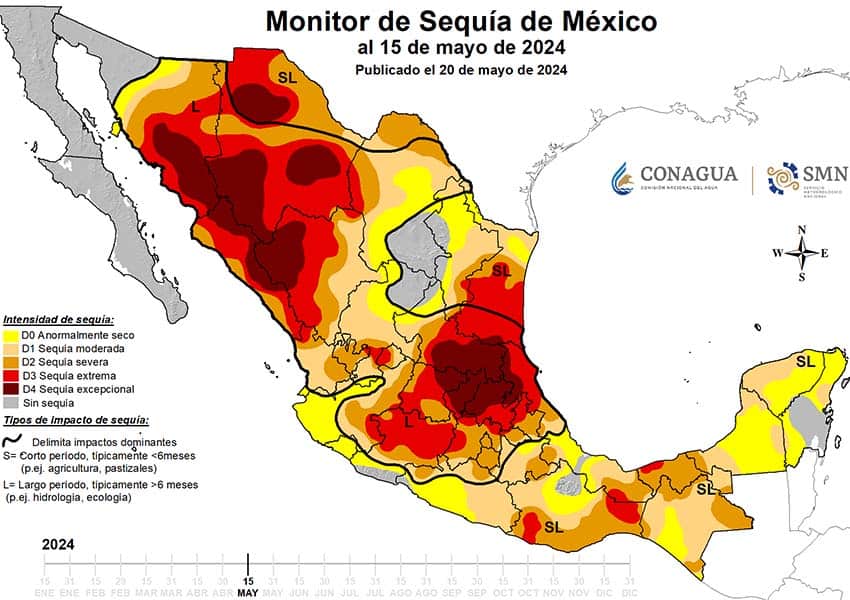
As Mexico City’s worsening water crisis and continued drought across the country garner escalating national — and international — attention, some are also raising the alarm about the quality of the nation’s groundwater.

Sixty percent of Mexico City’s water comes from an over-exploited aquifer and about 28% is derived from the aging Cutzamala water system. Experts say the capital’s aquifer could be depleted in 40 years, if certain actions are not taken by authorities within the next 15.

The National Water Commission (Conagua) has dug increasingly deep wells (over 600 meters deep) in efforts to meet demand, according to a report by Infobae news outlet, but this can lead to a contaminated water supply.

Conagua has implemented a well and groundwater analysis program to determine the quality of water using a color-coding system. Its most recent study from 2022 found that only 42.5% of groundwater nationwide could be categorized as “green” (fit for human consumption), whereas 39% was categorized as “red.” The latter category means excess fluoride, coliform bacteria, nitrates or heavy metals were detected in the water.

Meanwhile, Conagua is working with the Mexico City and México state governments to increase the flow of water from the Cutzamala system.

This system, built between the late 1970s and early 1990s, is an inter-basin water transfer project that requires coordination among federal, state and municipal authorities. However, there is no autonomous agency authorized to make decisions for the entire Valley of México. Instead, Conagua, the Mexico City Water System (Sacmex) and the Mexico State Water Ministry each have their own policies and priorities, creating major gaps in management.

A woman fills tanks with a pipe of water
Water scarcity in Mexico City has led to some neighborhoods going for days without municipal water and depending on deliveries by truck. (Cuartoscuro)

Last week, 20 researchers from the National Autonomous University of Mexico (UNAM) also presented a proposal to address the valley’s water crisis. Their water security plan includes intensive water capture, increased use of treated residual waters in agriculture and artificially recharging the aquifer by injecting surface water directly into the ground.

The UNAM study also found that in the Valley of México, only 75% of irrigated lands utilize treated water and less than 12% of that water is reused. If more agricultural lands used residual waters, potable water would be freed up for consumers.

The UNAM plan requires an investment of 97 billion pesos (approximately US $5.8 billion), part of which would be used for much-needed maintenance on the aging Cutzamala system, originally designed to provide service for 20 years. Additional spending is required for maintenance on water pipes as a stunning 40% of water is estimated to be lost to leaks.

The urgency of Mexico City’s water crisis has led to media reports of an imminent “Day Zero” — cited as June 26, 2024 — when the Cutzamala system might not have enough water to supply the city.

With reports from La-Lista and Infobae

Ayotzinapa student killed by police in confrontation in Guerrero

1
Police patrol truck on fire in Chilpancingo
A police patrol vehicle was set on fire by protesters after the death of the student on Thursday. (Cuartoscuro)

A student from the Ayotzinapa Rural Teachers’ College in Guerrero was killed in a confrontation with state police in Chilpancingo on Thursday, authorities said.

President Andrés Manuel López Obrador confirmed the death at his Friday morning press conference in Morelia, saying that it was “very regrettable” that “this situation” occurred “a day after a protest was carried out at the National Palace.”

Protesters ramming a car through an entrance to Mexico City's National Palace on March 6, 2024
Protesters used a Federal Electricity Commission truck to ram through the wooden doors of Mexico’s historic National Palace Wednesday. (Cuartoscuro)

On Wednesday morning, Ayotzinapa students used a pickup truck to break open wooden doors at the National Palace during a protest related to the disappearance and presumed murder in 2014 of 43 young men who were studying to become teachers at the Ayotzinapa school.

On Thursday night, Yanqui Kothan Gómez Peralta, 23, was killed when police shot at the occupants of a vehicle reported as stolen.

According to a statement from the Guerrero Ministry of Public Security (SSP), police used live security camera footage to locate the pickup truck and came under fire when they approached it near a hotel in Chilpancingo. The officers returned fire and one of the aggressors was injured, according to the SSP statement.

The Guerrero Attorney General’s Office later said that it had initiated a homicide investigation in connection with the incident. López Obrador said Friday that in addition to the death of one student, another young man was wounded.

Family members of the Ayotzinapa victims
Family members of the 43 students who disappeared in 2014 held a press conference on Thursday in Tixtla. (Cuartoscuro)

According to the SSP, police found a pistol in the stolen pickup as well as cartridges, three small bags of “a crystalline substance” — presumably methamphetamine — and beer.

Speaking at his morning press conference, López Obrador said that the second victim was not seriously injured. He conveyed his condolences to the family of the man who was killed and said he would ask the Federal Attorney General’s Office to take charge of the case.

“We’re going to respectfully ask that it investigate well and announce what happened,” he said.

“… It wasn’t a clash between police and protesters,” stressed the president, who frequently speaks out in support of people’s right to demonstrate peacefully. “… We don’t want anyone to lose their life.”

State government officials also asserted that there was no concerted effort on the part of Guerrero police to go after students from the Ayotzinapa school, who frequently participate in protests that sometimes turn violent.

Ayotzinapa students responded to the death of their fellow future teacher by seizing and setting on fire two state police vehicles in Chilpancingo, local media reported. The Ayotzinapa Rural Teachers’ College is located around 15 kilometers east of the state capital in the municipality of Tixtla.

The death of the young man raises tension at a time when the families of the 43 abducted students, current Ayotzinapa students and others are already angry about the government’s failure to deliver justice in the almost 10-year-old case that occurred during the president of Enrique Peña Nieto.

Well over 100 people — including military personnel and police officers — have been arrested in connection with the students’ disappearance, but no one has faced trial or been convicted of the crime. The remains of just three students have been found.

The current government initiated a new investigation soon after taking office and pledged to definitively determine what happened to the young men. But just seven months before the end of López Obrador’s six-year term, it still hasn’t delivered on its promise, although it did publish a new report last September that outlines three “possible reasons” for the abduction of the students.

The president this week said that the government is “making progress in the investigation,” and reiterated that it would uncover the truth and “find the young men,” whose abduction and presumed murder is one of the most notorious criminal cases in Mexican history.

With reports from López-Dóriga Digital, Quadratín, El Universal and Milenio

When and where are the Women’s Day marches in Mexico?

2
8M womens march
Find the International Women's Day march happening in your city on March 8, 2024. (Michael Balam Chan/Cuartoscuro)

Hundreds of thousands of women all over Mexico are getting ready to participate in International Women’s Day (8M) marches and rallies on Friday.

Feminist groups, activists of various human rights movements, family members and friends will be taking to the streets nationwide to demand – among other things – access to safe and legal abortions in all states; the eradication of gender violence; access to more jobs and better wages; more help from men with domestic work; and justice in cases of femicide that remain unpunished.

Every year on March 8, the women of Mexico take to the streets in protest against rampant gender violence in the country. (Victoria Razo/Cuartoscuro)

According to María de la Luz Estrada, director of the National Citizens’ Observatory of Femicide (OCNF), more than 3,000 women, girls and adolescents are murdered each year, although only 24% of these cases are counted as feminicide.

In Mexico, the March 8, or 8M, demonstrations began in the 1970s, but “in recent years they have acquired a sense of urgency due to the sexist context that women continue to face in the country,” Sara González wrote in the newspaper El País. Massive gatherings are set to occur all over the country.

President Andrés Manuel López Obrador used his morning press conference to ask that the protests be peaceful. He also urged, “with all due respect,” that the demonstrators take off their hoods.

“It is not an order or a mandate, nor an instruction. It is a respectful recommendation,” he added. “If we live in a free country, why cover up? … You have to show your face.”

First and foremost, the 70-year-old AMLO stressed that he is 100% behind the right to demonstrate.

“Because in our country, there is no repression, freedoms are fully guaranteed, freedom of demonstration, expression, etc. are not limited,” he said. “It was before. I just say that you should try to protest, demonstrate, which is your right, in a peaceful manner.”

In Mexico City, 90,000 participants are expected, which would match last year’s total. Many streets will be closed to traffic as demonstrators follow a route that starts at the Glorieta de las Mujeres Que Luchan (Roundabout of the Women Who Fight).

Mexico City is also observing 8M with the Tiempo de Mujeres (Time for Women) festival from March 1-17, with more than 120 activities such as a March 16 free concert in the Zócalo by international pop star Julieta Venegas.

La Glorieta de Mujeres que Luchan
The Glorieta de las Mujeres Que Luchan in Mexico City was previously the site of a Christopher Columbus statue until 2021. (Andrea Murcia/Cuartoscuro)

Other marches are scheduled in cities all across Mexico. Find your city and the departure point and time for the march below: 

  • Tijuana, La Glorieta, 1 p.m.
  • Tlaxcala, Asta Bandera (La Virgen), 3 p.m.
  • Oaxaca, Monumento a la Madre, 3:30 p.m.
  • Villahermosa, Parque Estrella, 3:30 p.m.
  • Mexico City, Glorieta de las Mujeres Que Luchan, 4 p.m.
  • Monterrey, Explanada de Colegio Civil, 4 p.m.
  • Querétaro, Plaza del Estudiante, 4 p.m.
  • Puebla, El Gallito, 5 p.m.
  • Morelia, Plaza Morelos/Plaza del Caballito, 5 p.m.
  • Puerto Vallarta, Parque de las Mujeres, 5:40 p.m.
  • Mérida, Plaza de España, 7:30 p.m.

Some demonstrations will include the construction or completion of (or paying homage to) an anti-monumento, installations that are traditionally placed during major protests in Mexico to remind people about important events and/or issues of justice that have been brushed aside or not adequately addressed by the government.

Many of these protest monuments relate to femicides, forced disappearances and violence against women. On Friday, at the installation in Mexico City (aptly referred to in the feminine anti-monumenta) where some marchers will gather, there will be an open microphone from 12-3:30 p.m. for direct and indirect victims of gender violence to speak their minds in a safe space.

With reports from El País, Animal Politico, Diario AS, La Voz, El Financiero and Mi Morelia

Mexico-US trade had a record-breaking January

6
Shipping containers filled with export and import goods at Lázaro Cárdenas port in Michoacán, Mexico
Export revenue grew over 4% in 2024, surpassing experts' expectations. (Cuartoscuro)

Mexico retained the enviable title of top exporter to the United States in January, sending products worth more than US $38 billion to its North American neighbor, according to U.S. government data.

Mexico also remained the United States’ top trade partner in the first month of the year, with two-way trade between the countries increasing just under 1% in annual terms to $64.52 billion, the highest figure ever for the month of January.

The U.S. Census Bureau and the U.S. Bureau of Economic Analysis published data on Thursday that showed that Mexico’s exports to the United States were worth $38.04 billion in January, a 2.8% increase compared to the same month of 2023. That was Mexico’s highest ever revenue total for exports shipped to the United States in the month of January. The value of Mexican exports to the U.S. has now risen during nine consecutive months.

Mexico ranked ahead of China and Canada as the No. 1 exporter to the U.S. in January. While the value of Mexican exports to the U.S. increased, the value of those from both China and Canada fell.

In 2023, Mexico surpassed China to become the top exporter to the United States, ousting the East Asian economic powerhouse from a position it had occupied for two decades.

In January, 15% of all exports to the United States came from Mexico, which ships a range of products to its USMCA trade partner including cars, auto parts, electronics, crude oil, alcoholic beverages and agricultural products.

Woman worker preparing avocados for shipment
Agricultural products, like avocados, are one of the primary exports from Mexico to the United States. (Cuartoscuro)

The total value of those exports easily exceeded the value of Mexico’s imports from the U.S. in January. United States exports to Mexico were worth $26.48 billion, down slightly from a year earlier, leaving Mexico with a trade surplus of $11.56 billion with the U.S. in the first month of 2024. Mexico’s surplus in January was just over 15% higher than it was in the same month of last year.

In 2023, Mexico was the United States largest trade partner for the first time in four years, dislodging Canada from the position it occupied in 2022.

Mexico’s exports to the U.S. were worth $475.6 billion last year, a 4.6% increase compared to 2022, while two-way trade totaled $798.8 billion, up 2.5% compared to the previous year.

Mexico’s exports to the United States and the rest of the world are expected to continue increasing in coming years as more and more foreign manufacturing companies establish a presence here, including firms from China seeking to circumvent U.S. tariffs on Chinese-made goods.

With reports from Reforma and El Financiero

Uff, qué cañón – how to use ‘cannon’ in conversation in Mexico

8
Learn how to use the Mexican phrase "cañón" in different contexts with our handy guide. (Unsplash)

A simple truth: Mexico is a cannon country! – that didn’t sound good in English so let’s try again in Spanish: ¡México es un país cañón! 

But, what does that actually mean? Well, this is what we are going to be discussing in today’s article since cañón is a slang word that we use all the time and in all kinds of contexts. 

The phrase México es un país cañón means that Mexico is a really cool and outstanding country, like saying Mexico is the bomb! This word is used in a casual, informal environment and is used as an alternative to a bad word. Let’s dive into its usages. 

Navigating Difficulty:

In its most common context, “está cañón” is used to articulate challenging circumstances. Whether facing a formidable task or encountering unexpected obstacles, Mexicans may casually remark, “Hoy estuvo cañón” (“Today was tough”) or “Estuvo cañona la clase” referring to a Crossfit class where people ended up exhausted due to the difficulty of the exercises. This usage reflects the resilience inherent in Mexican culture, acknowledging challenges while embracing the determination to overcome them. 


View this post on Instagram


A post shared by Mexico News Daily (@mexiconewsdaily)

 

Exclaiming Surprise:

Beyond difficulties, we use “está cañón” to express surprise or amazement. When talking about an extraordinary experience or encountering something truly impressive, someone might exclaim, “¡Eso sí está cañón!” (“That’s really something!”) or simply “está cañón el pozole” to say that the food is incredibly delicious. This demonstrates the phrase’s versatility in capturing a spectrum of emotions, from astonishment to appreciation.

Describing Outstanding Individuals:

In a unique twist, “está cañón” or “es cañón” is also applied to describe individuals with exceptional qualities. When someone possesses remarkable skills, talents or stands out in a crowd, we can say “Ella está cañona” (“That girl is outstanding”). In this context, the phrase acquires a positive connotation, meaning that someone is really good at doing something celebrating uniqueness and excellence.

Acknowledging Adversity:

Whether referring to intense weather conditions, traffic congestion, or a challenging phase of life, we might state: “El tráfico está cañón hoy” (“The traffic is tough today”), “está cañón el calor/sol” (It’s crazy hot today/the Sun is really strong).

Affirmation: 

It is similar to saying “sure,” “absolutely,” or “you bet” in English. When someone uses cañón in this context, they are expressing confirmation or agreement with what has been said or proposed.

For example:

Person A: “Está padre, ¿no?” (It is cool, right?)

Person B: “¡Cañón!” (Absolutely!)

This word serves as more than a linguistic tool. It reflects the Mexican spirit, emphasizing perseverance, resilience, and the ability to find humor even in challenging circumstances.

Paulina Gerez is a translator-interpreter, content creator, and founder of Crack The Code, a series of online courses focused on languages. Through her social media, she helps people see learning a language from another perspective through her fun experiences. Instagram: paulinagerezm / Tiktok: paugerez3 / YT: paulina gerez

It’s Women’s Day! 5 books by Mexican women about the history of Mexico

0
Laura Esquivel (left), Elena Poniatowska (center) and Sofía Segovia (right) are some of the most important Mexican women writers of the last century. Each have provided critical perspectives on Mexican history.

Shaped by pre-Columbian traditions, Spanish colonization and Catholicism, Mexico is a diverse and intricate country that is impossible to comprehend just by visiting or living here. To understand Mexico, one must read their way through it.

Each book in this list is set in a different period of the country’s history, from the early years of the Spanish conquest to the Mexico of today. 

Written with a strong female voice, each book offers a glimpse into the challenging context in which women and other vulnerable groups have lived. With richly researched plots and vivid descriptions of the past, these five books are sure to give you a new appreciation for Mexico’s woman authors.  

The books are presented in chronological order (according to their settings) and include both historical fiction and journalistic accounts of events in Mexico’s history. 

1. Malinche (2006) by Laura Esquivel

This book tells the fascinating story of one of the most controversial figures in Mexican history: la Malinche, the Indigenous woman many Mexicans decry for her role in the Spanish conquest of Mexico.  

The novel follows the life of Malinalli (later known as La Malinche), from being given away as a slave to acquiring a significant role as the interpreter and lover of the Spanish conquistador, Hernán Cortés. 

Malinalli believed that the gods sent Cortés to liberate her people from Mexica rule. With her assistance, Cortés was able to form strategic alliances with communities under Mexica rule, which ultimately led to the fall of Tenochtitlán. 

As the love affair between Malinalli and Cortés unfolds, readers gain a deeper understanding of key historical events that contributed to the Spanish empire’s victory over the Mexica empire, and why, centuries later, La Malinche was accused of treason. 

If you’ve ever heard the word malinchista in Mexican slang, now you know it was inspired by the story of La Malinche to refer to those who prefer “foreign” over Mexican.

2. Like Water for Chocolate (1989) by Laura Esquivel

Another entry from Laura Esquivel, “Like Water for Chocolate” (Como Agua para Chocolate) alludes to being at a boiling point, as water must be to make hot chocolate.

A lyrical and charming magical realism novel, this story accurately portrays rural Mexico’s social landscape during the Mexican Revolution in the 1910s. The book was also included in our must-read Mexican classics list.

Through homemade recipes in monthly installments, the story depicts the forbidden romance between Tita and Pedro, cursed from the start by Tita’s family. As the youngest of the family, Tita must never marry to care for her widowed mother.

The magical recipes that Tita cooks take the readers into the life of a household run by women as they navigate life with a tyrannical mother capable of frightening a Revolutionary army.  

An instant international bestseller, Like Water for Chocolate has resonated with a large audience thanks to the creative way it depicts universal themes like love, treason, passion, family traditions and food.   

3. In The Shadow of the Angel (1995) by Kathryn Blair

Taking place during three transformational decades in Mexico City, “In The Shadow of the Angel” (A la Sombra del Ángel) tells the captivating true story of Antonieta Rivas Mercado, daughter of the famed architect Antonio Rivas Mercado, who built the Angel of Independence monument in Mexico City. 

The story is told by Kathryn Blair, the wife of Antonieta’s only son, and is based on interviews she conducted with her husband Albert and the rest of Antonieta’s surviving family.  

It begins when Antonieta, at the age of 31, takes her life in Notre Dame, Paris. What led Antonieta to commit suicide? The book then jumps back in time to Antonieta’s birth. It follows her life through Porfirio Díaz’s regime, the Mexican Revolution and the country’s first attempts to become a democratic nation.   

With a deep love for Mexico, the fine arts and a large fortune, Antonieta played a significant role in shaping the country’s cultural landscape while also fighting for women’s rights, indigenous rights and education.

4. The Murmur of Bees (2015) by Sofía Segovia

Following in the path of Latin America’s tradition of magical realism, Segovia takes us to a remote place near Monterrey, Nuevo León, amidst the backdrop of the Mexican Revolution. 

The epic story touches on love, loss, pain, hope and several societal issues, including national identity, traditional values, women’s roles, revenge and ambition.

The book begins in the early 1900s when a baby surrounded by bees is found under a bridge by Nana Reja, the Morales family’s nanny. Despite the superstition and hate that surrounds the child – due to a hollow in his face that prevents him from speaking – the family adopts the baby.

Simonopio, as he is named, grows up to develop a fantastical relationship with bees, who protect and guide the boy amidst the turbulent times of the Revolution and the fundamental changes the Morales family is destined to experience.

5. Massacre in Mexico (1971) by Elena Poniatowska

Massacre in Mexico chronicles the lives and deaths of Mexican students who protested police repression a week before the 1968 Olympics in Mexico City. The massacre occurred during a peaceful rally on Oct. 2 in the Plaza de las Tres Culturas in Tlatelolco, Mexico City, during the government of President Gustavo Díaz Ordaz.

The book is a journalistic collection of testimonies from students, parents, workers and others who were part of the movement or witnessed the events. The text is divided into two parts, with an annex containing a chronology.

According to Mexico’s National Commission of Human Rights (CNDH), the massacre in Tlatelolco was the culmination of several state crimes that could be considered crimes against humanity.

La Noche de Tlatelolco, as it is known in Spanish, has helped bring to light a disturbing episode in Mexico’s authoritarian regime, highlighting a larger wave of repression against social movements in Latin America.

Gabriela Solís is a Mexican lawyer based in Dubai turned full-time writer. She covers business, culture, lifestyle and travel for Mexico News Daily. You can follow her life in Dubai in her blog Dunas y Palmeras.

Aeroméxico-ITA Airways codeshare deal boosts Italy-Mexico air connectivity

0
Photo of Florence skyline
Thanks to the deal signed Thursday, Aeroméxico passengers flying from Mexico City's AICM will more easily connect to 15 Italian destinations, including Florence, pictured here. (Shutterstock)

Starting this Sunday, it’ll be easier to fly between Mexico and Italy thanks to a new codeshare agreement between Aeroméxico and ITA Airways.

The deal signed Thursday will allow Aeroméxico passengers flying from Mexico City International Airport (AICM) to Rome’s Leonardo da Vinci–Fiumicino Airport (FCO) to connect with a single ticket to 15 other Italian destinations, such as Milan, Genoa, Florence, Naples and Turin.

Similarly, those flying to Mexico City on ITA Airways will have access to 28 destinations in Mexico served by Aeroméxico.

One of the major pluses: your luggage will be checked straight through from your point of origin to your destination.

Additionally, both country’s flagship airlines will allow frequent flyers to accrue and redeem points with either airline. That’s in addition to benefits they already get as SkyTeam or Elite/Elite Plus members.

Notably, members of Aeroméxico Rewards who have Platinum or Titanium status will be able to use ITA Airways lounges in Italy, check an additional bag for free and get priority boarding. 

The same will hold true for Premium- and Executive-level members of Volare, the ITA Airways loyalty program.

Aeroméxico said it will continue using the Boeing 787 Dreamliner for its nonstop Mexico City/Rome route. ITA’s fleet comprises 83 Airbus airplanes.

Aeroméxico, which has established 36 codeshare agreements over the past two years, recently announced it would be resuming flights to South Korea on Aug. 1 and that it is expanding its service out of Mexico City’s second airport Felipe Ángeles International (AIFA).

Overall, the expansion of Mexican airline routes is on the upswing, especially since the United States’ Federal Aviation Administration reinstated Mexico’s Category 1 aviation safety rating last September after it had been downgraded to Category 2 for more than two years.

A recent report by Mabrian, a travel and tourism data intelligence company, showed that Mexico is No. 1 in international air connectivity among Latin American nations — by a large margin.

With reports from Reforma, American Journal of Transportation and Europa Press

E-commerce growth in Mexico beats other booming global markets

0
photo of a person's hands holding a credit card and entering information onto a laptop keyboard
The value of e-commerce sales in Mexico skyrocketed to 658.3 billion pesos (US $39 billion) in 2023, more than the usual top countries like the Philippines, Brazil and India. (EC/Wikimedia Commons)

Mexico has surged to the top of global e-commerce growth, experiencing a 24.6% increase in online sales in 2023, according to the Mexican Association of Online Sales (AMVO).

This spike surpasses the growth rates of established e-commerce markets like the Philippines, Brazil and India, placing Mexico at the forefront of a wave of dynamic e-commerce players.

Mexican man on his smartphone passing a poster advertising Mexico's Buen Fin sale
Mexico’s Black Friday-style sales events, such as Buen Fin and Hot Sale, lure deal-seeking Mexicans into brick-and-mortar stores, but increasingly, they also can shop these sales online. (Daniel Augusto/Cuartoscuro)

Booming market, booming users

The value of e-commerce sales in Mexico skyrocketed to 658.3 billion pesos (US $39 billion) in 2023, exceeding the previous record by a significant margin. This growth is fueled by a rapidly expanding user base, with over 69.5 million Mexicans — approximately 52% of the population — now embracing online shopping.

Smartphones are the preferred device for these digital shoppers, with 98% of them having used them for online purchases at least once.

What’s driving growth?

Major sales events here like Buen Fin and Hot Sale —  both similar to Black Friday in the United States — and annual sales near Easter and Christmas have played a significant role. So have increasing internet penetration and widespread mobile phone adoption.

The growth trend is strongest in the southeast and central regions of Mexico, where the surge in e-commerce activity has exceeded 29% growth. At the state level, Tlaxcala, Chiapas and Hidalgo recorded the highest levels of growth.

photo of Mexicans sitting at a bus stop using their cell phones
Just over 50% of Mexico’s population has embraced online shopping, according to the Mexican Association of Online Sales — and 98% of them prefer doing it on a smartphone. (Moises Pablo Nava/Cuartoscuro)

AMVO noted that the greatest expansion of e-commerce retail was most notable in the second quarter of 2023, largely due to the Buen Fin, Hot Sale and December holiday period.

Consumer preferences and challenges

E-commerce shoppers’ favorite categories were fashion, prepared food, beauty and personal care, electronics and cell phones. These represented the highest volume of purchases, AMVO noted, while kitchen utensils and tools were popular among first-time online buyers.

Also popular are online payment options for electricity, water and internet bills, and using digital banking, online subscription services and telecommunications. 

A combination of online and physical stores is preferred by 70% of users, especially in higher socioeconomic groups, highlighting the importance of omnichannel shopping experiences.

Building trust is also crucial, with good customer service and review options being important for 87% of buyers. Lack of information and transparency are the main reasons that potential customers log off without making a purchase.

Mercado Libre rides the wave

The Argentine e-commerce and financial services platform Mercado Libre reported profits of US $1.2 billion at the end of 2023, a growth of 156% over the previous year. For the fourth quarter of 2023, it reported sales of US $14.5 billion across its various operating markets in Latin America, a year-over-year (YoY) increase of 37.4%. 

Mercado Libre noted that its number of unique active buyers reached almost 85 million in 2023, its biggest annual jump in users in three years. Regarding its Paypal-like digital payment service, Mercado Pago — also used in Mexico by many smaller brick-and-mortar businesses to handle debit and credit card transactions with their in-person customers — growth in 2023’s fourth quarter increased 33% YoY.

According to a Mercado Libre report late last year, Mexico remains a priority market, with about 357 million items sold during 2023’s third quarter, a 38% YoY rise and a 34% jump from the previous quarter.

Amazon’s e-commerce presence in Mexico looms large, but Mexico’s antitrust regulation agency has concerns about it monopolizing the market, along with another online shopping giant, Mercado Libre. (Omar Martínez/Cuartoscuro)

Trouble ahead for e-commerce giants in Mexico?

Not all is going smoothly for e-commerce platforms, however. 

In February, the Federal Economic Competition Commission (Cofece), Mexico’s antitrust regulation agency, reported having identified “possible barriers” to fair competition in the e-commerce market by Amazon and Mercado Libre. Together, the agency said, the two firms control more than 85% of transactions and sales.

In a preliminary investigation, Cofece noted that strong networks between users’ groups limit new entrants into the marketplace and pose a “practically insurmountable challenge for the expansion of the smaller players.”

“This market is very important since more and more consumers are using this option to acquire goods or services since the beginning of the COVID-19 pandemic” read Cofece’s preliminary findings in the government’s official gazette (DOF). Cofece recommended a program of corrective measures it wants the federal government to require from both companies within six months. One of those measures includes splitting customer rewards programs from streaming services. 

Mercado Libre promised to “abide by the proceedings and applicable regulatory framework, including by cooperating with the relevant authorities, as it has always done.” 

An Amazon representative echoed this statement, telling the magazine Expansión that the company would continue collaborating with Cofece.

Looking ahead, Mexico’s remarkable e-commerce sector growth is expected to continue, solidifying Mexico’s position as a key player in the global e-commerce landscape.

With reports from El Universal, Aristegui Noticias, Reuters and El Economista

Grupo México, CPKC have submitted 8 passenger train route proposals

6
CPKC cargo train
Canadian Pacific Kansas City has submitted proposals for adding passenger service to two existing railroad routes. (CPKC)

Private rail companies have submitted eight proposals to the federal government to operate passenger trains on railroad routes that are currently only used by freight trains.

The government in January said it had received five proposals from companies interested in operating passenger train services on existing freight tracks, and last week revised the figure to eight.

Jorge Nuño Lara at a press conference
Jorge Nuño provided an update on the passenger train proposals at the Feb. 28 morning press conference. (Lopezobrador.org.mx)

Infrastructure, Communications and Transport Minister Jorge Nuño presented details of the proposals at President Andrés Manuel López Obrador’s Feb. 28 press conference. Six come from Grupo México via its subsidiaries Ferromex and Ferrosur and two were submitted by Canadian Pacific Kansas City (CPKC).

According to the information presented by Nuño, Ferromex has submitted proposals to operate passenger trains on four routes:

  • Mexico City-Querétaro-León-Aguascalientes
  • Manzanillo-Colima-Guadalajara-Irapuato
  • Mexico City-Querétaro-Guadalajara-Tepic-Mazatlán-Nogales
  • Aguascalientes-Chihuahua-Ciudad Juárez

Ferrosur has expressed interest in operating passenger trains on two routes:

  • Mexico City-Veracruz-Coatzacoalcos
  • AIFA-Pachuca (AIFA is the Felipe Ángeles International Airport, located north of Mexico City in México state)

CPKC (formerly known in Mexico as Kansas City Southern de México) has also submitted proposals for two routes:

  • Mexico City-Querétaro
  • Querétaro-San Luis Potosí-Monterrey-Nuevo Laredo

The submission of the proposals comes after López Obrador — an avowed train enthusiast — published a decree in November that established the provision of passenger train services as a priority for national development.

The decree said that companies with concessions for freight tracks would be “the first to be invited to present projects for the implementation of passenger train services” on a range of different routes.

Nuño told reporters that the private rail companies that submitted proposals are currently carrying out feasibility studies that are scheduled to be completed in the next five to seven months. They are seeking to determine how much they would need to invest in their proposed projects, he said.

Map of proposed passenger service railways in Mexico
A map showing the proposed routes from private companies Grupo México (Ferromex and Ferrosur) and Canadian Pacific Kansas City. (Jorge Nuño/X)

Getting tracks ready for use by passenger trains might not be cheap, although López Obrador has claimed that it wouldn’t be a costly undertaking.

The consultancy Alttrac estimates that upgrading the 18,000 kilometers of tracks that make up the national rail network so that they can be simultaneously used by passenger and freight trains would cost some 1.8 trillion pesos (US $107 billion).

Passenger trains used to operate all over Mexico, but services fell by the wayside after the privatization of the rail network in the mid 1990s.

President López Obrador on the Isthmus of Tehuantepec train
President López Obrador on an inaugural ride on the isthmus passenger train. (Lopezobrador.org.mx)

In building the Maya Train railroad in Mexico’s southeast and modernizing an existing line across the Isthmus of Tehuantepec between Salina Cruz, Oaxaca, and Coatzacoalcos, Veracruz, López Obrador has gone some way towards restoring passenger train services.

However, he would like to see rail travel in Mexico return to its heyday, although he has acknowledged that it will be up to the next federal government to follow through on his initiative, something that Claudia Sheinbaum — the heavy favorite to win the June 2 presidential election — has pledged to do.

Earlier this year, López Obrador asserted that public and private investment in rail projects would create jobs and “reactivate the economy of the entire country.”

He also claimed that reviving nationwide train travel wouldn’t be an expensive exercise.

“What will it cost? Nothing,” he said, adding that the project would involve nothing more than “fixing the tracks up a bit” and “buying passenger trains — just as we did in the Isthmus [of Tehuantepec].”

With reports from APEl Universal and Reforma

3 women dead, 1 suspect arrested after stabbings in Guadalajara

3
Campus of the Technological University of Guadalajara with police officers
The attacks were reported to police by a young man who was injured by the assailant on Wednesday. (Screen capture)

A 20-year-old man was arrested in Guadalajara on Wednesday after allegedly murdering two women at a university and another woman at a motel in the Jalisco capital.

A man identified as Gabriel Alejandro “N” is accused of stabbing to death two university administrative workers at the Olímpica campus of the Technological University of Guadalajara (UTEG) late Wednesday afternoon. One of the victims was reportedly 35, the other 40.

A 20-year-old suspect was arrested on Wednesday, not long after the murders of two women at a university campus and one at a motel.


It appears they were the first people the aggressor came across after he entered the campus, where security measures are supposedly in place to prevent the unauthorized entry of outsiders. Gabriel Alejandro is not a UTEG student or staff member.

Earlier on Wednesday, the suspect is believed to have murdered a young woman in a room at a motel a few kilometers from the university. The approximately 22-year-old victim was stabbed in the chest and neck, authorities said. Video footage shows Gabriel Alejandro entering the motel a few hours before he allegedly committed the double murder at UTEG.

At the university, the aggressor reportedly pursued students with a knife and a small ax that he used to smash windows. In addition to allegedly murdering the two women, he is accused of wounding a 25-year-old man who confronted him. Panic-stricken students hid in classrooms to avoid the attacker.

The 25-year-old victim — a university employee who witnessed the murders of the two women — left the university after he was injured and alerted police to the presence of the assailant, according to the El Universal newspaper. Police subsequently arrested and disarmed Gabriel Alejandro in a classroom he had barricaded with chairs. A video shows the handcuffed suspect being put into a police vehicle.

Jalisco Attorney General Luis Joaquín Méndez Ruiz told a press conference that authorities couldn’t rule out the possibility that the suspect committed other crimes — perhaps even femicides — before the murders on Wednesday.

He said there was no “apparent motive” for the murders on Wednesday, but noted that an individual had provided information to authorities that indicated that the suspect belonged to an online group where members share stories about crimes of “fanaticism.”

It wasn’t completely clear what that meant, but the news outlet Latinus interpreted the remark as meaning that the group is “fanatical” about “extreme violence.”

It wasn’t clear whether Gabriel Alejandro had disclosed an intent to commit the crimes he allegedly perpetrated on Wednesday.

Jalisco Governor Enrique Alfaro described the events at UTEG as “the terrible ending of a horror story that is difficult to explain and which dismays us as a society.”

On the X social media platform, he said the suspect perpetrated the attack “without reason” and pledged to not rest until “he suffers the consequences” of his actions. The governor said he was unable to understand just how “rotten our social fabric must be to arrive at tragedies as raw, painful and inexplicable as this.”

UTEG said in a statement that it was “fully collaborating” with authorities in their investigation into “this terrible incident. Classes have been canceled at all of the university’s campuses “until further notice.”

Jalisco is one of Mexico’s most violent states, but most homicides committed there are related to organized crime.

With reports from El Universal, Proceso, La Silla Rota and Latinus